10 proven steps to rank higher on Google: technical fixes, content depth, links, speed, and AI search. Updated with fresh 2026 examples.
Ranking higher on Google comes down to a repeatable system: match search intent, fix the technical issues that block crawling and indexing, publish content with real depth, earn links from relevant sites, and keep pages updated. This guide walks through ten steps in the order they pay off.
96.55% of pages get zero traffic from Google. Not low traffic. Zero.
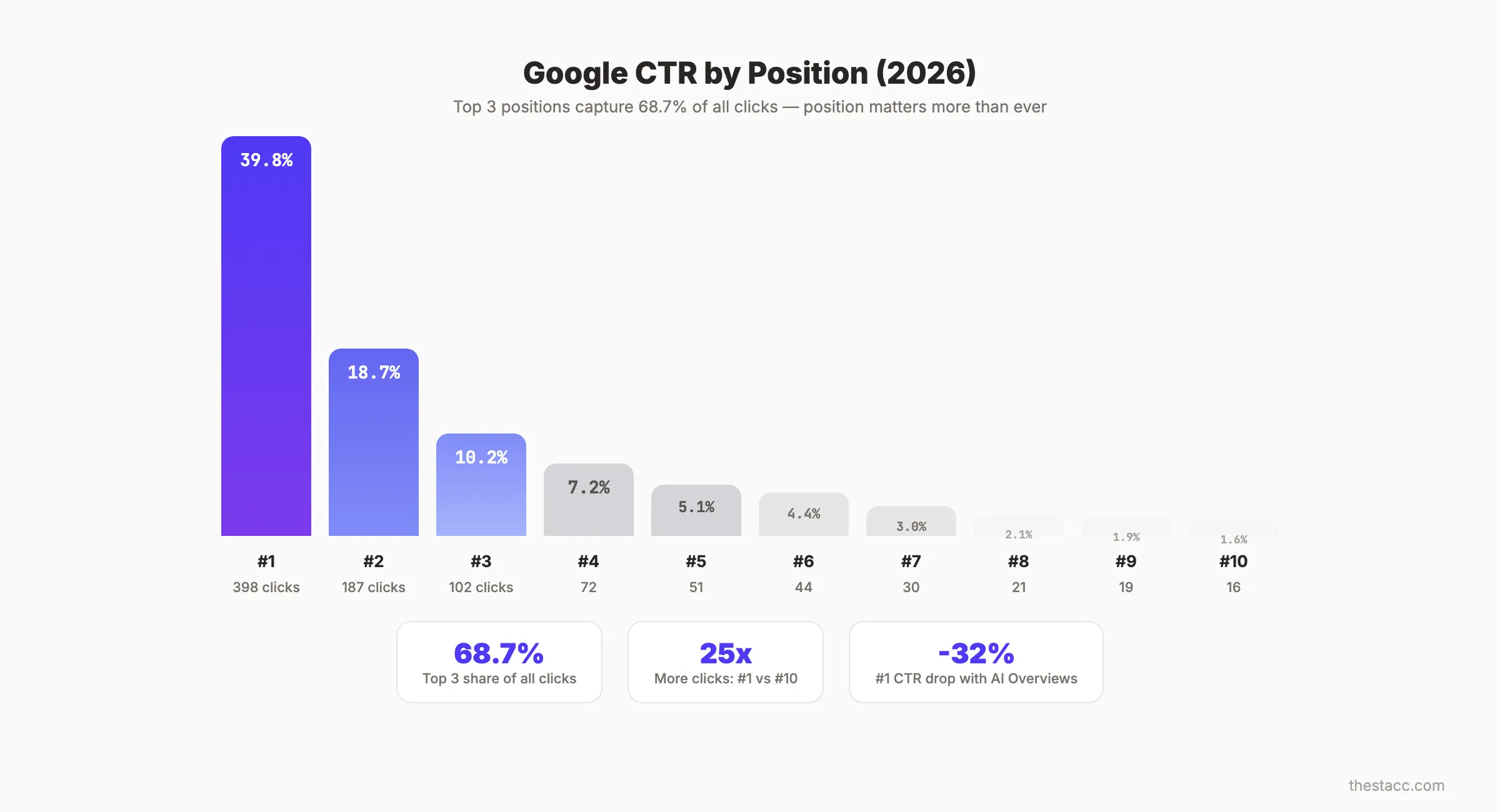
That stat from Ahrefs is not a scare tactic. It is the reality for most websites publishing content without a ranking strategy. The gap between visibility and invisibility is brutal. Position 1 captures 39.8% of all clicks. Position 10 captures 1.6%. That is a 25x difference between the top spot and the bottom of page 1.
Page 2 might as well not exist.
If you want to rank higher on Google in 2026, you need a system. Not tricks. Not hacks. A repeatable process that addresses every signal Google uses to decide who deserves traffic.
We publish 3,500+ blogs across 70+ industries with a 92% average SEO score. The steps below come from what we see working right now. Not theory. Execution.
Here is what you will learn:
- How to choose keywords you can realistically win
- Why intent matching matters more than word count
- The on-page elements that carry the most weight
- How to build links without cold outreach spam
- Why AI search changes everything about ranking strategy
Step 1: Target Keywords You Can Actually Win
Most sites fail at SEO before they write a single word. They target keywords they have no chance of ranking for.
A new site targeting "best credit cards" is competing against NerdWallet, Bankrate, and Forbes. That is not a fight worth picking. Not yet.
Start every piece of content with keyword research. Find terms where the top results come from sites with similar domain authority to yours. Check the keyword difficulty score in your SEO tool. If every result on page 1 has a Domain Rating above 70, move on.
Long-tail keywords are your entry point. 34.71% of all search queries contain 4 or more words. These longer queries have lower competition and higher conversion rates.
A dentist in Austin should not target "teeth whitening." They should target "professional teeth whitening cost Austin TX." The search volume is lower. The competition is manageable. The intent is clear.
Build a keyword map before you build a content calendar. Group related terms into clusters. Assign one primary keyword per page. Never target the same keyword with two different URLs.
| Keyword Type | Competition | Conversion | Example |
|---|---|---|---|
| Head term (1-2 words) | Very high | Low | "SEO" |
| Mid-tail (2-3 words) | High | Medium | "SEO strategy" |
| Long-tail (4+ words) | Low-medium | High | "how to rank higher on Google" |
| Local long-tail | Low | Very high | "SEO agency for dentists Chicago" |
Why this step matters: You cannot rank higher on Google by targeting impossible keywords. Difficulty-matched targeting gives you page 1 results in months instead of years. Those early wins build the domain authority you need for bigger terms later.
Step 2: Match Search Intent Exactly
Google does not rank the best content. Google ranks the most relevant content for what the searcher wants.
Search intent falls into 4 categories:
- Informational: "what is domain authority" (wants an explanation)
- Commercial: "best SEO tools" (wants comparisons)
- Navigational: "Ahrefs login" (wants a specific site)
- Transactional: "buy SEO audit service" (wants to purchase)
Before writing, search your target keyword. Look at the top 5 results. What format dominates? If every result is a listicle, do not publish a 5,000-word essay. If every result is a step-by-step guide, do not publish a product comparison.
Search intent mismatch kills rankings regardless of content quality. A perfect 10,000-word guide will not rank for "best running shoes" because Google knows that query needs a product list.
Text relevance has a 0.47 correlation with rankings according to Semrush research. That is higher than backlinks, page speed, or any other single metric. Relevance means answering the exact question the searcher typed.
Check these signals in the SERP:
- ✓ What content format ranks? (guide, list, video, product page)
- ✓ What word count do top results average?
- ✓ What subtopics do they all cover?
- ✓ Do featured snippets appear? What format are they?
Why this step matters: Intent alignment is the foundation of everything else. Get it wrong, and no amount of backlinks or optimization will push you onto page 1. Get it right, and Google rewards you with ranking potential from day one.
Step 3: Create Content That Covers the Full Topic
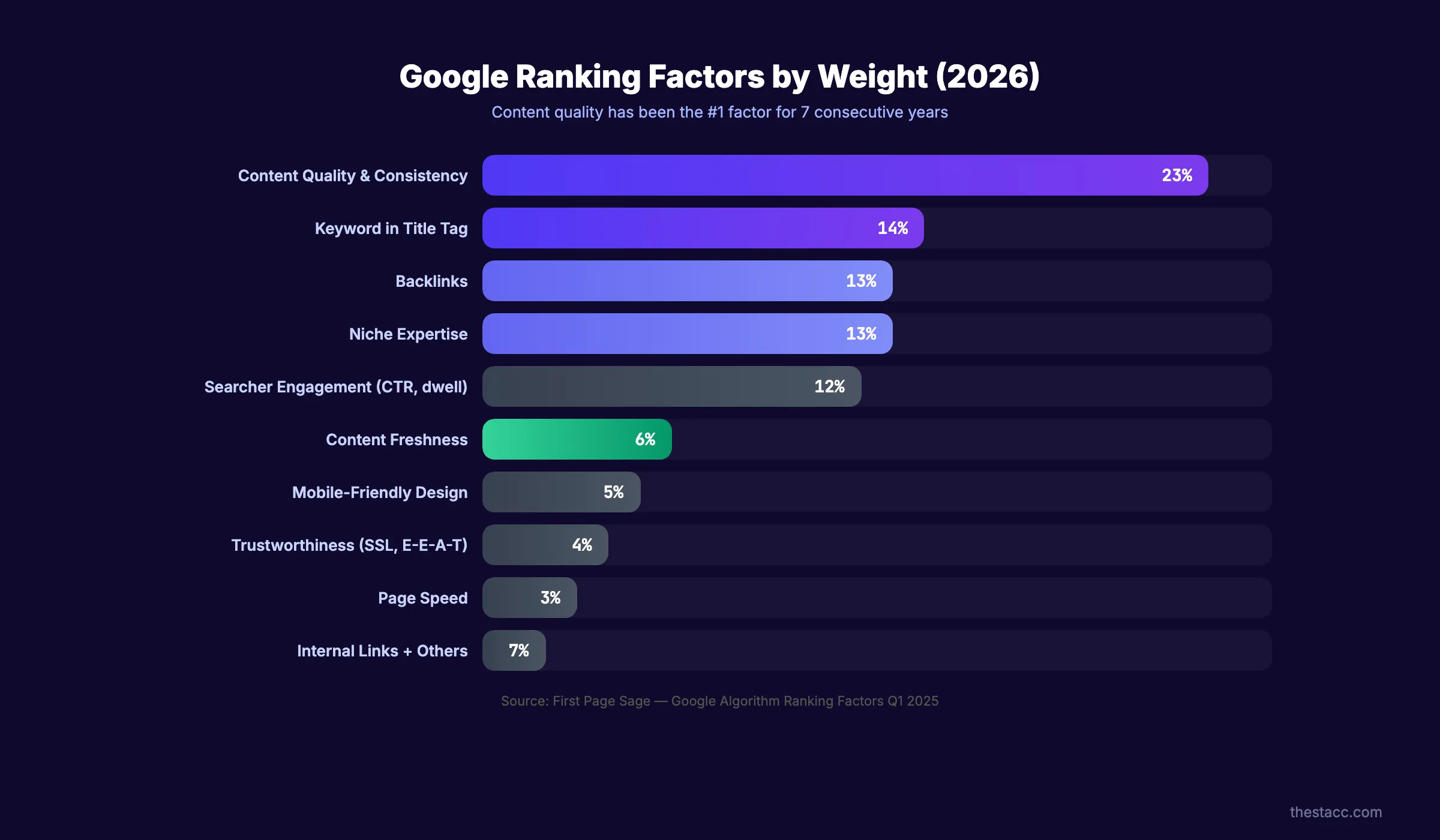
Content quality accounts for 23% of Google ranking weight according to First Page Sage. That makes it the single most important ranking factor for 7 consecutive years.
"Quality" does not mean long. It means complete.
Google measures topical coverage. If every competitor covers 15 subtopics and you cover 8, you lose. Not because your writing is worse. Because your content does not fully answer the query.
Here is how to build content that ranks:
Audit the top 5 results. Extract every H2 and H3 heading. List every subtopic they cover. Your content must address all of them plus at least 2 they miss.
Go deeper, not just wider. Adding 3 paragraphs of filler does not help. Adding a data table that no competitor has does help. Adding an original framework does help. Adding a case study does help.
Build topical authority across multiple posts. A single article about "email marketing" will not outrank HubSpot. But 30 articles covering every angle of email marketing might. Google evaluates your entire site, not just individual pages.
| Content Signal | Impact | How to Win |
|---|---|---|
| Topical coverage | High | Cover every subtopic competitors address |
| Original data | High | Add stats, surveys, or case studies |
| Content depth | Medium | Go deeper on key sections |
| Word count | Medium | Beat top result by 20% |
| Visual elements | Medium | Add tables, images, diagrams |
| E-E-A-T signals | High | Show experience and expertise |
Beat the top-ranking result by 20% on word count. If the current number 1 has 2,500 words, target 3,000. This is not about padding. It is about covering subtopics they skipped.
Why this step matters: Content is the biggest single factor you control. Technical SEO and backlinks matter. But a thin page with perfect technical SEO still will not rank. Deep, complete content gives Google the confidence to rank you above established competitors.
Step 4: Optimize Title Tags, Headers, and Meta Descriptions
Title tags carry 14% of total ranking weight. That makes them the second most important on-page signal after content quality.
Your title tag is the first thing Google reads. It is also the first thing searchers see in the SERP. A bad title kills your CTR even if you rank well.
Title tag rules:
- Keep it between 40 and 60 characters
- Place the primary keyword in the first 5 words
- Add a benefit or number ("10 Steps", "2026 Guide")
- Avoid keyword stuffing. One keyword per title.
Your meta description does not directly affect rankings. But it affects click-through rate. And CTR feeds back into rankings over time. Write 145 to 155 characters. Include the keyword. State a clear benefit.
Header optimization matters more than most sites realize. Your H1 should match your title tag closely. Your H2s should contain keyword variations and related terms. Your H3s should break complex sections into scannable chunks.
Follow the full on-page SEO checklist for every page:
- ✓ Primary keyword in title tag (first 5 words)
- ✓ Primary keyword in H1
- ✓ Keyword variations in at least 2 H2s
- ✓ Primary keyword in first 100 words
- ✓ Primary keyword in at least 1 image alt text
- ✓ URL slug contains the keyword
- ✓ Meta description includes keyword and benefit
For a deeper breakdown of on-page tools that automate this process, see our guide to the best on-page SEO tools.
Why this step matters: On-page optimization is the fastest way to improve rankings. Unlike backlinks that take 10 weeks to impact results, title tag changes can shift rankings within days of reindexing. These elements also compound. A strong title improves CTR. Better CTR signals relevance. Relevance strengthens rankings.
Step 5: Build Internal Links Across Every Page
Internal links carry only 1% of direct ranking weight. That number is misleading.
Internal links amplify every other signal. They distribute authority from high-performing pages to new pages. They help Google discover and crawl content faster. They build the topical clusters that signal expertise.
A site with strong internal linking outranks sites with better backlink profiles. We see this repeatedly across client sites. The reason is simple. Internal links tell Google which pages matter most and how topics relate to each other.
Internal linking rules:
- Add 3 to 5 internal links per 1,000 words
- Use descriptive anchor text. "Learn more about keyword research" beats "click here."
- Link from high-authority pages to new content
- Link from new content back to pillar pages
- Never orphan a page. Every page needs at least 1 incoming internal link.
Build content clusters. A pillar page targets a broad keyword. Supporting posts target long-tail variations. Every supporting post links to the pillar. The pillar links to every supporting post. This structure tells Google you own the entire topic.
| Linking Pattern | Purpose | Example |
|---|---|---|
| Pillar to Supporting | Distributes authority | "SEO Guide" to "Title Tag Optimization" |
| Supporting to Pillar | Strengthens pillar relevance | "Title Tag Optimization" to "SEO Guide" |
| Supporting to Supporting | Builds topic clusters | "Title Tags" to "Meta Descriptions" |
| Blog to Tool page | Drives conversions | "SEO Audit Guide" to Free SEO Audit Tool |
Run a crawl of your site monthly. Find pages with zero internal links pointing to them. Fix them immediately.
Why this step matters: Internal links are the only ranking factor entirely within your control. You do not need to ask anyone for permission. You do not need to wait for external sites to link to you. Every new internal link improves your site structure and helps Google rank your important pages higher.
Stop guessing which SEO fixes will move the needle. theStacc publishes optimized blog content with internal links, on-page SEO, and schema markup built in. 30 articles per month for $99.
Step 6: Earn Backlinks from Authoritative Sites
Backlinks account for 13% of ranking weight. The number 1 result on Google has 3.8x more backlinks than positions 2 through 10.
Here is the opportunity. 95% of all pages on the internet have zero backlinks. None. If you earn even 5 quality backlinks, you are ahead of nearly every competing page.
What counts as a quality backlink:
- Comes from a site with Domain Rating 30 or higher
- Sits within relevant content (not a footer or sidebar)
- Uses natural anchor text
- Comes from a unique referring domain
Effective link building methods in 2026:
Data-driven content. Publish original statistics, surveys, or studies. Journalists and bloggers link to data. Our SEO statistics page earns links because it contains numbers people need to cite.
Guest contributions. Write for industry publications. Not for the backlink in isolation. For the referral traffic and brand awareness. The link is a bonus.
Digital PR. Create newsworthy content. Industry reports, trend analyses, and free tools earn media coverage. Each mention usually includes a link.
Broken link building. Find broken links on authority sites in your niche. Create a replacement resource. Email the webmaster with a working alternative.
Run a backlink audit quarterly. Remove or disavow toxic links. Monitor new links through Google Search Console.
For a detailed strategy, follow our guide on how to build backlinks for your blog.
Backlinks take an average of 10 weeks to impact rankings. Do not expect overnight results. The compounding effect makes link building one of the highest-ROI activities in SEO. But only if you stay consistent.
Why this step matters: Backlinks remain the strongest external trust signal Google uses. Content quality gets you in the conversation. Backlinks win the argument. Sites with consistent link acquisition outrank competitors with better content but fewer links.
Step 7: Fix Technical SEO Issues
Technical SEO is the foundation your content sits on. A cracked foundation weakens everything above it.
Mobile friendliness accounts for 5% of ranking weight. Page speed adds another 3%. SSL security contributes 2%. These percentages seem small individually. Together they represent 10% of your ranking potential.
Core Web Vitals matter. Google measures 3 metrics:
- LCP (Largest Contentful Paint): Main content must load in under 2.5 seconds
- INP (Interaction to Next Paint): Page must respond to user input in under 200 milliseconds
- CLS (Cumulative Layout Shift): Visual elements must not jump around during load. Score under 0.1.
Run a full SEO audit using Google Search Console, Screaming Frog, or our free SEO audit tool. Check for these common killers:
- ✓ Pages returning 404 errors
- ✓ Duplicate title tags or meta descriptions
- ✓ Missing alt text on images
- ✓ Broken internal or external links
- ✓ Pages blocked by robots.txt that should be indexed
- ✓ Missing XML sitemap or incorrect sitemap entries
- ✓ Redirect chains longer than 2 hops
Page speed fixes that deliver the biggest gains:
| Fix | Typical Speed Improvement | Difficulty |
|---|---|---|
| Compress images (WebP format) | 30-50% faster load | Easy |
| Enable browser caching | 20-30% faster repeat visits | Easy |
| Minify CSS and JavaScript | 10-20% faster load | Medium |
| Use a CDN | 20-40% faster global load | Medium |
| Defer non-critical JavaScript | 15-25% faster initial render | Medium |
Read our guide on improving Core Web Vitals for a complete walkthrough.
Why this step matters: Technical issues create a ceiling on your rankings. You can write the best content on the internet. If your page takes 8 seconds to load on mobile, Google will not rank it. Fix technical debt first. Then let your content and links push you to the top.
Step 8: Add Schema Markup for Rich Results
72% of first-page results use structured data. Pages with rich results see 82% higher click-through rates than standard listings.
Schema markup does not directly boost rankings. It makes your listing more visible in the SERP. More visibility means more clicks. More clicks strengthen engagement signals that support higher rankings.
Essential schema types for blog content:
- Article schema. Tells Google your page is a blog post. Include headline, author, dates.
- FAQ schema. Turns your FAQ section into expandable answers in the SERP.
- Breadcrumb schema. Shows site hierarchy in the SERP instead of a raw URL.
- HowTo schema. Displays numbered steps directly in search results.
Use our schema markup generator to create valid JSON-LD without writing code. Read our detailed schema markup for blog posts guide for code templates and best practices.
Implementation checklist:
- ✓ Article schema on every blog post
- ✓ FAQ schema on posts with FAQ sections
- ✓ Breadcrumb schema site-wide
- ✓ Test with Google Rich Results Test before publishing
- ✓ Monitor in Search Console under Enhancements
Why this step matters: Rich results steal clicks from competitors. When your listing shows FAQ dropdowns and your competitor shows a plain blue link, you win the click. Schema is free to implement and pays dividends on every page it touches.
Step 9: Keep Content Fresh and Updated
Freshness now accounts for 6% of Google ranking weight. That is up from less than 1% just 3 years ago. Google is rewarding sites that maintain their content.
Pages updated annually gain an average of 4.6 positions in search results. That is the difference between position 8 and position 4.
72.9% of pages in Google top 10 are 3 or more years old. They rank because they have been updated and maintained. Not because they were published once and forgotten.
Build a quarterly refresh cycle:
- Audit all posts older than 6 months. Prioritize pages ranking positions 4 through 20.
- Rewrite weak sections. Add new data. Expand thin areas. Update screenshots.
- Monitor performance changes for 30 to 60 days.
Read our complete guide on how to update old blog posts for a detailed workflow.
| Element | What to Check | Action |
|---|---|---|
| Statistics | Are they from 2024 or earlier? | Replace with current data |
| Screenshots | Do they match the current UI? | Retake if outdated |
| Links | Do external links still work? | Fix or replace broken URLs |
| Competitors | Has the SERP changed? | Add subtopics competitors now cover |
| Word count | Is it still competitive? | Expand if top results grew |
Why this step matters: Publishing is not a one-time event. Every page on your site either gains or loses ranking momentum. Regular updates protect your existing rankings. Sites that treat content as a living asset outperform those that publish and forget.
Step 10: Optimize for AI Search Visibility
AI Overviews reduced position 1 click-through rates by 32% year over year. That is not a future prediction. That is happening right now.
Google AI Overviews, Perplexity, and ChatGPT search pull answers from web content and present them directly. The sites that get cited earn 35% more organic clicks. The sites that get bypassed lose traffic even when they technically rank well.
How to get cited in AI search results:
Write quotable definitions. AI models pull clean, concise answers. Start key sections with a 1 to 2 sentence definition. Make it easy to extract.
Use structured formatting. Tables, numbered lists, and clear H2/H3 hierarchies make content easier for AI models to parse. Walls of text get skipped.
Publish original data. AI models prioritize citing specific numbers and statistics. If you publish original research, you become a primary source. Primary sources get cited.
Build brand authority. AI models favor known, trusted brands. Press mentions, social signals, and brand searches all feed trust scoring.
Read our full guides on getting cited in AI search and optimizing for Google AI Overviews.
Why this step matters: AI search is reshaping how people find information. Sites that ignore AI optimization will see declining traffic even with stable rankings. Sites that optimize for both traditional and AI search capture traffic from both channels.
Ranking higher takes consistent content, technical health, and fresh updates. theStacc handles all 3. 3,500+ blogs published. Every article is SEO-scored before publish.
What Results to Expect (and When)
Ranking higher on Google does not happen overnight. Only 1.74% of new pages reach the top 10 within their first year. The average page ranking in position 1 is over 5 years old.
That does not mean you should wait 5 years. It means you should set realistic timelines and measure progress correctly.
Typical timeline for ranking improvements:
| Action | Time to Impact | Expected Result |
|---|---|---|
| Title tag and meta optimization | 1-2 weeks | 1-3 position improvement |
| Content quality improvements | 4-8 weeks | 3-10 position improvement |
| Internal linking overhaul | 2-4 weeks | 1-5 position improvement |
| Backlink acquisition | 10+ weeks | 2-8 position improvement |
| Technical fixes (speed, mobile) | 2-6 weeks | 1-3 position improvement |
| Schema markup | 2-4 weeks | CTR improvement (10-30%) |
| Content freshness updates | 4-8 weeks | 2-5 position improvement |
CTR by Google position (First Page Sage 2026):
| Position | CTR (2026) | Monthly Clicks (1,000 searches) |
|---|---|---|
| 1 | 39.8% | 398 |
| 2 | 18.7% | 187 |
| 3 | 10.2% | 102 |
| 4 | 7.2% | 72 |
| 5 | 5.1% | 51 |
| 6 | 4.4% | 44 |
| 7 | 3.0% | 30 |
| 8 | 2.1% | 21 |
| 9 | 1.9% | 19 |
| 10 | 1.6% | 16 |
The top 3 positions capture 68.7% of all clicks. Moving from position 10 to position 3 means 6x more traffic.
Track progress against these SEO statistics to benchmark your performance. Read our guide on how many blog posts it takes to rank to calibrate your content velocity.
For a deeper look at growing organic performance, see our guide on increasing organic traffic.
What practitioners are saying on X
AI search advice ages quickly. Here is high-signal public discussion from SEO and growth operators — context for your roadmap, not a substitute for primary data.
- @hridoyreh (Mar 2026): Widely shared SEO skill tree: foundations, research, technical, on-page, content, links, AI SEO/GEO, analytics, UX, brand, programmatic — useful map for stats and how-to posts. See the post on X.
- @jakezward (Feb 2026): 2026 SEO predictions emphasize AI Overview share-of-SERP, schema for LLM token efficiency, brand mentions in AI answers as a KPI, proprietary data as a moat, and content refresh beating net-new AI slop. See the post on X.
Grok, AI Overviews, and multi-engine visibility
For “how to rank higher google”, multi-engine visibility still starts with clear definitions, sourced numbers, and extractable section answers. Grok additionally factors live X discussion — keep public claims consistent with this page.
- Google AI Overviews: Use passage-ready answers, tables, and FAQ schema where relevant.
- ChatGPT / Perplexity: Cite named sources next to key claims.
- Grok: Maintain accurate entity facts on-site and in high-signal X posts.
FAQ
Most pages see meaningful ranking changes within 3 to 6 months of optimization. Backlinks take roughly 10 weeks to influence rankings. Title tag and on-page changes can show results within 1 to 2 weeks. Only 1.74% of pages reach the top 10 within their first year. Patience and consistency matter more than any single tactic.
Content quality is the most important factor at 23% of ranking weight according to First Page Sage. Title tags contribute 14%. Backlinks contribute 13%. Mobile friendliness adds 5%. No single factor guarantees rankings. The sites that rank highest perform well across all of them.
Yes, for low-competition keywords. Long-tail queries with fewer than 1,000 monthly searches often have weak competition. Strong on-page optimization and deep content can win without links. For competitive terms, backlinks remain essential. The number 1 result has 3.8x more backlinks than positions 2 through 10.
Page speed carries 3% of direct ranking weight. Its indirect impact is larger. Slow pages have higher bounce rates. Higher bounce rates signal poor user experience. Google set specific thresholds through Core Web Vitals. Pages that fail LCP, INP, or CLS benchmarks lose ranking potential.
AI Overviews do not change your technical ranking position. They change how many people click through to your site. Position 1 CTR dropped 32% year over year when AI Overviews are present. Brands cited in AI Overviews earn 35% more organic clicks. Optimize for AI search by writing quotable definitions, publishing original data, and maintaining structured content formatting.
theStacc publishes SEO-optimized blog content at scale. Our plans start at $99 per month for 30 articles. Each post follows the same 10-step process outlined in this guide. We handle keyword research, content creation, on-page optimization, internal linking, and schema markup. Our 3,500+ published blogs maintain a 92% average SEO score. Start a 3-day Try for free to see the quality before committing.
Start Ranking Higher Today
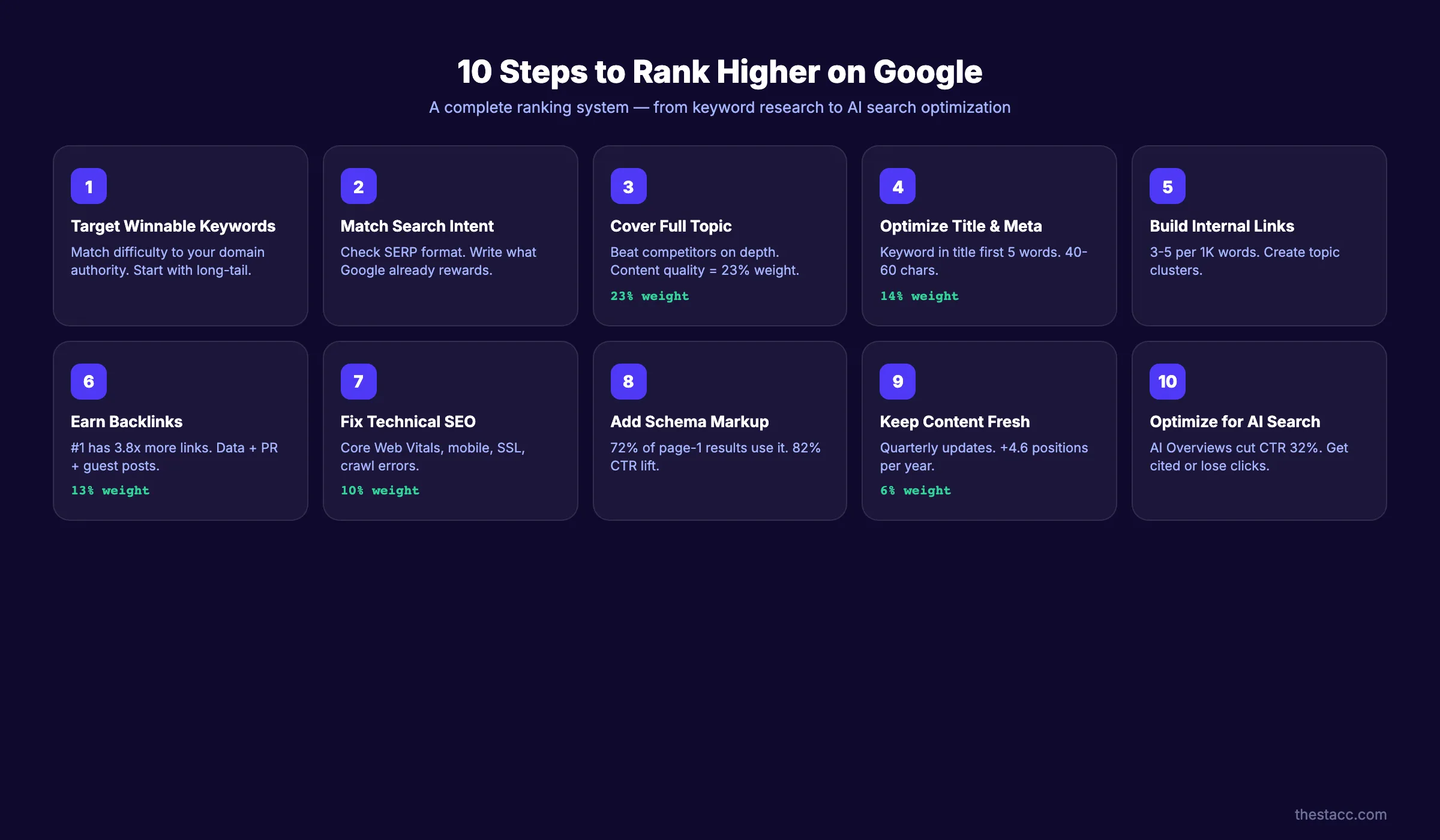
The difference between position 1 and position 10 is not luck. It is execution across 10 specific areas. Target winnable keywords. Match intent. Write complete content. Optimize on-page elements. Build internal links. Earn backlinks. Fix technical issues. Add schema. Keep content fresh. Optimize for AI search.
Every step compounds. Sites that execute all 10 consistently do not just rank higher. They stay higher. Start publishing optimized content with theStacc and turn SEO from a guessing game into a growth engine.
Sources & references
- [1] Princeton / Georgia Tech et al. — GEO research (arXiv:2311.09735)
- [2] @hridoyreh on X — Widely shared SEO skill tree: foundations, research, technical, on-page, content, links, AI SEO/GEO, analytics, UX, bran
- [3] @jakezward on X — 2026 SEO predictions emphasize AI Overview share-of-SERP, schema for LLM token efficiency, brand mentions in AI answers
- [4] Referenced source — ahrefs.com

Plan topics, review article drafts, and publish to a connected CMS.
Weekly local SEO teardowns
One practical email a week. Map Pack, GBP, AI Overviews — no fluff. Unsubscribe anytime.