Healthcare SEO has to clear two bars at once: search relevance and clinical accuracy. That means named clinician authorship, reviewed medical content, accurate service and insurance pages, and a Google Business Profile for every location. Reviews and local visibility drive most new-patient volume, because patients search before they ever call.
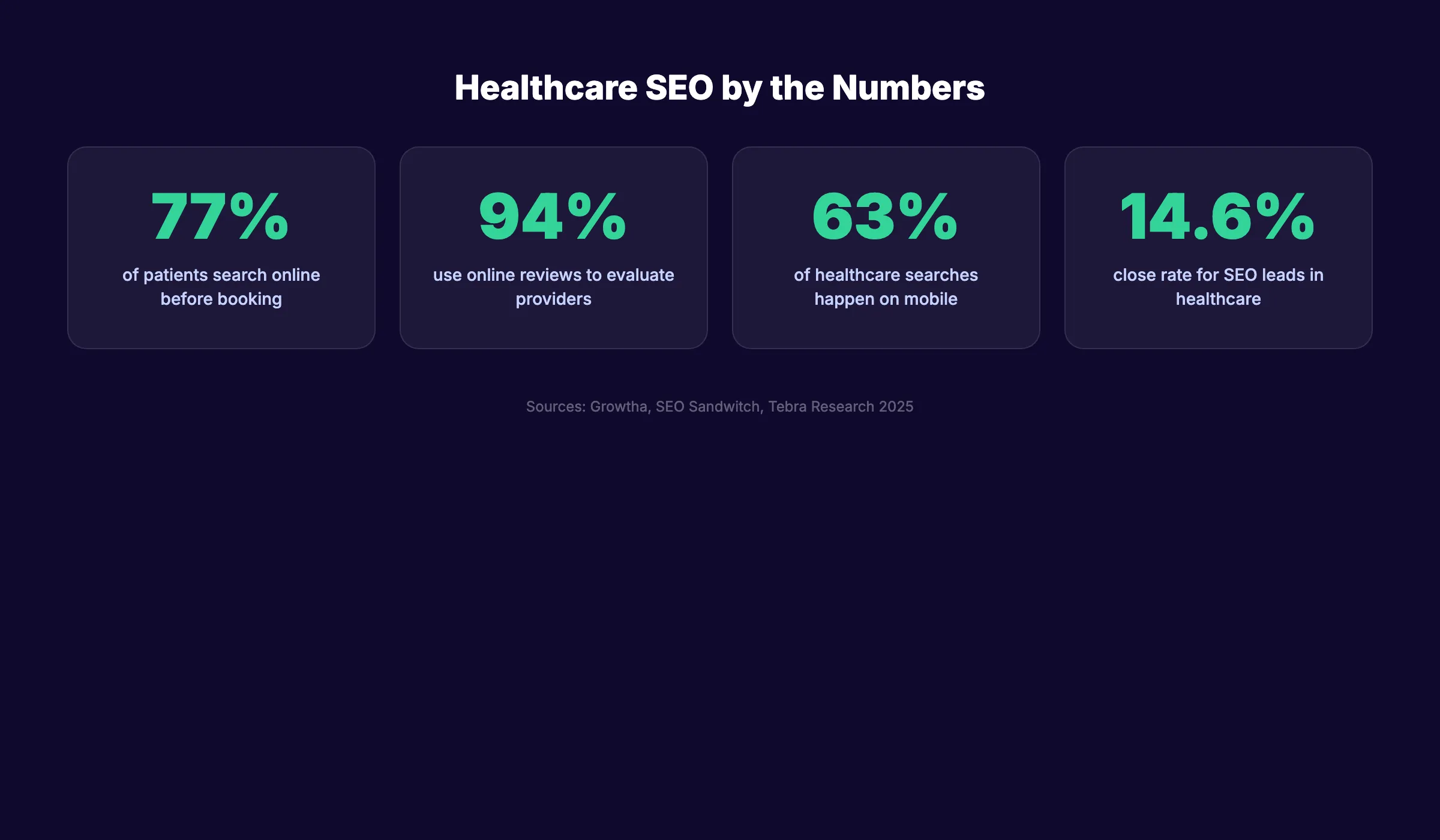
77% of patients search online before booking a medical appointment. That single stat defines why healthcare SEO matters more than almost any other marketing channel.
Yet 62% of healthcare businesses spend only 1 to 5% of revenue on marketing. The gap between patient search behavior and provider investment is massive. Practices that close this gap rank on Google. The rest rely on referrals and hope.
Healthcare SEO is not the same as regular SEO. Google classifies medical content as YMYL (Your Money or Your Life) and applies stricter quality standards. One misleading health claim can tank your entire site. One missing author bio can prevent a well-written article from ranking.
This healthcare SEO guide covers every tactic medical practices, clinics, hospitals, and health organizations need to rank on Google in 2026.
We have published 3,500+ blog posts across 70+ industries, including healthcare, dental, and medical practices. This guide covers everything we know about SEO for healthcare providers.
Here is what you will learn:
- Why Google holds healthcare websites to a higher standard than other industries
- How to apply E-E-A-T principles to medical content
- Which keywords healthcare patients actually search for
- How to dominate local search results and the Google Map Pack
- On-page SEO techniques specific to medical websites
- The content strategy that builds authority and patient trust
- Technical SEO fixes and HIPAA compliance requirements
- How to build links in a regulated industry
- How to measure whether your healthcare SEO is working
What Is Healthcare SEO and Why Google Holds It to a Higher Standard
Healthcare SEO is the process of optimizing a medical practice, clinic, or hospital website to rank higher in Google search results. It covers your website content, local listings, technical infrastructure, and the authority signals Google uses to evaluate medical sites.
The stakes are different in healthcare. A bad restaurant recommendation wastes a meal. Bad medical advice can harm someone. Google knows this.
Google classifies healthcare content as YMYL (Your Money or Your Life). This means any content that could impact a person's health, safety, or well-being receives extra scrutiny from Google's quality evaluation systems.
The numbers back this up. 89% of healthcare search traffic flows through Google. 80% of patients use search engines to research symptoms and conditions before visiting a doctor. And 94% of patients use online reviews to evaluate providers before making a decision.
Over 70,000 health-related Google queries happen every minute. And 87% of patients who find a provider online end up booking an appointment. For medical practices, the math is simple. Patients search. Google decides who appears. SEO determines whether that is your practice or your competitor.
What Makes Healthcare SEO Different
Three things separate healthcare SEO from standard SEO:
| Factor | Standard SEO | Healthcare SEO |
|---|---|---|
| Content scrutiny | Normal quality guidelines | YMYL classification with stricter evaluation |
| Author requirements | Optional | Medical credentials expected on health content |
| Compliance | Standard privacy policies | HIPAA compliance for forms, tracking, and data |
Most SEO agencies apply a generic playbook to healthcare websites. That approach fails because it ignores YMYL requirements, skips author credentials, and uses tracking tools that may violate HIPAA regulations.
E-E-A-T and YMYL: The Rules That Govern Medical Content
E-E-A-T stands for Experience, Expertise, Authoritativeness, and Trustworthiness. Google uses these signals to evaluate whether content deserves to rank, especially for YMYL topics like healthcare.
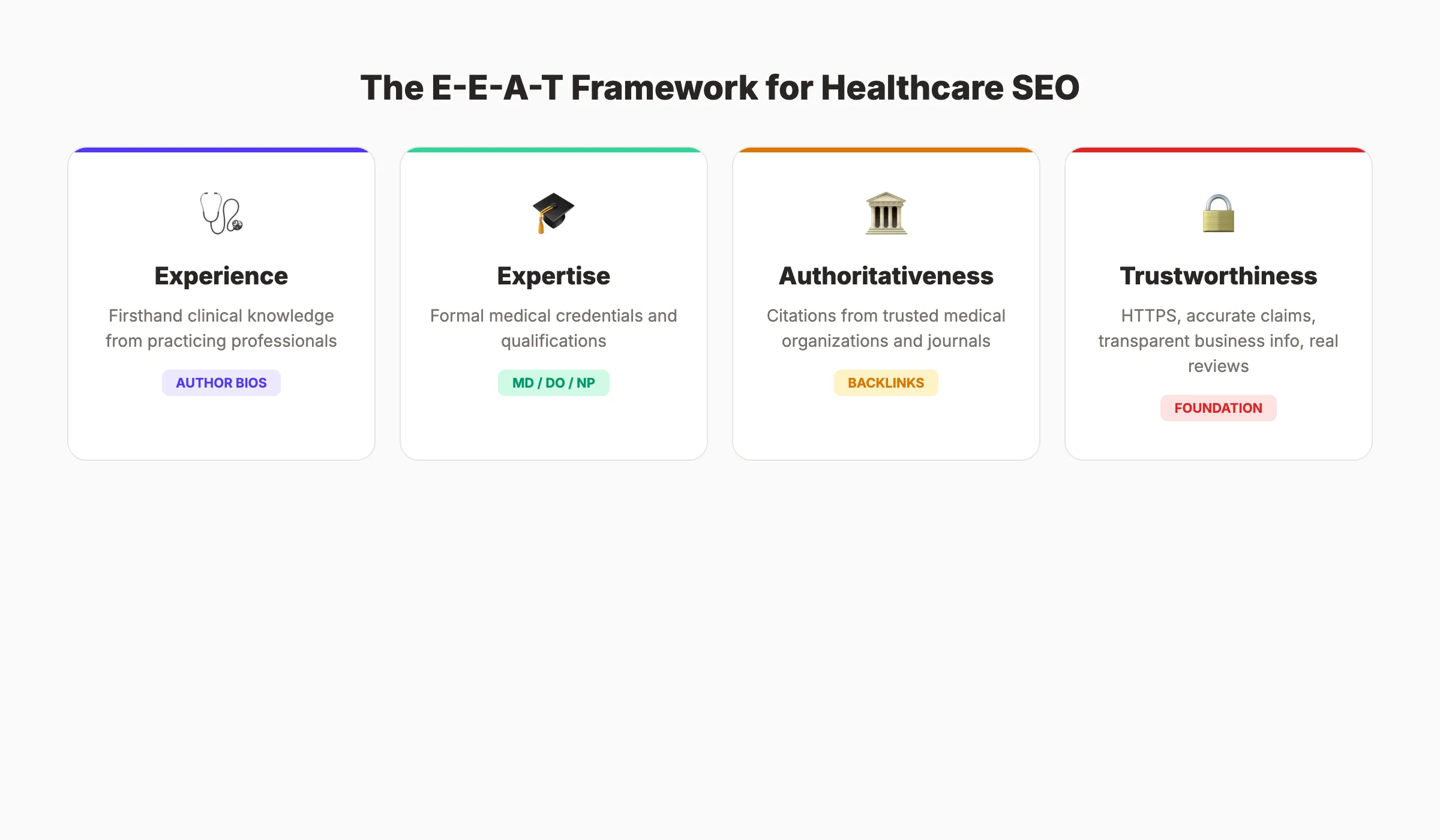
Experience refers to firsthand knowledge. A cardiologist writing about heart disease from 20 years of clinical practice demonstrates experience. A generic article written by an anonymous contributor does not.
Expertise means the content creator has formal qualifications. For healthcare content, Google expects content written or reviewed by licensed medical professionals. Every health-related page on your site should have a visible author bio with credentials.
Authoritativeness is earned when other trusted sites link to and reference your content. Medical practices build authority through published research, media mentions, and citations from health organizations.
Trustworthiness is the foundation. Secure websites (HTTPS), transparent business information, accurate medical claims with citations, and real patient reviews all contribute to trust.
How to Apply E-E-A-T to Your Healthcare Website
Add author bios to every health content page. Include the practitioner's name, title, credentials, years of experience, and a headshot. Link to their profile on medical directories like Healthgrades or Doximity.
Add medical review badges. If a nurse practitioner writes content that a physician reviews, add a "Medically Reviewed By Dr. [Name], [Credential]" line below the title.
Cite authoritative sources. Link to PubMed, the CDC, the WHO, the NIH, or peer-reviewed journals when referencing medical claims. Unsourced health claims are a ranking liability.
Maintain an "About Us" page with credentials. List every practitioner, their board certifications, hospital affiliations, and professional memberships. This page is one of the first things Google's quality raters check.
Update content regularly. Medical guidelines change. A page about hypertension management from 2021 may contain outdated treatment recommendations. Add "Last Updated" dates to all health content.
Your SEO team. $99 per month. SEO-scored articles, published automatically. theStacc handles healthcare content that ranks.
Keyword Research for Healthcare Providers
Healthcare keyword research follows the same principles as standard keyword research, but with 3 categories that matter most for patient acquisition.
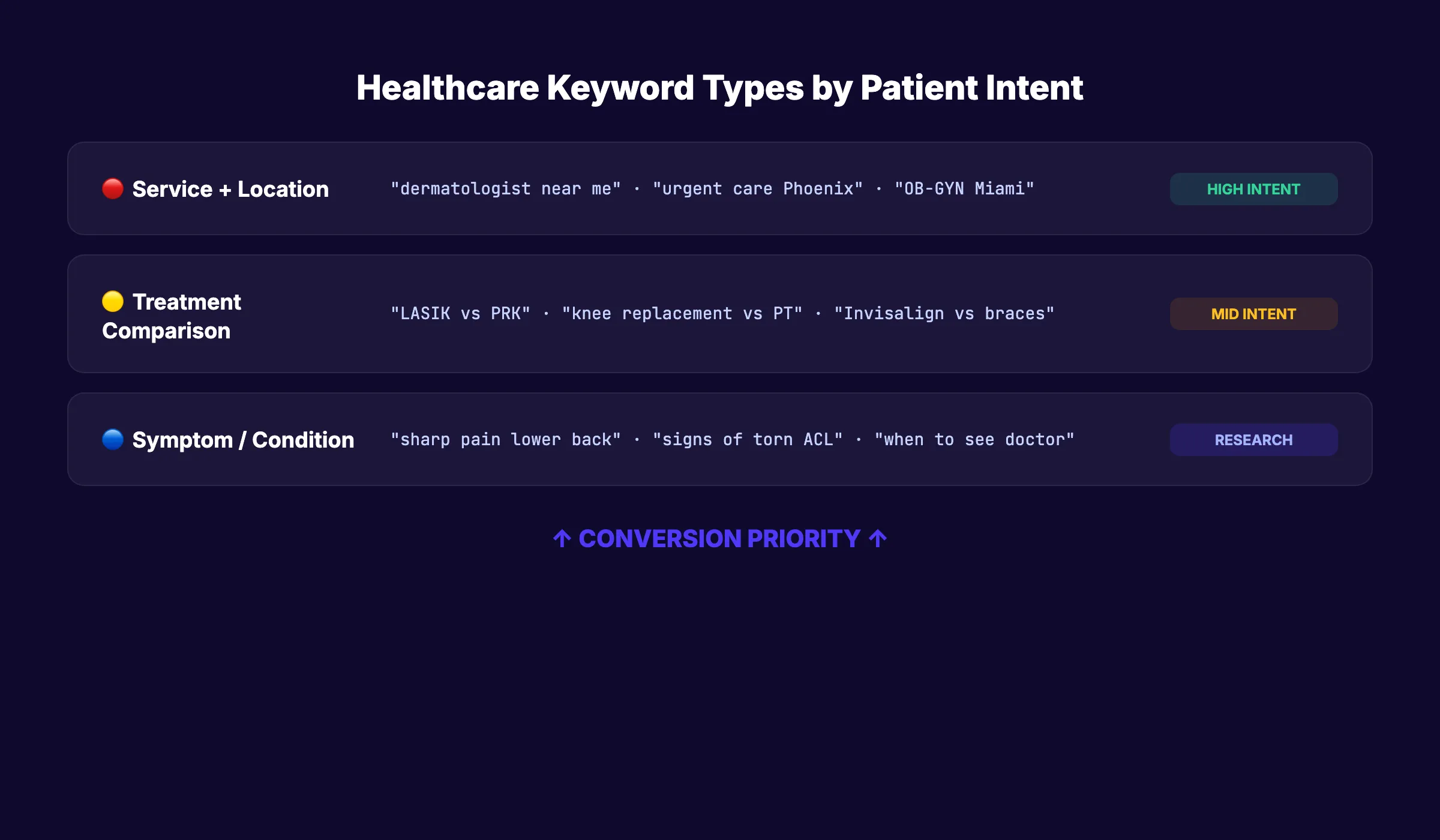
Service + Location Keywords (Highest Priority)
These keywords signal a patient ready to book. They combine a medical service with a location.
- "dermatologist near me"
- "orthopedic surgeon Dallas TX"
- "urgent care open now Phoenix"
- "physical therapy Chicago"
- "OB-GYN accepting new patients Miami"
18% of local mobile healthcare searches convert to an appointment within 24 hours. Every service your practice offers needs a dedicated page targeting that service plus your city or region.
Symptom and Condition Keywords
Patients research symptoms before they search for a provider. These keywords capture them at the research stage.
- "sharp pain in lower back causes"
- "signs of a torn ACL"
- "when to see a doctor for chest pain"
- "difference between cold and flu"
44% of patients who research symptoms online end up seeking medical attention. Content targeting these queries positions your practice as the trusted source they find first.
Treatment Comparison Keywords
These capture patients comparing treatment options before choosing a provider.
- "knee replacement vs physical therapy"
- "Invisalign vs braces for adults"
- "LASIK vs PRK recovery time"
- "medication vs therapy for anxiety"
Treatment comparison content converts well because the patient has already decided to seek care. They are choosing how and where.
Keyword Research Tools for Healthcare
Use Google Search Console to find queries your site already ranks for. Use Ahrefs or Semrush to discover new keyword opportunities and evaluate competition. Check "People Also Ask" boxes on Google for question-based content ideas.
Filter for keywords with local intent. A practice in Houston does not need to rank nationally for "cardiologist." It needs to rank for "cardiologist Houston TX" and "heart doctor near me."
Local SEO: Where Most Patient Searches Start
63% of healthcare searches happen on mobile devices. Most of those searches have local intent. Patients want a provider near them, open now, with good reviews.
Local SEO for healthcare practices revolves around 3 pillars: your Google Business Profile, your online reviews, and your local citations.
Google Business Profile Optimization
Your Google Business Profile (GBP) determines whether your practice appears in the Map Pack, the 3 local listings Google shows above organic results.
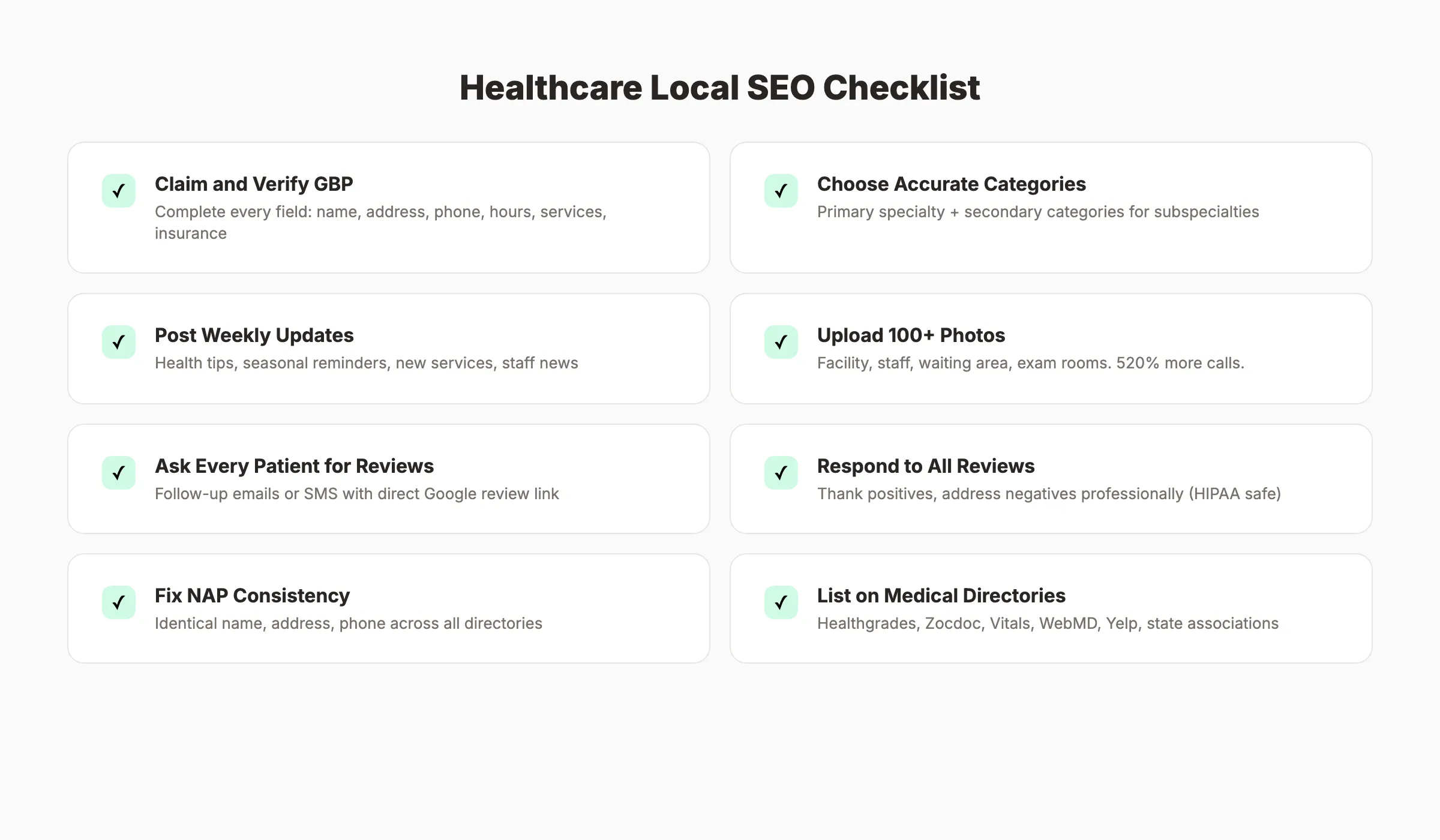
Complete every field. Business name, address, phone number, website, hours, appointment link, insurance accepted, services offered, and a detailed business description. Google rewards complete profiles.
Choose accurate categories. Your primary category should match your specialty. "Dermatologist" not "Doctor." Add secondary categories for subspecialties: "Cosmetic Dermatologist," "Pediatric Dermatologist," "Mohs Surgeon."
Post weekly updates. Share health tips, seasonal reminders (flu shot availability, allergy season prep), new services, or staff introductions. Active profiles rank higher than dormant ones.
Add photos regularly. Upload images of your facility, staff, waiting area, and exam rooms. Practices with 100+ photos on GBP get 520% more calls than those with fewer than 10.
Patient Reviews Are a Ranking Factor
Google confirmed that reviews influence local search rankings. The quantity, quality, and recency of your reviews all matter.
94% of patients read reviews before choosing a provider. 84% trust online reviews as much as personal recommendations. For healthcare practices, reviews are not optional. They are a competitive necessity.
Ask every patient for a review. Train front desk staff to request reviews after positive appointments. Use follow-up emails or SMS with a direct link to your Google review page. Read our guide on getting more Google reviews for a step-by-step process.
Respond to every review. Thank positive reviewers. Address negative reviews professionally and without disclosing any patient health information (HIPAA applies here too). Google values businesses that engage with their reviews.
NAP Consistency and Local Citations
NAP stands for Name, Address, and Phone number. Your NAP must be identical across every online listing: your website, GBP, Healthgrades, Zocdoc, Vitals, Yelp, and every healthcare directory your practice appears on.
Even minor inconsistencies hurt rankings. "123 Main St Suite 200" on your website versus "123 Main Street #200" on Healthgrades confuses Google. Use the exact same format everywhere.
Rank everywhere. Do nothing. Blog SEO, Local SEO, and Social on autopilot. theStacc handles the publishing so you can focus on patients.
On-Page SEO for Medical Websites
On-page SEO is what you control directly on your website. Most healthcare websites fail here because they treat their site like a digital brochure instead of a patient acquisition tool.
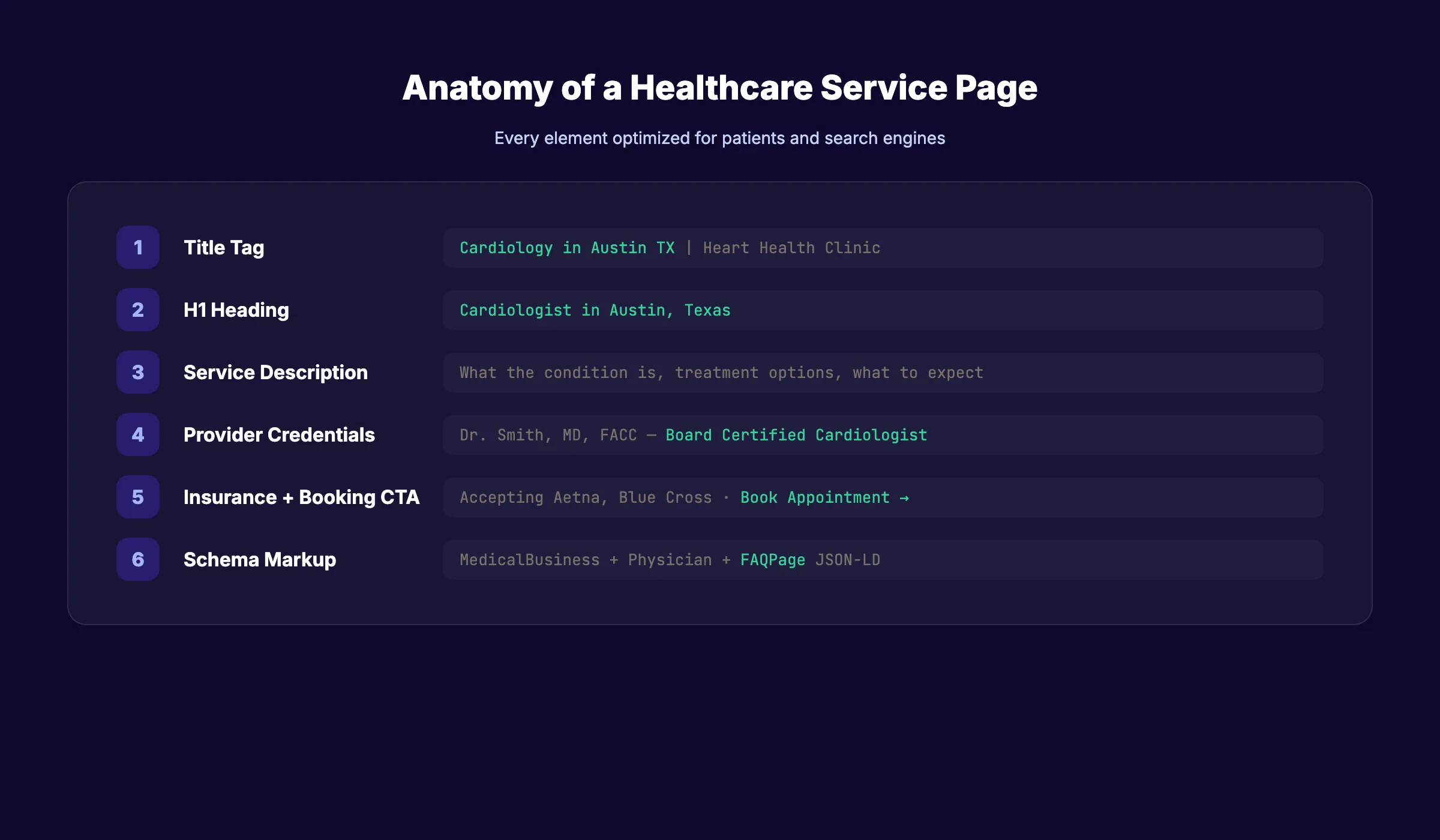
Create Dedicated Service Pages
The biggest mistake healthcare websites make is listing all services on a single page. One "Services" page does not rank for anything specific. You need a dedicated page for every service you offer.
| Service | Page URL | Target Keyword |
|---|---|---|
| Primary Care | /services/primary-care | "primary care doctor [city]" |
| Cardiology | /services/cardiology | "cardiologist [city]" |
| Orthopedics | /services/orthopedics | "orthopedic surgeon [city]" |
| Dermatology | /services/dermatology | "dermatologist [city]" |
| Physical Therapy | /services/physical-therapy | "physical therapy [city]" |
| Urgent Care | /services/urgent-care | "urgent care near me" |
Each service page should include a description of the condition or treatment, what patients can expect, provider credentials, insurance accepted, and a clear appointment booking CTA.
Title Tags and Meta Descriptions
Your title tag appears as the blue link in search results. It is the first impression patients get.
Title formula: [Service] in [City] | [Practice Name]
Example: "Orthopedic Surgeon in Austin TX | Hill Country Orthopedics"
Keep titles under 60 characters. Include the target keyword at the beginning. Write meta descriptions between 145 and 155 characters with a clear benefit and call to action.
Schema Markup for Healthcare
Schema markup tells Google exactly what your page is about in a structured format. Healthcare sites should implement these schema types:
- MedicalBusiness or Physician schema for your practice
- MedicalClinic for multi-provider locations
- FAQPage schema for common patient questions
- LocalBusiness schema with hours, address, and phone number
- Review schema for patient testimonials (where compliant)
Use our schema markup generator to create the JSON-LD code for your practice.
Internal Linking
Connect your service pages, blog posts, condition pages, and provider profiles with internal links. A blog post about "signs of a torn ACL" should link to your orthopedics service page. A provider bio for your cardiologist should link to your cardiology service page.
Internal links help Google understand the relationship between your pages. They also keep patients on your site longer, which signals quality to search engines.
Content Strategy That Builds Authority and Trust
Healthcare content has a dual purpose. It ranks on Google and it earns patient trust. Both require the same thing: accurate, well-sourced, easy-to-understand information written by qualified professionals.
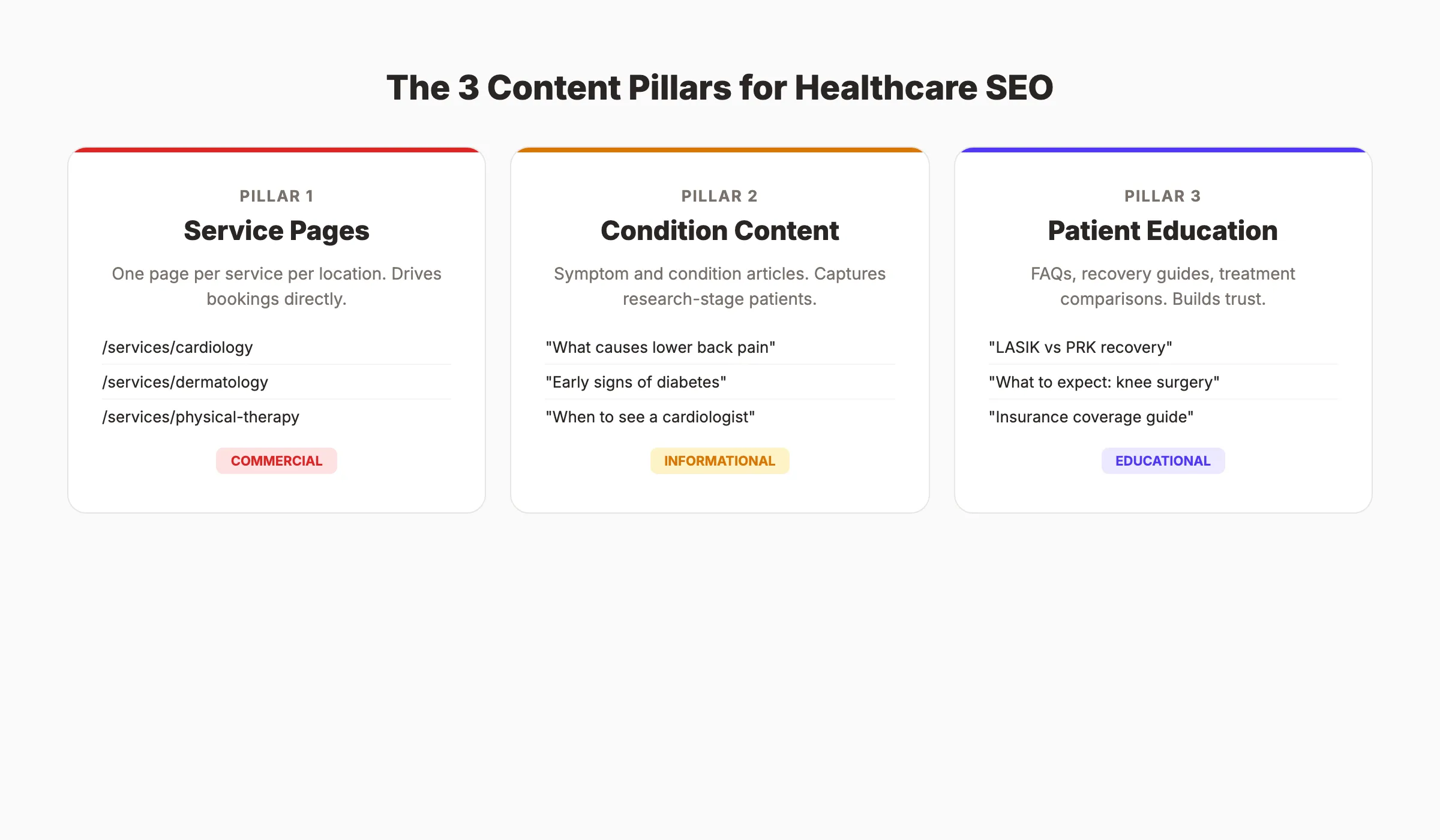
The 3 Content Pillars for Healthcare SEO
Pillar 1: Service Pages. Target commercial keywords. One page per service per location. Focus on what the patient needs to know before booking.
Pillar 2: Condition and Symptom Content. Target informational keywords. "What causes lower back pain" or "early signs of diabetes." These pages attract patients at the research stage and feed topical authority signals that boost your service pages.
Pillar 3: Patient Education. FAQ pages, treatment comparison guides, "what to expect" articles, and recovery timelines. This content builds trust and reduces patient anxiety, which increases appointment bookings.
Publishing Frequency Matters
Practices that publish 2 to 4 articles per month build topical authority faster than those publishing sporadically. Consistency signals to Google that your site is actively maintained and current.
Each article should target a specific keyword, link to relevant service pages, and include author credentials. SEO content writing for healthcare follows the same optimization principles as any industry, but with the added requirement of medical accuracy and E-E-A-T compliance.
Content Mistakes Healthcare Sites Make
Publishing without author attribution. Anonymous health content does not rank. Every article needs a named, credentialed author.
Using clinical jargon patients do not understand. Write at a 6th to 8th grade reading level. "Hypertension" should be introduced as "high blood pressure." Match the language patients use in search queries.
Copying manufacturer or association content. Duplicate content from medical device companies, pharmaceutical sites, or medical associations will not rank. Google penalizes copied content. Write original material based on your clinical experience.
Never updating published content. Medical guidelines change. Treatment recommendations evolve. Outdated content erodes trust and rankings. Audit your health content quarterly and update anything with stale information.
3,500+ blogs published. Every article is SEO-scored before publish. See what theStacc can do for your healthcare practice.
Technical SEO and HIPAA Compliance
Technical SEO ensures Google can crawl, index, and render your website properly. For healthcare sites, technical SEO also intersects with HIPAA compliance, which adds requirements that most standard SEO guides ignore.
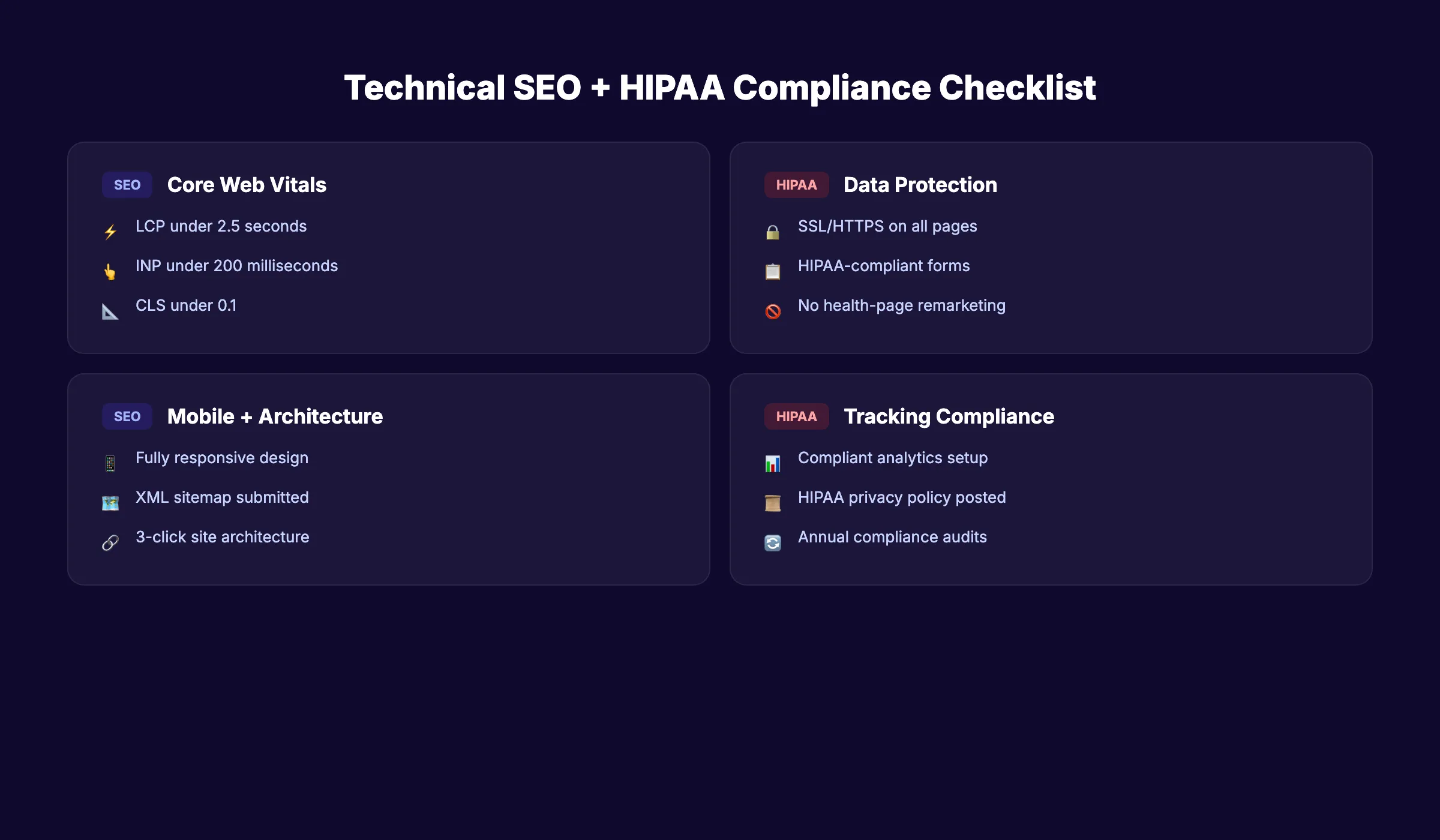
Core Web Vitals
Google uses Core Web Vitals as a ranking factor. Healthcare sites must meet these thresholds:
| Metric | Target | What It Measures |
|---|---|---|
| LCP (Largest Contentful Paint) | Under 2.5 seconds | Main content load time |
| INP (Interaction to Next Paint) | Under 200 milliseconds | Response to user interaction |
| CLS (Cumulative Layout Shift) | Under 0.1 | Visual stability during load |
Many healthcare websites load slowly because of unoptimized images, heavy practice management widgets, or outdated WordPress themes. Run your site through Google PageSpeed Insights and fix anything scoring below 90.
Mobile Optimization
63% of healthcare searches happen on mobile. Your site must be fully responsive. Test every page on a phone. Appointment booking buttons must be thumb-friendly. Phone numbers must be tap-to-call. Forms must be easy to complete on a small screen.
HIPAA Compliance for Your Website
HIPAA compliance is not optional for healthcare websites that collect patient information. Here is what your website needs:
SSL certificate (HTTPS). Every healthcare website must use HTTPS. This encrypts data between the patient's browser and your server. Google also uses HTTPS as a ranking signal.
HIPAA-compliant forms. Every contact form, appointment request form, and patient intake form must transmit data through encrypted, HIPAA-compliant channels. Standard WordPress contact forms are not compliant by default. Use HIPAA-compliant form providers or ensure your forms integrate with a compliant practice management system.
Tracking restrictions. Standard marketing tools like Google Analytics can expose Protected Health Information (PHI) if not configured properly. The HHS guidance on tracking technologies restricts how healthcare websites use cookies, pixels, and remarketing tags.
You cannot use standard remarketing to show ads to patients based on the health pages they visited. A patient who viewed your "HIV Testing" page cannot be retargeted with ads about that service. This is a HIPAA violation.
Privacy policy. Display a clear HIPAA privacy policy that explains how you collect, store, and use patient data submitted through your website.
Site Architecture
Structure your site so Google and patients can find everything within 3 clicks:
Homepage
├── /services/
│   ├── /services/primary-care
│   ├── /services/cardiology
│   └── /services/dermatology
├── /conditions/
│   ├── /conditions/back-pain
│   └── /conditions/diabetes
├── /providers/
│   ├── /providers/dr-smith
│   └── /providers/dr-jones
├── /blog/
└── /about/
Submit an XML sitemap to Google Search Console. Run a quarterly SEO audit to catch broken links, missing meta tags, and indexing issues. Use our free SEO audit tool for a quick site health check.
Link Building for Healthcare Sites
Backlinks remain one of Google's top 3 ranking factors. For healthcare sites, link building requires a different approach than most industries because medical content is regulated and trust signals matter more.
Link Building Strategies That Work for Healthcare
Medical directories and associations. List your practice on Healthgrades, Zocdoc, Vitals, WebMD, and your state medical association directory. These are high-authority, relevant backlinks.
Local business directories. Chamber of Commerce, Better Business Bureau, and local business associations all provide valuable local backlinks.
Community partnerships. Sponsor local health fairs, school sports physicals, or charity runs. Each sponsorship typically earns a backlink from the event website.
Guest articles on health publications. Write expert commentary for local news outlets, health blogs, or medical publications. A cardiologist writing about heart health for a local newspaper earns a high-quality, relevant backlink.
Original research and data. Publish patient satisfaction surveys (anonymized), treatment outcome statistics, or health trend reports. Original data attracts links naturally from journalists, researchers, and other healthcare sites.
Links to Avoid
Paid links from generic directories. Google penalizes manipulative link schemes. A $50 listing on a random web directory does not help.
Links from irrelevant sites. A backlink from a gaming blog to your cardiology practice looks suspicious to Google. Relevance matters.
Reciprocal link schemes. "I will link to you if you link to me" arrangements are a known Google penalty trigger.
How to Measure Healthcare SEO Results
Healthcare SEO takes time. Expect initial ranking movement in 60 to 90 days. Meaningful results typically appear in 3 to 6 months. Here is what to track.
Key Metrics
| Metric | Tool | What It Tells You |
|---|---|---|
| Organic traffic | Google Search Console | How many patients find you through search |
| Keyword rankings | Ahrefs or Semrush | Where you rank for target keywords |
| Map Pack visibility | GBP Insights | How often you appear in local results |
| Appointment requests | Your CRM or booking system | Direct revenue impact of SEO |
| Review count and rating | GBP dashboard | Your competitive position in local search |
| Core Web Vitals | PageSpeed Insights | Whether your site meets Google's speed standards |
What Good Healthcare SEO Looks Like
After 6 months of consistent SEO work, a well-optimized healthcare practice should see:
- 30 to 50% increase in organic traffic
- Top 10 rankings for 5 to 10 service + location keywords
- Map Pack visibility for primary service categories
- 2 to 3x increase in appointment requests from organic search
- Growing review count with 4.5+ average rating
Organic search achieves a 76.9% prospect-to-patient conversion rate compared to 64.2% for paid search. SEO leads in healthcare have a 14.6% close rate, compared to 1.7% for outbound marketing. Every ranking you earn compounds over time. A service page that ranks today generates patient inquiries for years.
Stop writing. Start ranking. theStacc writes, optimizes, and publishes SEO articles for your healthcare practice. No writers. No agencies. No headaches.
What practitioners are saying on X
AI search advice ages quickly. Here is high-signal public discussion from SEO and growth operators — context for your roadmap, not a substitute for primary data.
- @hridoyreh (Mar 2026): Widely shared SEO skill tree: foundations, research, technical, on-page, content, links, AI SEO/GEO, analytics, UX, brand, programmatic — useful map for stats and how-to posts. See the post on X.
- @jakezward (Feb 2026): 2026 SEO predictions emphasize AI Overview share-of-SERP, schema for LLM token efficiency, brand mentions in AI answers as a KPI, proprietary data as a moat, and content refresh beating net-new AI slop. See the post on X.
Grok, AI Overviews, and multi-engine visibility
For “healthcare seo guide”, multi-engine visibility still starts with clear definitions, sourced numbers, and extractable section answers. Grok additionally factors live X discussion — keep public claims consistent with this page.
- Google AI Overviews: Use passage-ready answers, tables, and FAQ schema where relevant.
- ChatGPT / Perplexity: Cite named sources next to key claims.
- Grok: Maintain accurate entity facts on-site and in high-signal X posts.
Publish content built for Google and AI citations. theStacc’s Content SEO module ships SEO-scored articles structured for rankings and generative engines — including clearer entity pages models like Grok can quote.
FAQ
Expect initial ranking improvements in 60 to 90 days. Meaningful traffic and appointment increases typically take 3 to 6 months. Competitive markets like major metro areas may take 6 to 12 months for high-value keywords. Consistency matters more than speed.
Yes. Healthcare websites fall under Google's YMYL (Your Money or Your Life) classification, which means stricter quality evaluation. Medical content needs credentialed authors, cited sources, and E-E-A-T compliance. Healthcare sites also face HIPAA requirements for forms, tracking, and data collection that other industries do not.
SEO agencies charge $1,000 to $5,000 per month for healthcare SEO. Freelance content writers charge $80 to $250 per article. theStacc publishes optimized articles from $99 per month, well below agency rates. Read our guide on SEO for dentists or SEO for law firms for industry-specific breakdowns.
You can handle foundational tasks like GBP optimization, review management, and basic on-page SEO. Content creation and technical SEO typically require more time and expertise than most practitioners have between patient appointments. Many practices handle local SEO in-house and outsource content creation.
Yes. HIPAA restricts how you use tracking tools, remarketing pixels, and patient data on your website. You cannot retarget patients based on health-related pages they visit. Contact forms must use HIPAA-compliant encryption. Standard analytics tools need proper configuration to avoid PHI exposure.
Google Business Profile optimization delivers the fastest results for most healthcare practices. It directly controls Map Pack visibility, where the majority of local patient searches convert. Combine GBP optimization with consistent content publishing and review management for the strongest long-term results.
Healthcare SEO is not a one-time project. It is a system that compounds. Every optimized service page, every patient review, every published article builds on the last. The practices ranking on page 1 today started building that foundation months or years ago.
The best time to start was a year ago. The second best time is now.
Related Tools & Resources
Free SEO Tools:
Best Lists:
Sources & references
- [1] Princeton / Georgia Tech et al. — GEO research (arXiv:2311.09735)
- [2] @hridoyreh on X — Widely shared SEO skill tree: foundations, research, technical, on-page, content, links, AI SEO/GEO, analytics, UX, bran
- [3] @jakezward on X — 2026 SEO predictions emphasize AI Overview share-of-SERP, schema for LLM token efficiency, brand mentions in AI answers
- [4] Referenced source — searchengineland.com

Plan topics, review article drafts, and publish to a connected CMS.
Weekly local SEO teardowns
One practical email a week. Map Pack, GBP, AI Overviews — no fluff. Unsubscribe anytime.
Explore this topic: SEO for healthcare practices that need the schedule filled, not a rebrand..