A step-by-step keyword optimization guide: placement, intent matching, on-page structure, internal links, and the mistakes that flatten rankings.
You picked the right keywords. You wrote the content. You still do not rank. The problem is almost never the keywords themselves. It is how you use them on the page.
Keyword optimization is the process of placing, structuring, and refining keywords across your content so search engines understand what each page is about. Done right, it connects the right pages to the right searches. Done wrong, it triggers spam filters or confuses Google about which page to rank.
An analysis of 1,536 search results found no correlation between keyword density and ranking position. A separate study of 250,000+ results found that topical authority now outperforms keyword density as the strongest on-page ranking signal. The rules have changed.
This guide covers keyword optimization as it actually works in 2026. Not density formulas from 2015. Not vague advice without evidence.
We have published 3,500+ blog posts across 70+ industries. Here is what we have learned about making keywords work.
What you will learn:
- Where to place keywords on a page (with data from real studies)
- How to optimize for different content types (blogs, product pages, landing pages, local)
- The 1+5 rule for keyword targeting per page
- How keyword optimization changes for AI search and GEO
- A page-level keyword optimization checklist you can use today
- The 7 most common optimization mistakes and how to fix them
What Is Keyword Optimization?
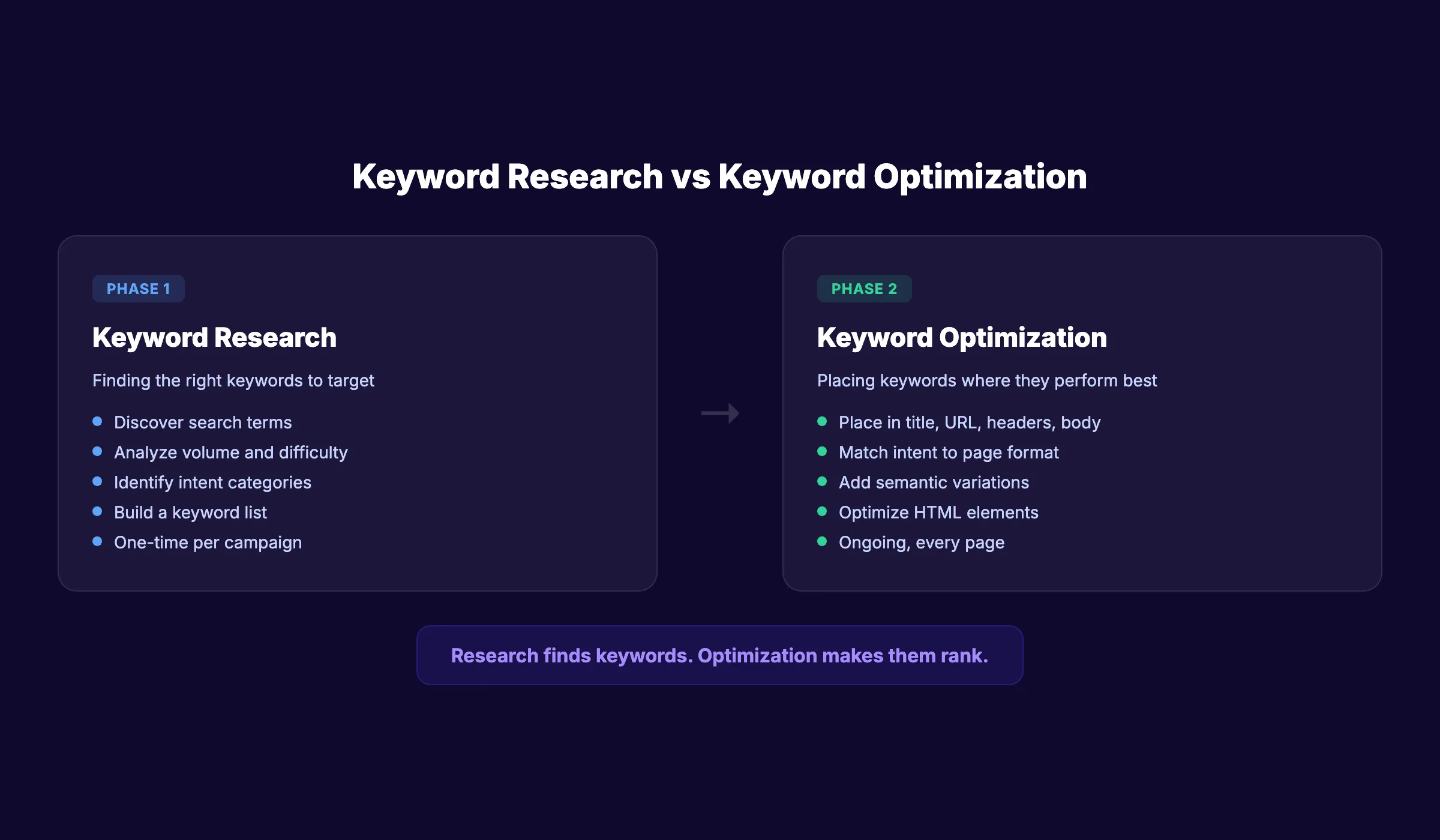
Keyword optimization is what happens AFTER keyword research. Research finds the right keywords. Optimization puts them in the right places.
Specifically, keyword optimization covers:
- Placement: Where keywords appear on a page (title, headers, URL, body, meta description, images)
- Intent alignment: Making sure the page format matches what the searcher expects
- Semantic coverage: Including related terms and entities that reinforce your topic
- Technical signals: Using keywords in HTML elements that search engines prioritize
- Ongoing refinement: Updating keyword usage based on performance data
Most SEO guides treat keyword research and keyword optimization as the same thing. They are not. Research is a one-time discovery process. Optimization is an ongoing discipline applied to every page you publish.
Keyword Optimization vs Keyword Research
| Aspect | Keyword Research | Keyword Optimization |
|---|---|---|
| When | Before writing | During and after writing |
| Goal | Find what people search for | Place keywords where they perform best |
| Output | A keyword list with volume and difficulty | An optimized page that ranks and converts |
| Frequency | Quarterly or per campaign | Every page, every update |
| Tools | Ahrefs, Semrush, Google Keyword Planner | On-page checkers, GSC, content editors |
The 1+5 Rule: How Many Keywords Per Page
One of the most common questions in SEO is "how many keywords should I target per page?" The answer is simpler than most guides suggest.
The 1+5 Rule:
- 1 primary keyword: The main term you want to rank for. It goes in the title, URL, H1, first 100 words, and meta description.
- Up to 5 secondary keywords: Related terms, synonyms, and long-tail variations that reinforce the primary topic. Spread these through H2s, body text, and image alt text.
This structure keeps each page focused on one clear topic while capturing related search traffic. Pages that target 10+ unrelated keywords confuse search engines and rank for none of them.
Example for this page:
| Type | Keyword |
|---|---|
| Primary | keyword optimization |
| Secondary | keyword placement SEO |
| Secondary | keyword density |
| Secondary | optimize keywords for SEO |
| Secondary | keyword mapping |
| Secondary | keyword strategy |
Every secondary keyword should be semantically related to the primary keyword. If a secondary keyword deserves its own H1, it deserves its own page.
Where to Place Keywords: Data-Backed Rules
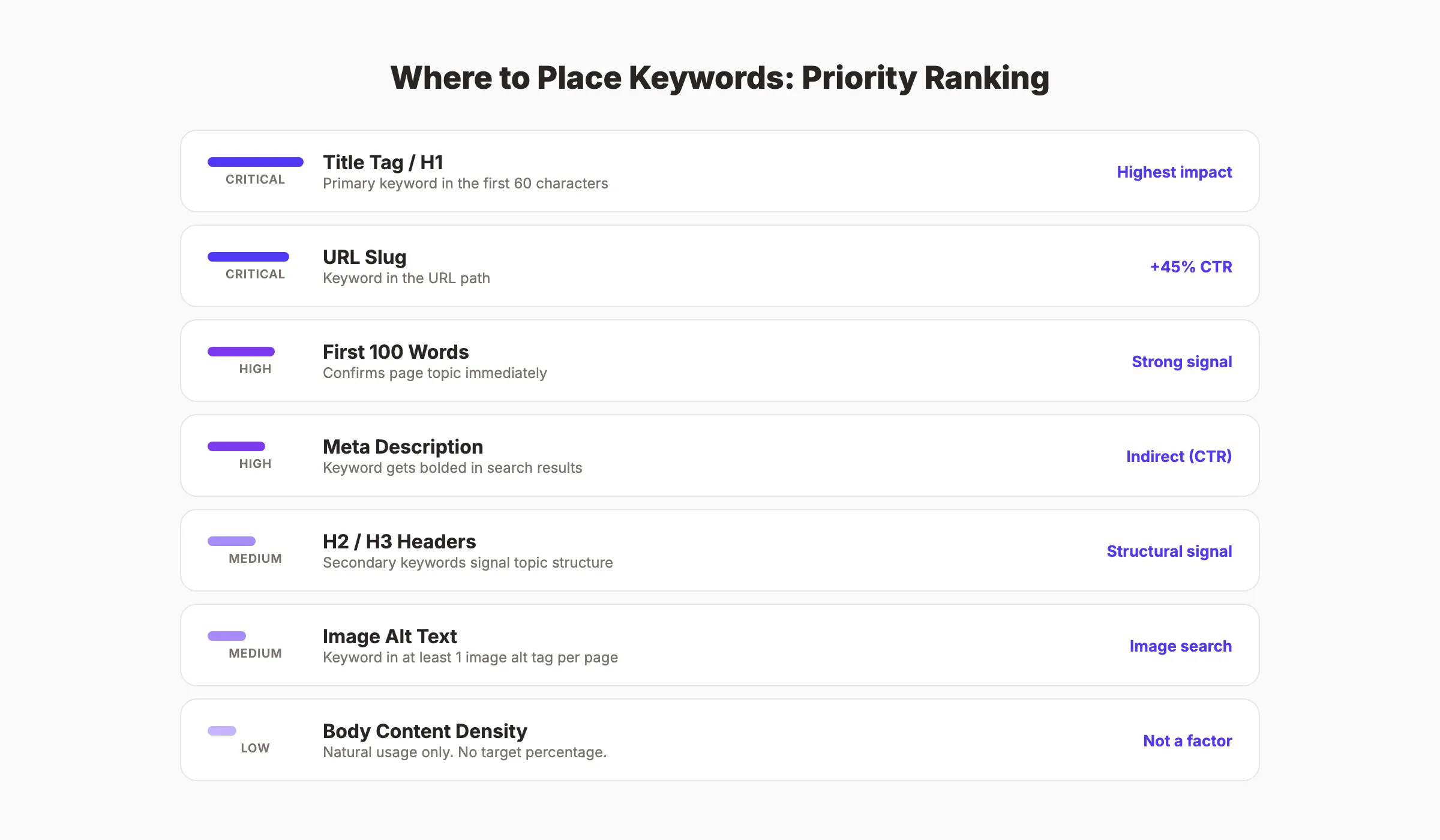
Most keyword optimization advice lacks evidence. Here are placement rules backed by actual studies.
Title Tag (H1 / Title)
Pages with the keyword in the title tag rank significantly better for that term. A Moz study confirmed that title tags starting with the target keyword perform better than those with the keyword placed later.
Rules:
- Primary keyword in the first 60 characters
- Keyword closer to the beginning performs better
- Keep the full title under 60 characters
For more on writing effective titles, see our guide on on-page SEO.
URL / Slug
Pages with the keyword in the URL see a 45% higher click-through rate compared to pages without it.
Rules:
- Include the primary keyword in the URL slug
- Use hyphens to separate words
- Keep it short (3-5 words ideal)
- Remove stop words (a, the, in, of)
Meta Description
Meta descriptions do not directly affect rankings. They directly affect CTR. A well-optimized meta description with the keyword bolded in search results attracts more clicks.
Rules:
- Include the primary keyword naturally
- Keep it between 145 and 155 characters
- Add a benefit and a freshness signal (year or "updated")
Read our full guide on writing meta descriptions for more detail.
First 100 Words
Google gives extra weight to content that appears early on the page. Place your primary keyword within the first 100 words of body text. This confirms the page topic immediately.
H2 and H3 Headers
Use secondary keywords in H2 headers. Use long-tail variations in H3s. Headers signal topic structure to both readers and search engines.
Rules:
- At least 1 H2 should contain the primary keyword or a close variation
- Secondary keywords belong in other H2s
- Do not force keywords into every header. Write naturally.
Image Alt Text
Alt text serves two purposes: accessibility for screen readers and keyword signals for Google Image Search. Include your primary keyword in at least 1 image alt tag per page.
Body Content
This is where keyword density debates happen. The evidence is clear: density does not matter. Google's John Mueller stated directly: "Keyword density is not a ranking factor. Never has been."
What matters is natural usage. If you write thoroughly about a topic, the keywords will appear at a natural frequency. Forcing a specific percentage creates awkward copy and risks triggering spam filters.
Stop writing. Start ranking. theStacc publishes 30 SEO articles per month for your business, starting at $99.
How to Optimize Keywords by Content Type
Generic keyword advice ignores a critical fact: different page types need different optimization strategies. A blog post and a product page serve different search intents and require different approaches.
Blog Posts
Blog posts target informational and early commercial keywords. Optimization focuses on depth, structure, and topical authority.
| Element | Optimization Rule |
|---|---|
| Title | Primary keyword + power word + hook |
| URL | /blog/[primary-keyword] |
| H2s | Secondary keywords and related questions |
| Body | Natural keyword usage throughout, 1-2% density max |
| Images | 1 per 500 words, keyword in at least 1 alt tag |
| Internal links | 3-5 per 1,000 words to related posts |
| FAQ | Target People Also Ask queries at the bottom |
For blog-specific optimization, read our SEO content writing guide.
Product Pages
Product pages target transactional keywords. Optimization focuses on clarity, features, and conversion.
Key differences from blog posts:
- Title should include the product name + primary keyword modifier ("buy," "price," "review")
- Description should lead with benefits before features
- Schema markup (Product schema) is critical for rich results
- Include real customer reviews for E-E-A-T signals
- Optimize for Google Shopping and image search
Landing Pages
Landing pages target commercial and transactional keywords. Every element on the page should drive toward a single action.
Key differences:
- H1 should state the value proposition with the keyword
- Subheadings should address objections
- CTAs should use action-oriented keyword variations
- Testimonials and proof points should surround conversion elements
- Less focus on word count, more on persuasion (see our SEO copywriting guide)
Local SEO Pages
Local pages target "[service] + [location]" keywords. Optimization follows specific local search rules.
Key differences:
- Include city, neighborhood, or region in the title, H1, and URL
- Embed a Google Map
- Add NAP (Name, Address, Phone) consistently
- Include local schema markup (LocalBusiness)
- Link to your Google Business Profile
For a deeper guide on local keyword strategy, read our local SEO guide.
Keyword Optimization for AI Search
This is the section no other keyword optimization guide covers. In 2026, Google AI Overviews appear in a growing number of searches. ChatGPT, Perplexity, and Gemini pull answers from web content. Keyword optimization for AI search works differently.
How AI Models Process Keywords
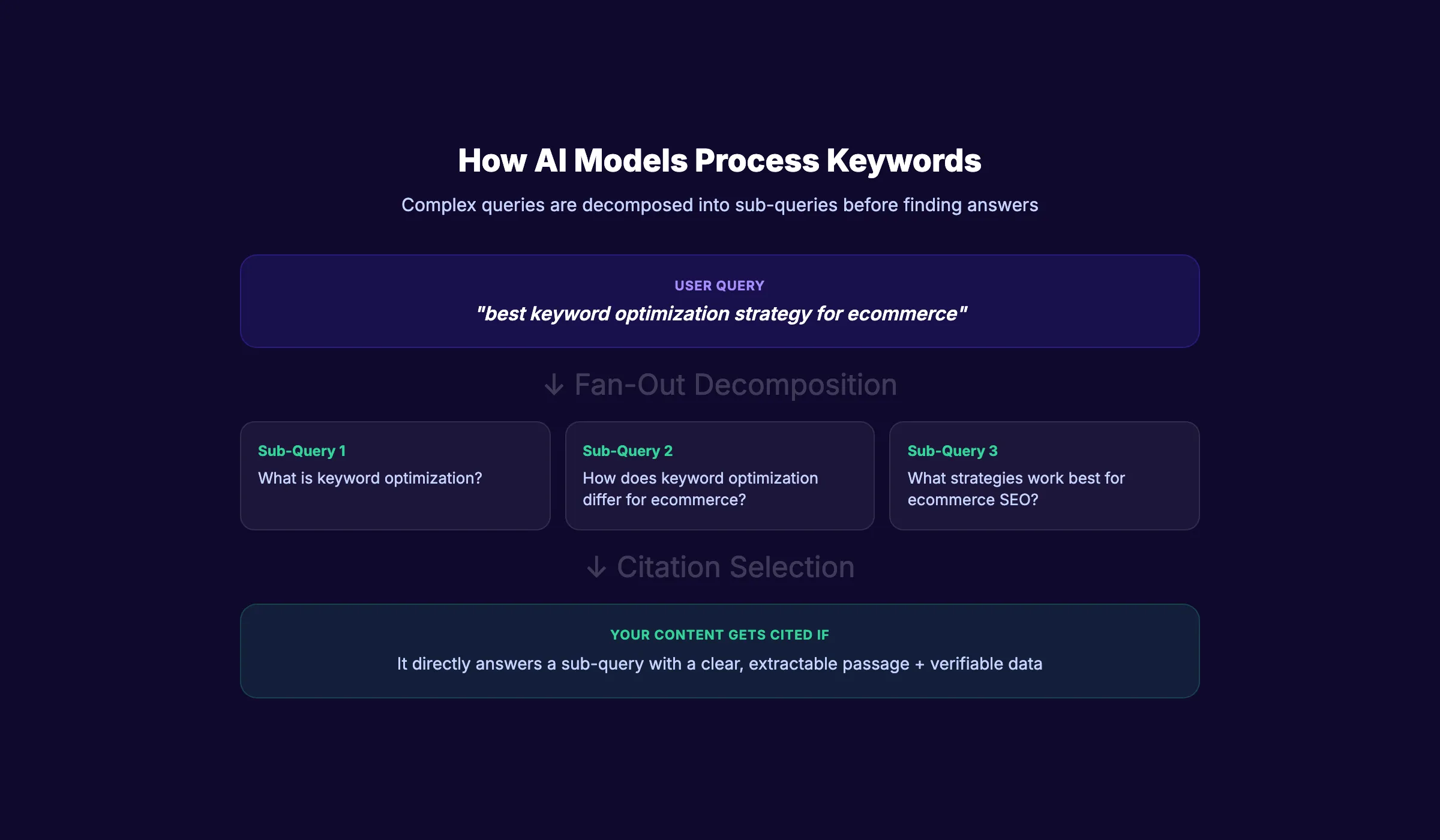
Traditional search matches keywords to pages. AI models decompose complex queries into sub-queries (called "fan-out queries") and synthesize answers from multiple sources.
A query like "best keyword optimization strategy for ecommerce" might break into:
- What is keyword optimization?
- How does keyword optimization differ for ecommerce?
- What strategies work best for ecommerce SEO?
If your page directly answers one of these sub-queries with a clear, well-structured passage, AI models are more likely to cite it.
How to Optimize for AI Citations
- Write definitive, extractable passages. AI models pull 2-3 sentence chunks. Make sure your key points stand alone as complete answers.
- Use clear header + answer structure. Every H2 should function as a question, with the answer immediately below it.
- Include statistics with sources. AI models prefer citing content that includes verifiable data.
- Build topical authority through content clusters. AI models favor authoritative sources that cover a topic across multiple pages.
- Optimize your
llms.txtfile. This emerging standard tells AI crawlers how to understand your site structure.
For a deeper guide on this, read our generative engine optimization guide.
3,500+ blogs published. Every article is SEO-scored before publish. See what theStacc can do for your site.
How to Fix Keyword Cannibalization
Keyword cannibalization happens when two or more pages on your site compete for the same keyword. Google does not know which page to rank. Often, it ranks neither well.
How to Detect Cannibalization
- Search
site:yourdomain.com "target keyword"in Google - Check Google Search Console for multiple pages ranking for the same query
- Look for pages with overlapping H1s or title tags
- Use our On-Page SEO Checker to audit individual pages
How to Fix It
| Situation | Fix |
|---|---|
| Two similar pages, one is better | Redirect the weaker page (301) to the stronger one |
| Two pages cover different angles of the same topic | Differentiate their primary keywords and add cross-links |
| A blog post and a landing page compete | Assign the informational keyword to the blog, the commercial keyword to the landing page |
| Multiple thin pages on the same topic | Consolidate into one deep guide |
Prevention: Build a Keyword Map
The best way to prevent cannibalization is to build a keyword map before you start publishing. A keyword map assigns one primary keyword to each URL on your site. Before writing any new page, check the map. If the keyword is already assigned, either write about a different angle or update the existing page.
A simple keyword map looks like this:
| URL | Primary Keyword | Secondary Keywords | Search Intent |
|---|---|---|---|
| /blog/keyword-research-for-blog-posts | keyword research | find keywords, keyword ideas | Informational |
| /blog/keyword-optimization-guide | keyword optimization | keyword placement, optimize keywords | Informational |
| /blog/fix-keyword-cannibalization | keyword cannibalization | duplicate keywords, competing pages | Informational |
For a step-by-step walkthrough, read our guide on how to fix keyword cannibalization.
7 Keyword Optimization Mistakes to Avoid
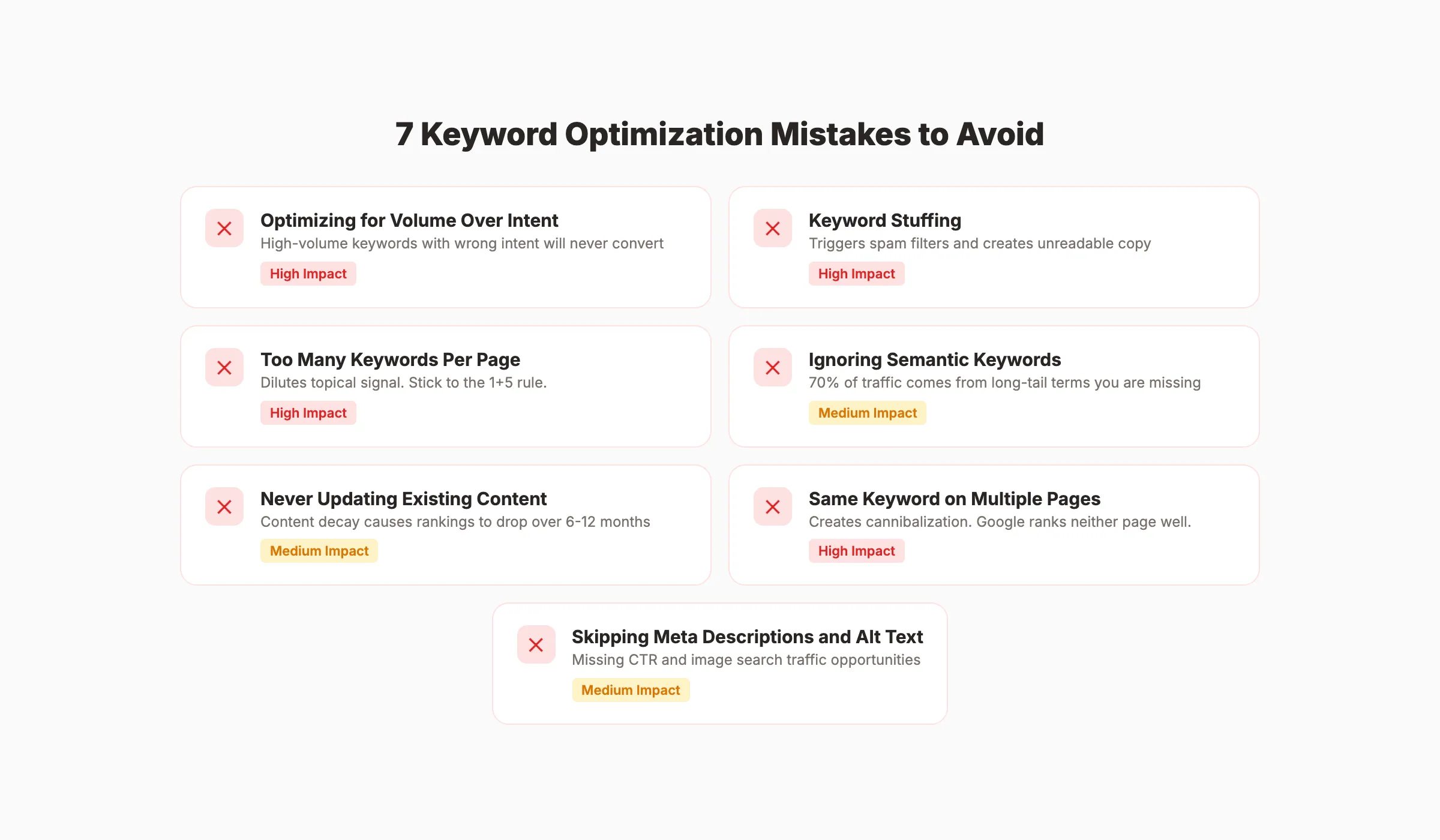
These are the most common mistakes we see across the 3,500+ blog posts we have published and audited.
1. Optimizing for Volume Instead of Intent
A keyword with 50,000 monthly searches means nothing if the intent does not match your page. A blog post will never rank for "buy running shoes." A product page will never rank for "how to start running." Match the format to the search intent.
2. Keyword Stuffing
Keyword stuffing is repeating your target keyword excessively to try to manipulate rankings. Google has penalized this since 2011 (Panda update). Modern NLP models detect unnatural keyword usage instantly. Write for readers. The keywords will follow.
3. Targeting Too Many Keywords Per Page
Trying to rank one page for 15 different keywords dilutes the topical signal. Stick to the 1+5 rule. If a keyword needs its own H1, build a separate page.
4. Ignoring Semantic Keywords
Optimizing for one exact-match keyword without including related terms leaves ranking potential on the table. 70% of all search traffic comes from long-tail keywords, according to ResultFirst. Include synonyms, related questions, and entity variations.
5. Forgetting to Optimize Existing Content
Most businesses focus keyword optimization on new content only. Existing pages that ranked 6 months ago may be losing positions due to content decay. Audit and re-optimize your top pages every 6 months.
6. Using the Same Keyword Across Multiple Pages
This creates cannibalization. Map one primary keyword to one page. Build a keyword map that assigns unique targets to every URL on your site.
7. Skipping Meta Descriptions and Image Alt Text
These "secondary" elements affect CTR and image search traffic. Pages with keywords in URLs see 45% higher CTR. Skipping meta descriptions means Google writes one for you. It is rarely what you would choose.
Keyword Optimization Checklist
Use this checklist for every page you publish or update. Run through it before hitting publish.
Pre-Publishing Checklist
- ✓ Primary keyword identified (1 per page)
- ✓ 3-5 secondary keywords mapped
- ✓ Search intent verified (informational, commercial, transactional)
- ✓ No other page on the site targets the same primary keyword
On-Page Placement
- ✓ Primary keyword in title tag (first 60 characters)
- ✓ Primary keyword in URL slug
- ✓ Primary keyword in H1
- ✓ Primary keyword in first 100 words
- ✓ Primary keyword in meta description
- ✓ Primary keyword in at least 1 image alt tag
- ✓ Secondary keywords in H2 headers
- ✓ Related terms used naturally in body content
Content Quality
- ✓ Content matches the search intent of the primary keyword
- ✓ Word count meets or exceeds top-ranking competitors
- ✓ Page has clear blog post structure with H2/H3 hierarchy
- ✓ At least 1 table, list, or visual per major section
- ✓ FAQ section targets People Also Ask queries
Technical SEO
- ✓ Internal links to 3-5 related pages
- ✓ External links to 2-3 authoritative sources
- ✓ Images optimized with descriptive alt text
- ✓ Page loads in under 3 seconds
- ✓ Mobile-responsive layout
Post-Publishing
- ✓ Page indexed in Google Search Console
- ✓ Organic CTR monitored after 2 weeks
- ✓ Rankings tracked for primary and secondary keywords
- ✓ Content updated every 6 months with fresh data
Your SEO team. $99 per month. 30 optimized articles, published automatically.
What practitioners are saying on X
AI search advice ages quickly. Here is high-signal public discussion from SEO and growth operators — context for your roadmap, not a substitute for primary data.
- @hridoyreh (Mar 2026): Widely shared SEO skill tree: foundations, research, technical, on-page, content, links, AI SEO/GEO, analytics, UX, brand, programmatic — useful map for stats and how-to posts. See the post on X.
- @jakezward (Feb 2026): 2026 SEO predictions emphasize AI Overview share-of-SERP, schema for LLM token efficiency, brand mentions in AI answers as a KPI, proprietary data as a moat, and content refresh beating net-new AI slop. See the post on X.
Grok, AI Overviews, and multi-engine visibility
Research topics like “keyword optimization guide” get cited when frameworks and decision rules are extractable. Lead with definitions and tables; keep Grok-ready entity language for tools and SERP features named on the page.
- Google AI Overviews: Use passage-ready answers, tables, and FAQ schema where relevant.
- ChatGPT / Perplexity: Cite named sources next to key claims.
- Grok: Maintain accurate entity facts on-site and in high-signal X posts.
Publish content built for Google and AI citations. theStacc’s Content SEO module ships SEO-scored articles structured for rankings and generative engines — including clearer entity pages models like Grok can quote.
FAQ
No. Google's John Mueller confirmed that keyword density has never been a ranking factor. An analysis of 1,536 search results found no consistent correlation between density and ranking position. Write naturally about your topic. If you cover it thoroughly, the keyword frequency will be appropriate on its own.
Follow the 1+5 rule: 1 primary keyword and up to 5 secondary keywords per page. The primary keyword goes in your title, URL, H1, first 100 words, and meta description. Secondary keywords go in H2s and body content. If a keyword needs its own H1, it deserves its own page.
Keyword research is finding the right keywords to target. Keyword optimization is placing those keywords effectively on your pages. Research happens before writing. Optimization happens during and after writing. Both are essential, but they require different skills and tools.
Write clear, extractable passages that answer specific questions. Use a header + answer structure so AI models can pull clean responses. Include statistics with sources. Build topical authority through content clusters. These signals help AI models like ChatGPT, Perplexity, and Google AI Overviews cite your content.
Audit your top-performing pages every 6 months. Check Google Search Console for declining impressions or CTR. Update statistics, refresh examples, and add new sections based on current search trends. Pages that ranked well 12 months ago may need re-optimization due to competitor activity or algorithm changes.
You should not. Targeting the same primary keyword on multiple pages creates keyword cannibalization. Google does not know which page to rank, so it often ranks neither well. Map one primary keyword to one page. If two pages overlap, consolidate or differentiate their keyword targets.
Keyword optimization is not about hitting a density number or stuffing terms into every HTML element. It is about placing the right keywords in the right places, matching search intent, and building topical depth around every page you publish.
Apply the 1+5 rule. Follow the placement checklist. Audit your existing content every 6 months. That cycle, repeated consistently across every page, is how keyword optimization compounds into rankings.
Related Tools & Resources
Free SEO Tools:
Best Lists:
Sources & references
- [1] Princeton / Georgia Tech et al. — GEO research (arXiv:2311.09735)
- [2] @hridoyreh on X — Widely shared SEO skill tree: foundations, research, technical, on-page, content, links, AI SEO/GEO, analytics, UX, bran
- [3] @jakezward on X — 2026 SEO predictions emphasize AI Overview share-of-SERP, schema for LLM token efficiency, brand mentions in AI answers
- [4] Referenced source — www.rankability.com

Plan topics, review article drafts, and publish to a connected CMS.
Weekly local SEO teardowns
One practical email a week. Map Pack, GBP, AI Overviews — no fluff. Unsubscribe anytime.