
SEO for Landscapers: Get More Leads from Google (2026)
SEO for landscapers explained step by step. Covers local keywords, Google Business Profile, service pages, seasonal content, and tracking. Updated 2026.
Siddharth Gangal • 2026-03-28 • Local SEO
In This Article
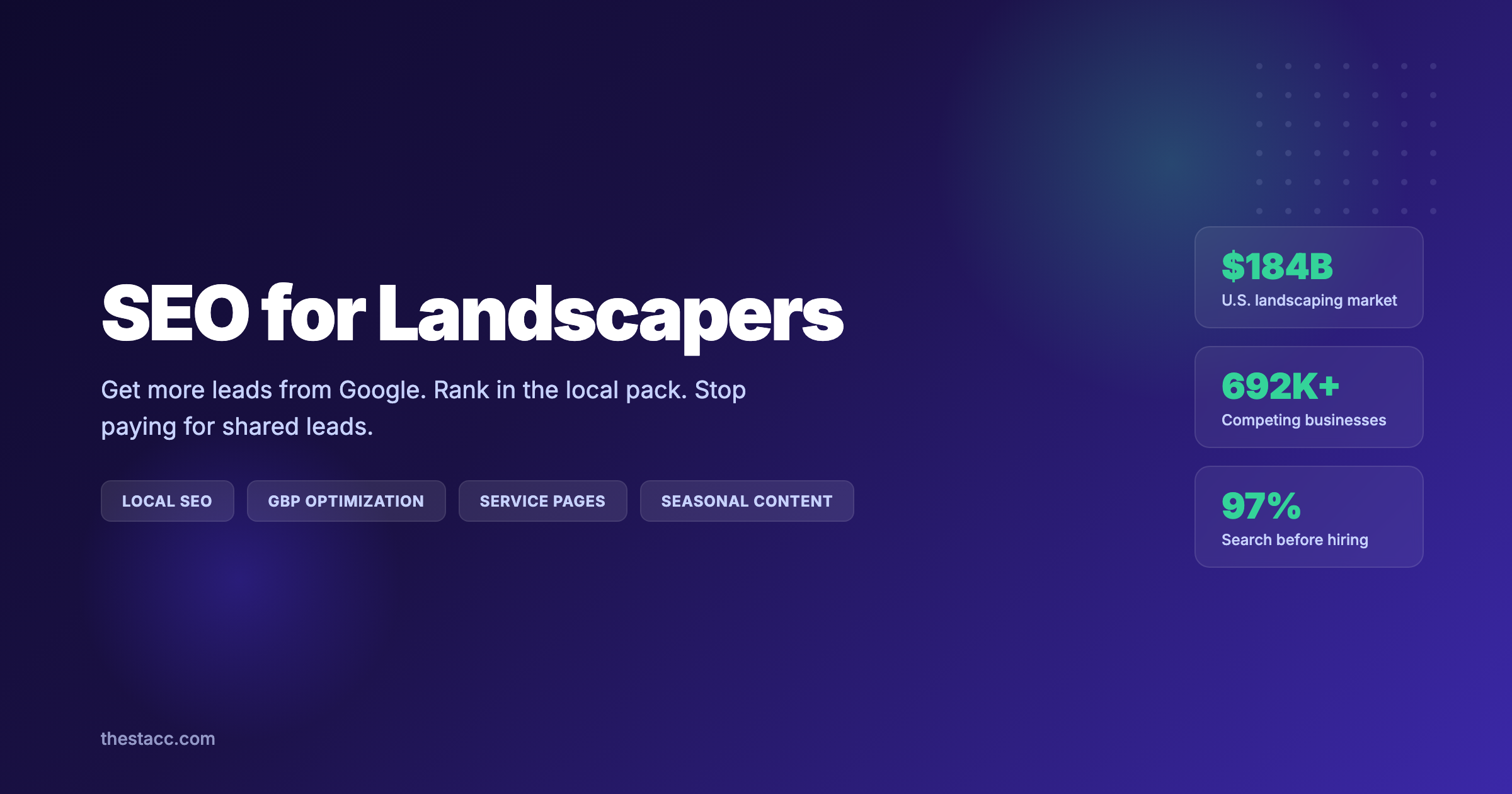
The U.S. landscaping industry is worth $184 billion. Over 692,000 businesses compete for the same homeowners in the same cities. Most of those businesses rely on referrals and HomeAdvisor leads. Few invest in SEO. The ones that do rank first on Google Maps and get calls without paying per click.
SEO for landscapers is not optional in 2026. 97% of consumers search online before hiring a local service provider. 76% visit a business within 1 day of a local search. And 54% of homeowners choose a service provider within 4 hours of starting their search, according to BrightLocal research.
The problem: most landscaping companies either ignore SEO entirely or pay $1,500 to $3,000 per month to agencies that deliver vague reports and no measurable results. LawnSite forum threads are filled with frustrated owners asking the same question: “I am paying for SEO but have no idea what they are actually doing.”
This guide fixes that. We publish 3,500+ articles across 70+ industries, including home services and landscaping. Every tactic here is specific to landscaping businesses, not generic advice with the word “landscaper” swapped in.
Here is what you will learn:
- The exact keywords landscaping companies should target (by service type and season)
- How to optimize your Google Business Profile for the local pack
- The service page structure that ranks for “[service] near me” searches
- A month-by-month seasonal content calendar
- How to track which SEO efforts generate actual phone calls
- The GBP photo and review strategy that most guides skip
Why SEO Matters More Than Paid Leads for Landscapers
HomeAdvisor and Angi charge $15 to $85 per lead. Those leads are shared with 3 to 5 other landscapers. Close rates on shared leads average 10% to 15%.
SEO leads are different. When a homeowner searches “landscaping company near me” and finds your website organically, that lead is exclusive. You did not pay for that click. Nobody else shares that contact. And organic leads convert at 14.6% compared to 1.7% for outbound leads, according to HubSpot.
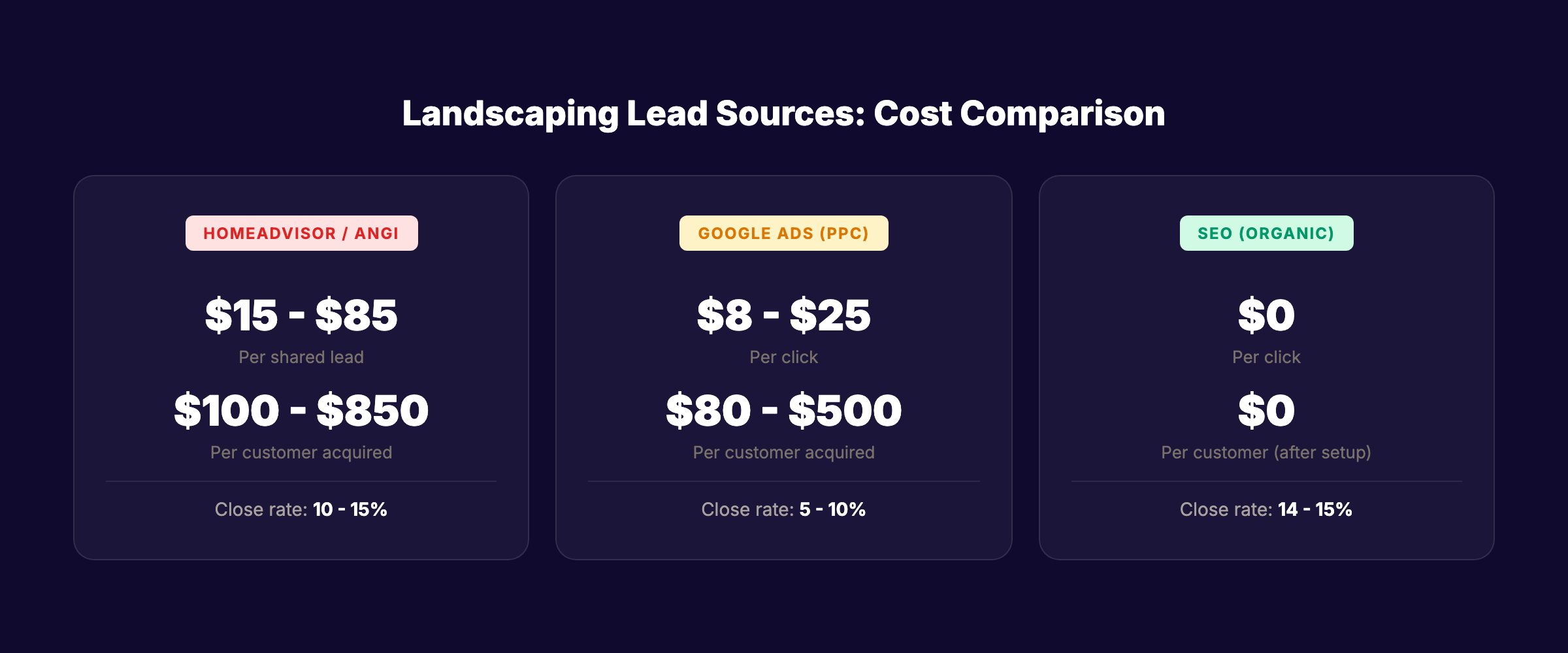
The math matters for a landscaping business:
| Lead Source | Cost per Lead | Close Rate | Cost per Customer |
|---|---|---|---|
| HomeAdvisor / Angi | $15 - $85 | 10 - 15% | $100 - $850 |
| Google Ads (PPC) | $8 - $25 per click | 5 - 10% | $80 - $500 |
| SEO (organic) | $0 per click | 14 - 15% | $0 (after setup costs) |
A landscaping business spending $2,000 per month on HomeAdvisor gets roughly 25 to 130 leads. At 12% close rate, that is 3 to 16 customers. With SEO, the same $2,000 invested in content and optimization builds a permanent asset that generates leads month after month with zero recurring per-click cost.
The first Google result receives approximately 28% of all clicks. Position 2 gets 15%. Position 10 gets 2.5%. If you are not on page 1 for your target keywords, you are invisible to the homeowners actively searching for your services.
Stop paying for shared leads. Stacc publishes 30 SEO articles per month for $99. Build a lead pipeline that grows every month without per-click costs. Start for $1 →
Keyword Research for Landscaping Companies
The right keywords connect your website to homeowners who are ready to hire. Landscaping keywords fall into 4 categories.
High-Intent Service Keywords
These are the money keywords. A homeowner searching “patio installation near me” is ready to buy. Target these on your service pages.
| Service Category | Target Keywords |
|---|---|
| Hardscaping | patio installation [city], retaining wall contractor [city], outdoor kitchen builder near me, driveway pavers [city] |
| Lawn care | lawn mowing service near me, lawn fertilization [city], aeration service [city], weed control [city] |
| Softscaping | garden design [city], plant installation near me, flower bed maintenance [city] |
| Tree services | tree trimming service [city], tree removal near me, stump grinding [city] |
| Irrigation | sprinkler system installation [city], irrigation repair near me, drip irrigation [city] |
| Seasonal | spring cleanup service [city], fall leaf removal [city], snow removal [city] |
Every keyword above should have a matching service page on your website. Not a paragraph buried on your homepage. A dedicated page.
Informational Keywords
These keywords attract homeowners in the research phase. They may not hire today, but they build your topical authority and bring traffic that converts over time.
Examples:
- “how much does landscaping cost”
- “best plants for low maintenance landscaping”
- “front yard landscaping ideas”
- “when to aerate lawn”
- “how to choose a landscaping company”
Target these with blog posts. Each post positions your business as the local expert.
Location Keywords
Landscaping is local. Every core keyword needs a city or neighborhood modifier. The pattern:
[service] + [city] → “lawn care Austin TX”
[city] + [service] → “Denver landscape design”
[service] + near me → “landscaping company near me”
If you serve multiple cities, create a dedicated page for each. We cover the right way to do this in the service area section below.
Seasonal Keywords
Landscaping search volume shifts dramatically by season. Keyword research for landscapers must account for these cycles.
| Season | Keyword Spikes |
|---|---|
| Spring (Mar - May) | spring cleanup, mulching, lawn aeration, garden bed installation |
| Summer (Jun - Aug) | irrigation repair, lawn mowing service, landscape lighting |
| Fall (Sep - Nov) | fall cleanup, leaf removal, overseeding, winterization |
| Winter (Dec - Feb) | snow removal, snow plowing, winter lawn care, holiday lighting |
Publish seasonal content 6 to 8 weeks before peak search volume. A blog post about “spring lawn care tips” published in January ranks by March when homeowners start searching.
Google Business Profile Optimization for Landscapers
Your Google Business Profile is the single most important ranking factor for the local map pack. 4 out of 5 homeowners check the map section before calling a landscaper.
Complete Every Field
An incomplete GBP profile loses to a complete one. Fill out these fields precisely:
- Business name (exact legal name, no keyword stuffing)
- Primary category: “Landscaper” or “Landscaping Company”
- Secondary categories: Lawn Care Service, Garden Designer, Tree Service, etc.
- Service area: list every city and ZIP code you serve
- Business hours (including seasonal adjustments)
- Phone number (use a trackable local number)
- Website URL
- Business description (750 characters, include top 3 services and city names)
- All service types listed with descriptions
The Photo Strategy Most Guides Skip
GBP listings with 100+ photos receive 520% more calls than the average listing, according to BrightLocal. Most landscapers upload 5 photos and stop.
Upload at minimum:
- 10 before/after project photos (label each with the service type)
- 3 team photos (builds trust)
- 5 photos of specific services in progress (hardscaping, lawn care, tree trimming)
- 2 photos of equipment and vehicles (branded wraps help)
- New photos every 2 weeks during peak season
Geo-tag photos before uploading. The metadata tells Google where the work was performed, reinforcing your service area relevance.
Reviews: Velocity Matters More Than Volume
Google does not just count reviews. It measures how fast new reviews arrive. A landscaping company with 50 reviews and 5 new ones per month outranks a competitor with 200 reviews and zero new ones per month.
A practical review system:
- Send a text message with your Google review link after every completed job
- Follow up 48 hours later if no review is submitted
- Respond to every review within 24 hours (positive and negative)
- Target 10 to 15 new reviews per month during peak season
Your SEO team. $99 per month. 30 optimized articles, published automatically. Plus Local SEO for $49/mo to manage your GBP posts. Start for $1 →
Service Pages That Rank for “Near Me” Searches
Your homepage cannot rank for every service. Each major service needs its own page with its own URL, its own title tag, and its own content.
The Service Page Template
Every landscaping service page should follow this structure:
URL pattern: /services/[service-name]-[city]
Example: /services/patio-installation-austin
Required elements:
-
H1: [Service Name] in [City] — [Benefit] Example: “Patio Installation in Austin — Custom Designs, Licensed Installers”
-
Opening paragraph: Name the service, the location, and the primary benefit in the first 100 words. Include the target keyword naturally.
-
Service description: 300 to 500 words explaining what you do, your process, and what the homeowner should expect. Be specific. “We install pavers, flagstone, and stamped concrete patios” beats “we do patio work.”
-
Photo gallery: 4 to 8 photos of completed projects for this specific service.
-
Pricing guidance: Even a range (“Patio installation in Austin typically costs $15 to $35 per square foot”) helps. Homeowners search for pricing. Pages that answer pricing questions rank better.
-
Schema markup: Add
LocalBusinessandServiceschema. This helps Google understand your business type, service area, and offerings. -
CTA: Clear call-to-action with phone number and contact form.
Service Area Pages for Multi-City Businesses
If you serve 10 cities, you need 10 location pages. But do not copy the same content and swap city names. Google detects thin content and demotes it.
Each city page should include:
- Unique opening paragraph referencing local landmarks, neighborhoods, or conditions
- City-specific service details (soil types, climate, common landscaping needs)
- Project photos from that specific city
- Local reviews or testimonials from customers in that area
- Embedded Google Map showing your service area
A Dallas patio page should mention “North Texas clay soil” and “Dallas summer heat affecting concrete cure times.” A Denver page should reference “Front Range altitude” and “freeze-thaw cycles.” Specificity proves local expertise.
Content Strategy: What to Blog About as a Landscaper
Blog content builds topical authority and captures informational searches. A landscaping company that publishes 20 to 30 articles per month dominates search results within 6 to 12 months.
The Seasonal Content Calendar
Timing determines whether your content ranks when homeowners search for it. Publish content 6 to 8 weeks ahead of seasonal demand.
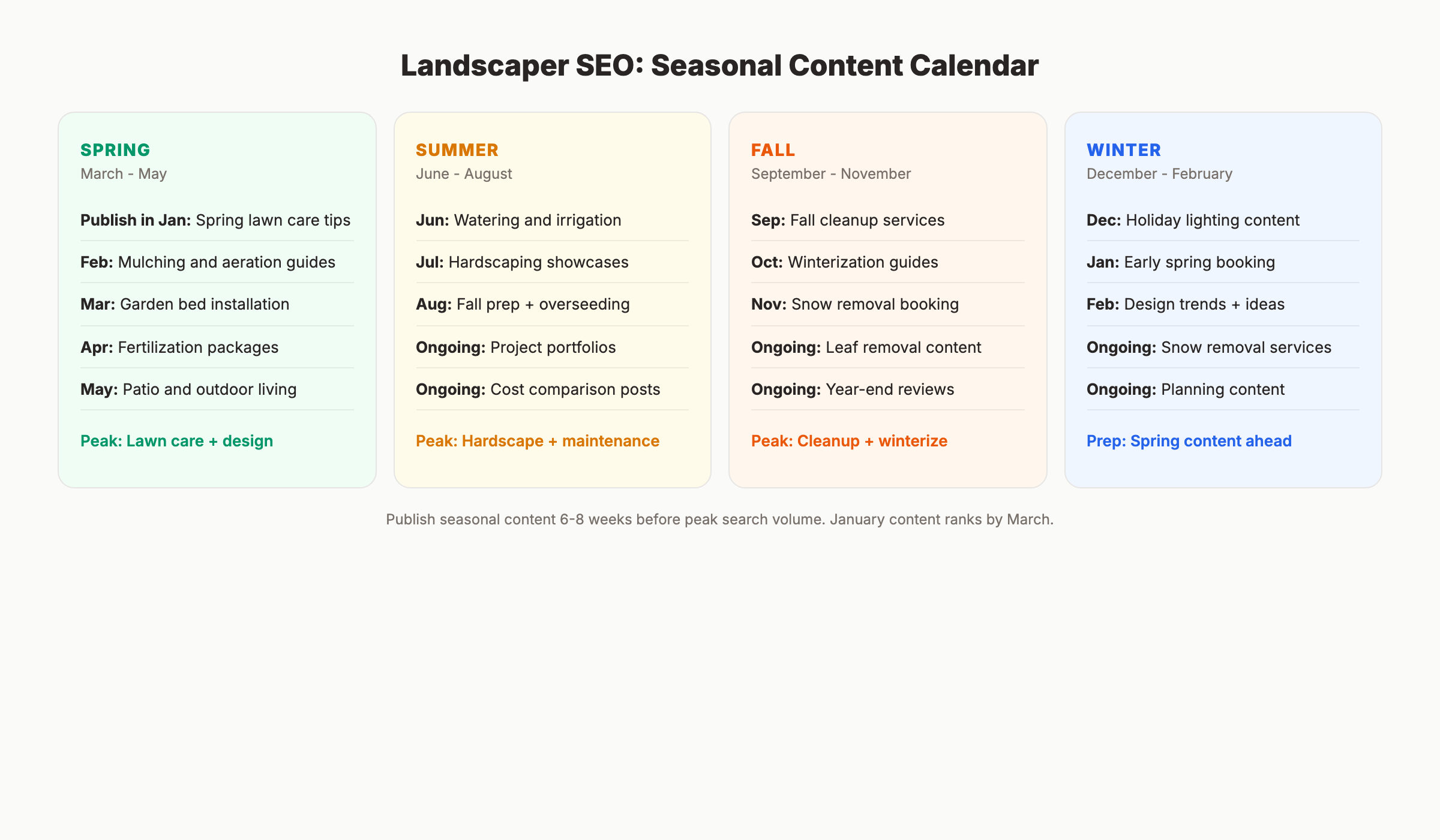
| Month | Content Topics | Target Keywords |
|---|---|---|
| January | Spring lawn prep, aeration guides, early booking promos | spring lawn care tips, when to aerate lawn |
| February | Landscape design trends, front yard ideas | landscaping ideas 2026, front yard design |
| March | Mulch guides, garden bed prep, irrigation startup | mulching services [city], garden bed installation |
| April | Lawn care packages, fertilization guides | lawn care services [city], lawn fertilization |
| May | Outdoor living content (patios, fire pits, lighting) | patio installation near me, landscape lighting |
| June | Summer maintenance tips, watering guides | lawn watering schedule, irrigation repair |
| July | Hardscaping project showcases, design portfolios | hardscape contractor [city], outdoor kitchen |
| August | Fall prep content, overseeding guides | when to overseed lawn, fall lawn care |
| September | Fall cleanup services, leaf removal | fall cleanup service [city], leaf removal |
| October | Winterization guides, final mowing tips | winterize sprinkler system, lawn winterization |
| November | Snow removal booking, holiday lighting | snow removal service [city], holiday lights |
| December | Year-end reviews, early spring booking | landscaping company [city], lawn care plans |
Blog Topics That Generate Leads
Not all blog posts drive revenue. Focus on these high-conversion topic types:
Cost and pricing posts: “How Much Does Patio Installation Cost in [City]?” These capture homeowners in the buying decision phase. Include your actual pricing ranges.
Comparison posts: “Pavers vs Stamped Concrete: Which Is Better for Your Patio?” These attract buyers choosing between options.
FAQ posts: “10 Questions to Ask Before Hiring a Landscaper” These build trust and rank for voice search queries.
Before-and-after showcases: Document real projects with photos, cost, timeline, and the specific challenges solved. This is content no competitor can replicate because it requires your actual work.
Technical SEO for Landscaping Websites
Technical issues silently kill rankings. 96% of websites fail at least one Core Web Vitals test. Landscaping websites are especially vulnerable because of heavy photo use.
Mobile Optimization
Over 80% of local searches happen on mobile. If your website loads slowly or displays poorly on a phone, you lose those visitors.
Checklist:
- Site loads in under 3 seconds on mobile
- All text is readable without zooming
- Phone number is click-to-call on every page
- Contact form works on mobile
- Photos are compressed (under 200KB each)
- No horizontal scrolling on any page
Image Optimization
Landscaping websites are image-heavy. Uncompressed photos are the number 1 cause of slow loading times.
Compress every image to under 200KB. Use WebP format. Add descriptive alt text that includes the service and location: “completed patio installation with pavers in Austin TX” not “IMG_4532.jpg.”
Local Schema Markup
Add LocalBusiness schema to your homepage and Service schema to each service page. Use the Schema Markup Generator to create the JSON-LD code.
Required fields:
- Business name, address, phone
- Service area (list of cities)
- Operating hours
- Price range
- Aggregate rating (if you have reviews)
Internal Linking
Link your blog posts to your service pages. Link service pages to related blog content. Link city pages to each other. A strong internal linking structure helps Google understand which pages matter most.
Every blog post about lawn care should link to your lawn care service page. Every service page should link to 2 to 3 related blog posts. This creates clusters that build authority around each service category.
3,500+ blogs published. 92% average SEO score. See what Stacc can do for your landscaping business. Blog SEO + Local SEO starting at $133/mo bundled. Start for $1 →
Link Building for Landscaping Companies
Backlinks from other websites tell Google your site is trustworthy. Landscaping companies have specific opportunities that most industries do not.
Local Directory Listings
Submit your business to these directories. Ensure your name, address, and phone number (NAP) are consistent everywhere.
- Google Business Profile
- Yelp
- Angi (formerly HomeAdvisor)
- Houzz
- Better Business Bureau
- Local Chamber of Commerce
- Thumbtack
- Porch.com
- HomeGuide
- Your city or county business directory
Industry-Specific Link Opportunities
- Supplier websites (material providers often list certified installers)
- Local real estate agent blogs (offer landscaping tips for home sellers)
- HOA newsletters and websites (offer seasonal maintenance articles)
- Local news sites (submit seasonal gardening tips as expert commentary)
- Landscaping industry association websites (NALP, state associations)
The Before-and-After Strategy
Document projects with professional photos. Publish them as case studies. Reach out to home improvement blogs and local publications with the content. Real project photos earn links because they provide value other websites cannot create themselves.
Tracking SEO Results for Your Landscaping Business
The number 1 complaint from landscaping business owners about SEO: “I have no idea if it is working.” Fix this with proper tracking from day 1.
Essential Tracking Setup
- Google Search Console — shows which queries bring traffic and your ranking positions
- Google Analytics 4 — tracks website visitors, pages viewed, and form submissions
- Call tracking — assigns a unique phone number to your website to track SEO-generated calls separately from other sources
- GBP Insights — tracks profile views, direction requests, and phone calls from your Google listing
What to Measure Monthly
| Metric | What It Tells You | Target |
|---|---|---|
| Organic traffic | How many people find you via Google | 20% increase per quarter |
| Keyword rankings | Where you rank for target keywords | Top 3 for local terms within 6 months |
| Phone calls from website | How many calls SEO generates | Track total and trend month over month |
| GBP views | How often your profile appears in maps | Steady growth quarter over quarter |
| Review count and rating | Trust signals for rankings and conversions | 10+ new reviews per month during peak season |
| Form submissions | Leads from website contact forms | Track as percentage of total traffic |
The Ranking-Without-Converting Problem
Some landscaping businesses rank well but still do not get calls. This is a conversion problem, not an SEO problem. Common causes:
- No phone number visible above the fold
- Contact form too long (name + phone + zip is enough)
- No project photos showing real work
- No reviews or testimonials on the website itself
- Pricing information completely absent (homeowners leave to find pricing elsewhere)
If you rank in the top 3 but your click-through rate is low, your meta description needs work. If you get clicks but no calls, your landing page needs improvement.
Rank everywhere. Do nothing. Blog SEO, Local SEO, and Social on autopilot. Landscaping businesses use Stacc starting at $99/mo. Start for $1 →
FAQ
How long does SEO take for a landscaping company?
Expect initial ranking improvements in 60 to 90 days. Meaningful lead generation from organic search typically begins at 4 to 6 months. Competitive local markets may take longer. Consistency matters more than speed. Publishing 20 to 30 articles per month accelerates the timeline significantly.
How much does SEO cost for landscapers?
SEO agencies charge $500 to $3,000 per month for landscaping clients. Done-for-you services like Stacc start at $99 per month for 30 published articles. The total investment depends on whether you handle SEO yourself (free tools + your time), hire an agency, or use an automated service.
Do landscapers need a blog?
Yes. Blog content targets informational keywords that service pages cannot rank for. A blog post about “how much does patio installation cost” captures buyers during research. Without a blog, you only rank for direct service keywords and miss the larger research audience.
What keywords should a landscaping company target first?
Start with your highest-revenue service + your primary city. If you make the most money from patio installation and you are in Austin, target “patio installation Austin” first. Then expand to related services and neighboring cities. Always target long-tail keywords with location modifiers.
Is SEO better than Google Ads for landscapers?
Both work. Google Ads delivers immediate traffic but stops the moment you stop paying. SEO takes longer to produce results but generates free traffic indefinitely. Most landscapers benefit from running Google Ads in the first 3 to 6 months while SEO builds. Then reduce ad spend as organic rankings grow.
How do I rank my landscaping business on Google Maps?
Optimize your Google Business Profile, collect 10+ new reviews per month, post weekly updates, add geo-tagged photos, and ensure your NAP is consistent across all directories. These signals directly influence map pack rankings.
SEO for landscapers produces the highest ROI of any marketing channel when executed consistently. Every article published, every review collected, and every service page optimized compounds over time. Start with your highest-value service, your primary city, and your Google Business Profile. Build from there.
Written and published by Stacc. We publish 3,500+ articles per month across 70+ industries. All data verified against public sources as of March 2026.
