
Link Building Outreach: 7 Email Templates That Work
Get 7 proven link building outreach email templates with real response rates. Covers guest post, broken link, and resource page outreach. Updated March 2026.
Link building outreach emails have an average response rate of 8.5%. That means over 90% of outreach emails get ignored. Most people blame the recipients. The real problem is the email.
Generic outreach fails because it asks for something without offering anything. “I noticed your article and thought you might want to link to my content” is not a pitch. It is a request wrapped in a compliment. Site owners receive dozens of these daily. They delete them all.
The fix is not sending more emails. It is sending better ones. Link building outreach that works starts with a real value proposition, targets the right person, and follows a proven structure. This guide includes 7 copy-ready email templates with the exact approach that produces 15 to 20% response rates instead of 3%.
We have published 3,500+ blogs across 70+ industries and built backlink profiles for every one of them. These templates come from real campaigns, not theory.
Here is what you will learn:
- Why most outreach emails fail and what to fix first
- 7 email templates for different link building strategies
- How to personalize at scale without sounding robotic
- The follow-up sequence that boosts replies by 65%
- Which days and subject lines get the highest open rates
- How to find the right contact for every outreach target
- Common mistakes that kill response rates
Why Most Link Building Outreach Fails
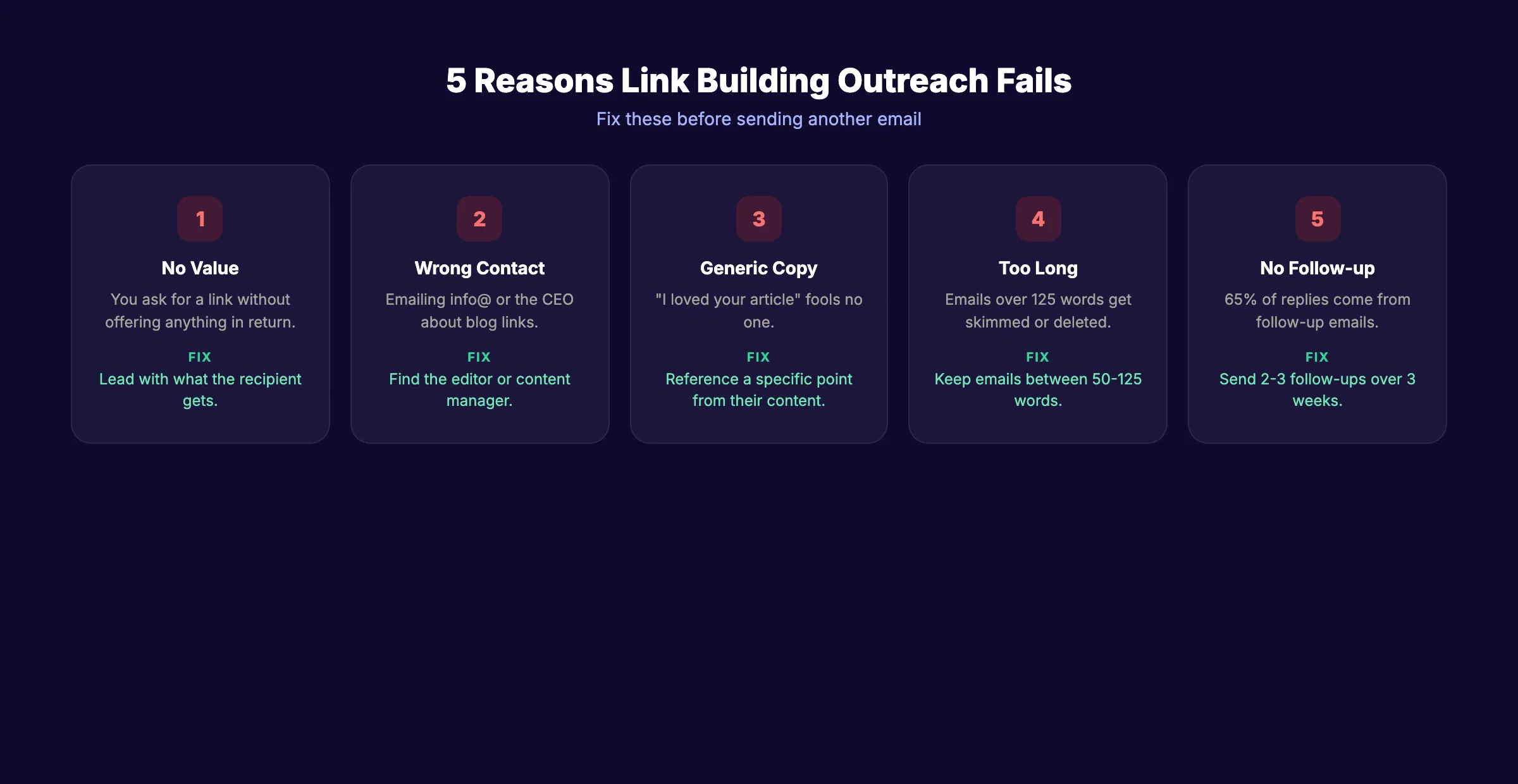
The average link building outreach campaign converts at 1 to 3%. That is not a strategy problem. It is an execution problem. Most campaigns fail for the same 5 reasons.
Reason 1: No Value Proposition
Every outreach email asks for something. Few offer anything in return. The recipient has no reason to act. Before writing any email, answer one question: what does the recipient get from linking to you? If the answer is “nothing,” your email will be deleted.
Reason 2: Wrong Contact Person
Emailing [email protected] or a CEO about a blog link is a waste of time. The person who controls editorial decisions is usually a content manager, editor, or blog owner. Finding the right contact takes extra time, but it is the difference between a reply and silence.
Reason 3: Generic Templates
“I loved your article about [topic]” followed by a link request fools no one. A Backlinko study found that personalized outreach emails get 32% more responses than generic templates. Real personalization means referencing a specific point from their content that connects to yours.
Reason 4: Too Long
Outreach emails should be 50 to 125 words. Anything longer gets skimmed or ignored. The recipient needs to understand the ask within 10 seconds. Cut every sentence that does not directly support the pitch.
Reason 5: No Follow-Up
An analysis of 600,000 outreach emails found that follow-ups boost reply rates by 65%. Most outreach campaigns send 1 email and stop. A 2 to 3 email sequence is standard practice. The first follow-up should arrive 3 to 5 days after the initial email.
How to Find the Right Outreach Targets
Sending the best email to the wrong person produces zero results. Targeting is where most of the ROI lives.
Step 1: Build a Prospect List
Start with pages that already link to similar content. Use Ahrefs, Semrush, or Moz to find sites linking to competitor articles on the same topic. These sites have already demonstrated willingness to link to content like yours.
Other prospect sources:
- Resource pages. Search
[your topic] + "useful resources"or[your topic] + "recommended links"in Google. - Broken link targets. Use Ahrefs Broken Link Checker or Check My Links (Chrome extension) to find dead links on relevant pages.
- Guest post targets. Search
[your topic] + "write for us"or[your topic] + "guest post guidelines"in Google. - Mention targets. Search for articles that mention your brand, product, or data without linking to you.
Step 2: Find the Right Contact
For each prospect, identify the person who controls the content:
| Site Type | Best Contact | Where to Find |
|---|---|---|
| Company blog | Content manager or editor | LinkedIn, About page |
| Personal blog | The blog owner | Contact page, social bio |
| News site | Section editor or reporter | Bylines, LinkedIn |
| Resource page | Webmaster or site owner | WHOIS, About page |
Use Hunter.io, Voila Norbert, or LinkedIn to find email addresses. Avoid generic addresses like info@ or contact@ when possible.
Step 3: Verify Email Addresses
Sending to invalid addresses damages your sender reputation. Use an email verification tool before sending. A bounce rate above 5% signals bad list quality and can trigger spam filters.
Stop writing. Start ranking. Stacc publishes 30 SEO articles per month for $99. Content worth linking to, published automatically. Start for $1 →
7 Link Building Outreach Email Templates
Each template below targets a specific link building strategy. Customize the bracketed sections for every recipient. Never send the template without personalization.
Template 1: Guest Post Pitch
Use when: You want to write an article for another site with a link back to yours.
Subject line: Article idea for [Site Name]: [Topic]
Hi [Name],
I read your post on [specific article title]. Your point about [specific detail] stood out because [brief reason it connected to your expertise].
I have an article idea that fits your audience: [Proposed Title]. It covers [2-3 bullet points of what the article will include]. I can have a draft ready within [timeframe].
Here are 2 recent pieces I have published for reference:
- [Link to published article 1]
- [Link to published article 2]
Would this work for [Site Name]?
[Your Name]
Why it works: It proves you read their content, pitches a specific idea (not “anything you need”), and shows published credentials.
Template 2: Broken Link Outreach
Use when: You find a dead link on a relevant page and have content that can replace it.
Subject line: Broken link on your [topic] page
Hi [Name],
I was reading your [page title] at [URL] and noticed the link to [anchor text of broken link] returns a 404.
I have a similar resource that covers [topic]: [Your URL]. It includes [1-2 specific things your content covers that the dead link probably covered].
Thought it might be a good replacement. Either way, wanted to flag the broken link.
[Your Name]
Why it works: You are doing the recipient a favor by flagging a problem. The link suggestion is secondary to the helpful gesture.
Template 3: Resource Page Inclusion
Use when: A site maintains a list of useful tools, guides, or resources in your niche.
Subject line: Resource for your [topic] page
Hi [Name],
I came across your [resource page title] at [URL]. Great collection. I noticed you link to [2-3 resources already on the page].
I recently published [Your Resource Title] at [URL]. It covers [specific angle or data point that makes it unique]. I think it would fit between your sections on [topic A] and [topic B].
Would you consider adding it?
[Your Name]
Why it works: You reference their existing content structure and position your resource as a natural fit, not a random addition.
Template 4: Skyscraper Outreach
Use when: You created a better version of content that already has backlinks.
Subject line: Updated [topic] resource (2026 data)
Hi [Name],
I noticed your article [their article title] links to [competitor URL] for [topic]. That resource was last updated in [year] and is missing [specific gap: new data, recent changes, etc.].
I published an updated version that includes [2-3 specific improvements over the old resource]: [Your URL].
Would you consider updating the link? Happy to answer any questions about the data.
[Your Name]
Why it works: You identify a specific gap in their current linked resource and offer a concrete improvement. The ask is simple: swap the link.
Template 5: Unlinked Brand Mention
Use when: Someone mentions your brand, product, or content without linking to you.
Subject line: Thanks for mentioning [Your Brand]
Hi [Name],
Thanks for mentioning [Your Brand/Content] in your article [article title]. Appreciate the reference.
Quick request: would you be able to add a link to [Your URL] where you mention us? It helps readers find the resource directly.
Thanks for the great piece.
[Your Name]
Why it works: The shortest template because it requires the least persuasion. They already mentioned you. You are asking for a small action on an existing reference.
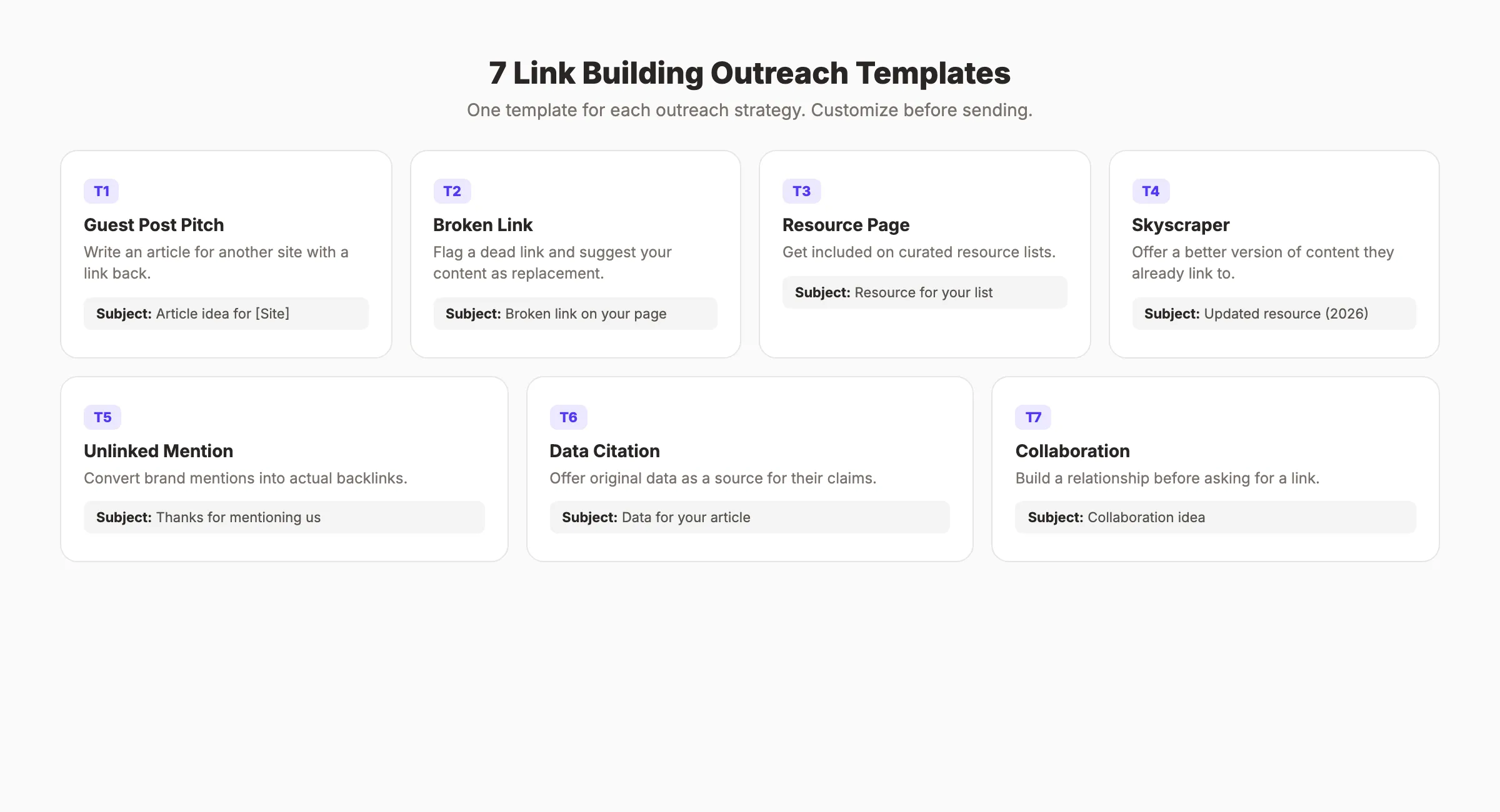
Template 6: Data or Stat Citation
Use when: Your content contains original data, statistics, or research that supports claims in other articles.
Subject line: Data for your [topic] article
Hi [Name],
I read your article on [topic]. You mention that [specific claim or stat they reference without a source, or with an outdated source].
We recently published [study/data set] with updated numbers on this: [Your URL]. The key finding is [1-sentence summary of the relevant data point].
Feel free to reference it if you are updating the piece.
[Your Name]
Why it works: You offer editorial value. Writers need sources. Providing a relevant, original data point gives them a reason to link that benefits their article.
Template 7: Content Collaboration
Use when: You want to build a relationship before asking for a link.
Subject line: Collaboration idea: [Topic]
Hi [Name],
I have been following [Site Name] for a while. Your piece on [specific article] influenced how we approach [related topic] at [Your Company].
I am working on [describe content piece: guide, study, roundup] and would love to include your perspective. Specifically, [1 question relevant to their expertise].
Happy to link back to your work and share the final piece with our audience of [size/description].
[Your Name]
Why it works: You give before you ask. Including their perspective in your content earns goodwill. The reciprocal link happens naturally.
How to Personalize at Scale
Personalization and scale seem contradictory. They are not. The key is layered personalization.
Layer 1: Segment by Strategy
Group prospects by outreach type: broken link, guest post, resource page, skyscraper. Each group gets a different template. This is the baseline.
Layer 2: Customize the Hook
For each email, add 1 sentence that proves you visited their site. Reference a specific article title, a unique point they made, or a recent update. This takes 60 seconds per email and separates you from 95% of outreach.
Layer 3: Match the Value to the Prospect
A blogger with 5 articles has different needs than a content manager at a SaaS company. Adjust your value proposition. The blogger wants exposure. The SaaS company wants authoritative sources. Frame your pitch around their motivation.
Tools for Scaling Outreach
| Tool | Purpose | Price |
|---|---|---|
| BuzzStream | CRM for outreach, relationship tracking | $24/month |
| Pitchbox | Automated prospecting + outreach | $550/month |
| Hunter.io | Email finding and verification | Free to $49/month |
| Respona | All-in-one outreach platform | $197/month |
| GMass | Gmail-based mail merge | $25/month |
Campaigns with fewer than 50 recipients per batch perform nearly 3 times better than mass blasts. Send in small, targeted batches.
Your SEO team. $99 per month. 30 optimized articles published automatically. Content that earns links on its own. Start for $1 →
The Follow-Up Sequence That Gets Replies
One email is not enough. A follow-up sequence turns an 8.5% response rate into 14% or higher.
Follow-Up 1: The Gentle Bump (3-5 Days After Initial Email)
Subject line: Re: [Original Subject Line]
Hi [Name],
Just bumping this to the top of your inbox. I know [day of the week] can be busy.
[1-sentence recap of the original ask]. Let me know if you have any questions.
[Your Name]
Follow-Up 2: New Angle (7-10 Days After Follow-Up 1)
Subject line: One more thought on [Topic]
Hi [Name],
Wanted to share an additional reason [your content] might be useful for [their audience]. [1 new data point, angle, or benefit not mentioned in the original email].
Either way, appreciate your time.
[Your Name]
Follow-Up 3: The Breakup (14 Days After Follow-Up 2)
Hi [Name],
I will not follow up again after this. If the timing is not right, no worries at all.
The offer to [specific value] stands whenever it fits. Thanks for your time.
[Your Name]
Rules for follow-ups:
- Never send more than 3 follow-ups. After that, you are spamming.
- Each follow-up should add new value or a new angle. Do not just repeat the original ask.
- Send follow-ups on Tuesday, Wednesday, or Thursday. These days produce the highest open rates.
- Space follow-ups 3 to 14 days apart. Do not send daily.
Subject Lines That Get Opened
The subject line determines whether your email gets opened or ignored. Research shows that subject lines between 30 and 50 characters perform best.
Subject Line Formulas That Work
| Formula | Example | Why It Works |
|---|---|---|
| [Topic] + [Site Name] | “SEO guide for MarketingBlog” | Personalized, relevant |
| Question format | ”Quick question about your links page” | Creates curiosity |
| Value-first | ”Resource for your SEO roundup” | Leads with benefit |
| Direct ask | ”Article idea for [Site Name]“ | Clear intent, no tricks |
| Problem flag | ”Broken link on your tools page” | Helpful, not salesy |
Subject Lines to Avoid
- “Partnership opportunity” (vague, used by every spammer)
- “Quick favor” (requests without context)
- “[First Name], I loved your article” (obviously automated)
- “URGENT: Link request” (aggressive, unprofessional)
- Anything with all caps or excessive punctuation
How to Build Linkable Content First
The best outreach email in the world will not work if the content is not worth linking to. Build linkable assets before starting outreach.
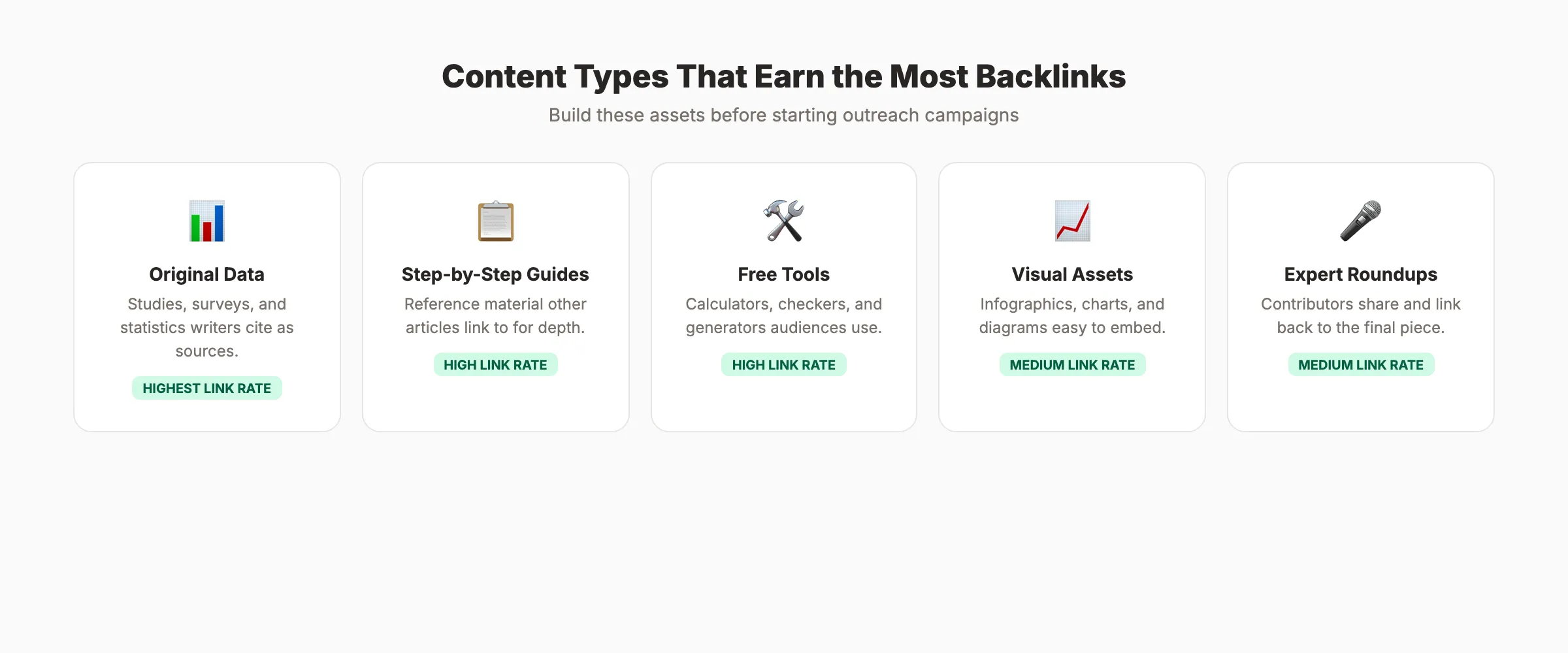
Content Types That Earn Links
| Content Type | Why It Earns Links | Example |
|---|---|---|
| Original research and data | Writers need sources to cite | Industry statistics |
| Step-by-step guides | Reference material for other articles | SEO audit guide |
| Free tools | Practical value for audiences | SEO score checker |
| Visual assets | Easy to embed and reference | Infographics, charts, diagrams |
| Expert roundups | Contributors share and link back | Interview-based content |
Every piece of content you publish should answer: “Would a writer reference this in their own article?” If the answer is no, the content is not linkable. Improve it before running outreach.
Consistent publishing builds topical authority, which makes future outreach easier. Sites are more likely to link to a source that publishes regularly on a topic than to a one-off article.
3,500+ blogs published. 92% average SEO score. See what Stacc can do for your site. Start for $1 →
FAQ
What is a good response rate for link building outreach?
The average response rate across all outreach is 8.5%. Well-crafted campaigns targeting relevant prospects with personalized emails achieve 15 to 20%. Cold link requests to strangers typically convert at 1 to 3%. Warm outreach to contacts you have engaged with previously achieves 15 to 30%.
How many outreach emails should I send per week?
For quality results, send 50 to 75 personalized emails per week. At a 3 to 5% conversion rate, that produces 2 to 4 new backlinks per week, or 8 to 16 per month. Campaigns with fewer than 50 recipients per batch outperform mass blasts by 3 times.
What is the best day to send outreach emails?
Wednesday and Thursday produce the highest response rates at 7.6%. Tuesday is the third best day. Avoid Saturday, which has the lowest response rate at 5.6%. Send between 9 AM and 11 AM in the recipient’s local time zone.
Should I use link building outreach tools or do it manually?
Use tools for prospecting, email finding, and tracking. Do personalization manually. Tools like BuzzStream and Pitchbox handle the workflow. The actual email customization should be done by a human. Fully automated outreach produces lower response rates.
How many follow-ups should I send?
Send 2 to 3 follow-ups spaced 3 to 14 days apart. The first follow-up alone boosts response rates by 65%. After 3 follow-ups with no reply, stop. More than that damages your sender reputation and gets you marked as spam.
Does link building outreach still work in 2026?
Yes. Backlinks remain one of Google’s top ranking factors. The approach has shifted from volume to quality. One link from a high domain authority site is worth more than 50 links from low-quality directories. Outreach is how you earn those high-value links.
Link building outreach is a numbers game, but only after you get the fundamentals right. Pick the right template for each strategy, personalize every email, follow up 2 to 3 times, and only pitch content worth linking to. The teams that treat outreach as a relationship-building process instead of a mass email campaign are the ones building link profiles that actually move rankings.

Written by
Siddharth GangalSiddharth is the founder of theStacc and Arka360, and a graduate of IIT Mandi. He spent years watching great businesses lose organic traffic to competitors who simply published more. So he built a system to fix that. He writes about SEO, content at scale, and the tactics that actually move rankings.
30 SEO blog articles published every month
Keyword-optimized, scheduled, and live on your site. Automatically.
30-day trial · Cancel anytime
theStacc
Stop writing SEO content manually
30 blog articles, 30 GBP posts, and social media content. Published every month. Automatically.
Start Your $1 Trial$1 for 3 days · Cancel anytime