Build pressure washing SEO around real services, service areas, capacity, proof, intake, and completed-job evidence—without ranking promises.
Short answer: Pressure washing SEO connects a local search to a job your crew can complete. This guide covers service pages, Google Business Profile accuracy, service-area truth, proof, intake and the measurement chain from impression to completed job. It sets no ranking promise and no portable conversion benchmark.
92% of searchers choose businesses on the first page of local search results. For pressure washing companies, that means one thing: if you do not show up when someone searches "pressure washing near me," you do not exist to that customer.
The pressure washer market is projected to reach $7.37 billion by 2031. Residential demand accounts for 56% of the market. Every homeowner with a dirty driveway, stained deck, or grimy siding is a potential customer. But they will hire the first company they find on Google.
Pressure washing SEO is how you become that first result. Not paid ads. Not door flyers. Organic search that brings you calls from homeowners ready to book.
We have published 3,500+ blog posts across 70+ industries, including dozens of home services businesses. This guide covers the exact SEO strategy that drives booked jobs for pressure washing and power washing companies.
Here is what you will learn:
- Why local SEO is the highest-ROI marketing channel for pressure washers
- How to find the keywords your ideal customers search
- The Google Business Profile playbook that fills your schedule
- How to build service area pages that rank in every city you serve
- A content strategy that turns your website into a lead machine
- Technical SEO essentials for pressure washing websites
- How to turn reviews into your strongest competitive advantage
Why Local SEO Wins for Pressure Washing Companies
Pressure washing is a hyperlocal business. Your customers live within a 30-mile radius. They search on their phones. They call the first company that looks credible.
That makes local SEO the single most valuable marketing channel for your business.
The Local Search Funnel
Every pressure washing customer follows the same search path:
| Stage | What They Search | What They Need |
|---|---|---|
| Awareness | "how often should you pressure wash a driveway" | Education. Blog content. |
| Consideration | "pressure washing services [city]" | Service pages. Before/after photos. |
| Decision | "best pressure washer near me" | Reviews. Google 3-Pack. Pricing info. |
| Action | "[company name] reviews" | Social proof. Easy booking. |
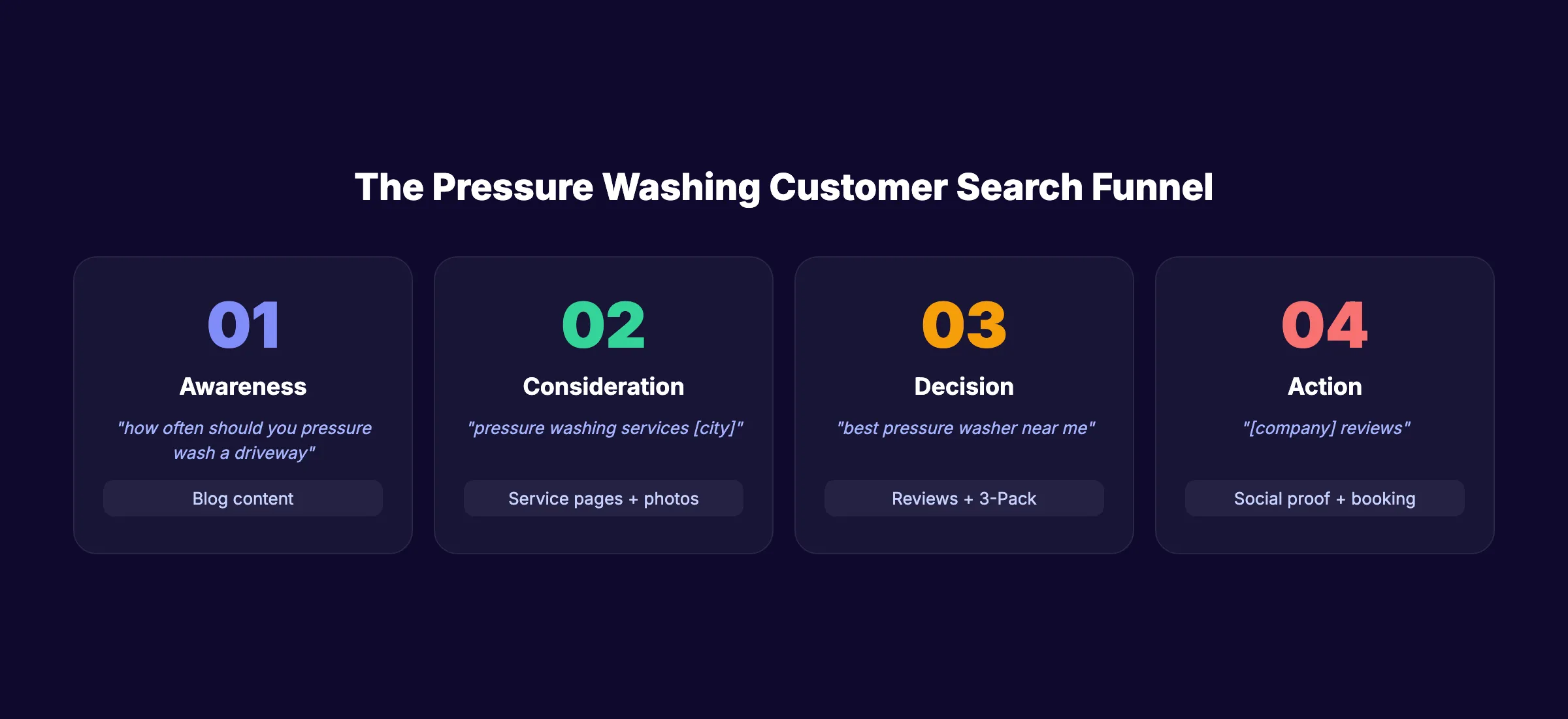
Your SEO strategy needs content for every stage. Most pressure washing websites only have a homepage and a contact page. That is not enough to rank.
SEO vs. Paid Ads for Pressure Washers
| Factor | SEO (Organic) | Google Ads (Paid) |
|---|---|---|
| Cost per lead | Decreases over time | Stays flat or increases |
| Lead quality | High (actively searching) | High (actively searching) |
| Time to results | 3-6 months | Immediate |
| Long-term value | Compounds monthly | Stops when you stop paying |
| Trust factor | Higher (organic results) | Lower (ad label) |
| Click share | 70-80% of clicks go to organic results | 20-30% of clicks go to ads |
Paid ads have their place for immediate leads. But SEO builds an asset that generates calls every month without ongoing ad spend. The best pressure washing companies run both.
The Numbers Behind Pressure Washing SEO
- 46% of all Google searches have local intent
- 76% of people who search for something nearby visit a business within a day
- 28% of those local searches result in a purchase
- Organic search drives 53% of all website traffic
For a pressure washing company charging $200-500 per job, ranking in the Google 3-Pack for your city can generate 20-50+ calls per month. At a 30% close rate, that is 6-15 booked jobs from SEO alone.
Stop writing. Start ranking. theStacc publishes 30 SEO articles per month for your pressure washing company. Every post targets the keywords your customers search.
Keyword Research for Pressure Washing Companies
The keywords you target determine which customers find you. Most pressure washing companies target generic terms and miss the high-intent searches that actually book jobs.
High-Value Keyword Categories
Service + Location Keywords (highest conversion rate):
- "pressure washing [city]"
- "power washing services [city] [state]"
- "driveway pressure washing [city]"
- "house washing [city]"
- "deck cleaning [city]"
- "roof cleaning services near me"
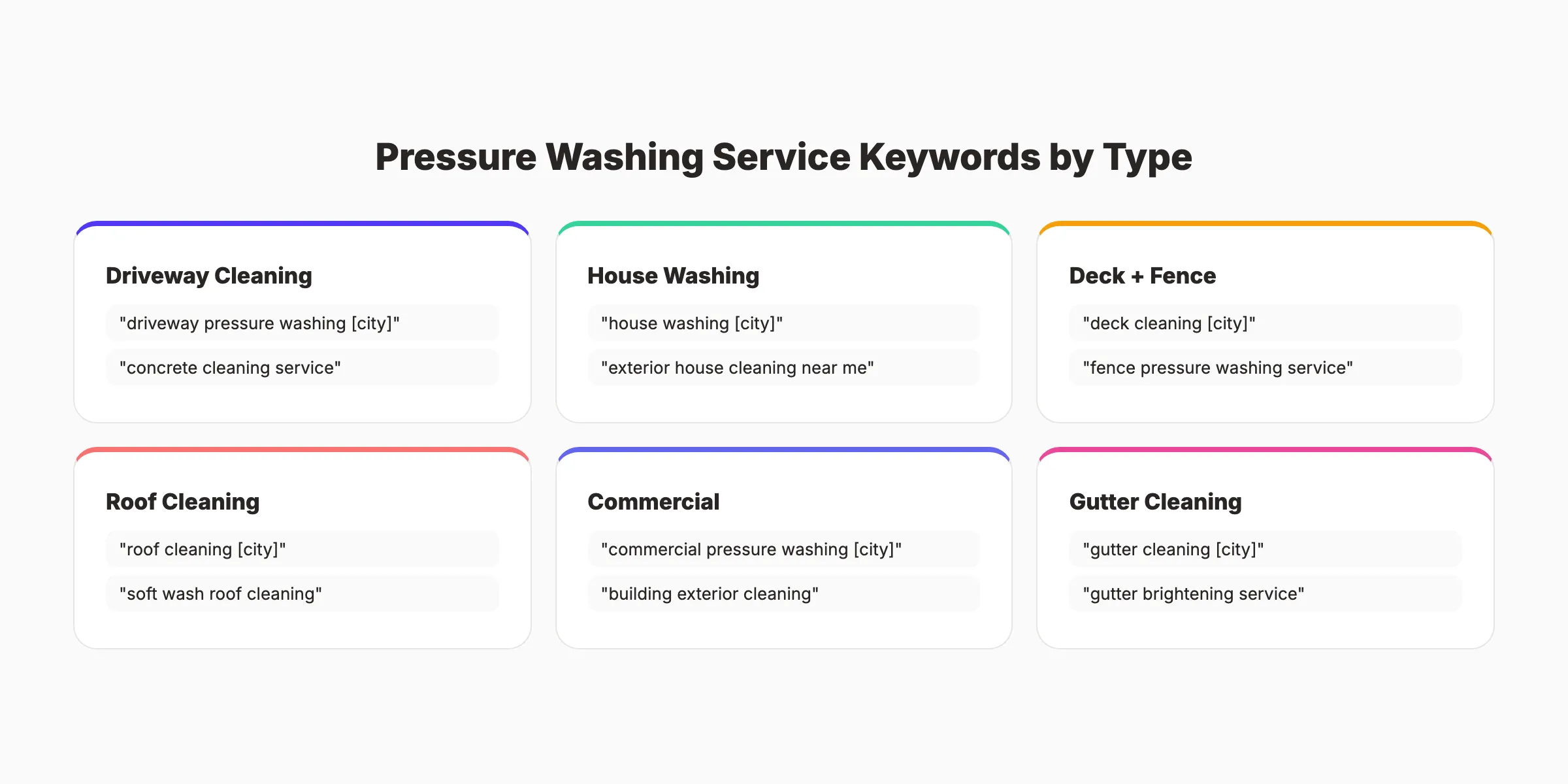
Service-Specific Keywords (target each service separately):
| Service | Target Keywords |
|---|---|
| Driveway cleaning | "driveway pressure washing [city]," "concrete cleaning service" |
| House washing | "house washing [city]," "exterior house cleaning near me" |
| Deck and fence | "deck cleaning [city]," "fence pressure washing service" |
| Roof cleaning | "roof cleaning [city]," "soft wash roof cleaning" |
| Commercial | "commercial pressure washing [city]," "building exterior cleaning" |
| Gutter cleaning | "gutter cleaning [city]," "gutter brightening service" |
Problem-Based Keywords (informational, builds authority):
- "how to remove algae from siding"
- "how often should you pressure wash your house"
- "pressure washing vs soft washing difference"
- "does pressure washing damage concrete"
- "best time of year for pressure washing"
Power Washing vs. Pressure Washing
This is a keyword opportunity most companies miss. "Power washing" and "pressure washing" are different search terms with different volumes. Many customers use them interchangeably.
Create separate pages targeting each term. A page titled "Power Washing Services in [City]" and another titled "Pressure Washing Services in [City]" can both rank and capture different search audiences.
Use your keyword research process to build a list of 50-100 target keywords organized by service type and location.
Seasonal Search Patterns
Pressure washing searches follow strong seasonal patterns:
| Season | Search Volume | Strategy |
|---|---|---|
| Spring (Mar-May) | Peak season. Highest volume. | Publish content in February. Run full SEO campaign. |
| Summer (Jun-Aug) | High volume. Peak booking. | Focus on service pages and reviews. |
| Fall (Sep-Nov) | Moderate. Prep-focused searches. | "Prepare your deck for winter" type content. |
| Winter (Dec-Feb) | Lowest volume. Planning season. | Publish spring-prep content. Build citations. |
The biggest mistake is starting SEO in March when searches peak. Start in November or December so you rank by spring.
Google Business Profile: Your Most Valuable Asset
Your Google Business Profile is the single most important ranking factor for a pressure washing company. When someone searches "pressure washing near me," Google shows the 3-Pack. Your GBP determines whether you appear in it.
Profile Setup Checklist
Every field matters. Incomplete profiles rank lower:
- ✓ Business name (exact legal name, no keyword stuffing)
- ✓ Primary category: "Pressure Washing Service"
- ✓ Secondary categories: "Power Washing Service," "House Cleaning Service," "Gutter Cleaning Service"
- ✓ Full street address (or service area if you operate from home)
- ✓ Local phone number
- ✓ Website URL
- ✓ Business hours (update for seasonal changes)
- ✓ Service area (list every city and zip code you serve)
- ✓ Business description (750 characters, include services and locations)
- ✓ Services list with descriptions and starting prices
- ✓ 10+ photos (before/after shots, equipment, team, completed work)
GBP Posts: Your Secret Weapon
Most pressure washing companies never post to their Google Business Profile. That is a massive missed opportunity. GBP posts signal to Google that your business is active.
Post 3-5 times per week. Content ideas:
- Before and after photos with a short description of the job
- Seasonal promotions ("Spring driveway special: 15% off this month")
- Customer testimonials (screenshot the review, add context)
- Tips and education ("3 signs your deck needs cleaning this spring")
- Completed project highlights ("Just finished a full house wash in [neighborhood]")
Before and after photos perform exceptionally well. They prove results and catch attention in the local search feed.
Photos Drive Engagement
Google reports that businesses with photos receive 42% more direction requests and 35% more click-throughs to their websites.
For pressure washing, photos are your strongest asset. Upload:
- At least 3 before/after sets per month
- Team photos with branded uniforms
- Equipment photos
- Action shots of work in progress
- Completed project photos with location context
Service Area Pages That Rank
If you serve multiple cities, you need a dedicated page for each location. A single homepage that says "Serving the tri-state area" will not rank for any specific city search.
Building Effective Service Area Pages
Each page needs unique, substantial content. Google penalizes thin, templated pages that swap only the city name.
What every service area page needs:
- ✓ City name in the H1 title
- ✓ City name in the URL (/pressure-washing-[city]/)
- ✓ 500+ words of unique content about that area
- ✓ Specific services offered in that location
- ✓ Local landmarks, neighborhoods, or community references
- ✓ Testimonial from a customer in that area (if available)
- ✓ Embedded Google Map centered on that city
- ✓ NAP consistent with your Google Business Profile
- ✓ Internal links to your main service pages
What Makes a Service Area Page Unique
Generic approach (Google penalizes this):
"We offer pressure washing in [City]. Call us today for a free quote."
Specific approach (Google rewards this):
"Homes in the [Neighborhood] area of [City] face heavy pollen buildup from March through June. Our soft wash system removes pollen stains from vinyl siding without damaging the finish. We typically complete a full house wash in [City] in 2-3 hours."
Reference local conditions. Mention common home styles, weather patterns, and specific cleaning challenges in each area.
How Many Service Area Pages?
Create a page for every city where you actively work and want more business. For most pressure washing companies, that means 5-20 location pages.
Do not create 50+ pages for cities you barely serve. Quality beats quantity. Each page must provide genuinely useful information about your services in that specific area.
Follow our local SEO guide for a full strategy on location-based ranking.
Your SEO team. $99 per month. 30 optimized articles published automatically. Built for pressure washing companies that want more booked jobs.
Content Strategy for Pressure Washing Websites
Most pressure washing websites have 3-5 pages: Home, About, Services, Contact, Gallery. That is not enough content to rank for anything meaningful.
A blog and additional service pages create dozens of entry points for potential customers to find you through search.
Content Pillars for Pressure Washing
Pillar 1: Service-Specific Pages Create a dedicated page for each service you offer:
- Driveway and sidewalk pressure washing
- House and siding washing (soft wash)
- Deck and patio cleaning
- Roof cleaning and soft washing
- Fence cleaning and restoration
- Commercial pressure washing
- Gutter cleaning and brightening
- Concrete sealing after pressure washing
Each page should be 500-1,000 words. Include pricing ranges, process descriptions, before/after photos, and a clear call to action.
Pillar 2: Educational Blog Content Answer the questions your customers ask before they hire:
- "How much does pressure washing cost in [city]?"
- "How often should you pressure wash your house?"
- "Pressure washing vs soft washing: which is right for your home?"
- "Can pressure washing damage [surface type]?"
- "Best time of year to pressure wash in [region]"
- "DIY vs professional pressure washing: the real cost comparison"
Pillar 3: Seasonal and Local Content Tie content to seasons and local events:
- "[City] spring cleaning checklist for homeowners"
- "Preparing your deck for summer entertaining in [region]"
- "Why [city] homes need annual house washing"
- "How [weather pattern] affects your home's exterior in [state]"
Pillar 4: Before and After Case Studies Document your best projects:
- "Driveway transformation: 20 years of grime in [neighborhood]"
- "Full house wash restores curb appeal in [city]"
- "Commercial building exterior cleaning: [business name] project"
Each case study should include high-quality photos, a description of the challenge, your process, and the result.
Publishing Frequency
| Publishing Pace | Expected Timeline | Growth Rate |
|---|---|---|
| 2-4 posts per month | 6-12 months | Slow build |
| 8-12 posts per month | 3-6 months | Strong growth |
| 20-30 posts per month | 60-90 days | Rapid authority |
Consistency matters more than perfection. One blog post per week is enough to start building topical authority. 4 per week accelerates results dramatically.
Technical SEO for Pressure Washing Websites
Technical issues silently kill rankings. Many pressure washing websites run on free or cheap builders with poor technical foundations.
Site Speed
Pressure washing websites often load slowly due to large before/after photo galleries. Target these Core Web Vitals thresholds:
| Metric | Target | Common Issue |
|---|---|---|
| LCP (Loading) | Under 2.5 seconds | Unoptimized gallery images |
| INP (Interactivity) | Under 200ms | Heavy chat widgets |
| CLS (Visual Stability) | Under 0.1 | Late-loading photo carousels |
Quick fixes:
- Convert all images to WebP format (reduces file size by 50-80%)
- Lazy-load photo galleries
- Compress before/after images before uploading
- Enable browser caching
- Remove unnecessary plugins or widgets
Mobile Optimization
76% of people who search locally on their phone visit a business within a day. Your website must work flawlessly on mobile:
- ✓ Click-to-call button visible on every page
- ✓ Contact form easy to complete on small screens
- ✓ Before/after photos display properly on mobile
- ✓ Navigation menu accessible with one thumb
- ✓ No horizontal scrolling on any page
- ✓ Text readable without pinching or zooming
Schema Markup
Schema markup helps Google understand your business. Implement these types:
- LocalBusiness with NAP, hours, and service area
- Organization with sameAs links to all profiles
- Service schema for each pressure washing service
- Article/BlogPosting on every blog post
- FAQPage on service pages
- Review schema for displayed testimonials
Use our Schema Markup Generator to create valid structured data.
HTTPS
Every page must use HTTPS. An unsecured site immediately loses trust with both Google and potential customers. Most hosting providers offer free SSL certificates through Let's Encrypt.
3,500+ blogs published. Every article is SEO-scored before publish. See what theStacc can do for your pressure washing company.
Reviews: Your Strongest Competitive Advantage
For pressure washing companies, Google reviews are the most powerful local ranking factor you can directly control. They also convert browsers into callers.
Why Reviews Matter More for Pressure Washers
Pressure washing is a trust-based service. You show up at someone's home with high-pressure equipment. Customers want proof that you are professional, careful, and deliver results.
Reviews provide that proof. A company with 85 five-star reviews beats a company with 5 reviews every time. Both in Google rankings and in customer decisions.
Building a Review System
- Ask immediately after every job. Send a text with a direct Google review link within 2 hours of completing the work. The customer is happiest right after seeing their clean driveway.
- Show the before/after. Send the customer a side-by-side photo along with your review request. Seeing the transformation motivates them to share it.
- Use a QR code. Print one on your invoices, business cards, and vehicle wrap.
- Follow up once. If no review within 3 days, send one reminder. Never more.
- Respond to every review. Thank positive reviewers by name. Address negative reviews professionally.
Review Response Templates
| Review Type | Response Approach |
|---|---|
| 5-star with detail | Thank by name, reference specific work ("Glad the driveway looks brand new!") |
| 5-star generic | Thank them, mention the service and area |
| 3-star with feedback | Acknowledge concern, describe how you addressed it, invite them back |
| 1-star unfair | Stay professional, state facts briefly, offer offline resolution |
Target Review Counts
| Review Count | Competitive Position |
|---|---|
| Under 10 | Invisible to most searchers |
| 10-25 | Baseline credibility |
| 25-50 | Competitive in most markets |
| 50-100 | Dominant in small to mid markets |
| 100+ | Market leader positioning |
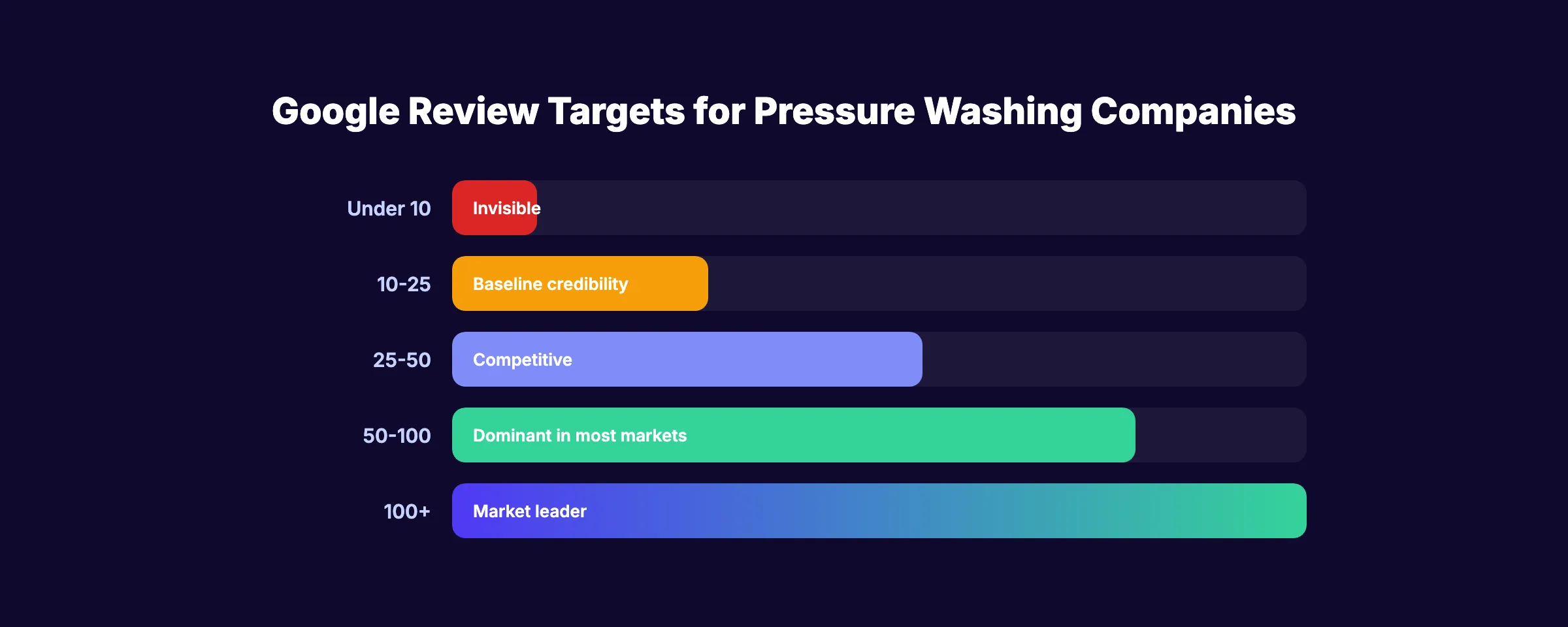
Target 4-8 new reviews per month during peak season. During slow months, follow up with past customers you missed.
Link Building for Pressure Washing Companies
Backlinks signal to Google that other websites trust your business. For local service companies, local backlinks carry the most weight.
Easy Link Opportunities
| Source | How to Get the Link |
|---|---|
| Local business directories | Register on Yelp, Angi, Thumbtack, HomeAdvisor, BBB |
| Chamber of Commerce | Join and get listed in the member directory |
| Supplier websites | Ask equipment suppliers to list you as a certified user |
| Home services platforms | Create profiles on Porch, Houzz, Nextdoor |
| Local news sites | Offer tips for seasonal home maintenance stories |
| Real estate agents | Partner for move-in/move-out cleaning referrals |
| HOA websites | Offer community discount for listing on their resources page |
Content That Earns Links
- Pricing guides: "How much does pressure washing cost in [city]?" earns links from home improvement blogs.
- Comparison content: "Pressure washing vs soft washing" gets referenced by other service providers.
- Local guides: "Home maintenance checklist for [city] homeowners" earns links from local blogs and real estate sites.
Common Pressure Washing SEO Mistakes
Only Having a Homepage
A one-page website cannot rank for multiple keywords. Create dedicated pages for each service, each service area, and each blog topic.
Ignoring Google Business Profile
Your GBP is more important than your website for local search. Claim it, complete every field, post regularly, and generate reviews.
Duplicate Location Pages
Creating 15 city pages with identical content except the city name earns a Google penalty. Each page needs unique content about that specific market.
No Before/After Photos
Pressure washing is a visual business. Photos prove your results better than any text. Upload them everywhere: your website, GBP, social media, and review responses.
Starting SEO in Spring
Peak season for pressure washing searches is March through May. SEO takes 3-6 months to produce results. Start your SEO campaign in October or November to rank by spring.
No Conversion Tracking
Ranking means nothing without tracking which keywords and pages generate phone calls. Set up Google Analytics goals and call tracking to know your true ROI.
Measuring Your Pressure Washing SEO Results
| Metric | Tool | Target |
|---|---|---|
| Organic traffic | Google Analytics | 20%+ growth quarter over quarter |
| 3-Pack rankings | Google Search Console | Top 3 for "[service] + [city]" keywords |
| Keyword rankings | Semrush, Ahrefs, or Search Console | Page 1 for 10+ service keywords in 6 months |
| GBP profile views | GBP insights | Month-over-month increase |
| Phone calls from search | Call tracking or GBP metrics | 20-50+ calls per month at maturity |
| Booked jobs from SEO | CRM or manual tracking | Track cost per job acquisition |
| Review count and rating | GBP dashboard | 50+ reviews, 4.7+ average |
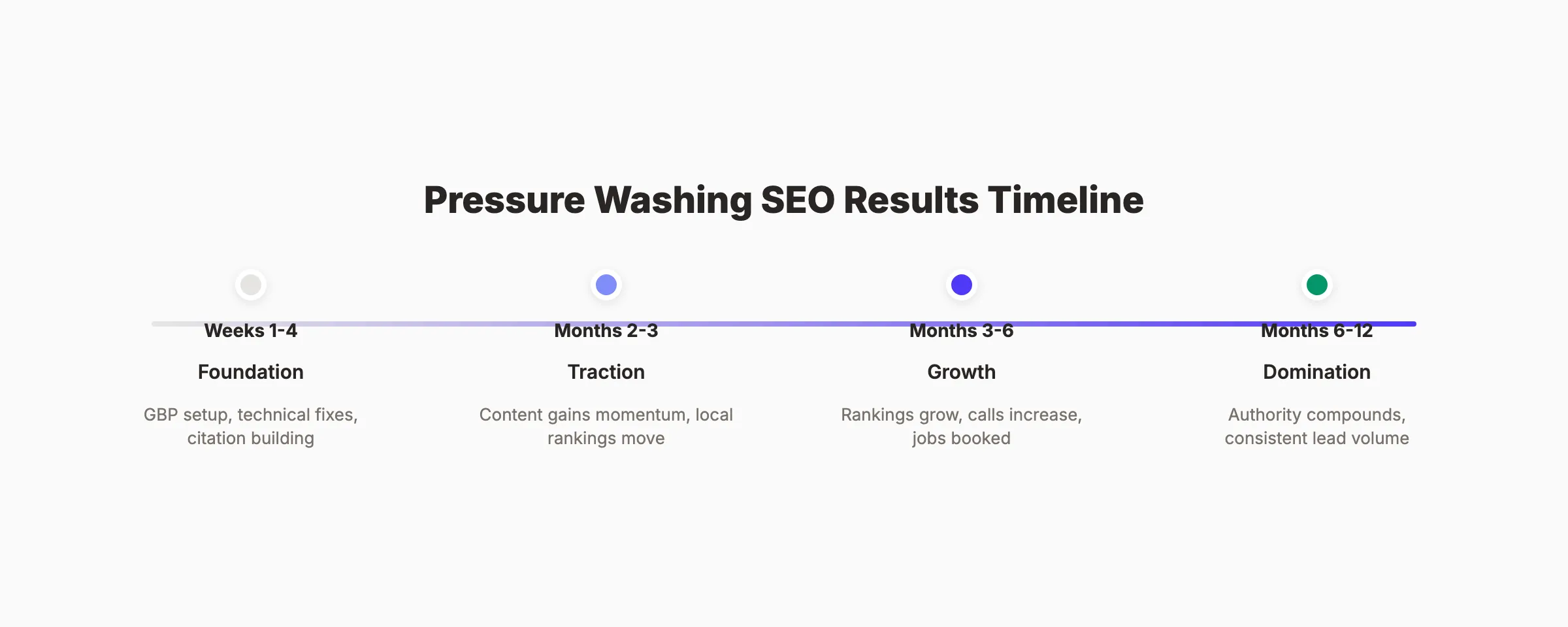
Timeline
- Weeks 1-4: Technical fixes, GBP setup, citation building. Minor local improvements.
- Months 2-3: Content gains traction. Local rankings begin moving.
- Months 3-6: Rankings grow. Organic traffic and calls increase.
- Months 6-12: Authority compounds. Rankings dominate local searches. Consistent lead volume.
Rank everywhere. Do nothing. Blog SEO, Local SEO, and Social Media on autopilot for your pressure washing company.
What practitioners are saying on X
AI search advice ages quickly. Here is high-signal public discussion from SEO and growth operators — context for your roadmap, not a substitute for primary data.
- @hridoyreh (Mar 2026): Widely shared SEO skill tree: foundations, research, technical, on-page, content, links, AI SEO/GEO, analytics, UX, brand, programmatic — useful map for stats and how-to posts. See the post on X.
- @jakezward (Feb 2026): 2026 SEO predictions emphasize AI Overview share-of-SERP, schema for LLM token efficiency, brand mentions in AI answers as a KPI, proprietary data as a moat, and content refresh beating net-new AI slop. See the post on X.
Grok, AI Overviews, and multi-engine visibility
For “pressure washing seo guide”, multi-engine visibility still starts with clear definitions, sourced numbers, and extractable section answers. Grok additionally factors live X discussion — keep public claims consistent with this page.
- Google AI Overviews: Use passage-ready answers, tables, and FAQ schema where relevant.
- ChatGPT / Perplexity: Cite named sources next to key claims.
- Grok: Maintain accurate entity facts on-site and in high-signal X posts.
Publish content built for Google and AI citations. theStacc’s Content SEO module ships SEO-scored articles structured for rankings and generative engines — including clearer entity pages models like Grok can quote.
FAQ
Most pressure washing companies see initial local ranking improvements within 4-8 weeks. Meaningful results like consistent 3-Pack rankings and regular phone calls from search typically take 3-6 months. Start your SEO campaign before peak season for the best results.
Focus on service + location keywords: "pressure washing [city]," "driveway cleaning [city]," "house washing near me." Create separate pages for pressure washing and power washing since customers search both terms. Target each service type individually.
SEO agencies charge $1,000-3,000+ per month for home services SEO. Automated publishing services like theStacc start at $99 per month for 30 optimized articles. DIY SEO is free but requires 5-10 hours per week and significant learning.
Yes. Google reviews are one of the strongest local ranking signals. Companies with 50+ reviews and a 4.7+ average rating rank significantly higher in local results. Build a system to request reviews immediately after every completed job.
Absolutely. Blog content targets long-tail keywords that service pages cannot cover. Posts like "how much does pressure washing cost" or "pressure washing vs soft washing" attract potential customers at the research stage. Publishing 4+ posts per month builds authority faster.
Starting SEO too late. Pressure washing searches peak from March through May. SEO takes 3-6 months to produce results. Companies that start in spring will not rank until the season is already over. Start in fall or winter to be ready for peak demand.
What pressure-washing SEO actually does
Pressure-washing SEO helps search engines understand your real services and helps searchers find suitable pages or local information. It coordinates organic listings, local results, website discovery, and conversion operations. It cannot guarantee indexing or first position, create crew capacity, validate permissions, or turn an unsuitable enquiry into a completed job.
Organic results and local results are separate surfaces. A service page may appear among standard website listings. An eligible Google Business Profile may appear in local results. The head query can show both, while a related query may show only organic listings, so do not judge the entire program by one result layout.
Google describes SEO as helping search engines understand content and helping users find a site. Its SEO Starter Guide also says there is no practice that guarantees first position or even automatic indexing. That makes the operating goal precise: improve the match between offered work, search intent, and evidence, then observe what the market and search systems do.
Define success in stages. Visibility includes impressions and local appearances. Engagement includes organic clicks, call-button clicks, and forms. Operations includes qualification, booking, and completion. A top-three position may be an internal target for a defined query and geography, but capacity and job fit determine whether more discovery is useful.
Start with service truth and job economics
Build SEO from an operator-approved inventory of work, not a borrowed keyword list. For every job type, record who buys it, where you can perform it, the method language customers use, capacity, economics, proof, verification status, and exclusions. Unknown fields stay unknown until the accountable owner supplies evidence.
Pressure washing, power washing, and soft washing can describe services, methods, or customer language. The operator must decide what each term means inside this company. Separate residential house wash, driveway or concrete, roof or soft-wash, deck or fence, gutter or exterior add-ons, commercial flatwork or facility work, fleet or equipment work, and non-offered jobs.
| Service-and-economics field | Operator entry | Why SEO needs it |
|---|---|---|
| Job and customer type | Exact offered job; residential, commercial, or both | Prevents a page from attracting work the crew does not perform |
| Surface and method boundary | Approved service wording and exclusions | Keeps pressure, power, and soft-wash claims aligned with operations |
| Geography | Actual service radius or named feasible areas | Stops unsupported location expansion |
| Timing and capacity | Locally used urgency/deadline label; crew slots; operating window | Gates promotion when work cannot be accepted |
| Economics | Owner-entered ticket, direct-cost, and gross-profit bands | Supports a local go/no-go decision without portable benchmarks |
| Verification | License, permit, bonding, environmental source and check date | Flags claims requiring jurisdiction-specific review |
| Proof and ownership | Permitted photos, job record, page owner, intake exclusions | Connects claims and conversion paths to accountable evidence |
Do not import another operator’s ticket size, margin, service radius, season, or urgency label. US requirements can vary with activity and location, according to the Small Business Administration. Record the actual authority consulted and date checked; this guide does not decide which requirements apply.
A simple prioritization test is enough: promote only an offered, verified job that fits the feasible area, has acceptable owner-recorded economics, has capacity, and can be measured through completion. Everything else is a research item, an operational fix, or an explicit exclusion.
Map searches to the right page owner
Assign each observed search intent to one strongest URL. Group head terms, specific jobs, problems, customer types, locations, and research questions, then compare the dominant search results before deciding to keep, refresh, create, or merge. Different wording alone does not justify another page, and every decision needs an evidence date.
| Query cluster | Likely owner | Validation question |
|---|---|---|
| Pressure washing company or service | Core service or relevant location page | Do results show providers, guides, local results, or a mixture? |
| Driveway, house, roof, deck, commercial, fleet | Distinct service page only for offered work | Is this a separate job with its own proof and intake path? |
| Stains, buildup, surface concerns, method questions | Service section or educational article | Can the operator answer without an unsafe or unsupported claim? |
| Residential or commercial modifier | Existing page or distinct page based on intent | Do buyer, job, proof, and results materially differ? |
| City, neighborhood, near me | Truthful local owner | Is there real operational value beyond replacing a place name? |
| Cost, timing, comparison, maintenance research | Educational owner | Can records and caveats answer the question honestly? |
The working search-owner map should retain: query cluster, observed intent, dominant result type, existing URL, keep/refresh/create/merge decision, evidence date, content owner, and next review. This catches two expensive errors: multiple URLs competing for the same intent and a single generic page trying to own unrelated jobs.
Do not create separate “pressure washing” and “power washing” pages solely to capture synonyms. Likewise, do not multiply every service by every city. A new owner needs distinct offered work or local value, a different observed intent, and enough evidence to make the page useful. The dedicated keyword-research article is not yet a live route, so this guide does not link to it.
Turn the map into a manageable publishing plan. theStacc’s Content SEO module supports keyword and search-result research, drafting, on-page scoring, queueing, and CMS publishing. Your operator still owns service facts and approvals.
Build local visibility on a truthful Business Profile
A pressure-washing Business Profile must represent an eligible real business accurately. Verify the customer-contact model, operating location, address display, service area, hours, offered services, categories, managers, phone, website, and proof assets. Profile optimization supports local discovery; it does not replace website SEO or guarantee local placement.
Google’s eligibility guidance requires in-person customer contact during stated hours and excludes lead-generation and online-only businesses. Its service-area guidance says the business should represent its real location and service area accurately, generally with one profile for its central office or location. Hide a residential address when customers are not served there.
Local eligibility card: record the real operating location, customer-contact model, address-display choice, actual service area and hours, profile owner, authorized managers, offered services, category verification date, phone, website, permitted proof assets, and suspension or escalation owner.
Do not stuff services or cities into the business name. Do not create a virtual office or extra profiles to manufacture proximity. Verify the available primary and additional categories inside the current Profile interface against what the business actually does; the brief does not authorize a universal category prescription.
Google says local results are mainly based on relevance, distance, and prominence, and businesses cannot request or pay Google for better local ranking. Maintain accurate hours, services, contact details, and service areas. Use genuine job photos and reviews with permission, without implying that posts or replies cause rank movement.
For the complete profile workflow, use the Google Business Profile optimization guide. If an accountable team needs operational support, the Local SEO module covers Profile posts and review replies, citations and NAP monitoring, and local rank tracking.
Build service and location pages around real work
A service or location page deserves to exist only when it represents real work and helps a suitable customer decide. Give it a specific job, proof, process boundary, feasible service area, compliance caveat, intake path, and useful detail. Merge pages that differ only by synonyms or substituted city names.
A driveway or concrete page should clarify whether that is an offered job, which customer types it serves, what the quote needs, what work is excluded, and which proof belongs to that service. A commercial facility page may need different scheduling and intake fields. Do not claim methods, surface safety, chemicals, runoff handling, insurance, or permissions until the operator’s approved records support them.
A location page must pass a stronger test. Ask whether crews actually take jobs there, travel remains feasible, relevant services are offered, local operating constraints have been checked, and the company possesses area-specific proof or knowledge that helps the customer. A fabricated neighborhood reference or generic weather claim does not pass.
- Keep: a page with distinct intent, real operations, suitable proof, and an active intake path.
- Refresh: a valid owner whose service facts, proof, or conversion path are outdated.
- Merge: synonym pages or thin city pages that compete for the same search need.
- Remove or redirect: an owner for work no longer offered or a location no longer served.
The service-area page guide covers the execution details. Here the rule is narrower: never prescribe one page for every city. Build the smallest route set that accurately represents distinct services and real local operations.
Use pressure-washing proof without inventing expertise
Use operator-owned job proof with recorded permission and restrained claims. Label before-and-after images by actual job type and surface, use only privacy-appropriate date and location detail, and limit the outcome to what the evidence shows. A visible cleaning result does not prove an unrecorded method, safety claim, lifespan, or customer outcome.
Create a proof register with the source job ID, permission status, asset owner, service label, surface label approved by operations, allowed location granularity, capture date, and pages using the asset. If the business cannot verify a field, omit it. Avoid invented case narratives and do not present a stock image as completed work.
Before-and-after sets need consistent framing to be interpretable, but the caption should stay factual: “Driveway cleaning, [approved service area], [month/year]” is stronger than an unsupported claim about age, damage, restoration, or method. Customer reviews can add perspective, provided the business follows platform rules and does not rewrite the customer’s experience.
Large galleries create a technical ownership problem. Keep the original asset archived, publish an appropriately sized derivative, provide width and height, use descriptive alternative text, and lazy-load offscreen media. Test the actual page rather than asserting a pressure-washing-specific speed benchmark. The Core Web Vitals guide explains the broader performance work.
Create content around seasonal capacity and job fit
Plan content from the company’s own demand and operations records, not a national pressure-washing season. Compare booked and completed jobs, local weather notes, crew slots, service mix, equipment constraints, and intake outcomes by week or month. Publish only for work the team can accept in the relevant operating window.
| Calendar field | What the owner records | Decision it supports |
|---|---|---|
| Week or month | Locally observed search, enquiry, booking, and completion evidence | Separates repeat patterns from assumptions |
| Job and capacity | Offered types, crew slots, equipment constraint | Chooses which service can be promoted |
| Operating context | Weather note, access constraint, compliance status | Explains pauses and confounders |
| Action | Page update, content task, or accurate Profile update | Assigns a specific owner |
| Capacity gate | Written threshold that pauses intake or promotion | Prevents visibility from outrunning operations |
Possible customer labels include preparation deadlines, post-weather cleanup, a property sale or event, an HOA or facility cycle, and a commercial schedule. Treat each as a hypothesis to validate against local records. Do not turn it into a universal urgency or demand claim.
Work backward from the operating decision. If facility work has open slots but residential work is full, update and promote the verified commercial owner rather than publishing another broad “near me” article. If proof or compliance review is incomplete, schedule that dependency first. If no capacity exists, pause the relevant CTA or clearly state availability.
Diagnose technical, local, content, and intake failures separately
Diagnose the first broken stage instead of calling every weak result an SEO problem. Indexation, canonicalization, relevance, geography, local accuracy, proof, capacity, and intake can fail independently. Label the failure, inspect its evidence source, assign an owner, and avoid claiming that any single error automatically costs leads.
| Observed failure | First evidence to inspect | Likely owner |
|---|---|---|
| Not indexed or wrong canonical | URL inspection, rendered canonical, sitemap and internal links | SEO or developer |
| Irrelevant impressions | Query-to-page map and service taxonomy | SEO plus operator |
| Impressions but no clicks | Matched query, result title/description, dominant result type | SEO |
| Clicks but no call click or form | Mobile page, CTA, event test, form and phone display | Web and analytics |
| Spam or duplicate form | Form backend and deduplication rule | Analytics or intake |
| Missed call | Call system record and staffing coverage | Intake |
| Outside area or unsupported service | Landing-page promise and qualification reason | Operator plus content owner |
| Compliance uncertain or no capacity | Verification log or scheduling system | Operations |
| Qualified but unbooked, canceled, or incomplete | CRM, schedule, cancellation, and job record | Sales or operations |
Technical checks include indexability, selected canonical, internal links, status codes, mobile usability, and gallery handling. Local checks cover eligibility and Profile accuracy. Content checks ask whether the page matches a real offered job and observed intent. Intake checks test the actual phone and form paths, qualification rules, response ownership, and capacity.
Measure every stage from impression to completed job
Measure pressure-washing SEO as a chain: impression → organic click → call click or form → qualified enquiry → booked job → completed job. Every stage needs its own source, timestamp, owner, evidence window, exclusions, and reconciliation rule. Search Console measures search-stage observations; it does not count calls, bookings, or completed work.
Search Console’s Performance report provides query and page impressions, clicks, click-through rate, and average position. Google recommends emphasizing impression and click trends over position alone, and its metric definitions explain how those observations work across Google surfaces. Keep filters and aggregation consistent when comparing periods.
GA4 provides recommended lead-event names including generate_lead, qualify_lead, working_lead, and close_convert_lead, but the business must define and send applicable events. Analytics events do not replace the form backend, call system, CRM, scheduler, or job record.
| Formula | Numerator ÷ denominator | Window and source | Owner and exclusions |
|---|---|---|---|
| Organic CTR | Organic web clicks for defined page/query set ÷ matching impressions | Declared 28-day window; Search Console Performance | SEO owner; exclude branded queries when non-branded, out-of-scope search types/countries/devices, incomplete days |
| Call-click rate | Unique tracked call-button clicks from organic landing sessions ÷ unique organic landing sessions | Declared 28-day window; analytics event log | Analytics owner; exclude repeat firing, staff/tests, non-organic sessions; clicks are not answered calls |
| Form-submission rate | Unique valid pressure-washing forms from organic landing sessions ÷ unique organic landing sessions | Declared 28-day window; analytics plus form backend | Analytics/intake owner; exclude spam, tests, duplicates, employment/vendor and non-organic forms |
| Qualified-enquiry rate | Unique organic enquiries meeting written service, area, compliance, timing, and capacity rules ÷ all unique valid organic enquiries | Declared 28-day intake cohort; CRM/intake log | Intake owner; exclude spam, duplicates, vendor/employment contacts, unsupported service/area, unverifiable source |
| Booked-job rate | Unique qualified organic enquiries with confirmed booking ÷ all unique qualified organic enquiries | 28-day intake cohort plus declared booking lag; CRM/scheduler | Scheduling owner; count reschedules once; cancellations remain booked, not completed |
| Completed-job rate | Unique booked organic jobs marked completed under written rule ÷ all unique booked organic jobs | 28-day booking cohort plus declared completion lag; job system | Operations owner; exclude canceled, no-show, refunded-before-completion, duplicate, test, incomplete jobs |
| SEO contribution per completed job | Direct SEO cost assigned to cohort ÷ unique organic-attributed completed jobs | Declared monthly or quarterly cohort plus completion lag; invoices/time log and funnel systems | Finance owner with marketing/operations sign-off; exclude undisclosed owner labor, unattributable and non-organic jobs, canceled/incomplete work; keep revenue and profit separate |
Store implementation timestamps and attribution rules before interpreting a change. Reconcile records by a stable enquiry or job identifier where permitted. Log unmatched records instead of forcing attribution. For deeper search-stage setup, use the Search Console guide.
Build reporting around decisions, not vanity totals. Bring your service map, current routes, and funnel gaps to a working session.
Decide whether SEO is worth doing now
SEO is worth considering now only when the business can serve and measure the demand it seeks. Use a go/no-go card covering eligible service economics, capacity, local demand evidence, proof, compliant claims, website and intake readiness, measurement, and ownership. “Not yet” is valid when a dependency would make more visibility wasteful.
- Economics: owner records show an eligible service and acceptable direct-cost or gross-profit band.
- Capacity: the scheduling owner identifies real slots and a pause condition.
- Demand evidence: local query, impression, enquiry, or completed-job records support the hypothesis; unavailable demand remains unavailable.
- Proof and claims: assets have permission, and operational or compliance claims have a source and review date.
- Website and intake: a useful page, working phone/form path, qualification rules, and response owner exist.
- Measurement: baseline, source systems, funnel definitions, reconciliation, and review date are documented.
Choose “go” for one controlled service-and-area slice, not the entire market. Choose “hold” when the answer depends on missing proof, uncertain compliance, broken intake, or no capacity. Choose “stop” for non-offered work or an infeasible area. This framing prevents rankings from becoming the default answer to an operations problem.
Choose DIY, assisted, or hired execution
Choose a sourcing model by assigning tasks and evidence, not by repeating generic prices or time estimates. DIY works when internal owners can perform and review the work. Assisted execution fills specific gaps. Hired execution transfers delivery, but the operator must still approve service truth, proof, compliance inputs, capacity, and completed-job reconciliation.
| Model | Best fit | Required matrix fields | Escalation trigger |
|---|---|---|---|
| DIY | Named internal owners cover research, content, Profile, web, analytics, proof, verification, intake, and operations review | Accountable owner, actual available hours, evidence required, approval point | Missed reviews, untested changes, or tasks exceeding recorded capacity |
| Assisted | Internal operator owns truth while specialists fill defined research, writing, development, or analytics gaps | Contract scope, system access, handoff evidence, approval owner | Gap crosses disciplines or nobody owns reconciliation |
| Hired | External team delivers most execution under written access, evidence, and approval rules | Deliverables, owners, source access, proof permissions, change log, review cadence | Vendor asserts outcomes without page-level and funnel-stage evidence |
Build a row for each task: query research, content, Business Profile operations, development, analytics, proof permissions, local compliance verification, intake, and monthly operations reconciliation. Enter actual internal hours and contract terms. The DIY SEO guide can help scope in-house work, but your capacity record decides the model.
Use checkpoints instead of a fixed SEO timeline
Replace a promised time-to-rank with evidence checkpoints. Record the change and implementation date, identify the earliest stage it could affect, declare an observation window and completion lag, list confounders, and assign an owner. Review crawl, impressions, clicks, enquiries, bookings, and completions in order rather than skipping to revenue.
| Checkpoint | Evidence | Decision question |
|---|---|---|
| Baseline and implementation | Change log, page snapshot, Profile record, test results | What changed, when, by whom, and for which service-area slice? |
| Crawl and indexation | URL inspection, sitemap, selected canonical | Can Google access and select the intended owner? |
| Query and impression discovery | Filtered Search Console data | Are the page and queries relevant to offered work? |
| Clicks and site actions | Search Console plus tested analytics events | Do suitable searchers reach and use the page? |
| Qualification and booking | Intake and scheduling cohort | Do enquiries meet written fit rules and confirm work? |
| Completion | Job system after declared completion lag | Which booked jobs meet the written completion rule? |
For every row, store the minimum declared observation window, source, owner, confounders, and keep/change/revert decision. Compare like-for-like windows only where filters match. Weather, capacity pauses, changed service mix, missed calls, and offline referrals can all alter downstream outcomes.
Google says changes may take from hours to several months and suggests waiting a few weeks before assessing many effects. That range is not a pressure-washing forecast. The SEO timeline guide provides broader expectation-setting; your checkpoint sheet supplies the local evidence.
Run the pressure-washing SEO checklist
Use one visible checklist that joins search, local accuracy, operations, and measurement. A checked item means its evidence is stored and an owner has accepted it. Complete the list for one service-and-area slice before expanding, then schedule the next review around the declared observation and completion windows.
- ✓ Service truth approved: offered jobs, method language, areas, economics, capacity, verification status, proof, and exclusions have owners.
- ✓ Route collision checked: one URL owns each intent; synonym and thin city owners are merged.
- ✓ Page and Profile accuracy verified: service, area, hours, phone, website, eligibility, and ownership match reality.
- ✓ Proof permission logged: job photos, captions, privacy level, and page use are recorded.
- ✓ Local compliance checked: authority, scope, outcome, owner, and verification date are stored.
- ✓ Call and form events tested: repeat firing, spam, tests, and attribution exclusions are handled.
- ✓ Funnel owners assigned: search, analytics, intake, scheduling, operations, and finance know their reconciliation duties.
- ✓ Capacity gate set: the trigger to pause or redirect promotion is written.
- ✓ Baseline stored: filters, dates, source systems, definitions, and known gaps are preserved.
- ✓ Review scheduled: the date follows the declared evidence window and completion lag.
The broader SEO checklist covers generic site work. This version protects the pressure-washing-specific boundaries: no invented service truth, no cloned location matrix, no unverified method claims, and no collapsed funnel.
Pressure-washing SEO FAQ
These answers resolve the implementation choices that remain after the operating system is defined: which surface owns what, how to set expectations, when to source help, when seasonality changes the decision, and where page duplication or funnel reporting goes wrong. Each answer adds a decision rule rather than repeating a tactic list.
Pressure-washing SEO is the work of making a real service business understandable and discoverable in organic search and local results, then measuring what happens after discovery. It connects offered jobs, feasible service areas, useful pages, an accurate Business Profile, proof, intake, and completed-job records without promising rankings or demand.
SEO covers website discovery in organic results, including service pages, location evidence, internal links, indexation, and content. Business Profile optimization manages an eligible local listing and its accuracy. They coordinate, but they are different surfaces with different records. A website click and a Profile interaction should remain separately attributable where your tools allow it.
There is no universal pressure-washing SEO timeline. Google says some changes may appear in hours while others can take several months. Review checkpoints in order: implementation, crawl and indexation, relevant impressions, clicks, enquiries, qualification, bookings, then completions. Judge each stage only after its declared observation window and operating lag.
Yes, if named owners can maintain service facts, research queries, edit pages, administer the Business Profile, test analytics, verify local requirements, approve proof, and reconcile enquiries with completed jobs. Use assistance for the tasks your team cannot perform reliably. Compare responsibility and evidence, not generic DIY-hour or agency-price claims.
It may be, when eligible services have acceptable economics, locally observed search demand, available capacity, usable proof, compliant claims, working intake, and stage-by-stage measurement. Seasonality makes capacity planning more important, not SEO automatically worthwhile. If the next operating window is full or the offer is unverified, “not yet” is a sound decision.
Not merely because the phrases differ. Keep them on one page when customers use both terms for the same offered job and the search results show the same intent. Create separate pages only when the operator offers distinct jobs, the intent and dominant results differ, and each page has its own truthful process, proof, and intake path.
No. Create a location page only when the business has real operations and useful evidence for that area: feasible travel, offered jobs, local proof or operational detail, applicable checks, and a suitable intake path. A city-name swap is not local value. Consolidate thin or colliding pages into the strongest truthful owner.
It should confirm the operator-approved service taxonomy, route-collision review, website and Business Profile accuracy, proof permissions, jurisdiction-specific compliance checks, tested call and form events, named funnel owners, a capacity gate, stored baseline, and scheduled review date. Each checked item should point to evidence, not just a completed task label.
No. A call click records an interface event, not an answered call. A submitted form may be spam, outside the service area, or for unsupported work. Keep call clicks, valid forms, qualified enquiries, booked jobs, and completed jobs separate, then reconcile them with analytics, intake, scheduling, and job-management records.
Start with one service-area slice
The practical next step is one controlled slice: one eligible service, one feasible area, one page owner, one accurate local profile, one proof set, and one tested intake path. Store the baseline, name each funnel owner, set the capacity gate, and schedule the first checkpoint before publishing more pages.
If the slice produces relevant impressions but no clicks, inspect the result and intent. If clicks produce no actions, test the page and events. If enquiries do not qualify, revisit service and area promises. If booked jobs do not complete, take the problem to operations. That sequence makes pressure washing company SEO accountable without pretending search controls every outcome.
Bring the service matrix and the first broken stage. We can help turn them into a focused search and content plan while your team keeps control of operating truth and approvals.
Sources & references
- [1] Google Search Central — SEO Starter Guide
- [2] Google Business Profile — eligibility guidelines
- [3] Google Business Profile — service-area business guidelines
- [4] Google Business Profile — how local results work
- [5] Google Search Console — Performance report
- [6] Google Search Console — impressions, clicks, and position
- [7] Google Analytics — recommended lead events
- [8] US Small Business Administration — licenses and permits

Manage Google Business Profile posts, review replies, and local rank tracking.
Weekly local SEO teardowns
One practical email a week. Map Pack, GBP, AI Overviews. No fluff. Unsubscribe anytime.
Explore this topic: Best pressure washing marketing agencies in 2026: 12 ranked · SEO for pressure washing companies who want the driveway job, not the drive-by..