The complete social media guide for insurance agents. Platforms, content ideas, posting schedule, and lead generation strategies. Updated March 2026.
The average American spends over 2 hours per day on social media. Your prospects are scrolling Facebook, LinkedIn, and Instagram right now. Social media for insurance agents is no longer a "nice to have." It is a direct lead generation channel that builds trust before a prospect ever picks up the phone.
Most insurance agents treat social media like a bulletin board. They post a company-branded graphic once a week, get zero engagement, and conclude that social media does not work for insurance. The problem is not the platform. The problem is posting promotional content to people who are not in buying mode.
Insurance is a relationship business. Social media extends your relationship-building capacity from 30 conversations per week to 3,000 impressions per week. The agents growing their book of business fastest in 2026 are the ones who show up consistently online while their competitors stay invisible.
We have published 3,500+ blog posts across 70+ industries. This guide covers what works for insurance agents on social media.
Here is what you will learn:
- Which platforms generate the most leads for insurance agents
- The 80/20 content rule that keeps followers engaged
- A weekly posting schedule with specific examples
- How to turn social media engagement into booked appointments
- Paid advertising strategies for insurance lead generation
- Compliance considerations every agent must follow
Which Platforms Matter for Insurance Agents
Focus on the platforms where your prospects spend time. An independent agent selling personal lines needs a different platform strategy than a broker selling group benefits.
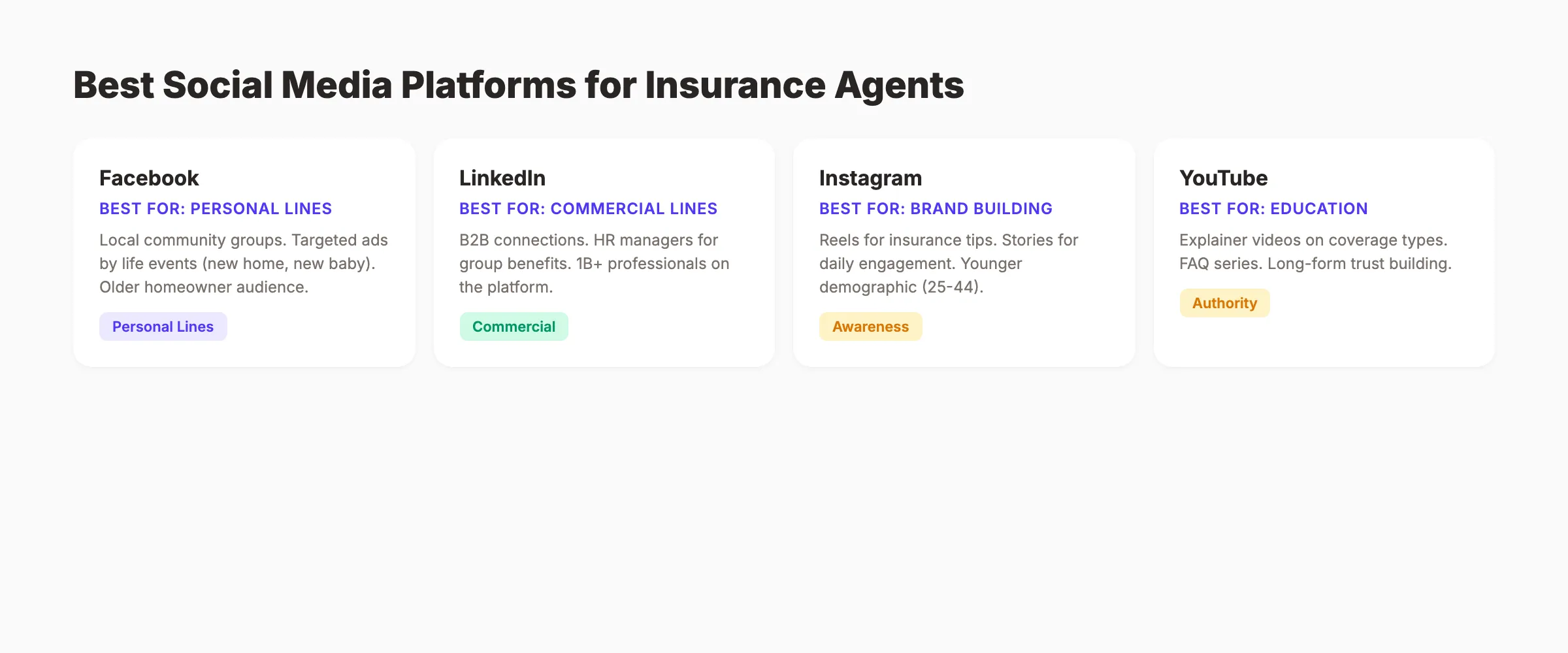
Facebook: Best for Personal Lines
Facebook reaches the broadest homeowner and family demographic. It is the strongest platform for agents selling auto, home, life, and umbrella coverage.
- 3 billion monthly active users. Your policyholders are already there.
- Life event targeting. Facebook ads let you target people who recently bought a home, got married, or had a baby. These are peak insurance shopping moments.
- Local community groups. "Recommendations" posts in neighborhood groups generate warm referrals with zero ad spend.
- Facebook Business Page reviews build social proof that shows up in Google search.
Set up a Facebook Business Page with your license information, office photos, and a clear "Get a Quote" CTA. Join 5 to 10 local community groups. When someone asks "Does anyone know a good insurance agent?", be the first to respond with your credentials and a link to your reviews.
LinkedIn: Best for Commercial Lines and Group Benefits
LinkedIn is where HR directors, business owners, and CFOs evaluate partners. Over 1 billion professionals use the platform.
- Commercial insurance prospects research vendors on LinkedIn before scheduling meetings.
- Group benefits decisions involve HR teams who are active on LinkedIn daily.
- Professional credibility grows faster on LinkedIn than any other platform.
- Content about business risk, compliance, and employee benefits performs well.
Post 3 to 4 times per week. Share industry insights, claims prevention tips, and coverage explanations. Connect with local business owners and HR managers. Comment on their posts. Visibility builds relationships that convert to policies.
Instagram: Best for Brand Building (Ages 25-44)
Instagram reaches younger homeowners and first-time insurance buyers. Reels (short videos under 90 seconds) reach 3 to 5x more people than static posts.
- Before-and-after claim stories (with client permission) show your value visually.
- 60-second explainer Reels ("What does liability actually cover?") build trust.
- Stories keep you visible daily without needing polished content.
- Carousel posts ("5 things your renters insurance does not cover") get saved and shared.
YouTube: Best for Long-Form Education
Insurance topics are complex. YouTube lets you explain coverage types, compare policies, and answer questions in depth. A 5-minute video explaining "The difference between HO-3 and HO-5 homeowners policies" ranks in Google video results and builds trust over months.
Platforms to Skip
- TikTok: Limited ROI for insurance unless you target Gen Z renters exclusively.
- Twitter/X: Low local discovery. Low engagement for service businesses.
- Pinterest: Wrong format for insurance content.
Pick 2 platforms. Facebook + LinkedIn is the best combination for most agents. Add Instagram if your target market skews under 45.
Your SEO team. $99/month. 30 optimized articles published automatically. Social media posts included at $49/mo.
The 80/20 Content Rule for Insurance Agents
Most agents post promotional content exclusively. "Call us for a free quote" repeated 4 times per week generates zero engagement. The 80/20 rule works better: 80% value-driven content, 20% promotional.
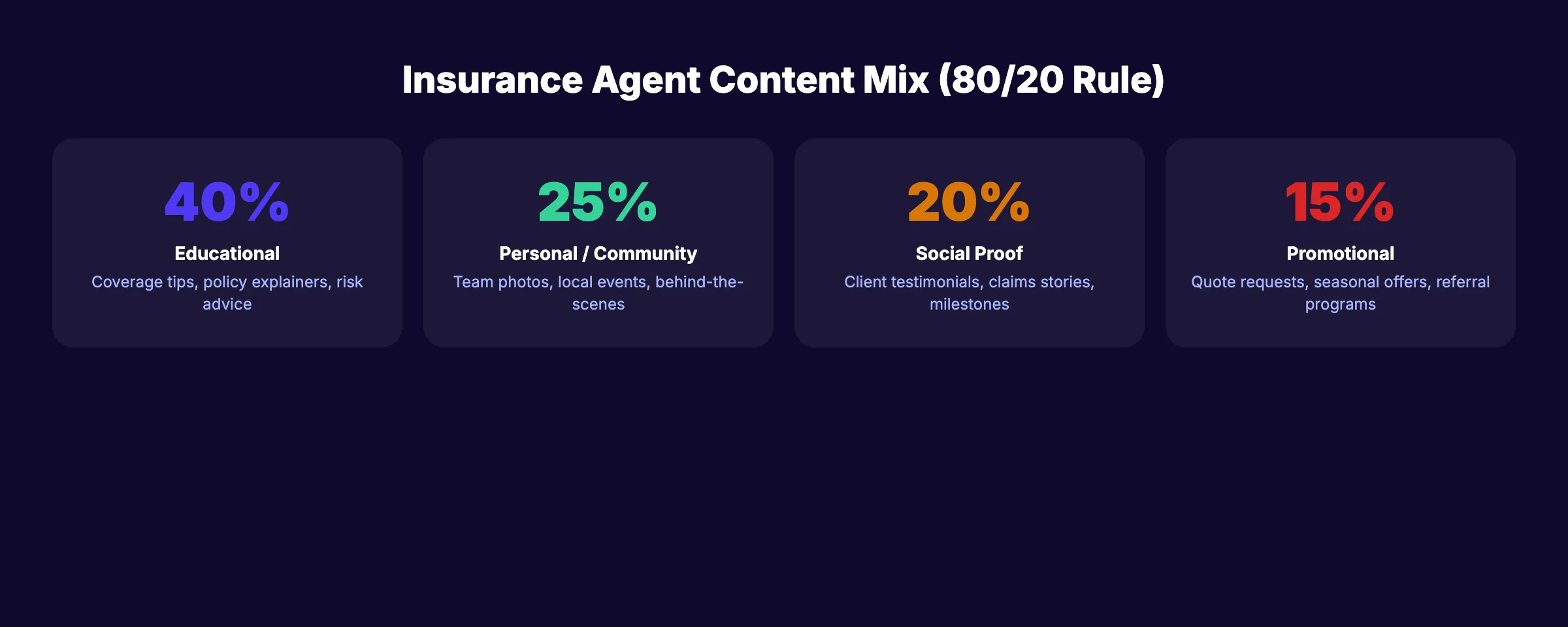
Educational Content (40% of Posts)
Answer the questions your clients ask every day:
- "What does liability insurance actually cover?"
- "3 things your renters insurance does not cover"
- "Home vs condo insurance: what is the difference?"
- "Do I need an umbrella policy? Here is how to decide."
- "How much life insurance do you actually need?"
Keep posts under 150 words. Use simple language. Avoid jargon. Insurance is confusing enough. Your job on social media is to make it clear.
Short-form video works best for educational content. A 60-second Reel explaining one concept builds more trust than a 500-word text post. Film on your phone. Speak naturally. Polished production is not required. 63% of consumers prefer authentic, relatable video over high production quality.
Personal and Community Content (25% of Posts)
People buy insurance from people they trust. Show the human side of your agency:
- Team photos and introductions
- Local event sponsorships and community involvement
- Office celebrations and milestones
- Volunteer work and charity partnerships
- Personal stories (within professional boundaries)
A photo of your team volunteering at a local food bank builds more connection than 10 posts about deductibles. Homeowners want to know their agent cares about the same community they live in.
Social Proof (20% of Posts)
Share evidence that clients trust you:
- Google review screenshots with a "thank you" caption
- Client testimonials (video testimonials perform 2x better than text)
- Claims success stories ("We helped the Martinez family rebuild after the storm")
- Retention milestones ("15 years with the same clients")
- Awards, certifications, or industry recognitions
Promotional Content (15% of Posts)
Limit direct sales pitches to 15% or less. Save promotions for moments that matter:
- "Open enrollment starts October 15. Let us review your plan."
- "Spring storm season is here. Is your homeowners policy up to date?"
- "New home? Congratulations. Here is a free coverage review."
- "Refer a friend and both receive a $25 gift card."
Every promotional post needs a clear CTA: phone number, quote link, or "DM us."
Weekly Posting Schedule for Insurance Agents
Consistency matters more than frequency. 4 posts per week on a predictable schedule outperforms random daily posting.
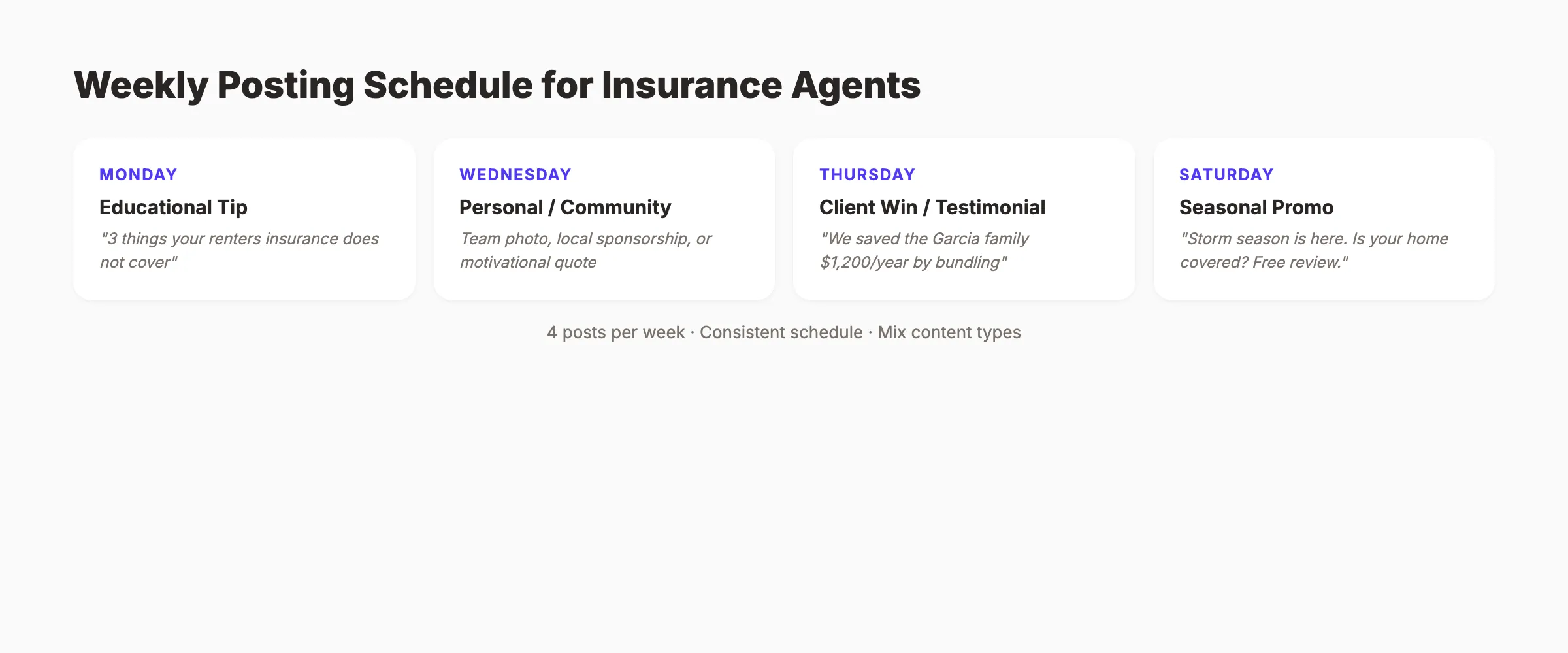
Monday: Educational Tip
Share one useful piece of insurance knowledge. Keep it specific and practical.
Example: "Most people do not know that standard homeowners insurance does not cover flood damage. If you live in a flood zone, you need a separate flood policy. Not sure? Check FEMA's flood map or call us for a free review."
Wednesday: Personal or Community Post
Show the human side of your agency. Team content, local involvement, or a behind-the-scenes moment.
Example: "Our team spent Saturday morning at the Cedar Park Community Clean-Up. Proud to serve the same neighborhoods we protect."
Thursday: Client Win or Testimonial
Share a positive outcome. Use client permission and avoid specific policy details.
Example: "We just helped the Garcia family save $1,200 per year by bundling their home and auto. Same coverage. Lower premium. Sometimes a second look is all it takes."
Saturday: Seasonal or Promotional Post
Tie promotions to relevant seasonal events or life changes.
Example: "Hurricane season starts June 1. Most flood claims are filed by people who did not think they needed flood insurance. Let us review your policy before the storms arrive. Free, no obligation."
Scaling to Daily Posting
Add these if you want to post more often:
- Tuesday: Industry news or policy update ("New state regulations on auto coverage")
- Friday: FAQ video ("This week's question: Does car insurance cover rental cars?")
- Sunday: Motivational or personal reflection post
For social media automation tools to schedule posts in advance, see our guide.
Turning Engagement Into Appointments
Likes do not pay commissions. Booked appointments do. Here is how to convert social media activity into revenue.
Optimize Every Profile for Lead Capture
Every social media profile needs:
- Phone number (tap-to-call on mobile)
- "Get a Quote" link in your bio
- Office location and service area
- License number (builds compliance and trust)
- Business hours
Respond to Comments and DMs Within 1 Hour
A prospect who comments "Do you offer business insurance?" or DMs "How much is renters insurance?" is a warm lead. Respond within 1 hour. After 4 hours, the prospect contacts a competitor. Speed wins.
Set mobile notifications for all business messages. If you have staff, assign social media response to a specific team member during business hours.
Use Facebook Life Event Targeting
Facebook allows you to target people based on life events. These are peak insurance shopping moments:
| Life Event | Insurance Need | Ad Message |
|---|---|---|
| Recently moved | Homeowners / renters | "New home? Make sure you are covered." |
| Recently engaged | Life + auto bundle | "Congrats on the engagement. Let us help you plan ahead." |
| New baby | Life insurance | "Growing family? A life insurance review takes 15 minutes." |
| New job | Auto + benefits review | "New job? Make sure your benefits package covers what you need." |
| Turned 65 | Medicare | "Turning 65? Let us walk you through your Medicare options." |
Life event targeting converts 3 to 5x better than interest-based targeting because you reach people at the exact moment they need insurance.
Run a Referral Program on Social
Insurance thrives on referrals. Social media amplifies them. Create a simple referral program and promote it monthly:
"Refer a friend to our agency. When they bind a policy, you both receive a $25 gift card. No limit on referrals."
Post the referral offer once per month. Tag clients who refer successfully (with permission). Social proof of referrals encourages more referrals.
Rank everywhere. Do nothing. Blog SEO, Local SEO, and Social on autopilot. theStacc starts at $49/mo.
Compliance Considerations for Insurance Social Media
Insurance is a regulated industry. Every social media post must comply with state regulations and carrier guidelines.
What You Must Include
- License number on your profile and any post that solicits business
- Carrier disclaimers when discussing specific products or rates
- State-required disclosures (varies by state and line of business)
What to Avoid
- Guaranteed savings claims ("We will save you 40%") without qualification
- Specific rate quotes in public posts (rates vary by individual risk)
- Client-identifying information without written consent
- Disparaging comments about competitors or carriers
- Misleading claims about coverage or benefits
Best Practices for Compliance
- Get carrier approval for any post mentioning their products by name
- Archive all social media posts (many compliance tools do this automatically)
- Review your state's Department of Insurance social media guidelines
- When in doubt, keep posts educational rather than product-specific
- Have a compliance officer or E&O carrier review your content calendar quarterly
Compliance does not have to kill your social media presence. Educational content, community posts, and client testimonials rarely trigger compliance issues. Product-specific rate comparisons and coverage guarantees do.
FINRA and SEC Considerations (For Securities-Licensed Agents)
If you sell variable products, annuities, or investment-linked insurance, FINRA regulations add another layer. All social media posts about these products must be pre-approved by your broker-dealer. Static posts require principal approval before posting. Interactive content (comments, replies) must be supervised. Archive everything for at least 3 years. Check with your compliance department before posting anything about investment-linked products.
Paid Social Advertising for Insurance Agents
Organic reach builds long-term presence. Paid ads generate immediate leads.
Facebook and Instagram Ads
| Ad Type | Best For | Budget |
|---|---|---|
| Lead Ads | Collecting quote requests | $15-$30/day |
| Life Event Ads | Targeting new homeowners, new parents | $10-$25/day |
| Retargeting Ads | People who visited your quote page | $5-$15/day |
| Video Ads | Brand awareness and education | $10-$20/day |
LinkedIn Ads for Commercial Lines
LinkedIn ads cost more per click ($5 to $15) but reach decision-makers directly. Target by job title (HR Director, CFO, Office Manager), company size, and industry. LinkedIn Lead Gen Forms collect contact information without leaving the platform.
For commercial lines, one closed policy from LinkedIn can justify 6 months of ad spend. Target carefully and follow up quickly.
Tracking ROI
Track every campaign with:
- Cost per lead (target under $30 for personal lines, under $75 for commercial)
- Cost per bound policy (your true acquisition cost)
- Return on ad spend (target 5x for personal, 10x for commercial)
- Lead-to-quote conversion rate
- Quote-to-bind conversion rate
3,500+ blogs published. Every article is SEO-scored before publish. See what theStacc can do for your insurance agency.
Common Mistakes Insurance Agents Make on Social Media
Only Posting Company-Branded Graphics
Carrier-provided graphics look generic. They do not differentiate you from the 10 other agents posting the same image. Create your own content. A phone video of you explaining a coverage tip outperforms a branded graphic every time.
Posting Sporadically
3 posts one week, then silence for a month, resets your algorithm visibility to zero. Batch-create a month of content in 2 hours. Schedule it with a social media management tool. Consistency compounds.
Ignoring Comments and Messages
Every unanswered message is a lost appointment. Treat social media DMs with the same urgency as a phone call. Set up notifications and respond within the hour.
Making Every Post a Sales Pitch
"Call us for a free quote" posted 4 times per week drives unfollows. Follow the 80/20 rule. Educate, connect, and build trust 80% of the time. Sell 20%.
Not Tracking Results
If you do not know which posts generate quote requests, you cannot optimize. Track engagement, website clicks, and direct messages by post type. Double down on what drives appointments.
Ignoring LinkedIn for Commercial Lines
Facebook works for personal lines. LinkedIn works for commercial lines. Most agents only use Facebook and miss the entire B2B opportunity. If you sell business insurance, workers comp, or group benefits, LinkedIn is your highest-ROI platform.
For a broader content marketing strategy that combines social media with SEO and blog content, see our dedicated guide.
What practitioners are saying on X
Marketing systems still win. Here is operator signal from X on SEO stacks and fundamentals.
- @jakezward (Feb 2026): 2026 SEO predictions emphasize AI Overview share-of-SERP, schema for LLM token efficiency, brand mentions in AI answers as a KPI, proprietary data as a moat, and content refresh beating net-new AI slop. See the post on X.
- @ConnorGillivan (Jul 2026): 2026 SEO stack favorite list: Semrush/Ahrefs, GSC, Surfer, KeywordInsights, ChatGPT, SEOwind, Screaming Frog, ClearScope, GA4, Notion/Airtable — tools amplify systems, they don’t replace them. See the post on X.
- @HlynurStefDev (Jul 2026): Public case: niche site traffic jumped from ~18 to 4,162 Google visits/month after focused technical/on-page SEO work (GSC screenshots claimed) — reminds that fundamentals still move numbers. See the post on X.
Grok, AI Overviews, and multi-engine visibility
For “social media for insurance”, multi-engine visibility still starts with clear definitions, sourced numbers, and extractable section answers. Grok additionally factors live X discussion — keep public claims consistent with this page.
- Google AI Overviews: Use passage-ready answers, tables, and FAQ schema where relevant.
- ChatGPT / Perplexity: Cite named sources next to key claims.
- Grok: Maintain accurate entity facts on-site and in high-signal X posts.
Publish content built for Google and AI citations. theStacc’s Content SEO module ships SEO-scored articles structured for rankings and generative engines — including clearer entity pages models like Grok can quote.
FAQ
Facebook is the best overall platform for personal lines agents. It offers the largest homeowner audience, life event targeting for ads, and active community groups. LinkedIn is the best platform for commercial lines and group benefits. Most agents should focus on Facebook + LinkedIn and add Instagram if they target a younger demographic.
Post 3 to 4 times per week on a consistent schedule. Monday education, Wednesday community, Thursday social proof, and Saturday promotion is an effective pattern. Consistency matters more than frequency. 4 posts per week every week beats daily posting followed by weeks of silence.
Follow the 80/20 rule: 80% value-driven content (educational tips, community involvement, client testimonials) and 20% promotional content (quote requests, seasonal offers, referral programs). The biggest mistake agents make is posting promotional content exclusively.
Yes. Facebook Lead Ads and life event targeting generate qualified leads for personal lines agents. The average cost per lead for insurance on Facebook is $15 to $30 for personal lines. Life event targeting (new homeowners, new parents, newly married) converts 3 to 5x better than interest-based targeting.
Include your license number on your profile. Get carrier approval for product-specific posts. Avoid guaranteed savings claims without qualification. Do not share client-identifying information without consent. Archive all posts. Have compliance or E&O review your content calendar quarterly. Educational and community content rarely triggers compliance issues.
Social media amplifies referrals rather than replacing them. When a client tags you in a recommendation post, that referral reaches hundreds of their connections. A referral program promoted on social media generates more referrals than word-of-mouth alone. The best agents use social media to make every happy client a visible advocate.
Social media for insurance agents works when you stop treating it like a billboard and start treating it like a relationship tool. Show up consistently. Educate more than you sell. Respond quickly. The agents growing their book of business fastest are the ones their community sees every week, not the ones hiding behind a carrier logo.
Related Tools & Resources
Free SEO Tools:
Best Lists:
Sources & references
- [1] Princeton / Georgia Tech et al. — GEO research (arXiv:2311.09735)
- [2] @hridoyreh on X — Widely shared SEO skill tree: foundations, research, technical, on-page, content, links, AI SEO/GEO, analytics, UX, bran
- [3] @jakezward on X — 2026 SEO predictions emphasize AI Overview share-of-SERP, schema for LLM token efficiency, brand mentions in AI answers
- [4] Referenced source — www.sendible.com

Plan topics, review article drafts, and publish to a connected CMS.
Weekly local SEO teardowns
One practical email a week. Map Pack, GBP, AI Overviews. No fluff. Unsubscribe anytime.
Explore this topic: Social Media Marketing · Keep your social calendar moving without starting from scratch..