Storage Facility SEO: Rank on Google and Fill More Units
The complete storage facility SEO guide. Google Business Profile, local keywords, reviews, and content strategy for self-storage operators. Updated 2026.
Siddharth Gangal • 2026-04-02 • Local SEO
In This Article
The U.S. self-storage market reached $21.75 billion in 2024 and continues growing at 6.1% annually. Over 50,000 storage facilities compete for renters across the country. Unit inventory increased 9.3% in the past 3 years alone.
Most storage facility operators lose renters to competitors who rank higher on Google.
The problem is clear. When someone types “storage units near me,” they call the first facility in the Google Maps local pack. They do not scroll. They do not compare 10 options. They call the facility that appears first, looks trustworthy, and has good reviews. If your storage facility does not appear in that top 3, you lose the rental.
Storage facility SEO is different from other local businesses. Renters make fast decisions. They often need storage within days, not weeks. They search by location, unit size, and features like climate control. Your SEO strategy must match that search behavior.
This guide covers every aspect of storage facility SEO. Not generic marketing advice. Specific tactics for self-storage operators, multi-location brands, and independent facilities competing against REITs.
We have published 3,500+ SEO articles across 70+ industries, including self-storage businesses. This is the approach we use.
Here is what you will learn:
- How to optimize your Google Business Profile for storage searches
- The exact keywords renters use to find storage facilities
- Content strategy that drives organic rentals
- Why reviews determine which storage facility gets the call
- Technical SEO basics every storage website needs
- How to compete against large REITs with a local SEO advantage
Why Most Storage Facilities Lose Renters to Google
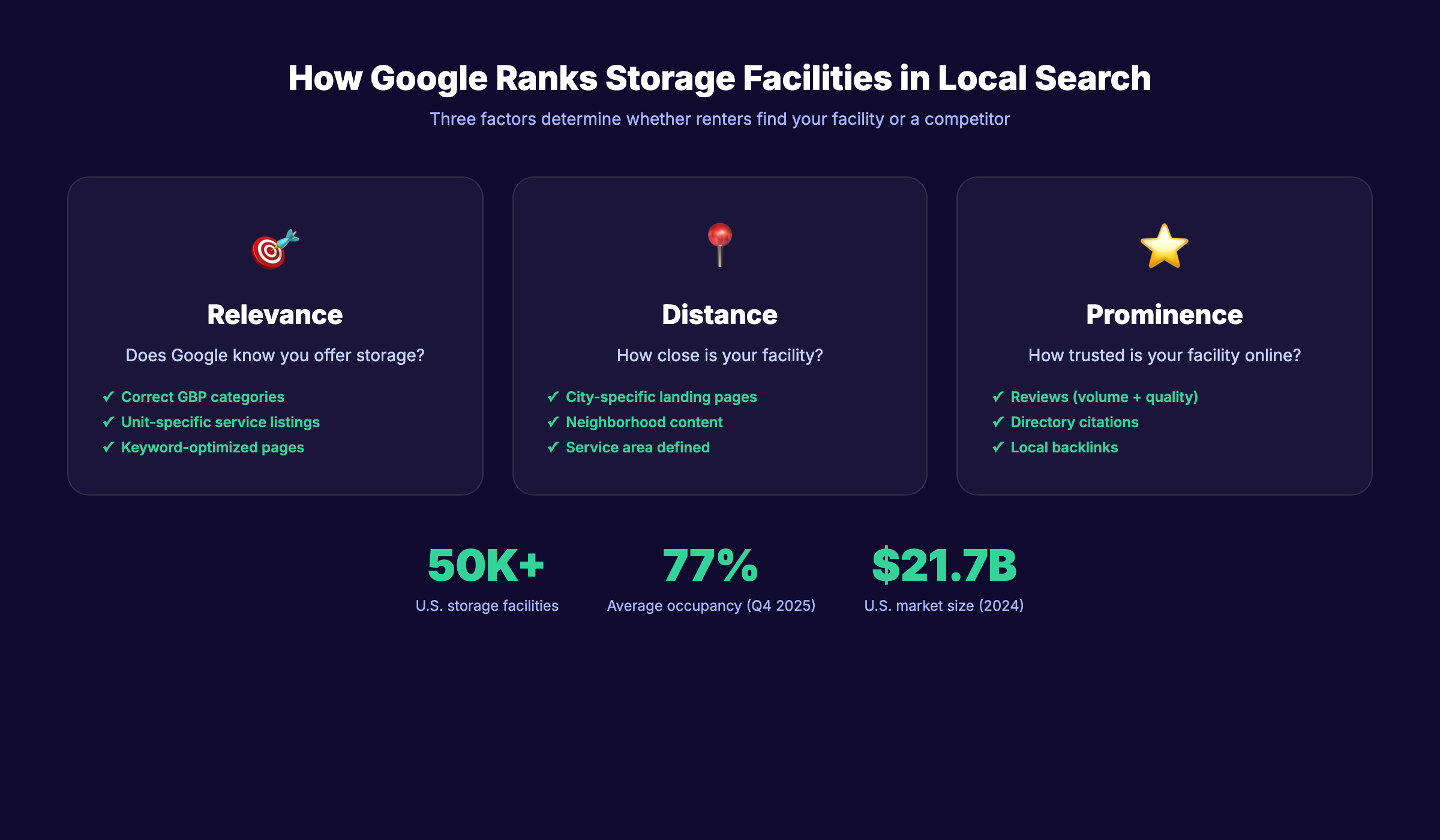
Google uses 3 factors to determine which storage facilities appear in local search results.
Relevance. Does Google understand that your business offers self-storage? Correct categories, unit-specific service listings, and keyword-optimized content signal relevance.
Distance. How close is your facility to the searcher? Most renters travel within 15 to 30 minutes to reach a storage facility. You cannot move your building. But you can create content targeting surrounding neighborhoods and nearby cities.
Prominence. How trusted is your facility online? Reviews, backlinks, directory citations, and consistent NAP (Name, Address, Phone Number) data build prominence.
Most storage facilities fail on relevance and prominence. They have a basic website with no blog content, an incomplete Google Business Profile, and fewer than 30 reviews. The competitor with 200 reviews, unit-specific landing pages, and weekly blog posts wins every “storage near me” search.
The local SEO statistics confirm this. 46% of all Google searches have local intent. 76% of people who search for a local business visit within 24 hours. For storage renters searching during a move, that urgency is even higher.
Optimize Your Google Business Profile for Storage Searches
Your Google Business Profile determines whether you appear in the Maps local pack. That 3-result box above organic search results captures the majority of clicks for storage-related searches.
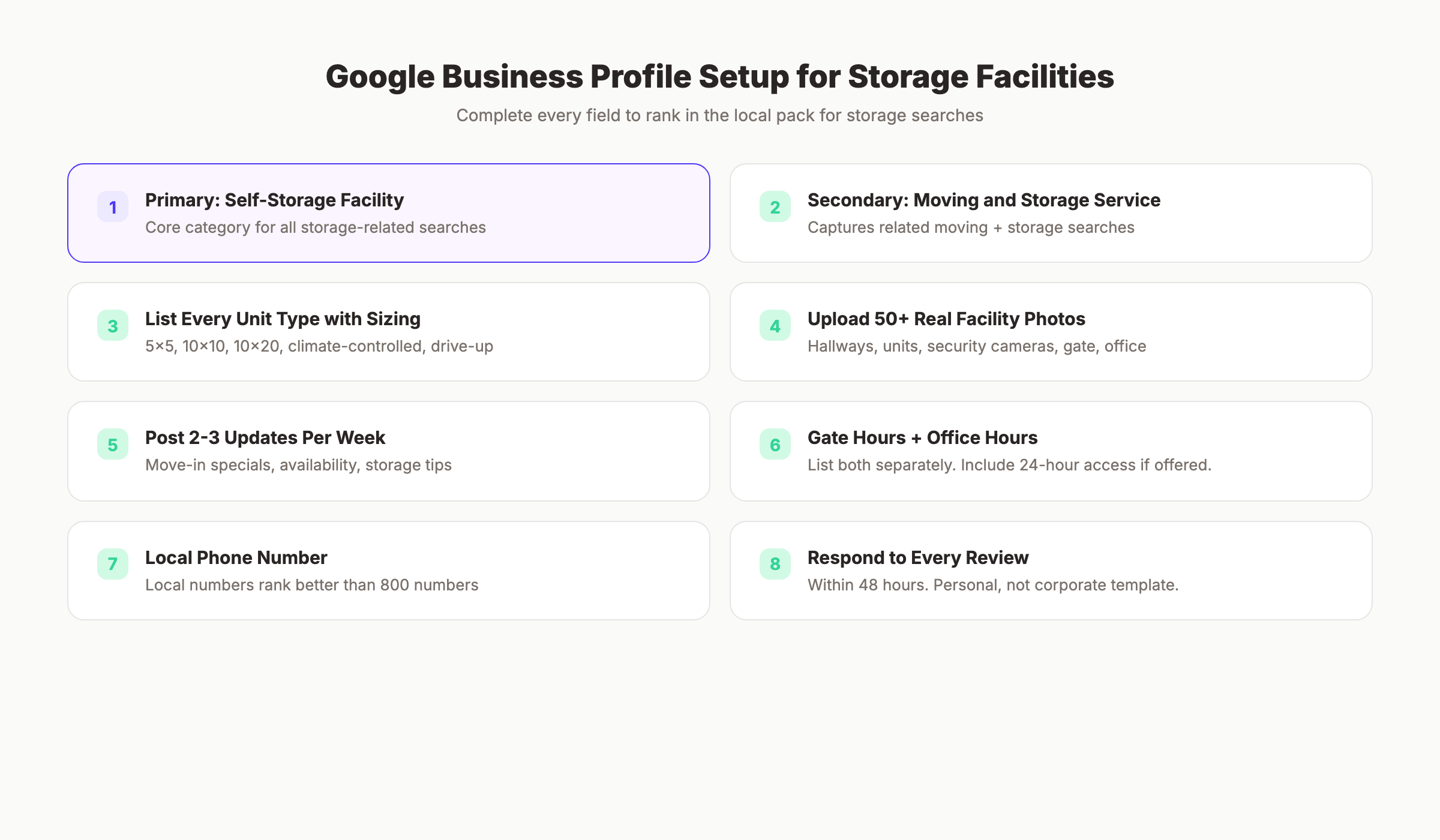
Claim and Complete Every Field
| Field | What to Enter | Why It Matters |
|---|---|---|
| Business name | Exact legal name (no keyword stuffing) | Google penalizes names with added keywords |
| Primary category | Self-Storage Facility | Determines core search visibility |
| Secondary categories | Moving and Storage Service, Warehouse | Captures related searches |
| Address | Full street address | Determines local pack eligibility |
| Phone | Local phone number | Local numbers rank better |
| Website | Your facility website URL | Drives clicks from the profile |
| Hours | Accurate gate hours and office hours | Incorrect hours trigger negative reviews |
| Services | List every unit type with pricing | Helps Google match searches to your profile |
List Unit Types as Services
Google lets you list individual services. Use this to list every unit type with dimensions and features.
- 5x5 storage unit (25 sq ft)
- 5x10 storage unit (50 sq ft)
- 10x10 storage unit (100 sq ft)
- 10x15 storage unit (150 sq ft)
- 10x20 storage unit (200 sq ft)
- 10x30 storage unit (300 sq ft)
- Climate-controlled storage units
- Drive-up access units
- Vehicle and RV storage
- Boat storage
- Business and commercial storage
- Wine storage (if applicable)
Each listing gives Google another signal. A renter searching “10x10 climate controlled storage near me” needs to see that exact unit type on your profile.
Post Photos That Sell
Storage facility photos directly influence rental decisions. Renters want to see clean, well-lit, secure facilities before they visit.
Post 3 to 5 photos per week:
- Facility exterior and entrance signage
- Clean hallways and individual units
- Security features (cameras, gate access, fencing)
- Climate-controlled unit interiors
- Drive-up access areas
- Vehicle and RV parking spots
- Office and customer service area
Avoid stock photos. Real photos of your actual facility build trust. Before-and-after photos of facility improvements perform especially well.
For a full walkthrough, read our Google Business Profile optimization guide. Use our free GBP post generator to create weekly updates quickly.
Stop writing. Start ranking. Stacc publishes 30 SEO articles per month for $99. Built for storage facilities that want to fill units from Google. Start for $1 →
Storage Facility SEO Keywords That Drive Rentals
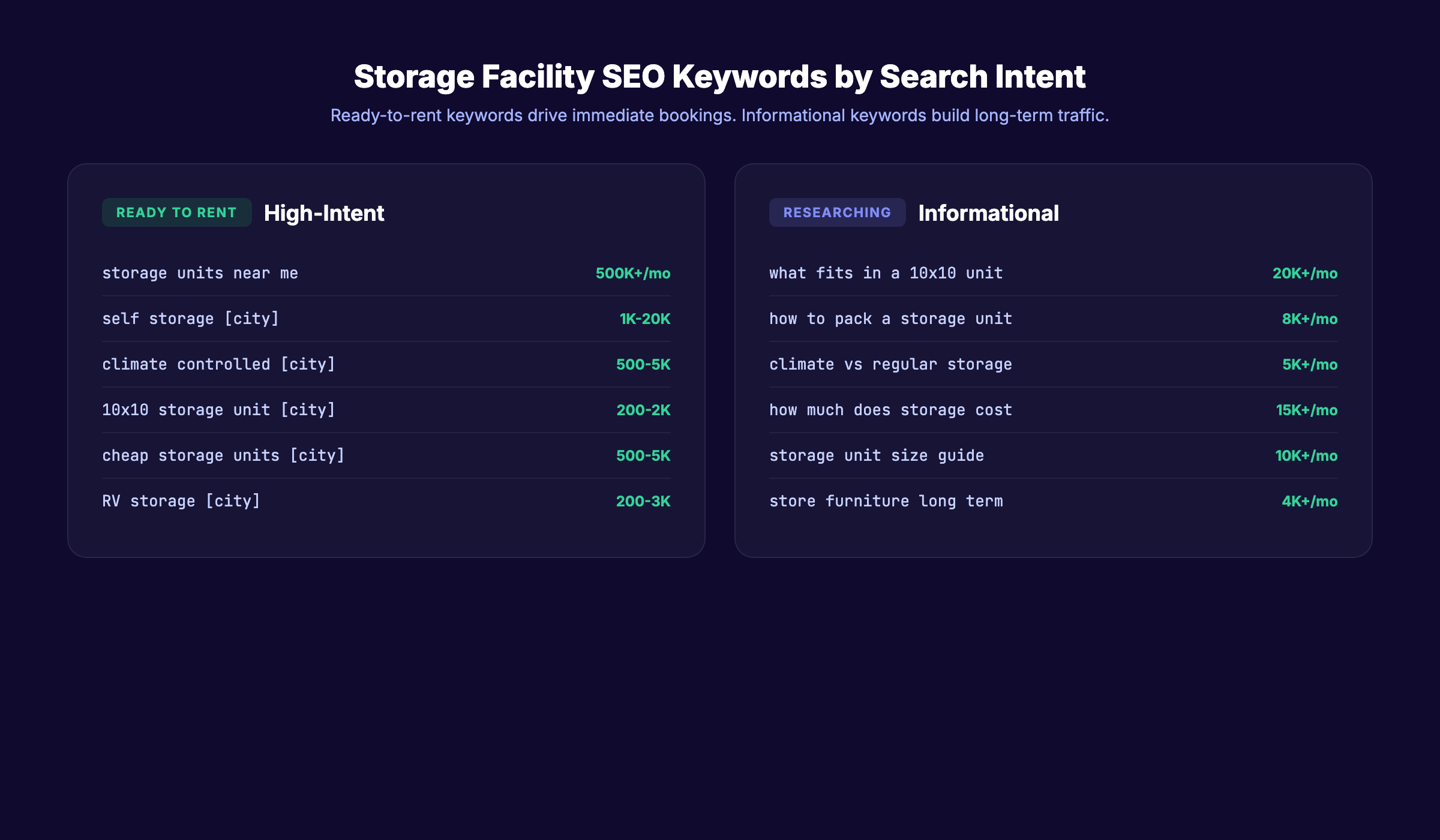
Renters search for storage in predictable patterns. They combine location, unit size, and features into specific queries. Your job is to match those patterns across your website and Google profile.
High-Intent Keywords
These keywords come from renters who are ready to book a unit.
| Keyword Pattern | Monthly Volume | Intent |
|---|---|---|
| storage units near me | 500K+ | Ready to rent |
| self storage [city] | 1K-20K per city | Ready to rent |
| climate controlled storage [city] | 500-5K per city | Feature-specific |
| 10x10 storage unit [city] | 200-2K per city | Size-specific |
| cheap storage units [city] | 500-5K per city | Price-sensitive |
| RV storage [city] | 200-3K per city | Vehicle storage |
| storage unit prices [city] | 500-3K per city | Comparing options |
| moving storage near me | 50K+ | Time-sensitive |
Informational Keywords for Blog Content
These keywords attract renters earlier in their decision process. Many people research storage before a move, downsizing, or home renovation.
- “What fits in a 10x10 storage unit”
- “How to pack a storage unit efficiently”
- “Climate controlled vs regular storage”
- “How much does a storage unit cost”
- “Do I need climate controlled storage”
- “How to choose a storage facility”
- “Storage unit size guide”
- “Best way to store furniture long term”
- “How to prepare for a move with storage”
- “Is self storage worth it”
Each keyword becomes a blog post. Each blog post targets renters in your area. Over time, these posts build topical authority that helps your entire site rank higher for competitive storage keywords.
For detailed keyword research methods, read our keyword research for blog posts guide.
Content Strategy for Storage Facilities
Most storage facility websites have a homepage, an about page, a unit sizes page, and a contact form. That is not enough for Google to rank you against competitors or REITs with hundreds of pages.
The storage facilities that dominate local search publish useful, specific content consistently. Not marketing fluff. Practical information that renters actually search for.
Content Categories That Work
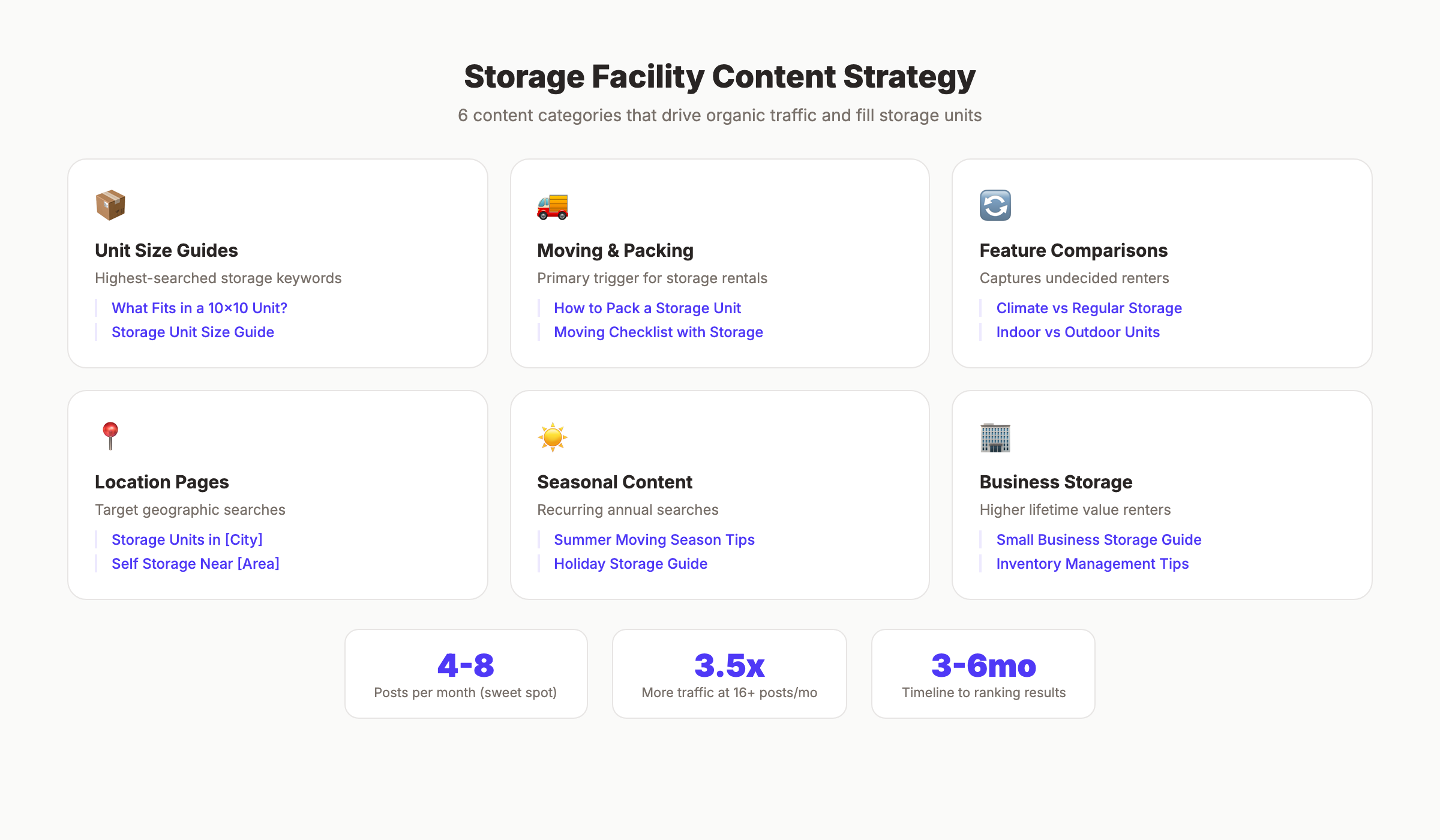
Unit size guides. “What Fits in a 5x10 Storage Unit?” or “10x10 Storage Unit: Size, Cost, and What It Holds.” These are among the highest-searched storage keywords. Renters want to know exactly which unit to rent before they visit.
Moving and packing guides. “How to Pack a Storage Unit to Maximize Space” or “Moving Checklist: Using Storage During a Relocation.” Moving is the primary trigger for storage rentals. Content that helps movers naturally leads to storage bookings.
Feature comparisons. “Climate Controlled vs Regular Storage: Do You Need It?” or “Indoor vs Outdoor Storage Units: Pros and Cons.” Comparison content captures renters who are undecided on features.
Location-specific pages. “Storage Units in [City]” or “Self Storage Near [Neighborhood].” Create a unique landing page for every city and neighborhood your facility serves. Each page targets a different geographic search.
Seasonal content. “Summer Moving Season: Storage Tips for Peak Demand” or “Holiday Storage: How to Store Decorations Safely.” Seasonal content ranks for recurring annual searches.
Business storage guides. “Small Business Storage: What You Need to Know” or “How to Use Self Storage for Inventory Management.” Business renters tend to stay longer and rent larger units. They represent higher lifetime value.
Publishing Frequency
Publishing 4 to 8 articles per month creates enough momentum to outrank competitors who publish nothing. Research from HubSpot shows businesses publishing 16+ posts per month get 3.5x more traffic than those publishing 0 to 4.
For storage facilities, consistency matters more than volume. Even 4 posts per month on unit sizes, packing tips, and local content creates a visible advantage within 3 to 6 months.
For help building your publishing schedule, read our content calendar for SEO guide.
Reviews: The Ranking Factor That Fills Units
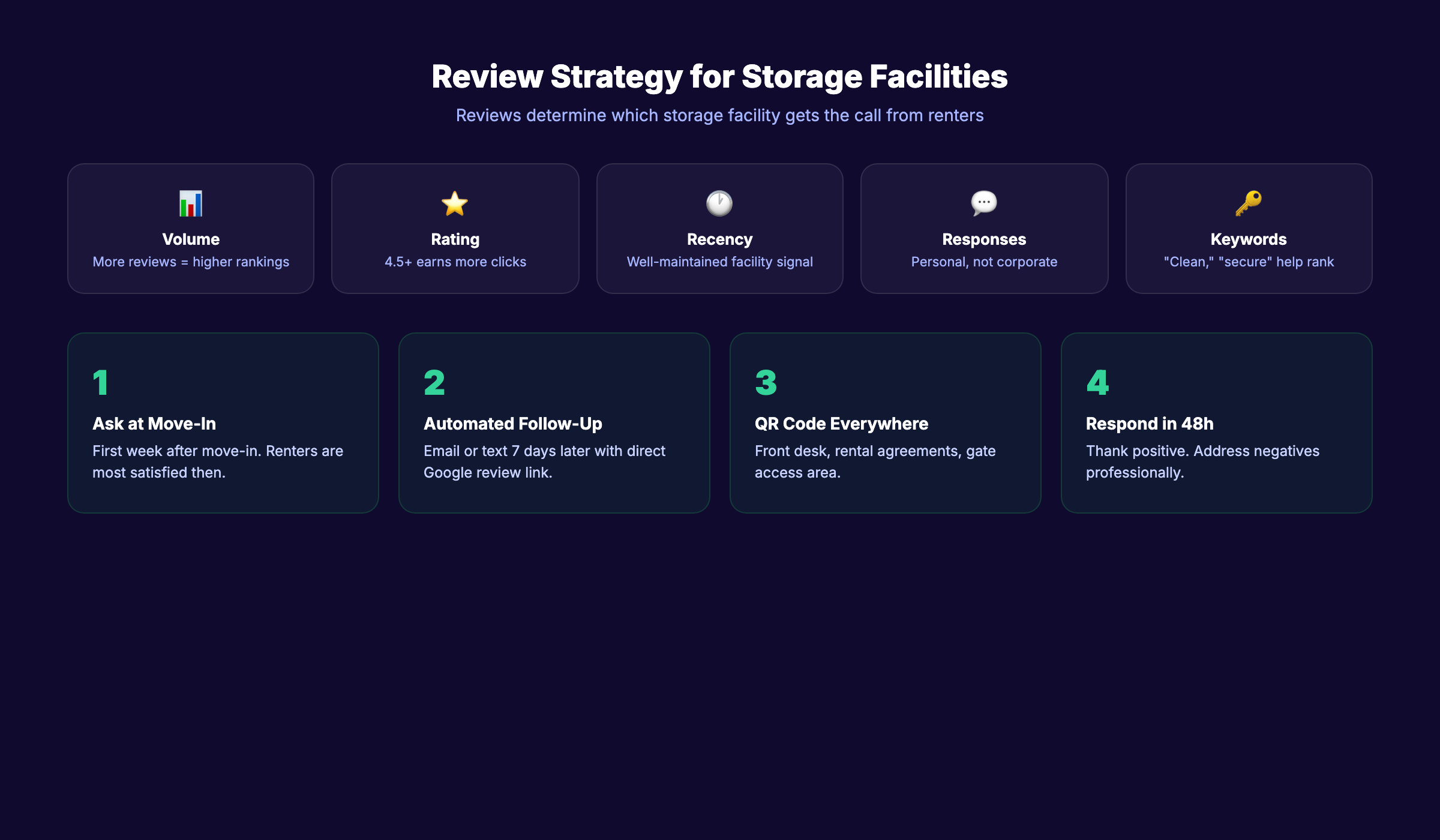
Reviews determine which storage facility gets the call. A renter choosing between 3 facilities in the Google Maps local pack picks the one with the most reviews and the highest rating almost every time.
Why Reviews Matter More for Storage
| Review Factor | Impact on Storage Facilities |
|---|---|
| Total review count | Higher count correlates with higher local pack rankings |
| Average star rating | 4.5+ stars earn significantly more clicks |
| Review recency | Recent reviews signal active, well-maintained facility |
| Owner responses | Responding to every review improves trust and rankings |
| Specific mentions | Reviews mentioning “clean,” “secure,” or unit sizes help rankings |
Average national occupancy at stabilized facilities sits at 77% as of Q4 2025. The facilities at 90%+ occupancy almost always have stronger review profiles than their competitors.
Build Your Review System
- Ask every new renter to leave a Google review during the first week after move-in. They are most satisfied when the unit is fresh and clean.
- Send an automated email or text 7 days after move-in with a direct Google review link.
- Place a QR code at your front desk, on rental agreements, and on the gate access keypad area.
- Respond to every review within 48 hours. Thank positive reviewers by name. Address negative reviews professionally and offer to resolve concerns.
Use our free review QR code generator and review request templates to automate the process.
For a full review strategy, read our guide on how to ask customers for reviews.
Your SEO team. $99 per month. 30 optimized articles, published automatically. Built for storage facilities that want higher occupancy from Google. Start for $1 →
Technical SEO for Storage Facility Websites
A clean, fast website is the foundation of storage facility SEO. If Google cannot crawl your site properly, no amount of content or reviews will help.
Mobile-First Design
Over 60% of storage searches happen on mobile. Renters search from their phones while planning a move or driving to a new apartment. Google uses mobile-first indexing.
Check these items:
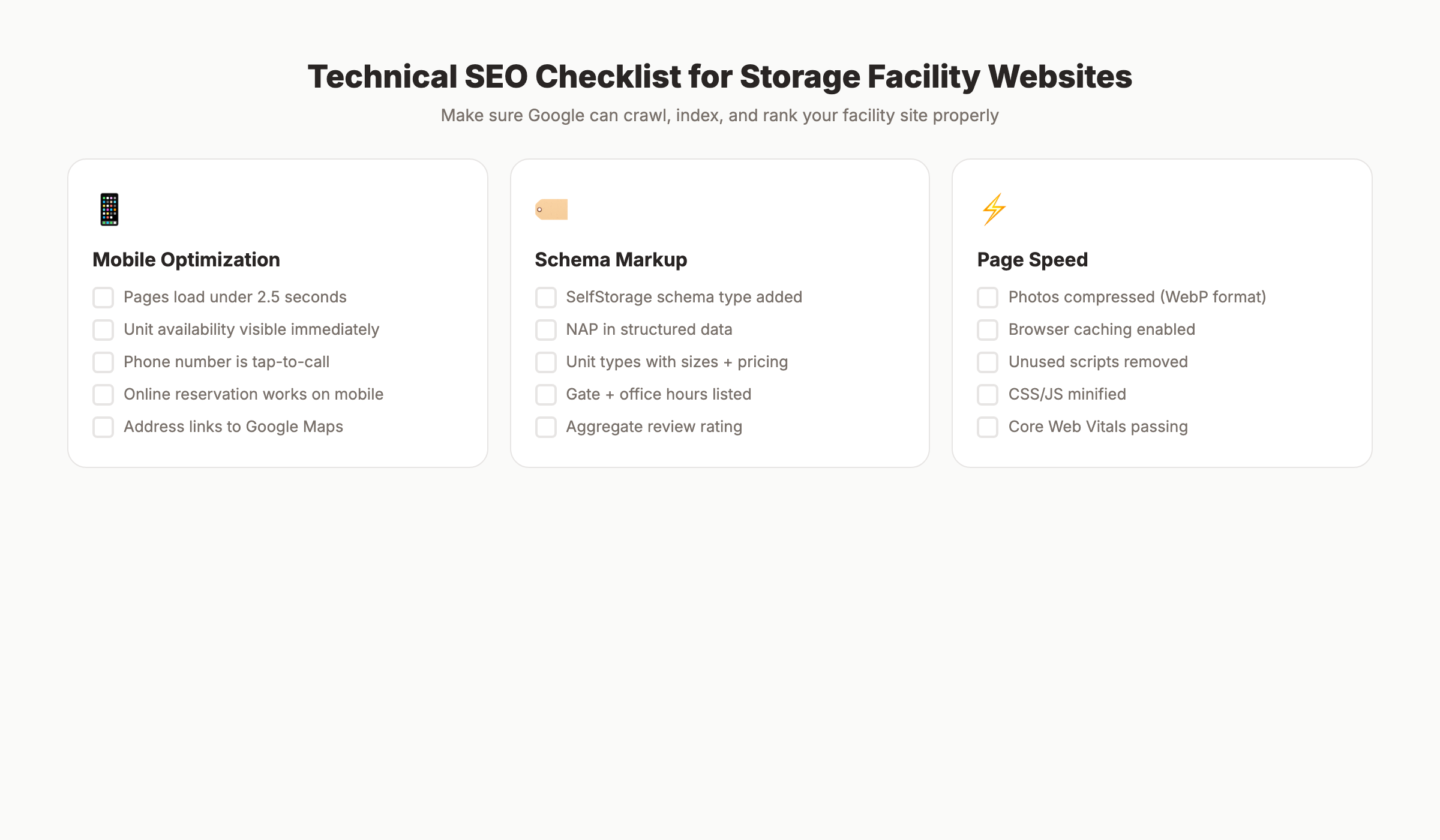
- Pages load in under 2.5 seconds on mobile
- Unit availability and pricing visible without scrolling
- Phone number is clickable (tap-to-call)
- Online reservation forms work on mobile
- Address links to Google Maps for driving directions
Schema Markup
Schema markup tells Google exactly what your business offers. For storage facilities, use the SelfStorage schema type (a subtype of LocalBusiness).
Add schema for:
- Business name, address, and phone number
- Hours of operation (gate hours and office hours)
- Unit types with sizes and pricing
- Amenities (climate control, drive-up, 24-hour access)
- Reviews and aggregate ratings
- Geographic service area
For implementation help, read our schema markup SEO guide. Use our free schema markup generator to create the JSON-LD.
Page Speed
Slow websites lose renters. Google research shows pages loading over 3 seconds see a 53% higher bounce rate. For a renter comparing 3 facilities, a slow-loading website means they book with the competitor whose page loaded first.
Quick improvements:
- Compress all facility photos before uploading
- Use WebP image format instead of PNG or JPEG
- Enable browser caching
- Remove unused scripts and plugins
- Minimize CSS and JavaScript files
Run our free SEO audit tool to find technical issues on your site.
Build Citations and Local Backlinks
Citations confirm your storage facility exists at the address you claim. Backlinks from local organizations build authority.
Essential Directories for Storage Facilities
Submit your facility to these directories with identical NAP information.
- Google Business Profile
- Yelp
- SpareFoot
- StorageCafe
- SelfStorage.com
- Apple Maps (read our Apple Maps SEO guide)
- Bing Places
- Facebook Business
- Better Business Bureau
- Local Chamber of Commerce
- Self Storage Association (SSA)
- State self-storage association
Consistency is everything. Your facility name, address, and phone number must match exactly across every listing. One wrong digit can confuse Google and drop your local pack ranking.
Local Backlinks
Target backlinks from organizations in your service area.
- Real estate agents and agencies. Many recommend storage during transitions. Ask to be listed on their resources page.
- Moving companies. Partner with local movers for mutual referrals and website listings.
- Apartment complexes. Offer move-in storage discounts for their residents and get listed on their site.
- Local business associations. Join and get listed on their member directory.
- Home staging companies. Home sellers often need temporary storage. Cross-promote with stagers.
- Local news and community sites. Offer tips for moving season stories.
Each local backlink tells Google your storage facility is a trusted part of the community. For a full overview, read our local SEO guide.
Compete Against REITs With Local SEO
Large storage REITs like Public Storage, Extra Space Storage, and CubeSmart dominate national search results. They have massive marketing budgets and hundreds of pages of content. Independent operators cannot outspend them.
But you can outrank them locally.
Your Local Advantage
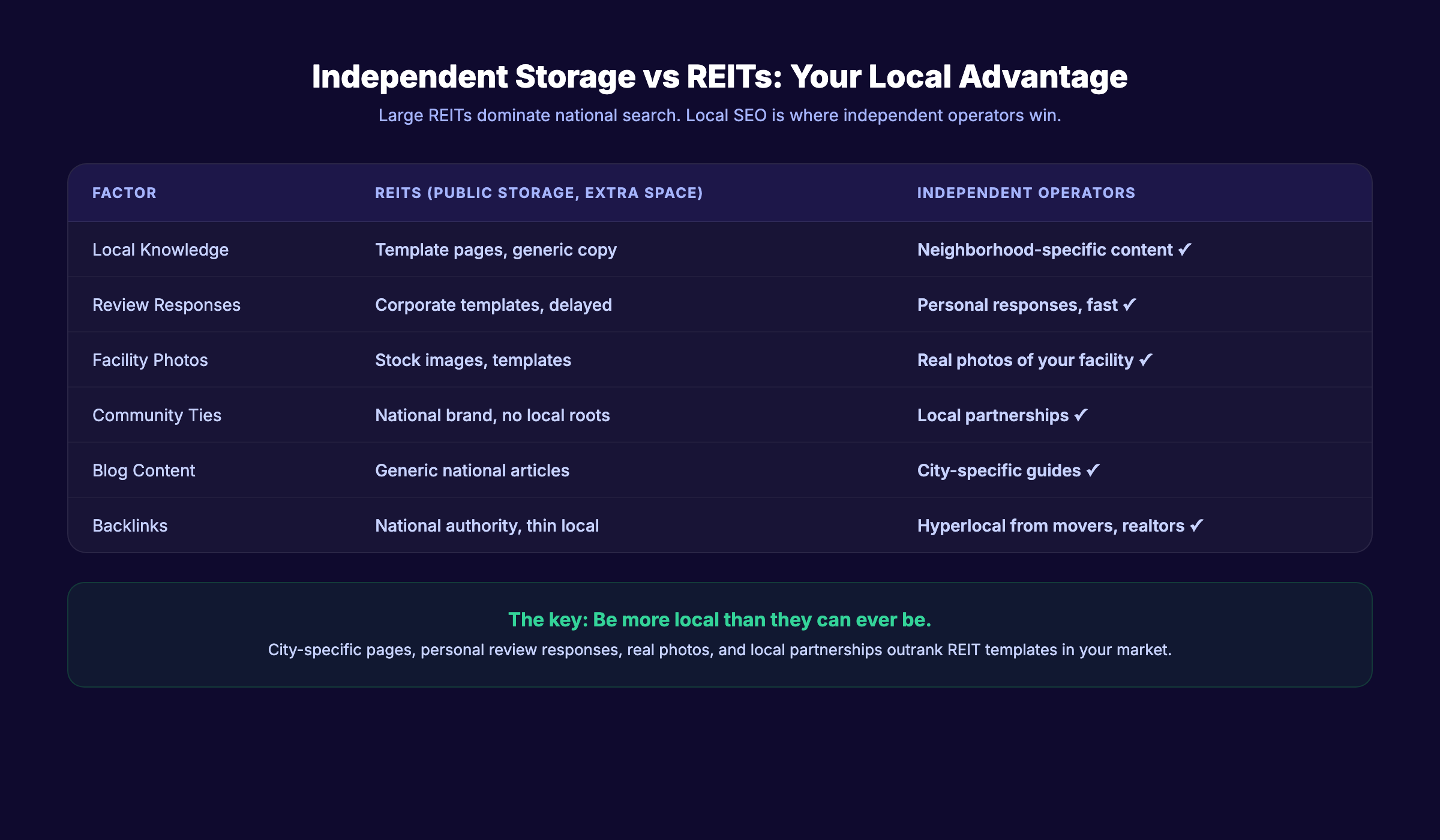
REITs optimize for scale. They create template pages for thousands of locations. Those pages often feel generic. They use the same stock photos, the same descriptions, and the same blog content across every market.
As an independent operator, you have advantages they do not:
| Factor | REITs | Independent Operators |
|---|---|---|
| Local knowledge | Template pages, generic copy | Neighborhood-specific content |
| Reviews | Corporate responses, delayed | Personal responses, fast turnaround |
| Photos | Stock images, facility templates | Real photos of your actual facility |
| Community ties | National brand, no local roots | Local partnerships and sponsorships |
| Content | Generic national blog | Local guides, city-specific content |
How to Win
Create city-specific landing pages. Write unique content for every city and neighborhood you serve. Not template pages. Genuinely unique content that mentions local landmarks, nearby businesses, and area-specific storage needs.
Respond to reviews personally. REITs use corporate review response templates. You can respond as the owner with personal, specific replies. Google and renters both notice the difference.
Build local backlinks. REITs do not partner with local moving companies or apartment complexes in your city. You can. Those hyperlocal backlinks carry more weight in local rankings than national brand authority.
Publish local content. “Best Moving Tips for [Your City]” or “Storage Demand During [Your City] College Move-In Season.” REITs will never write content this specific. That specificity is your ranking advantage.
The GBP categories guide covers how to set up your profile categories correctly to maximize visibility against larger competitors.
3,500+ blogs published. 92% average SEO score. We publish storage facility SEO content that ranks locally and fills units. Start for $1 →
Storage Facility SEO Checklist
Use this checklist to audit and optimize your storage facility for Google.
Google Business Profile:
- Profile claimed and verified
- Primary category: Self-Storage Facility
- Secondary categories: Moving and Storage Service
- All unit types listed as services with sizes and pricing
- Gate hours and office hours accurate
- 50+ real facility photos uploaded
- Posting 2 to 3 GBP updates per week
- Responding to every review within 48 hours
Website:
- Homepage targets “[city] storage units”
- Individual landing pages for each unit size
- Location pages for each city or neighborhood served
- Blog publishing 4+ posts per month
- Mobile-friendly with online reservation capability
- SelfStorage schema markup added
- NAP matches GBP and all directory listings
Reviews:
- 50+ Google reviews (more than top local competitor)
- 4.5+ star average rating
- New reviews weekly from recent renters
- Every review gets a personal response
Content:
- Unit size guides for every size offered
- Moving and packing tips published
- Feature comparison content (climate vs regular)
- City-specific landing pages
- Seasonal storage content updated annually
Citations and Backlinks:
- Listed on SpareFoot, StorageCafe, SelfStorage.com
- All major general directories (Yelp, BBB, Apple Maps)
- 3+ local backlinks from moving companies or real estate agents
- Chamber of Commerce and industry association listings
Run our free on-page SEO checker to verify your website covers the fundamentals.
FAQ
How long does storage facility SEO take to show results?
Most storage facilities see initial ranking improvements within 60 to 90 days. Significant traffic and occupancy impact typically takes 4 to 6 months. The timeline depends on your local competition, starting position, and how consistently you implement changes. Facilities in less competitive markets rank faster.
How much does storage facility SEO cost?
A local SEO agency charges $1,500 to $4,000 per month for storage facilities. Freelance consultants charge $500 to $1,500 per month. Automated services like Stacc start at $99 per month for 30 articles plus $49 per month for GBP management. Multi-location operators should expect higher costs as each location needs its own optimization.
What are the best keywords for storage facility SEO?
The highest-intent keywords are “storage units near me,” “self storage [city],” “climate controlled storage [city],” and “10x10 storage unit [city].” For blog content, target guides like “what fits in a 10x10 storage unit” and “climate controlled vs regular storage.” Use the keyword table in this guide as your starting reference.
Can a small storage facility compete against Public Storage and Extra Space?
Yes. Large REITs dominate national search. But local search is different. Google favors facilities with genuine local signals: real facility photos, personal review responses, local backlinks, and city-specific content. An independent operator with strong local SEO consistently outranks REITs in their specific market.
Does blogging help a storage facility get more renters?
Yes. Blog content builds topical authority and gives Google more pages to rank. A storage facility with 50 articles about unit sizes, packing tips, and moving guides will outrank a competitor with a 4-page website. Unit size guides in particular drive direct conversions because renters search for specific dimensions before booking.
Can Stacc handle SEO for storage facilities?
Yes. Stacc publishes storage-specific blog content automatically. Topics include unit size guides, packing and moving tips, feature comparisons, seasonal content, and city-specific landing pages. We also handle Google Business Profile updates for local visibility. The combination of blog SEO and local SEO fills units from Google search.
Storage facility SEO comes down to 4 pillars. A complete Google Business Profile with every unit type listed. Consistent, useful content about storage topics renters actually search. A steady flow of genuine reviews from real renters. And accurate citations across every storage directory. The facilities that execute these 4 pillars systematically fill more units than those relying on paid ads alone. Start with your GBP, build your review system, and publish content that answers the questions renters ask before they book.
Written and published by Stacc. We publish 3,500+ articles per month across 70+ industries. All data verified against public sources as of March 2026.