
Towing Company SEO: The Complete Guide (2026)
Learn how to rank your towing company on Google Maps and search. Covers GBP, keywords, reviews, and local SEO. Real data included. Updated 2026.
Siddharth Gangal • 2026-03-29 • Local SEO
In This Article
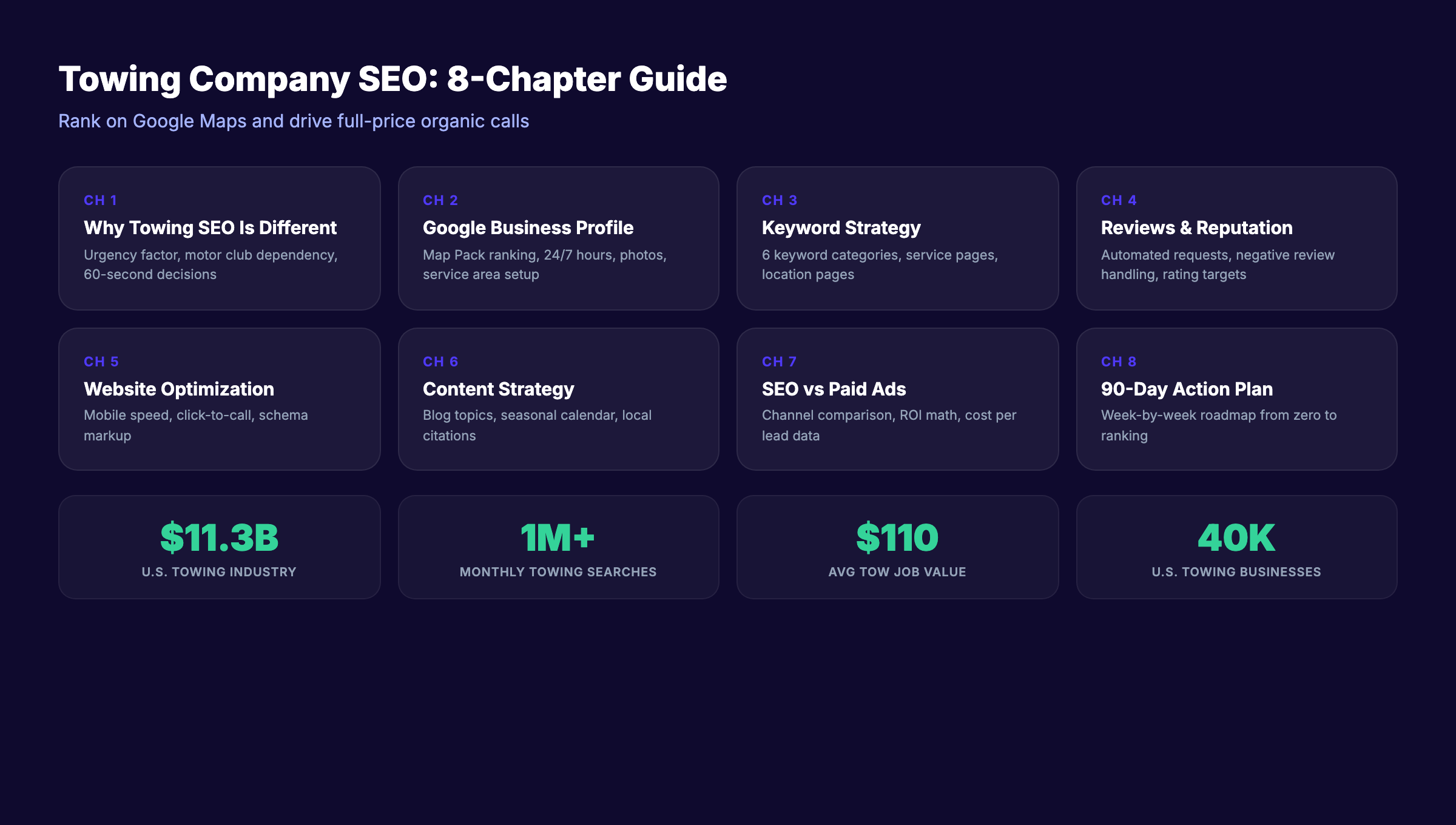
Over 1 million people search for towing services on Google every month in the U.S. alone. The towing industry generates $11.3 billion in annual revenue across nearly 40,000 businesses. Most of those businesses are invisible on Google.
Towing company SEO is different from every other type of local SEO. Your customers are not browsing. They are stranded on the side of a highway at 11 PM with a dead battery or a flat tire. They search “tow truck near me,” tap the first result that looks trustworthy, and call. The entire decision happens in under 60 seconds.
That means ranking in the top 3 results on Google Maps is not optional. It is the difference between getting 30 calls per day and getting 3.
This guide covers every element of towing company SEO: Google Business Profile optimization, keyword strategy, local rankings, review management, and the content that builds long-term authority. We have published 3,500+ SEO articles across 70+ industries, including automotive and roadside services.
Here is what you will learn:
- Why towing SEO works differently than other local service industries
- How to dominate the Google Map Pack for “tow truck near me” searches
- The keyword categories that drive the highest-value calls
- How to break free from motor club dependency with organic leads
- A 90-day action plan to start ranking your towing company
Chapter 1: Why Towing SEO Works Differently
Most local SEO advice assumes the customer has time to research. They read reviews, compare prices, visit websites, and make a decision over days or weeks. Towing customers do none of that.
The Urgency Factor
A person searching “tow truck near me” needs help right now. They are not comparison shopping. They need a phone number, a response time, and confirmation that someone is coming.
This changes every element of your SEO strategy:
- Speed matters more than design. A website that loads in 5 seconds loses the customer. They will hit the back button and call the next result.
- Click-to-call beats contact forms. Mobile users need to tap once and connect. A form asking for name, email, and vehicle details is a dead end.
- Google Maps outranks organic results. For emergency towing queries, the Map Pack appears first. Ranking #1 in organic results but missing from the Map Pack means losing 80% of potential calls.
- Reviews build instant trust. A stranded driver choosing between a 4.8-star company with 200 reviews and a 3.5-star company with 12 reviews will pick the first one every time.
The Motor Club Problem
Most towing companies depend on AAA, GEICO Roadside, and other motor clubs for calls. These programs deliver volume but at rock-bottom margins. A motor club tow pays $50 to $75. A direct customer call from Google for the same tow pays $110 to $200+.
SEO breaks the motor club dependency. Every organic call is a full-price customer who found you directly. Over 12 months, shifting even 20% of your call volume from motor clubs to organic leads can add $50,000+ in annual revenue for a small operation.
For a broader understanding of local search fundamentals, our local SEO checklist covers the complete setup.
Chapter 2: Google Business Profile for Towing Companies
The Google Map Pack is where towing companies win or lose. 46% of all Google searches have local intent, and for towing queries that number is closer to 90%. Your Google Business Profile is the single most important ranking factor.
GBP Setup Checklist
- Claim and verify your listing at business.google.com
- Set primary category to “Towing Service”
- Add secondary categories: “Roadside Assistance Service,” “Auto Wrecker,” “Vehicle Recovery Service”
- Define your service area by specific cities and zip codes (not just a radius)
- Enter your exact NAP (Name, Address, Phone) matching your website
- Mark hours as 24/7 if applicable (businesses open at search time rank higher)
- Add all services: flatbed towing, wheel-lift, heavy-duty, lockout, jump start, tire change, winch-out
- Upload 15+ photos: each truck type, team, storefront, branded vehicles
- Write a 750-word business description with target keywords and service areas
Why 24/7 Hours Matter for Rankings
Google prioritizes businesses that are open at the time of the search. A towing company marked as 24/7 gets a ranking boost for late-night and weekend searches. If you operate around the clock, make sure your GBP reflects that.
If you close at certain hours, still set accurate times. Marking 24/7 when you do not answer the phone hurts your reviews and rankings long-term.
Photos That Convert
GBP listings with photos get 35% more clicks than those without. For towing companies, the right photos build trust instantly:
- Individual truck photos showing each truck type (flatbed, wheel-lift, heavy-duty)
- Branded vehicle wraps demonstrating professionalism
- Team photos with uniforms and names
- Action shots of recoveries and roadside assists (with customer permission)
- Storefront or yard showing a real business location
For detailed GBP category strategy, our GBP categories guide covers how to select the right categories.
Stop writing. Start ranking. Stacc publishes 30 SEO-optimized articles per month for $99. Built for local service businesses. Start for $1 →
Chapter 3: Towing Keyword Strategy
“Tow truck near me” is the obvious keyword. Every towing company wants to rank for it. But the real opportunity is in the hundreds of specific keywords that your competitors ignore.
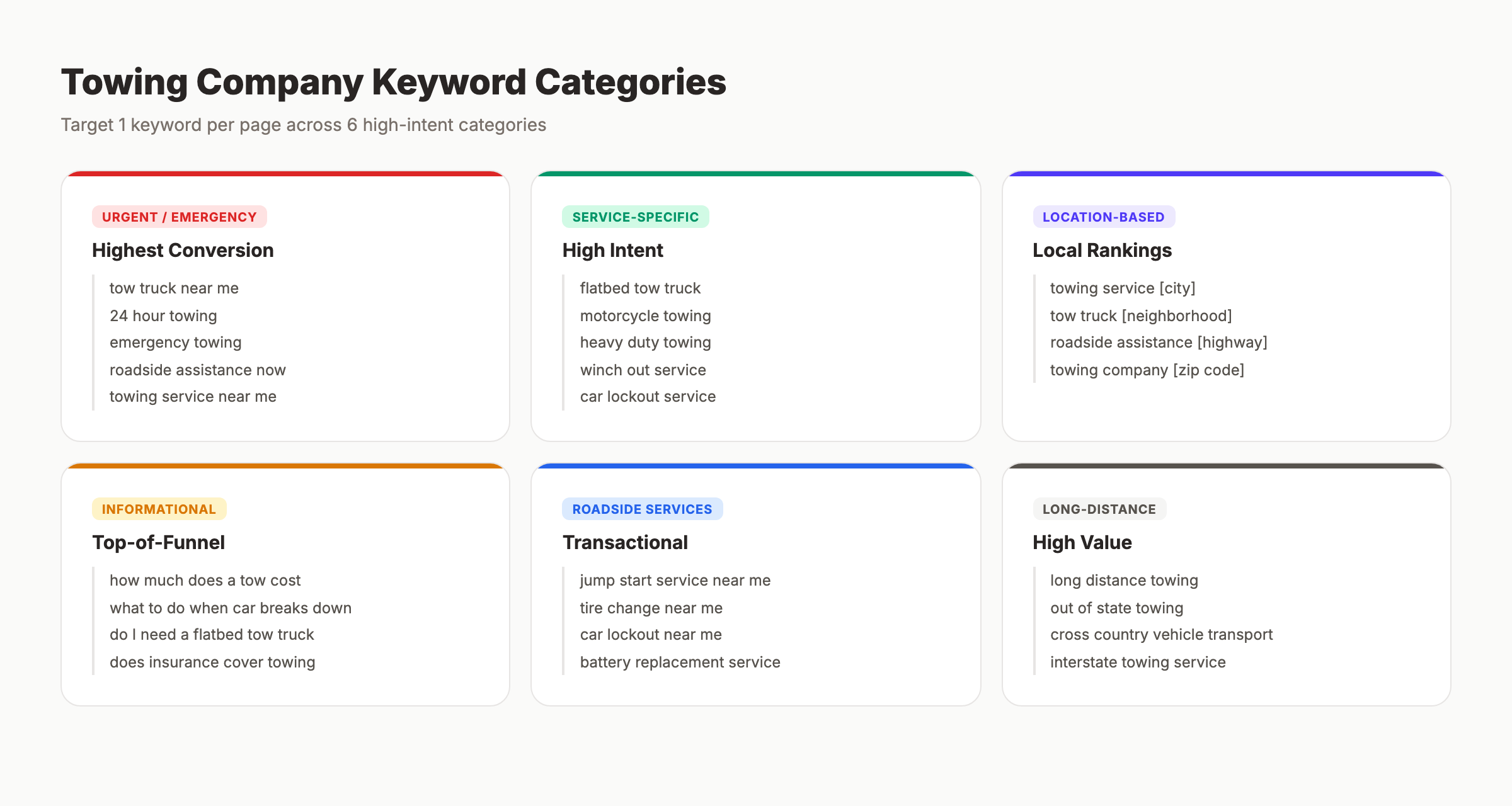
Keyword Categories for Towing Companies
| Category | Example Keywords | Intent |
|---|---|---|
| Emergency / Urgent | tow truck near me, 24 hour towing, emergency towing | Immediate call |
| Service-Specific | flatbed tow truck, motorcycle towing, heavy duty towing, winch out service | High intent |
| Location-Based | towing service [city], tow truck [neighborhood], roadside assistance [highway] | Local |
| Informational | how much does a tow cost, what to do when car breaks down, do I need a flatbed | Top-of-funnel |
| Roadside Services | car lockout service near me, jump start service, tire change near me | Transactional |
| Long-Distance | long distance towing, out of state towing, cross country vehicle transport | High value |
Build Dedicated Pages for Each Service
One homepage trying to rank for every keyword will lose to competitors who build dedicated pages. Create a separate page for each core service:
- Flatbed towing
- Wheel-lift towing
- Heavy-duty / commercial towing
- Motorcycle towing
- Long-distance towing
- Lockout service
- Jump start service
- Tire change service
- Winch-out / recovery
- Accident towing
Each page targets its own primary keyword + your city name. “Flatbed towing in [city]” has far less competition than “towing near me” and converts at higher rates.
Location Pages for Multi-Area Coverage
If you serve 10 cities, you need 10 location pages. Each page should include:
- The city name in the title tag, H1, and meta description
- Specific neighborhoods, highways, and landmarks you cover
- Estimated response times to that area
- A unique paragraph about serving that community (not copy-pasted from other pages)
Generic location pages with just a city name swap get flagged as thin content. Write unique content for each one.
For a deeper dive into keyword research, our SEO for beginners guide covers the fundamentals.
Chapter 4: Reviews and Reputation
Reviews are the strongest trust signal for towing companies. A driver stranded at midnight is not reading your About page. They are checking your star rating and your most recent reviews.
The Numbers That Matter
| Metric | Target | Why |
|---|---|---|
| Star rating | 4.7+ | Below 4.5 loses clicks to competitors |
| Total reviews | 100+ | Volume signals an established business |
| Review recency | New reviews every week | Stale reviews (90+ days) lose ranking weight |
| Response rate | 100% | Respond to every review, positive and negative |
| Response time | Under 24 hours | Fast responses signal active management |
How to Get More Reviews
Towing has a built-in advantage: every completed job is a review opportunity. The customer just had a stressful experience, and you solved their problem. That emotional relief makes them more likely to leave a positive review.
Automated review requests:
- Connect your dispatch software to an SMS tool
- Send a review request within 1 hour of completing the job
- Include a direct link to your Google review page
- Keep the message simple: “Thanks for choosing [Company]. We would appreciate a quick Google review: [link]”
In-person asks:
- Train drivers to ask at drop-off: “If we did a good job today, a Google review would really help us out.”
- Print QR codes on business cards that link directly to your review page
- Add the review link to receipts and invoices
Handling Negative Reviews
Towing companies get negative reviews from people who were involuntarily towed (parking enforcement, impound). These are different from customer service complaints.
For legitimate complaints: Acknowledge the issue, apologize, and offer to make it right. A professional response often convinces the reviewer to update their rating.
For impound-related reviews: Respond factually. “We were contracted by [property/city] to enforce posted parking regulations. We understand the frustration and are happy to explain the process.” Do not argue. Do not get defensive.
Our respond to Google reviews guide covers response templates for every scenario.
For broader reputation strategy, our GBP statistics guide covers the data behind review impact on local rankings.
Chapter 5: Website Optimization for Towing
Most towing websites look like they were built in 2012. Slow load times, no mobile optimization, and no clear call-to-action cost these businesses hundreds of calls per month.
Mobile-First Design
The majority of towing searches happen on mobile phones. Often from the side of a highway. Your website must load fast and make calling effortless.
Non-negotiable elements:
- Load time under 3 seconds. Every additional second drops conversion rates by 4.42%. A 5-second load time loses 20% of callers.
- Sticky click-to-call button. A phone number that stays visible as the user scrolls. One tap to call.
- Above-the-fold CTA. The first thing a visitor sees should be your phone number and a “Call Now” button. Not a slideshow. Not a welcome message.
- Service area visible immediately. “Serving [City], [City], and [City]. 24/7 availability.”
- No pop-ups. A stranded driver does not want to close a newsletter signup before calling for help.
Service Pages That Rank
Each service page needs:
- A title tag with the service + city: “Flatbed Towing in Phoenix, AZ”
- An H1 matching the title
- 500 to 800 words of unique content explaining the service
- Pricing transparency (at minimum a starting price range)
- A clear CTA with phone number
- Schema markup for LocalBusiness
Schema Markup for Towing Companies
Add JSON-LD structured data to your homepage and service pages. Use the “LocalBusiness” type (there is no specific “TowingService” type in Schema.org).
Required fields:
@type: “LocalBusiness”name: Your business nametelephone: Your phone numberaddress: Full postal addressgeo: Latitude and longitude coordinatesopeningHoursSpecification: Your hours (mark 24/7 if applicable)areaServed: Cities and regions you coveraggregateRating: Your Google review rating and count
Schema markup helps Google understand your business and can trigger rich results like star ratings, hours, and phone numbers directly in search results.
For a full technical walkthrough, our technical SEO checklist covers schema, site speed, and crawlability.
Your SEO team. $99 per month. 30 optimized articles, published automatically. Blog SEO, Local SEO, and Social on autopilot. Start for $1 →
Chapter 6: Content Strategy for Towing Companies
Most towing companies do not blog. That creates an opportunity. Publishing consistent, keyword-targeted content builds the topical authority that pushes your site above competitors in organic results.
Blog Topics That Drive Traffic
| Topic Type | Examples | Keyword Target |
|---|---|---|
| Cost / Pricing | ”How much does a tow cost in [city]?“ | how much does towing cost |
| What-To-Do Guides | ”What to do if your car breaks down on the highway” | car broke down what to do |
| Service Explainers | ”Flatbed vs wheel-lift towing: which do you need?“ | flatbed vs wheel lift towing |
| Seasonal Content | ”Winter driving tips to avoid breakdowns in [city]“ | winter driving tips [city] |
| Local Content | ”Most dangerous intersections in [city] for accidents” | [city] dangerous intersections |
| FAQ Content | ”Does insurance cover towing?“ | does car insurance cover towing |
| Comparison | ”AAA roadside vs calling a local tow company” | AAA vs local towing company |
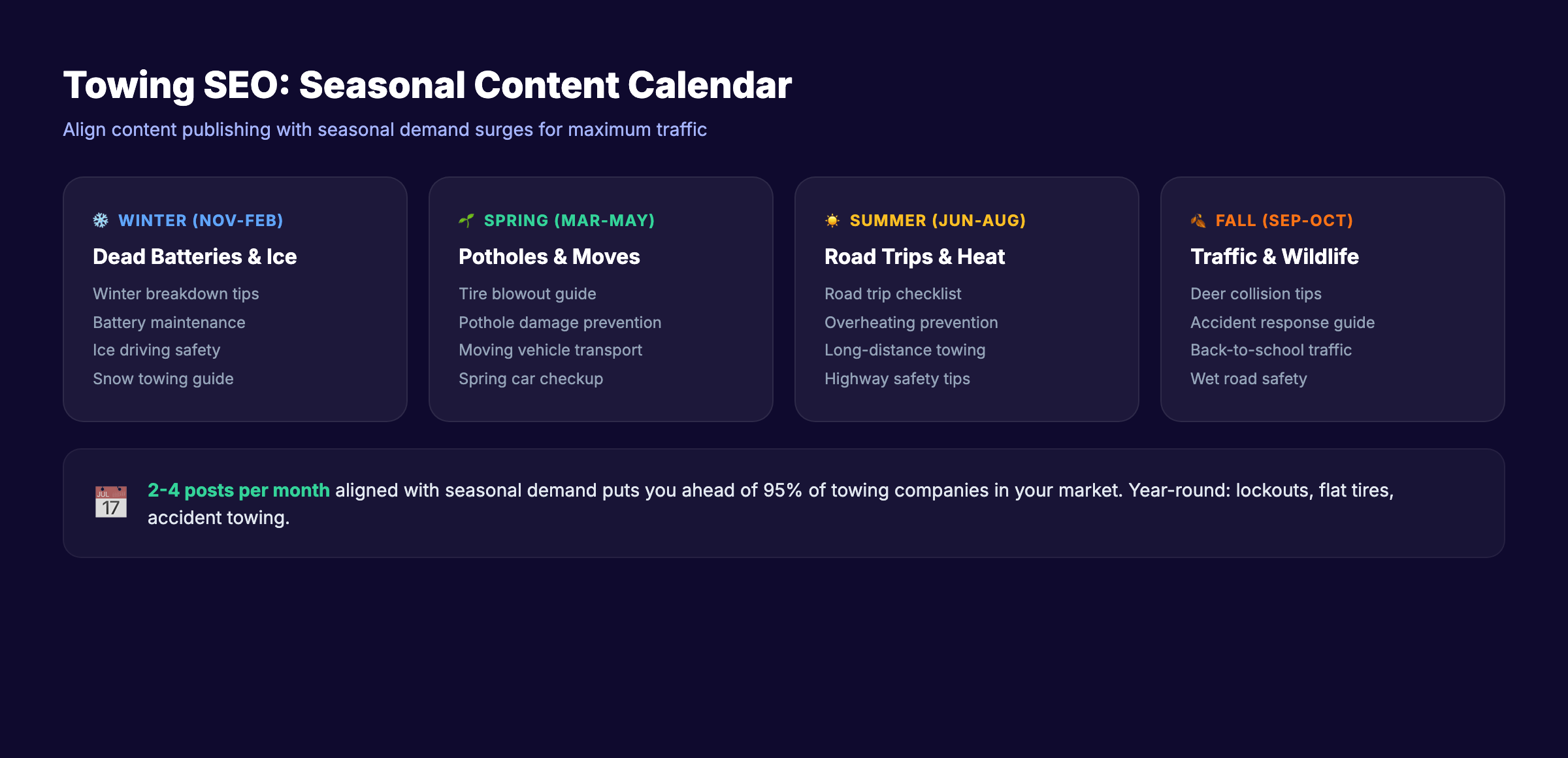
Seasonal Content Calendar
Towing demand follows predictable patterns. Align your content publishing with seasonal surges:
| Season | Demand Driver | Content to Publish |
|---|---|---|
| Winter (Nov-Feb) | Dead batteries, icy roads, snowstorms | Winter breakdown tips, battery maintenance, ice driving safety |
| Spring (Mar-May) | Pothole damage, spring cleaning moves | Tire blowout guide, moving vehicle transport |
| Summer (Jun-Aug) | Road trips, overheating, increased accidents | Summer road trip checklist, overheating prevention |
| Fall (Sep-Oct) | Back to school traffic, deer collisions | Accident response guide, deer collision tips |
| Year-round | Lockouts, flat tires, accidents | Evergreen service pages and FAQ content |
Publishing 2 to 4 posts per month aligned with seasonal demand puts content in front of searchers exactly when they need it.
Our blog frequency study covers the optimal publishing cadence by business size.
For broader content strategy, see our content marketing for small business guide.
Building Local Citations
Citations are online listings of your business name, address, and phone number. Consistent citations across directories boost your local rankings.
Priority citation sources for towing companies:
- Google Business Profile
- Yelp
- BBB (Better Business Bureau)
- Yellow Pages
- Manta
- Angi (formerly Angie’s List)
- Superpages
- Industry-specific directories (TowingLocator, TowForce)
- City and county business directories
- Chamber of Commerce
Ensure your NAP is identical across every listing. One wrong phone digit or inconsistent business name confuses Google and suppresses your rankings.
Our NAP consistency guide covers how to audit and fix citations across all platforms.
Chapter 7: SEO vs. Paid Ads for Towing
Towing companies have 3 main channels for Google visibility: organic SEO, Google Ads (PPC), and Local Service Ads (LSAs). Each has different costs, timelines, and returns.
Channel Comparison
| Channel | Cost | Timeline | Avg. Cost Per Lead | Long-Term Value |
|---|---|---|---|---|
| Organic SEO | $99-$2,000/mo | 3-6 months | Near-zero after ramp | Compounds over time |
| Google Ads (PPC) | $100-$300/day | Immediate | $15-$30/lead | Stops when you stop paying |
| Local Service Ads | Pay per lead | 1-2 weeks | $20-$40/lead | Stops when you stop paying |
| Motor Club Calls | Revenue share | Ongoing | N/A (low-margin) | No brand building |
The Math Behind SEO ROI
Average towing job value: $110 to $200. Average close rate from organic calls: 60 to 80% (high-intent searches). Monthly organic leads after 6 months of SEO: 30 to 80 calls.
At the conservative end: 30 calls x 60% close rate x $110 average job = $1,980/month from organic leads alone.
At the high end: 80 calls x 80% close rate x $150 average job = $9,600/month.
Compare that to the $99 to $500/month cost of SEO content and optimization. The ROI ranges from 4x to 96x.
Google Ads deliver immediate results but the cost never decreases. Organic SEO costs stay flat while lead volume grows. After 12 months, organic leads cost a fraction of what paid leads cost per acquisition.
For a detailed comparison, our Google Ads vs SEO guide breaks down when each channel makes sense.
Our SEO vs PPC guide covers the long-term economics in depth.
3,500+ blogs published. 92% average SEO score. See what Stacc can do for your towing company. Start for $1 →
Chapter 8: 90-Day Towing SEO Action Plan
Here is a week-by-week roadmap to go from zero to ranking.
Weeks 1-2: Foundation
- Claim and optimize your Google Business Profile (full checklist from Chapter 2)
- Audit and fix NAP consistency across all online directories
- Install Google Search Console and Google Analytics
- Ensure your website loads in under 3 seconds on mobile
- Add a sticky click-to-call button to every page
- Add LocalBusiness schema markup to your homepage
Weeks 3-4: Pages and Keywords
- Build a keyword spreadsheet (50+ keywords across all categories)
- Create dedicated service pages for each towing service you offer
- Create location pages for each city you serve
- Add FAQPage schema to service pages
- Start a weekly GBP posting schedule
Weeks 5-8: Content and Reviews
- Publish 2 to 3 blog posts per week targeting long-tail keywords
- Set up automated SMS review requests after every completed job
- Respond to all existing reviews within 24 hours
- Submit your business to 10+ citation directories
- Add photos of every truck in your fleet to GBP
Weeks 9-12: Optimization and Scale
- Review Google Search Console for ranking keywords
- Identify pages ranking on page 2 and optimize for page 1
- Build local backlinks (sponsor local events, join Chamber of Commerce)
- Analyze competitor GBP profiles and content for gaps
- Track call volume and source attribution weekly
Expected Results
| Milestone | Typical Timeline |
|---|---|
| GBP ranking improvements | 4 to 8 weeks |
| First page 2 organic rankings | 6 to 10 weeks |
| Map Pack appearances for service keywords | 8 to 12 weeks |
| Consistent page 1 rankings | 4 to 6 months |
| 30+ organic calls per month | 6 to 9 months |
Results accelerate after month 3. The towing companies ranking on page 1 today started their SEO 6 to 12 months ago.
Our SEO cost guide explains what to expect at different investment levels.
Common Towing SEO Mistakes
One homepage for everything. A single page trying to rank for flatbed towing, lockout service, jump starts, and 8 different cities will rank for none of them. Build dedicated pages.
Ignoring mobile speed. Your customer is on a phone, on a highway, with low patience. A 6-second load time sends them to the competitor below you.
No review strategy. A towing company with 15 Google reviews in 2026 looks like it barely exists. Set up automated requests and aim for 100+ reviews.
Inconsistent NAP data. Your phone number is different on Yelp, your old address is on Yellow Pages, and your business name has an extra “LLC” on Google. Fix every listing.
Depending on motor clubs. AAA and GEICO calls pay $50 to $75 per tow. An organic Google call pays $110 to $200+. SEO shifts your call mix toward direct, full-price customers.
No content publishing. Your competitors are not blogging either. That means 2 to 4 posts per month puts you ahead of 95% of towing companies in your market.
For a broader checklist of local SEO fundamentals, our Google Maps SEO guide covers everything from Map Pack ranking to local visibility.
FAQ
Is SEO worth it for a towing company?
Yes. Over 1 million people search for towing services on Google every month. The average towing job is $110 to $200. Even 30 organic calls per month at a 60% close rate generates $1,980+ in revenue. Compare that to $99 to $500/month for SEO. The ROI is clear.
How long does towing company SEO take to work?
Google Business Profile improvements show results in 4 to 8 weeks. Organic search rankings take 3 to 6 months for meaningful movement. Most towing companies see 30+ organic calls per month within 6 to 9 months of consistent effort.
How do towing companies get more calls from Google?
Optimize your Google Business Profile, get 100+ reviews with a 4.7+ rating, build dedicated service and location pages, publish blog content targeting towing keywords, and ensure your site loads in under 3 seconds on mobile with a click-to-call button on every page.
What keywords should a towing company target?
Start with service + city combinations: “flatbed towing [city],” “24 hour towing [city],” “roadside assistance [city].” Then expand to informational keywords: “how much does a tow cost,” “what to do when car breaks down.” Target 1 keyword per page.
How much does towing SEO cost?
DIY SEO costs only your time. A done-for-you service like Stacc starts at $99 per month for 30 articles and $49 per month for GBP management. Towing-specific SEO agencies charge $500 to $2,000 per month. Google Ads cost $100 to $300 per day on top of that.
Should a towing company use Google Ads or SEO?
Both. Google Ads deliver immediate calls while SEO builds long-term organic traffic. Start with Ads for quick leads, then invest in SEO to reduce your cost per lead over time. After 6 to 12 months, organic leads should outpace paid leads in volume and ROI.
Rank everywhere. Do nothing. Blog SEO, Local SEO, and Social on autopilot. Stacc starts at $99/mo with a $1 SEO trial. Start for $1 →
The towing companies dominating Google in your city are not bigger than you. They started their SEO earlier. Every blog post, every review, and every GBP update compounds your visibility. Start today. In 6 months, you will be the one getting the calls.
Written and published by Stacc. We publish 3,500+ articles per month across 70+ industries. All data verified against public sources as of March 2026.
