Updated August 2026 · An honest warning, not a sales page

Cheap SEO companies: what $99–$500/mo really buys

Cheap SEO at $99 to $500 a month buys automation, templates or a long contract far more often than it buys senior time. We ranked 12 low-cost providers on pricing transparency, deliverables and contract terms, explain in arithmetic what that money can physically pay for, and name the ones structured so the cheap part is the bait.

Best overall
theStacc
Real SEO at a low price because software does the volume, not shortcuts.
★★★★★ 4.9
Most transparent cheap provider
FATJOE
A full public rate card and no contract — you know exactly what you buy.
★★★★☆ 4.5
Best cheap diagnosis
Loganix
Fixed-price audits at $500 and $750, no retainer required.
★★★★☆ 4.3
Highest-risk structure
Hibu
6–12 month term plus a setup fee, and no published price. Read carefully.
★★☆☆☆ 2.5
How we ranked these

Our criteria — and why they matter

Start with the arithmetic, because it settles most of the argument. A competent SEO specialist costs a provider somewhere between $30 and $80 an hour once overheads are counted. At $299 a month, after sales cost and margin, that buys roughly two to four hours of human attention. Two hours cannot research a market, write and edit four articles, fix technical issues, build links and produce a report. So something has to give, and the question worth asking is which thing gave.

Each company is scored on five weighted factors:

Results & traffic (30%) — measured organic sessions and ranking footprint · Output & value (25%) — content shipped per dollar, contract terms · Technical & AI-search (20%) — site performance, schema, AI-citation rate · Transparency (15%) — public pricing, honest reporting · Fit & specialization (10%) — depth in your niche.

The three answers we see most often: the work is automated (a scan, a template, an unedited AI draft), the links come from a private network that Google's link spam policies exist to catch, or the low monthly price is subsidised by a long term and a separate implementation fee you find in the contract. Hibu, to its credit, publishes the six-to-twelve-month term openly. Several others publish nothing at all. We scored pricing transparency at 15% of the total and marked providers we could not verify as unverified rather than guessing. theStacc ranks first here not because it is the cheapest thing on the page — Thryv's $85 tier is — but because it is the cheapest thing on the page that is actually doing SEO with a human reviewing it. If your budget is genuinely a little higher, our affordable SEO services ranking compares the $750–$3,000 bracket on value per dollar. If you would rather run it yourself, cheap SEO tools and local SEO packages price the DIY and productised routes.

The ranking

12 cheap SEO options, assessed honestly

#1 · Best overall
1

theStacc

AI-powered managed SEO · modules from $49/mo · full service from $749/mo

Here is the honest case, and it is not "cheap SEO is bad, buy ours instead". Cheap SEO fails because the price cannot fund the labour. There are exactly two ways around that: do less work, or make the work cost less to produce. Most cheap providers pick the first. theStacc picks the second — an AI engine handles research, drafting, internal linking and schema, and a human SEO manager reviews everything before it publishes, which is the part that cannot be automated away. That produces 30+ pages a month for $749, or $49 a month for Local SEO alone if your entire problem is a neglected Google Business Profile, or $99 for Content SEO, or $167 for the bundle. Nothing published is a link scheme, everything published to your domain stays yours permanently, and there is no minimum term, so you are not funding a twelve-month recovery from a bad first quarter. It will not guarantee you a ranking — nobody honest will — but you will know what was published, who reviewed it, and what it cost.

Strengths

  • Modules from $49/mo — a genuine entry point, not a teaser rate
  • A human SEO manager reviews every page before it goes live
  • No link schemes, no unreviewed content, no penalty exposure
  • No minimum term, no setup fee, and your content stays yours

Good to know

  • Software carries the volume so the price can be low without the work being thin
  • The published price is the whole price — no implementation fee appears later
Pricing: Modules from $49/mo · full service from $749/moMin term: NoneSetup fee: NoneOutput: 30+ pages/mo
Book a demo
2

FATJOE

White-label links and content · full public rate card

If you are going to buy cheap SEO, buy it from someone who tells you exactly what it costs and exactly what arrives. FATJOE publishes a complete rate card — blogger outreach from around £60 a placement, and packaged campaigns running from roughly $600 through to $4,800 depending on scope — with no contract and an order-as-needed model. Nothing here pretends to be a strategy. It is components: links, content, digital PR, sold like stock. That honesty is why it ranks second. The risk is entirely on you: components without a plan produce a pile of links pointing at pages that were never going to convert.

Strengths

  • Publishes a complete public rate card — genuinely rare
  • No contract, order-as-needed, cancel by not ordering
  • Consistent, well-documented delivery process
  • Popular with agencies for a reason — the units are reliable

Consider

  • Components only — no strategy, no technical, no local
  • You own the risk of buying the wrong thing
Pricing: Public rate card — campaigns from ~$600; outreach from ~£60/placementMin term: None — order as neededBest for: Agencies and operators who already know what they need

theStacc vs FATJOE: FATJOE sells you parts and lets you assemble them; theStacc sells the assembled program with a human SEO manager on it.

Price from $749 vs From ~$600Output/mo 30+ vs Per orderContract Month-to-month vs None
Compare on your site — book a demo →
3

Loganix

White-label SEO services · fixed-price audits

Loganix is one of the few providers anywhere that will sell you a proper standalone SEO audit at a fixed, published price — a mini audit at $500 and a full one at $750, delivered in roughly ten days and white-labelled so an agency can pass it on. For a small business that suspects something is technically broken but cannot commit to a retainer, that is a genuinely useful $500 to spend. Beyond the audit, retainer pricing is not published, and the wider service list is the standard reseller catalogue: links, content, local citations.

Strengths

  • Fixed, published prices for standalone audits — $500 and $750
  • Roughly ten-day turnaround, white-label ready
  • Clean, readable deliverables
  • A real diagnostic option without a monthly commitment

Consider

  • Retainer pricing not published
  • Beyond audits, it is a standard reseller catalogue
Pricing: Mini audit $500 · Full audit $750 (published on loganix.com)Min term: None for one-off auditsBest for: A cheap, honest diagnosis before you commit

theStacc vs Loganix: Loganix diagnoses cheaply and stops there; theStacc fixes and publishes every month for $749 — roughly the price of one Loganix audit.

Price from $749 vs $500–750 one-offOutput/mo 30+ vs One-offContract Month-to-month vs None
Compare on your site — book a demo →
4

The HOTH

Productized SEO and links · publishes product pricing

The HOTH built the productized SEO category and still runs it more openly than most: individual products carry listed prices — links from around $150, a technical audit around $1,000, managed SEO tiers starting near $1,000 a month at the time we checked. Be aware that its pricing pages have moved around, so verify the current figure in a browser before you budget from it. The work is competent and standardised, which is both the appeal and the ceiling: standardised means it was not built for your market specifically.

Strengths

  • Product-level pricing listed rather than quoted
  • Long track record and a large delivery operation
  • Easy to buy one thing without a retainer

Consider

  • Pricing pages have moved — verify the current figure yourself
  • Standardised output is not tailored to your market
Pricing: Product pricing listed on thehoth.com — links from ~$150, managed tiers from ~$1,000/mo (verify current)Best for: Buying one defined deliverable without a contract

theStacc vs The HOTH: The HOTH sells standardised units at listed prices; theStacc sells 30+ pages a month built around your business, for less than its managed tier.

Price from $749 vs ~$1,000/moOutput/mo 30+ vs VariesContract Month-to-month vs Monthly
Compare on your site — book a demo →
5

Thryv

SMB software with marketing services · fully published pricing

Thryv is not really an SEO company, and that is the honest framing. It is small-business software — booking, CRM, invoicing, reputation — with marketing services layered on, and it publishes its plans openly at $85 a month for Starter and $340 a month for Signature, with a discount for annual billing. If your problem is that your business runs on paper and your Google listing is a mess, $85 a month is defensible spending. If your problem is that you need to rank for competitive commercial terms, this is not the tool and no amount of it will become one.

Strengths

  • Publishes full plan pricing openly — $85 and $340 tiers
  • Genuinely useful for SMB operations beyond marketing
  • Low entry cost with an annual discount

Consider

  • Not an SEO service in any meaningful sense
  • Will not move competitive commercial rankings
Pricing: Starter $85/mo · Signature $340/mo (published on thryv.com)Best for: SMB operations software, not ranking

theStacc vs Thryv: Thryv runs your back office; theStacc publishes the pages that bring the bookings in — different jobs, and only one of them is SEO.

Price from $749 vs $85–340Output/mo 30+ vs n/aContract Month-to-month vs Monthly or annual
Compare on your site — book a demo →
6

DashClicks

White-label SaaS + fulfillment marketplace · partial pricing

DashClicks publishes its software price — $199 a month, or $1,788 a year — and states plainly that there are no contracts, which is more than most. The catch for anyone comparing cheap SEO is that the fulfillment prices, the part you actually care about, sit inside a logged-in marketplace. You cannot compare what an article or a link costs until you have signed up. That is a deliberate design choice and it is the reason this sits mid-table rather than higher.

Strengths

  • Software price published at $199/mo, no contracts
  • Legitimate white-label model for small agencies
  • Marketplace covers a wide service range

Consider

  • SEO fulfillment prices are hidden behind a login
  • Built for agencies reselling, not for end businesses
Pricing: Software $199/mo (published) · fulfillment pricing behind loginMin term: None — states no contractsBest for: Small agencies reselling under their own brand

theStacc vs DashClicks: DashClicks makes you sign up to see the price; theStacc prints it on the homepage.

Price from $749 vs $199 + fulfillmentOutput/mo 30+ vs VariesContract Month-to-month vs None
Compare on your site — book a demo →
7

Semify

White-label SEO reseller · no published pricing

Semify is a long-standing white-label reseller aimed at agencies, and by most accounts a competent one. But it sits here for a specific reason: its own site answers the pricing question with the phrase "custom price based on volume". For a reseller — a business model whose entire premise is standardised units bought wholesale — declining to publish a unit price is a strange position, and it makes comparison shopping impossible. Competent supplier, opaque commercial posture.

Strengths

  • Established white-label reseller with a real delivery team
  • Volume pricing genuinely does reward scale
  • Familiar with agency workflows and reporting

Consider

  • States only "custom price based on volume" — no unit price anywhere
  • Nothing here is buyable by an end business directly
Pricing: "Custom price based on volume" — no figures publishedBest for: Agencies with volume to negotiate against

theStacc vs Semify: Semify prices by how much you buy; theStacc charges $749 whether you are one business or the hundredth.

Price from $749 vs CustomOutput/mo 30+ vs VariesContract Month-to-month vs Not published
Compare on your site — book a demo →
8

Boostability

SMB SEO through partner channels · pricing unverified

Boostability has built a large small-business SEO operation largely through partner and reseller channels, which means most customers never buy from Boostability directly — they buy from a host, a directory or a media company with Boostability underneath. That layering matters, because it makes it hard to know who is accountable when results stall. We attempted to verify pricing on its own site and were blocked at every path, so we have printed nothing. Not evidence of hiding, but not verifiable either.

Strengths

  • Large operation genuinely focused on small business
  • Wide partner network makes it easy to find
  • Long operating history in the SMB segment

Consider

  • We could not verify any pricing from its own site
  • Delivered through partners — accountability is layered
Pricing: Not verified — site inaccessible to our checksBest for: SMBs buying through an existing partner relationship

theStacc vs Boostability: With Boostability you often do not know who is doing the work; with theStacc a named SEO manager reviews every page before it publishes.

Price from $749 vs UnverifiedOutput/mo 30+ vs VariesContract Month-to-month vs Not published
Compare on your site — book a demo →
9

Hibu

SMB digital marketing · terms published, prices not

Hibu sells websites, listings, ads and SEO to small businesses through a direct sales force, and it names three tiers on its site — with no prices attached to any of them. What it does publish is the part most buyers discover too late: engagements run six to twelve months and there is a separate implementation fee on top of the monthly. We give credit for stating the term openly. We also think a small business should read that combination carefully: a year-long commitment, a setup fee, and no published rate is the exact structure that makes cheap SEO expensive.

Strengths

  • Publishes its contract term openly, which most do not
  • Handles website, listings and ads alongside SEO
  • Real support presence for non-technical owners

Consider

  • Six to twelve month term plus a separate implementation fee
  • Three named tiers with no prices on any of them
Pricing: Custom — not publishedMin term: 6–12 months + implementation fee (stated on hibu.com)Best for: Owners who want one vendor and will sign a term

theStacc vs Hibu: Hibu asks for six to twelve months and a setup fee before you know the price; theStacc asks for one month at $749.

Price from $749 vs CustomOutput/mo 30+ vs LowContract Month-to-month vs 6–12 mo
Compare on your site — book a demo →
10

LocaliQ

SMB marketing platform and services · pricing page unavailable

LocaliQ pairs a marketing platform with managed services and a white-label arm, and it is a serious operation with real reach into local markets. On the question this page exists to answer — what does it cost — we could find no working pricing page; the obvious path returns a 404. That is not an accusation of bad faith, but for a buyer comparing four cheap options on a Thursday afternoon, an unreachable price is functionally the same as a hidden one.

Strengths

  • Genuine scale and reach in local markets
  • Platform plus managed services in one place
  • Established white-label channel

Consider

  • No accessible pricing page
  • Service depth varies by market and rep
Pricing: Not published — pricing page returns 404Best for: Local businesses buying platform plus services together

theStacc vs LocaliQ: LocaliQ has no reachable price; theStacc has one number on the site and no sales call between you and it.

Price from $749 vs Not publishedOutput/mo 30+ vs VariesContract Month-to-month vs Not published
Compare on your site — book a demo →
11

Marketing 360

SMB marketing platform · pricing behind signup

Marketing 360 bundles a website builder, CRM, ads and content into one small-business platform, which is genuinely convenient if you want one login and one invoice. Pricing, however, sits behind a signup flow — the public pricing path returns a 404 — so you cannot evaluate it against anything without handing over your details first. For an owner comparing options at 9pm, that is a real cost. The SEO component inside the bundle is light relative to the marketing around it.

Strengths

  • Genuine all-in-one convenience for non-technical owners
  • Website, CRM and ads under one login
  • Established SMB platform with support

Consider

  • Pricing gated behind signup; public pricing page 404s
  • SEO is a light component inside a broad bundle
Pricing: Not published — gated behind signupBest for: Owners wanting one platform for everything

theStacc vs Marketing 360: Marketing 360 wants your details before a price; theStacc publishes $749 and the module prices below it.

Price from $749 vs Not publishedOutput/mo 30+ vs LowContract Month-to-month vs Not published
Compare on your site — book a demo →
12

Fiverr Pro

Freelance marketplace · seller-set prices, visible upfront

This is where most genuinely cheap SEO is actually bought, so pretending otherwise would be dishonest. On a marketplace you see the price before you pay, you can read reviews, and for a narrowly defined one-off task — a title-tag rewrite, a schema implementation, a single well-briefed article — a good freelancer is excellent value. The failure mode is everything else. Packages promising hundreds of backlinks or full monthly SEO for under $200 are almost always automated, and the accountability when something goes wrong is a support ticket. Buy tasks here. Never buy a strategy.

Strengths

  • Prices visible upfront, before you commit anything
  • Excellent for narrow, well-specified one-off tasks
  • Review history gives some signal on quality

Consider

  • Cheap monthly SEO packages here are usually automated
  • No accountability structure when results stall
Pricing: Set per seller, shown before purchaseBest for: Single, tightly specified tasks — never an ongoing program

theStacc vs Fiverr Pro: A marketplace gig does one task once; theStacc runs the whole program monthly with a human reviewing every page.

Price from $749 vs Per gigOutput/mo 30+ vs One-offContract Month-to-month vs None
Compare on your site — book a demo →
Our best proof

We don't ask you to trust us. We show you the data.

The reason cheap SEO usually fails is that nothing gets published. Here is the opposite — what consistent monthly publishing produced on real sites, with the Search Console data behind it.

Best result
Solar installer · Heaven Green Energy

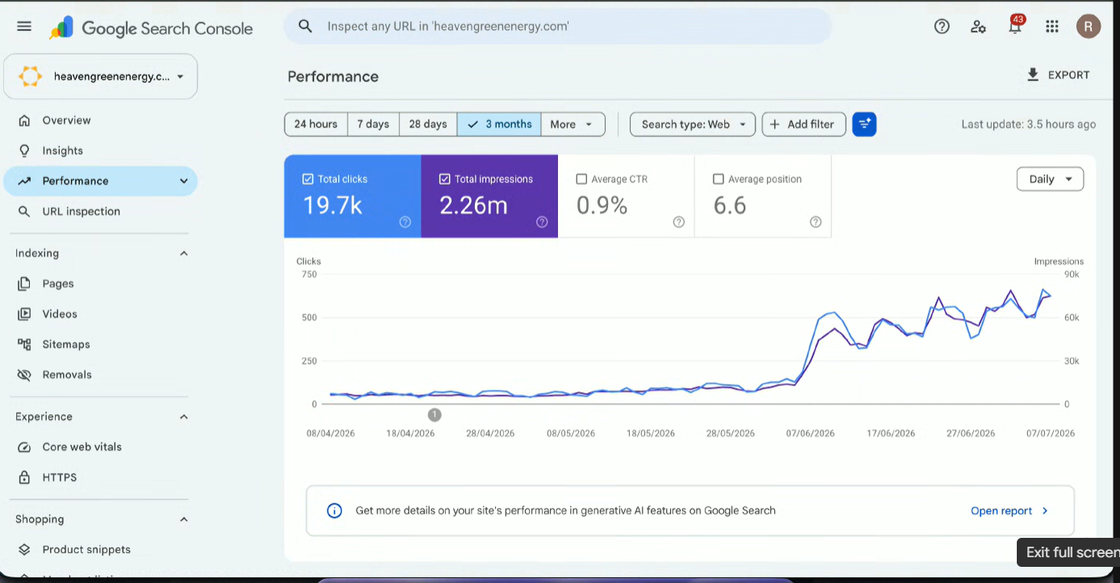
From nobody could find them, to 19.7k visits in three months.

A solar company with almost no presence online. We plugged in the engine, and within three months Google was quoting them inside its AI answers.

Visits from search
019.7k
Times shown in search
02.26M
Keywords they rank for
01.8K
Site authority (DA)
4.410
See the real screenshots
Google Search Console · heavengreenenergy.com
Visits and impressions bending upward, average position 6.6.
Semrush organic · heavengreenenergy.com
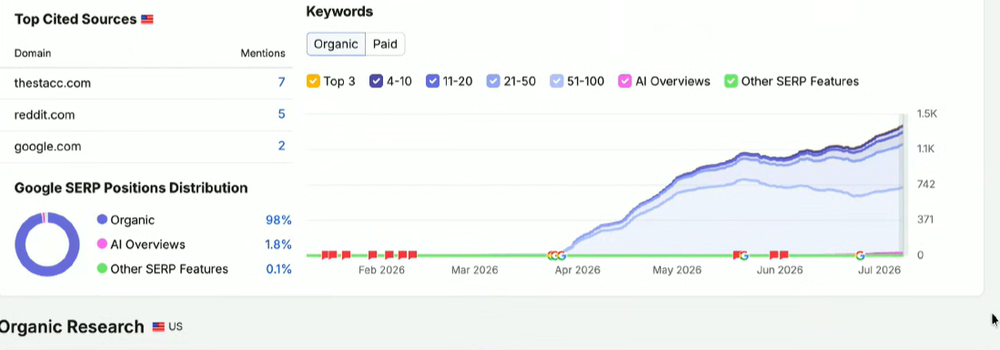
1.8K keywords, showing up in Google AI answers for 5.6% of them.
Solar software · SurgePV

From a new brand, to 3,000 keywords bringing in customers.

Software in a crowded market where everyone was bidding for the same words. The engine built the footprint and took their own brand terms to the top.

Visits from search
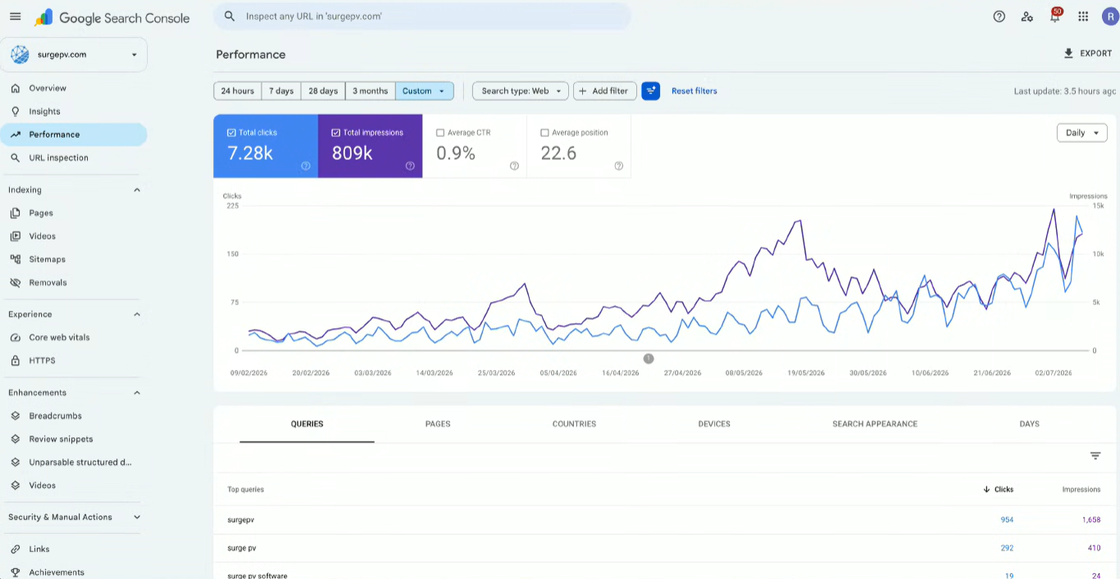
07.28k
Times shown in search
0809k
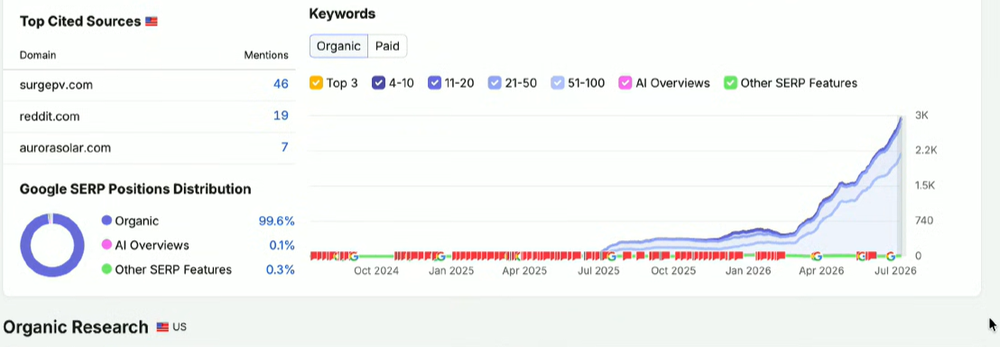
Keywords they rank for
03K
Site authority (DA)
026
See the real screenshots
Google Search Console · surgepv.com
A steady climb to 7.28k visits, with the brand owning its top searches.
Semrush organic · surgepv.com
3K keywords, and the most quoted source in its category.
Our own website · theStacc.com

From a brand new domain, to ranking in the hardest topic we could pick.

Anyone can make claims. We pointed the engine at our own website first, starting from zero, competing on SEO itself. If it could not work for us, why would you trust it?

Visits from search
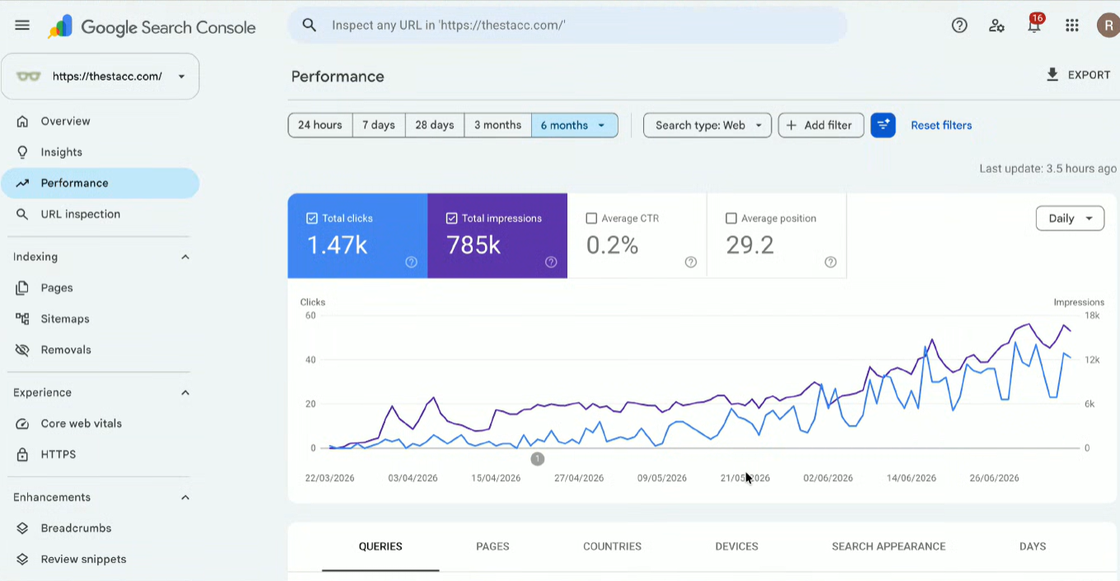
01.47k
Times shown in search
0785k
Keywords we rank for
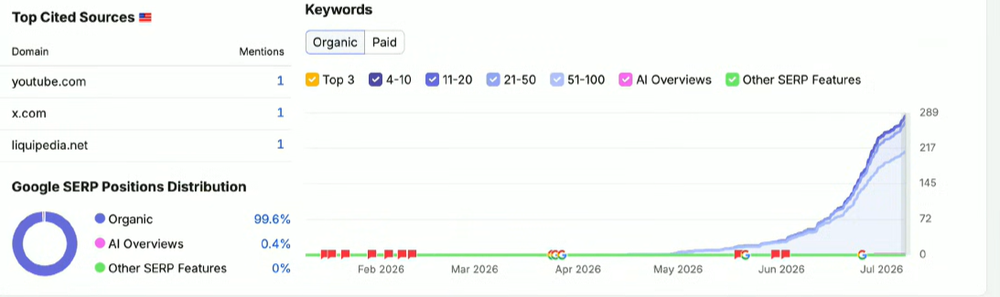
01.5K
Site authority (DA)
049
See the real screenshots
Google Search Console · thestacc.com
From zero to 785k impressions on a website that did not exist before.
Semrush organic · thestacc.com
1.5K keywords, and quoted by AI tools, in the SEO niche itself.
At a glance

Compare all 12 on price, term and what is hidden

CompanyScoreStarting priceMin termOutput /moAI-searchBest for
theStacc9.6$49–$749None30+YesBest overall value at low cost
FATJOE8.8From ~$600NonePer orderNoTransparent components
Loganix8.4$500–750 auditNoneOne-offNoCheap honest diagnosis
The HOTH8.0~$1,000/moMonthlyVariesNoListed-price products
Thryv7.7$85–340Monthly/annualn/aNoSMB operations software
DashClicks7.3$199 + hiddenNoneVariesNoAgency white-label
Semify6.9CustomNot publishedVariesNoVolume resellers
Boostability6.6UnverifiedNot publishedVariesNoPartner-channel SMBs
Hibu6.3Not published6–12 mo + setupLowNoOne-vendor SMBs
LocaliQ6.1Not publishedNot publishedVariesNoLocal platform + services
Marketing 3605.9Behind signupNot publishedLowNoAll-in-one convenience
Fiverr Pro5.6Per gigNoneOne-offNoSingle defined tasks

Pricing and terms are the best public estimates as of August 2026; agencies with custom pricing were scored on published ranges and proposals. Output = typical articles published per month.

Why SEO feels slow and expensive

SEO shouldn't be limited by your team's capacity.

A freelancer gives you five posts a month. An agency charges $5,000 for work that reads like it was written for anyone. Hire in-house and you're training someone for months. They all hit the same wall — there are only so many hours in a day.

Freelancer
$3,000+per month
  • One person, so one bottleneck
  • Five or six posts a month
  • Everything stops when they take a holiday
SEO agency
$5,000+per month
  • Long contracts, work that could be for anyone
  • Months before you see anything move
  • You end up chasing them for the report
Someone in-house
$2,500–4,000per person / month
  • You have to find, train and manage them
  • One person cannot do all of it well
  • Months before they are up to speed
theStacc · the engine
from $749fully managed, month to month
  • 30+ pages a month, published for you
  • Blogs, website, Google listing and social
  • It doesn't take holidays or slow down
Book a demo
The difference

An SEO engine with a team on top. Not another agency.

Agencies sell you hours, so wanting more means paying more. We spent years learning how Google — and now AI — decide who ranks. Then we built software that does that work on repeat. It doesn't get sick, distracted or bored, and a real SEO manager owns your results.

Step 1 · Research

We work out what your customers search for

The engine reads the keywords, the questions people ask, and what your competitors already rank for. It covers more ground in a day than one person could in a month.

Step 2 · Publishing

We turn it into pages and post them

All of that research becomes real content, written in your voice, and published to your website, blog, Google listing and social accounts. Every week, without you asking.

Step 3 · The team

Real people check the work

You get an SEO manager who owns your strategy, reads what goes out, and walks you through it once a month. The software does the volume. People decide what good looks like.

The result

30+ pages a month, month after month

An agency sends you five or six blogs. We publish more than thirty, all researched, all optimized, all live. And because it never stops, the results build on each other.

Buyer's guide

How to buy cheap SEO without getting burned

Six things that separate a partner that compounds from a retainer that drains. Take them into every sales call.

01

Match the model to your size

Enterprise brands can absorb a $10k/mo retainer; a small business or a Series-A startup usually can't and shouldn't. Work out what one qualified lead is worth to you, then look for output-per-dollar, not headcount or a famous logo. A team of 40 doesn't help if only two of them touch your account.

02

Insist on transparent pricing and month-to-month terms

A 12-month lock-in protects the agency, not you. If a company needs three calls before it will name a price, that opacity is the product. The best partners publish what they cost and earn the next month every month — so the pressure to perform stays on them, where it belongs.

03

Ask how they handle AI search (GEO + AEO)

More buyers now ask ChatGPT, Gemini and Perplexity "who's the best…" before they ever open Google, then read the answer box without clicking. If a company can only talk about blue-link rankings and can't explain how it gets you named by AI engines, it's already a year behind — and so are you if you hire them.

04

Check who actually does the work

"AI-powered" should mean an engine that multiplies a real team's output — not a black box that publishes unreviewed, and not a team so small it caps at six posts a month. Ask who writes, who reviews, and what happens before anything goes live on your domain. The right answer is: software for volume, humans for judgment.

05

Demand proof on real sites, not logos

A wall of client logos proves someone paid an invoice, not that rankings moved. Ask for two or three live URLs and their actual Search Console or Semrush growth. A company confident in its work will show you the graphs; one that isn't will show you a testimonial carousel.

06

Read the contract for who owns the content

Some agencies host your content on their platform and take it down the day you leave, so cancelling means losing everything you paid for. Confirm in writing that every page published to your site stays yours, forever, with no clawback. If they hesitate, that tells you how the relationship ends.

On the call

Questions to ask before you sign.

Copy these into your notes. The answers tell you more than any pitch deck.

  • Can I see three live client sites and their real ranking growth?
  • Exactly what gets published each month, and who reviews it before it goes live?
  • How do you get me cited by ChatGPT, Perplexity and Google AI Overviews?
  • What's the minimum term — and what happens to my content if I leave?
  • Who is my point of contact, and how often do we actually talk?
  • How do you measure success: rankings, traffic, or booked leads?
  • How fast does the first work go live after I sign?
  • Is pricing fixed, or does "more output" always mean "more money"?
Walk away if…

Six red flags that cost you a year.

Any one of these on a sales call is reason enough to keep looking.

  • A 12-month lock-in demanded before you've seen a single result.
  • No named clients or live examples you can independently verify.
  • "AI-powered" with no human reviewing what publishes on your domain.
  • Vague, custom-only pricing that takes three calls to pin down.
  • Reporting you have to chase, in a format you can't act on.
  • No real answer for how they handle AI search in 2026.
Questions

Cheap SEO, answered honestly

What does $99 to $500 a month actually pay for?

Run the numbers rather than the marketing. A competent SEO specialist costs a provider $30–$80 an hour fully loaded. Strip out sales cost and margin from a $299 invoice and you are buying two to four hours of human attention a month. Two hours does not cover keyword research, four edited articles, technical fixes, link acquisition and a report. So the realistic contents of a sub-$500 package are: an automated rank-tracking report, a generic site scan you could have run yourself, one or two thin articles, and some directory or link submissions. None of that is inherently fraudulent. It is just very little, and it is usually less than the promise on the sales page.

What are the actual risks — not the scare stories?

Four specific ones, in order of how often we see the damage. First, private blog network links: paid placements on networks of sites built purely to sell links. Google's link spam policies exist precisely for this, and when action is taken it lands on your domain, not the vendor's. Second, scaled unreviewed content — hundreds of near-identical AI pages published without a human reading them, which Google's scaled content abuse policy directly addresses. Third, hostage architecture: the provider hosts your website or your blog on their platform or subdomain, so cancelling deletes everything you paid for and the rankings with it. Fourth, and most common by far, is simple waste — twelve months and $3,600 spent on reports while a competitor published two hundred pages.

How do I check a cheap provider in fifteen minutes?

Five questions, and write down the answers. One: does every page published to my site stay mine permanently, in writing, with no clawback if I cancel? Two: where do links come from, specifically — and treat any mention of a private network or a fixed number of guaranteed links as disqualifying. Three: who reads the content before it publishes, by name and role? Four: what is the minimum term, and is there a setup, onboarding or implementation fee on top of the monthly? Five: will I have direct access to my own Search Console and Analytics? If you cannot see your own data, no claim they make afterwards can be checked.

Are any cheap SEO companies genuinely worth buying from?

Yes — and they share a pattern. The good cheap providers sell defined components at published prices with no contract. FATJOE publishes a complete rate card and sells links and content as units. Loganix sells a fixed-price audit at $500 or $750 with a stated turnaround. The HOTH lists product prices. You know precisely what arrives, so you can judge whether it was worth it. The dangerous pattern is the opposite: a low monthly price attached to an open-ended promise of "SEO", with no defined deliverable, a term you discover in the contract, and a setup fee you discover on the invoice.

Should I just do SEO myself instead?

For a small local business, sometimes yes — for a while. Claiming and properly filling out your Google Business Profile, fixing your title tags, getting your NAP consistent and writing genuinely useful pages about what you do will beat most $299 packages. The limit is time and durability: DIY SEO stops the week you get busy, and SEO that stops does not compound. That is the actual argument for paying someone — not that they know a secret, but that it happens every month whether or not your week went well. If you go the paid route, buy on published output and published price, and keep the term short enough that a bad quarter costs you thirty days rather than a year.

Skip the comparison shopping

See why theStacc ranks #1 — on your own site.

Book a demo and we'll walk through what theStacc would publish for your site, and what it would cost.

Book a demo

From $749/mo · Month-to-month · Content stays yours

Start for free