Your Google Business Profile is the most valuable piece of digital property you do not own, and Google can suspend it on a Tuesday without explaining why. We ranked 12 Google Business Profile management services on category strategy, posting cadence, review replies, photo and Q&A work, suspension recovery, spam fighting, price and contract terms.
By Ritik Namdev, Growth Manager at theStaccScored on live profiles, posting cadence and Map Pack results13 min read
Best overall
theStacc
Posts and review replies published for you, from $749/mo.
4.9
Best for suspensions
Sterling Sky
The reinstatement specialists other agencies call.
4.6
Best specialist
Steady Demand
Treats the profile as the product, not an add-on.
4.4
Best value tooling
BrightLocal
Tracking, audits and reports from around $39/mo.
4.3
How we ranked these
Our criteria — and why they matter
Profile work is easy to invoice and hard to inspect, so we inspected it. We pulled sample client profiles for every provider and checked what is actually happening on them: how recently a post went up, whether posts are on a real cadence or arrived in one burst, how many reviews carry a reply and how fast, whether photos are current, whether the Q&A section has been seeded or abandoned, and whether the primary category matches the business. Then we ran location-varied searches to see where those profiles sit in the Map Pack.
Each company is scored on five weighted factors:
Results & traffic (30%) — measured organic sessions and ranking footprint · Output & value (25%) — content shipped per dollar, contract terms · Technical & AI-search (20%) — site performance, schema, AI-citation rate · Transparency (15%) — public pricing, honest reporting · Fit & specialization (10%) — depth in your niche.
Every provider here answers a different question. Sterling Sky when the profile is suspended or behaving strangely. Steady Demand when it needs a specialist owner. Whitespark when years of duplicate listings need untangling. BrightLocal when you only need to see what is happening. Yext or Uberall when thousands of records need governing. theStacc places first because most businesses do not have a profile problem, they have a nobody-is-doing-it problem — posts stop, reviews go unanswered, photos age — and that is a weekly labour issue no consultancy hour and no dashboard solves. If you want the software comparison instead, see our Google Business Profile software page. If you would rather run the profile yourself, compare GBP management tools and local citation tools instead.
The ranking
12 GBP management services, ranked
#1 · Best overall
theStacc
Managed profile posts, review replies and local SEO · from $749/mo
9.6
out of 10
theStacc runs the profile as a weekly job rather than a quarterly audit. Posts go out on a schedule, replies to new reviews get written and published to Google, your Google profile performance (calls, directions, visits) is shown in one place, and the profile audit score tells you exactly which fields are still incomplete. On top of that, 30 service, neighbourhood and location pages get published to your website every month, each reviewed by a human SEO manager — which matters because the profile and the site feed each other. A strong profile with no supporting pages stalls at the edge of the Map Pack, and pages with a neglected profile never reach the map at all. Works with or without a website, scales the same for one address or forty, from $749/mo with no minimum term.
Strengths
Profile posts published on a set cadence, not in bursts
Review replies written and published to Google for you
Google profile performance: calls, directions, visits
30 supporting service and location pages published a month
Good to know
Works with or without an existing website
The same engine repeats cleanly across every location
Pricing: managed service from $749/mo (software plans from $49/mo)Min term: NoneOutput: 30 pages/moAI-search: Yes
The team other agencies call when a profile is suspended, merged with a competitor's, or ranking in a city nobody chose. Sterling Sky runs original local-search testing and publishes the findings, so the advice comes from experiments rather than recycled blog posts, and the reinstatement track record on hard cases is the best available. This is diagnosis and strategy at consultancy rates — nobody here is writing your weekly posts or answering your reviews.
Strengths
Best reinstatement record for suspended profiles
Runs and publishes original local-search testing
Handles category and spam-fighting edge cases
Consider
Consultancy pricing
No ongoing posting or review work
Pricing: Custom (consultancy)Best for: Suspensions and hard cases
theStacc vs Sterling Sky: theStacc runs the weekly profile work Sterling Sky would diagnose and hand back to you.
Pricefrom $749 vs CustomOutput/mo30+ vs AdvisoryContractMonth-to-month vs 3–6 mo
Google Business Profile specialists · custom pricing
8.7
out of 10
One of the few agencies that treats the profile itself as the product rather than a checkbox inside a wider SEO retainer — category selection, posts, products, services, Q&A seeding and photo strategy, with unusually deep knowledge of how each surface behaves. If the profile is the main thing standing between you and the Map Pack, this focus is exactly right. It is a specialist boutique, so capacity is limited and website content sits outside the scope.
Local SEO tools and services · $499–$1,999/mo services
8.5
out of 10
The company that made local listings a discipline, and rare in offering both software and done-for-you work in published price bands from $499 to $1,999 a month. The in-house profile clean-up service is genuinely good at untangling duplicate, mismatched and abandoned listings — the mess that quietly caps rankings for older businesses. Service tiers cap monthly output, and content production is not the focus.
Strengths
Published service pricing instead of quote theatre
Excellent profile and listing clean-up service
Tools and services from one provider
Consider
Output capped by service tier
Content is not the focus
Pricing: $499–$1,999/mo (services)Best for: Profile clean-up and listings
theStacc vs Whitespark: theStacc adds continuous publishing on top of the clean profile Whitespark builds.
Pricefrom $749 vs $499+Output/mo30+ vs LowContractMonth-to-month vs Monthly
Local SEO platform with done-for-you options · from ~$39/mo
8.2
out of 10
The most affordable serious entry point in local: rank tracking, audits, review monitoring, a profile post scheduler, and white-label client reporting from around $39 a month, with done-for-you profile setup and management available on top. Agencies stay for the reports, which look better than anything they would build. It is software first — the dashboard tells you what is wrong, and unless you buy the service tier you still fix it.
Strengths
From around $39/mo, best value in the category
Strong white-label reporting for agencies
Post scheduler and done-for-you options
Consider
Software first — you do the work on base plans
Service tiers priced separately
Pricing: From ~$39/moBest for: Tracking, audits and reporting
theStacc vs BrightLocal: theStacc does the work the BrightLocal dashboard tells you needs doing, every week.
Pricefrom $749 vs ~$39+Output/mo30+ vs ToolingContractMonth-to-month vs Monthly
Multi-location and franchise local marketing · custom pricing
8.0
out of 10
A Google Premier Partner managing profiles for multi-location and franchise brands across hundreds of US cities, with the account structure and process discipline that scale demands — permissions, brand consistency, and a single point of accountability across dozens of locations. That is the hard part of franchise local marketing. Pricing is agency-scale and quoted, and a single-location business will be paying for coordination machinery it does not need.
Strengths
Real multi-location and franchise experience
Google Premier Partner credentials
Structured account management at scale
Consider
Agency-scale quoted pricing
Overbuilt for a single location
Pricing: CustomBest for: Franchise and multi-location
theStacc vs V Digital Services: theStacc repeats the same engine per location without the per-location agency fee.
Pricefrom $749 vs CustomOutput/mo30+ vs Low–MedContractMonth-to-month vs 6–12 mo
Productised profile management · published packages
7.7
out of 10
A productised service with packaged deliverables — optimisation, posting, review responses, photo uploads — sold at a published monthly rate rather than through a discovery call. For a small business that wants the profile handled and does not want a proposal process, that transparency is the main appeal. Packages are standardised by design, so market-specific strategy is thin and there is no wider SEO capability attached.
Strengths
Published packages, no proposal process
Covers posting, replies and photos
Affordable for single locations
Consider
Standardised deliverables, limited strategy
Profile only, no site work
Pricing: Published packagesBest for: Simple, packaged profile management
theStacc vs GMB Gorilla: theStacc bundles the profile work with 30 published pages, which the packages exclude.
Pricefrom $749 vs PublishedOutput/mo30+ vs Profile workContractMonth-to-month vs Monthly
Enterprise listings and knowledge network · custom pricing
7.5
out of 10
The original listings network: push business data, hours and attributes from one record to dozens of platforms, with strong governance and permissions for large brands. Profile management sits inside a much bigger knowledge-graph product. It is the safe enterprise choice for keeping thousands of records accurate, and it is also expensive, contract-bound, and does nothing to earn you rankings beyond the value of accurate data.
Strengths
Reliable data push across dozens of platforms
Enterprise governance and permissions
Mature multi-location tooling
Consider
Enterprise contracts and pricing
Data accuracy only, no ranking work
Pricing: Custom (enterprise)Best for: Enterprise data governance
theStacc vs Yext: theStacc turns accurate profile data into rankings by publishing the pages behind it.
Pricefrom $749 vs CustomOutput/mo30+ vs Data syncContractMonth-to-month vs Annual
European-strong location marketing covering listings sync, profile management and reviews for large multi-location brands, with good coverage of platforms outside the US that most competitors handle poorly. If your locations span several countries, that international reach is the differentiator. Like every platform in this tier it manages information rather than creating demand, and onboarding is an enterprise project.
Strengths
Strong international platform coverage
Listings, profiles and reviews together
Built for large location counts
Consider
Enterprise onboarding and pricing
Information management, not demand creation
Pricing: Custom (enterprise)Best for: International multi-location
theStacc vs Uberall: theStacc writes per-location pages in the local language rather than syncing the same record.
Pricefrom $749 vs CustomOutput/mo30+ vs Data syncContractMonth-to-month vs Annual
A mid-market alternative to the enterprise listing networks, bundling profile management, listings distribution and reviews with agency-friendly multi-client handling. Reasonable value if you want one platform covering the local data layer for a portfolio of clients. Depth on each individual surface is a step below the specialists, and the profile posting workflow is functional rather than strategic.
Strengths
One platform across listings, profiles and reviews
Agency multi-client structure
Mid-market pricing
Consider
Less depth than single-purpose specialists
Functional rather than strategic posting
Pricing: CustomBest for: Agencies managing local data
theStacc vs Synup: theStacc gives agencies the published content alongside the local data work.
Pricefrom $749 vs CustomOutput/mo30+ vs Data + postsContractMonth-to-month vs Annual
Profile posting and grid rank tracking · published plans
6.9
out of 10
A low-cost tool built around two jobs: scheduling profile posts across many locations and tracking rankings on a geographic grid so you can see how visibility decays block by block. For agencies managing dozens of profiles cheaply, the value per dollar is high and the published plans make budgeting simple. It is a tool with no service attached, and the strategy — what to post, which categories, what to fix — remains entirely yours.
Strengths
Very low published pricing
Bulk post scheduling across many profiles
Geo-grid rank visualisation
Consider
Tool only, no managed service
No strategy or content included
Pricing: Published plansBest for: Cheap bulk posting and grid tracking
theStacc vs LocalViking: theStacc supplies the posts themselves, which is the part a scheduler assumes you already wrote.
Pricefrom $749 vs PublishedOutput/mo30+ vs SchedulingContractMonth-to-month vs Monthly
Local listings management, review monitoring and map rank tracking bolted onto the wider Semrush platform at a published monthly add-on price. Convenient if your team already lives in Semrush and wants local data in the same login rather than a second subscription. As a dedicated profile solution it is shallow — posting and profile-surface management are limited, and there is no service layer at all.
Strengths
Published add-on pricing
Sits inside an SEO suite you may already use
Decent map rank tracking
Consider
Shallow profile management features
No managed service option
Pricing: Published add-onBest for: Existing Semrush users
theStacc vs Semrush Local: theStacc is a service, not a tab in a dashboard you have to remember to open.
Pricefrom $749 vs PublishedOutput/mo30+ vs ToolingContractMonth-to-month vs Monthly
We don't ask you to trust us. We show you the data.
A profile that stopped posting in March is a profile Google reads as inactive. Here is what running the profile and the pages together does across SEO, GEO and AEO on client accounts and our own site.
Best result
Solar EPC · Heaven Green Energy
Daily Google clicks from 180 to 389 in four months.
A Surat solar EPC company that published one blog post every two weeks. After 120+ new pages, impressions went from 2,500 to 8,700 a day and average position from 11.2 to 6.5.
September Google clicks from 252 to 4,499 in a year.
B2B solar design software sold worldwide. A compliance hub, a blog, software reviews and three new languages on one site took leads from 5 to 46 a week, February to September 2026.
From a brand new domain, to ranking in the hardest topic we could pick.
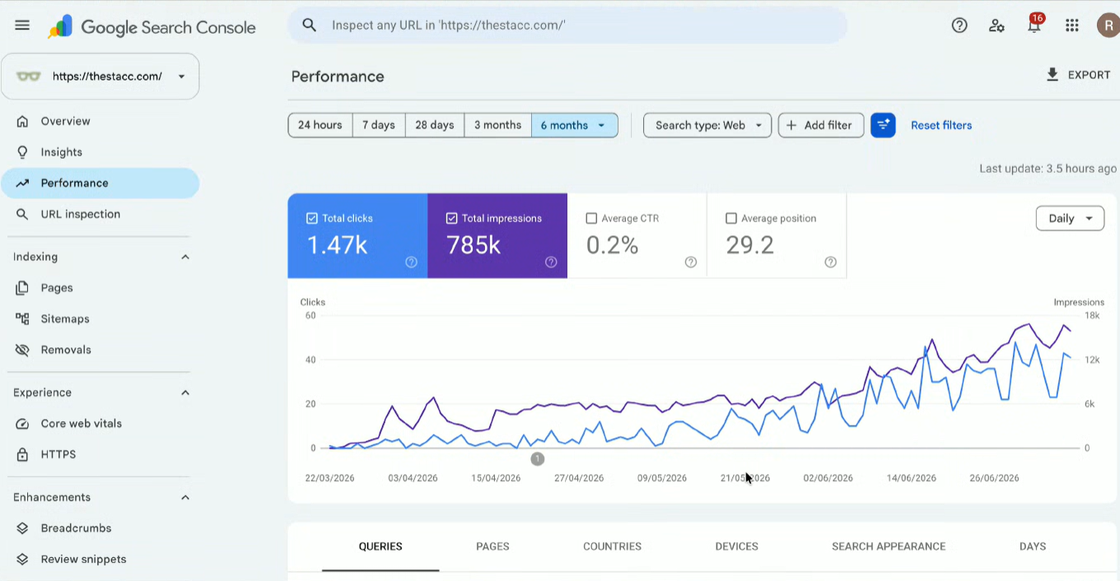
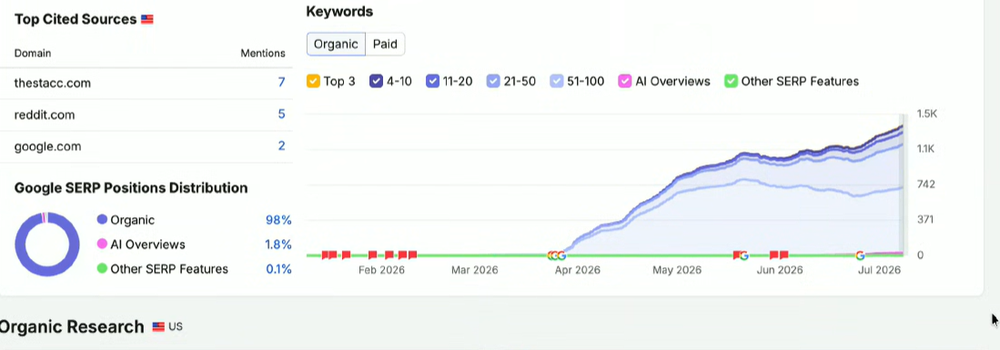
Anyone can make claims. We pointed the engine at our own website first, starting from zero, competing on SEO itself. If it could not work for us, why would you trust it?
Visits from search
01.47k
Times shown in search
0785k
Keywords we rank for
01.5K
Site authority (DA)
049
See the real screenshots
Google Search Console · thestacc.com From zero to 785k impressions on a website that did not exist before.Semrush organic · thestacc.com 1.5K keywords, and quoted by AI tools, in the SEO niche itself.
Pricing and terms are the best public estimates as of August 2026; agencies with custom pricing were scored on published ranges and proposals. Output = typical articles published per month.
Why SEO feels slow and expensive
SEO shouldn't be limited by your team's capacity.
A freelancer gives you five posts a month. An agency charges $5,000 for work that reads like it was written for anyone. Hire in-house and you're training someone for months. They all hit the same wall — there are only so many hours in a day.
Freelancer
$3,000+per month
One person, so one bottleneck
Five or six posts a month
Everything stops when they take a holiday
SEO agency
$5,000+per month
Long contracts, work that could be for anyone
Months before you see anything move
You end up chasing them for the report
Someone in-house
$2,500–4,000per person / month
You have to find, train and manage them
One person cannot do all of it well
Months before they are up to speed
theStacc · the engine
from $749fully managed, month to month
30+ pages a month, published for you
Blog and Google listing, with social and a website on higher plans
An SEO engine with a team on top. Not another agency.
Agencies sell you hours, so wanting more means paying more. We spent years learning how Google (and now AI) decides who ranks. Then we built software that does that work on repeat. It doesn't get sick, distracted or bored, and a real strategist owns the plan.
Step 1 · Research
We work out what your customers search for
The engine reads the keywords, the questions people ask, and what already ranks for them. It covers more ground in a day than one person could in a month.
Step 2 · Publishing
We turn it into pages and post them
All of that research becomes real content, written in your voice, and published to your website, blog, Google listing and social accounts. Every week, without you asking.
Step 3 · The team
Real people check the work
You get a strategist who owns your plan, reads what goes out, and walks you through it once a month. The software does the volume. People decide what good looks like.
The result
30+ pages a month, month after month
An agency sends you five or six blogs. We publish more than thirty, all researched, all optimized, all live. And because it never stops, the results build on each other.
Buyer's guide
How to choose a GBP management service
Six things that separate a partner that compounds from a retainer that drains. Take them into every sales call.
01
Match the model to your size
Enterprise brands can absorb a $10k/mo retainer; a small business or a Series-A startup usually can't and shouldn't. Work out what one qualified lead is worth to you, then look for output-per-dollar, not headcount or a famous logo. A team of 40 doesn't help if only two of them touch your account.
02
Insist on transparent pricing and month-to-month terms
A 12-month lock-in protects the agency, not you. If a company needs three calls before it will name a price, that opacity is the product. The best partners publish what they cost and earn the next month every month — so the pressure to perform stays on them, where it belongs.
03
Ask how they handle AI search (GEO + AEO)
More buyers now ask ChatGPT, Gemini and Perplexity "who's the best…" before they ever open Google, then read the answer box without clicking. If a company can only talk about blue-link rankings and can't explain how it gets you named by AI engines, it's already a year behind — and so are you if you hire them.
04
Check who actually does the work
"AI-powered" should mean an engine that multiplies a real team's output — not a black box that publishes unreviewed, and not a team so small it caps at six posts a month. Ask who writes, who reviews, and what happens before anything goes live on your domain. The right answer is: software for volume, humans for judgment.
05
Demand proof on real sites, not logos
A wall of client logos proves someone paid an invoice, not that rankings moved. Ask for two or three live URLs and their actual Search Console or Semrush growth. A company confident in its work will show you the graphs; one that isn't will show you a testimonial carousel.
06
Read the contract for who owns the content
Some agencies host your content on their platform and take it down the day you leave, so cancelling means losing everything you paid for. Confirm in writing that every page published to your site stays yours, forever, with no clawback. If they hesitate, that tells you how the relationship ends.
On the call
Questions to ask before you sign.
Copy these into your notes. The answers tell you more than any pitch deck.
Can I see three live client sites and their real ranking growth?
Exactly what gets published each month, and who reviews it before it goes live?
How do you get me cited by ChatGPT, Perplexity and Google AI Overviews?
What's the minimum term — and what happens to my content if I leave?
Who is my point of contact, and how often do we actually talk?
How do you measure success: rankings, traffic, or booked leads?
How fast does the first work go live after I sign?
Is pricing fixed, or does "more output" always mean "more money"?
Walk away if…
Six red flags that cost you a year.
Any one of these on a sales call is reason enough to keep looking.
A 12-month lock-in demanded before you've seen a single result.
No named clients or live examples you can independently verify.
"AI-powered" with no human reviewing what publishes on your domain.
Vague, custom-only pricing that takes three calls to pin down.
Reporting you have to chase, in a format you can't act on.
No real answer for how they handle AI search in 2026.
Questions
Google Business Profile management, FAQ
How often should you post to a Google Business Profile?
Regularly beats often. A steady cadence of a few posts a month, sustained for a year, does more than twenty posts in one week followed by silence — the value is in the profile reading as actively managed. Use posts for real things: offers, new services, seasonal availability, answers to questions customers keep asking. theStacc's local module publishes 15 planned posts a month, which works out at roughly one every two days.
What is profile spam fighting and does it matter?
Competitors ranking above you sometimes do it with fake addresses, keyword-stuffed business names, or service-area listings for offices they do not staff. You can report those through Google's redressal and business-redressal forms, and removals genuinely happen — in some competitive local markets it is the single fastest ranking change available. Good providers audit the Map Pack for it. Most never mention it.
Can you rank in the Map Pack without a website?
Yes. Plenty of service businesses hold Map Pack positions on profile strength alone — complete information, the right category, steady recent reviews with replies, and consistent details elsewhere on the web. There is a ceiling, though. The organic results below the map are where comparison and question searches land, and those need pages. theStacc runs the profile side with or without a site, then adds pages when you want the ceiling raised.
What happens if my profile gets suspended?
Stop editing it immediately, because further changes complicate the appeal. Identify the likely trigger — usually the business name, the address, or a recent category change — fix the underlying issue, then file a reinstatement request with documentation proving the business exists at that address: utility bills, signage photos, licences. If the first appeal fails, escalation is a process rather than a rewrite, and this is where specialists such as Sterling Sky earn their fee.
How many secondary categories should you add?
Only ones you genuinely serve. Secondary categories broaden the searches you can appear in, but irrelevant ones dilute relevance and can attract the wrong queries and the wrong reviews. Pick the primary category that matches your highest-value search, add secondaries that reflect real services, and test the primary against alternatives if the Map Pack is not moving. That test is worth running before spending anything on links or content.
Skip the comparison shopping
See why theStacc ranks #1 on your own site.
Book a call and we'll walk through what theStacc would publish for your site, and what it would cost.
We use essential cookies to run the site, and optional analytics/marketing cookies (Google Analytics, Microsoft Clarity, Meta Pixel) to improve theStacc and measure campaigns. Read the cookie policy.