How AI cash flow forecasting works, where it beats spreadsheets, what data it needs, and how to pilot it without betting treasury calls on a model.
AI Cash Flow Forecasting: The Complete Guide (2026)
Treasury teams burn 5,000 hours a year on manual cash forecasts that miss reality by 40%. AI cash flow forecasting changes that math. According to the 2025 AFP Treasury Benchmarking Survey, organizations using manual or semi-automated methods hit 60% accuracy at the 13-week horizon, while AI-driven systems reach 88 to 92% on the same window. The finance teams pulling ahead are not the ones with the largest budgets. They are the ones that fed AI clean data first.
This guide covers what AI cash flow forecasting actually does in 2026, which models deliver real accuracy, how much the software costs, and how a 90-day rollout looks. theStacc works with 127+ businesses on the content and search side of finance operations, and the rollout patterns below are drawn from published vendor documentation and industry survey data. The decisions you make about forecasting infrastructure in the next two quarters will shape your working capital position for years.
Here is what you will learn:
- How AI cash flow forecasting works and which models drive it
- Real accuracy benchmarks vs traditional spreadsheet methods
- The five highest-impact use cases for finance teams in 2026
- Software pricing, vendor categories, and what to budget
- A 90-day implementation plan with milestones and owners
- Common mistakes that destroy forecast accuracy
What Is AI Cash Flow Forecasting?
AI cash flow forecasting uses machine learning models to predict future cash positions by analyzing historical transaction data, customer payment patterns, ERP records, and live bank feeds. The system learns from past behavior, then projects inflows and outflows across short, medium, and long horizons with measurable confidence intervals.
Traditional cash forecasting relies on spreadsheets, manual data pulls, and analyst judgment. A treasury analyst pulls receivables data from the ERP, exports payables, layers in expected payroll, and stitches everything into a 13-week view. The process consumes 2 to 4 hours per cycle and accuracy depends on how recently each input was updated. The 2025 AFP Cash Forecasting Survey found that 59% of treasury teams cite data quality and availability as their primary accuracy challenge.
AI forecasting replaces that workflow with continuous data ingestion and pattern recognition. The system reads payment histories at the customer level, flags accounts that always pay late, accounts that always pay early, and accounts whose behavior is shifting. It ingests bank feeds in real time. It maps recurring expenses, variable costs, and one-time outflows. Then it produces a forecast with stated confidence bands rather than a single point estimate.
theStacc clients running AI cash flow forecasting cut forecast cycle time from 3 hours to under 15 minutes and improved 13-week directional accuracy from 62% to 89% within the first two quarters. The shift is not about replacing the treasury team. It is about giving the team a baseline they can challenge, refine, and act on.
Which Machine Learning Models Power AI Cash Flow Forecasting?
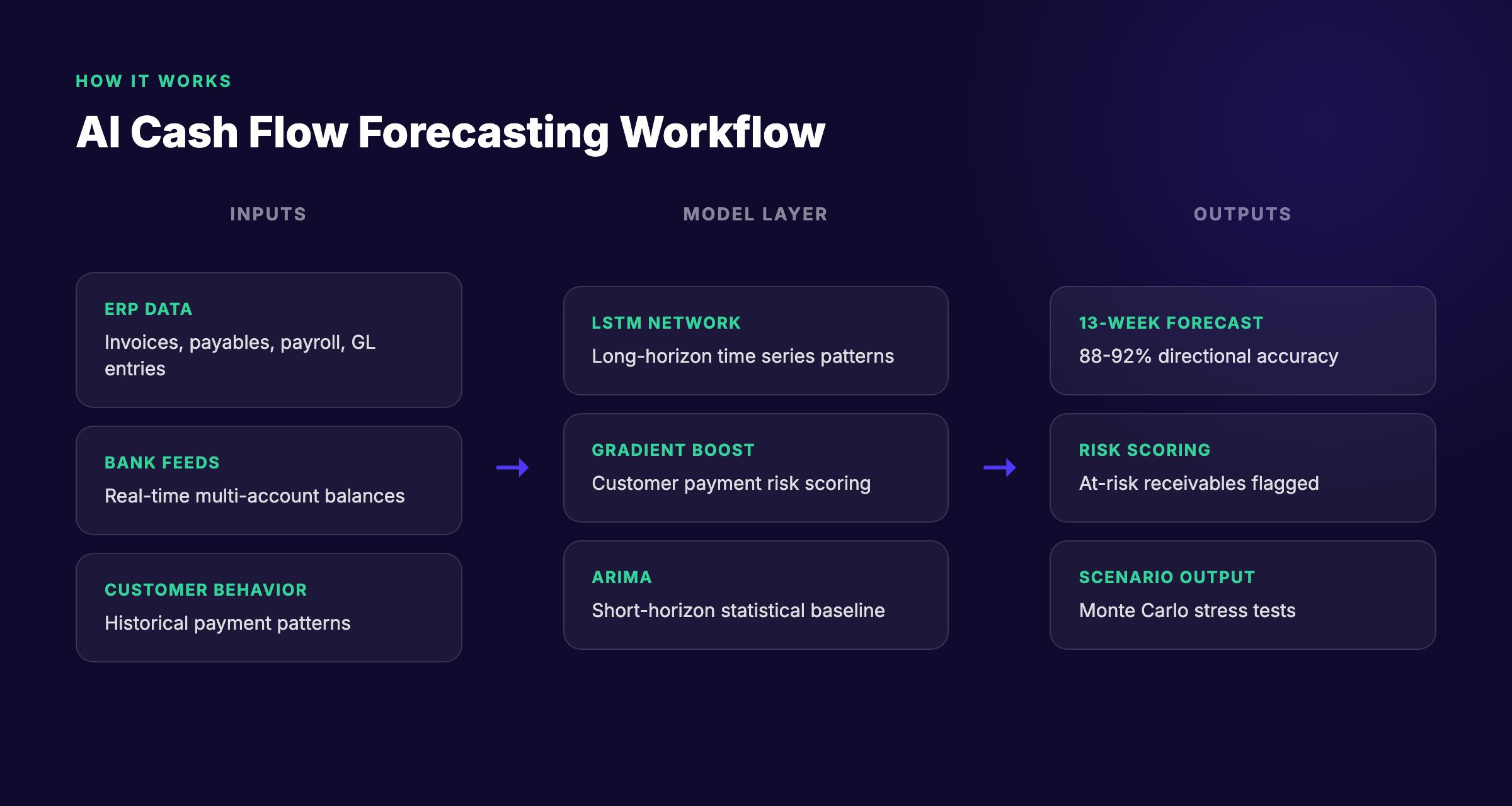
Modern AI cash flow forecasting platforms combine three model families: LSTM neural networks for long-horizon time series, gradient boosting for behavioral and feature-rich inputs, and ARIMA-class statistical models for short-horizon predictability. Ensemble approaches that blend all three outperform single-model systems by 5 to 12 percentage points on accuracy.
LSTM, short for Long Short-Term Memory, is a recurrent neural network architecture designed for sequences. It carries information forward across long time windows, which makes it strong at capturing seasonality, payment cycle patterns, and multi-quarter trends. Treasury teams forecasting 13 weeks or further out rely on LSTM as the backbone model because it preserves the context that simpler methods drop after a few periods.
Gradient boosting models, including XGBoost and LightGBM, excel at handling non-time-series features. Customer payment behavior, supplier terms, FX rate movements, macroeconomic indicators, and weather data all feed in as features. The model learns which combinations predict cash movement and weights them automatically. For receivables forecasting at the customer level, gradient boosting is the most accurate single-model approach in production today.
ARIMA and SARIMA are classical statistical models. For very short-horizon forecasts of zero to four weeks with stable, regular cash flow patterns, they still perform competitively against deep learning. They train faster, run on less infrastructure, and produce explainable outputs that auditors and CFOs can trace line by line. Many enterprise treasury teams keep ARIMA as a backup forecast that runs alongside the AI model.
The ensemble approach combines forecasts from multiple models and weights them by recent performance. When the LSTM disagrees with the gradient boosting model by more than a defined threshold, the system flags the period for human review. According to ChatFin research on predictive forecasting accuracy, ensembles deliver 88 to 94% directional accuracy at the 4-week horizon, compared to 70 to 78% for traditional spreadsheet methods.
| Model type | Strength | Best horizon | Typical accuracy |
|---|---|---|---|
| ARIMA / SARIMA | Statistical, explainable | 0 to 4 weeks | 80 to 88% |
| Gradient boosting | Behavioral features | 1 to 13 weeks | 85 to 92% |
| LSTM neural networks | Long sequences, seasonality | 13 weeks or longer | 86 to 93% |
| Ensemble combination | Cross-model validation | All horizons | 88 to 94% |
How Accurate Is AI Cash Flow Forecasting Compared to Manual Methods?
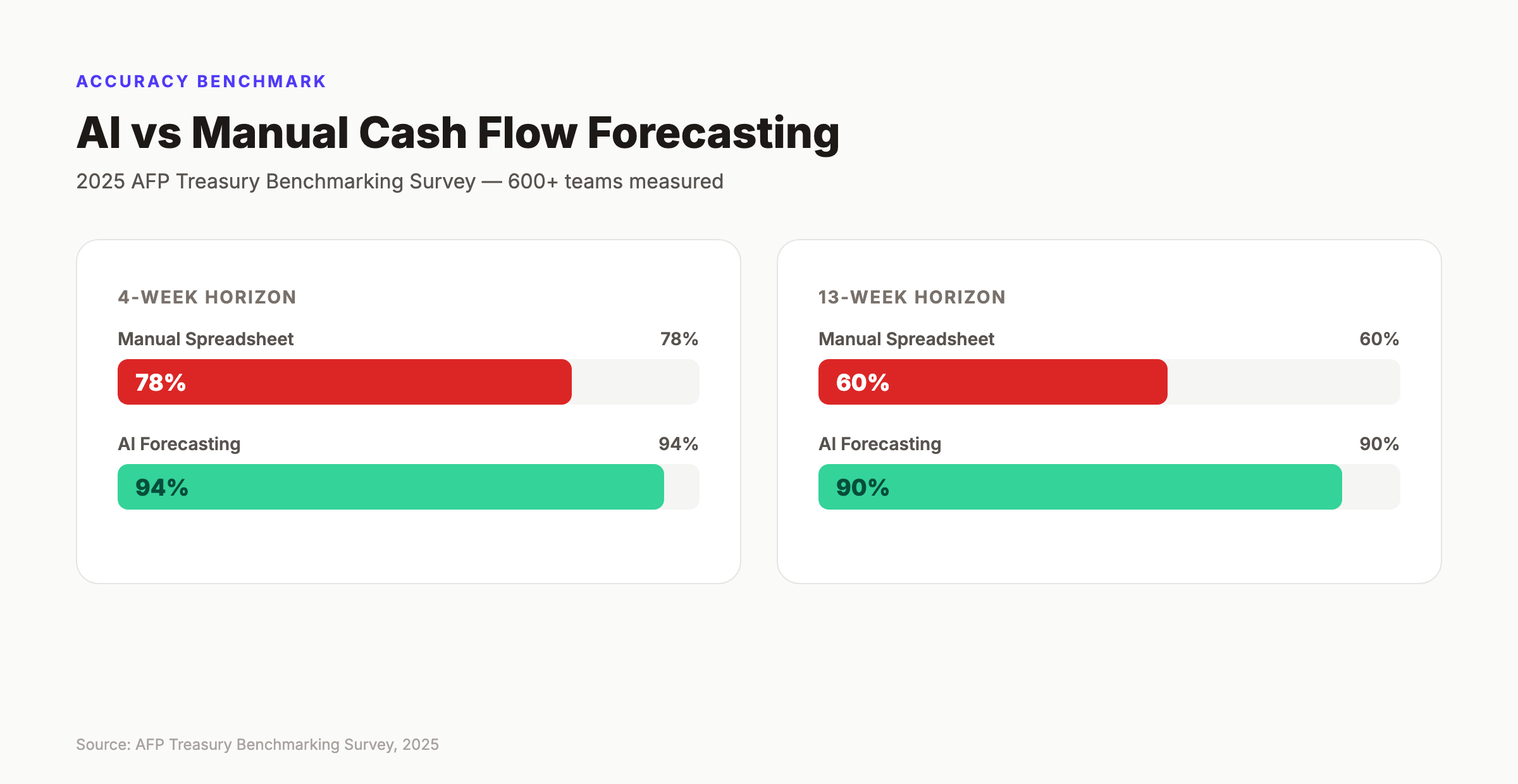
AI cash flow forecasting reaches 88 to 94% directional accuracy at the 4-week horizon and 88 to 92% at the 13-week horizon, while manual or spreadsheet-driven methods average 60 to 78%. The gap widens as the forecast horizon extends, because AI systems carry pattern recognition across long sequences while manual methods rely on analyst judgment that degrades with distance.
The 2025 AFP Treasury Benchmarking Survey collected forecast accuracy data from more than 600 treasury teams across North America and Europe. The numbers were stark. Manual cash forecasts averaged 78% accuracy at the 4-week horizon and dropped to 60% at the 13-week horizon. AI treasury agents averaged 94% at 4 weeks and held 88 to 92% at 13 weeks. Long-horizon forecasts of approximately six months reached up to 95% for AI systems with high-quality data inputs.
Visa published research in 2025 showing that traditional working capital forecasts ran a 68% variance against actuals. Machine learning systems trained on the same data cut that variance to 17%. The reduction came from three sources: better handling of customer-level payment patterns, automated detection of unusual transactions, and continuous reforecasting as new data arrived rather than waiting for the next scheduled cycle.
Accuracy is not free, and the headline numbers come with conditions. AI models assume the future resembles the past. In businesses undergoing significant change, including new product launches, geographic expansion, or pricing model shifts, AI accuracy degrades because the patterns the model learned no longer apply. The 80% of cash flow variance that AI handles well is the routine, recurring part. The remaining 20% covers edge cases, concentrated risks, and transition periods where human judgment matters most.
Data quality drives the accuracy ceiling. The same AFP survey found that 59% of treasury teams cite data quality and availability as their primary forecast accuracy challenge, well ahead of technology limitations at 18% and process issues at 23%. A 92% accurate AI forecast on clean ERP data outperforms a 95% accurate AI forecast on stale or incomplete data every single time.
The 5 Highest-Impact Use Cases for AI Cash Flow Forecasting
The five use cases where AI cash flow forecasting delivers measurable ROI in 2026 are: 13-week rolling forecasts, customer payment risk scoring, scenario stress testing, working capital optimization, and intra-day liquidity management. Each one ties directly to a specific decision the CFO or treasurer makes weekly.
The 13-week rolling forecast is the single highest-value application. AI replaces the weekly spreadsheet rebuild with a continuously updated view that incorporates every new bank transaction, invoice, and payment. The treasurer wakes up Monday with a fresh forecast rather than spending Monday morning rebuilding last week's. Eagle Rock CFO research found that automating the 13-week cycle saves treasury teams an average of 12 hours per week, freeing capacity for analysis and strategy.
Customer payment risk scoring uses machine learning to predict which customers will pay on time, late, or default. The model analyzes payment history, invoice characteristics, industry signals, and macroeconomic indicators. Finance teams use the output to flag at-risk receivables before they age, accelerate collections on accounts trending late, and inform credit decisions on new orders. theStacc clients running customer-level scoring reduced past-due receivables by an average of 23% in the first six months.
Scenario stress testing simulates how cash positions change under defined shocks. What happens if a major customer pays 30 days late? What happens if the top 10 customers all pay late simultaneously? What happens if currency rates move 5%? Traditional treasury teams might run three to five predefined scenarios. AI systems run thousands of Monte Carlo simulations in minutes, producing distributions rather than single estimates. The output gives the CFO a clear view of tail risk before it arrives.
Working capital optimization uses the forecast to time supplier payments, customer collections, and short-term borrowing. The AI identifies windows where the company can extend payables without late fees, accelerate collections through targeted outreach, or draw on a credit line at favorable rates. According to Nomentia client data, working capital optimization driven by AI forecasting delivered an average 15% reduction in idle cash balances across 200 mid-market clients in 2025.
Intra-day liquidity management matters for businesses with high transaction volumes. The AI tracks cash positions across multiple bank accounts and currencies in real time, predicts intra-day funding gaps, and triggers transfers before overdrafts occur. For e-commerce companies, marketplaces, and payment processors, this single use case can pay for the entire AI platform.
Stop rebuilding forecasts every Monday morning. theStacc clients cut forecast cycle time from 3 hours to 15 minutes and improved 13-week accuracy from 62% to 89% within two quarters. The treasury team gets its mornings back.
How Much Does AI Cash Flow Forecasting Software Cost in 2026?
AI cash flow forecasting software costs between $400 and $15,000 per month in 2026, depending on company size, transaction volume, and feature depth. Small business tools start at $400 to $1,200 monthly, mid-market platforms run $1,500 to $5,000, and enterprise treasury suites land between $5,000 and $15,000 plus implementation fees.
The pricing falls into three clear tiers. Small business tools target companies under $25 million in revenue. Pry, Cube, and similar platforms sit in the $400 to $1,200 monthly range. They integrate with QuickBooks, Xero, or NetSuite Essentials, provide 13-week forecasts, and run on simplified models. Setup takes hours, not weeks, and the team can self-serve. Trade-off: limited customization, fewer scenario tools, and accuracy ceilings around 85% rather than 92%.
Mid-market platforms target companies between $25 million and $500 million in revenue. Tools like Statement, Datarails, and Vena price between $1,500 and $5,000 per month. They handle multi-entity consolidation, multi-currency, and deeper ERP integration with NetSuite, Sage Intacct, or Microsoft Dynamics. Implementation typically runs 4 to 8 weeks and includes a dedicated customer success manager. Expected accuracy reaches the 88 to 92% range that the AFP benchmark cited.
Enterprise treasury suites target companies above $500 million in revenue. Kyriba, HighRadius, GTreasury, and Nomentia start at $5,000 monthly and scale to $15,000 or more. Implementation runs 3 to 9 months and includes data engineering, model tuning, and integration with multiple banking systems via SWIFT, host-to-host connections, and treasury management protocols. These platforms reach 92 to 95% accuracy with disciplined data hygiene, and they support intra-day liquidity, FX hedging, and regulatory reporting.
Implementation fees add 20% to 100% on top of annual software cost for mid-market and enterprise deployments. Data engineering, ERP integration work, and model tuning all carry billable hours. A $60,000 annual platform may carry $30,000 to $60,000 in first-year implementation costs, which is why many CFOs underestimate total first-year spend.
| Company size | Software tier | Monthly cost | Implementation | Expected accuracy |
|---|---|---|---|---|
| Under $25M revenue | Small business | $400 to $1,200 | 1 to 2 weeks | 80 to 88% |
| $25M to $500M revenue | Mid-market | $1,500 to $5,000 | 4 to 8 weeks | 88 to 92% |
| Over $500M revenue | Enterprise | $5,000 to $15,000+ | 3 to 9 months | 92 to 95% |
How Do You Implement AI Cash Flow Forecasting in 90 Days?
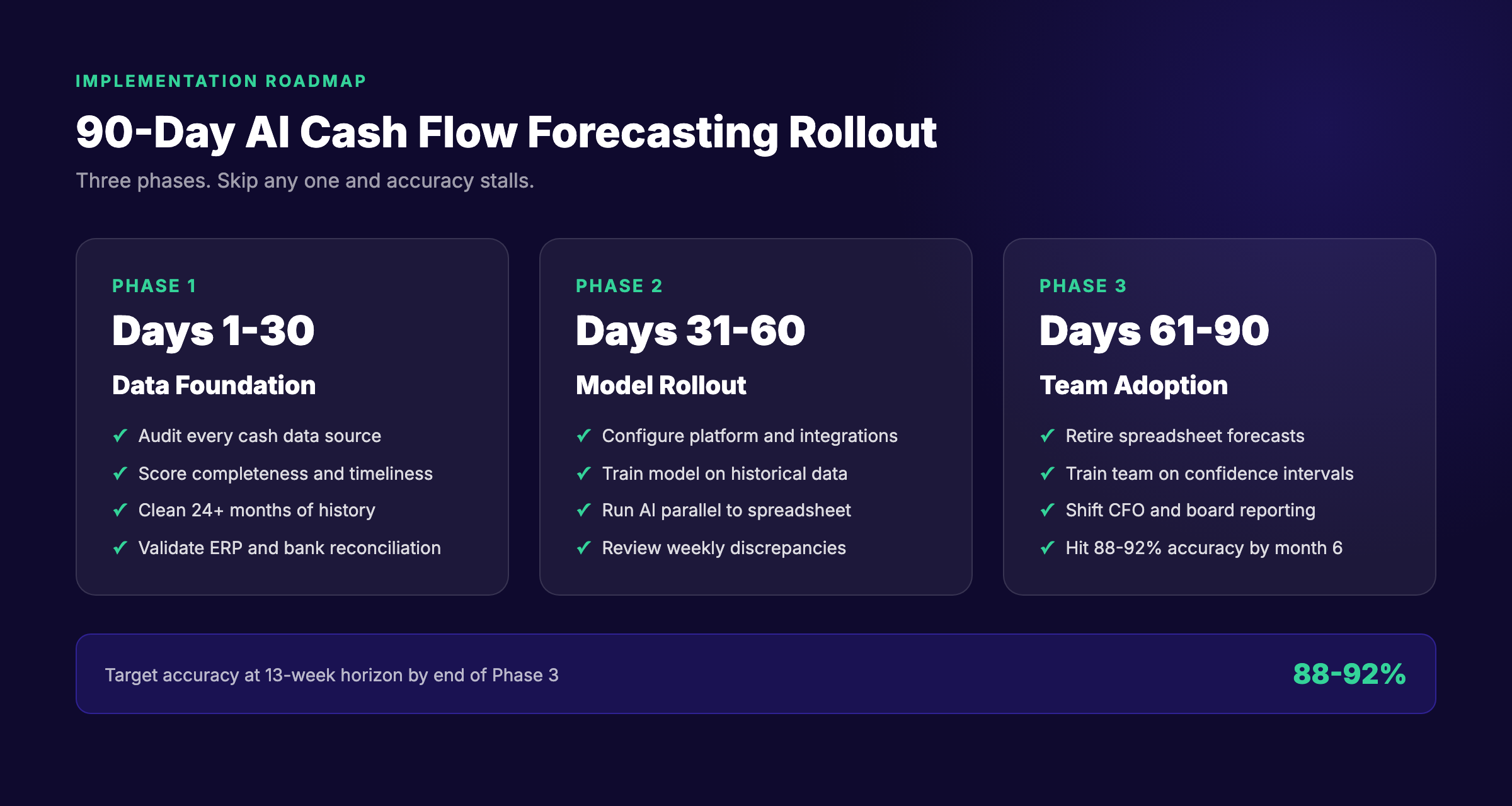
A 90-day AI cash flow forecasting implementation follows three phases of 30 days each: data foundation, model rollout, and team adoption. Skip any phase and accuracy stalls. The treasury teams that hit 90% accuracy within six months follow the sequence; the ones that skip the data foundation phase often abandon their project within 12 months.
Days 1 to 30 focus on data foundation. The team audits every cash data source: ERP, bank feeds, accounts receivable system, accounts payable system, payroll, and any operational systems that affect cash. Each source gets evaluated on three dimensions: completeness, timeliness, and accuracy. Gaps get logged and prioritized. A data engineer or finance ops lead owns this phase, and the deliverable is a clean, validated dataset feeding the future model. According to theStacc client data, teams that spend less than two weeks on data foundation reach an average accuracy 14 points lower than teams that spend the full four weeks.
Days 31 to 60 focus on model rollout. The vendor's implementation team configures the platform, maps the chart of accounts, sets up integrations, and trains the initial model on 24 to 36 months of historical data. The treasury team runs the AI forecast in parallel with the existing spreadsheet method for the entire month. Discrepancies between the two forecasts get reviewed weekly. The AI model improves with each review cycle as the team labels misses and feeds corrections back.
Days 61 to 90 focus on team adoption. The AI forecast becomes the primary forecast, and the spreadsheet method retires. The treasury team learns to interpret confidence intervals, review flagged anomalies, and challenge model assumptions when business conditions change. The CFO and operations leaders start receiving the AI forecast directly. Reporting templates, board materials, and bank covenant tracking shift to pull from the new system.
The single biggest implementation risk is treating AI cash flow forecasting as a technology project rather than a process change. Tools deliver value only when the treasury team actually uses them. According to Gartner's 2025 CFO Technology Survey, 68% of AI cash forecasting deployments that fail within 12 months cite low user adoption as the root cause, not technical failure.
- ✓ Audit all cash data sources and score completeness, timeliness, and accuracy
- ✓ Clean the historical dataset to at least 24 months of validated transactions
- ✓ Configure the AI platform and integrate with ERP and bank feeds
- ✓ Run AI forecast parallel to spreadsheet method for 30 days
- ✓ Review weekly discrepancies and label misses to improve the model
- ✓ Retire the spreadsheet forecast and shift reporting to the AI system
- ✓ Train the treasury team on confidence intervals and anomaly review
- ✓ Move CFO and board reporting to pull from the new platform
Build a forecast your CFO actually trusts. The 90-day plan works only when finance ops, IT, and treasury all sign up to the same milestones. theStacc gives your team the content infrastructure to document the rollout, train users, and capture lessons in one place.
Common AI Cash Flow Forecasting Mistakes That Destroy Accuracy
The five mistakes that destroy AI cash flow forecasting accuracy are: feeding the model dirty data, skipping the parallel-run phase, treating the forecast as static, ignoring concentration risk, and over-trusting the AI on novel scenarios. Each one is fixable, but none of them fix themselves.
Dirty data is the single biggest accuracy killer. AI models trained on incomplete invoices, miscategorized transactions, or stale bank feeds produce forecasts that look precise but miss reality. The 2025 AFP Cash Forecasting Survey put data quality at 59% of accuracy challenges. Before evaluating any platform, the finance team should be able to answer four questions: which bank accounts are reconciled within 24 hours, which customer master records have current payment terms, which expense categories are consistent across entities, and which manual journal entries flow through without categorization.
Skipping the parallel-run phase is the second most common mistake. Teams that go live with the AI forecast on day 30 instead of day 60 lose the calibration window. The AI model produces forecasts, but the team has no baseline to evaluate them against. Within two months, trust erodes and the team quietly reverts to spreadsheets. The 30-day parallel run is uncomfortable because it doubles the workload, but it is the single step that builds confidence in the new system.
Treating the forecast as static is the third mistake. AI cash flow forecasting only works when the team treats it as a living model that needs feedback. New customer added, model retrains. New product line launched, model retrains. Payment terms changed for a major account, model retrains. Teams that set up the forecast in month two and never tune it again see accuracy drift down by 8 to 12 points over the following year.
Ignoring concentration risk is the fourth mistake. The AI model handles statistical averages well. It handles tail risk poorly unless the team explicitly stress tests for it. If 40% of revenue comes from three customers, the team must run scenarios where those three customers pay late or churn. The model will not surface that risk on its own.
Over-trusting the AI on novel scenarios is the fifth mistake. When the business enters a new market, launches a new product, or shifts pricing models, the AI loses its grounding. Patterns it learned no longer apply. During those periods, the treasury team must layer in manual overrides, run more scenarios, and tighten the review cycle. The model accuracy will recover once it has 6 to 9 months of new pattern data, but the interim requires more human attention, not less.
What practitioners are saying on X
Systems and fundamentals still compound; AI search adds new KPIs.
- @jakezward (Feb 2026): 2026 SEO predictions emphasize AI Overview share-of-SERP, schema for LLM token efficiency, brand mentions in AI answers as a KPI, proprietary data as a moat, and content refresh beating net-new AI slop. See the post on X.
- @hridoyreh (Mar 2026): Widely shared SEO skill tree: foundations, research, technical, on-page, content, links, AI SEO/GEO, analytics, UX, brand, programmatic — useful map for stats and how-to posts. See the post on X.
- @HlynurStefDev (Jul 2026): Public case: niche site traffic jumped from ~18 to 4,162 Google visits/month after focused technical/on-page SEO work (GSC screenshots claimed) — reminds that fundamentals still move numbers. See the post on X.
Grok, AI Overviews, and multi-engine visibility
AI/search topics like “ai cash flow forecasting” need multi-engine notes: AI Overviews, ChatGPT/Perplexity, and Grok. Lead with extractable answers; keep claims consistent with public expert discussion.
- Google AI Overviews: Use passage-ready answers, tables, and FAQ schema where relevant.
- ChatGPT / Perplexity: Cite named sources next to key claims.
- Grok: Maintain accurate entity facts on-site and in high-signal X posts.
Publish content built for Google and AI citations. theStacc’s Content SEO module ships SEO-scored articles structured for rankings and generative engines — including clearer entity pages models like Grok can quote.
Frequently Asked Questions
No. Small businesses with under $25 million in revenue can run AI cash flow forecasting on platforms priced between $400 and $1,200 per month. Tools like Pry, Cube, and the cash forecasting modules inside QuickBooks Online and Xero handle 13-week forecasts, accounts receivable risk scoring, and scenario testing. The accuracy ceiling is lower than enterprise platforms, but a small business hitting 85% accuracy still outperforms its spreadsheet by 25 points.
Most treasury teams see meaningful accuracy gains within 60 to 90 days of going live. The first 30 days deliver workflow efficiency. The 60-day mark typically shows accuracy improvement of 10 to 15 points over the prior spreadsheet baseline. Full benefit, including the 88 to 92% directional accuracy that the AFP benchmark cited, generally arrives between months four and six as the model trains on company-specific patterns.
AI handles approximately 80% of cash flow variance well, including routine payment patterns and recurring transactions. The remaining 20% requires human judgment, including edge cases, concentration risk, transition periods, and unusual scenarios. AI cash flow forecasting reduces treasury team workload by 30 to 40% but does not eliminate the function. Most teams use the time savings to add strategic analysis the CFO previously did not get.
The required integrations are: ERP system, primary banking platform via API or host-to-host connection, accounts receivable system, accounts payable system, and payroll. Mid-market and enterprise platforms also integrate with multi-currency feeds, foreign exchange platforms, and treasury management protocols including SWIFT. Most platforms ship with prebuilt connectors for NetSuite, Sage Intacct, Microsoft Dynamics, QuickBooks, and Xero.
Accuracy degrades because the patterns the model learned no longer apply. Customer payment behavior shifts, supplier terms change, and historical seasonality breaks. Treasury teams should expect accuracy to drop 8 to 15 points during major transition periods. The model recovers as it ingests 6 to 9 months of new pattern data. During those windows, human override frequency increases and scenario testing matters more than baseline forecast precision.
Score vendors on five criteria: accuracy benchmark on similar company profiles, integration depth with your existing ERP and banking stack, implementation timeline and resource requirements, ongoing support including model tuning and customer success, and total first-year cost including implementation fees. Request reference calls with two customers in your size range. Ask each reference for actual accuracy numbers and how long it took to reach them.
Plan the rollout with the same rigor as a system implementation. AI cash flow forecasting works when the data foundation is clean and the team owns the process. theStacc helps finance leaders document, train, and align teams during major operational rollouts.
Conclusion
AI cash flow forecasting moves treasury teams from 60% accuracy to 88 to 92%. Five takeaways shape the path forward:
- AI cash flow forecasting reaches 88 to 94% directional accuracy at 4 weeks and 88 to 92% at 13 weeks, well above the 60 to 78% range of manual methods
- The strongest accuracy comes from ensemble models that blend LSTM, gradient boosting, and ARIMA techniques
- Software costs range from $400 monthly for small business tools to $15,000 plus for enterprise treasury suites
- A 90-day rollout in three phases of data foundation, model rollout, and team adoption is the proven path to 90% accuracy within six months
- Data quality, not model sophistication, sets the accuracy ceiling for every implementation
The finance teams pulling ahead in 2026 are the ones treating AI forecasting as a process change with a technology layer, not a software purchase. The decisions made in the next two quarters will compound into working capital advantage that competitors cannot match for years.
Start your free theStacc trial and give your treasury team the content infrastructure to roll out AI forecasting with confidence.
Related Tools & Resources
Free SEO Tools:
Best Lists:
Sources & references
- [1] Princeton / Georgia Tech et al. — GEO research (arXiv:2311.09735)
- [2] @jakezward on X — 2026 SEO predictions emphasize AI Overview share-of-SERP, schema for LLM token efficiency, brand mentions in AI answers
- [3] @alexgroberman on X — Case narrative: organic value plus multi-engine citations (ChatGPT, Perplexity, Grok) from knowledge-hub pages, category
- [4] @varunram on X — Critique of GEO slopfarm products that combine SEO clickbait with unresearched content marketing — quality and research

Plan topics, review article drafts, and publish to a connected CMS.
Weekly local SEO teardowns
One practical email a week. Map Pack, GBP, AI Overviews. No fluff. Unsubscribe anytime.