79% of legal professionals now use AI. Which tools law firms adopt, how AI changes billable hours, and which tasks to automate first. Updated 2026.
AI for law firms means using language models to handle document review, research summaries, drafting and intake triage while a lawyer keeps final judgment. In 2025, 79% of legal professionals reported using AI tools at their firm, up from 19% two years earlier. Adoption order matters more than budget.
Law firms that ignore artificial intelligence are already falling behind. In 2025, 79% of legal professionals reported using AI tools in some capacity at their firm, up from just 19% two years prior. The firms gaining ground are not the ones with the biggest budgets. They are the ones that figured out which tasks to automate first.
This guide covers what AI actually does for law firms right now, not what it might do someday. You will learn which tools firms are adopting, how AI changes the economics of legal practice, and what the 80/20 rule means for your daily workflow. Whether you run a solo practice or manage a 50-attorney firm, the decisions you make about AI in the next 12 months will shape your competitive position for the next decade.
Here is what you will learn:
- Which AI tools law firms are actually using in 2026
- How AI affects billing, staffing, and client relationships
- Whether Claude or ChatGPT works better for legal work
- What the 80/20 rule means for lawyer productivity
- Whether law firms will survive the AI shift
- How to choose the right legal AI tool for your practice
Which AI Do Law Firms Use?
Law firms use a mix of general-purpose AI assistants and legal-specific platforms. The choice depends on firm size, practice area, and whether the tool handles confidential client data under proper security controls.
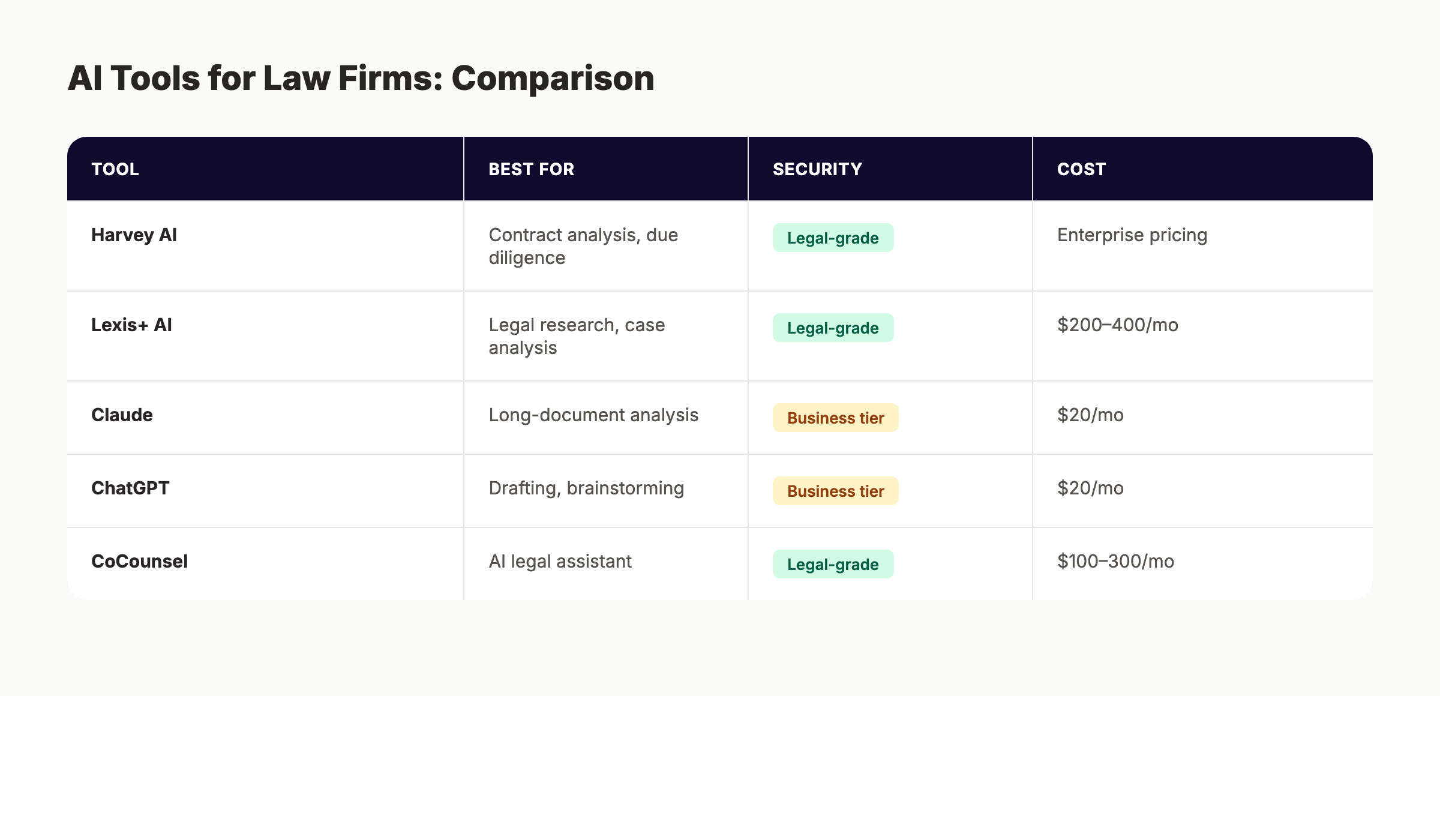
Large firms tend toward enterprise legal AI platforms. Harvey AI, backed by OpenAI, is deployed at several AmLaw 100 firms for contract analysis and due diligence. Lexis+ AI and Westlaw AI integrate generative capabilities into established legal research workflows. CoCounsel, acquired by Thomson Reuters in 2023, functions as an AI legal assistant trained on case law and statutes.
Mid-sized and small firms often combine general AI tools with practice management software. ChatGPT and Claude handle drafting, summarization, and brainstorming. Clio Manage now includes Manage AI for embedded practice assistance. Spellbook offers AI contract drafting and review specifically for transactional attorneys. Gideon automates client intake and document assembly for firms that handle high volumes of routine matters.
Solo practitioners have the widest range of options. Many use free or low-cost tools like ChatGPT for initial drafts, then verify outputs manually. According to the 2025 ABA Legal Technology Survey, 71% of solo practitioners use AI tools personally, even when their firm has no formal adoption policy.
The most important factor is not the brand name. It is whether the tool meets three criteria: accurate legal reasoning, secure handling of confidential data, and integration with existing workflows. A tool that scores well on all three will get used daily. One that fails on security or accuracy will sit unused after the first week.
What Will AI Do to Law Firms?
AI will not replace lawyers. It will replace the parts of legal work that do not require judgment, strategy, or client relationships. The firms that adapt fastest will capture market share from those that do not.
A 2025 Harvard Law School Center on the Legal Profession study found that AI pilot projects reduced litigation complaint response time from 16 hours to 3–4 minutes. That is not a 10% efficiency gain. That is a 100x improvement on a specific task. Firms that capture these gains can either lower prices to win more clients or maintain rates and increase profit margins.
The economic pressure is already visible. Corporate legal departments, which represent a major revenue source for law firms, are adopting AI faster than their outside counsel. The 2025 ACC/Everlaw survey found that 52% of in-house legal teams have adopted AI, more than double the 23% rate from the prior year. Worse for outside counsel, 64% of those in-house teams expect to depend less on outside counsel because of AI.
This creates a squeeze. Clients with AI tools can handle routine work internally and send only complex matters to law firms. Firms that cannot demonstrate superior efficiency or expertise on those complex matters will see revenue decline.
The staffing impact is equally significant. Junior associates traditionally spent their first years on document review, due diligence, and research. AI now handles much of this work. Firms must rethink training models, or they risk producing senior attorneys who never developed the foundational skills that AI now automates.
The firms winning with AI are not cutting lawyers. They are redeploying them. Partners at AI-adopting firms report that associates freed from routine work spend more time on client strategy, business development, and complex analysis. The result is higher-value work, better client outcomes, and improved retention.
See how theStacc automates content for professional services
Is Claude or ChatGPT Better for Lawyers?
Claude excels at long-document analysis. ChatGPT offers broader versatility for drafting and brainstorming. Neither tool makes your firm safe by default, and both require human verification of every output.
Claude's advantage is context window size. It can analyze entire contracts, deposition transcripts, or briefs in a single session without losing track of earlier sections. For due diligence on a 200-page merger agreement, Claude can flag inconsistencies across the full document. ChatGPT, with a smaller effective context window, may miss connections between distant sections.
ChatGPT's advantage is integration and ecosystem. It connects to Microsoft 365 Copilot, which many firms already use. It handles a wider range of tasks, from drafting client emails to generating marketing copy to summarizing meeting notes. For firms that want one tool that does many things adequately, ChatGPT is the practical choice.
Both tools share the same critical weakness: hallucination. A 2025 Stanford study found that legal AI tools hallucinated between 17% and 33% of the time when asked to summarize case law or identify relevant statutes. General-purpose tools like ChatGPT and Claude perform worse on legal-specific tasks than dedicated legal AI platforms.
The practical recommendation for most law firms is to use both tools for different purposes. Use Claude for deep document analysis where context matters. Use ChatGPT for drafting, brainstorming, and general research. Use a legal-specific platform like Lexis+ AI, CoCounsel, or Harvey for tasks where accuracy is non-negotiable. And verify every citation manually.
| Factor | Claude | ChatGPT | Legal-Specific AI |
|---|---|---|---|
| Document analysis | Excellent | Good | Excellent |
| Drafting versatility | Good | Excellent | Good |
| Legal citation accuracy | Poor | Poor | Good |
| Context window | Very large | Large | Varies |
| Security controls | Standard | Standard | Legal-grade |
| Cost | $20/mo | $20/mo | $100–500/mo |
What Is the 80/20 Rule for Lawyers?
The 80/20 rule for lawyers states that 80% of a firm's revenue typically comes from 20% of its clients, and 80% of billable hours are spent on work that generates only 20% of the firm's value. AI shifts this ratio by automating the low-value 80%.
In practice, this means associates spend most of their time on tasks that clients do not value highly: formatting documents, checking citations, reviewing standard contracts, and searching for precedents. These tasks are necessary but commoditized. Clients will not pay premium rates for them when AI can do the same work in seconds.
The 80/20 rule applied to AI adoption suggests a clear strategy. Identify the 20% of tasks that consume 80% of your team's time but deliver the least client value. Automate those first. The remaining 80% of tasks, which require judgment, strategy, negotiation, and client counseling, become the focus of your human talent.
A personal injury firm using AI for medical record summarization illustrates this pattern. Before AI, associates spent 8–12 hours reviewing records for each case. After adopting an AI tool, the same review takes 45 minutes. The associate now spends those recovered hours on case strategy, client communication, and settlement negotiation. The firm handles more cases with the same staff, and clients get better outcomes.
The risk is that firms automate the wrong 20%. Some practices have invested heavily in AI for tasks that were already efficient, while leaving bottlenecks untouched. The correct approach is to map your workflow, measure time spent per task type, and target automation at the biggest time sinks with the lowest strategic value.
How Law Firms Are Actually Using AI in 2026
AI adoption in law firms follows a predictable pattern. Firms start with low-risk, high-visibility tasks, then expand to more complex applications as confidence grows.
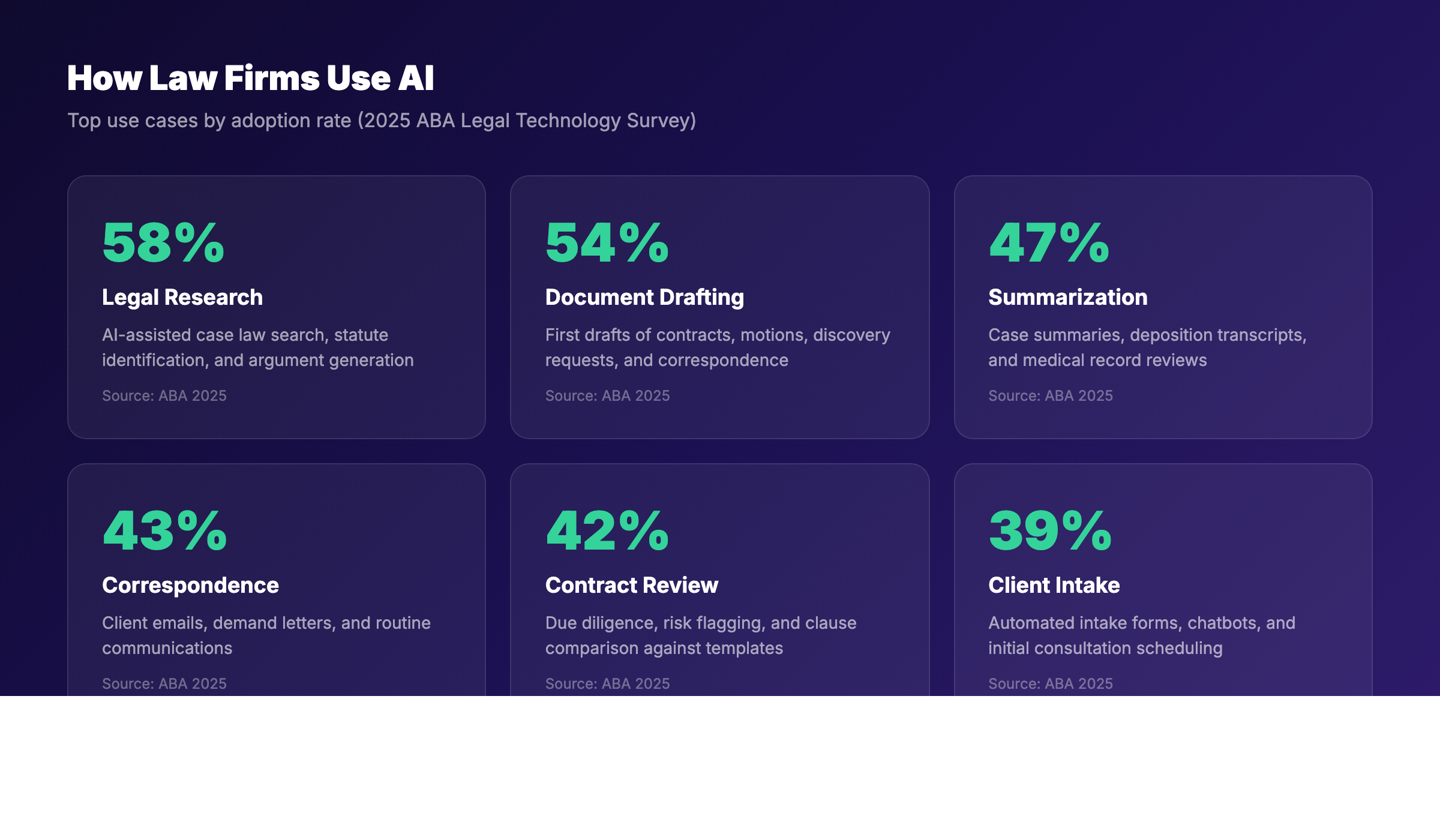
Legal research remains the most common use case. According to the 2025 ABA survey, 58% of lawyers using AI apply it to research tasks. Lexis+ AI and Westlaw AI now generate case summaries, identify relevant statutes, and suggest arguments based on precedent. The time savings are substantial: research that once took 4–6 hours now takes 45–90 minutes with AI assistance.
Document drafting is the second most popular use case at 54%. AI tools generate first drafts of contracts, motions, discovery requests, and client correspondence. The key word is "first draft." Every output requires attorney review, but the starting point is significantly better than a blank page. Firms report that AI-assisted drafting reduces document preparation time by 40–60%.
Contract review and analysis is where AI delivers the most dramatic results. Tools like Harvey AI, Diligen, and Ironclad can review hundreds of contracts in the time it takes a human to review one. They flag unusual terms, compare against standard templates, and identify risks. For M&A due diligence, this capability has become essential.
Client intake and communication is a growing use case. Smith.ai provides AI-driven virtual receptionists that handle initial client calls, schedule consultations, and capture intake information. Chatbots on firm websites answer common questions and qualify leads before a human attorney gets involved.
Billing and time tracking is an emerging application. AI analyzes attorney activity to suggest time entries, identify billable work that was not recorded, and flag entries that do not match the actual work performed. This addresses a chronic problem: studies suggest attorneys fail to capture 10–30% of their billable time.
Will Law Firms Survive AI?
Law firms will survive, but not all of them. The firms at risk are those that treat AI as a threat to be resisted rather than a tool to be mastered.
The evidence supports optimism for adaptable firms. No AmLaw 100 firm anticipates reducing attorney headcount because of AI, according to the 2025 Thomson Reuters report. Instead, they plan to redeploy attorneys to higher-value work. The same report found that 90% of firms expect AI to improve service quality, and 50% would consider taking on lower-margin work that was previously unprofitable.
The survival risk is concentrated in three areas:
- Commoditized practice areas. Personal injury, immigration, bankruptcy, and residential real estate are increasingly handled by AI-assisted platforms or non-lawyer services. Firms in these areas must either differentiate through expertise and service quality or adopt AI to match competitor pricing.
- Firms with outdated billing models. The billable hour creates perverse incentives when AI reduces task time from hours to minutes. A firm that bills $500 per hour for research that AI completes in 10 minutes cannot sustain that model. Alternative fee arrangements, flat fees, and value-based pricing are becoming necessities.
- Solo practitioners who do not adapt. Solo practitioners face a paradox. They have the most to gain from AI, which levels the playing field against larger firms. But they also have the least time to evaluate tools, implement systems, and train themselves. The solos who invest that time will thrive. Those who do not will struggle to compete.
The firms that survive and prosper will share three characteristics. They will use AI to handle routine work efficiently. They will price services based on value rather than time. And they will invest their human capital in the judgment, strategy, and relationships that AI cannot replicate.
Your competitors are already using AI. The 2025 Clio Legal Trends Report found that firms using AI report 94% measurable benefits in time savings and work quality. The question is not whether AI will change legal practice. It is whether your firm will lead that change or follow it.
Learn how AI transforms content strategy for professional services
How to Choose the Right Legal AI Tool
Selecting an AI tool for your law firm requires evaluating six factors. The wrong choice wastes money and creates security risks. The right choice becomes part of your daily workflow within a week.
Security and confidentiality is the first and most important criterion. Any AI tool you use must guarantee that your data is not used to train the model and is not accessible to other users. Legal-specific platforms like Harvey, CoCounsel, and Lexis+ AI offer legal-grade security. General tools like ChatGPT and Claude have business tiers with enhanced privacy, but you must verify settings rather than assume protection.
Accuracy on legal tasks varies dramatically. General-purpose AI tools hallucinate legal citations at rates between 17% and 33%, according to Stanford research. Legal-specific platforms perform better but still require verification. Test any tool on tasks you perform regularly before committing to a subscription.
Integration with existing systems determines whether the tool gets used. An AI tool that requires copying and pasting between five applications will not survive a busy week. Look for integrations with your practice management software, document management system, and email platform.
Ease of use matters more than feature count. A tool with 50 features that requires a training course will underperform against a tool with 10 features that your team can use intuitively. Request a trial period and observe how quickly your attorneys adopt the tool without formal training.
Vendor reputation and support indicate long-term viability. The legal AI market is consolidating. Several tools that launched in 2023–2024 have already shut down or been acquired. Choose vendors with established funding, clear roadmaps, and responsive support teams.
Cost structure should align with your usage patterns. Some tools charge per user, others per document, and others by API call. A solo practitioner handling 10 matters per month has different needs than a firm processing 1,000 contracts. Calculate your total cost of ownership, including implementation time and training.
| Criterion | Weight | Questions to Ask |
|---|---|---|
| Security | Critical | Is client data used for model training? Is data encrypted? |
| Accuracy | Critical | What is the hallucination rate on legal citations? |
| Integration | High | Does it connect to our practice management system? |
| Ease of use | High | Can attorneys use it without training? |
| Vendor stability | Medium | How long has the vendor operated? What is their funding? |
| Cost | Medium | What is total cost per month at our usage level? |
The Ethics of AI in Legal Practice
Every state bar association has addressed AI ethics, and the consensus is clear: lawyers may use AI, but they remain fully responsible for the work product. The American Bar Association's Model Rules of Professional Conduct require competence, diligence, and confidentiality. AI does not change these obligations.
The 2024 ABA Formal Opinion 512 addressed generative AI specifically. It confirmed that lawyers may use AI tools but must understand their limitations, verify outputs, and supervise their use. The opinion emphasized that feeding confidential client information into a public AI tool without proper safeguards may violate confidentiality rules.
Several states have gone further. California's State Bar issued practical guidance requiring attorneys to disclose AI use to clients in certain circumstances. Florida's Bar requires lawyers to certify that AI-generated filings have been reviewed for accuracy. New York's courts have sanctioned attorneys for submitting AI-generated briefs with fabricated citations.
The practical implications for law firms are straightforward. Develop a written AI policy that specifies which tools are approved, which tasks may use AI, and what verification steps are required. Train all attorneys and staff on the policy. Document AI use in case files for malpractice insurance purposes. And never submit AI-generated work to a court without human review of every citation and legal argument.
Protect your firm's reputation with verified, accurate content. theStacc publishes fact-checked articles for professional services firms, with every claim sourced and reviewed. No hallucinations. No fabricated citations. Just content you can stand behind.
Implementing AI at Your Law Firm: A Practical Roadmap
AI implementation fails when firms try to change everything at once. The successful approach starts small, measures results, and expands gradually.
Phase 1: Audit your workflow (Week 1). List every task your team performs in a typical week. Categorize each as high-value (requires judgment, strategy, client interaction) or low-value (routine, repetitive, rules-based). Estimate hours spent on each. The low-value tasks with the highest hour counts are your first automation targets.
Phase 2: Select one tool for one task (Weeks 2–3). Choose a single AI tool that addresses your highest-impact low-value task. If your team spends 20 hours per week on initial contract review, test a contract analysis tool. If research consumes 30 hours, try a legal research AI. Run a pilot with one attorney for two weeks.
Phase 3: Measure and document (Week 4). Compare the AI-assisted output to the traditional approach. Measure time saved, quality differences, and attorney satisfaction. Document any errors or limitations. This data justifies expansion or justifies stopping.
Phase 4: Train and expand (Weeks 5–8). If the pilot succeeds, train the full team on the tool. Add a second tool for the next highest-impact task. Establish your AI policy and verification procedures.
Phase 5: Optimize and integrate (Ongoing). Review AI tool usage monthly. Identify underused tools and determine why. Look for integration opportunities that reduce friction. Stay current on new tools and bar association guidance.
Firms that follow this roadmap report implementation success rates above 80%. Firms that skip the audit and pilot phases report failure rates above 60%.
What practitioners are saying on X
AI search advice ages quickly. Here is high-signal public discussion from SEO and growth operators — context for your roadmap, not a substitute for primary data.
- @jakezward (Feb 2026): 2026 SEO predictions emphasize AI Overview share-of-SERP, schema for LLM token efficiency, brand mentions in AI answers as a KPI, proprietary data as a moat, and content refresh beating net-new AI slop. See the post on X.
- @alexgroberman (Jul 2026): Case narrative: organic value plus multi-engine citations (ChatGPT, Perplexity, Grok) from knowledge-hub pages, category authority links, commercial intent content, and tight internal linking — not thin product copy. See the post on X.
- @varunram (Jul 2026): Critique of GEO slopfarm products that combine SEO clickbait with unresearched content marketing — quality and research still separate winners from farms. See the post on X.
Grok, AI Overviews, and multi-engine visibility
AI/search topics like “ai for law firms” need multi-engine notes: AI Overviews, ChatGPT/Perplexity, and Grok. Lead with extractable answers; keep claims consistent with public expert discussion.
- Google AI Overviews: Use passage-ready answers, tables, and FAQ schema where relevant.
- ChatGPT / Perplexity: Cite named sources next to key claims.
- Grok: Maintain accurate entity facts on-site and in high-signal X posts.
Publish content built for Google and AI citations. theStacc’s Content SEO module ships SEO-scored articles structured for rankings and generative engines — including clearer entity pages models like Grok can quote.
Frequently Asked Questions
Law firms use a combination of general-purpose and legal-specific AI tools. Large firms favor enterprise platforms like Harvey AI, Lexis+ AI, and CoCounsel. Small and mid-sized firms often use ChatGPT or Claude for drafting and research, combined with practice management tools like Clio Manage with built-in AI. Solo practitioners frequently rely on free or low-cost options like ChatGPT for initial drafts, supplemented by legal-specific tools for critical tasks.
AI will automate routine tasks like document review, legal research, and contract analysis. This reduces the need for junior associates to perform commoditized work and shifts firm economics toward value-based pricing. Corporate clients are adopting AI faster than law firms, which pressures outside counsel to demonstrate superior efficiency. Firms that adapt will handle more matters with the same staff. Firms that resist will lose market share.
The 80/20 rule applied to legal practice means that 80% of billable hours are spent on tasks that generate only 20% of client value. AI shifts this ratio by automating the low-value 80%, allowing attorneys to focus on strategy, negotiation, and client relationships. The key is identifying which tasks in your practice fit the low-value category and targeting those for automation first.
Claude is better for long-document analysis due to its larger context window. ChatGPT is more versatile for drafting, brainstorming, and general tasks. Neither tool is reliable for legal citations without verification. For tasks where accuracy is critical, legal-specific platforms like Lexis+ AI or CoCounsel outperform both. Most firms benefit from using multiple tools for different purposes.
Yes, but not all firms in their current form. Firms that treat AI as a tool to be mastered will thrive by redeploying attorneys to higher-value work. Firms that resist AI will face pressure from corporate clients bringing work in-house and from competitors using AI to offer lower prices. No AmLaw 100 firm plans to reduce headcount due to AI. The threat is not elimination but obsolescence for firms that fail to adapt.
Some do, but it is not typical. Partners at large firms in major markets can earn $500,000 or more. Associates at those firms typically earn $150,000–$250,000. Solo practitioners and small firm attorneys often earn less, with median salaries around $80,000–$120,000 depending on practice area and location. AI may widen this gap by increasing productivity at high-performing firms while pressuring commoditized practices.
A focused pilot takes 2–4 weeks. Full implementation across a firm takes 2–3 months. The timeline depends on firm size, the complexity of existing systems, and attorney willingness to adopt new tools. Firms that start with one tool for one task and expand gradually report higher success rates than those attempting firm-wide transformation in a single initiative.
The primary risks are hallucination (AI generating false citations or incorrect legal analysis), confidentiality breaches (client data exposed to public AI models), ethical violations (failing to supervise AI-generated work), and malpractice exposure (relying on unverified AI outputs). Every state bar association that has addressed AI agrees: the attorney remains fully responsible for all work product, regardless of AI assistance.
Key Takeaways
- 79% of legal professionals now use AI tools, but only 21% of firms have formal adoption policies
- AI reduces litigation complaint response time from 16 hours to 3–4 minutes in pilot projects
- Corporate legal departments are adopting AI faster than outside counsel, with 64% planning to reduce reliance on law firms
- Claude excels at document analysis; ChatGPT offers broader versatility; legal-specific platforms deliver the best citation accuracy
- The 80/20 rule means automating low-value tasks first, then redeploying human talent to strategy and client relationships
- No AmLaw 100 firm plans to cut attorneys because of AI, but all plan to change how attorneys spend their time
- Security, accuracy, and integration are the three most important criteria when selecting legal AI tools
- Every state bar requires attorneys to verify AI outputs and maintain confidentiality
The law firms that thrive in 2026 and beyond will not be the ones that avoid AI. They will be the ones that use it strategically, ethically, and consistently to deliver better outcomes for clients at lower cost.
Related Tools & Resources
Free SEO Tools:
Best Lists:
Sources & references
- [1] Princeton / Georgia Tech et al. — GEO research (arXiv:2311.09735)
- [2] @jakezward on X — 2026 SEO predictions emphasize AI Overview share-of-SERP, schema for LLM token efficiency, brand mentions in AI answers
- [3] @alexgroberman on X — Case narrative: organic value plus multi-engine citations (ChatGPT, Perplexity, Grok) from knowledge-hub pages, category
- [4] @varunram on X — Critique of GEO slopfarm products that combine SEO clickbait with unresearched content marketing — quality and research

Plan topics, review article drafts, and publish to a connected CMS.
Weekly local SEO teardowns
One practical email a week. Map Pack, GBP, AI Overviews. No fluff. Unsubscribe anytime.
Explore this topic: Best SEO agencies for law firms in 2026: 12 ranked.