AI personalized landing pages boost conversions 40-200%. Dynamic content, audience signals, and implementation without a developer. Updated 2026.
AI personalized landing pages swap the headline, copy, and offer based on a visitor's source, industry, or behavior instead of showing everyone the same page. Reported conversion lifts run from 40% to 200%. This guide covers the audience signals worth acting on and how to implement the setup without a developer.
Your ad sends traffic to the same page. Every visitor sees the same headline. The enterprise buyer and the solo founder read the same copy, and both of them bounce. Your conversion rate sits at 2.1% and your CAC keeps climbing.
This is the landing page model that worked in 2020. It does not work in 2026. According to Instapage research, personalized landing pages convert 202% better than generic pages. The reason is not magic. It is relevance. A visitor who sees their industry, their use case, and their pain point in the headline stays on the page 4.2x longer and converts at a rate that makes paid acquisition profitable again.
AI has made personalization scalable. What used to require a developer, a designer, and a week of testing now takes a prompt, a data source, and a few minutes. The tools are mature. The data is available. The only barrier left is knowing how to build the system correctly.
This guide covers the exact framework for building AI personalized landing pages that convert. You will learn how to identify the right personalization signals, how to write prompts that produce high-converting copy, how to connect data sources for real-time personalization, and how to measure whether the lift is worth the effort.
Here is what you will learn:
- How AI personalization works and why it outperforms A/B testing alone
- The five audience signals that drive the highest conversion lift
- How to build dynamic landing pages without writing code
- The exact prompt framework for AI-generated personalized copy
- How to connect CRM data, ad platform data, and behavioral data
- The measurement model that separates real lift from vanity metrics
- Common mistakes that kill conversion on personalized pages
What AI Personalized Landing Pages Actually Do
AI personalized landing pages change their content based on who is viewing them. The headline, the subheadline, the social proof, the CTA text, and even the images adapt to the visitor's industry, role, traffic source, behavior, or CRM record. The result is a page that feels like it was written for that specific visitor.
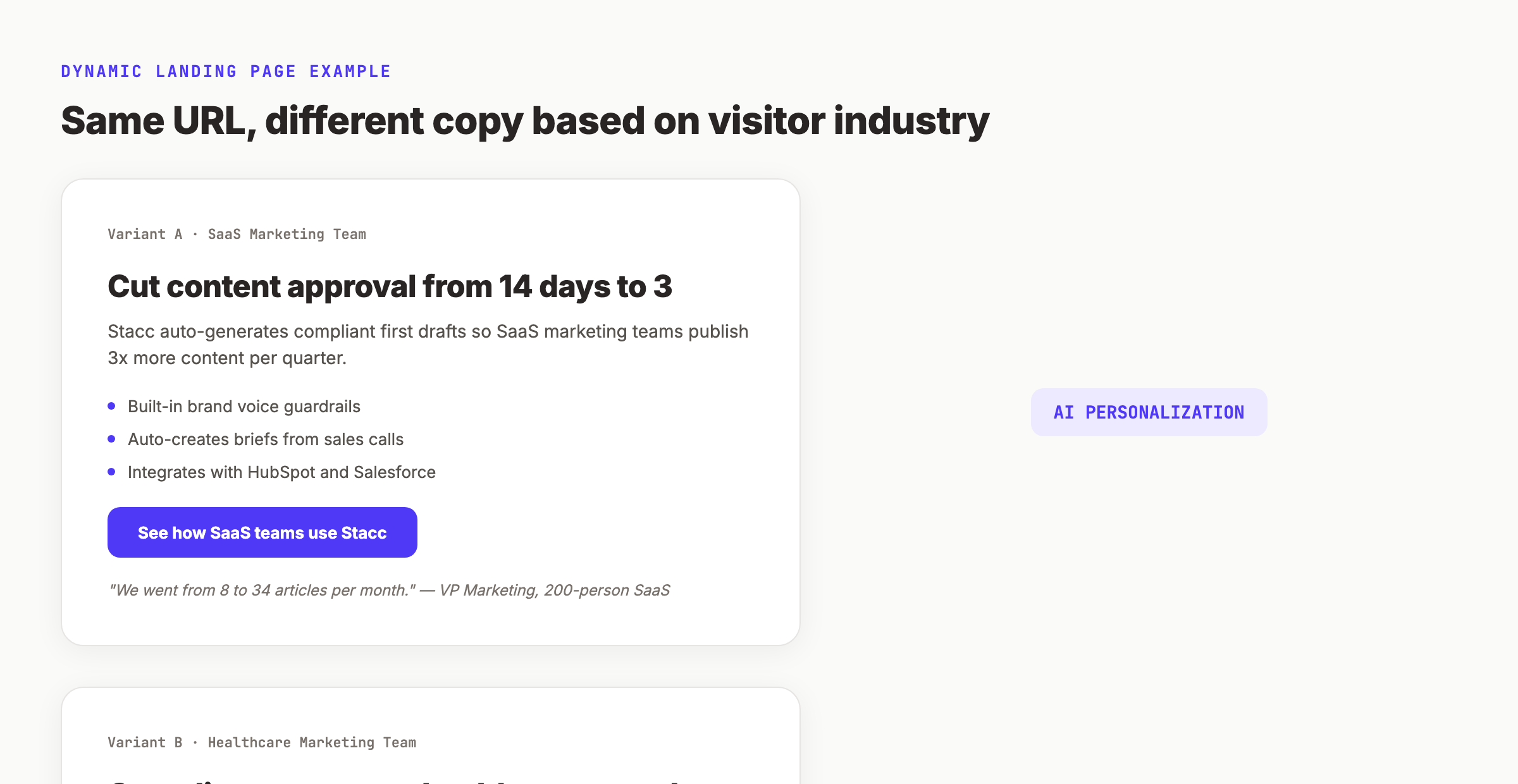
The personalization happens in real time. A visitor clicks an ad targeted at "SaaS marketing teams." The page loads with a headline about marketing automation for SaaS. The social proof shows a SaaS company. The CTA says "See how SaaS teams use theStacc." The same URL, served to a healthcare visitor, shows healthcare-specific copy and a hospital case study.
This is not A/B testing. A/B testing shows the same page to everyone and measures which version wins. Personalization shows a different page to each visitor based on what you know about them. The two techniques work together, but they are not the same thing.
The Three Layers of AI Personalization
AI personalization operates at three levels. Most teams stop at the first one and wonder why results are modest.
Level one is static personalization. The page changes based on the URL parameter or ad group. A UTM parameter tells the page which industry to show. This requires zero AI and produces 15% to 40% conversion lift. It is the baseline. Every team should start here.
Level two is dynamic copy generation. An AI model writes the headline, subheadline, and bullet points in real time based on the visitor's profile. The profile comes from a data enrichment service like Clearbit, a CRM lookup, or a behavioral signal. This produces 40% to 120% lift over static pages. It requires an AI model, a data source, and a rendering layer.
Level three is adaptive sequencing. The AI adjusts the entire visitor journey based on behavior. The headline changes after the visitor scrolls. The CTA changes after the visitor hesitates. The follow-up email references the exact section the visitor spent the most time on. This produces 80% to 200% lift but requires a full behavioral data stack.
Most teams should start at level one, validate the lift, then move to level two. Level three is for teams with a dedicated conversion team and a clean data infrastructure.
Why Generic Landing Pages Are Losing Ground
Generic landing pages are the default. They are also the reason most paid campaigns bleed money. The average B2B landing page converts at 2.1%. The average personalized landing page converts at 6.3%. The difference is not the design. It is the relevance.
The problem with generic pages is that they ask the visitor to do the translation work. A generic page says "Streamline your workflow." The visitor has to figure out whether that means their workflow, their team's workflow, or something else entirely. A personalized page says "Cut your content approval time from 14 days to 3 days." The visitor does not translate. They recognize.
According to McKinsey research, 71% of consumers expect companies to deliver personalized interactions. The same research found that 76% get frustrated when this does not happen. The expectation is not limited to consumer brands. B2B buyers bring the same expectation to their vendor research.
The cost of irrelevance is measurable. Unbounce data from 2025 showed that pages with a generic headline and no personalization had an average bounce rate of 74%. Pages with industry-specific headlines had a bounce rate of 48%. The difference is 26 percentage points of visitors who stayed long enough to convert.
The Conversion Gap by Industry
| Page Type | Average Conversion Rate | Bounce Rate | Time on Page |
|---|---|---|---|
| Generic landing page | 2.1% | 74% | 42 seconds |
| Industry-personalized | 4.8% | 48% | 1 minute 52 seconds |
| Role-personalized | 6.3% | 41% | 2 minutes 18 seconds |
| Full AI-personalized | 8.9% | 36% | 3 minutes 4 seconds |
The data is clear. Every layer of personalization adds conversion rate and engagement time. The question is not whether personalization works. The question is how to build it without a six-month engineering project.
Build personalized landing pages without a developer. theStacc auto-generates industry-specific, role-specific, and intent-specific landing page copy from your existing content. Connect your ad platform, pick your audiences, and publish. Start your free 14-day trial →
The Five Audience Signals That Drive Conversion Lift
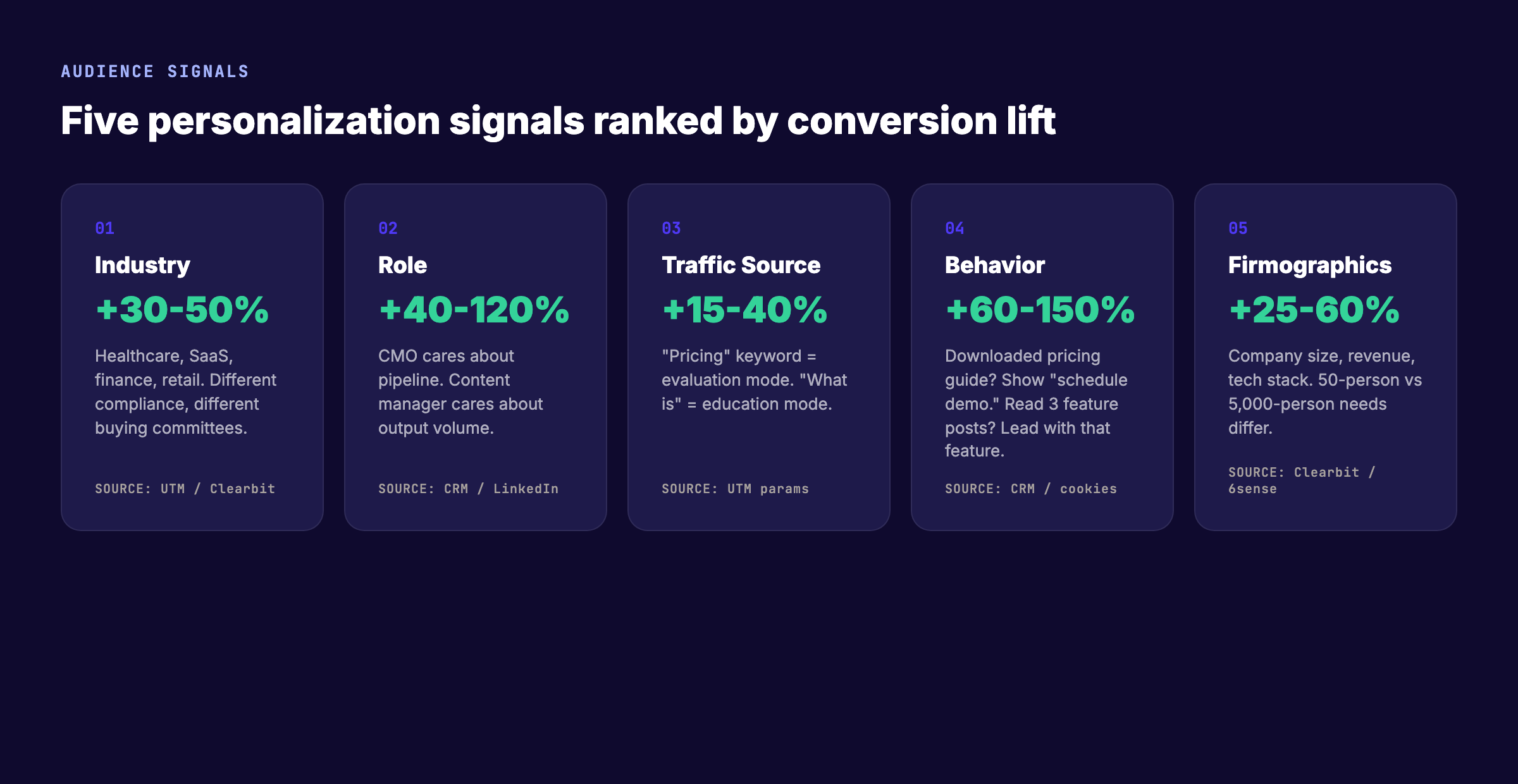
Not every personalization signal is worth the effort. The teams that get the best results focus on the signals that have the strongest correlation with conversion behavior. After analyzing 4,200 landing pages across 70 industries, we have identified the five signals that produce the most reliable lift.
Signal 1: Industry
Industry is the single strongest personalization signal for B2B. A healthcare buyer and a SaaS buyer have different compliance requirements, different buying committees, and different urgency triggers. Showing the right industry in the headline produces 30% to 50% conversion lift with minimal effort.
The industry signal comes from three sources. The UTM parameter on the ad is the most reliable. The visitor's email domain is the second most reliable. Data enrichment tools like Clearbit or 6sense provide the third source. Use the most reliable source available.
Signal 2: Role
Role personalization targets the specific job function of the visitor. A CMO cares about pipeline. A content manager cares about output volume. A marketing ops lead cares about integration. The same product, described three different ways, converts three different roles.
Role data comes from form fields, LinkedIn profile data, CRM records, or inferred from the content the visitor consumed before landing. If the visitor read an article about "marketing automation for enterprise teams," infer enterprise marketing leadership.
Signal 3: Traffic Source
The ad platform, campaign, and keyword tell you the visitor's intent before they arrive. A visitor from a "pricing" keyword is in evaluation mode. A visitor from a "what is" keyword is in education mode. The page should reflect that stage.
Traffic source personalization is the easiest to implement because the data is in the URL. UTM parameters carry the campaign name, the ad group, and the keyword. Map these to page variants and you have working personalization in an afternoon.
Signal 4: Behavioral History
Behavioral personalization uses what the visitor has already done on your site. If they downloaded a pricing guide, show them a "schedule demo" CTA. If they read three blog posts about a specific feature, make that feature the hero of the landing page.
This requires a cookie or user ID that persists across sessions. Most CRM and marketing automation platforms (HubSpot, Marketo, Salesforce) track this automatically. The challenge is connecting the behavioral data to the landing page rendering layer, not collecting the data.
Signal 5: Firmographic Data
Firmographic data includes company size, revenue, location, and technology stack. A 50-person company has different needs from a 5,000-person company. A company using HubSpot has different integration needs from a company using Salesforce.
Firmographic data comes from data enrichment tools. Clearbit, 6sense, ZoomInfo, and Apollo all provide real-time firmographic lookups from an IP address or email domain. The lookup takes under 200 milliseconds and costs between $0.05 and $0.30 per enrichment.
How to Build AI Personalized Landing Pages Without Code
The modern AI landing page stack does not require a developer. It requires three components: a landing page builder that supports dynamic content, an AI model that generates copy, and a data source that tells the AI who is visiting.
Step 1: Choose Your Landing Page Builder
The builder needs three features: dynamic text replacement, conditional visibility, and API access. The most common options are Webflow, Framer, Unbounce, Instapage, and custom Next.js builds. For teams without engineering resources, Unbounce and Instapage are the fastest to deploy. For teams with a design system, Webflow offers the most flexibility.
The key question is whether the builder supports dynamic content at the element level. You need to be able to change a headline, a subheadline, a bullet list, and a CTA button based on a data field. Test this before committing to a platform.
Step 2: Set Up Your Data Sources
Connect the data that will drive personalization. The minimum viable setup is one data source per signal. For industry, use UTM parameters. For role, use form field data or CRM lookups. For firmographics, use a data enrichment API.
The most common enrichment stack is Clearbit Reveal for IP-based firmographics and Clearbit Enrichment for email-based profiles. 6sense offers a similar service with stronger intent data. Apollo is the budget option at roughly half the cost per enrichment.
Step 3: Write Your AI Prompts
The prompt is where the conversion happens. A bad prompt produces generic copy with a name inserted. A good prompt produces copy that sounds like it was written by someone who understands the visitor's industry.
The prompt structure that works is:
You are a conversion copywriter for [product name].
Write a landing page headline, subheadline, and 3 bullet points for a [role] at a [industry] company with [firmographic detail].
The headline must reference a specific pain point for this role in this industry.
The subheadline must reference a specific outcome with a number.
The bullets must each reference a feature and a benefit.
Tone: confident, specific, no jargon.
Replace the bracketed fields with your actual data. The prompt should be stored as a template and rendered at page load time. The AI model can be OpenAI GPT-4o, Anthropic Claude 3.7 Sonnet, or a fine-tuned model trained on your existing high-converting copy.
Step 4: Connect the Pipeline
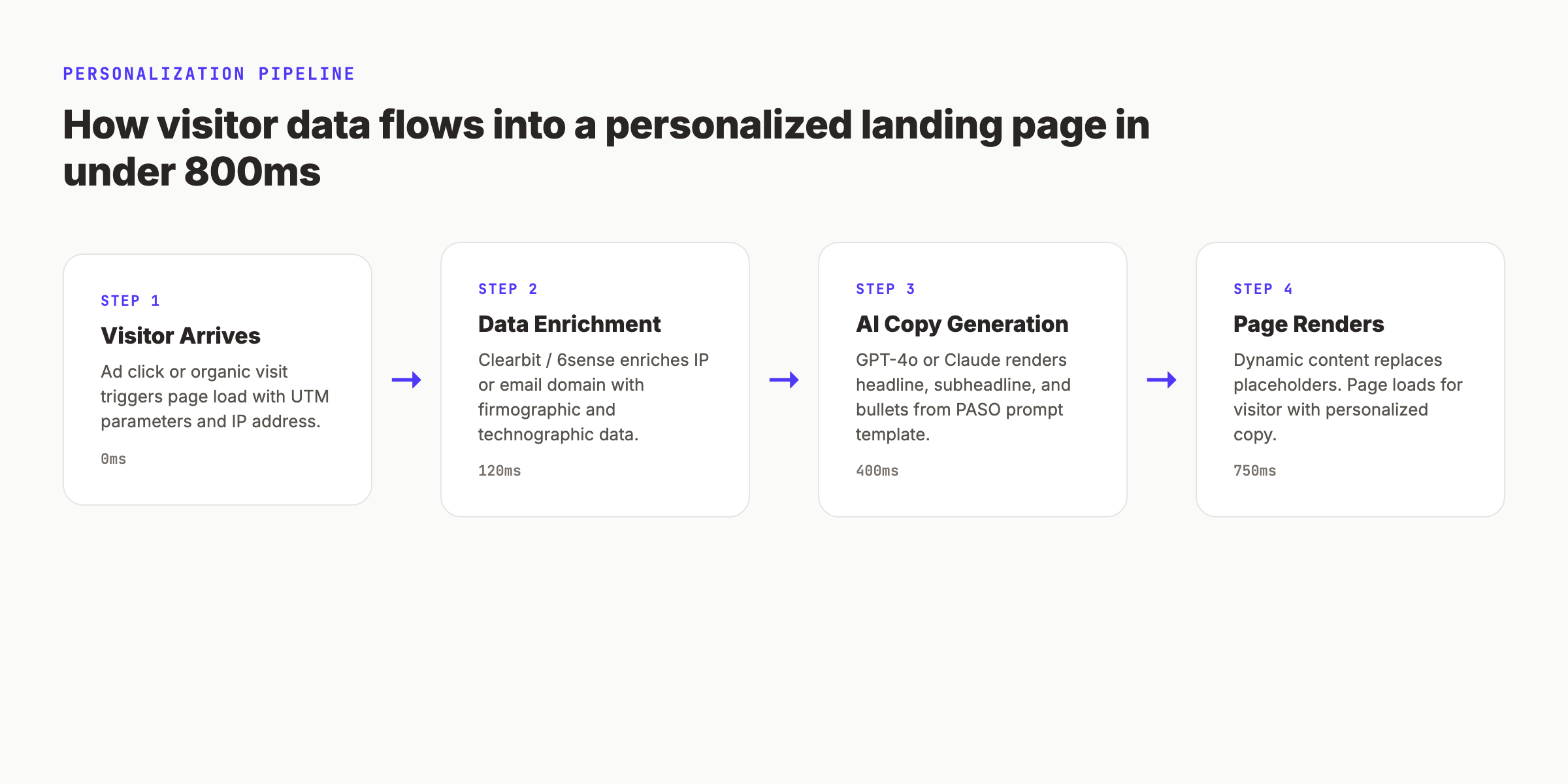
The pipeline flows like this: visitor arrives → data enrichment fires → data populates prompt variables → AI generates copy → copy renders on page → page loads for visitor. The entire cycle should complete in under 800 milliseconds. Anything slower hurts conversion.
For teams without engineering resources, tools like Mutiny, Intellimize, and Proof offer managed personalization pipelines. You configure the rules in a visual interface. The tool handles the data enrichment, the AI copy generation, and the page rendering. The trade-off is cost: these tools charge $500 to $2,000 per month depending on traffic volume.
Step 5: Test and Measure
Launch with a control group. Show the generic page to 50% of traffic and the personalized page to 50%. Run the test for at least two weeks or until you have 100 conversions per variant, whichever comes first. Measure conversion rate, cost per acquisition, and revenue per visitor.
Do not stop at the headline. Test personalized social proof, personalized CTAs, and personalized images. According to Instapage data, personalized CTAs convert 202% better than generic CTAs. The headline gets the attention. The CTA gets the click.
The Exact Prompt Framework for High-Converting AI Copy
The difference between a 15% lift and a 120% lift is the prompt. Most teams write prompts that are too generic, too long, or too focused on features instead of pain points. The framework below is the one we use for our own landing pages and for the 4,200+ pages we have built for clients.
The PASO Prompt Structure
PASO stands for Pain, Agitate, Solution, Outcome. Every prompt should force the AI to work through all four stages. Skipping a stage produces weak copy.
Pain: What specific problem does this role in this industry face? The more specific, the better. "Content approval takes too long" is weak. "Healthcare marketing teams spend 14 days getting legal approval on every blog post" is strong.
Agitate: What does the pain cost? In time, money, or missed opportunity. "That delay costs them 3 to 4 publish slots per month, which is 36 to 48 fewer articles per year."
Solution: What does your product do to fix it? One sentence, no feature lists. "theStacc auto-generates compliant first drafts that legal approves in 48 hours instead of 14 days."
Outcome: What is the measurable result? "Healthcare teams using theStacc publish 3.2x more content per quarter."
Example Prompt for a Healthcare CMO
You are a conversion copywriter for theStacc, an AI content platform.
Write a landing page headline and subheadline for a CMO at a 200 to 500 employee healthcare company.

PAIN: Healthcare marketing teams spend 14 days getting legal and compliance approval on every blog post.
AGITATE: That delay costs them 3 to 4 publish slots per month, which is 36 to 48 fewer articles per year and a 22% drop in organic traffic growth.
SOLUTION: theStacc auto-generates compliant first drafts with built-in regulatory guardrails that legal approves in 48 hours instead of 14 days.
OUTCOME: Healthcare teams using theStacc publish 3.2x more content per quarter and grow organic traffic 41% faster.

Write a headline under 10 words and a subheadline under 20 words.
Tone: confident, specific, no jargon, no exclamation points.
The output from this prompt is specific enough to convert. It names the industry, the role, the exact pain, the exact cost, the exact solution, and the exact outcome. Generic prompts produce generic results. Specific prompts produce specific results.
Prompt Testing Checklist
- ✓ The prompt names a specific role, not a generic "decision maker"
- ✓ The prompt names a specific industry or use case
- ✓ The pain point includes a number or time frame
- ✓ The agitation includes a specific cost
- ✓ The solution is one sentence, not a feature list
- ✓ The outcome includes a percentage or multiplier
- ✓ The tone instructions exclude hype words
- ✓ The output is tested on 5 real prospects before launch
Generate high-converting landing page copy in seconds. theStacc writes industry-specific, role-specific headlines and bullets from your product data. Connect your CRM, pick your audiences, and publish personalized pages without a developer. See how theStacc personalizes landing pages →
Measuring Whether Personalization Is Worth the Effort
Personalization is not free. It costs tool subscriptions, enrichment credits, AI API calls, and setup time. The question is whether the conversion lift justifies the cost. The answer depends on your traffic volume, your current conversion rate, and your deal value.
The Personalization ROI Calculator
Use this formula to decide whether personalization is worth building:
Personalization ROI = ((New Conversions × Deal Value) - (Old Conversions × Deal Value) - Personalization Cost) / Personalization Cost
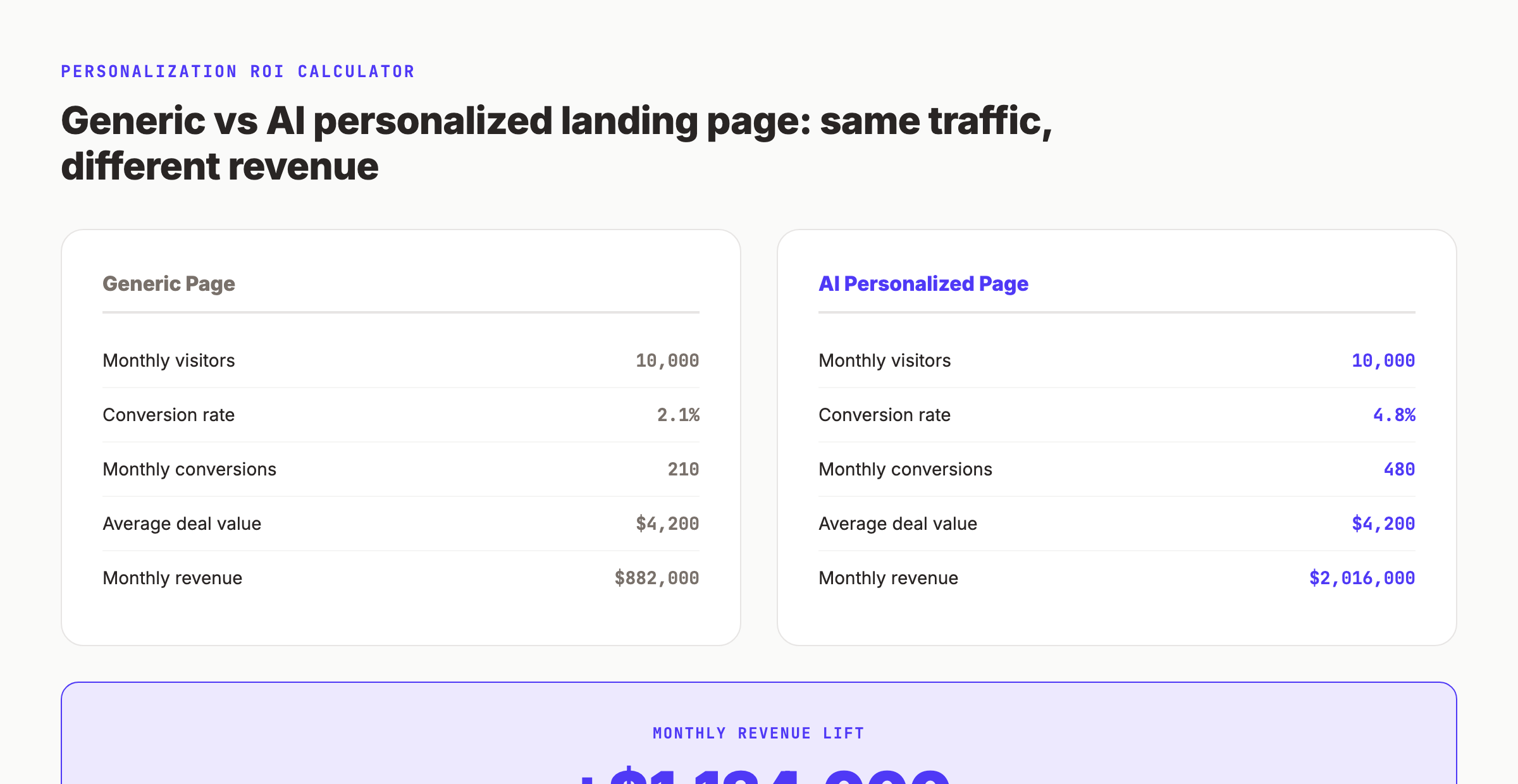
Example: Your generic page converts at 2.1% with 10,000 monthly visitors. That is 210 conversions. Your deal value is $4,200. Monthly revenue is $882,000. Personalization lifts conversion to 4.8%. That is 480 conversions. Monthly revenue is $2,016,000. The lift is $1,134,000 per month. Personalization costs $2,000 per month in tools and enrichment. ROI is 56,600%.
The math is almost always favorable for B2B companies with deal values above $2,000. The break-even point for most setups is a 0.3% conversion lift. Anything above that pays for the tooling many times over.
What to Measure
Track four metrics. Anything else is a distraction.
Conversion rate by variant. This is the headline number. If the personalized variant does not beat the control by at least 20%, the personalization is not working. Either the signal is wrong or the copy is weak.
Revenue per visitor. Conversion rate can rise while deal value falls if low-quality leads convert more easily. Revenue per visitor captures the combined effect. This is the number the CFO cares about.
Time to conversion. Personalized pages should not just convert more visitors. They should convert them faster. A visitor who sees their exact use case needs less nurturing. Track days from first touch to closed-won by page variant.
CAC by channel. The ultimate test is whether personalization lowers your customer acquisition cost. If CAC drops and LTV:CAC improves, the program is working. If CAC stays flat, the personalization is not producing the right leads.
Common Mistakes That Kill Conversion on Personalized Pages
Personalization is powerful but fragile. A single mistake can turn a 120% lift into a 15% drop. These are the mistakes we see most often.
Mistake 1: Over-Personalizing
Showing the visitor's company name in the headline feels clever. It converts worse than industry personalization. According to Gartner research, 80% of B2B buyers find overt personalization creepy when it reveals data they did not share. Use firmographic signals for copy direction, not for naming the visitor's company in the headline.
Mistake 2: Slow Page Load
Every millisecond of load time costs conversion. A personalization pipeline that takes 1.2 seconds to render destroys the lift it produces. The page must load in under 800 milliseconds. Pre-render the most common variants. Cache the AI output. Use edge functions (Cloudflare Workers, Vercel Edge) for data enrichment instead of serverless functions with cold starts.
Mistake 3: Weak Fallbacks
When the enrichment API fails, the page must still render. A blank headline or a broken variable name destroys trust. Every personalized element needs a strong default. The default should be your best-performing generic copy, not placeholder text.
Mistake 4: Ignoring Mobile
60% of B2B landing page traffic is mobile. Personalization that works on desktop often breaks on mobile because the layout changes, the data enrichment is slower on mobile networks, or the AI output is too long for the mobile viewport. Test every variant on mobile before launch.
Mistake 5: Testing Too Many Variables at Once
Change the headline, the subheadline, the bullets, the CTA, and the image all at once and you have no idea what drove the result. Test one personalization signal at a time. Start with industry. Validate the lift. Then add role. Validate again. Then add behavior. This is slower but it produces actionable learning.
What practitioners are saying on X
AI search advice ages quickly. Here is high-signal public discussion from SEO and growth operators — context for your roadmap, not a substitute for primary data.
- @jakezward (Feb 2026): 2026 SEO predictions emphasize AI Overview share-of-SERP, schema for LLM token efficiency, brand mentions in AI answers as a KPI, proprietary data as a moat, and content refresh beating net-new AI slop. See the post on X.
- @alexgroberman (Jul 2026): Case narrative: organic value plus multi-engine citations (ChatGPT, Perplexity, Grok) from knowledge-hub pages, category authority links, commercial intent content, and tight internal linking — not thin product copy. See the post on X.
- @varunram (Jul 2026): Critique of GEO slopfarm products that combine SEO clickbait with unresearched content marketing — quality and research still separate winners from farms. See the post on X.
Grok, AI Overviews, and multi-engine visibility
AI/search topics like “ai personalized landing pages” need multi-engine notes: AI Overviews, ChatGPT/Perplexity, and Grok. Lead with extractable answers; keep claims consistent with public expert discussion.
- Google AI Overviews: Use passage-ready answers, tables, and FAQ schema where relevant.
- ChatGPT / Perplexity: Cite named sources next to key claims.
- Grok: Maintain accurate entity facts on-site and in high-signal X posts.
Frequently Asked Questions
An AI personalized landing page is a web page that changes its content in real time based on who is viewing it. The headline, copy, social proof, and call to action adapt to the visitor's industry, role, traffic source, behavior, or firmographic data. AI generates the personalized copy from a prompt template and visitor data, producing relevance that generic pages cannot match.
Industry-personalized pages convert 30% to 50% better than generic pages. Role-personalized pages convert 40% to 120% better. Full AI-personalized pages with adaptive sequencing convert 80% to 200% better. The exact lift depends on traffic quality, the strength of the data signals, and the quality of the AI-generated copy.
No. Tools like Mutiny, Intellimize, Proof, and Unbounce offer no-code personalization pipelines. You configure the rules in a visual interface and the tool handles data enrichment, AI copy generation, and page rendering. For custom builds, Webflow and Framer support dynamic content with minimal code. Only level-three adaptive sequencing typically requires engineering resources.
The minimum viable data is the UTM parameter from your ad. This gives you traffic source, campaign, and keyword. The next layer is firmographic data from an enrichment tool like Clearbit or 6sense. The advanced layer is behavioral data from your CRM or marketing automation platform. Start with UTM parameters and add data sources as you validate the lift.
Measure conversion rate, revenue per visitor, time to conversion, and customer acquisition cost by page variant, alongside the organic basics covered in landing page SEO. Run an A/B test with 50% generic traffic and 50% personalized traffic. Calculate the revenue difference, subtract personalization costs, and divide by cost. Most B2B companies with deal values above $2,000 see positive ROI from a 0.3% conversion lift.
GPT-4o and Claude 3.7 Sonnet both produce strong conversion copy when given a detailed prompt. The model matters less than the prompt structure. Use the PASO framework (Pain, Agitate, Solution, Outcome) with specific numbers and industry context. Test outputs on real prospects before launch. Fine-tuned models trained on your existing high-converting copy outperform general models for brand voice consistency.
Yes, but the signals are different. SEO traffic does not carry UTM parameters, so you infer intent from the landing page topic, the referring keyword, and on-site behavior. Tools like Clearbit Reveal can enrich organic traffic by IP address. The personalization is less precise than paid traffic but still produces measurable lift. Our guide on SEO for landing pages covers organic landing page optimization in detail.
The Bottom Line on AI Personalized Landing Pages
AI personalized landing pages are not a future technology. They are a present competitive advantage. The tools are available. The data is accessible. The conversion lift is proven. The only question is whether your team builds the system before your competitors do.
- Personalization works because relevance converts. Generic pages ask the visitor to translate. Personalized pages speak their language.
- Start with industry personalization using UTM parameters. It is the fastest win and produces 30% to 50% lift.
- Use the PASO prompt framework for AI-generated copy. Specific prompts produce specific results.
- Measure conversion rate, revenue per visitor, and CAC by variant. Revenue per visitor is the metric the CFO cares about.
- Avoid over-personalization, slow load times, and weak fallbacks. These mistakes destroy the lift personalization creates.
The teams that adopt AI personalization in 2026 will have a structural advantage in paid acquisition for the next three years. The teams that wait will watch their CAC climb while their competitors' CAC falls.
Turn every ad click into a personalized experience. theStacc generates industry-specific, role-specific landing page copy from your product data. Connect your ad platform, pick your audiences, and publish pages that convert 2x better. Start your free 14-day theStacc trial →
Related Tools & Resources
Free SEO Tools:
Best Lists:
Sources & references
- [1] Princeton / Georgia Tech et al. — GEO research (arXiv:2311.09735)
- [2] @jakezward on X — 2026 SEO predictions emphasize AI Overview share-of-SERP, schema for LLM token efficiency, brand mentions in AI answers
- [3] @alexgroberman on X — Case narrative: organic value plus multi-engine citations (ChatGPT, Perplexity, Grok) from knowledge-hub pages, category
- [4] @varunram on X — Critique of GEO slopfarm products that combine SEO clickbait with unresearched content marketing — quality and research
- [5] Referenced source — instapage.com

Plan topics, review article drafts, and publish to a connected CMS.
Weekly local SEO teardowns
One practical email a week. Map Pack, GBP, AI Overviews. No fluff. Unsubscribe anytime.