AI recommends competitors when your entity signals are weak. Learn the 6 fixes that get ChatGPT and Perplexity to recommend your business in 2026.
You ask ChatGPT for the best tool in your category. It recommends three competitors. None of them are you. Your business has more customers, better reviews, and a longer track record. None of that matters because the AI does not know you exist.
This is happening across every industry right now. Businesses with strong traditional SEO rankings discover that AI assistants ignore them entirely. The lost opportunity is enormous. ChatGPT alone processes 1.1 billion daily queries. Perplexity has grown to 780 million monthly searches. When AI tools recommend a business, that business captures buyers at the exact moment of decision. When they recommend your competitor instead, you lose the customer before you even know they were looking.
This guide explains exactly why AI systems recommend your competitors, what signals they use to decide, and the six concrete fixes that close the gap. You will learn how entity recognition works, why structured data matters more than keywords, and how to audit your current AI visibility in under 30 minutes.
Why AI Recommends Competitors Instead of You
AI systems recommend businesses based on entity recognition, not search rankings. An entity is a clearly identifiable business with consistent signals across the web: schema markup, structured data, third-party mentions, reviews, and direct references in authoritative sources. When AI cannot recognize your business as a clear entity, it defaults to the businesses it can recognize. Those are your competitors.
Traditional SEO ranks pages. AI recommends entities. These are different things. A page can rank on Google by matching keywords, building backlinks, and earning user signals. An entity gets recommended by AI when the system has enough verified information to confidently describe what your business does, who it serves, and why it is credible.
Research from theStacc and other AI search analysts shows that approximately 70% of AI queries end without a click-through, which means the recommendation inside the AI response is the entire customer interaction. If your competitor is named in that response and you are not, your competitor wins the customer at the point of decision.
The problem is structural, not promotional. AI tools do not favor size or marketing budget. They favor clarity. A small business with well-structured content, consistent online presence, and strong reviews can outperform a larger competitor that has not optimized for AI recognition. The reverse is also true: a market leader with weak entity signals can lose to a smaller competitor that has invested in AI readiness.
How AI Decides Which Business to Recommend
To fix the problem, you need to understand the selection process. AI assistants use a layered evaluation when they recommend businesses.
Layer 1: Entity Existence
Before any recommendation can happen, the AI must know your business exists. This is the entity recognition layer. The AI checks structured data on your website, third-party databases like Wikipedia and Wikidata, business directories, news mentions, and review platforms.
If your business has no schema markup, no directory listings, and no third-party mentions, the AI may not know you exist at all. You are invisible at the entity layer, which means you cannot be recommended regardless of how good your website is.
Layer 2: Category Matching
Once the AI confirms your business exists, it checks whether your business matches the category implied by the user's query. If a user asks for "the best CRM for small business," the AI needs to confirm that your business is a CRM, that it serves small businesses, and that it competes in the small business segment.
This matching happens through explicit signals: the words on your homepage, the schema type you use, the categories you appear in across directories, and the language third parties use to describe you. Vague positioning is the most common failure here. Businesses that describe themselves with abstract terms instead of specific category names get filtered out at this layer.
Layer 3: Trust and Authority
After category matching, the AI evaluates trust signals. These include the number and quality of reviews, the consistency of your business information across the web, the authority of sources that mention you, and the freshness of those mentions.
Businesses with thousands of reviews on Google, G2, Capterra, and Trustpilot have a major advantage here. Businesses with sparse review profiles or inconsistent information across platforms get filtered out.
Layer 4: Relevance to the Specific Query
Finally, the AI ranks the businesses that survived the first three layers based on relevance to the specific query. This includes content that directly answers the question, case studies that match the user's described situation, and comparison content that positions your business against alternatives.
A business that survives all four layers gets recommended. A business that fails at any layer gets dropped. Your competitors are recommended because they survive all four layers. The fix is to identify where you are failing and close the gaps.
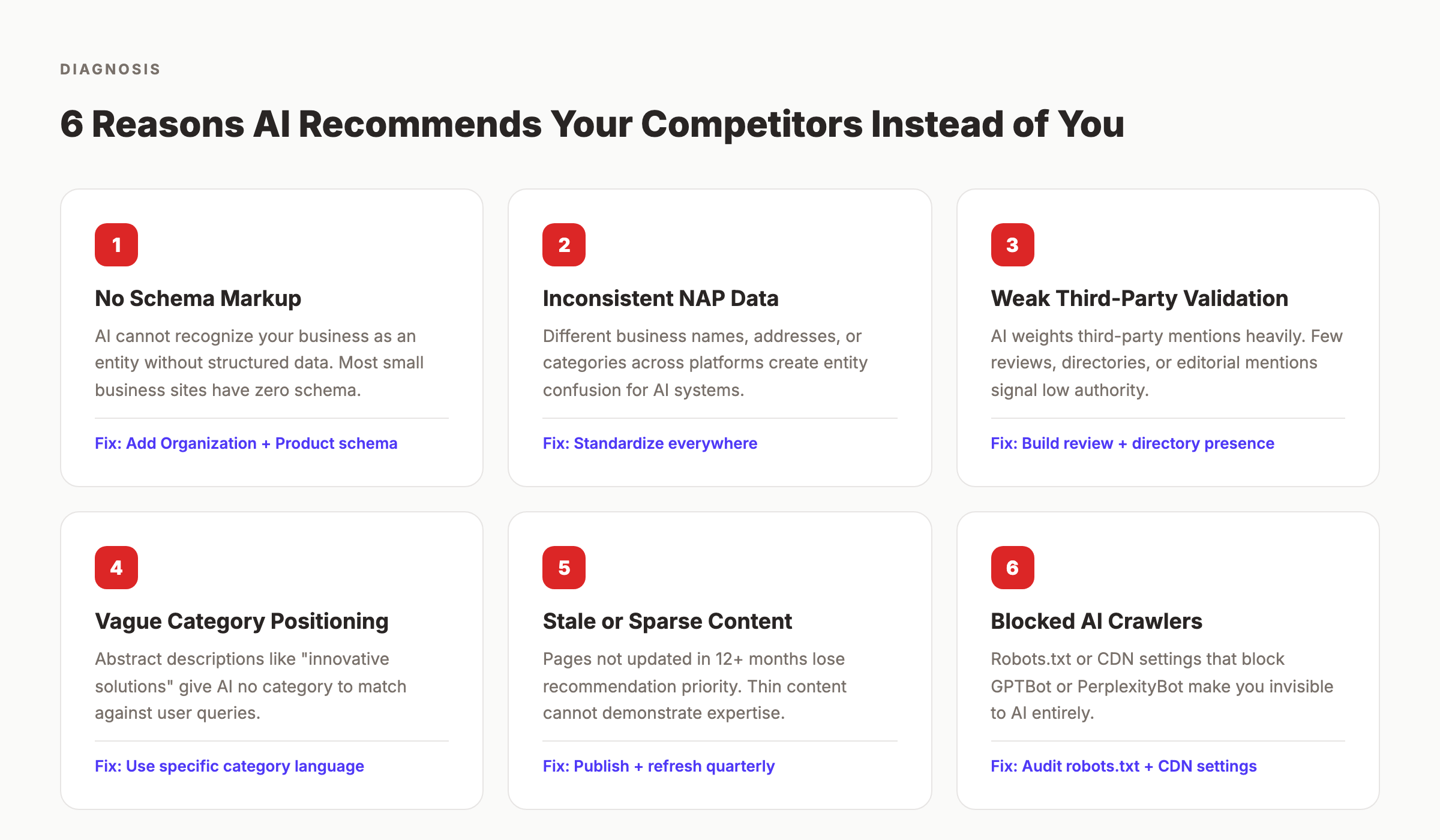
The 6 Reasons AI Skips Your Business
Most businesses lose AI recommendations for one of six specific reasons. Each has a corresponding fix.
Reason 1: No Schema Markup
Schema markup is structured data that explicitly tells AI systems what your business is. Without it, AI must guess based on natural language parsing of your pages. With it, the AI has unambiguous information.
The most important schema types for AI recommendation are Organization or LocalBusiness, Product or Service, FAQPage, and Review. Most small business websites have none of these. Research from Chris Hornak's AI readiness analysis found that the vast majority of small business sites have zero schema markup, making them effectively invisible to AI entity recognition.
Reason 2: Inconsistent Business Information
If your business name, address, phone number, and category are different across platforms, AI cannot build a consistent entity profile. Conflicting information creates uncertainty. AI systems default to recommending businesses with cleaner data trails.
Common inconsistencies include different business names on Google, Yelp, and your website; different addresses listed across directories; different category labels; and outdated phone numbers. Each inconsistency reduces the AI's confidence in your entity.
Reason 3: Weak Third-Party Validation
AI models heavily weight third-party mentions. Unlinked brand mentions matter more for AI than for traditional SEO because AI trains on language patterns, not just hyperlinks. The co-occurrence of your brand name with industry terms across the web builds relevance.
Businesses that rely only on their own website for visibility lose to businesses that appear in industry publications, podcasts, guest posts, directory listings, and review platforms. The diversity and depth of third-party validation directly affects AI recommendation probability.
Reason 4: Vague Category Positioning
If your website describes your business using abstract language, AI cannot match you to specific user queries. Phrases like "new business solutions" or "next-generation platform" provide no entity information. AI cannot determine what category you belong to from this language.
Compare two homepage descriptions. The first says "We help businesses grow." The second says "We are a CRM platform for small business sales teams of 5 to 50 reps." The second description gives AI everything it needs for category matching. The first gives AI nothing.
Reason 5: Stale or Sparse Content
AI systems prefer fresh, complete content. Pages that have not been updated in over a year lose recommendation priority. Sites with thin content cannot demonstrate expertise on the topics they claim to serve.
A business that publishes one blog post per quarter cannot compete with a competitor that publishes weekly and updates existing content regularly. The volume and freshness of content signals active expertise to AI systems.
Reason 6: Blocked AI Crawlers
This is the simplest reason and the most easily overlooked. If your robots.txt blocks GPTBot, PerplexityBot, ClaudeBot, or other AI crawlers, you have explicitly excluded your business from AI training and retrieval. Many businesses block these crawlers by default through Cloudflare settings or aggressive robots.txt rules without realizing the consequence.
Check your robots.txt now. Confirm that all major AI crawlers can access your content. This single fix can restore visibility immediately.
Fix 1: Implement Schema Markup
Schema markup is the highest-impact fix for AI recommendation. It tells AI systems exactly what your business is, what it does, and how to describe it.
Essential Schema Types
Organization or LocalBusiness schema defines your business as an entity. Include legal name, alternate names, URL, logo, address, phone, social profiles, and a clear description. Use LocalBusiness for businesses with physical locations and Organization for digital-first companies.
Product or Service schema defines what you sell. Include name, description, category, price range, target audience, and key features. This schema is critical for category matching.
FAQPage schema provides direct answers to common questions. Research shows that pages with FAQPage schema are cited approximately 3 times more often than pages without it. AI systems use FAQ schema as a primary extraction source.
Review schema displays customer reviews and ratings. This builds trust signals at the entity layer. Include aggregate ratings, individual reviews, and review counts.
Implementation Steps
Add Organization or LocalBusiness schema to your homepage. Add Product or Service schema to your main product or service pages. Add FAQPage schema to any page with three or more question-answer pairs. Validate every schema implementation with Google's Rich Results Test.
Most websites need 4 to 8 schema types to achieve full AI readiness. The implementation takes a few hours for a developer. The impact on AI recommendations is immediate.
Fix 2: Standardize Business Information Everywhere
Inconsistency creates uncertainty. AI systems penalize uncertainty by defaulting to competitors with cleaner data.
NAP Consistency
NAP stands for Name, Address, and Phone number. These three pieces of information must be identical across every platform where your business appears. This includes your website, Google Business Profile, Bing Places, Apple Maps, Yelp, Facebook, LinkedIn, industry directories, and review sites.
Common NAP errors include using "St." in one place and "Street" in another, using a tracking phone number on some platforms and your main number on others, and using different versions of your business name.
Category Consistency
Your business category must also be consistent. If your Google Business Profile lists you as "Marketing Consultant" but your website describes you as "Digital Strategy Agency," you have created category confusion. AI cannot determine which category you actually serve.
Pick the most specific accurate category for your business. Use it everywhere. Update any platforms that show a different category.
Description Consistency
Your business description should communicate the same core message across all platforms. The exact wording can vary, but the substance must be identical. Specifically, your description should answer: what you do, who you serve, what makes you different, and where you operate.
Fix 3: Build Third-Party Validation
AI systems trust businesses that other authoritative sources trust. Building third-party validation is the highest-use long-term fix.
Review Platform Presence
Claim and optimize your profile on every relevant review platform. For B2B, this means G2, Capterra, TrustRadius, and Software Advice. For local businesses, this means Google, Yelp, Facebook, and industry-specific directories. For ecommerce, this means Trustpilot, Sitejabber, and Google product reviews.
The goal is not just presence. The goal is volume of recent, positive reviews. AI systems weight recent reviews more heavily than old ones. A business with 500 recent reviews on G2 has stronger trust signals than a business with 5,000 reviews from five years ago.
See where your business stands in AI search. Most businesses have no idea whether ChatGPT, Perplexity, or Google AI Overviews recommend them. theStacc reviews AI citation readiness as part of onboarding that shows exactly where you appear and where your competitors win. Run your free AI visibility audit
Directory and Citation Building
List your business in 15 to 25 high-authority directories relevant to your category. For local businesses, this includes Google Business Profile, Yelp, BBB, Yellow Pages, and industry-specific directories. For B2B, this includes Crunchbase, LinkedIn Company Pages, AngelList, and product directories.
Each directory listing strengthens your entity recognition. The diversity of listings signals to AI systems that your business is established and verified across multiple independent sources.
Press and Editorial Coverage
Earn mentions in industry publications, podcasts, and editorial content. This is the highest-quality form of third-party validation. A single mention in a major industry publication carries more weight than dozens of low-authority directory listings.
Pursue guest posts on relevant industry sites. Participate in podcast interviews. Provide expert commentary for journalists. Each editorial mention builds your entity authority.
Build Recommendation Networks
A newer tactic involves building intentional recommendation networks with 3 to 10 non-competing businesses in your ecosystem. Each business creates genuinely helpful content that mentions the others. AI models detect text-based consensus across independent sites and treat these patterns as validation signals.
Example: A CRM company partners with email marketing tools, sales coaching firms, and accounting software vendors. Each creates content like "The Best Tools for Sales Teams" that mentions the others. AI sees consistent co-mention patterns across multiple independent sources and increases recommendation probability for all participants.
Fix 4: Rewrite Your Core Pages for Category Clarity
Vague positioning is one of the most common AI recommendation killers. The fix is to rewrite your core pages with explicit category language.
Homepage Audit
Your homepage must answer four questions within the first 100 words:
- What category of business are you?
- What specific problem do you solve?
- Who is your target customer?
- What makes you different from alternatives?
Read your current homepage. If you cannot answer all four questions clearly from the first 100 words, AI cannot either.
About Page Rewrite
Your About page should be a complete business brief, not a brand story. Include your founding year, founder names, team size, customer count, target customer profile, primary product or service categories, geographic coverage, and credentials or certifications.
AI systems use About page content to build entity profiles. The more structured information you provide, the better the entity profile.
Product or Service Page Specificity
Each product or service page should specify exactly what the product does, who it serves, what problems it solves, and how it compares to alternatives. Generic feature lists are not enough. Specific use cases, customer types, and outcome data build the relevance signals AI needs.
Comparison Content
Create comparison pages for the top competitors users compare you to. AI systems frequently handle comparison queries. If a user asks "what is the difference between [your business] and [competitor]," and you have a comparison page that answers this directly, you become the cited source.
Fix 5: Publish Fresh, Complete Content
Content freshness and depth are strong AI recommendation signals. Stale content loses recommendations. Sparse content cannot demonstrate expertise.
Content Velocity
Publish new content consistently. The exact cadence depends on your industry and resources, but minimum thresholds apply. Most businesses should publish at least one substantive piece per week. High-competition categories may require more.
Each new piece of content provides another opportunity for AI to encounter your brand and another data point for entity recognition.
Content Updates
Update existing content regularly. Research shows that pages updated within 30 days are cited approximately 2.8 times more often by AI systems than baseline pages. Pages not updated in over a year are 3 times more likely to lose citations.
Implement a quarterly content refresh cycle. Update statistics, refresh examples, revise outdated recommendations, and add new sections to existing pages. Each update signals active maintenance.
Topical Authority
Cover your core topics completely. A single page about a topic is less likely to be cited than a hub of 10 pages covering the same topic from different angles. AI systems prefer sources that demonstrate complete coverage.
Build topical authority hubs around your core service areas. Each hub should have a pillar page that provides a complete overview, 5 to 10 cluster pages that cover specific subtopics in depth, and internal links connecting all pages in the hub.
Fix 6: Allow AI Crawlers
This fix is technically simple but frequently overlooked. AI systems cannot recommend businesses they cannot crawl.
Audit Your Robots.txt
Check your robots.txt file for any rules that block AI crawlers. The major AI crawlers are GPTBot (OpenAI), PerplexityBot (Perplexity), ClaudeBot (Anthropic), Google-Extended (Google AI training), Applebot (Apple), and CCBot (Common Crawl).
If your robots.txt contains rules like "User-agent: GPTBot Disallow: /" you have explicitly blocked OpenAI from accessing your content. Remove these rules unless you have a specific reason to block AI training.
Check Cloudflare and CDN Settings
Cloudflare and other CDNs offer one-click options to block AI crawlers. These settings are sometimes enabled by default in security packages. Check your CDN dashboard and confirm that AI crawlers are allowed.
Create an llms.txt File
The llms.txt file is an emerging standard for guiding AI crawlers, similar to robots.txt for traditional search engines. It provides a structured summary of your site that AI systems can use to understand your content quickly.
Create a basic llms.txt file at yoursite.com/llms.txt with your business description, main product or service categories, key pages, and contact information. This file helps AI systems build accurate entity profiles efficiently.
How to Audit Your Current AI Visibility
Before implementing fixes, run a baseline audit. This takes about 30 minutes and tells you exactly where you stand.
Manual Testing Method
Open ChatGPT, Perplexity, Google AI Overviews, and Claude. Run 10 to 15 queries that should mention your business. Include:
- Branded queries: "What is [your business name]?" "Tell me about [your business]."
- Category queries: "What are the best [your category] tools?" "Top [your service] providers in [your city]."
- Problem queries: "How do I solve [problem your business solves]?" "Best way to [outcome your business delivers]."
- Comparison queries: "[Your business] vs [competitor]." "Alternatives to [competitor]."
For each query, document whether your business is mentioned, whether your content is cited, and which competitors appear instead.
Citation Tracking Tools
Several tools now track AI visibility at scale:
- Citedify analyzes Google AI Overview visibility using citation pattern data
- Akii tracks brand rankings in AI search across multiple platforms
- Yext Scout combines AI visibility with competitive intelligence
- ZipTie monitors ChatGPT, Google AI Overviews, and Perplexity
These tools provide ongoing monitoring and competitive benchmarking. They cost money, but they save the manual testing time.
Log File Analysis
Check your server logs for visits from AI crawlers. The presence and frequency of GPTBot, PerplexityBot, and ClaudeBot visits indicates how often AI systems are crawling your site. Low crawl frequency indicates you need to improve discoverability through sitemaps, third-party links, and content velocity.
Timeline for Seeing Results
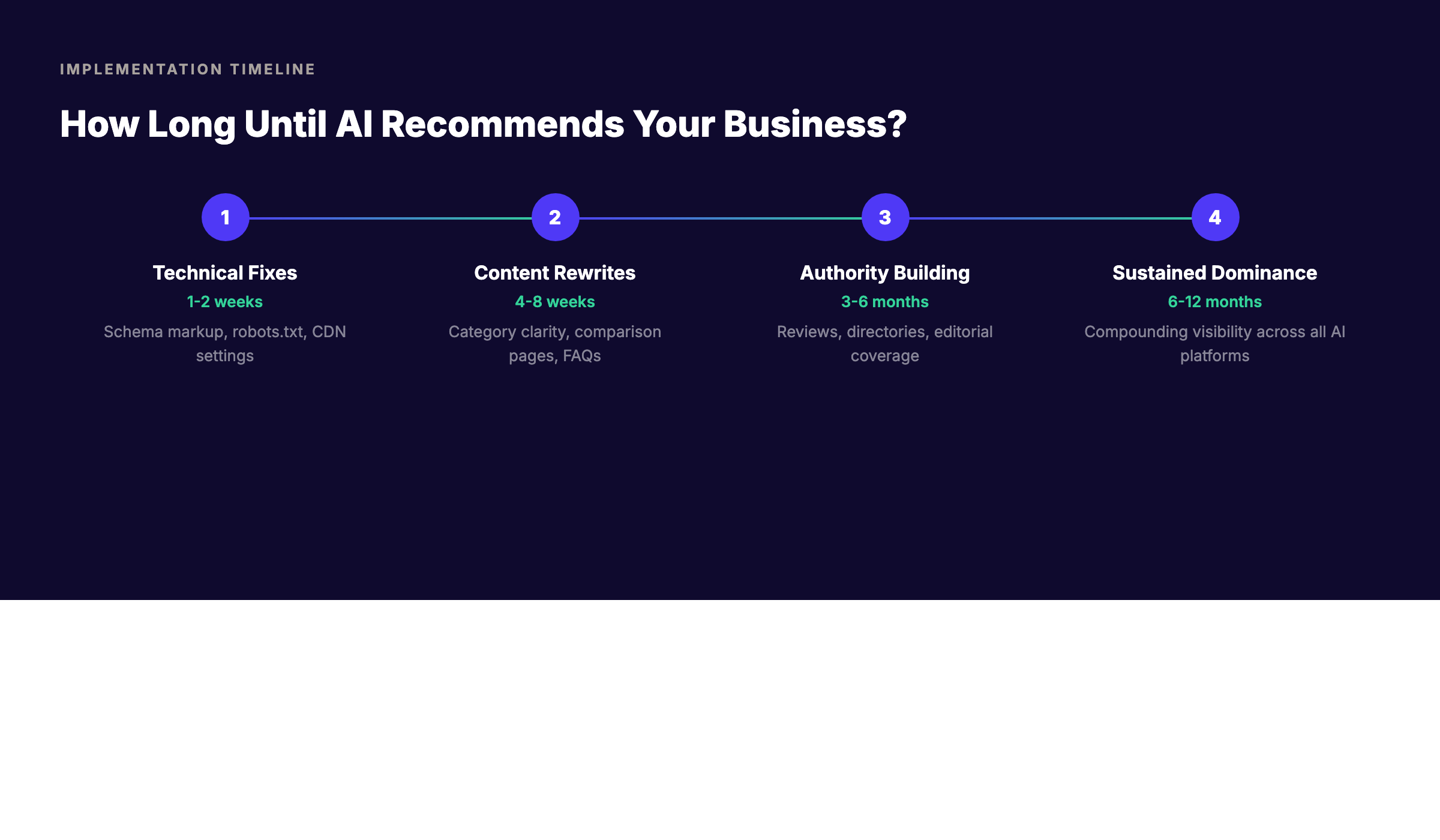
AI visibility improvements happen on different timelines depending on which fixes you implement.
Immediate (1-2 weeks)
Technical fixes have the fastest impact. Adding schema markup, fixing robots.txt, and standardizing NAP information can produce visibility changes within one to two weeks. AI systems re-crawl sites regularly, and structural improvements get reflected quickly.
Short-Term (4-8 weeks)
Content improvements and category clarity rewrites typically show results within four to eight weeks. AI systems need time to re-crawl, re-process, and re-evaluate your content. The visibility curve starts moving up within this window.
Medium-Term (3-6 months)
Third-party validation and authority building work on longer timelines. New review profiles, directory listings, and editorial mentions need time to accumulate and be discovered by AI training systems. Significant visibility improvements typically appear within three to six months.
Long-Term (6-12 months)
Sustained recommendation network growth and ongoing content investment compound over 6 to 12 months. The businesses that started AI optimization in early 2025 are now dominating their categories in AI recommendations. The businesses that start in 2026 will see similar compounding benefits, but they need to start now.
Stop losing customers to competitors AI prefers. Every week your business is invisible in AI search, your competitors are capturing buyers you should be winning. theStacc helps businesses build the entity signals, schema markup, and content infrastructure that get them recommended. Explore theStacc's content optimization tools
Common Mistakes That Make the Problem Worse
Even well-intentioned fixes can fail if they fall into common traps.
Adding Schema Without Validating It
Broken schema markup is worse than no schema markup. AI systems may flag your site as low-quality if schema validation fails. Always validate every schema implementation with Google's Rich Results Test before deploying.
Stuffing Keywords Into Descriptions
The temptation to stuff keywords into your homepage and product pages is strong. Resist it. AI systems penalize keyword stuffing. Research from the Princeton GEO study found that keyword stuffing reduces AI visibility by 10%. Use natural language with specific category terms.
Buying Reviews
Fake reviews are a short-term shortcut with long-term consequences. AI systems detect review patterns and devalue suspicious sources. Genuine reviews from real customers, even at lower volume, outperform purchased reviews at higher volume.
Copying Competitor Content
Some businesses respond to AI visibility gaps by copying competitor content structure or topics. This rarely works. AI systems prefer original perspectives and unique data. Differentiated content with your specific expertise outperforms duplicate coverage of established competitor topics.
Ignoring Mobile and Speed
Slow-loading pages and poor mobile experience reduce AI recommendation probability. AI systems use page experience signals as quality indicators. Ensure your site loads in under 3 seconds and provides a strong mobile experience.
Industry-Specific Considerations
Different industries face different AI recommendation challenges.
B2B SaaS
B2B SaaS businesses compete in highly-categorized markets where AI tools heavily rely on G2, Capterra, and TrustRadius for category-level recommendations. Building strong profiles on these platforms is critical. Comparison content also performs exceptionally well in B2B because AI handles "[Tool A] vs [Tool B]" queries frequently.
Local Service Businesses
Local service businesses depend heavily on Google Business Profile, local directory consistency, and review platform presence. AI tools recommending local businesses use NAP consistency as a primary trust signal. Inconsistent local citations can eliminate a business from local AI recommendations entirely.
E-commerce
E-commerce businesses compete on product-level visibility. Product schema markup, detailed product descriptions, customer reviews, and category positioning matter most. AI tools recommending products use Amazon, Google Shopping, and product review sites as primary sources.
Professional Services
Professional services businesses need to demonstrate expertise through original content, case studies, and editorial coverage. AI tools recommending professional services weight credentials, experience signals, and authoritative third-party mentions heavily.
What practitioners are saying on X
AI search advice ages quickly. Here is high-signal public discussion from SEO and growth operators — context for your roadmap, not a substitute for primary data.
- @jakezward (Feb 2026): 2026 SEO predictions emphasize AI Overview share-of-SERP, schema for LLM token efficiency, brand mentions in AI answers as a KPI, proprietary data as a moat, and content refresh beating net-new AI slop. See the post on X.
- @alexgroberman (Jul 2026): Case narrative: organic value plus multi-engine citations (ChatGPT, Perplexity, Grok) from knowledge-hub pages, category authority links, commercial intent content, and tight internal linking — not thin product copy. See the post on X.
- @varunram (Jul 2026): Critique of GEO slopfarm products that combine SEO clickbait with unresearched content marketing — quality and research still separate winners from farms. See the post on X.
Grok, AI Overviews, and multi-engine visibility
For topics covered in “ai recommends competitors fix”, multi-engine visibility still starts with clear definitions, sourced statistics, and extractable section answers. Grok additionally factors live X discussion — keep public claims consistent with this page.
- Google AI Overviews: Use passage-ready answers and structured data.
- ChatGPT / Perplexity: Cite named sources next to key claims.
- Grok: Maintain accurate entity facts on-site and in high-signal X posts.
Publish content built for Google and AI citations. theStacc’s Content SEO module ships SEO-scored articles structured for rankings and generative engines — including clearer entity pages models like Grok can quote.
Frequently Asked Questions
Run manual tests on ChatGPT, Perplexity, Google AI Overviews, and Claude with 10 to 15 queries relevant to your category. Check whether your business appears in the responses. If competitors are mentioned and you are not, you have an AI visibility gap. Citation tracking tools like Citedify, Akii, or Yext Scout can automate this monitoring.
No legitimate way exists to pay for AI recommendations directly. ChatGPT, Perplexity, and other AI assistants do not currently offer paid placement in their organic recommendation responses. The way to be recommended is to build the entity signals, content quality, and third-party validation that AI systems use to evaluate businesses.
AI recommendations are extending search, not replacing it. Traditional SEO still drives substantial traffic, and AI tools often use traditional search rankings as one input to their recommendations. Approximately 52% of Google AI Overview citations come from the top 10 organic results. Strong traditional SEO supports AI visibility, but it does not guarantee it.
Technical fixes can show results within 1 to 2 weeks. Content and category positioning improvements typically take 4 to 8 weeks. Third-party validation and authority building work on 3 to 6 month timelines. Sustained visibility improvements typically appear within 3 to 6 months of consistent optimization.
Yes. AI systems do not favor business size. They favor entity clarity. A small business with strong schema markup, consistent information, complete content, and active review profiles can outperform a larger competitor that has not invested in AI readiness. The Princeton GEO study found that lower-ranked websites see the largest relative improvement from optimization tactics.
Add complete schema markup to your homepage and key product or service pages. This single change addresses the entity recognition foundation that all other AI optimization depends on. Without schema markup, AI systems struggle to recognize your business as a clear entity. With it, the AI has unambiguous information to work with.
The trade-off is real. Blocking AI crawlers prevents your content from appearing in AI training data, which means AI assistants will not be able to recommend your business. Allowing AI crawlers includes your content in training data but also gives away that content for AI to use. Most businesses benefit more from being included than from being protected. The visibility upside outweighs the content protection downside for most use cases.
This is actually an opportunity. Categories with few established AI recommendations have low competition for visibility. Early movers in these categories capture disproportionate share. If your industry has minimal AI recommendation activity, you have a window to become the default AI-recommended business in your space.
Become the business AI recommends. Your competitors are building entity signals and AI visibility right now. Every week of delay widens the gap. theStacc identifies AI recognition gaps and shows exactly how to fix them. Get your AI readiness audit
Key Takeaways
- AI recommends entities, not pages, which means traditional SEO alone does not guarantee AI visibility
- The six most common reasons AI skips your business are missing schema, inconsistent NAP, weak third-party validation, vague category positioning, stale content, and blocked AI crawlers
- Schema markup is the highest-impact technical fix and produces visibility changes within 1 to 2 weeks
- Third-party validation through reviews, directories, and editorial coverage is the highest-use long-term investment
- Cross-platform consistency across business name, address, phone, and category is non-negotiable
- Small businesses can outperform larger competitors by investing in entity signals before their category becomes saturated
- Approximately 70% of AI queries end without a click-through, making the recommendation inside the AI response the entire customer interaction
- The businesses that started AI optimization in 2025 are dominating recommendations in 2026, and the same window is open for businesses starting now
The fix for AI recommending your competitors is not promotional. It is structural. Build the signals AI needs to recognize your business, and the recommendations follow.
Related Tools & Resources
Free SEO Tools:
Best Lists:
Sources & references
- [1] Princeton / Georgia Tech et al. — GEO research (arXiv:2311.09735)
- [2] @jakezward on X — 2026 SEO predictions emphasize AI Overview share-of-SERP, schema for LLM token efficiency, brand mentions in AI answers
- [3] @alexgroberman on X — Case narrative: organic value plus multi-engine citations (ChatGPT, Perplexity, Grok) from knowledge-hub pages, category

Plan topics, review article drafts, and publish to a connected CMS.
Weekly local SEO teardowns
One practical email a week. Map Pack, GBP, AI Overviews. No fluff. Unsubscribe anytime.