
Competitor Content Analysis: The Complete Guide
Competitor content analysis reveals what your rivals publish, what ranks, and where they miss. See the 7-step process to find gaps and outrank them.
Stacc Editorial • 2026-04-04 • Content Strategy
In This Article
You publish blog posts. Your competitors publish blog posts. Yet their pages rank on page 1, and yours sit on page 3. The difference is rarely quality alone. It is strategy. And strategy starts with competitor content analysis.
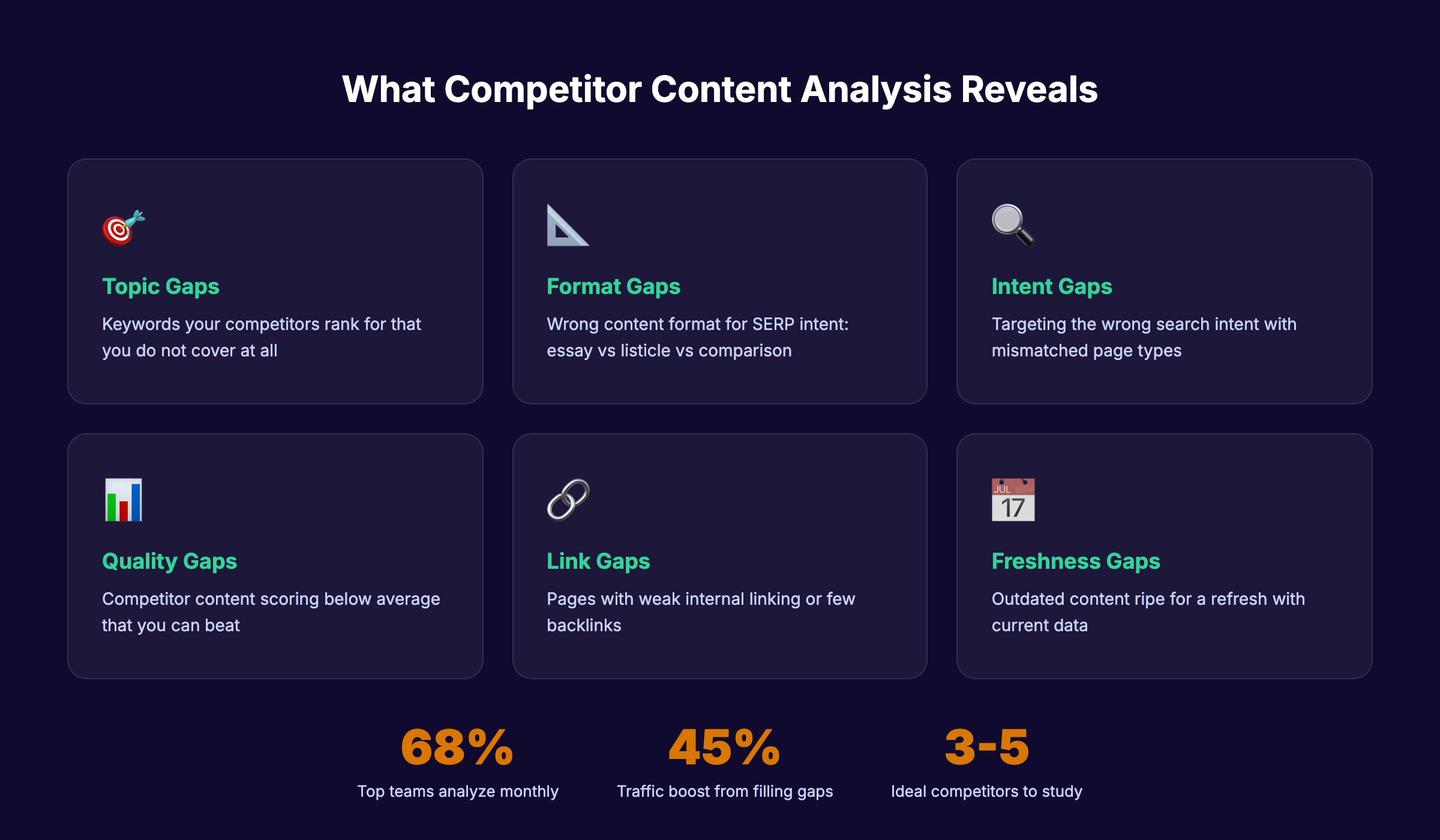
Most content teams skip this step. They brainstorm topics in isolation, write based on assumptions, and measure success by word count instead of rankings. A Crayon State of Competitive Intelligence report found that 68% of high-performing teams conduct competitive analysis at least monthly. Only 36% of underperforming teams do the same.
We publish 3,500+ blogs across 70+ industries. Every content strategy that produces results begins with studying what already ranks. This guide breaks down the entire process.
Here is what you will learn:
- What competitor content analysis is and why it differs from general SEO analysis
- How to identify your real content competitors (not just business rivals)
- The 7-step process to audit any competitor’s content strategy
- How to find topic, format, and intent gaps in competitor coverage
- The best tools for competitive content research
- How to turn competitor data into a publishing plan that outranks them
- Mistakes that waste time and produce misleading insights
What Is Competitor Content Analysis?
Competitor content analysis is the process of studying your rivals’ published content to understand what topics they cover, how they structure it, and where they earn rankings. The goal is to find patterns you can replicate and gaps you can exploit.
This is not the same as a broad SEO competitor analysis. SEO competitor analysis covers backlinks, technical SEO, domain authority, and site architecture. Competitor content analysis focuses specifically on the content itself: topics, formats, depth, search intent alignment, and publishing frequency.
Why Competitor Content Analysis Matters in 2026
Search has fragmented. Your content competes in traditional SERPs, AI overviews, social platforms, and AI chatbots. 77.6% of content marketers struggle to get their content to rank. Studying what already ranks is the shortest path to understanding what Google rewards in your niche.
Competitor content analysis answers 3 questions:
- What topics do my competitors rank for that I do not cover?
- Where is their content weak enough to beat?
- What formats and structures does Google prefer in my niche?
Without these answers, you are guessing. And guessing at scale is expensive.
How to Identify Your Content Competitors
Your content competitors are not always your business competitors. A SaaS company selling HR software might compete for blog traffic against SHRM, Forbes, and Indeed. None of those are product competitors. All of them are content competitors.
SERP-Based Identification
Search your top 10 target keywords. Record which domains appear in the top 10 results for 3 or more keywords. Those domains are your primary content competitors.
Do not stop at page 1. Check positions 11 through 20 as well. Competitors on page 2 often have content you can beat with moderate effort.
Topic-Based Identification
Use Ahrefs or Semrush to find sites that rank for the same topic cluster as your site. Enter your domain, go to the “Competing Domains” report, and filter by content overlap.
You will often discover competitors you did not know existed. Media sites, niche blogs, and industry associations frequently outrank businesses for informational keywords.
Audience-Based Identification
Ask your customers what they read. Check which sites appear in your Google Search Console “Search Appearance” reports. Look at who your audience follows on LinkedIn and X.
The best content competitors to study are the ones your audience already trusts. Outranking a trusted source requires better content and more topical authority. Outranking a weak source requires basic competence.
Pick 3 to 5 content competitors. Analyzing more than 5 at once dilutes focus without adding proportional insight.
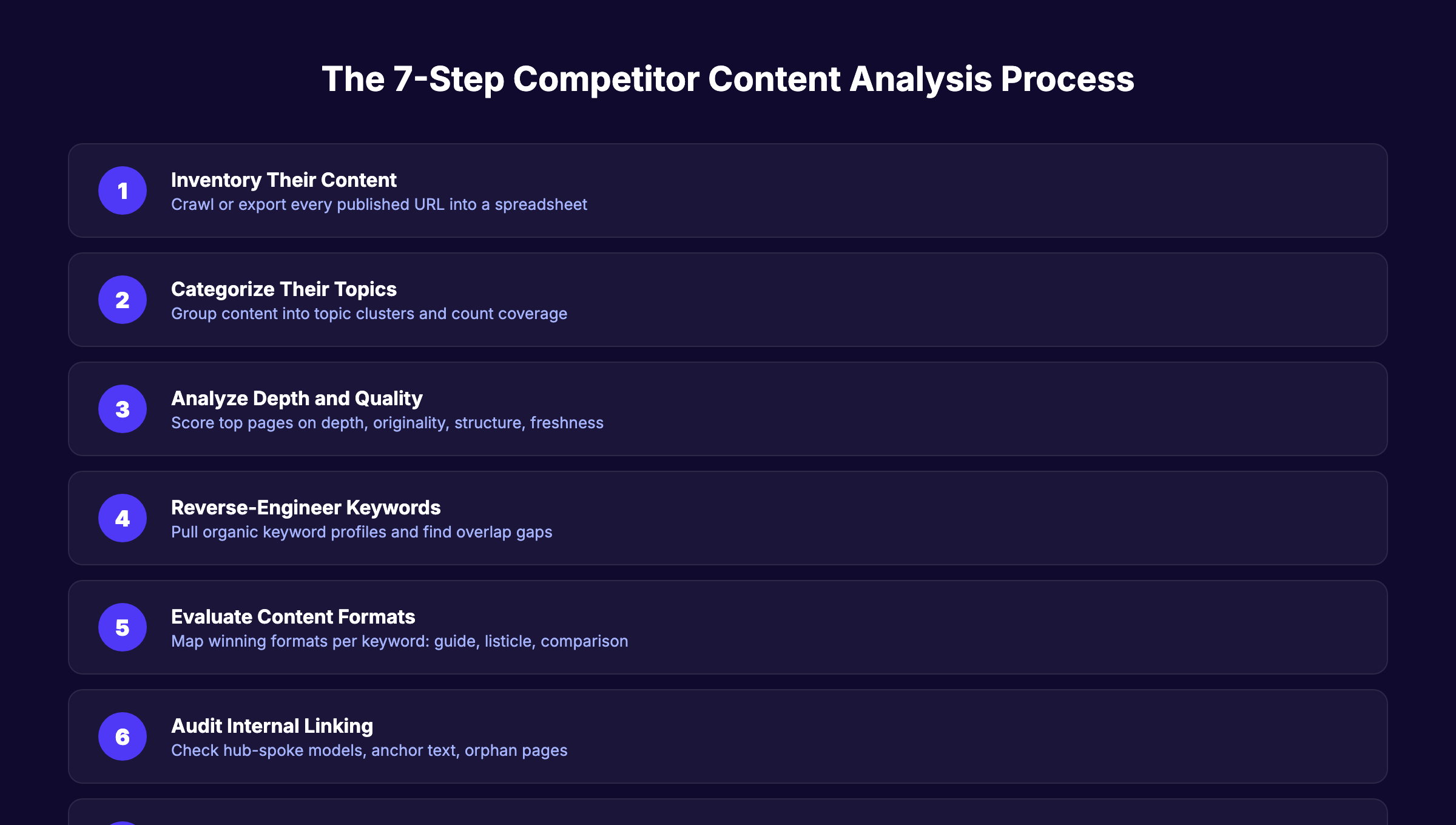
The 7-Step Competitor Content Analysis Process
Follow these steps in order. Each step feeds data into the next.
Step 1: Inventory Their Content
Export your competitor’s sitemap or use a tool like Screaming Frog to crawl their site. Build a spreadsheet of every published URL with these columns:
- URL
- Title
- H1 tag
- Word count
- Publish date
- Last modified date
- Primary keyword (estimated)
For blogs, focus on the /blog/ subfolder. Most sites publish 80% of their organic-traffic content in one subdirectory.
If you cannot crawl the site, use Ahrefs “Top Pages” report. It shows their highest-traffic pages sorted by estimated organic visits.
Step 2: Categorize Their Topics
Group every piece of content into topic categories. Most B2B content strategies cover 5 to 10 core topic clusters. Identify each cluster and count the number of articles per cluster.
This reveals their content marketing strategy at a glance. If a competitor has 40 articles about “email marketing” and 3 about “social media,” you know where they have invested authority.
Map these topic clusters against your own. Note which clusters you have not entered yet. Those are potential content gaps.
Step 3: Analyze Content Depth and Quality
Not all competitor content is good. Some of it ranks despite poor quality because of domain authority or backlink volume. Your job is to separate the content worth emulating from the content you can beat.
For each competitor, audit 10 to 15 of their top-performing pages. Score each page on these criteria:
| Criteria | What to Evaluate | Score (1-5) |
|---|---|---|
| Depth | Does it cover subtopics thoroughly? | |
| Originality | Does it offer unique data, examples, or frameworks? | |
| Structure | Clear headings, logical flow, scannable format? | |
| Freshness | Updated within the past 12 months? | |
| Visuals | Custom images, charts, or tables? | |
| E-E-A-T signals | Author bio, citations, experience markers? |
Pages scoring below 3 across multiple criteria are beatable targets. Prioritize those for your content plan.
Use a content scoring framework to keep evaluations consistent across your team.
Your competitors publish content. Stacc publishes 30 SEO-optimized articles per month, on autopilot. No writers. No briefs. No editing queue. Start for $1 →
Step 4: Reverse-Engineer Their Keyword Strategy
Pull each competitor’s organic keyword profile using Ahrefs or Semrush. Focus on:
- High-traffic keywords — Keywords driving the most visits
- High-ranking keywords — Keywords where they hold positions 1 through 5
- Quick-win keywords — Keywords where they rank 6 through 20 (beatable positions)
Export this data and cross-reference it with your own keyword rankings. Every keyword where a competitor ranks and you do not is a potential opportunity.
For a deeper dive into this process, see our guide on how to analyze competitor keywords.
Step 5: Evaluate Their Content Formats
Content format matters as much as content quality. Some niches reward long-form guides. Others reward listicles, comparison tables, or video content.
Record the format of each competitor’s top 20 pages:
| Format | Example | When It Wins |
|---|---|---|
| Ultimate guide | ”Complete Guide to X” | High-intent informational queries |
| How-to tutorial | ”How to Do X in 7 Steps” | Process-oriented searches |
| Listicle | ”10 Best Tools for X” | Commercial comparison queries |
| Data/statistics | ”X Statistics for 2026” | Linkable asset queries |
| Comparison | ”X vs Y” | Bottom-funnel decision queries |
| Case study | ”How We Achieved X” | Trust-building searches |
If 4 of your 5 competitors rank with listicles for a keyword, publishing a 5,000-word essay will not outrank them. Match the format Google prefers, then exceed the quality.
Step 6: Audit Their Internal Linking and Site Structure
Content does not rank in isolation. A competitor’s internal linking strategy tells you how they distribute authority across their site.
Check for:
- Hub-and-spoke models — Do they link from pillar pages to content clusters?
- Contextual links — How many internal links does each article contain?
- Anchor text patterns — Are they using keyword-rich or generic anchors?
- Orphan pages — Do any high-value pages lack internal links?
Use Screaming Frog or Sitebulb to visualize their internal link graph. Sites with strong internal linking often outrank sites with better content but weaker architecture.
Step 7: Track Their Publishing Cadence
Content velocity correlates with ranking growth. Record how often each competitor publishes new content and how often they update existing content.
Check the Wayback Machine or use Ahrefs “New Pages” report to estimate publishing frequency. Compare this to your own output.
If a competitor publishes 20 articles per month and you publish 2, closing the content gap will take years at your current pace. You either need to increase output or focus on higher-impact topics where fewer articles can win.
How to Find Content Gaps From Competitor Data
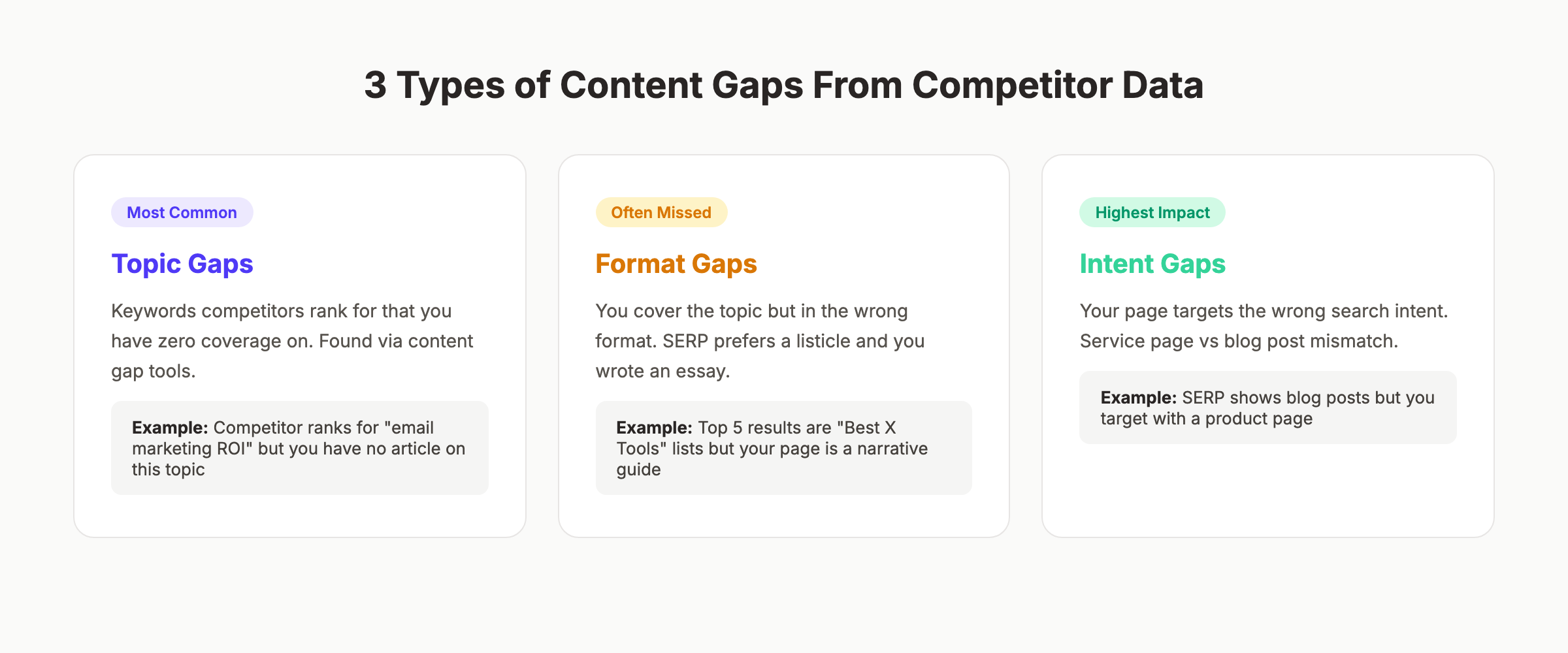
Content gaps are topics, formats, or angles your competitors cover that you do not. They are also topics none of your competitors cover well. Both types represent opportunities.
Topic Gaps
Run a content gap analysis in Ahrefs or Semrush. Enter your domain and up to 5 competitors. The tool shows keywords where at least 1 competitor ranks and you do not.
Filter by:
- Search volume above 100
- Keyword difficulty below 40
- Informational or commercial intent
This typically produces hundreds of keyword opportunities. Prioritize the ones closest to your existing topical map.
Targeting long-tail gaps can produce a 45% increase in organic traffic, according to content marketing research. The key is choosing gaps that align with your business goals, not just traffic volume.
Format Gaps
Sometimes you cover a topic but in the wrong format. If competitors rank with a comparison table and you published a narrative essay, the format mismatch costs you rankings.
Compare your content format against the top 3 results for each target keyword. Where formats differ, create a new version in the winning format.
Intent Gaps
The most overlooked gap. You might cover a topic but target the wrong search intent. If a keyword has informational intent and your page is a product landing page, you will not rank.
Check the SERP for each target keyword. If the top 10 results are all blog posts and your page is a service page, you have an intent mismatch. Fix it by creating a blog post that targets the informational intent and links to your service page.
Best Tools for Competitor Content Analysis
You do not need every tool on this list. Pick 1 primary SEO tool and 1 content analysis tool.
| Tool | Best For | Price |
|---|---|---|
| Ahrefs | Content gap analysis, keyword overlap, top pages | $99+/mo |
| Semrush | Competitive positioning, content audit, topic research | $129+/mo |
| Screaming Frog | Site crawling, content inventory, internal link mapping | Free (500 URLs) |
| BuzzSumo | Social engagement, top-shared content, trending topics | $199+/mo |
| SimilarWeb | Traffic estimates, audience overlap, referral sources | Free tier available |
| Clearscope | Content optimization scoring, SERP analysis | $170+/mo |
| SpyFu | Historical keyword data, competitor PPC analysis | $39+/mo |
Free Alternatives
You can run a basic competitor content analysis without paid tools:
- Google Search — Manual SERP analysis for your top keywords
- Google Search Console — Compare your rankings against SERP features
- Ahrefs Webmaster Tools — Free for sites you own (limited competitor data)
- Wayback Machine — Track competitor publishing history and content changes
- BuiltWith — Identify competitor tech stack and CMS
The free approach works for businesses analyzing 1 to 3 competitors. For larger audits, paid tools save 5 to 10 hours per competitor.
Skip the manual competitor research. Stacc analyzes your niche, finds content gaps, and publishes 30 articles per month. Your competitors will wonder how you scaled so fast. Start for $1 →
Turn Competitor Insights Into a Content Plan
Data without action is a report. Data with action is a strategy. Here is how to convert your competitor content analysis into a publishing plan.
Prioritize Opportunities
Not every content gap deserves an article. Score each opportunity on 3 factors:
- Business relevance — Does this topic attract your ideal customer?
- Ranking difficulty — Can you realistically rank in the top 10?
- Content effort — How much work is required to beat existing content?
Use a simple scoring matrix:
| Opportunity | Business Relevance (1-5) | Ranking Difficulty (1-5) | Content Effort (1-5) | Total |
|---|---|---|---|---|
| [Topic A] | 5 | 3 | 4 | 12 |
| [Topic B] | 4 | 4 | 3 | 11 |
| [Topic C] | 3 | 5 | 2 | 10 |
Prioritize opportunities with the highest total score. Publish those first.
Build Content Briefs
For each prioritized topic, create a content brief that includes:
- Target keyword and secondary keywords
- Search intent (informational, commercial, transactional)
- Competing URLs (top 3 results)
- Required H2 and H3 headings
- Minimum word count (match or beat top results)
- Unique angle or data point your competitors missed
- Internal link targets
A strong brief prevents your writers from producing content that merely copies competitors. The goal is to use competitor data as a baseline, then add original value.
Set a Publishing Cadence
Match or exceed your top competitor’s publishing frequency. If they publish 15 articles per month, publishing 4 will not close the gap.
For most businesses, 20 to 30 articles per month creates meaningful ranking momentum within 60 to 90 days. Fewer than 8 articles per month makes it difficult to build topical authority in competitive niches.
If your team cannot produce that volume, consider automating part of the workflow. A content audit of your existing articles can also reveal quick wins that do not require new content.
Common Mistakes in Competitor Content Analysis
Copying Instead of Competing
The goal is not to replicate competitor content word for word. Google does not need a second version of the same article. Your job is to cover the same topic better, with a unique angle, better data, or a clearer structure.
Analyzing Too Many Competitors
Studying 10 competitors produces spreadsheet paralysis. Stick to 3 to 5. You need enough data to spot patterns, not so much that you never move to execution.
Ignoring Content Freshness
A competitor’s page might rank with content from 2022. That does not mean the strategy is current. Always check publish dates and last-updated dates. Outdated content is a weakness you can exploit with a content refresh strategy.
Skipping the Execution Phase
The most common failure. Teams spend weeks analyzing competitors, build a 200-row spreadsheet, and never publish a single article. Set a deadline: analysis should take 1 to 2 days, not 1 to 2 months.
Focusing Only on Traffic, Not Intent
A competitor page with 50,000 monthly visits might attract the wrong audience. Prioritize keywords and topics that attract buyers, not just browsers. Commercial and transactional intent keywords convert at higher rates than pure informational queries.
Frequently Asked Questions
How often should you do a competitor content analysis?
Run a full analysis quarterly. Between full audits, monitor competitor publishing activity monthly. Set up Ahrefs or Semrush alerts for new pages and ranking changes. Markets shift quickly, and a competitor’s new content cluster can shift your keyword rankings in weeks.
What is the difference between content gap analysis and competitor content analysis?
Content gap analysis focuses on missing topics and keywords across your site. Competitor content analysis is broader. It includes topic gaps plus format analysis, quality assessment, publishing cadence, and structural evaluation. A content gap analysis is one output of a competitor content analysis. See our full guide on how to find content gaps.
Can you do competitor content analysis without paid tools?
Yes. Manual SERP analysis, Google Search Console, and the Wayback Machine provide enough data for a basic audit. Paid tools like Ahrefs and Semrush save time and provide deeper keyword and traffic data. For businesses analyzing more than 3 competitors or tracking more than 50 keywords, paid tools pay for themselves in time savings.
How many competitors should you analyze?
3 to 5 is the ideal range. Fewer than 3 does not give you enough data to identify patterns. More than 5 creates information overload without proportional benefit. Pick 2 competitors that outrank you and 1 that you currently outrank to get a balanced view.
What should you do first after completing a competitor content analysis?
Start with the highest-impact content gap. Find 1 topic where competitor content scores below average, search volume is above 500, and the topic aligns with your product. Write a better article. Publish it. Then move to the next gap. Momentum matters more than perfection.
Does competitor content analysis work for small businesses?
Absolutely. Small businesses benefit the most because they cannot afford to waste resources on the wrong topics. A 2-hour competitor analysis can prevent months of publishing content that never ranks. Focus on local and niche competitors rather than national brands.
Your competitors already have a content strategy. Now you need one that beats it. Stacc publishes 30 optimized articles per month so you can close the content gap fast. Start for $1 →
What Comes Next
Competitor content analysis is not a one-time project. It is a recurring input into your content marketing strategy. Run the 7-step process once to build your baseline. Then monitor competitors monthly and adjust your publishing plan based on what changes.
The businesses that outrank their competitors do not guess. They study, plan, and publish at a pace that compounds over time. Start with 1 competitor, 1 gap, and 1 article. Then scale from there.
Written and published by Stacc. We publish 3,500+ articles per month across 70+ industries. All data verified against public sources as of March 2026.
