Financial Advisor SEO: Get More Clients Online (2026)
Financial advisor SEO explained step by step. Covers YMYL compliance, local keywords, GBP, E-E-A-T signals, and niche strategies. Updated 2026.
Siddharth Gangal • 2026-03-28 • Local SEO
In This Article
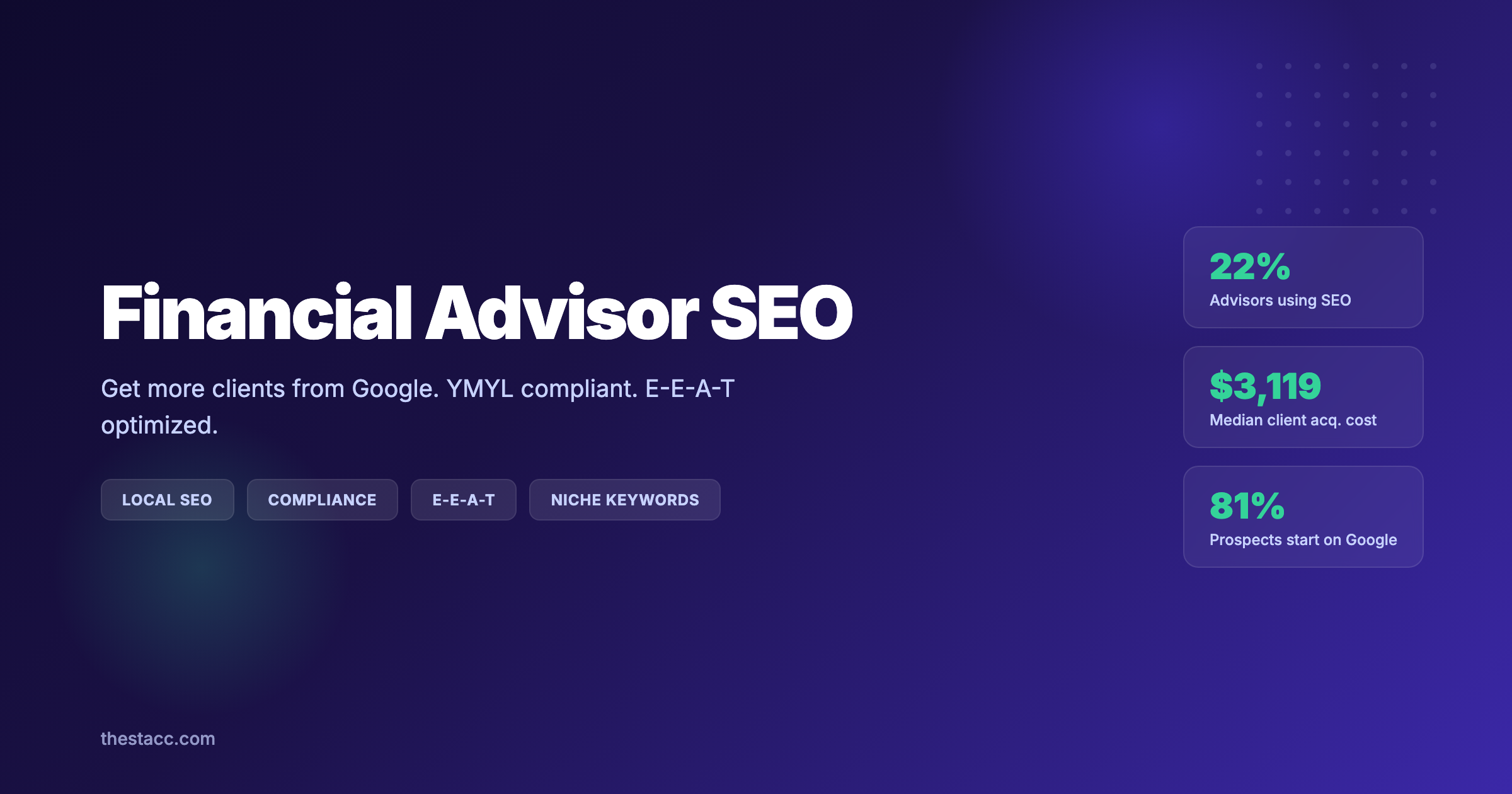
Only 22% of financial advisors use SEO as a marketing channel. The other 78% spend an average of $15,908 per year on marketing with no clear attribution on what works, according to Broadridge research. Meanwhile, 81% of their prospective clients start the search for a financial advisor on Google.
Financial advisor SEO is the gap between paying $3,119 to acquire each new client and building an organic pipeline that delivers leads at a fraction of that cost. The median client acquisition cost for advisors is $3,119, per Kitces Research. A well-ranked blog post costs $0 per click and generates leads for years.
The challenge: financial services is a YMYL (Your Money, Your Life) category. Google holds financial advisor websites to the highest quality standards. SEC and FINRA rules add compliance requirements that most SEO guides ignore. Generic advice does not work here.
This guide covers financial advisor SEO with the compliance and quality requirements built in. We publish 3,500+ articles across 70+ industries, including financial services and professional advisory firms.
Here is what you will learn:
- Why SEO delivers the highest ROI for financial advisor client acquisition
- The exact keywords financial advisors should target (by service type and niche)
- How to build E-E-A-T signals that satisfy Google’s YMYL requirements
- Google Business Profile optimization for advisors
- Compliance-safe content strategies that rank without regulatory risk
- How to measure which SEO efforts generate actual client inquiries
Why SEO Outperforms Every Other Advisor Marketing Channel
Financial advisors rely on referrals for 70% to 80% of new clients. Referrals work. But they are unpredictable and unscalable. SEO creates a second pipeline that runs independently of your referral network.
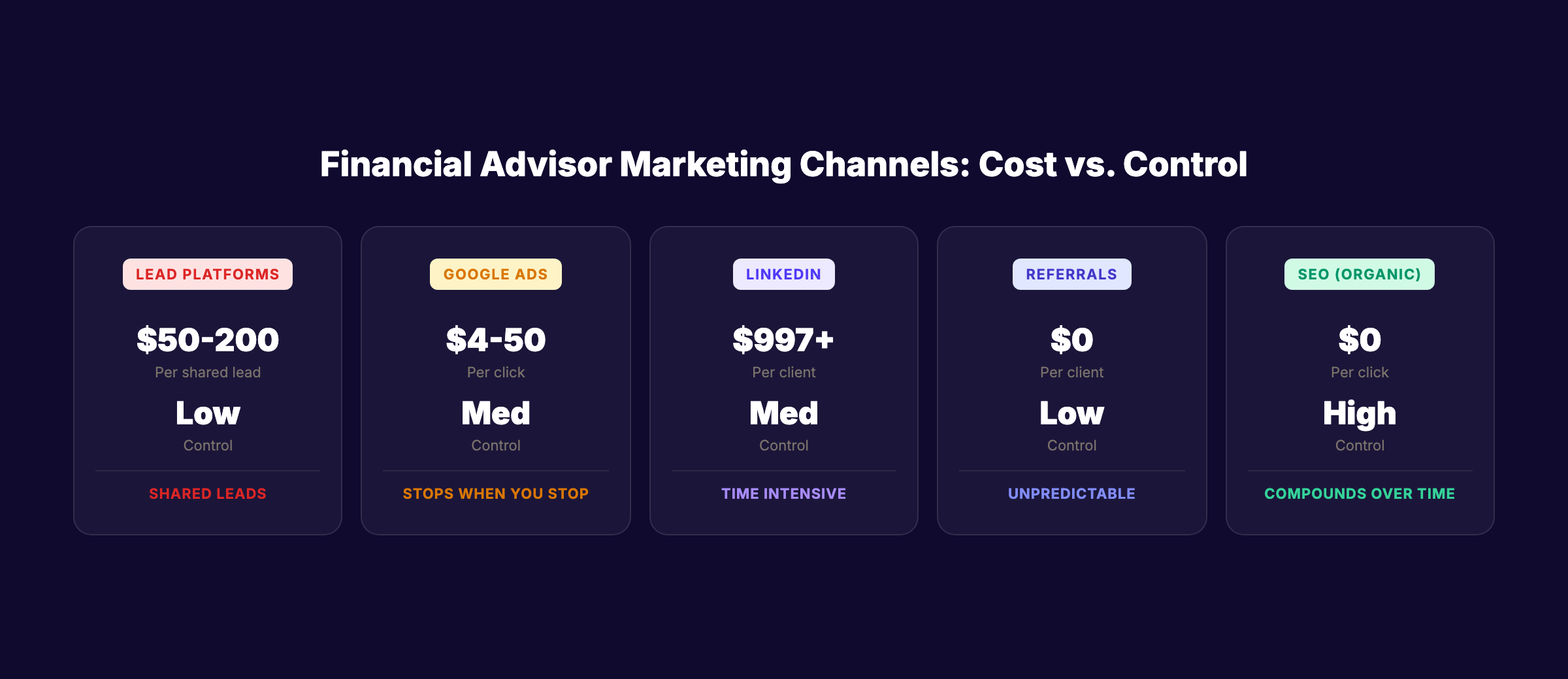
The Client Acquisition Cost Problem
The numbers tell the story:
| Marketing Channel | Cost per Lead | Avg Client Acquisition Cost | Control |
|---|---|---|---|
| SmartAsset / Lead platforms | $50 - $200 per lead | $500 - $2,000 | Low (shared leads) |
| Google Ads (PPC) | $4 - $50 per click | $800 - $3,000 | Medium |
| LinkedIn outreach | Time-intensive | $997+ per client | Medium |
| Referrals | Free | $0 (but unpredictable) | Low |
| SEO (organic search) | $0 per click | Setup cost only | High |
Growth-focused advisors spend roughly $997 per acquired client through active marketing channels. Organic search eliminates the per-lead cost entirely after the initial investment.
The Referral Amplification Effect
SEO does not replace referrals. It amplifies them. When a friend recommends you, the prospect searches your name on Google. If they find a professional website with educational content, strong reviews, and clear credentials, they call. If they find nothing or a thin one-page site, they keep searching.
77% of advisors lack a defined marketing strategy, according to Broadridge. Advisors with a strategy acquire 50% more clients and generate 168% more leads than those without one. SEO is the foundation of that strategy.
Stop chasing leads. Start ranking. Stacc publishes 30 SEO articles per month for $99. Build a client pipeline that grows every month. Start for $1 →
Keyword Strategy for Financial Advisors
The right keywords connect your website to people actively searching for financial advice. Financial advisor keywords fall into 4 categories.
Service-Type Keywords
These keywords target prospects looking for specific financial services. Each one should have a dedicated page on your website.
| Service | Target Keywords |
|---|---|
| Retirement planning | retirement planner [city], 401k rollover advisor, retirement income planning |
| Wealth management | wealth management [city], high net worth financial advisor, investment management |
| Tax planning | tax planning financial advisor [city], tax-efficient investing |
| Estate planning | estate planning advisor [city], trust and estate planning |
| Financial planning | certified financial planner [city], fee-only financial advisor [city] |
| Specialty | stock options planning, RSU tax planning, charitable giving advisor |
Niche Keywords
The most profitable SEO opportunity for financial advisors. A generic “financial advisor [city]” keyword is highly competitive. A niche keyword is not.
| Niche | Keywords |
|---|---|
| Physicians | financial advisor for doctors, physician wealth management |
| Tech employees | financial advisor for tech IPO, RSU and stock option planning |
| Business owners | financial advisor for small business owners, exit planning advisor |
| Divorcees | financial advisor for divorce, CDFA [city] |
| Federal employees | financial advisor for federal employees, TSP rollover advisor |
| Pre-retirees | retirement planner for 50+, early retirement financial advisor |
Niche keywords convert at higher rates because the searcher sees content written specifically for their situation. A physician reading “financial planning for doctors” trusts that advisor more than one reading a generic “financial planning” page.
Local Keywords
Financial advisory is a trust-based, relationship-driven business. Most clients want an advisor nearby. Every core keyword needs a location modifier.
Pattern: [service] + [city] or [qualifier] + financial advisor + [city]
Examples:
- “fee-only financial advisor Denver”
- “fiduciary financial planner Austin TX”
- “retirement planner near me”
- “CFP [city name]”
If you serve clients in multiple cities or states, create dedicated location pages. We cover the right approach in the local SEO section below.
Informational Keywords
Blog content targets people researching financial topics. They may not hire today, but they build your topical authority and attract future clients.
High-value topics:
- “how much does a financial advisor cost”
- “should I hire a financial advisor”
- “difference between fiduciary and financial advisor”
- “when to start retirement planning”
- “how do financial advisors get paid”
These questions get searched thousands of times per month. Ranking for them positions you as the expert before the prospect is ready to hire.
E-E-A-T: The Non-Negotiable for Financial Advisor Websites
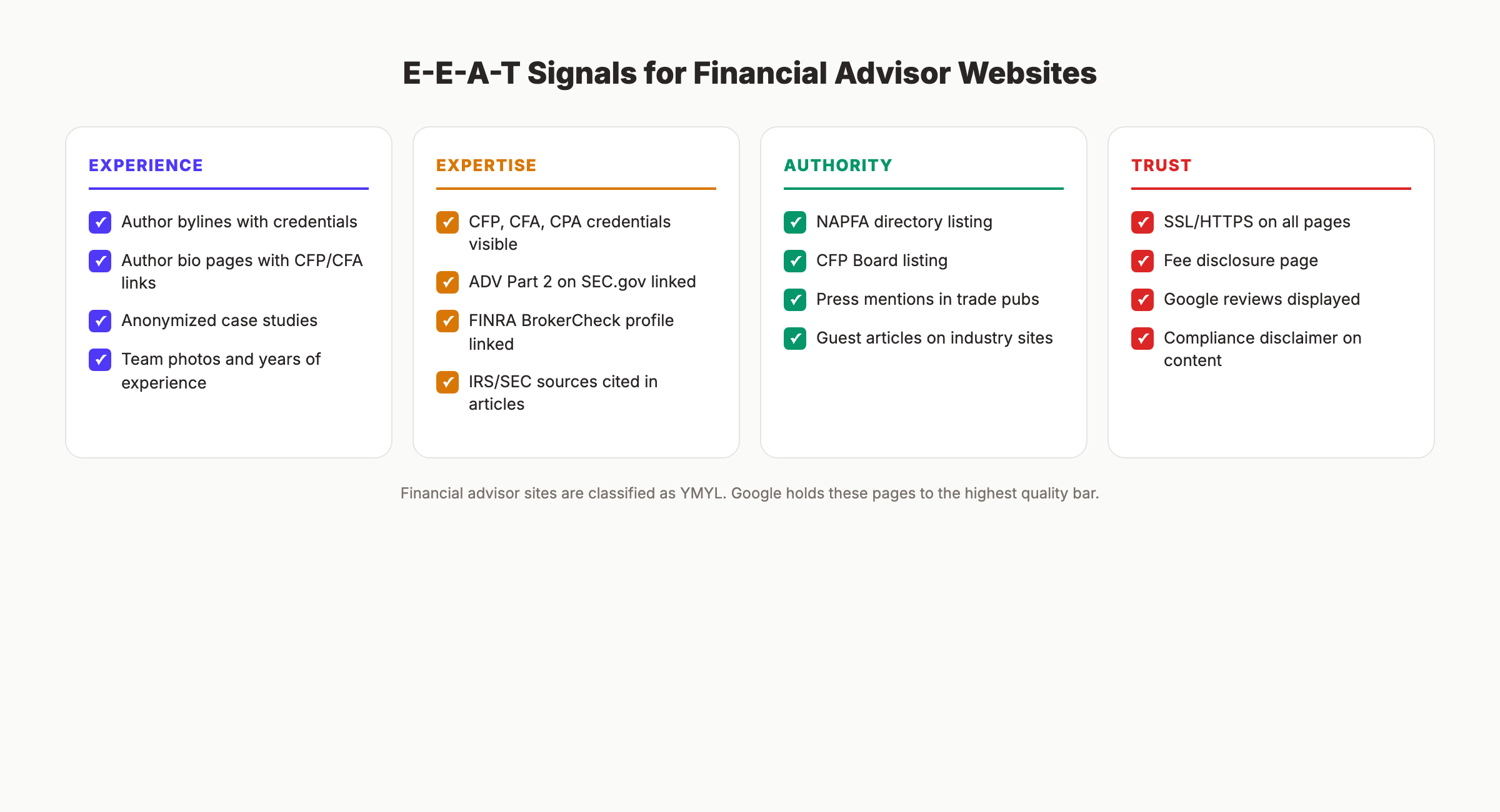
Google classifies financial advisor content as YMYL. This means your website faces the strictest quality evaluation criteria in search. E-E-A-T (Experience, Expertise, Authoritativeness, Trustworthiness) determines whether your pages rank or get buried.
Experience Signals
Google wants evidence that real humans with real financial experience created your content.
- Author bylines on every blog post with full name and credentials
- Author bio pages linking to CFP Board verification, SEC registration, or FINRA BrokerCheck
- Case studies or client scenarios (anonymized, compliance-approved)
- “About” page with team photos, credentials, and years of experience
Expertise Signals
Your credentials must be visible and verifiable.
- Display CFP, CFA, CPA, ChFC, or other designations prominently
- Link to your ADV Part 2 filing on SEC.gov
- Link to your FINRA BrokerCheck profile (if applicable)
- Cite IRS, SEC, and peer-reviewed sources in every article
Authoritativeness Signals
External validation from trusted sources tells Google your firm is legitimate.
- NAPFA directory listing (if fee-only)
- CFP Board “Find a CFP” listing
- Better Business Bureau profile
- Press mentions in financial publications (InvestmentNews, Financial Planning, Kiplinger)
- Guest articles on industry sites
- Active LinkedIn profile with professional content
Trustworthiness Signals
Trust is the foundation for YMYL pages.
- SSL certificate (HTTPS on all pages)
- Clear fee disclosure page
- Privacy policy and terms of service
- Physical office address displayed
- Client reviews on Google and third-party platforms
- Compliance disclaimer on all content pages
Most financial advisor websites have 2 or 3 of these signals. Firms that implement all of them outrank competitors because Google can verify their expertise across multiple touchpoints.
Your SEO team. $99 per month. 30 optimized articles, published automatically. Build E-E-A-T signals with consistent, expert-level content. Start for $1 →
Google Business Profile for Financial Advisors
Your Google Business Profile drives visibility in local map results. 46% of all Google searches have local intent. When a prospect searches “financial advisor near me,” the map pack appears first.
Profile Setup Checklist
- Primary category: “Financial Planner” or “Financial Consultant”
- Secondary categories: Investment Service, Retirement Planning Center, Tax Consultant
- Complete business description (750 characters, include city, services, and credentials)
- Office hours (include appointment-only availability)
- Phone number (trackable local number preferred)
- Website URL pointing to your homepage
- All service types listed with descriptions
- Service area defined (for advisors who serve clients virtually across states)
The Review Strategy
Reviews are the strongest local ranking signal for financial advisors. But compliance matters.
Compliant review collection:
- Ask clients for reviews after positive milestones (annual review meeting, tax season completion, retirement plan finalization)
- Send a direct link to your Google review page via email
- Respond to every review within 48 hours
- Never incentivize reviews (gift cards, fee discounts) as this violates both Google and SEC policies
- Do not ask clients to mention specific performance results in reviews
Target 3 to 5 new reviews per month. Google values review velocity (frequency of new reviews) as much as total count.
GBP Posts for Advisors
Post educational content to your GBP weekly. Topics that work:
- “3 questions to ask before rolling over your 401k”
- “Tax planning moves to make before December 31”
- “What the Fed rate decision means for your retirement savings”
- Market commentary (factual, educational, not predictive)
GBP posts signal to Google that your profile is active. Active profiles rank higher in the local pack.
Compliance-Safe Content That Ranks
Financial advisors face a unique SEO challenge: the content that ranks best (specific, data-driven, opinion-rich) can conflict with SEC and FINRA rules. Here is how to publish content that does both.
What You Can Publish Safely
Educational content is always safe. Blog posts that explain financial concepts without recommending specific products or predicting outcomes fall squarely within compliance guidelines.
Safe topics:
- “How a Roth conversion works” (educational)
- “5 tax deductions business owners miss” (informational)
- “What to expect in your first meeting with a financial advisor” (trust-building)
- “How financial advisors get paid: fee-only vs commission” (transparency)
What Requires Compliance Review
Testimonials and endorsements. The SEC Marketing Rule (Rule 206(4)-1) now allows testimonials, but they require specific disclosures: whether the person is a current client, whether they were compensated, and any material conflicts of interest.
Performance claims. Any mention of investment returns requires showing both gross and net performance with equal prominence. Avoid specific return numbers in blog content unless your compliance team approves the presentation.
Awards and rankings. Displaying “Top Financial Advisor” rankings from Forbes, Barron’s, or other publications requires full disclosure of selection methodology and whether any compensation was involved.
The Compliance Disclaimer
Every content page should include a footer disclaimer:
“This content is for informational purposes only and does not constitute personalized financial advice. Past performance does not guarantee future results. Consult a qualified financial professional before making investment decisions.”
This disclaimer does not replace compliance review. But it establishes the educational intent of your content for both regulators and Google.
Content Frequency for Advisors
Advisors who publish 4 to 8 articles per month build topical authority faster than those who publish sporadically. Each article targets a specific keyword and reinforces your expertise in that topic cluster.
A retirement planning advisor publishing weekly about Social Security, 401k rollovers, Roth conversions, and Medicare creates a content cluster that dominates retirement-related searches in their market.
Technical SEO for Financial Advisor Websites
Technical issues undermine even the best content. Financial advisor websites are often built on outdated platforms with slow loading times and poor mobile experiences.
Core Technical Checklist
- Mobile-responsive design (over 60% of local searches happen on mobile)
- Page speed under 3 seconds (test with Google PageSpeed Insights)
- SSL certificate active on all pages
- XML sitemap submitted to Google Search Console
-
robots.txtconfigured properly - No duplicate content across service pages
- Clean URL structure (/services/retirement-planning not /page?id=47)
- 404 page that redirects users to useful content
Schema Markup for Financial Services
Add structured data to help Google understand your business. Schema markup for financial advisors should include:
LocalBusiness schema on your homepage:
- Business name, address, phone
- Opening hours
- Service area
- Price range indicator
- Aggregate rating (from Google reviews)
Person schema on team/advisor pages:
- Full name, job title, credentials
- Links to CFP Board, SEC, FINRA profiles
- Image URL
FAQPage schema on FAQ and blog content:
- Increases chance of appearing in People Also Ask boxes
- Provides direct answers that AI search engines cite
Use the Schema Markup Generator to create the JSON-LD code without writing it manually.
Internal Linking Strategy
Connect your content with a clear internal linking structure:
- Every blog post about retirement links to your retirement planning service page
- Service pages link to 2 to 3 related blog posts
- All pages link back to your contact or consultation booking page
- Create content clusters around your core service areas
This structure tells Google which pages matter most and helps prospects find related content naturally.
3,500+ blogs published. 92% average SEO score. See what Stacc can do for your advisory firm. Start for $1 →
Building Backlinks for Financial Advisory Firms
Backlinks from authoritative websites signal credibility to Google. Financial advisors have unique link-building opportunities.
Directory Listings
Submit your firm to every relevant directory. Ensure your NAP (name, address, phone) is identical everywhere.
Industry directories:
- NAPFA “Find an Advisor” (fee-only advisors)
- CFP Board “Find a CFP Professional”
- Garrett Planning Network
- XY Planning Network
- FINRA BrokerCheck
General business directories:
- Google Business Profile
- Yelp
- Better Business Bureau
- Your local Chamber of Commerce
- LinkedIn company page
Earned Media Opportunities
- Respond to journalist queries on HARO, Qwoted, or Connectively
- Write guest articles for financial publications (InvestmentNews, Financial Planning Magazine)
- Offer commentary to local news outlets on tax season, market events, or retirement topics
- Speak at local business groups and get listed on their event pages
- Partner with CPAs and estate attorneys for reciprocal referral content
The Trust Signal Loop
Every authoritative backlink strengthens your E-E-A-T profile. A link from NAPFA tells Google you are a verified fee-only advisor. A link from a local newspaper tells Google you are a recognized community expert. A link from an industry publication tells Google you have peer credibility. These signals compound.
Measuring Financial Advisor SEO Results
85% of advisors struggle to find time for marketing, per Broadridge. Tracking the right metrics ensures the time you invest in SEO delivers measurable returns.
Essential Tracking Setup
- Google Search Console for ranking positions and search queries
- Google Analytics 4 for website traffic and form submissions
- Call tracking (assign a unique number to your website to measure SEO-generated calls)
- Consultation booking tracking (tag bookings by source)
What to Measure Monthly
| Metric | Why It Matters | Target |
|---|---|---|
| Organic traffic | Total visitors from Google search | 15-25% growth per quarter |
| Keyword rankings | Positions for target terms | Top 5 for local niche keywords within 6 months |
| Consultation requests | Leads from website forms and calls | Track trend month over month |
| GBP profile views | Visibility in local map results | Steady growth |
| Review count | Trust signal for prospects and Google | 3-5 new reviews per month |
| Backlinks acquired | Authority signals | 2-4 new quality links per month |
Calculating SEO ROI for Advisors
A single new client is worth far more to a financial advisor than to most other service businesses. If your average AUM per client is $500,000 and your fee is 1%, each new client generates $5,000 per year in revenue. With an average client relationship of 7 to 10 years, the lifetime value exceeds $35,000.
If SEO generates 2 new clients per month at zero per-click cost, the annual revenue impact is $120,000. Compare that to the $15,908 average annual marketing spend with mixed results.
Rank everywhere. Do nothing. Blog SEO, Local SEO, and Social on autopilot. Advisory firms use Stacc starting at $99/mo. Start for $1 →
FAQ
How long does SEO take to work for a financial advisor?
Expect initial ranking improvements in 60 to 90 days. Meaningful lead generation from organic search typically begins at 4 to 6 months. Financial advisor keywords are competitive, especially in major metros. Consistent publishing accelerates the timeline.
How much does SEO cost for financial advisors?
SEO agencies charge $2,000 to $5,000 per month for financial advisory clients. Done-for-you services like Stacc start at $99 per month for 30 published articles. The right investment depends on your market size, competition level, and existing online presence.
What is the best keyword to target first as a financial advisor?
Start with your highest-value service combined with your city. If you specialize in retirement planning in Denver, target “retirement planner Denver” first. Then expand to related keywords and neighboring cities. Niche keywords like “financial advisor for doctors Denver” typically have lower competition and higher conversion rates.
Do financial advisors need a blog for SEO?
Yes. Blog content targets informational queries that service pages cannot rank for. A blog post about “how much does a financial advisor cost” captures prospects during the research phase. Without a blog, you compete only on direct service keywords and miss the larger audience exploring financial topics.
Can financial advisors use testimonials on their website?
Yes, since the SEC Marketing Rule update in November 2022. Testimonials are now permitted but require specific disclosures: client status, compensation details, and any material conflicts of interest. Your compliance team should review all testimonials before publishing.
Should a financial advisor focus on local or national SEO?
Start local. Most clients prefer a nearby advisor for in-person meetings. Target your city and surrounding areas first. Expand to state-level or national keywords only after you dominate local search results. Virtual advisory firms serving clients nationwide can target niche keywords without location modifiers.
Financial advisor SEO delivers the highest ROI of any marketing channel when the content meets both Google’s quality standards and regulatory requirements. Every article published builds topical authority. Every review collected strengthens local visibility. Every compliance-safe page demonstrates the E-E-A-T signals Google rewards. Start with your strongest niche, your primary city, and your Google Business Profile.
Written and published by Stacc. We publish 3,500+ articles per month across 70+ industries. All data verified against public sources as of March 2026.