Learn how to buy SEO leads that convert. Covers lead types, vendor vetting, follow-up systems, and ROI tracking for marketing agencies. Updated 2026.
Buying SEO leads means paying a vendor for contact records of businesses that want search work. Exclusive leads cost more and convert far better than shared ones, but the deciding factor is the system around them: speed to first call, a written qualification rule, and a tracked cost per acquisition.
Most agencies buy SEO leads wrong.
They focus on cost per lead, not conversion rate. They buy shared leads and wonder why no one picks up. They send generic follow-up emails and blame the data when nothing closes.
The problem is rarely the leads. It is the system around the leads.
This guide shows you exactly how to buy SEO leads that convert. From selecting the right lead type to building the follow-up system that closes them. SEO leads close at 14.6%, nearly 9× higher than cold outbound. That number only holds when you get the process right.
theStacc publishes over 3,500 blogs for businesses across 70+ industries and works with marketing agencies building scalable client acquisition systems. If you want the full picture on growing an agency beyond referrals, read how to grow your marketing agency first.
Here is what you will learn:
- The 5 types of SEO leads and which one fits your agency
- How to define quality criteria before you spend anything
- How to choose between DIY databases and done-for-you vendors
- The vetting process that prevents bad data purchases
- The 24-hour follow-up window that determines conversion
- How to calculate real ROI and know when to stop buying
Time required: 1-2 weeks to set up a proper system Difficulty: Intermediate What you will need: A defined ideal client profile, a CRM, and a follow-up sequence ready before purchase
Step 1: Understand What You Are Actually Buying
"SEO leads" means different things from different vendors. Buying without knowing the difference wastes budget before a single call is made.
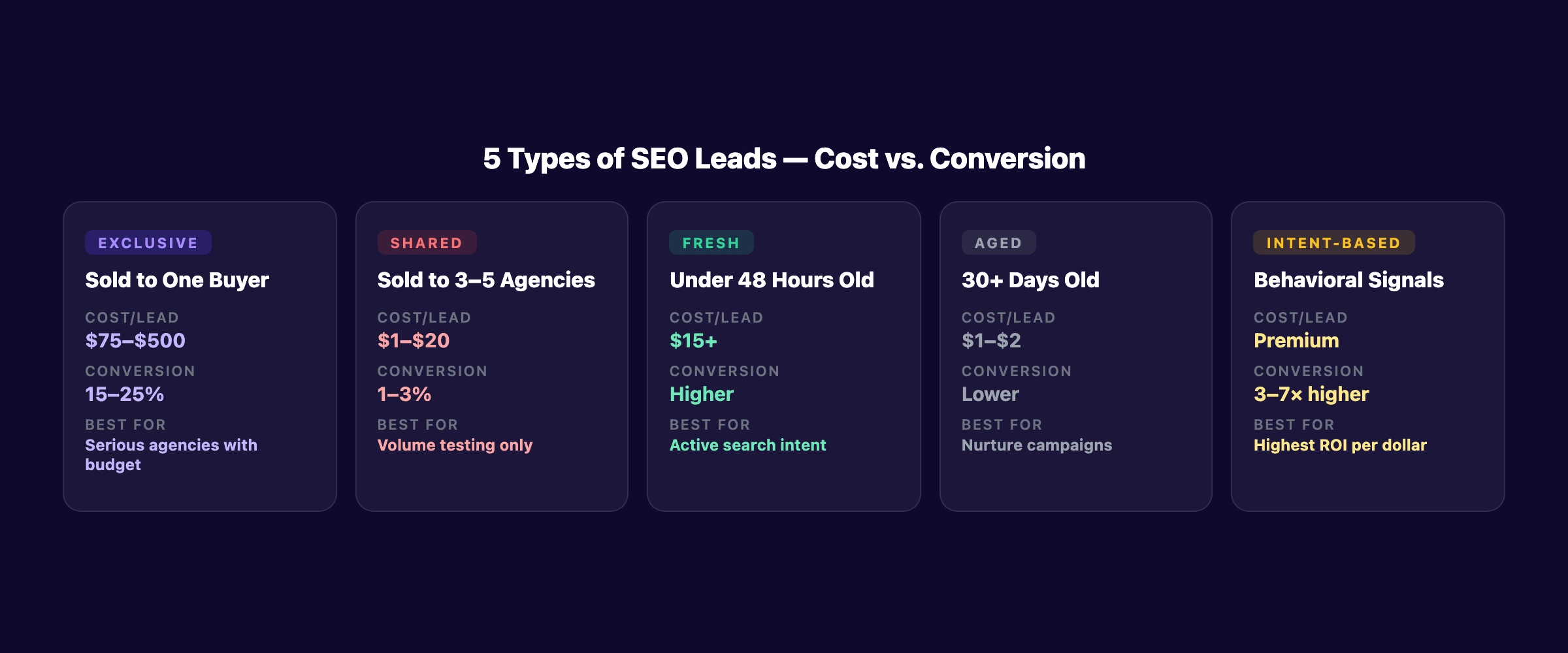
There are 5 types:
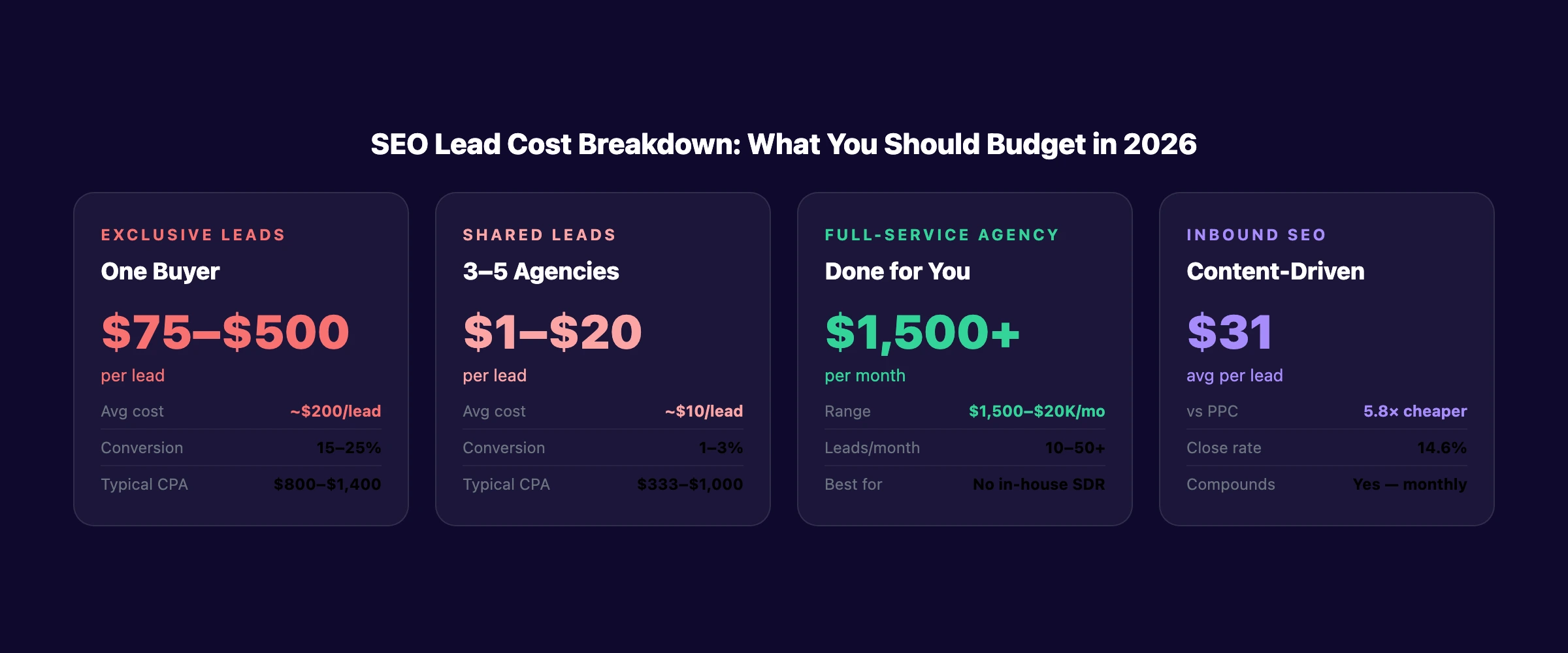
Exclusive leads are sold to only one buyer. A vendor collects contact data from a business actively searching for SEO services, then sells it to one agency only. Cost: $75-$500 per lead. Conversion rate: 15-25%.
Shared leads are sold to 3-5 agencies simultaneously. You compete with every other agency that bought the same record at the same time. Cost: $1-$20 per lead. Conversion rate: 1-3%.
Fresh leads are under 48 hours old. The contact is actively searching right now. These convert significantly better than aged data of the same supposed quality.
Aged leads are 30+ days old. The prospect may have already hired someone. These cost $1-$2 each and work for volume nurture campaigns, not for high-touch outreach.
Intent-based leads come with behavioral signals: this company visited 3 SEO agency websites this week, downloaded an SEO guide, and ran keyword searches about organic rankings. Platforms like ZoomInfo and Apollo surface this data. Intent leads convert 3-7× higher than generic cold contact lists.
The economics matter here. A $10 shared lead with a 2% conversion rate produces a $500 cost per acquisition. A $200 exclusive lead with a 20% conversion rate produces a $1,000 cost per acquisition. If your client is worth $3,000 per month, both are profitable. But the exclusive lead closes on far less sales effort.
Your team capacity determines which type fits. A 5-person sales team can work through shared volume. A 2-rep team should buy exclusive leads and work each contact thoroughly.
Why this step matters: Buying the wrong lead type does not just waste money. It wastes your team's time and can damage your sender reputation if contact rates are low.
Step 2: Define Your Ideal Lead Before You Spend
The most common mistake agencies make when buying leads: purchasing before defining what "good" looks like.
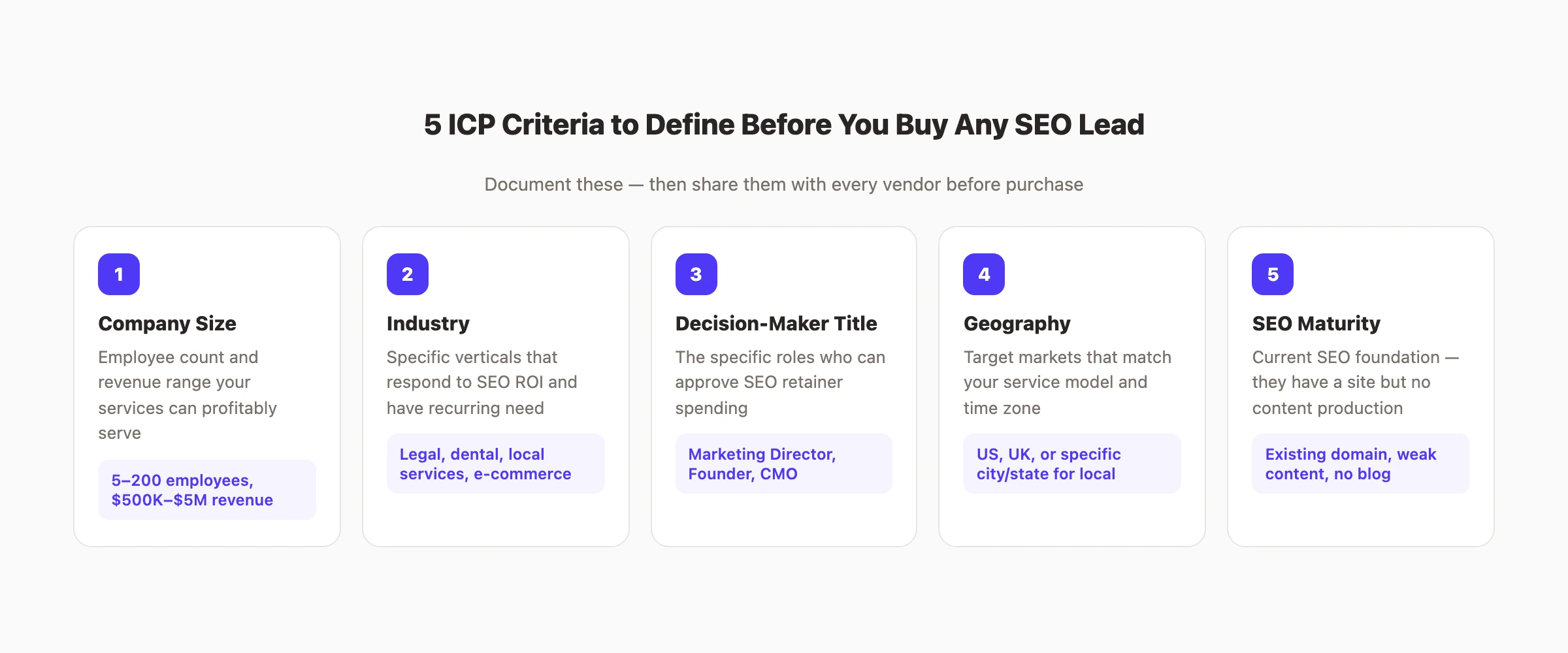
Lead vendors sell what they have. Your job is to match their inventory to your buyer persona. Document 5 criteria before any purchase:
1. Company size. What employee count and revenue range can actually afford and benefit from your SEO retainer? Most agencies do best with 5-200 employees and $500K-$5M in annual revenue. Below this, prospects cannot sustain consistent payments. Above this, they typically have in-house teams.
2. Industry. Niche agencies should only buy leads in their vertical. Generalist agencies should filter by industries with strong SEO ROI arguments: local service businesses, professional services, legal, dental, home services, e-commerce.
3. Decision-maker title. Marketing managers, digital marketing directors, and founders are the right contacts. IT directors and executive assistants cannot approve retainer spend.
4. Geography. If you sell locally, filter by city or state. If you operate remotely, filter by time zone and language to reduce friction in early calls.
5. SEO maturity. The ideal prospect has an existing domain, weak or nonexistent content, and no current SEO vendor. Companies with no website need remediation before content retainers. Companies mid-contract with a competitor are not good fits.
Write these criteria into a one-page ICP document. Share it with vendors before any purchase. If a vendor cannot filter to your criteria, they cannot help you.
Use lead scoring in your CRM to rank each contact against these 5 criteria automatically. Leads that match all 5 should trigger priority outreach within 60 minutes.
Why this step matters: A well-matched $300 exclusive lead costs less than a poorly matched $10 shared lead once you account for sales time, missed calls, and low close rates.
Step 3: Choose the Right Lead Source for Your Agency
Two models exist for buying SEO leads. The right one depends on whether you have in-house sales capacity.
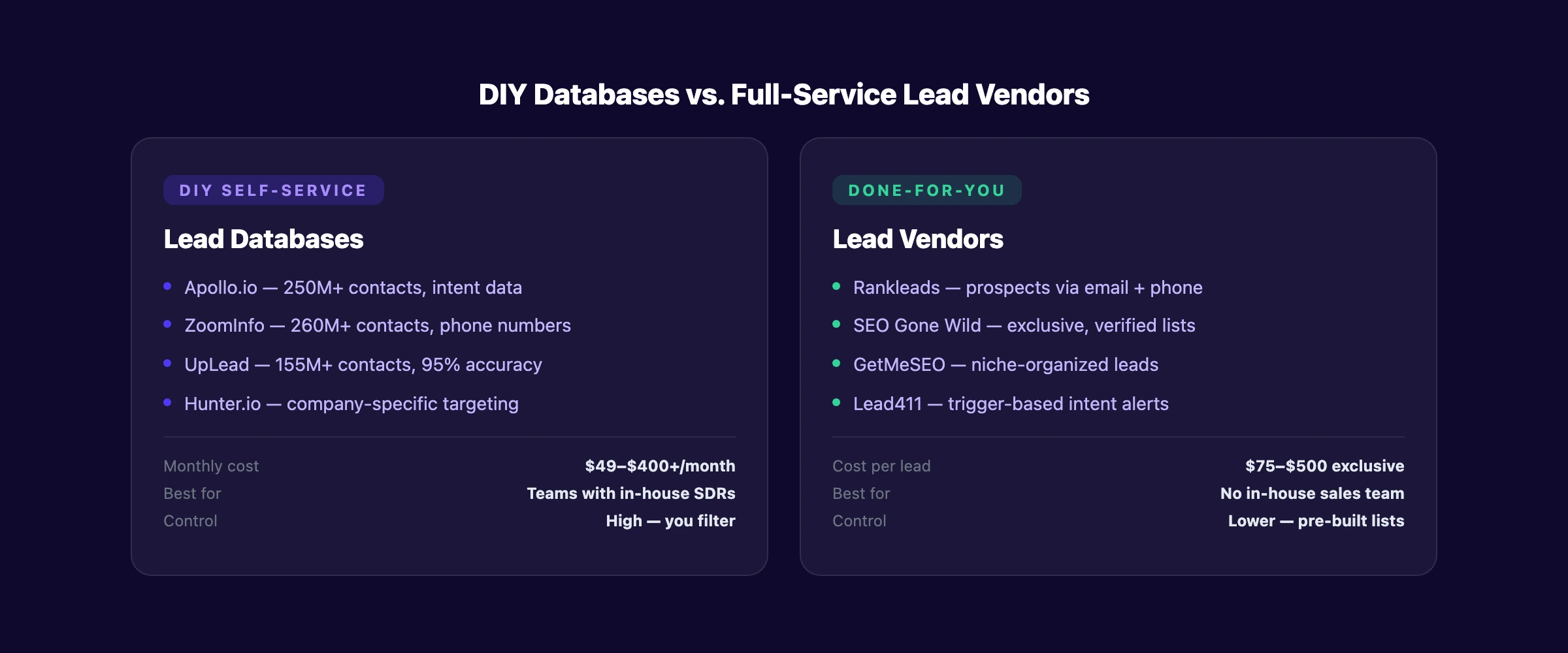
DIY Lead Databases
You build filtered lists using self-service platforms that let you search by industry, company size, job title, location, and intent signals.
| Platform | Database Size | Accuracy | Best For |
|---|---|---|---|
| Apollo.io | 250M+ contacts | 95%+ | Full-funnel prospecting with intent data |
| ZoomInfo | 260M+ contacts | High | Intent data + direct phone numbers |
| UpLead | 155M+ contacts | 95% guaranteed | Verified B2B emails, pay-per-contact |
| Hunter.io | Public web data | Good | Company-specific email targeting |
Monthly cost: $49-$400+ depending on export volume and features.
Best for: Agencies with an in-house SDR or sales rep who can do their own prospecting. You control what you search, how much you buy, and when you buy it.
Full-Service Lead Vendors
These companies sell pre-built lead lists or do prospecting on your behalf. You receive a CSV or CRM upload of contacts who have shown interest in SEO services.
Cost: $75-$500 per exclusive lead. Full-service retainers: $1,500-$20,000+ per month.
Best for: Agencies without a dedicated sales development function. You pay more per lead but skip the prospecting labor entirely.
The best SEO tools for agencies include platforms that combine lead prospecting with outreach automation. Worth reviewing before committing to a single tool.
Red flags regardless of model:
- No accuracy guarantee in writing
- Vendor refuses to provide sample leads before bulk purchase
- No verifiable reviews on G2, Capterra, or Trustpilot
- Data last verified more than 30 days ago
Why this step matters: Matching the wrong model to your team creates either wasted budget (overpaying for full-service when you have SDRs) or wasted time (building lists manually without capacity to work them).
Your SEO team. $99/month. theStacc publishes 30 SEO articles per month for your clients automatically. So when bought leads visit your site, they see content that already ranks.
Step 4: Vet Vendors and Request Samples Before Any Bulk Purchase
Never commit to a bulk package without testing first. Every vendor claims accuracy. Few deliver it consistently.
Run this vetting sequence before purchase:
1. Check independent reviews
Search "[vendor name] reviews" on Google. Check G2, Capterra, and Trustpilot specifically. Look for mentions of data accuracy, how the company handles bad records, and whether refunds are honored. Ratings below 4.0 on any major review platform signal problems.
2. Search Reddit and industry forums
"[Vendor name] site:reddit.com" pulls real user experiences the vendor cannot control. Search r/SEO, r/digital_marketing, and r/agency for threads about the vendor. Users discuss actual conversion rates, data quality issues, and customer service.
3. Request 10-20 sample leads
Ask for a small sample before any bulk commitment. Import them into your CRM. Verify email deliverability manually. Call 5 of them. If you cannot reach a single person in 5 calls, the database is stale. Do not buy.
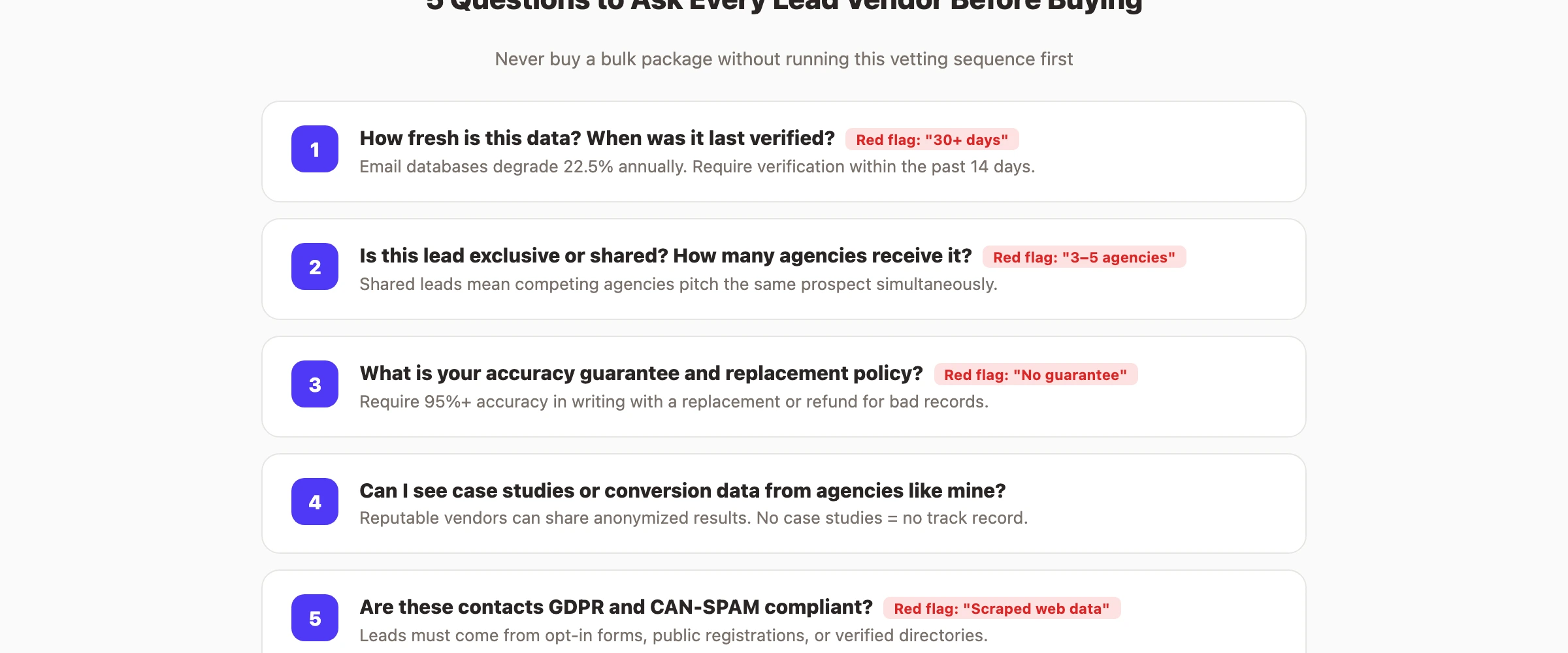
4. Ask these 5 specific questions:
- How fresh is this data and when was it last verified?
- Is this lead exclusive or shared. How many agencies receive it?
- What is your accuracy guarantee and refund policy for bad records?
- Can you share case studies or conversion data from agencies similar to mine?
- How were these contacts collected. Opt-in forms, public registrations, or web scraping?
5. Verify data compliance
Outreach using non-compliant contact data creates legal exposure. Email data must come from opt-in forms, public business registrations, or verified directories. Not scraped from websites without consent. Confirm GDPR and CAN-SPAM compliance in writing before purchasing any list.
According to UpLead's analysis of B2B data quality, poor data quality costs organizations $12.9 million annually on average per Gartner research. Email databases also degrade at 22.5% annually. A list from 6 months ago has lost nearly 1 in 8 valid contacts.
Why this step matters: One bulk purchase of bad data sets back your prospecting pipeline by weeks and wastes your sales team's outreach capacity on dead contacts.
Step 5: Build Your Follow-Up System Before You Spend
Most agencies buy leads without a follow-up system ready. Leads arrive. No one contacts them within the critical window. The opportunity closes.
Build this system before any purchase:
The 24-Hour Rule for Shared Leads
With shared leads, you compete with up to 4 other agencies who received the same contact. The agency that reaches the prospect first has the highest close rate. By 48 hours, that advantage is gone.
Your CRM must:
- Import new leads automatically on arrival
- Assign each lead to a rep within 60 minutes
- Send an automated intro email at the same time
- Schedule a follow-up call if no response within 24 hours
Phone calls convert 10-15× better than web clicks for this type of outreach. Call first, email second. Always.
The Nurture Sequence for Non-Ready Leads
Not every contact is ready to buy this month. Lead nurturing keeps you relevant until they are. Build a 6-touchpoint sequence over 3 weeks:
- Day 1: Introduction + one specific result you got for a similar business
- Day 3: One actionable tactic they can use this week (demonstrates expertise)
- Day 7: Case study or before/after result with real numbers
- Day 12: Obstacle-focused message ("The main thing holding [industry] businesses back from ranking is...")
- Day 17: Soft offer. Free audit or 30-minute strategy call
- Day 21: Final follow-up with easy opt-out
Personalize by industry. A dental practice owner responds to completely different messaging than a SaaS founder. Generic sequences waste leads you paid for.
Conversion-Optimized Messaging
Lead with a specific, verifiable result. "I helped a Chicago dental practice rank in the top 3 for emergency dentist keywords within 90 days" outperforms "Hi, I offer SEO services" by a wide margin. Your case studies are your best outreach asset. Learn how to write case studies that actually convert into effective outreach hooks.
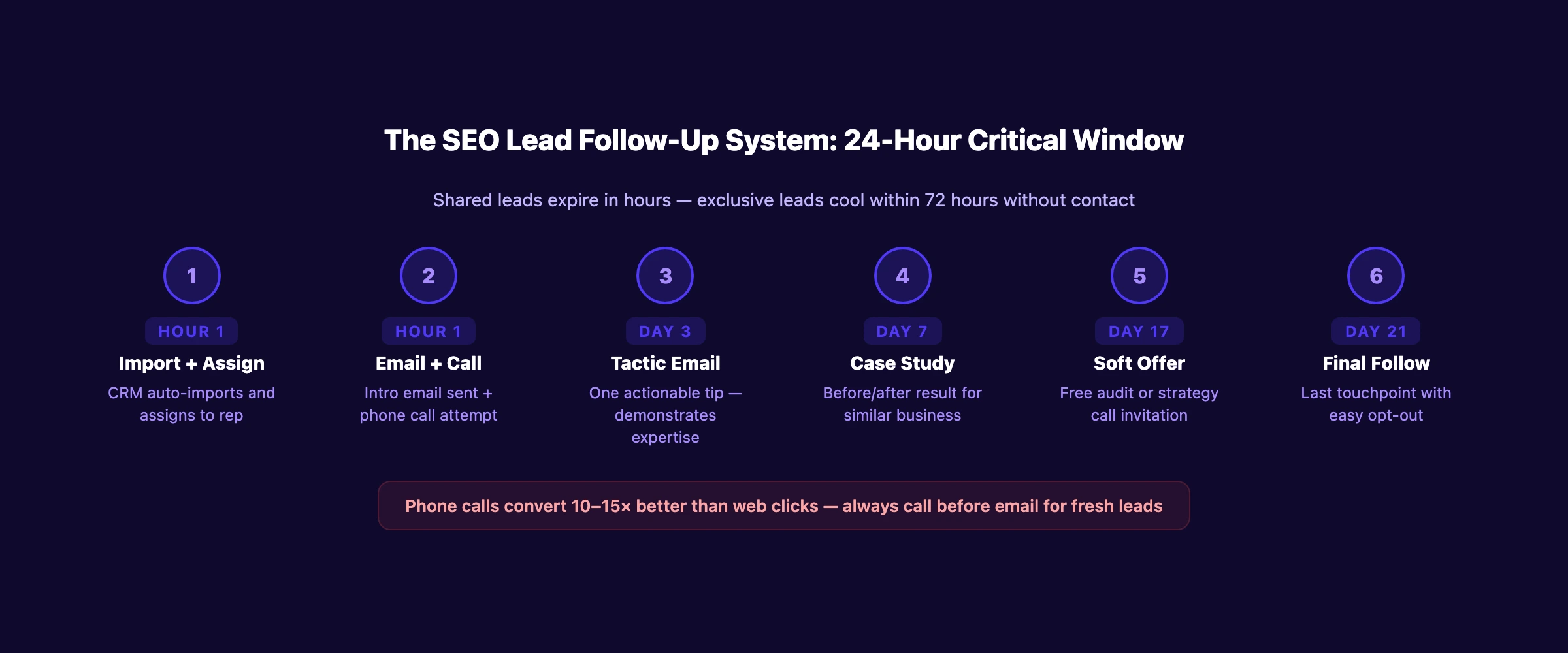
Why this step matters: Leads have a shelf life. Shared leads expire in hours. Even exclusive leads from warm prospects cool within 72 hours without contact. Build the system before you buy. Not after.
Step 6: Track ROI and Decide When to Stop Buying
Most agencies measure lead performance wrong. They track cost per lead and stop there. That metric does not tell you whether the economics work.
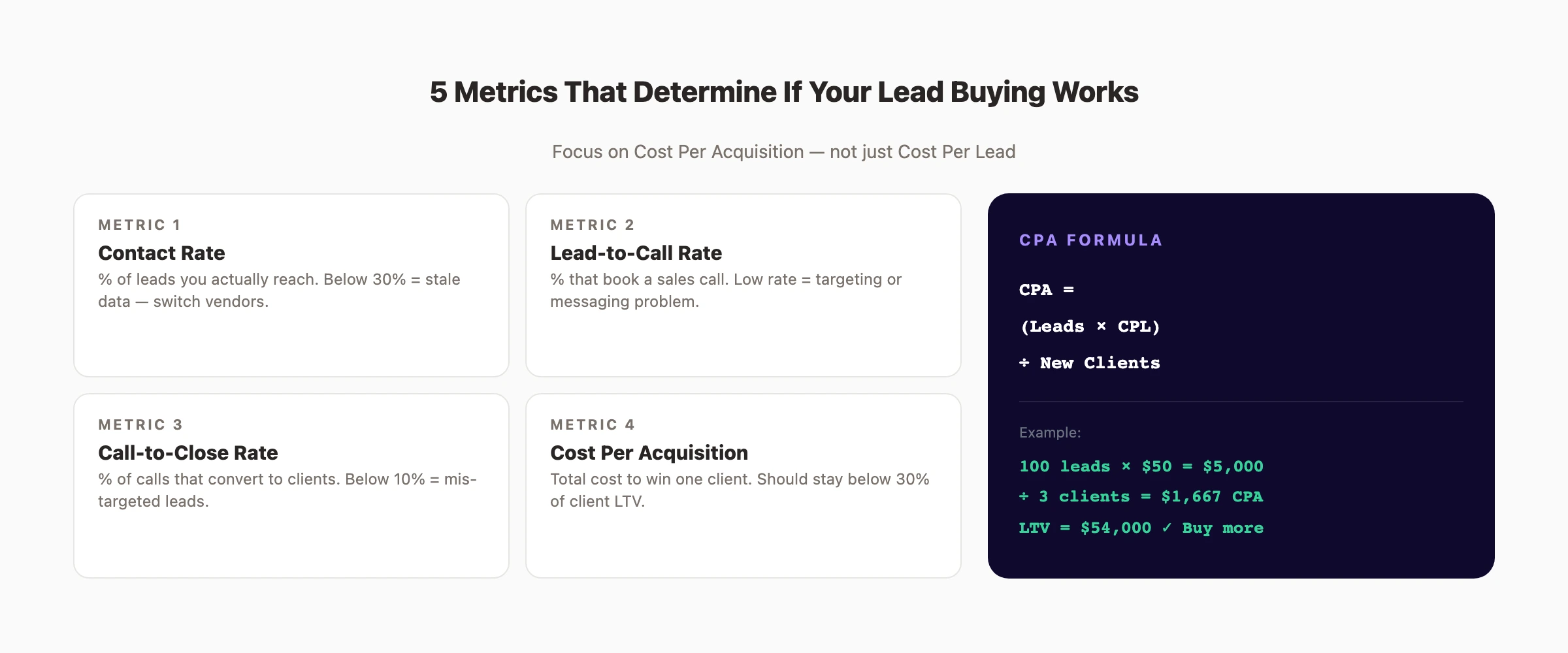
The metric that matters is cost per acquisition. The total cost to convert one prospect into a paying client.
Calculate it this way:
CPA = (Number of leads × Cost per lead) ÷ Number of new clients
Example: 100 leads at $50 each = $5,000 spent. You close 3 clients. CPA = $1,667.
If your average client pays $3,000/month and stays 18 months, lifetime value = $54,000. A $1,667 acquisition cost returns 32× investment. Buy more.
If your average client pays $1,000/month and stays 4 months, lifetime value = $4,000. The same CPA returns 2.4×. The economics are tight. Optimize before scaling.
5 Metrics to Track After Every 50-100 Leads:
| Metric | Target | Red Flag |
|---|---|---|
| Contact rate | 30%+ | Below 30% = stale data |
| Lead-to-call rate | 10%+ | Below 10% = messaging problem |
| Call-to-close rate | 10%+ | Below 10% = lead mismatch |
| Cost per acquisition | Under 30% of LTV | Approaching or exceeding 50% |
| CPA vs. LTV ratio | 5:1 or higher | Below 3:1. Pause buying |
Run this analysis after every 50-100 leads. If contact rate falls below 30%, switch vendors. The data is stale. If call-to-close is below 10%, revisit your ICP criteria. If CPA exceeds 50% of LTV, either increase prices or stop buying until the process improves.
When to Shift Budget to Inbound
Bought leads build a fast pipeline. They do not compound. According to First Page Sage's 2026 conversion benchmarks, inbound SEO leads cost approximately $31 per lead versus $75-$500 for exclusive bought leads. While closing at the same 14-15% rate.
Once your inbound content generates 10+ qualified leads per month, shift bought lead spend toward content. The conversion funnel for organic leads improves every month. Bought leads stay flat.
Read our SEO for lead generation guide for building the inbound side alongside your paid pipeline.
Why this step matters: Without consistent tracking, you cannot identify what is working. You scale failures and cut what should be expanded.
Rank everywhere. Do nothing. theStacc publishes SEO articles for your clients automatically. So your leads see a site that already ranks. $99/month per client. Free trial.
Results: What to Expect
After setting up this system correctly:
- Week 1-2: ICP documented, vendor vetted, sample leads reviewed, follow-up sequence built
- Week 3-4: First lead package purchased, CRM workflows activated, first outreach sent
- Month 2: Initial conversion data visible. Contact rates, response rates, first calls booked
- Month 3: CPA calculable; vendor performance clear; lead type optimization possible
- Month 3+: Decision point. Scale buying, switch vendors, or shift budget toward inbound
Expect 15-25% of exclusive leads to convert to a sales call. Expect 1-3% for shared leads. Expect 5-10 contact attempts before any lead makes a decision. Expect the system to take 60-90 days to produce reliable data for optimization.
What practitioners are saying on X
AI search advice ages quickly. Here is high-signal public discussion from SEO and growth operators — context for your roadmap, not a substitute for primary data.
- @hridoyreh (Mar 2026): Widely shared SEO skill tree: foundations, research, technical, on-page, content, links, AI SEO/GEO, analytics, UX, brand, programmatic — useful map for stats and how-to posts. See the post on X.
- @jakezward (Feb 2026): 2026 SEO predictions emphasize AI Overview share-of-SERP, schema for LLM token efficiency, brand mentions in AI answers as a KPI, proprietary data as a moat, and content refresh beating net-new AI slop. See the post on X.
Grok, AI Overviews, and multi-engine visibility
For “how to buy seo leads”, multi-engine visibility still starts with clear definitions, sourced numbers, and extractable section answers. Grok additionally factors live X discussion — keep public claims consistent with this page.
- Google AI Overviews: Use passage-ready answers, tables, and FAQ schema where relevant.
- ChatGPT / Perplexity: Cite named sources next to key claims.
- Grok: Maintain accurate entity facts on-site and in high-signal X posts.
Publish content built for Google and AI citations. theStacc’s Content SEO module ships SEO-scored articles structured for rankings and generative engines — including clearer entity pages models like Grok can quote.
FAQ
Exclusive leads (sold to one buyer) cost $75-$500 each, averaging around $200. Shared leads (sold to 3-5 agencies) cost $1-$20 each. Full-service agencies that source leads on your behalf charge $1,500-$20,000+ per month depending on volume and exclusivity. DIY database platforms like Apollo and ZoomInfo run $49-$400 per month for filtered exports.
Exclusive leads convert at 15-25% to a sales conversation. Shared leads convert at 1-3%. Intent-based leads. Where the prospect showed active research behavior. Convert 3-7× higher than generic cold contact data. According to First Page Sage's 2026 conversion data, inbound SEO leads close at 14.6%, making that the long-term benchmark to work toward.
Yes, in specific situations: when you need fast pipeline velocity, when inbound content has not yet scaled, or when you have a sales team with capacity for proper follow-up. Buying leads is not worth it if your close rate is consistently low (fix your sales process first), your ICP is unclear, or you do not have a CRM and follow-up system ready. The economics only work when CPA stays below 20-30% of client lifetime value.
For shared leads: within 1-2 hours of receiving the contact. You are competing with other agencies. For exclusive leads: within 24 hours. Research shows phone calls convert 10-15× better than web clicks for initial lead contact. Call first, email second.
Once inbound content generates 10+ qualified leads per month consistently, shift budget away from bought leads and invest in more content. Inbound SEO leads cost ~$31 per lead versus $75-$500 for bought exclusive leads. And compound every month. theStacc automates that inbound content at $99/month, giving agencies a way to build the organic pipeline without adding a writing team.
Now you have the 6-step system for buying SEO leads that actually convert. From choosing the right type to tracking the ROI that tells you when to stop.
Bought leads get you in the room fast. Content keeps the pipeline full for free. Build both in parallel, and the second eventually replaces the first.
Related Tools & Resources
Free SEO Tools:
Best Lists:
Sources & references
- [1] Princeton / Georgia Tech et al. — GEO research (arXiv:2311.09735)
- [2] @hridoyreh on X — Widely shared SEO skill tree: foundations, research, technical, on-page, content, links, AI SEO/GEO, analytics, UX, bran
- [3] @jakezward on X — 2026 SEO predictions emphasize AI Overview share-of-SERP, schema for LLM token efficiency, brand mentions in AI answers
- [4] Referenced source — www.uplead.com

Researched, written, and published articles that compound organic traffic.
Weekly local SEO teardowns
One practical email a week. Map Pack, GBP, AI Overviews — no fluff. Unsubscribe anytime.