
Buyer Persona SEO (2026): Strategies, Tactics & Examples
Practical buyer persona seo strategies for 2026: step-by-step tactics, real examples, and tools to improve rankings and drive organic traffic.
You publish 20 blog posts per month. Traffic grows. But the wrong people keep showing up. Visitors bounce. Leads do not convert. Sales complains the pipeline is full of tire-kickers.
The problem is not your content volume. The problem is that your buyer persona SEO strategy does not exist. You are writing for keywords, not for people.
Companies with documented personas are 71% more likely to exceed revenue goals, according to Cintell research. Thomson Reuters saw a 175% increase in marketing-attributed revenue after building persona-driven content, per a DemandGen Report study. The data is clear: personas make SEO profitable.
We have published 3,500+ blog posts across 70+ industries. The posts that convert best are not the ones targeting the highest-volume keywords. They are the ones built around a specific person with a specific problem at a specific stage in their buyer journey.
Here is what you will learn:
- How to build a buyer persona specifically for SEO (not generic marketing personas)
- The exact workflow for mapping personas to keywords and search intent
- How to create content strategies for each persona at every funnel stage
- Why negative personas save you from wasting content budget
- How to measure whether persona-driven SEO is working
What a Buyer Persona Is (And What It Is Not)
A buyer persona is a research-based profile of a specific segment of your audience. It describes who they are, what they need, how they search, and what blocks them from buying.
It is not a demographic snapshot. “Female, 35-45, $80K income, lives in suburbs” tells you nothing about search behavior. That persona visits Google just like everyone else. The useful question is: what does she type into the search bar?
Marketing Personas vs. SEO Personas
Traditional marketing personas focus on demographics, psychographics, and buying motivations. SEO personas add a critical layer: search behavior.
| Element | Marketing Persona | SEO Persona |
|---|---|---|
| Demographics | Age, income, location | Same |
| Pain points | Business challenges | Same, but phrased as search queries |
| Goals | Desired outcomes | Same, but mapped to keyword intent |
| Search behavior | Not included | Keywords, queries, SERP expectations |
| Content preferences | Channel preferences | Content format preferences (video, guide, list) |
| Objections | Sales objections | Comparison queries, “vs” and “alternative” searches |
An SEO persona answers one question a marketing persona does not: how does this person search for answers?
The Minimum Viable Persona
You do not need a 10-page persona document. You need five data points:
- Role or situation. Who are they? (e.g., “Marketing manager at a 50-person SaaS company”)
- Primary pain point. What keeps them stuck? (e.g., “Cannot produce enough content to rank”)
- Search behavior. How do they phrase their problem? (e.g., “how to scale blog content”)
- Decision stage. Are they researching, comparing, or ready to buy?
- Content format preference. Do they want guides, tools, lists, or case studies?
Five data points. That is enough to inform every keyword you target and every article you write.
Why Buyer Personas Matter for SEO
Generic keyword research produces generic traffic. Persona-driven keyword research produces qualified traffic that converts.
The Traffic-That-Converts Problem
Most SEO programs optimize for volume. More keywords. More pages. More traffic. But traffic without intent alignment is just server load.
A B2B SaaS company ranking for “what is CRM” gets massive traffic. The problem? 90% of those visitors are students writing papers, not software buyers. The keyword has volume. It does not have buyer intent.
Personas fix this by filtering keywords through a buyer lens before you create content. Every keyword gets tested: “Would Persona A search this? At what stage? With what expectation?”
How Personas Improve Every SEO Metric
| Metric | Without Personas | With Personas |
|---|---|---|
| Organic traffic quality | High volume, low relevance | Lower volume, high relevance |
| Bounce rate | 65-80% | 35-55% |
| Pages per session | 1.2-1.5 | 2.5-4.0 |
| Conversion rate | 0.5-1.5% | 2.5-5.0% |
| Content ROI | Negative for 6+ months | Positive in 3-4 months |
Persona-based content increases cold lead engagement by 6 times, according to research from THM. That multiplier compounds with every article you publish.
The connection between personas and content marketing ROI is direct. You spend less time creating content nobody wants. You spend more time ranking for queries that lead to revenue.
Stop writing for nobody. Stacc publishes 30 SEO articles per month, each targeted to your actual buyers. Start for $1 →
How to Build an SEO-Focused Buyer Persona
Building a persona for SEO requires different inputs than building one for sales or advertising. Search data tells you what people actually do, not what they say they do.
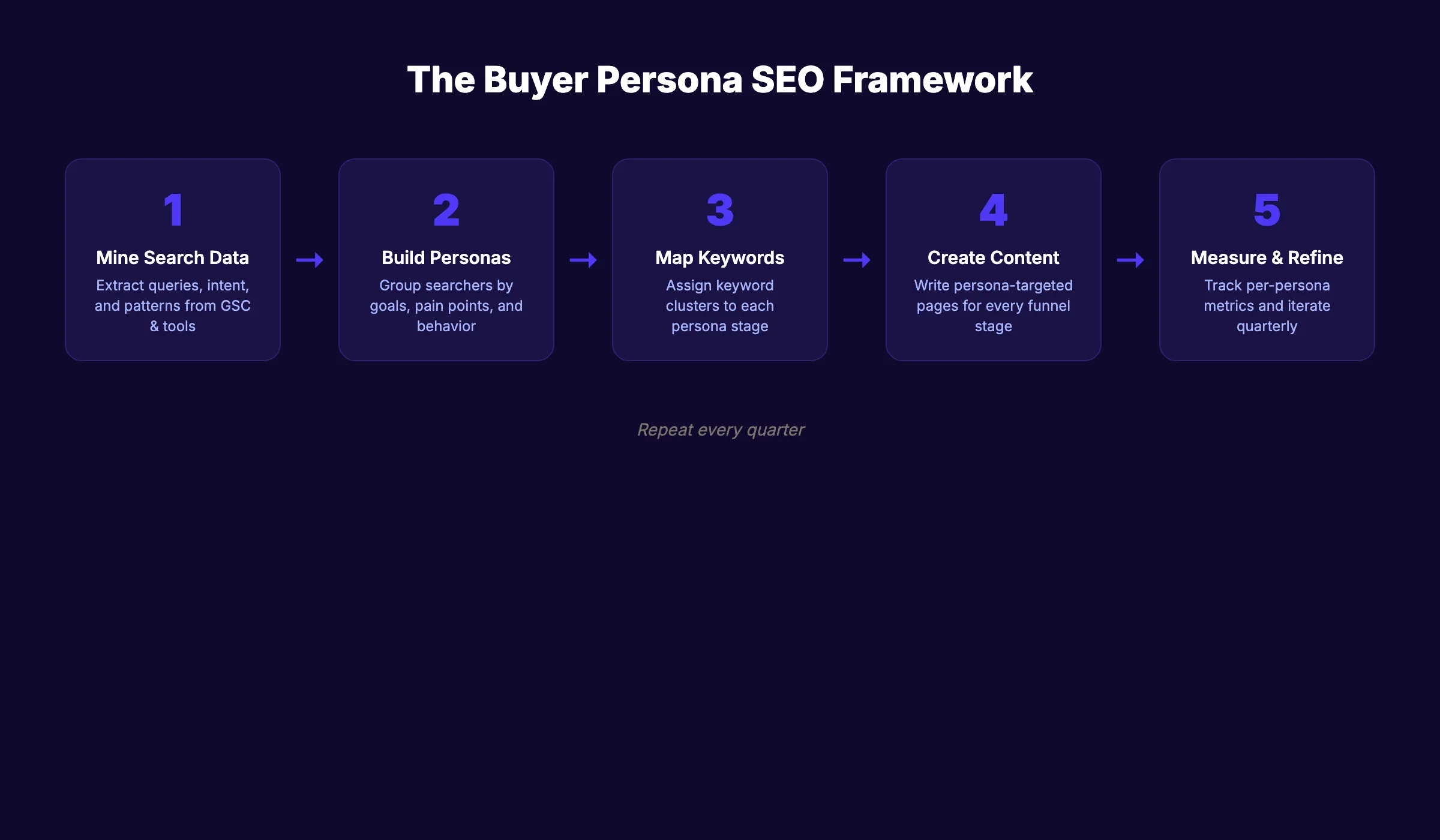
Step 1: Mine Your Existing Search Data
Start with Google Search Console. Export 12 months of query data. Sort by clicks, not impressions. Group the queries by theme.
Patterns will emerge. Some queries are technical (“how to fix crawl errors”). Some are evaluative (“best SEO tools for small business”). Some are transactional (“SEO service pricing”). Each pattern represents a different persona or a different stage.
Step 2: Analyze Your Converting Traffic
In Google Analytics 4, identify which landing pages drive conversions. Then trace backward:
- What keywords brought visitors to those pages?
- What other pages did they visit before converting?
- How long was the path from first visit to conversion?
This reveals which search behaviors lead to revenue. A persona built on converting traffic is worth 10 personas built on assumptions.
Step 3: Research How Your Audience Searches
Go beyond your own data. Research how your target audience discusses their problems:
- Reddit and forums. Search “[your industry] + problem” on Reddit. Note the exact language people use. These phrases become long-tail keyword targets.
- Sales call notes. Ask your sales team: “What questions do prospects ask in the first 5 minutes?” Those questions map directly to informational keywords.
- Customer support tickets. Common support questions reveal gaps in your content that personas would have flagged.
- Competitor reviews. Read 1-star reviews of competitors on G2 or Capterra. The complaints reveal unmet needs you can target.
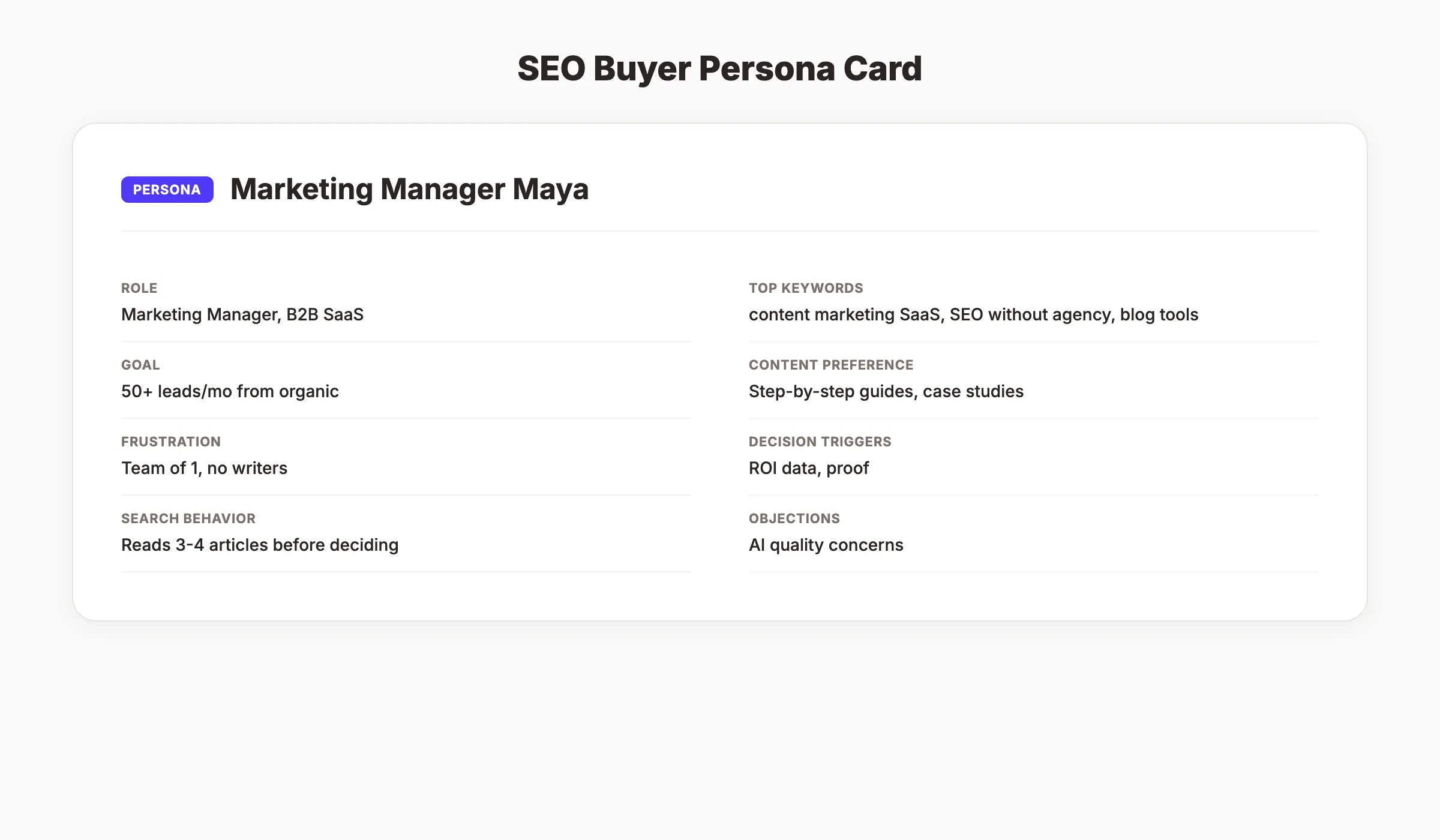
Step 4: Build the Persona Card
Compile your research into a single-page card:
| Field | Example: “Marketing Manager Maya” |
|---|---|
| Role | Marketing manager, B2B SaaS, 30-150 employees |
| Primary goal | Generate 50+ qualified leads per month from organic |
| Core frustration | Team of 1. No writers. No budget for agency ($3K+/mo) |
| Search behavior | Googles “how to” queries first. Reads 3-4 articles before deciding. Prefers guides over lists. |
| Keyword themes | ”content marketing for SaaS”, “SEO without an agency”, “blog writing tools” |
| Decision triggers | Sees ROI data. Needs proof it works for companies her size. |
| Content format preference | Step-by-step guides, case studies, tool comparisons |
| Objections | ”AI content does not rank.” “Automation means low quality.” |
Build 2-4 personas maximum. More than that creates overlap and analysis paralysis. For most businesses, 3 personas cover 80% of the target market.
How to Map Personas to Keywords
This is where buyer persona SEO becomes operational. Every keyword in your pipeline should map to a specific persona at a specific buyer journey stage.
The Persona-Keyword Matrix
Create a spreadsheet with these columns:
| Keyword | Persona | Journey Stage | Search Intent | Content Format | Priority |
|---|---|---|---|---|---|
| ”how to scale blog content” | Marketing Maya | Awareness | Informational | Guide | High |
| ”best AI blog writing tools” | Marketing Maya | Consideration | Commercial | Best-list | High |
| ”stacc vs surfer seo” | Marketing Maya | Decision | Transactional | Comparison | Medium |
| ”SEO for dentists” | Small Biz Sam | Awareness | Informational | Industry guide | High |
| ”local SEO service pricing” | Small Biz Sam | Decision | Transactional | Pricing page | High |
Mapping Search Intent to Persona Stage
Search intent and persona stage are connected but not identical. Here is how they align:
| Persona Stage | Typical Search Intent | Keyword Signals |
|---|---|---|
| Unaware | Informational | ”what is”, “why does”, “how to understand” |
| Problem-aware | Informational | ”how to fix”, “why is my”, “[problem] guide” |
| Solution-aware | Commercial | ”best [solution]”, “[solution] tools”, “ways to” |
| Product-aware | Commercial/Transactional | ”[brand] review”, “[brand] vs [brand]”, “[brand] pricing” |
| Ready to buy | Transactional | ”[brand] trial”, “[brand] signup”, “buy [product]” |
Map every keyword in your pipeline to one cell in this matrix. If a keyword does not fit any persona, it does not belong in your content plan.
Prioritizing Keywords by Persona Value
Not all personas are equal. Prioritize keywords based on persona revenue potential:
- High-value personas first. If Persona A has a $5,000 lifetime value and Persona B has a $500 lifetime value, Persona A keywords get priority.
- Decision-stage keywords first. Bottom-of-funnel keywords convert faster. Build those pages before top-of-funnel guides.
- Low-competition gaps second. Use competitor keyword analysis to find high-intent keywords competitors rank for but you do not.
This prioritization prevents the most common SEO mistake: spending months ranking for awareness keywords while decision-stage queries go untargeted.
Your SEO team. $99 per month. 30 optimized articles matched to your buyer personas. Published automatically. Start for $1 →
Content Strategy by Persona Stage
Each persona at each stage needs different content. Publishing the wrong format for the wrong stage wastes the article.
Awareness Stage Content
The persona knows they have a problem but does not know the solution exists.
Best formats: Ultimate guides, “what is” explainers, statistic roundups, problem-focused articles.
Example: Marketing Maya searches “why is my blog not getting traffic.” She does not know she needs an SEO strategy yet. The article educates her on the problem and introduces content SEO as the answer.
Link to your content cluster hub pages from awareness content. These visitors need a path deeper into your site.
Consideration Stage Content
The persona knows the solution category and is evaluating options.
Best formats: Comparison pages, best-of lists, feature breakdowns, case studies, how-to guides.
Example: Marketing Maya now searches “best blog writing tools for small teams.” She knows she needs a tool or service. She is comparing 5-10 options. Your content must position your product against alternatives with honest, specific comparisons.
Decision Stage Content
The persona is ready to choose. They need final proof and a clear path to purchase.
Best formats: Reviews, pricing comparisons, trial pages, demo videos, customer stories.
Example: Marketing Maya searches “Stacc review” or “Stacc vs Surfer SEO.” She has narrowed her options. Your content removes the last objections and makes the next step obvious.
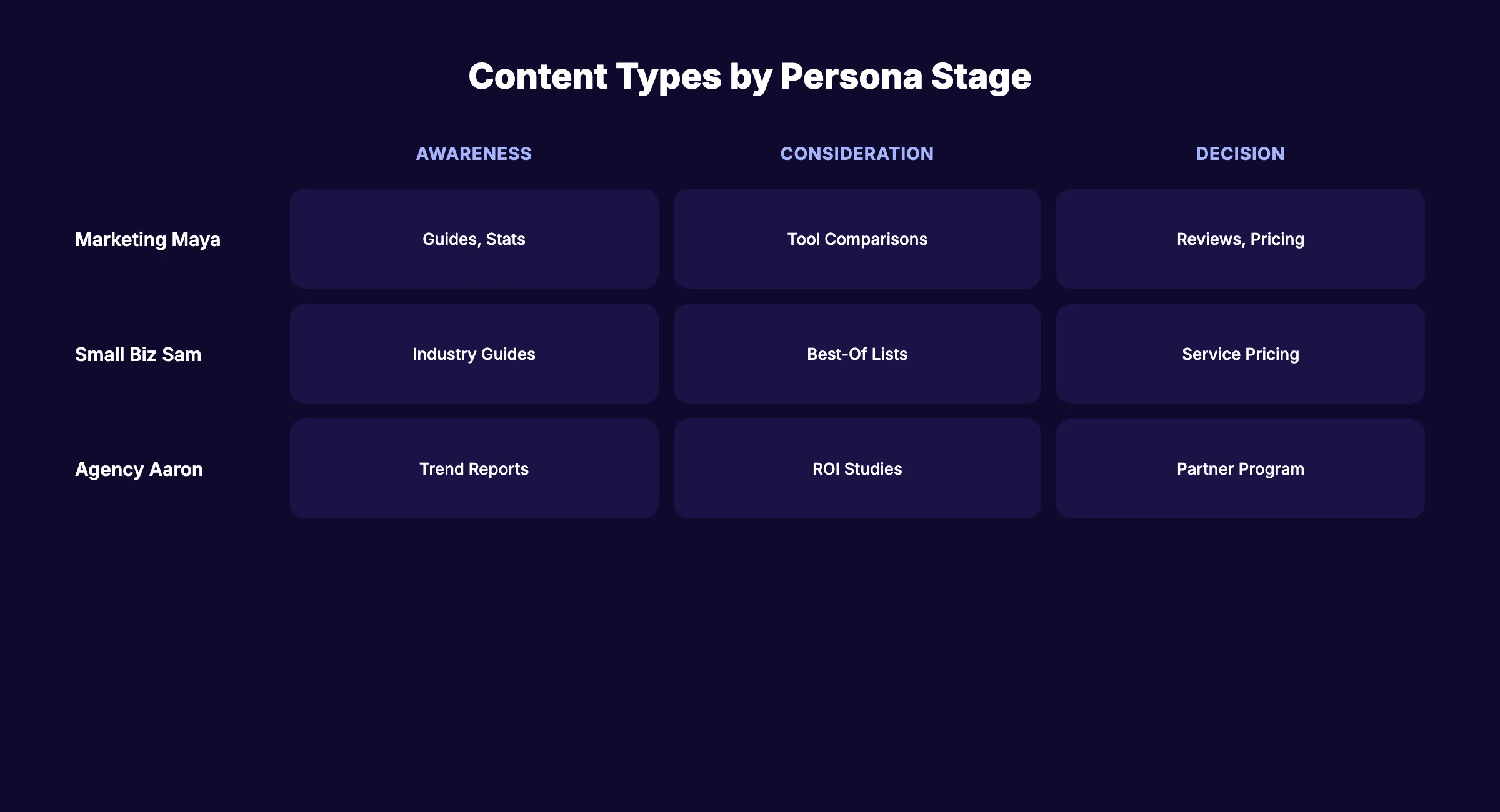
Content Format Matrix by Persona and Stage
| Awareness | Consideration | Decision | |
|---|---|---|---|
| Marketing Maya | Ultimate guides, stats pages | Tool comparisons, case studies | Reviews, pricing, trial |
| Small Biz Sam | Industry SEO guides | ”Best tools for” lists | Service pricing, demos |
| Agency Aaron | White-label guides, trend reports | Feature comparisons, ROI studies | Partner program, volume pricing |
Build your content calendar around this matrix. Assign each planned article to a persona and stage before writing the content brief.
The Negative Persona: Who to Exclude
Most persona guides skip this. That is a mistake. Knowing who to exclude from your content strategy saves as much budget as knowing who to include.
What a Negative Persona Is
A negative persona is a profile of someone who will never buy from you. They consume your content, inflate your traffic metrics, and waste your sales team’s time.
Common negative persona examples:
- Students researching for assignments (high traffic, zero revenue potential)
- Enterprise buyers for a product that only serves SMBs (wrong tier)
- DIY hobbyists for a done-for-you service (wrong buying behavior)
- Competitors studying your content strategy (they are not buying)
How Negative Personas Improve SEO Targeting
When you identify a negative persona, you can filter out their keywords:
| Keyword | Volume | Negative Persona Match | Action |
|---|---|---|---|
| ”what is SEO” | 110,000 | Students (80%+ of searchers) | Skip |
| ”free SEO tools no signup” | 8,100 | DIY hobbyists (will never pay) | Skip |
| ”enterprise SEO platform” | 2,400 | Enterprise (wrong tier for SMB product) | Skip |
| ”SEO service for dentists” | 720 | None | Target |
Skipping high-volume keywords that attract negative personas feels counterintuitive. But those keywords generate traffic that hurts your conversion rate, inflates your customer acquisition cost, and misleads your reporting.
Building a Negative Persona
Review your CRM data for leads that never converted. Look for patterns:
- Which keywords brought them in?
- What pages did they visit?
- At which stage did they drop off?
- What was their stated reason for not buying?
Document these patterns into a negative persona card. Then audit your keyword pipeline against it quarterly.
Measuring Persona-Driven SEO Performance
If you cannot measure it, you cannot improve it. Persona-driven SEO needs its own set of KPIs, separate from generic SEO metrics.
KPIs by Persona
Track these metrics for each persona separately:
| KPI | What It Measures | Target |
|---|---|---|
| Organic traffic by persona segment | Are we reaching the right people? | Growing month over month |
| Conversion rate by persona | Does persona content convert? | 2-5% for qualified personas |
| Pipeline value by persona | Which persona drives revenue? | Increasing quarter over quarter |
| Content coverage by persona | Are all stages covered? | 80%+ of persona-stage matrix filled |
| Keyword rankings by persona | Are we visible for persona queries? | 70%+ of target keywords in top 20 |
How to Segment Traffic by Persona
GA4 does not have a “persona” dimension. You need to create it:
- Tag content by persona in your CMS. Add a custom field to every blog post identifying the target persona.
- Create GA4 content groups based on URL patterns or page tags.
- Build persona segments using landing page groups as the filter.
For example, all articles tagged “Marketing Maya” become a segment. Track that segment’s traffic, engagement, and conversions separately from articles tagged “Small Biz Sam.”
The Persona Coverage Audit
Every quarter, audit your content library against your persona-keyword matrix:
- Every persona has at least 5 articles targeting awareness-stage keywords
- Every persona has at least 3 articles targeting consideration-stage keywords
- Every persona has at least 2 articles targeting decision-stage keywords
- No persona has more than 60% of content at a single stage
- Content gaps are documented and prioritized for next quarter
Run this audit alongside your regular content audit. The combination reveals both quality issues and persona coverage gaps.
Use content scoring to evaluate whether persona-targeted articles outperform generic ones. In our experience, they do. By a wide margin.
3,500+ blogs published. 92% average SEO score. See what Stacc can do for your site. Start for $1 →
Buyer Persona SEO Mistakes to Avoid
Eight years of publishing persona-driven content across 70+ industries. These are the mistakes we see most often.
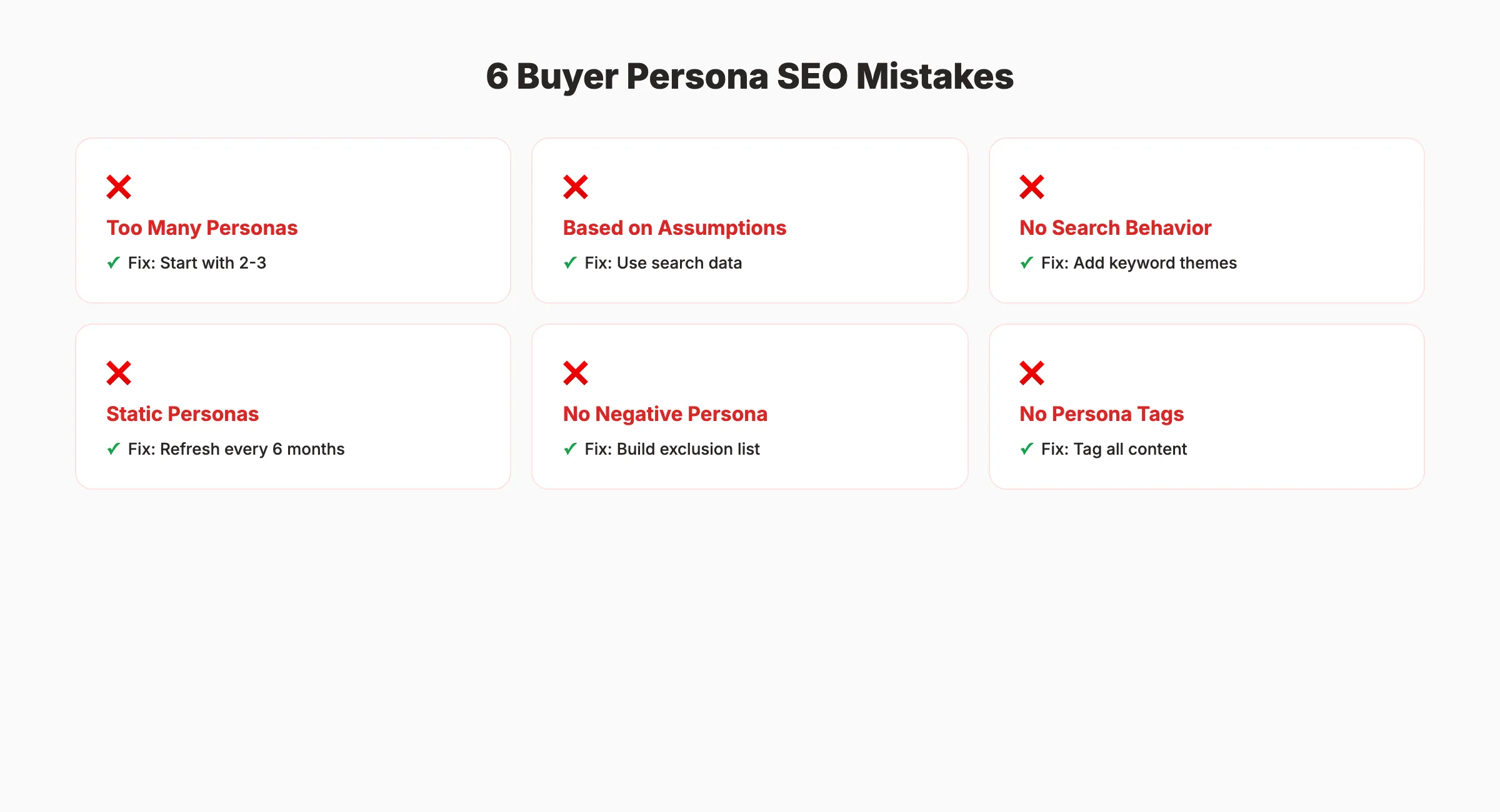
Mistake 1: Too Many Personas
Teams create 8-12 personas and spread content across all of them. The result is 2-3 thin articles per persona instead of 15-20 deep articles for 3 focused personas.
Fix: Start with 2-3 personas. Add a new persona only when the existing ones are fully covered at all funnel stages.
Mistake 2: Personas Based on Assumptions
Marketing teams build personas in a conference room without data. They guess at search behavior instead of mining Google Search Console, sales calls, and customer support tickets.
Fix: Every persona field should cite a data source. “We assume” is not a valid source.
Mistake 3: Ignoring Search Behavior
The persona card includes demographics, goals, and challenges but says nothing about how the person searches. Without search behavior data, the persona cannot inform SEO.
Fix: Add these fields to every persona: top 10 keywords, preferred content format, typical search journey (awareness → decision queries).
Mistake 4: Static Personas
Personas built in 2023 do not reflect 2026 search behavior. AI search, voice queries, and changing SERP formats shift how personas search.
Fix: Refresh personas every 6 months. Re-pull Search Console data. Re-interview sales. Update keyword themes.
Mistake 5: No Negative Persona
Without a negative persona, teams target every high-volume keyword and wonder why conversion rates stay below 1%.
Fix: Build at least 1 negative persona. Audit your keyword pipeline against it. Remove keywords that primarily attract non-buyers.
Mistake 6: Content Without Persona Tags
Every article in your library should be tagged with its target persona and funnel stage. Without tags, you cannot measure persona performance or identify coverage gaps.
Fix: Add persona and stage tags to your CMS. Backfill existing content. Make it a required field for all content briefs.
Buyer Personas and AI Search
AI search engines like Google AI Overviews, ChatGPT, and Perplexity change how personas interact with content. Your persona framework needs to account for this shift.
How AI Changes Persona Search Behavior
AI search provides direct answers. Awareness-stage queries that used to drive clicks to your site now get answered in the AI response. The persona still has the question. They just do not click through to your page.
This makes middle-funnel and bottom-funnel persona content more valuable. Consideration and decision queries still drive clicks because AI cannot make the buying decision for the user.
Optimizing Persona Content for AI Citability
AI models cite content that provides clear, specific, data-backed answers. For each persona-targeted article:
- Include specific numbers and statistics (AI models prefer quantified claims)
- Structure answers in Q&A format for featured snippet and AI citation potential
- Add original data or analysis that AI models cannot generate independently
Build topical authority around each persona’s topic cluster. AI models favor authoritative sources. A topical map organized by persona ensures deep coverage that signals expertise.
FAQ
What is a buyer persona in SEO?
A buyer persona in SEO is a research-based profile of your ideal customer that includes their search behavior, keyword patterns, content preferences, and decision journey. It goes beyond demographics to describe how a person uses search engines when researching, evaluating, and purchasing.
How many buyer personas should I create for SEO?
Start with 2-3 personas. Most businesses can cover 80% of their target market with 3 well-researched personas. Adding more creates content sprawl without proportional returns. Only add a 4th or 5th persona when the first 3 have full content coverage at all funnel stages.
How do buyer personas improve keyword research?
Personas act as a filter for keyword research. Instead of targeting every relevant keyword by volume, you evaluate each keyword against a specific persona: “Would this person search this? At what stage? Would they convert?” This filters out low-intent keywords that generate traffic but not revenue.
What is the difference between a buyer persona and an ICP?
An ideal customer profile describes the type of company that is a good fit (industry, size, revenue, tech stack). A buyer persona describes the specific person within that company who makes or influences the buying decision. ICPs filter accounts. Personas filter keywords and content.
How often should I update my SEO buyer personas?
Every 6 months at minimum. Search behavior shifts with new technologies (AI search, voice), seasonal patterns, and market changes. Re-pull your Search Console data, review sales call recordings, and update keyword themes. Personas built on 2-year-old data target 2-year-old search behavior.
Can Stacc create content for specific buyer personas?
Yes. During onboarding, we map your target personas, keyword themes, and funnel stages. Every article Stacc publishes targets a specific persona at a specific stage, with keywords selected from your persona-keyword matrix. The result is organic traffic that converts, not just visits.
Buyer persona SEO is not a one-time exercise. It is an operating system for your content program. Build the personas, map the keywords, fill the content matrix, measure the results, and refine every quarter. The teams that do this work outperform the teams that target keywords at random. Every time.
Related Tools & Resources
Free SEO Tools:
Best Lists:

Written by
Siddharth GangalSiddharth is the founder of theStacc and Arka360, and a graduate of IIT Mandi. He spent years watching great businesses lose organic traffic to competitors who simply published more. So he built a system to fix that. He writes about SEO, content at scale, and the tactics that actually move rankings.
30 SEO blog articles published every month
Keyword-optimized, scheduled, and live on your site. Automatically.
30-day trial · Cancel anytime
theStacc
Stop writing SEO content manually
30 blog articles, 30 GBP posts, and social media content. Published every month. Automatically.
Start Your $1 Trial$1 for 3 days · Cancel anytime