Scale your SEO agency with 8 proven steps: pricing optimization, service delivery systems, white-label partnerships, team hiring, and client acquisition.
Scaling an SEO agency past $50,000 per month comes down to eight moves: fixing pricing, productizing delivery, documenting the process, outsourcing production, hiring against roles rather than tasks, building a repeatable acquisition channel, tracking the right numbers, and cutting the clients that block growth. Each step is covered below.
70% of SEO agencies never break $50,000 per month in recurring revenue. Most founders know SEO. They can rank pages, write content, and deliver results for clients. But growing the business is a different problem entirely.
The owners who stay stuck at 10 clients face the same pattern. They handle sales, delivery, reporting, and client communication simultaneously. Margins erode as they try to grow. When one client leaves, the whole operation contracts.
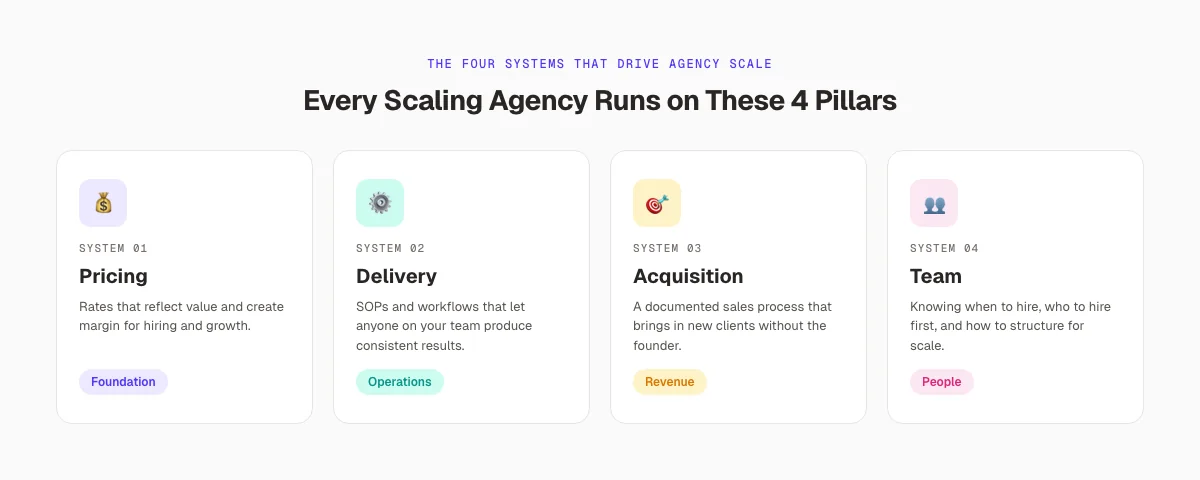
Scaling an SEO agency requires building 4 systems. Pricing, delivery, acquisition, and team. In the right sequence. This guide walks through exactly how to do that in 8 steps.
We have published 3,500+ blog articles across 70+ industries for service businesses and agencies. These are the frameworks that separate the 12.3% of agencies that break $200K/month from the 70% that never reach $50K.
Here is what you will learn:
- How to audit your agency's current state before adding a single new client
- Why fixing pricing is the most important step before any other growth tactic
- How to document delivery so your team can execute without you
- When and how to use white-label partnerships to extend capacity fast
- How to build a client acquisition system that does not rely on referrals
- When to hire and which role to add first
Time required: 3–6 months to implement all 8 steps fully Difficulty: Intermediate What you will need: Basic financial data on your agency, time to document processes, and a willingness to raise prices
Step 1: Audit Your Current Revenue, Margins, and Capacity
The agencies that scale fastest are not the ones that add clients fastest. They are the ones that understand their current state clearly before making any moves.
Pull 3 numbers before you do anything else:
- Revenue per client per month (average across all clients)
- Margin per client (revenue minus your time and any contractors)
- Hours per client per month (total team time spent per account)
Most agency owners discover the same thing when they run these numbers. Their highest-maintenance clients are often their lowest-margin clients. One or two clients consume 40%+ of team capacity while paying below-average retainers.
The capacity math:
If you charge $1,500/month per client and spend 15 hours on that account, your effective hourly rate is $100. If your team costs $65/hour including overhead, your margin is $35/hour or $525/client/month. That math works at 10 clients. It falls apart at 30 without systems.
Run this audit across every client. List each client, their monthly fee, estimated hours, and calculated margin. Rank them by margin, not by revenue.
Specifically:
- ✓ Calculate revenue per client per month
- ✓ Calculate hours per client per month (use time tracking data or estimates)
- ✓ Calculate effective margin per client
- ✓ Identify the 2–3 clients consuming the most time relative to revenue
Why this step matters: Agencies that skip the audit scale the wrong thing. They add clients at the same rate, margin, and structure that got them stuck. And hit a ceiling again, just higher up.
Pro tip: Run this audit quarterly. It catches scope creep before it becomes a margin problem.
Step 2: Fix Your Pricing Before You Add Clients
Pricing is the first thing that needs to change when an SEO agency wants to scale. It is also the step most founders delay because it feels risky.
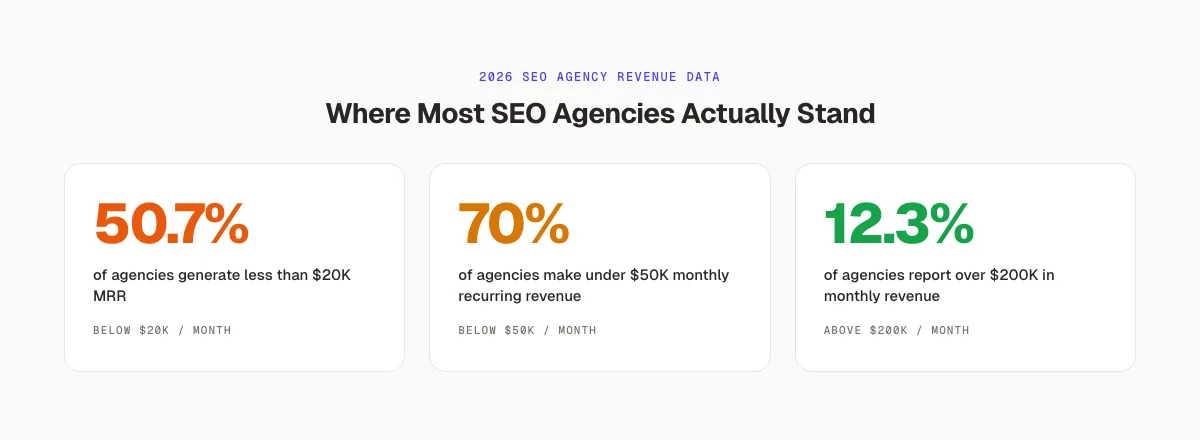
50.7% of SEO agencies generate less than $20,000 per month in recurring revenue. The primary reason is not a lack of clients. It is undercharging. According to the 2026 SEO Agency Growth Data Study, 56.2% of agencies are actively raising retainer prices this year. The ones that raised prices first are the ones now crossing $100K/month.
What undercharging costs you:
At $750/month per client, you need 67 clients to reach $50K/month. Serving 67 clients requires a substantial team, high coordination costs, and extreme delivery pressure. The math never works.
At $3,000/month per client, you need 17 clients. That is a manageable portfolio with room for real service quality.
How to raise prices without losing clients:
Do not apply price increases to existing clients immediately. Instead, set your new rate as the standard for all new clients starting now. Existing clients get 90 days notice before their renewal at the new rate. Frame the increase as a reflection of results delivered. Not an arbitrary adjustment.
Most agencies lose 0–2 clients when they raise prices 30–50%. The clients they lose are typically the most difficult ones. Churn on price is often a net positive.
The productized service model:
Stop charging by the hour or by project scope. Package your services into defined tiers with clear deliverables and prices. Three tiers works for most agencies:
| Tier | Monthly Price | Deliverables |
|---|---|---|
| Starter | $1,500–$2,000 | On-page optimization, 10 articles, monthly report |
| Growth | $3,000–$4,500 | Full SEO audit, 20 articles, link building, bi-weekly report |
| Scale | $5,000–$8,000 | Strategy, 30+ articles, link building, full reporting stack |
Clients can self-select their tier. You stop negotiating custom packages for every prospect.
For a detailed breakdown of SEO pricing at different service levels, the SEO cost guide covers what agencies typically charge. And what the market supports.
Why this step matters: Every other growth move in this guide requires margin. Without sufficient margin per client, you cannot hire, invest in tools, or build systems. Fix pricing first.
Step 3: Systematize Your Service Delivery
An agency that cannot deliver consistently cannot scale. The moment a second person joins your team, informal systems break. By the time a third person joins, everything is chaos.
The goal of systematization is simple: any trained person on your team should be able to deliver your service to the same standard you would deliver it yourself.
The 3 documents every agency needs:
1. Service SOPs (Standard Operating Procedures)
Document every repeatable task in your delivery stack:
- ✓ Keyword research process (tools, criteria, output format)
- ✓ On-page optimization checklist (title tags, meta, headers, internal links)
- ✓ Content brief template (target keyword, search intent, outline structure, word count)
- ✓ Link building outreach sequence (prospecting, email templates, follow-up cadence)
- ✓ Monthly reporting template (metrics to include, how to frame results)
2. Client Onboarding Playbook
Document exactly what happens in the first 30 days of every new client engagement:
- Week 1: Technical audit, access setup, baseline metric capture
- Week 2: Keyword research and content calendar
- Week 3: First content and on-page recommendations
- Week 4: Kickoff report and 90-day plan delivery
3. Quality Control Checklist
Before any deliverable leaves your team, a second person checks it against a standard checklist. Nothing ships without sign-off.
Our SEO workflow automation guide covers which parts of this process can run automatically. And which require human judgment.
Why this step matters: SOPs are what let you delegate. Without them, you stay the bottleneck forever. With them, you can hire and train someone new in a week instead of 3 months.
Your clients need 30 articles per month. Your team needs time to do real strategy. theStacc publishes SEO-optimized articles automatically. So your delivery team focuses on results, not writing.
Step 4: Niche Down to Command Higher Rates
Generalist SEO agencies compete on price. Specialist agencies compete on outcomes. The fastest-growing agencies in 2026 do not serve every business. They dominate one industry.
The argument against niching is always the same: "What if I cut off potential clients?" The counterargument is math. A dental SEO specialist charges 2–3× what a generalist charges, wins more referrals within the dental community, and builds a reputation that compounds over time.
How to choose your niche:
Look at your current client list and answer 3 questions:
- Which clients deliver the best results and generate the most referrals?
- Which industry do you understand deeply enough to speak with authority?
- Which industries have strong search volume, local competition, and recurring SEO needs?
Local service businesses (dental, legal, medical, HVAC, roofing) are strong niches because they have consistent recurring needs, high client lifetime value, and owners who understand the ROI of local search.
B2B SaaS companies are a higher-ticket niche with longer sales cycles but larger retainers and more sophisticated buyers.
Niching does not mean saying no to everyone else. It means your positioning, your case studies, your content, and your sales pitch all speak to one type of buyer. When a dentist lands on your website and sees "SEO for dental practices" with results from other dental clients, they call you instead of the generalist.
For agencies serving local businesses, our SEO for service businesses guide covers the keywords and strategies that matter most in that segment.
Why this step matters: Niching cuts your sales cycle in half and doubles your close rate. It also makes your SOPs from Step 3 more repeatable, since every client has similar needs.
Step 5: Build a Repeatable Client Acquisition System
Referrals are a great source of clients at $0–$20K/month. They are not a growth strategy beyond that. At some point, the referral network runs dry. The agencies that break through to $50K+ build a documented acquisition system that works regardless of who is running it.
The 3-channel acquisition stack:
Channel 1: Content SEO (24–36 month play)
Publish articles targeting the keywords your ideal clients search before hiring an agency:
- "SEO for dental practices"
- "how to get more patients from Google"
- "local SEO for plumbers"
Each article captures demand from business owners who are already researching. The build topical authority guide covers how to structure a content strategy around your niche.
Channel 2: Cold Outreach (90-day play)
Build a targeted list of 200–500 businesses in your niche in your target geography. Send a personalized email sequence focused on one insight:
"I noticed [Business Name] does not appear in the top 3 Google results for [high-value local keyword]. Three of your competitors do. Here is what they are doing differently."
One specific observation. One ask. No pitch deck. This converts significantly better than generic agency outreach.
Channel 3: Partnerships (ongoing)
Build referral relationships with:
- Web designers and developers who build sites for your target niche
- Business consultants who advise owners in your niche
- Business brokers and accountants in your market
A single solid partnership can deliver 2–5 qualified referrals per year on autopilot.
Why this step matters: A documented acquisition system is what separates an agency from a freelancer with more clients. If the founder gets sick, the pipeline should still produce leads.
Step 6: Extend Capacity With White-Label Partnerships
Most agency owners hire too soon. They add a full-time employee before they have consistent enough revenue to support the payroll. Then scramble when a client churns.
White-label partnerships solve the capacity problem without the payroll risk. Instead of hiring a content writer or link builder full-time, you contract with a white-label partner who delivers under your brand.
What to white-label first:
The best candidates for white-labeling are high-volume, lower-judgment tasks:
- Content writing (articles, blog posts, service pages)
- Link outreach and acquisition
- Technical audit execution (not strategy)
- Reporting compilation
The work you keep in-house is the work that requires client relationship management: strategy, communication, and quality review.
Our white-label SEO content guide covers how to evaluate white-label partners, set quality standards, and integrate external production into your delivery pipeline.
The unit economics of white-labeling:
If you charge a client $3,000/month for 20 articles and a white-label partner delivers those articles for $600, your gross margin is 80%. You keep the strategy and client relationship. The partner delivers the production. That margin supports growth without full-time hiring.
When to stop white-labeling:
Once you have predictable revenue above $30K/month and consistent demand for specific deliverables (e.g., always 300+ articles per month), bring that capacity in-house. The cost per unit drops and quality control becomes easier.
Why this step matters: White-label partnerships let you say yes to more clients today, without waiting 3 months to hire and train a full-time team member.
White-label SEO content at scale. theStacc delivers fully optimized articles on a fixed cadence. Published automatically to your clients' WordPress, Webflow, or Ghost sites.
Step 7: Hire the Right Role at the Right Time
Hiring mistakes at a scaling agency are expensive. The wrong hire in the wrong role at the wrong time sets you back 3–6 months and can cost $30,000–$80,000 in salary, severance, and opportunity cost.
Most agency founders hire a second account manager when what they actually need is a project manager. They hire a senior strategist when what they need is a reliable executor. Match the hire to the actual bottleneck.
The hiring sequence for a scaling agency:
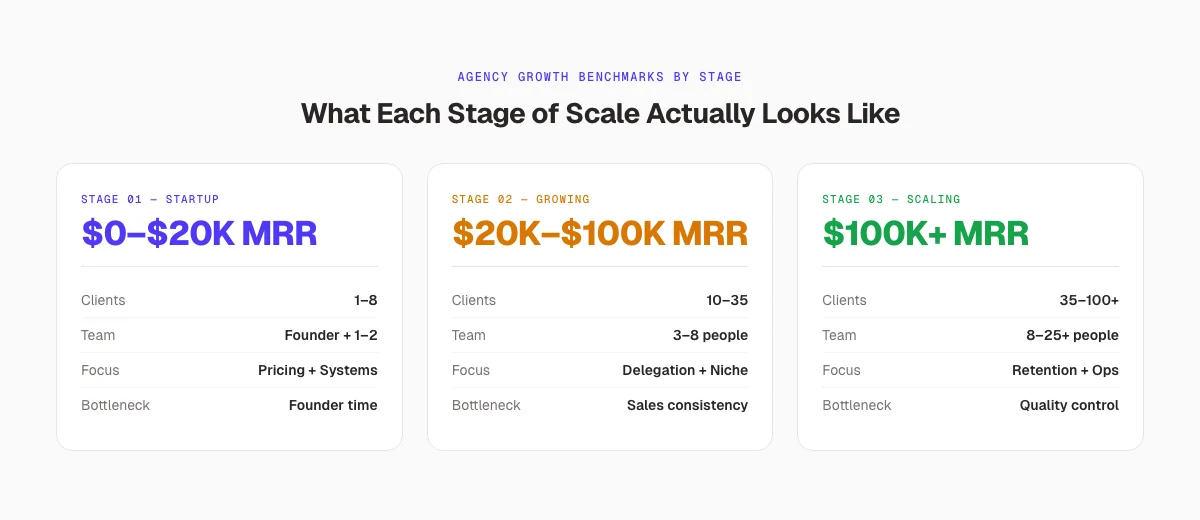
Hire 1: Project Coordinator (at $15K–$25K MRR)
This person manages the SOPs from Step 3. They handle task assignment, deadline tracking, and basic quality control. This frees the founder from operational management so they can focus on sales and strategy. A well-run project coordinator earns back their salary in 30–60 days by reducing founder hours.
Hire 2: Senior SEO Strategist (at $40K–$60K MRR)
This person handles account strategy for your largest clients. They conduct audits, develop keyword plans, and set content direction. The founder moves into sales and business development full-time.
Hire 3: Sales/Business Development (at $70K–$100K MRR)
Once you have a documented acquisition system from Step 5, hire someone to run it. A dedicated BDR or account executive can close 3–6 new clients per month with the right playbook.
For a detailed framework on building your agency team, the SEO team building guide covers org structure, compensation benchmarks, and when to hire vs. contract.
Why this step matters: The wrong hire is not just a financial cost. It is a distraction cost. Every month you spend managing the wrong person is a month you are not closing new clients or building systems.
Step 8: Track the Metrics That Predict Scale
Most agency owners track the wrong metrics. They watch monthly revenue and client count. Both are lagging indicators. By the time revenue drops, the problem started 2–3 months earlier.
The metrics that predict scaling problems are all leading indicators:
| Leading Metric | What It Tells You | Target |
|---|---|---|
| Client churn rate | Retention health | Under 5% per month |
| Average retainer size | Pricing progress | Growing quarter over quarter |
| Gross margin per client | Profitability | Above 60% |
| Time-to-first-result | Service quality | Under 60 days for ranking movement |
| Lead-to-close rate | Sales efficiency | Above 25% |
| Net Promoter Score | Referral potential | Above 40 |
Track these monthly. When a metric moves in the wrong direction, investigate immediately. Not after the next quarter.
The 3 reports every scaling agency should run weekly:
- Pipeline report: All active prospects, their stage, and expected close date
- Delivery report: All active clients, current deliverables status, and open issues
- Financial report: Revenue, projected churn, new client additions, and margin by client
Our SEO reporting guide covers how to build client-facing reports that reduce churn. The SEO KPIs guide has the full breakdown of which metrics matter at each stage.
For calculating the business value of SEO work, use the free SEO ROI Calculator. It translates organic traffic into estimated revenue impact.
Why this step matters: You cannot manage what you do not measure. The agencies that scale past $100K/month are obsessive about data. Not because data is interesting, but because it catches problems before they become crises.
Results: What to Expect After Following These Steps
After implementing all 8 steps, you should expect the following timeline:
- Month 1–2: Audit complete, pricing updated for new clients, first SOPs documented
- Month 3–4: White-label partnerships active, delivery more consistent, first price increase notices sent to existing clients
- Month 5–6: Acquisition system producing 2–5 qualified leads per month
- Month 9–12: First non-founder hire onboarded, operational workload shifts off founder
- Month 12–18: Agency crosses $50K–$100K MRR with consistent margins above 50%
Realistic expectations: scaling is not linear. You will lose some clients when you raise prices. You will have a bad hire at some point. The difference between agencies that break through and agencies that do not is whether they keep building the systems despite those setbacks.
Troubleshooting
Problem: Existing clients push back on price increases.
Solution: Frame the increase around results delivered, not service cost. "In the past 12 months, we have published 360 articles and moved you from page 3 to page 1 for your top 8 keywords. The new rate reflects the scale of that output." Most clients who push back still renew. Clients who leave would have churned anyway.
Problem: White-label content quality is inconsistent.
Solution: Build a quality brief template that leaves no room for interpretation. Include: target keyword, search intent, word count, required H2 structure, tone guidelines, and 3 example articles from your published work. Brief quality determines output quality.
Problem: Client acquisition system produces leads but not closes.
Solution: Audit your first 3 touchpoints. The cold email, the discovery call, and the proposal. Most conversion problems live in one of those 3 places. Record your discovery calls and review them. The objection you hear 80% of the time is your close rate problem.
What practitioners are saying on X
Agency and white-label models evolve fast. Here is operator signal from X on tooling and service delivery.
- @syedbalkhi (Sep 2024): White-label pro services can add multi-six-figure revenue without building an in-house services org — partner delivery behind the brand. See the post on X.
- @ConnorGillivan (Jul 2026): 2026 SEO stack favorite list: Semrush/Ahrefs, GSC, Surfer, KeywordInsights, ChatGPT, SEOwind, Screaming Frog, ClearScope, GA4, Notion/Airtable — tools amplify systems, they don’t replace them. See the post on X.
- @jakezward (Feb 2026): 2026 SEO predictions emphasize AI Overview share-of-SERP, schema for LLM token efficiency, brand mentions in AI answers as a KPI, proprietary data as a moat, and content refresh beating net-new AI slop. See the post on X.
Grok, AI Overviews, and multi-engine visibility
For “how to scale seo agency”, multi-engine visibility still starts with clear definitions, sourced numbers, and extractable section answers. Grok additionally factors live X discussion — keep public claims consistent with this page.
- Google AI Overviews: Use passage-ready answers, tables, and FAQ schema where relevant.
- ChatGPT / Perplexity: Cite named sources next to key claims.
- Grok: Maintain accurate entity facts on-site and in high-signal X posts.
Publish content built for Google and AI citations. theStacc’s Content SEO module ships SEO-scored articles structured for rankings and generative engines — including clearer entity pages models like Grok can quote.
FAQ
With consistent execution, most agencies can reach $100K MRR in 18–36 months from a solid $20K–$30K base. The bottlenecks are almost always pricing (charging too little) and delivery (no systems to grow without the founder). Fix those two first and the timeline compresses significantly.
Yes. Especially when scaling from $0 to $100K MRR. Niche agencies close faster, charge more, and retain clients longer. The loss of "potential clients" from niching is far smaller than the gain in conversion rate, referral velocity, and retainer size. Generalism becomes a competitive disadvantage above $50K/month.
The first hire should address the founder's biggest bottleneck. For most agencies, that is a project coordinator or operations manager. Someone who runs the delivery processes so the founder can focus on sales and strategy. Hiring another SEO specialist before the operations are documented usually just creates more chaos.
Apply new pricing to new clients first. Give existing clients 60–90 days notice before renewal at the new rate. Frame the increase around results delivered. Most agencies that raise prices 30–50% lose 0–2 clients. Typically the most difficult, lowest-margin accounts. The net revenue impact is usually positive.
Under 5% monthly churn (meaning less than 1 in 20 clients cancel each month) is a healthy baseline for a scaling agency. Agencies at $100K+ MRR typically maintain 3–4% monthly churn or below. Churn above 8% means either service quality, expectation-setting, or pricing is misaligned. And adding new clients will not fix it.
theStacc handles the content production side of SEO delivery. Your agency sets the strategy. We publish fully optimized articles directly to your clients' sites. That lets your team focus on strategy, reporting, and link building. Without managing a content writing operation. White-label pricing is available for agencies managing multiple client accounts.
Most SEO agencies do not fail because they cannot do SEO. They fail because they cannot build a business around SEO. The 8 steps in this guide are the operational difference between the agencies in the top 12.3% and the 70% that never break $50K/month.
Start with the audit in Step 1. Every other decision. Pricing, hiring, systems. Flows from what that audit reveals.
Scale your agency content. $99/month. theStacc writes and publishes SEO articles for your clients, automatically. White-label available.
Related Tools & Resources
Free SEO Tools:
Best Lists:
Sources & references
- [1] Princeton / Georgia Tech et al. — GEO research (arXiv:2311.09735)
- [2] @hridoyreh on X — Widely shared SEO skill tree: foundations, research, technical, on-page, content, links, AI SEO/GEO, analytics, UX, bran
- [3] @jakezward on X — 2026 SEO predictions emphasize AI Overview share-of-SERP, schema for LLM token efficiency, brand mentions in AI answers
- [4] Referenced source — sitechecker.pro

Researched, written, and published articles that compound organic traffic.
Weekly local SEO teardowns
One practical email a week. Map Pack, GBP, AI Overviews — no fluff. Unsubscribe anytime.