SaaS Link Building: The Complete Guide (2026)
Learn 12 SaaS link building strategies mapped to growth stage, with budgets, timelines, and real examples. Includes outreach templates. Updated 2026.
Siddharth Gangal • 2026-03-29 • SEO Tips
In This Article
SaaS companies face a link building problem that most SEO guides ignore. Generic advice about guest posting and broken links does not account for long sales cycles, product-led growth, or the fact that your competitors have 10x your budget.
Pages ranking number 1 on Google have 3.8x more backlinks than positions 2 through 10. Yet 94% of online content earns zero external links. For SaaS companies trying to rank for high-value keywords like “CRM software” or “project management tool,” the gap between winners and everyone else comes down to links.
SaaS link building is the process of earning backlinks from authoritative websites to improve your search rankings, referral traffic, and brand visibility. The tactics that work for SaaS differ from those that work for ecommerce, local businesses, or publishers.
We have published 3,500+ blog posts across 70+ industries, including dozens of B2B SaaS companies. This guide covers every link building strategy that works for SaaS in 2026, organized by growth stage and budget.
Here is what you will learn:
- Why SaaS needs different link building strategies than other business types
- The actual benchmarks: cost, timeline, and velocity data
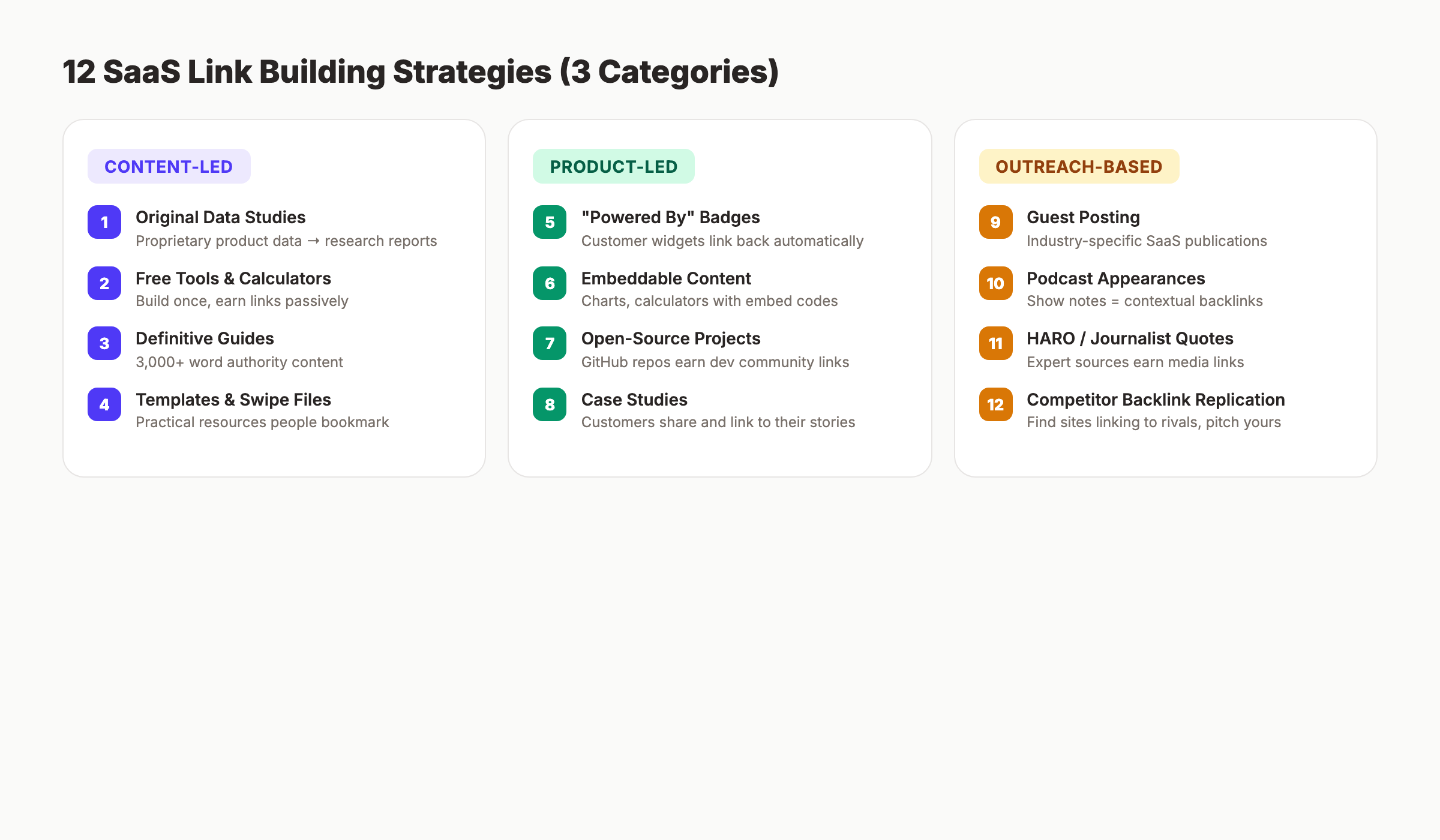
- 12 proven strategies split across content-led, product-led, and outreach categories
- A growth-stage playbook (pre-seed through Series B+)
- How to measure link building ROI for SaaS
- When to prioritize link building versus other SEO investments
Chapter 1: Why SaaS Companies Need a Different Link Building Approach
Most link building strategies assume you run a content site or ecommerce store. SaaS operates differently.
The SaaS Link Building Challenge
SaaS companies compete in keyword spaces dominated by well-funded incumbents. HubSpot earns 7 million organic visits per month. Semrush has 4,500 referring domains on a single blog post. Trying to outrank these companies with the same playbook they used is a losing strategy.
Three things make SaaS link building unique:
1. You have a product that generates links naturally. Free tools, integrations, embeddable widgets, and “powered by” badges create link opportunities that content-only businesses do not have.
2. Your content competes in high-difficulty keyword spaces. “Best project management software” has a keyword difficulty above 80 on most tools. Ranking for these terms requires both content quality and authority signals.
3. Your buyer journey is long. SaaS purchases involve research, trials, and committee decisions. Links from industry publications and comparison sites drive qualified traffic, not just SEO value.
What Works Differently for SaaS
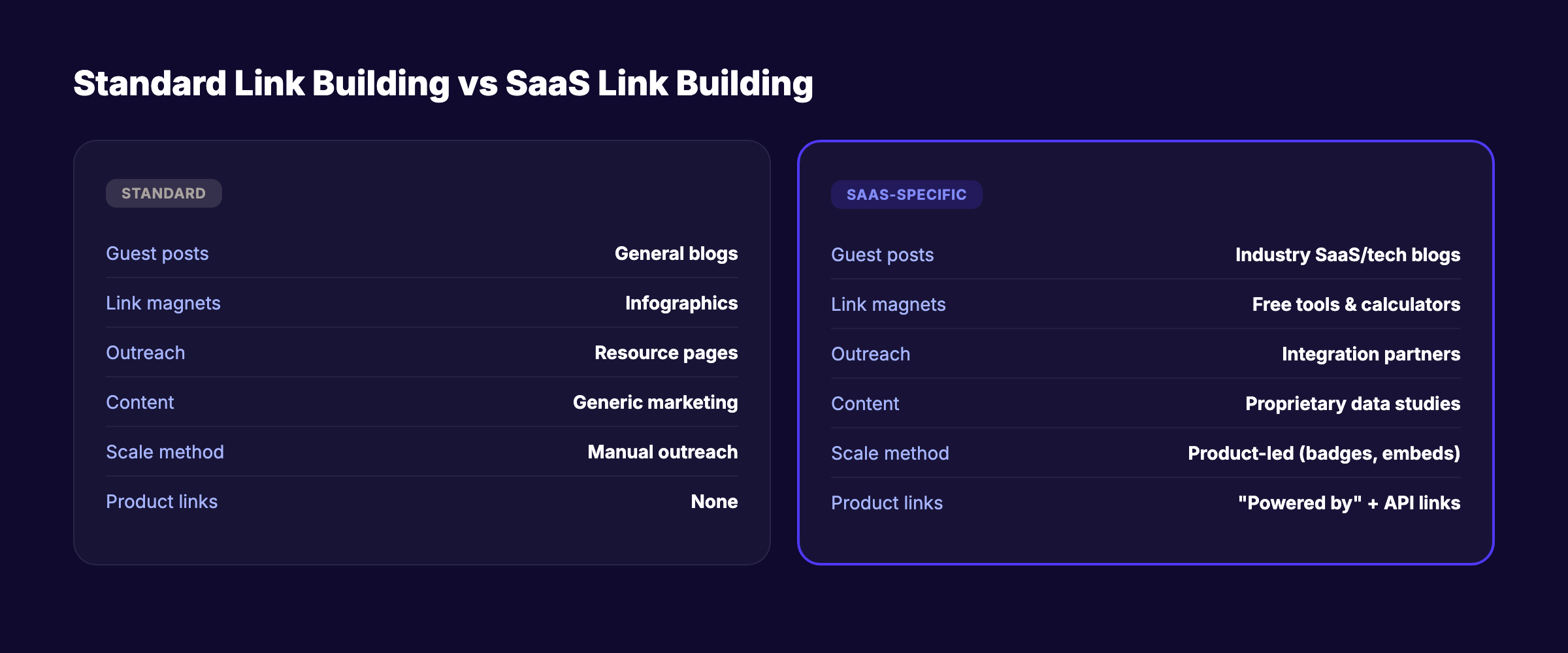
| Standard Link Building | SaaS Link Building |
|---|---|
| Guest posts on general blogs | Guest posts on industry-specific SaaS/tech blogs |
| Resource page outreach | Integration partner page exchange |
| Infographic outreach | Free tool or calculator link magnet |
| Generic content marketing | Data studies using your own product data |
| Manual outreach at scale | Product-led link acquisition (badges, embeds, APIs) |
The biggest advantage SaaS companies have: your product itself can generate links. No other business type has this built-in link engine.
Chapter 2: The Numbers — SaaS Link Building Benchmarks
Before building a strategy, understand the benchmarks.
Cost Per Link
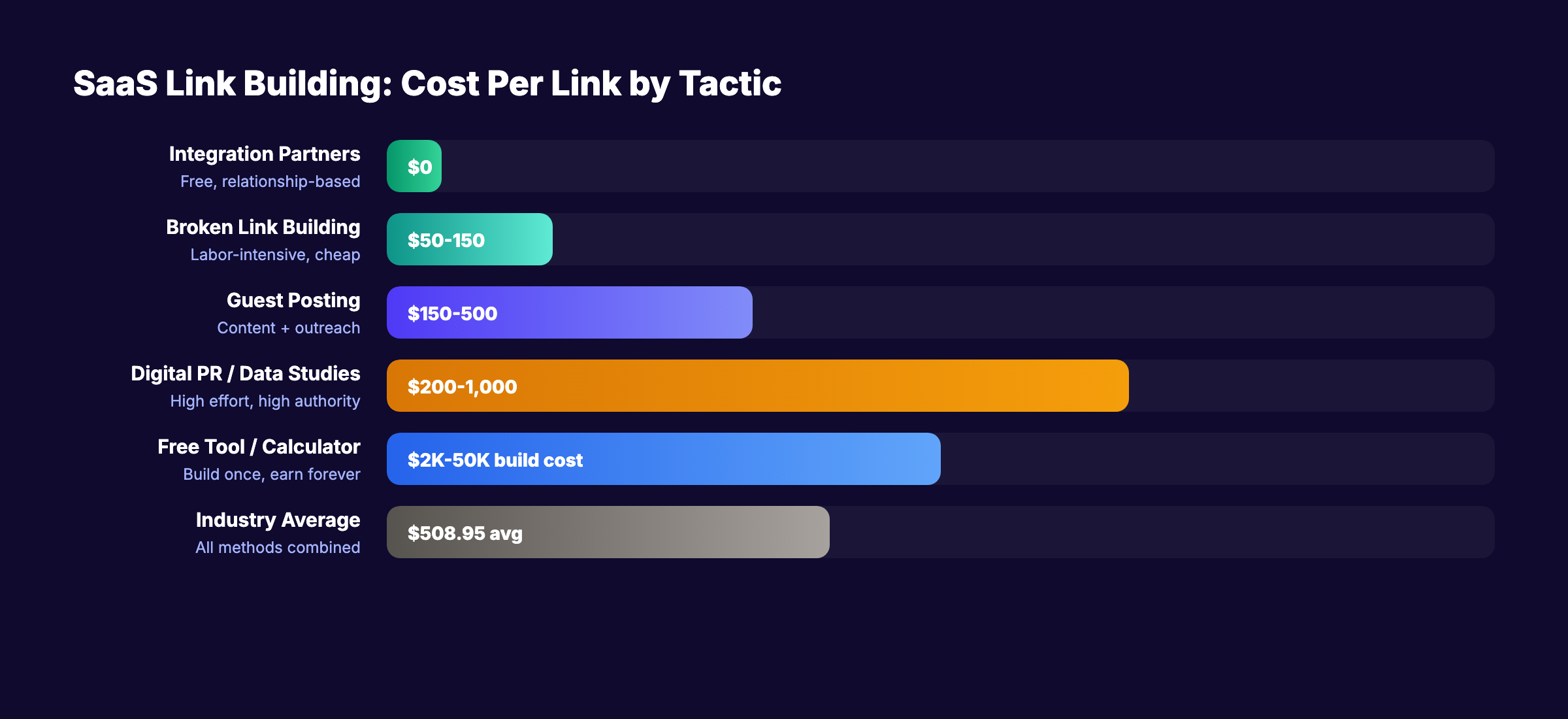
According to a survey of 518 SEO professionals, the average cost per high-quality backlink is $508.95. The minimum monthly budget for competitive link building is $8,406.
For SaaS specifically, costs vary by tactic:
| Tactic | Cost Per Link | Time Per Link |
|---|---|---|
| Guest posting | $150-500 | 4-8 hours |
| Digital PR / data studies | $200-1,000 | 8-20 hours |
| Broken link building | $50-150 | 2-4 hours |
| Integration partner links | $0 (relationship-based) | 1-2 hours |
| Free tool link magnets | $0-5,000 (build cost) | 0 (ongoing passive) |
| SaaS directory listings | $0-500 per directory | 1-2 hours |
| Podcast appearances | $0 | 2-3 hours |
Product-led strategies (integrations, free tools, badges) have the lowest marginal cost because they generate links passively after the initial build.
Timeline to Results
One backlink produces an average rank improvement of 1 position after 10 weeks. But link building compounds over time.
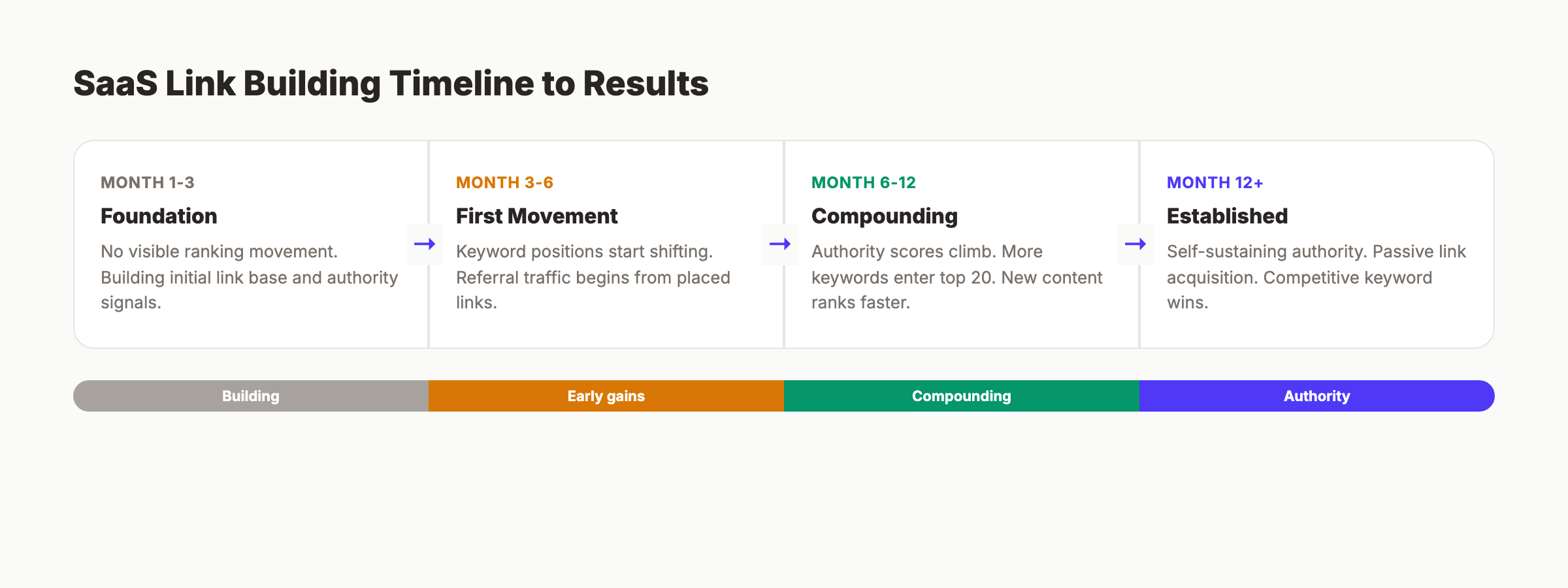
| Timeframe | What to Expect |
|---|---|
| Month 1-3 | Foundation links in place. No visible ranking movement. |
| Month 3-6 | First keyword position improvements. Referral traffic starts. |
| Month 6-12 | Compounding effect. Authority scores climb. More keywords enter top 20. |
| Month 12+ | Established authority. New content ranks faster. Link velocity self-sustains. |
Companies that stop link building after 3 months see gains plateau. The compounding effect requires sustained effort.
How Many Links Do You Need?
The answer depends on your competitive space. Use competitor analysis to benchmark:
- Identify 3-5 direct competitors ranking for your target keywords
- Check their referring domain count using Ahrefs or Semrush
- Calculate the gap between your domain and theirs
- Target closing 10-20% of that gap per quarter
A SaaS site with 50 referring domains competing against sites with 500+ needs a multi-year link building strategy. There are no shortcuts.
Your SEO team. $99 per month. Stacc publishes 30 optimized articles every month so you can focus on building links instead of writing content. Start for $1 →
Chapter 3: Foundation Links Every SaaS Site Needs First
Before launching outreach campaigns, secure the easy links that require minimal effort.
SaaS Directories and Review Sites
Every SaaS company should have profiles on these platforms:
- G2 — High domain authority, trusted by buyers, often ranks for “[product] reviews”
- Capterra — Gartner-owned, strong authority, drives qualified traffic
- Product Hunt — Especially valuable for launch campaigns and early backlinks
- GetApp — Part of the Gartner Digital Markets network
- TrustRadius — B2B-focused review platform
- AlternativeTo — Ranks well for “[competitor] alternatives” queries
- SourceForge — Strong domain authority, relevant for developer-facing products
These profiles create dofollow or nofollow links from domains with DR 80+. 78.8% of SEO experts believe nofollow links still affect rankings, so both types have value.
Social Profiles and Branded Properties
Claim your brand name on every platform. These links build entity signals that help Google associate your brand with your industry:
- GitHub (for developer-facing SaaS)
- LinkedIn Company Page
- Twitter/X
- YouTube
- Crunchbase
- AngelList
Integration Partner Pages
If your product integrates with other tools, request a listing on their integrations directory. Zapier, Slack, HubSpot, Salesforce, and Shopify all maintain partner directories that link back to listed products.
This is one of the highest-ROI link building tactics for SaaS. The links are:
- Contextually relevant (your product category)
- From high-authority domains (DR 80-95)
- Permanent (as long as the integration exists)
- Free (no payment or content creation required)
Venngage earned 429 referring domains through integration and embed links alone. InVision generated 10,700 backlinks through their projects subdomain.
Chapter 4: Content-Led Link Building Strategies
Content earns links when it provides something others cannot easily create themselves. For SaaS, that means data, tools, and frameworks.
Strategy 1: Original Data Studies
SaaS companies sit on proprietary data that no one else can access. Turn that data into publishable research.
Examples that earned massive links:
- Drift published a chatbot benchmark report and earned 350 referring domains
- HubSpot publishes annual “State of Marketing” reports that earn thousands of links
- Ahrefs regularly publishes studies using their own crawl data
How to execute:
- Identify a dataset unique to your product (usage patterns, benchmarks, trends)
- Analyze it for surprising or counterintuitive findings
- Publish the findings as a blog post with charts and a methodology section
- Pitch the findings to journalists and bloggers who cover your niche
Digital PR with original data is rated the most effective link building tactic by 48.6% of SEO experts. The key is the data must be proprietary. Publicly available data does not earn links because anyone can write about it.
Strategy 2: Free Tools and Calculators
Build a small, free tool that solves a specific problem in your industry. HubSpot’s Website Grader is the most cited example. It earned thousands of backlinks because people link to tools they recommend.
Good free tool characteristics:
- Solves one problem clearly
- Produces a shareable result (score, report, visual)
- Requires no login to use
- Takes under 60 seconds to complete
- Relates to your paid product’s value proposition
The build cost ranges from $2,000-10,000 for a simple calculator to $20,000-50,000 for a full diagnostic tool. But the link acquisition is passive. Once the tool exists, links accumulate without ongoing outreach.
Strategy 3: Definitive Guides and Frameworks
Long-form content (3,000+ words) earns 77.2% more backlinks than shorter posts, according to Backlinko research. But length alone does not earn links. The content must be the best resource on its topic.
What earns links:
- Proprietary frameworks with names (example: “The SaaS Metric Stack”)
- Visual diagrams that people embed or reference
- Regularly updated annual guides
- Content that answers questions journalists ask
This strategy compounds with content marketing. Every blog post you publish is potential link-earning material. Companies that blog consistently get 97% more backlinks than those that do not.
Strategy 4: Templates, Checklists, and Swipe Files
Practical resources earn links because they save people time. Think:
- Email sequence templates for outreach
- Project management checklists
- ROI calculators in spreadsheet format
- Comparison matrices
- Onboarding workflow diagrams
The more specific the template, the better. “Marketing plan template” is too broad. “SaaS onboarding email sequence template” targets a specific audience and earns links from SaaS blogs.
3,500+ blogs published. 92% average SEO score. See what Stacc can do for your site. Start for $1 →
Chapter 5: Product-Led Link Building Strategies
These strategies use your product itself as the link acquisition mechanism. They scale without ongoing outreach.
Strategy 5: “Powered By” Badges
If your product appears on customer websites (widgets, embeds, chatbots, analytics dashboards), add a small “Powered by [Your Brand]” link.
Companies doing this well:
- Intercom’s chat widget links back to intercom.com
- Typeform’s embedded forms include a branded footer link
- Hotjar’s heatmap badge links to their homepage
The math is simple. If 1,000 customers embed your product, and 30% keep the badge visible, you earn 300 backlinks from real business websites. These are contextually relevant, from unique domains, and they grow automatically as your customer base grows.
Strategy 6: Embeddable Content and Widgets
Create content that other sites want to embed: interactive charts, calculators, infographics with embed codes, or data visualizations.
When someone embeds your content, the embed code includes a link back to your site. This works especially well for:
- Benchmark data visualizations
- Industry survey results
- Interactive comparison tools
- Status pages and uptime monitors
Strategy 7: Open-Source Projects and Developer Tools
If your SaaS has a developer audience, open-source components earn links naturally. GitHub repositories get referenced in blog posts, documentation, and Stack Overflow answers.
This tactic is not relevant for every SaaS company. But for developer tools, APIs, and technical products, it can generate hundreds of high-quality backlinks from .io, .dev, and tech blog domains.
Strategy 8: Customer Success Stories and Case Studies
Publish case studies featuring your customers. When customers share their own success story, they link back to it from their own sites, social profiles, and press pages.
Execution:
- Interview 5-10 customers with measurable results
- Publish each as a standalone case study page
- Send the customer a shareable link and social graphics
- Customers share with their audience, which generates backlinks
Happy Scribe reported 98% lower customer acquisition costs through this type of content-driven link building.
Chapter 6: Outreach and Relationship-Based Strategies
These strategies require manual effort but target high-authority placements.
Strategy 9: Guest Posting on SaaS and B2B Publications
Guest posting remains effective when done correctly. The key for SaaS is targeting industry-specific publications, not generic marketing blogs.
High-value targets for SaaS guest posts:
- SaaS-specific blogs (SaaStr, ChartMogul, OpenView)
- Industry vertical publications (your customers read these)
- Startup and tech media (TechCrunch guest contributions, VentureBeat)
- Marketing publications (Search Engine Journal, Content Marketing Institute)
45% of SaaS companies prioritize industry-specific blogs for backlink acquisition, according to Dofollow. Generic DA 30 blogs do not move the needle. Target publications your buyers actually read.
Strategy 10: Podcast Appearances
Podcast hosts link to guests from show notes pages. A 30-minute podcast interview earns a contextual backlink from a niche-relevant domain.
How to find podcast opportunities:
- Search “[your niche] podcast” on Apple Podcasts or Spotify
- Use tools like Podchaser to find shows that interview SaaS founders
- Target podcasts with 50+ episodes (active shows, not dead ones)
- Pitch a specific topic, not “I would love to be on your show”
The link comes from the show notes. But the real value is brand visibility with a targeted audience.
Strategy 11: HARO and Journalist Requests
Help A Reporter Out (now Connectively) and similar platforms connect journalists with expert sources. When a journalist quotes you, they link to your site.
SaaS-specific tips:
- Monitor requests in the “Technology” and “Business” categories
- Respond within 2 hours (journalists work on tight deadlines)
- Provide specific data points from your product or industry
- Include your credentials and company name in every response
The response rate is low (expect 5-10% of pitches to result in a link), but the links come from high-authority news and industry publications.
Strategy 12: Competitor Backlink Replication
Use backlink analysis to find sites linking to competitors but not to you. If a site links to 3 of your competitors, they are likely open to linking to you too.
Process:
- Pull backlink profiles for 3-5 direct competitors
- Find domains that link to 2+ competitors but not you
- Analyze what content earned those links
- Create equal or better content on the same topic
- Outreach with your version as an alternative or addition
This is the skyscraper technique applied to SaaS. The advantage is that you already know the linking site is interested in your topic.
Stop writing. Start ranking. Stacc publishes 30 SEO articles per month for $99 so you can focus on link acquisition. Start for $1 →
Chapter 7: SaaS Link Building by Growth Stage
Your link building strategy should match your resources and goals.
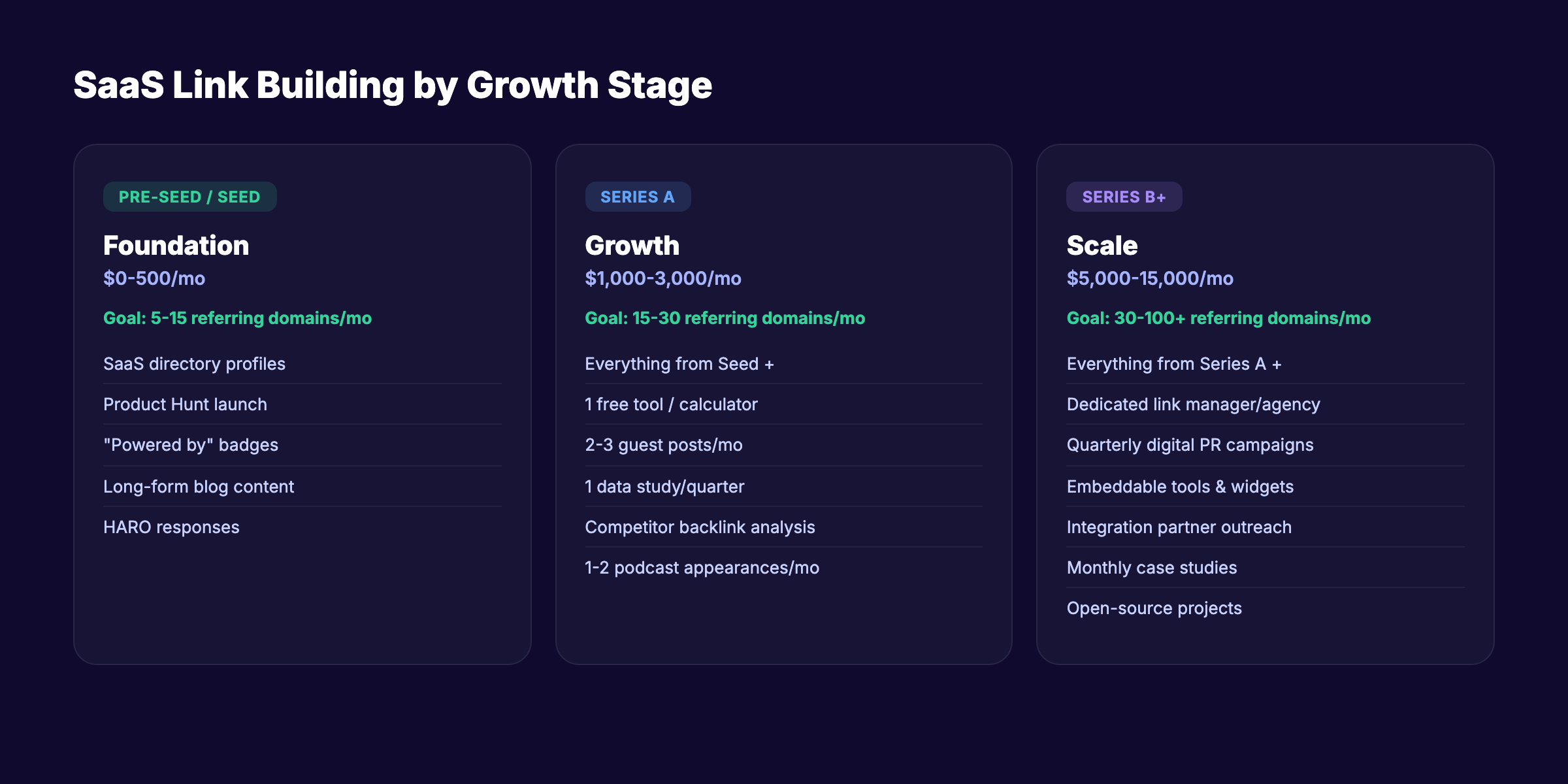
Pre-Seed to Seed ($0-500 per month)
At this stage, budget is minimal. Focus on free and low-effort tactics.
Priority tactics:
- Claim all SaaS directory profiles (G2, Capterra, Product Hunt)
- Set up social profiles and branded properties
- Launch on Product Hunt for initial backlinks and traffic
- Add “powered by” badges to any customer-facing features
- Publish 2-3 long-form blog posts per month for passive link earning
- Respond to 5-10 HARO queries per week
Goal: 5-15 referring domains per month.
Do NOT do: Paid link placements, agency hiring, or large-scale outreach. Your content library is too small to support it.
Series A ($1,000-3,000 per month)
You have some budget and a growing content library. Layer in active outreach.
Priority tactics:
- Everything from the Seed stage
- Build 1 free tool or calculator as a link magnet
- Start guest posting on 2-3 industry publications per month
- Publish 1 original data study per quarter using product data
- Begin competitor backlink replication campaigns
- Appear on 1-2 niche podcasts per month
Goal: 15-30 referring domains per month.
Budget allocation: 40% content creation, 30% outreach, 30% tools and monitoring.
Series B and Beyond ($5,000-15,000 per month)
At this stage, hire or outsource. Run multiple campaigns simultaneously.
Priority tactics:
- Everything from Series A
- Hire a dedicated link building manager or agency
- Launch digital PR campaigns with quarterly data reports
- Build embeddable tools and widgets for partner sites
- Run systematic integration partner outreach (target 5-10 new partners per month)
- Publish case studies monthly with customer co-promotion
- Develop open-source projects or community resources
Goal: 30-100+ referring domains per month.
Budget allocation: 30% digital PR, 25% content assets, 25% outreach/agency, 20% tools and partnerships.
When NOT to Build Links
Link building should not be your first investment if:
- Your site has fewer than 30 published pages (build content first)
- Your technical SEO has critical issues (fix those first)
- Your on-page optimization is weak (optimize existing pages before earning links)
- Your content does not match search intent (links to irrelevant content will not help)
The order matters: technical SEO → content → internal links → external links.
Chapter 8: Measuring and Tracking SaaS Link Building ROI
63% of SaaS companies monitor link building impact through referral traffic. But referral traffic is only one metric.
Key Metrics to Track
| Metric | What It Tells You | Tool |
|---|---|---|
| New referring domains per month | Link velocity and growth rate | Ahrefs, Semrush |
| Domain Rating / Authority Score | Overall authority trend | Ahrefs, Moz |
| Referring domain quality (DR distribution) | Whether you earn links from authoritative sites | Ahrefs |
| Anchor text distribution | Whether your profile looks natural | Ahrefs, Semrush |
| Organic traffic growth | Whether links translate to rankings | Google Search Console |
| Keyword position changes | Direct ranking impact | Rank tracker |
| Referral traffic from linked pages | Actual visitors from backlinks | Google Analytics |
| Link acquisition cost | Efficiency of your campaigns | Internal tracking |
Connecting Links to Revenue
The hardest part of SaaS link building measurement is tying backlinks to pipeline and revenue.
A practical framework:
- Track referral traffic from each backlink source in Google Analytics
- Set up goal completions for trial signups and demo requests
- Calculate conversion rate from referral traffic to trial
- Apply your trial-to-paid conversion rate
- Calculate lifetime value per customer acquired through link referral
Most SaaS companies will find that link building ROI is indirect. Links improve rankings. Rankings drive organic traffic. Organic traffic converts to trials. This makes attribution difficult but the channel profitable at scale.
Red Flags in Your Link Profile
Run a backlink audit quarterly. Watch for:
- Sudden spikes in low-quality referring domains (possible negative SEO)
- Over-optimized anchor text ratios (more than 10% exact match)
- Links from irrelevant industries or foreign-language sites
- A high percentage of links from a single domain
Use the Google Disavow Tool only when you have clear evidence of spammy link attacks. Over-disavowing legitimate links causes more harm than ignoring minor spam.
Rank everywhere. Do nothing. Blog SEO, Local SEO, and Social on autopilot. Start for $1 →
SaaS Link Building Checklist
Use this to track your link building program by growth stage:
- Claimed profiles on G2, Capterra, Product Hunt, and 4+ directories
- Set up branded social profiles and Crunchbase listing
- Launched or planned 1 free tool or calculator
- Published 1+ original data study using product data
- Secured integration partner links from 3+ platforms
- Added “powered by” badges to customer-facing features
- Began guest posting program (2-3 per month target)
- Started competitor backlink analysis with Ahrefs or Semrush
- Set up referral traffic tracking in Google Analytics
- Scheduled quarterly backlink audit
FAQ
What is SaaS link building?
SaaS link building is the process of earning backlinks to a software-as-a-service website from authoritative external sources. It includes tactics specific to SaaS: integration partner links, “powered by” badges, free tool link magnets, data studies using proprietary product data, and strategic guest posting on B2B publications.
How much does SaaS link building cost?
Costs range from $0 for DIY tactics (directory listings, integration links, HARO) to $5,000-15,000 per month for full-scale campaigns with digital PR, agency outreach, and content asset creation. The average cost per high-quality backlink across all methods is $508.95, according to Editorial.link.
How long does it take for SaaS link building to show results?
Expect 3-6 months before seeing meaningful ranking improvements. One backlink produces an average rank improvement of 1 position after 10 weeks. Compounding effects become visible after 6-12 months of consistent effort. Companies that stop after 3 months see gains plateau.
Should a SaaS startup invest in link building or content first?
Content first. Build at least 30-50 published pages before investing in link building. Without quality content, there is nothing worth linking to. The ideal order is technical SEO, then content, then internal linking, then external link building.
What are the best link building strategies for B2B SaaS?
The highest-ROI strategies for B2B SaaS are: integration partner links (free, high-authority), original data studies (48.6% of experts rate digital PR as most effective), free tools and calculators (passive link acquisition), and guest posting on industry publications. Product-led strategies scale better than outreach-based ones.
Is link building still important for SEO in 2026?
Yes. 73.2% of SEO experts believe backlinks influence AI search visibility, and pages ranking number 1 still have 3.8x more backlinks than lower positions. The tactics have evolved. Quality and relevance matter more than volume. But the fundamental relationship between backlinks and rankings remains strong.
SaaS link building is a long-term investment, not a quick fix. The companies that win start with foundation links, layer in content-led and product-led strategies, and scale outreach as their authority grows. Pick the tactics that match your current stage, track the metrics that matter, and commit to at least 12 months before judging ROI.
Written and published by Stacc. We publish 3,500+ articles per month across 70+ industries. All data verified against public sources as of March 2026.