
Broken Link Building (2026): Strategies, Tactics & Examples
broken link building guide for 2026: strategies, tactics, real examples, and implementation steps to get results faster.
Most link building tactics ask you to convince strangers to link to your content. Broken link building flips that dynamic. You find pages that already link to dead resources, create a better replacement, and offer it as a fix.
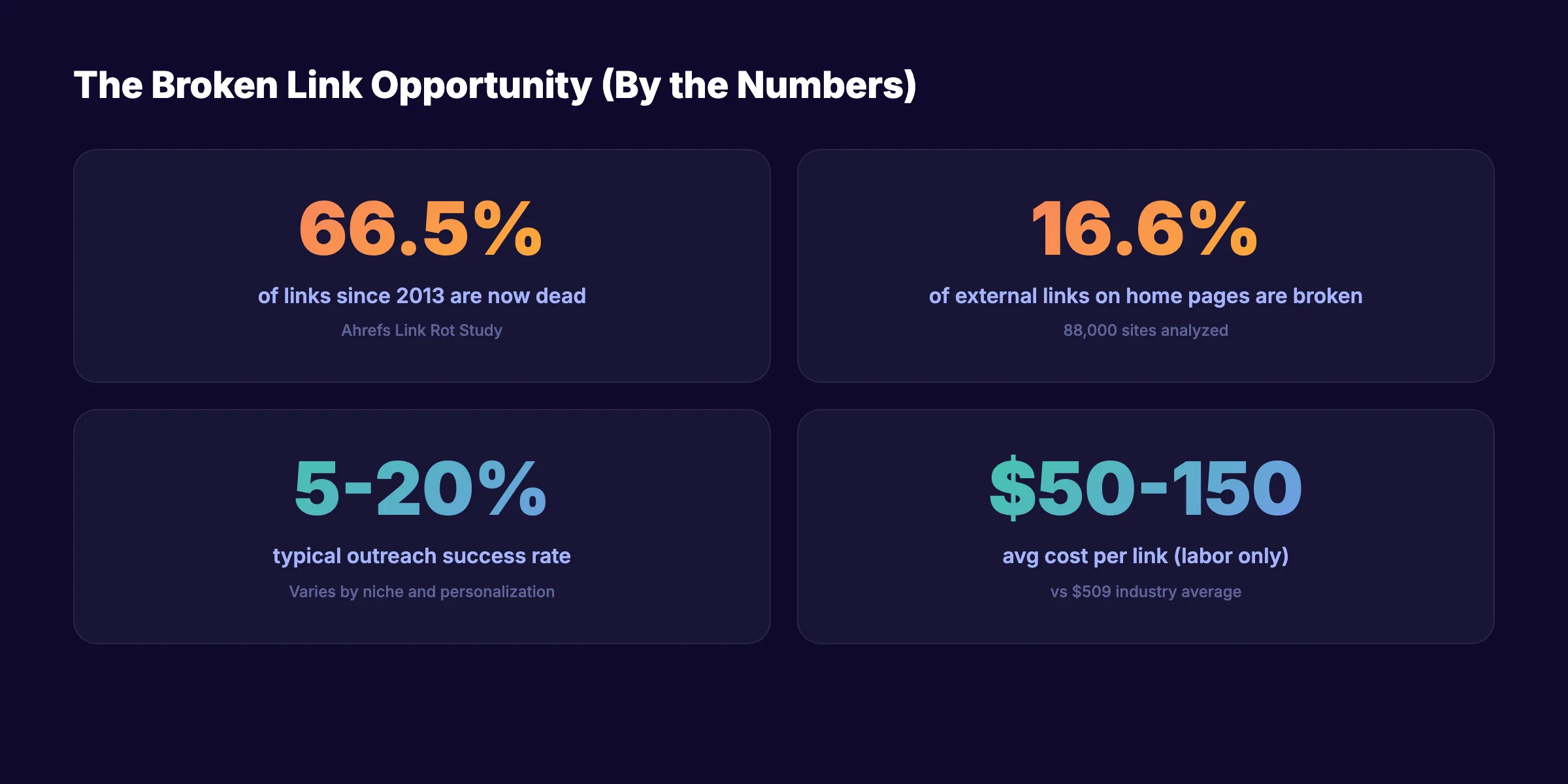
According to an Ahrefs link rot study, 66.5% of links to websites since 2013 are now dead. That is not a small number. Two-thirds of the web’s link graph points to pages that no longer exist. Every dead link is a potential backlink for someone willing to fill the gap.
Broken link building is a link building strategy where you earn backlinks by helping site owners replace their dead outbound links with working alternatives. You provide value. They fix a problem. Both sides benefit.
We have published 3,500+ blog posts across 70+ industries and run backlink campaigns for sites at every authority level. This guide covers the exact process we use.
Here is what you will learn:
- How broken link building works and why site owners respond to it
- The real success rates and benchmarks from industry data
- A 4-step process for finding high-value broken link opportunities
- A scoring framework for qualifying opportunities before outreach
- Outreach email templates with proven response rates
- The most common mistakes that kill campaigns
Chapter 1: What Broken Link Building Is and Why It Works
Broken link building targets dead outbound links on other websites. A site links to a resource. That resource disappears. The link now returns a 404 error. You create content that replaces the dead resource and ask the site owner to update their link.
Why Site Owners Say Yes
Most link building outreach asks for a favor. Broken link building offers a fix.
When you email a site owner about a dead link, you are solving a problem they did not know they had. Broken links hurt user experience, reduce trust signals, and leak link equity into dead ends. The site owner benefits from fixing them regardless of whether they link to you.
This is why broken link building has higher response rates than cold outreach. You lead with value instead of an ask.
How It Differs From Other Tactics
| Tactic | What You Offer | Typical Response Rate |
|---|---|---|
| Cold outreach | ”Please link to my content” | 1-3% |
| Guest posting | Free content for their site | 5-10% |
| Broken link building | A fix for their broken links | 5-20% |
| Link reclamation | ”You mentioned us but did not link” | 10-25% |
| Digital PR | Newsworthy data or story | Varies |
The range for broken link building is wide because success depends heavily on niche, email quality, and opportunity qualification. More on that in Chapter 2.
Is It White Hat?
Yes. Google’s guidelines focus on manipulative link schemes. Broken link building is the opposite. You create useful content and help site owners fix errors. No link exchange. No payment. No hidden schemes. Google’s own documentation targets artificial link patterns. Replacing dead resources with live alternatives does not qualify.
Chapter 2: The Numbers Behind Broken Link Building
Most guides skip the data. Here are the actual benchmarks.
The Opportunity Is Massive
The web is full of dead links. The numbers are larger than most SEOs expect.
| Statistic | Source |
|---|---|
| 66.5% of links to sites since 2013 are dead | Ahrefs |
| 16.63% of external links on 88,000 home pages are broken | Atom SEO |
| 63% of resource pages have not been updated in 1+ year | Industry data |
| 22% of editorial teams are unaware of broken links on their site | Industry data |
EverydayHealth.com alone has 19,594 broken backlinks. Google’s discontinued mobile-friendly test page still has 2,654 referring domains pointing to it. Every dead page with inbound links is an opportunity.
Realistic Success Rates
Most practitioners report 5-10% conversion rates on qualified outreach. The range depends on several factors.
| Factor | Impact on Success Rate |
|---|---|
| Niche competitiveness | Oversaturated niches (marketing, SaaS) convert at 3-5%. Less commercial niches (education, health) convert at 10-20%. |
| Email personalization | Personalized emails convert 3x higher than templates. Using first names adds 50%. |
| Content quality | Exact-match replacements convert higher than loosely related alternatives. |
| Site authority | Higher domain authority targets respond less often but deliver more value per link. |
| Follow-up cadence | One follow-up after 3-4 days recovers 20-30% of non-responses. |
One documented campaign sent 160 emails and earned 17 backlinks. That is an 11% success rate. Another practitioner reported 50 emails yielding 20 links (40%). These are outliers on the high end, but they show what strong qualification and personalization can achieve.
Cost Comparison
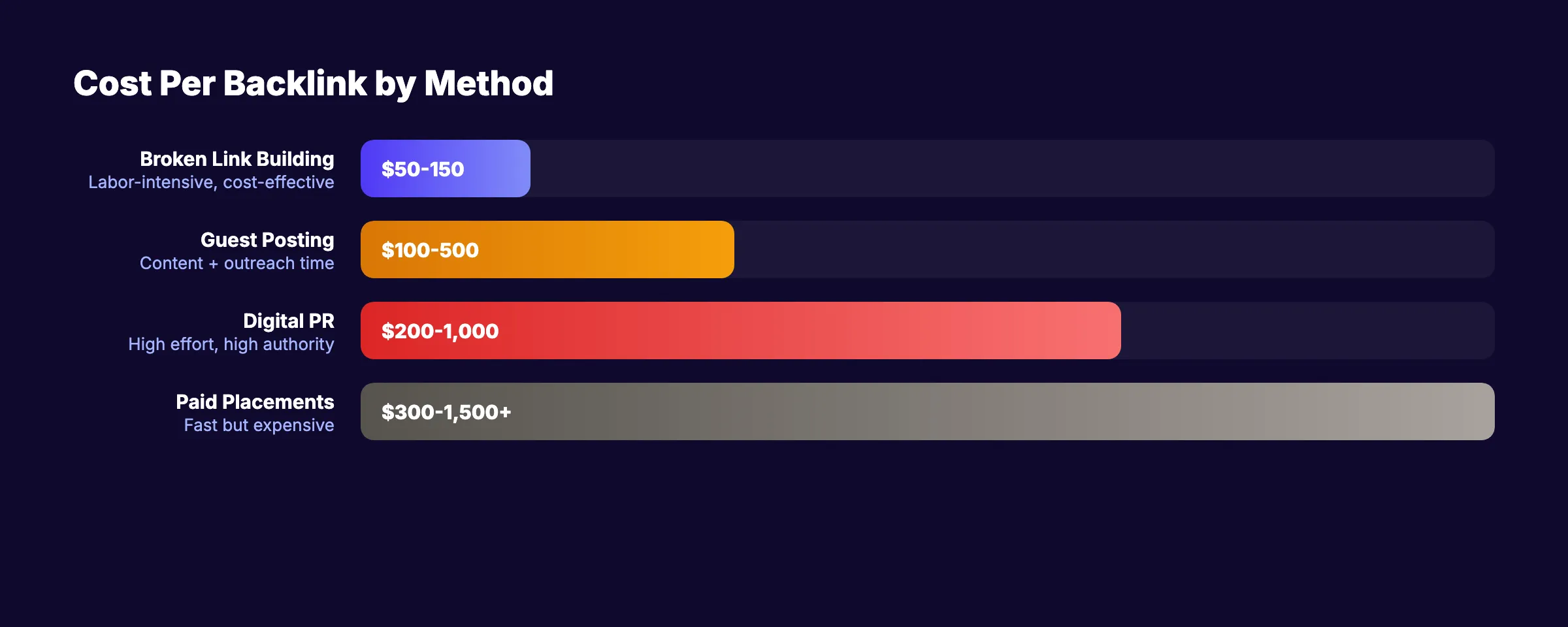
The average cost per quality backlink across all methods is $508.95, according to a survey of 518 SEO professionals. Broken link building typically costs less because it does not require payment to publishers.
| Method | Avg Cost Per Link | Time Investment |
|---|---|---|
| Broken link building | $50-150 (labor only) | 2-4 hours per link |
| Guest posting | $100-500 | 4-8 hours per link |
| Digital PR | $200-1,000 | 8-20 hours per link |
| Paid placements | $300-1,500+ | 1-2 hours per link |
The tradeoff is time. Broken link building is labor-intensive but cost-effective.
Your SEO team. $99 per month. Stacc publishes 30 optimized articles every month so you can focus on building links instead of writing content. Start for $1 →
Chapter 3: How to Find Broken Link Opportunities
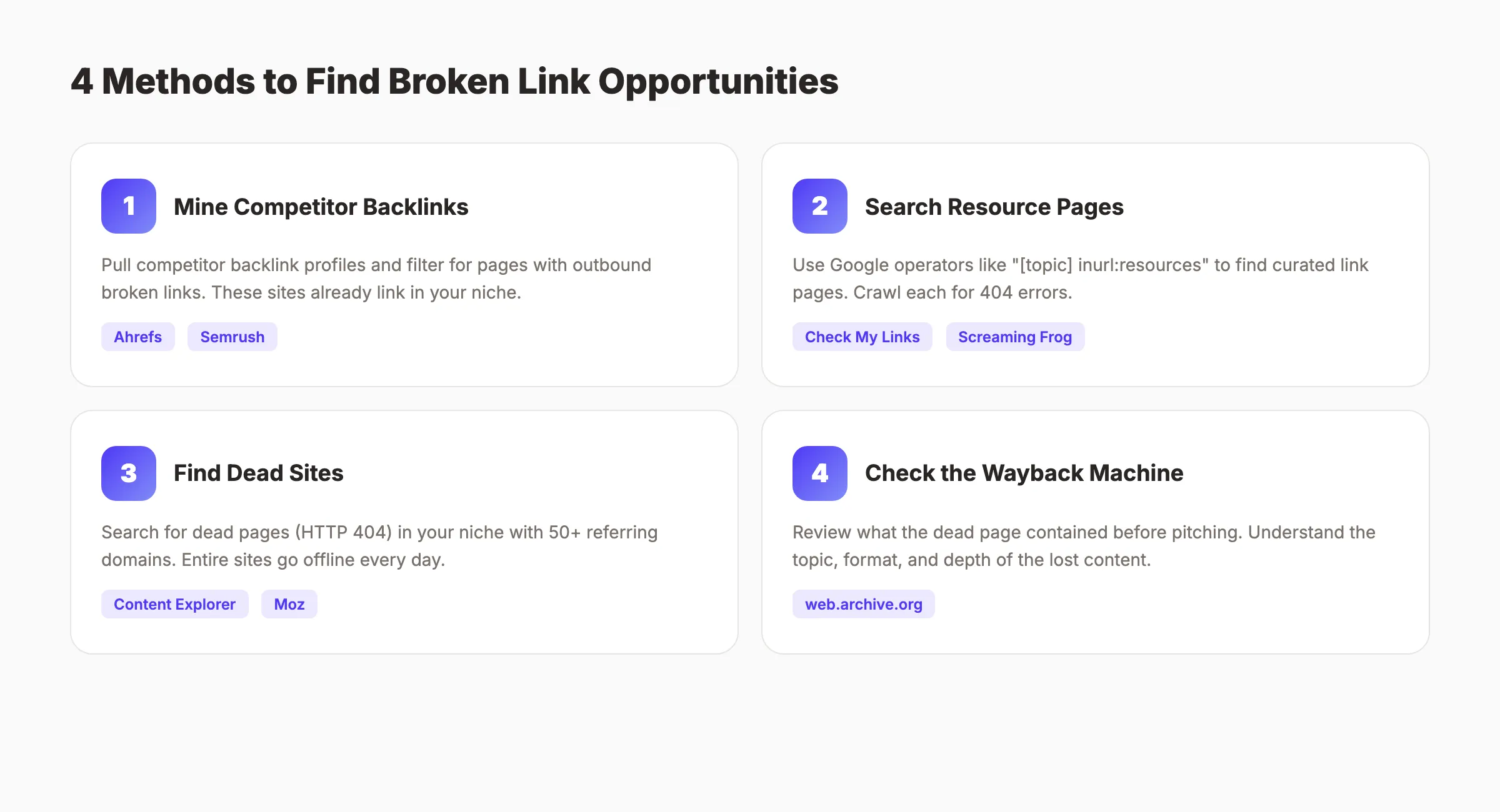
Four methods work. Start with the one that matches your tools and niche.
Method 1: Mine Competitor Backlinks
Your competitors have backlinks from pages that also link to dead resources. Use those pages as starting points.
Process:
- Enter a competitor URL into Ahrefs, Semrush, or a similar backlink analysis tool
- Pull their full backlink profile
- Filter for pages with outbound broken links
- Check each broken link for relevance to your content
This method works because the linking pages are already in your niche. If they link to your competitor, they are likely to link to you.
Method 2: Search Resource Pages
Resource pages are curated lists of links on a specific topic. They tend to accumulate broken links over time because nobody updates them.
Search operators to use:
[your topic] inurl:resources[your topic] "useful links"[your topic] "recommended resources"[your topic] intitle:resources inurl:links
Then crawl each resource page with a tool like Check My Links (free Chrome extension) or Screaming Frog. Flag every link that returns a 404 or 410 status code.
Method 3: Find Dead Sites With Backlinks
Entire websites go offline. Domain registrations lapse. Businesses close. The backlinks to those dead sites still exist in the link graph.
Process:
- Use Ahrefs Content Explorer to search for pages in your niche
- Filter by “one page per domain” and set referring domains to 50+
- Filter for HTTP status 404
- Sort by referring domains (highest first)
This surfaces dead pages that once had significant authority. If the dead page covered a topic you can recreate, you have a strong replacement pitch.
Method 4: Check the Wayback Machine
Before you outreach, check what the dead page actually contained. The Wayback Machine archives snapshots of most web pages.
Enter the dead URL. Review the most recent snapshot. Note:
- What topic the page covered
- How detailed the content was
- What format it used (listicle, guide, tool, data)
- Whether your existing content matches or exceeds it
This step is critical. You need to understand what was lost before you can offer a credible replacement.
Chapter 4: How to Qualify Opportunities Worth Pursuing
Not every broken link is worth chasing. Most are low-value. A scoring framework saves time.
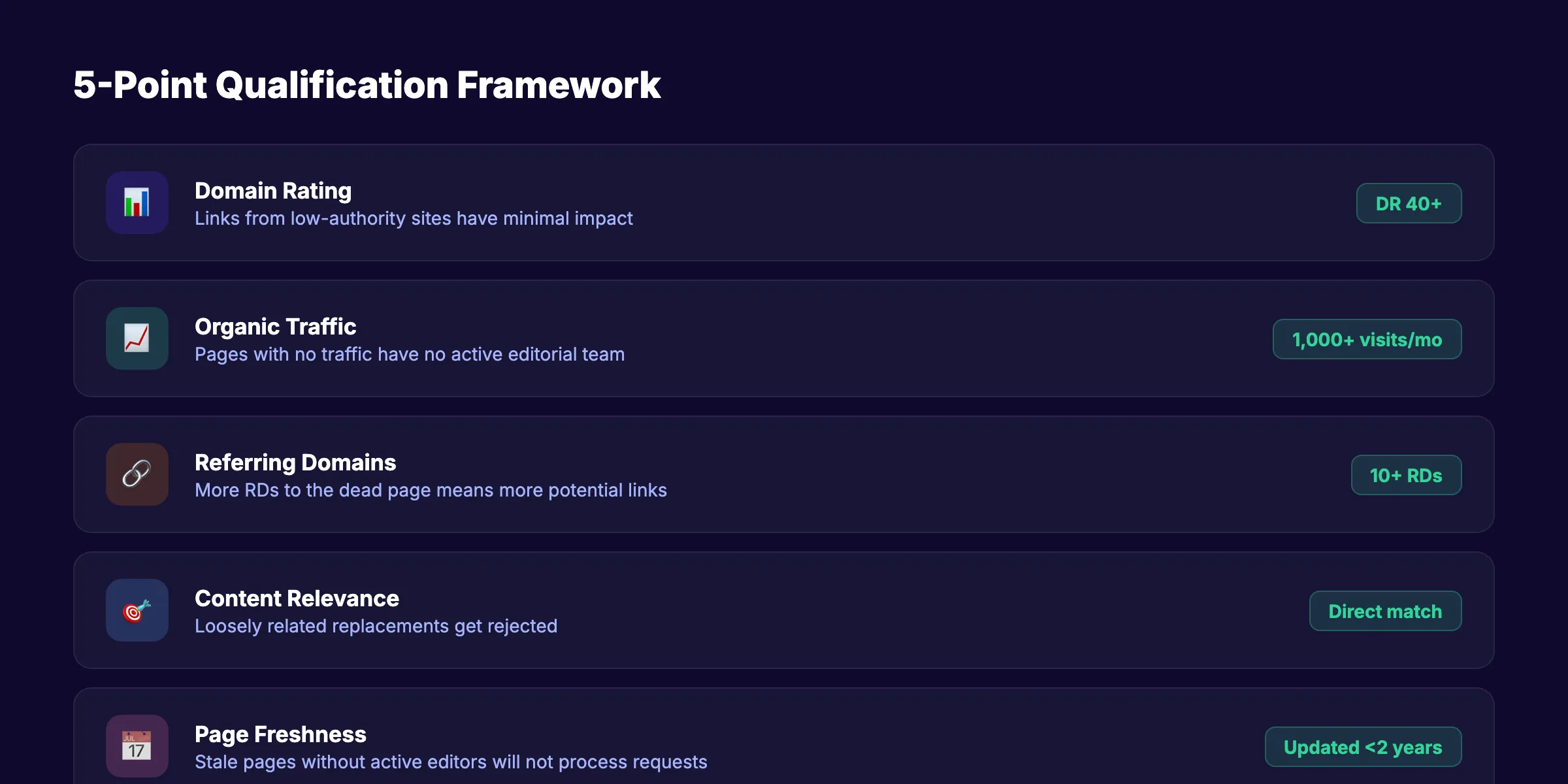
The 5-Point Qualification Framework
Rate each opportunity on these 5 criteria before adding it to your outreach list.
| Criteria | Threshold | Why It Matters |
|---|---|---|
| Domain Rating (DR) | 40+ | Links from low-authority sites have minimal ranking impact |
| Organic traffic | 1,000+ monthly visits | A page with no traffic likely has no editorial team maintaining it |
| Referring domains to the dead page | 10+ | More referring domains means more potential links from one dead page |
| Content relevance | Direct match to your niche | Loosely related replacements get rejected |
| Page freshness | Updated within 2 years | Stale pages without active editors will not process your request |
Score and Prioritize
Assign 1-3 points per criteria. Any opportunity scoring 10+ out of 15 goes to the top of your list. Anything under 7, skip it.
This prevents the most common broken link building mistake: spending 4 hours chasing a link from a DR 15 blog that gets 200 visits per month.
Red Flags to Skip
- Dead domains. If the entire domain is dead, there is no one to email
- Spam-heavy sites. Pages with 100+ outbound links are usually link farms
- No contact information. If you cannot find the editor, you cannot pitch
- Paid link pages. Some “resource” pages charge for inclusion. These violate Google’s spam policies
- Competitor roundup pages. Pages listing only your competitors will not add you
3,500+ blogs published. 92% average SEO score. See what Stacc can do for your site. Start for $1 →
Chapter 5: How to Create Replacement Content
You have two options: use existing content or create something new.
Option 1: Match With Existing Content
Review the dead page in the Wayback Machine. Compare it to content you already have published. If one of your existing pages covers the same topic at equal or greater depth, use that URL in your outreach.
This is the fastest path. No new content creation required.
Option 2: Create a Purpose-Built Replacement
If you do not have matching content, create it. The replacement should:
- Cover the same topic as the dead page
- Match or exceed the original depth and quality
- Use a similar format (if the dead page was a list, create a list)
- Be published and indexed before you start outreach
- Include updated data, links, and references
Do not create thin placeholder content. Site owners check the replacement before updating their link. A weak page kills your pitch.
The Improvement Angle
The best broken link building campaigns do not just replace dead content. They improve on it. The dead page had 10 tips. Your replacement has 25. The dead page was from 2019. Your version has 2026 data.
This gives site owners a reason to link to you beyond convenience. You are upgrading their page by offering a better resource than what they lost.
Content Formats That Convert Best
Based on competitor analysis of successful campaigns:
| Format | Conversion Rate | Why |
|---|---|---|
| Data-backed guides | Highest | Hard to recreate, high editorial value |
| Curated resource lists | High | Easy for editors to evaluate at a glance |
| Tools and calculators | High | Unique utility, no easy substitute |
| Opinion pieces or news | Low | Subjective content is harder to pitch as a “replacement” |
| Product pages | Lowest | Editors will not link to sales pages |
The pattern is clear. The more useful and objective your content, the higher the conversion rate.
Chapter 6: How to Write Outreach Emails That Get Replies
The email is where most campaigns fail. A great opportunity with a bad email produces zero links.
The Anatomy of an Effective Pitch
Every broken link building email needs 4 elements:
- Specific page reference. Name the exact page where the broken link exists
- Proof of the problem. Identify which link is broken and what error it returns
- Your replacement. Offer a specific URL as the fix
- Easy action. Make updating the link effortless
Template 1: Single Broken Link
Subject: Broken link on [Page Title]

Hi [First Name],

I was reading your article on [Topic] and noticed one of your links
is broken. The link to [Dead Page Title] in the [section name]
section returns a 404.

I recently published a guide on the same topic:
[Your URL]

It covers [2-3 specific things your content includes].

If you think it is a good fit, it could replace the dead link.
Either way, wanted to flag the 404.

[Your Name]
Template 2: Multiple Broken Links
Subject: Found a few broken links on [Site Name]

Hi [First Name],

I was going through your [Page Title] page and found a few links
that are no longer working:

- [Dead URL 1]. Returns 404
- [Dead URL 2]. Returns 404
- [Dead URL 3]. Domain expired

For the link about [Topic], I have an updated resource that covers
the same ground:
[Your URL]

Happy to help with alternatives for the others if useful.

[Your Name]
Template 3: Competitor Replacement
Subject: Quick note about [Page Title]

Hi [First Name],

Your article [Page Title] links to [Competitor Site] in the
[section] section. That page is no longer live.

I published a similar resource here: [Your URL]

It covers [specific angle], which is what the original page
addressed. Might be a good replacement.

[Your Name]
What Makes Emails Convert
Data from Editorial.link’s survey shows clear patterns:
- Personalized subject lines increase response rates by 33%
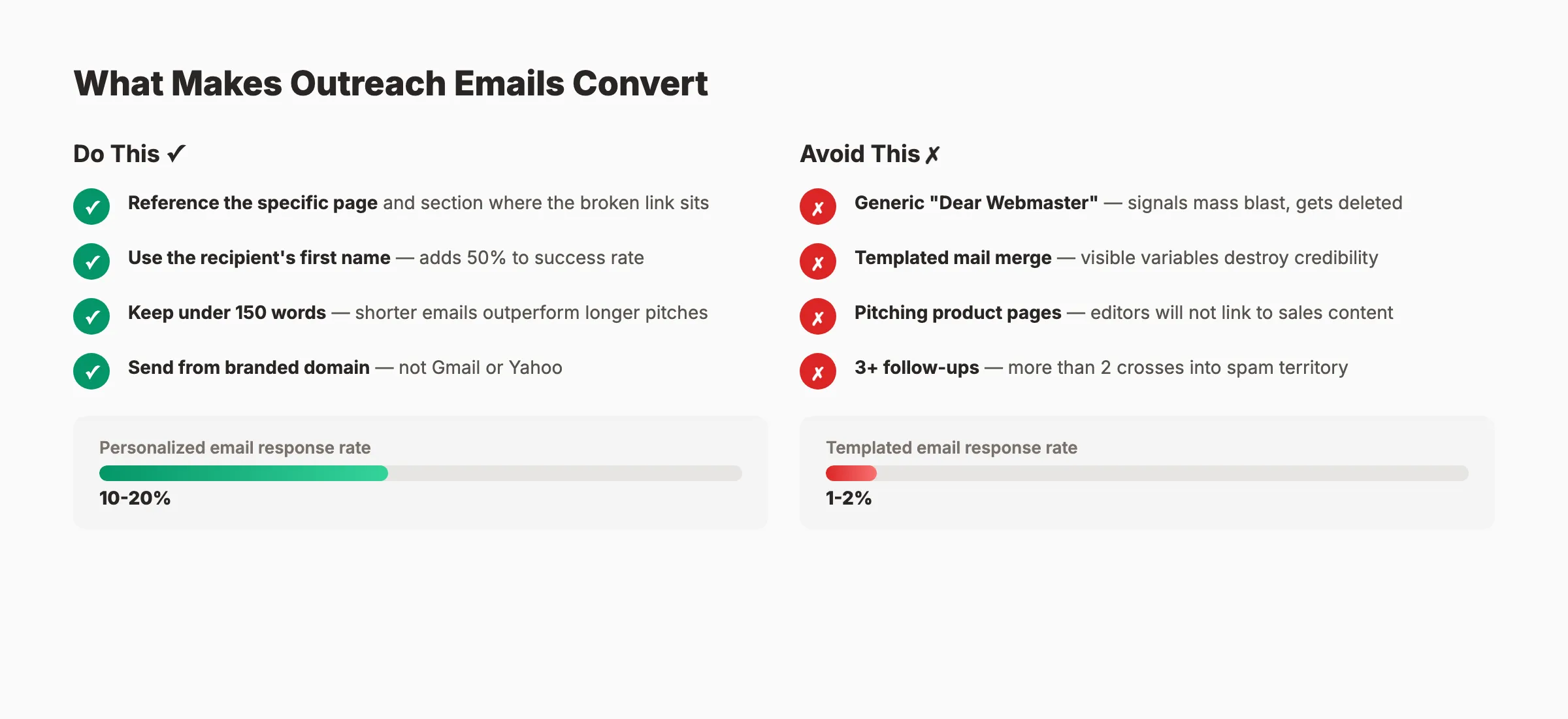
- Using the recipient’s first name increases success by 50%
- Referencing a specific page and section signals you actually read their content
- Keeping emails under 150 words outperforms longer pitches
- Sending from a branded domain email (not Gmail) improves credibility
The biggest mistake is templated outreach with mail merge variables left in. If your email reads like a mass blast, it gets deleted.
Chapter 7: Follow-Up Strategy and Campaign Management
Most replies come from follow-up emails, not the first touch.
Follow-Up Timing
| Timing | Purpose | |
|---|---|---|
| Initial pitch | Day 0 | Present the opportunity |
| Follow-up 1 | Day 3-4 | Gentle reminder |
| Follow-up 2 (optional) | Day 7-10 | Final check-in |
Stop after 2 follow-ups. Three or more emails cross from persistent into annoying.
Follow-Up Template
Subject: Re: Broken link on [Page Title]

Hi [First Name],

Just circling back on this. The broken link on your [Page Title]
page is still returning a 404.

Happy to help if you need an alternative resource.

[Your Name]
Tracking Your Campaigns
Use a spreadsheet or CRM to track every outreach attempt. Record:
- Target URL (the page with the broken link)
- Target domain and DR
- Dead URL (the broken link)
- Your replacement URL
- Contact name and email
- Email sent date
- Follow-up sent date
- Response (yes/no/pending)
- Link placed (confirmed in backlink audit)
Scaling Beyond 10 Links Per Month
To scale broken link building:
- Batch prospecting. Dedicate 2-3 hours per week to finding and qualifying opportunities. Build a pipeline of 50+ qualified targets before starting outreach.
- Templatize but personalize. Use templates as starting points. Customize the page reference, section mention, and content description for every email.
- Combine with content creation. Publish new content weekly. Each new page becomes potential replacement material for future campaigns.
- Track conversion rates by niche. Some verticals convert at 2%. Others convert at 15%. Double down on verticals that work and abandon those that do not.
Stop writing. Start ranking. Stacc publishes 30 SEO articles per month for $99 so you can focus on link acquisition. Start for $1 →
Chapter 8: Common Mistakes and How to Fix Them
These errors kill campaigns. Avoid every one.
Mistake 1: Skipping Qualification
Sending outreach to every broken link you find wastes time. A DR 12 blog with 50 monthly visits will not move your rankings even if you get the link. Use the scoring framework from Chapter 4.
Mistake 2: Not Checking the Dead Content
If you pitch a replacement without knowing what the dead page contained, you are guessing. The site owner will check. If your content does not match the topic, they reject the pitch immediately.
Always check the Wayback Machine first.
Mistake 3: Mass Templated Outreach
Sending identical emails to 500 people produces 1-2% response rates. Personalizing 50 emails produces 10-15% response rates and more total links with less effort.
Mistake 4: Pitching Product Pages
No editor will replace an informational dead link with your product or pricing page. Pitch blog posts, guides, tools, or data. Save commercial pages for your internal linking strategy.
Mistake 5: Giving Up After One Campaign
Broken link building is a volume game played over months. One week of outreach will not transform your link profile. The practitioners who earn 20+ links per month run campaigns consistently, refine their templates based on data, and expand into new niches over time.
Mistake 6: Ignoring Response Data
Track which emails get replies and which get ignored. Compare subject lines, email length, personalization level, and niche. After 100 emails, patterns emerge. Use those patterns to improve every future campaign.
Mistake 7: Not Building Linkable Content First
You cannot do broken link building without content worth linking to. If your site has 5 thin blog posts, you have nothing to offer as a replacement. Build a library of useful, data-backed content before starting outreach.
Broken Link Building Checklist
Use this to audit your process before every campaign:
- Identified 20+ broken link opportunities in your niche
- Scored each opportunity using the 5-point framework
- Checked Wayback Machine for every dead page
- Verified your replacement content matches or exceeds the dead page
- Found individual contact emails (not generic forms)
- Personalized every outreach email with page and section references
- Scheduled follow-ups for day 3-4 after initial send
- Set up tracking for responses and link placements
- Planned weekly prospecting sessions to maintain pipeline
FAQ
What is broken link building?
Broken link building is an SEO tactic where you find dead outbound links on other websites and offer your content as a replacement. You help site owners fix 404 errors on their pages while earning a backlink in the process.
Does broken link building still work in 2026?
Yes. The tactic works because the underlying problem keeps growing. 66.5% of web links since 2013 are now dead. As more content goes offline, the number of broken link opportunities increases every year. Response rates range from 5-20% depending on niche and email quality.
What tools do I need for broken link building?
At minimum, you need a backlink analysis tool (Ahrefs, Semrush, or Moz) to find broken links, Check My Links (free Chrome extension) to verify them, and the Wayback Machine to review dead content. For outreach at scale, a CRM like BuzzStream or a spreadsheet works for tracking.
How many broken link building emails should I send?
Start with 20-30 personalized emails per week. At a 10% conversion rate, that produces 2-3 links weekly. Scale to 50-100 emails per week as you refine your templates and build a larger prospect pipeline. Quality matters more than volume.
What is the difference between broken link building and link reclamation?
Link reclamation recovers links you already had. If a site used to link to your page and removed the link, you reclaim it. Broken link building earns new links from sites that never linked to you. The outreach angle differs: reclamation says “you used to link to us,” while broken link building says “here is a fix for your dead link.”
How long does it take to see results from broken link building?
Individual links can be placed within 1-2 weeks of outreach. Ranking impact from new backlinks typically appears within 3 months. Consistent campaigns running 3-6 months produce measurable improvements in domain authority and organic traffic.
Broken link building is not the fastest link building method. It is one of the most reliable. The process rewards patience, personalization, and genuine content quality. Start with 20 qualified opportunities, send your first batch of emails this week, and refine based on what the response data tells you.

Written by
Siddharth GangalSiddharth is the founder of theStacc and Arka360, and a graduate of IIT Mandi. He spent years watching great businesses lose organic traffic to competitors who simply published more. So he built a system to fix that. He writes about SEO, content at scale, and the tactics that actually move rankings.
30 SEO blog articles published every month
Keyword-optimized, scheduled, and live on your site. Automatically.
30-day trial · Cancel anytime
theStacc
Stop writing SEO content manually
30 blog articles, 30 GBP posts, and social media content. Published every month. Automatically.
Start Your $1 Trial$1 for 3 days · Cancel anytime