A complete marketing RFP template for SEO agencies. All 8 sections, 25 must-ask questions, and an evaluation scoring rubric. Updated for 2026.
Most companies that hire an SEO agency without a proper marketing RFP template end up with one of two problems: they overpay for a scope they never defined, or they pick the wrong agency because they compared incomparable proposals. A structured RFP fixes both.
We have worked with 70+ industry types and reviewed hundreds of agency-client relationships. The ones that start with a clear RFP process consistently report better results, fewer scope disputes, and shorter time-to-value. The ones that skip it argue about deliverables in Month 3.
This guide gives you a complete, copy-ready marketing RFP template for SEO agencies. With every section written out, 25 questions to include, an evaluation scoring rubric, and 2026-specific requirements that most templates miss.
Here is what you will learn:
- What a marketing RFP is and when you actually need one
- The data you must gather before writing a single line
- All 8 sections of an effective SEO RFP with template language
- 25 questions to ask every agency (including AI readiness questions)
- A scoring rubric for evaluating proposals fairly
- The 6 most common RFP mistakes that lead to bad hires
- 2026-specific additions that reflect how SEO has changed
What a Marketing RFP for SEO Agencies Actually Is
An RFP. Request for Proposal. Is a structured document you send to multiple SEO agencies to solicit comparable proposals. It is not a conversation starter. It is a specification document.
What an RFP Does
A good SEO RFP does 4 things simultaneously:
- Forces you to clarify your own goals before talking to anyone
- Gives every agency the same information so proposals are comparable
- Sets a professional tone that attracts serious agencies
- Creates a paper trail for expectations and deliverables
When You Need a Formal RFP
Use a formal RFP when:
- Your monthly SEO budget exceeds $3,000
- You are evaluating 3 or more agencies
- Multiple internal stakeholders must approve the hire
- You have specific compliance, integration, or technical requirements
- You are managing a rebrand, migration, or recovery from a penalty
When You Do Not Need a Formal RFP
Skip the full RFP process when:
- Your monthly budget is under $2,000
- You already have a strong referral from a trusted source
- You need results in 30 days, not 90
- You are testing a single channel with one agency
For smaller budgets or faster timelines, a managed SEO service avoids the RFP process entirely. Read the agency pricing models guide to understand where the cost-benefit line falls between hiring an agency and using an automated SEO platform.
What to Prepare Before You Write Anything
A weak RFP comes from weak preparation. Before writing a single section, gather 6 categories of data.
1. Analytics Baseline
Pull the last 12 months of data from Google Analytics and Google Search Console:
- Total organic sessions, month by month
- Top 20 organic landing pages by traffic
- Top 50 keywords you currently rank for (position + volume)
- Organic conversion rate and revenue (if applicable)
2. Technical Inventory
Document your current setup:
- CMS and platform (WordPress, Webflow, custom)
- Hosting and CDN provider
- Any known technical issues (site speed, crawl errors, canonicals)
- Past SEO audits or penalties (if applicable)
3. Competitive Context
List your top 3 to 5 organic competitors. Include their estimated traffic if you have it from Ahrefs or Semrush.
4. Internal Resources
Agencies need to know what your team can and cannot support:
- Do you have a content writer or will the agency handle all content?
- Who has access to the CMS for technical changes?
- Who is the internal SEO point of contact?
5. Past Vendor History
If you have worked with an SEO agency before:
- What did they deliver?
- Why did the relationship end?
- What would you do differently?
6. Budget and Timeline
Know your numbers before you ask agencies for theirs. Ambiguous budgets produce ambiguous proposals. Set a range: "Our budget for SEO services is $4,000 to $8,000 per month for the first 12 months."
Use the SEO ROI calculator to model expected returns at different investment levels before you set your budget.
Your SEO team. $99 per month. theStacc publishes 30 SEO-optimized articles per month. No agency overhead, no RFP process required.
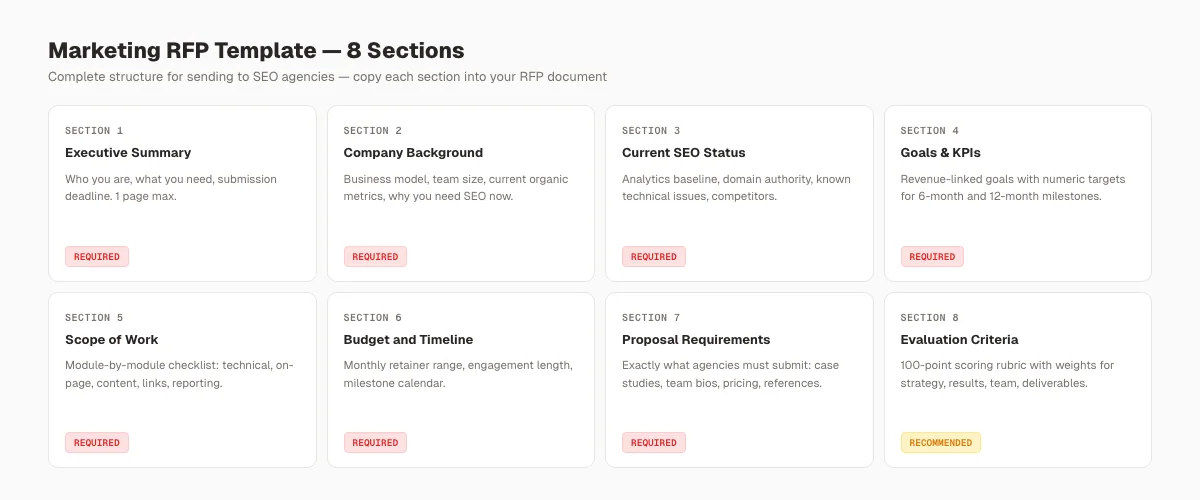
The Complete 8-Section Marketing RFP Template
Below is a complete, copy-ready RFP template. Sections in [brackets] are placeholders for your company's data.
Section 1: Executive Summary
Purpose: Give agencies a 1-page overview of who you are, what you need, and the submission deadline.
EXECUTIVE SUMMARY
Company: [Company Name] Industry: [Your Industry] Issued by: [Contact Name, Title] Issue Date: [Date] Submission Deadline: [Date. Allow 10 to 14 business days]
We are seeking proposals from qualified SEO agencies to [primary goal. E.g., "increase organic traffic by 40% in 12 months" / "recover from a Google core update" / "support a site migration"]. Proposals are due by [Date]. Shortlisted agencies will be notified by [Date] and finalists interviewed between [Date Range].
Section 2: Company Background
Purpose: Give agencies enough context to propose accurately. One page maximum.
COMPANY BACKGROUND
[Company Name] is a [company type: B2B SaaS / local service business / ecommerce brand] based in [Location]. We [describe what the company does in 1-2 sentences].
Website: [URL] Founded: [Year] Team size: [Range] Current monthly organic sessions: [Number from Google Analytics] Primary revenue model: [Subscription / transactional / service retainer / other]
Why we are issuing this RFP now: [Explain the trigger. Product launch, lost traffic, new market, site migration, etc.]
Previous SEO work: [None / worked with an agency (brief outcome) / managed internally]
Section 3: Current SEO Status
Purpose: Give agencies the data they need to scope the work honestly.
CURRENT SEO STATUS
| Metric | Current Value | Source |
|---|---|---|
| Monthly organic sessions | ✓ | Google Analytics |
| Domain Rating / Authority | ✓ | Ahrefs / Semrush |
| Number of indexed pages | ✓ | Google Search Console |
| Top-ranking keyword (position) | [Keyword] at [Position] | GSC |
| Core Web Vitals (LCP) | ✓ ms | PageSpeed Insights |
| Known technical issues | [List or "None known"] | Internal audit |
Content inventory: We publish [frequency] content pieces per month. Our content team consists of [description. E.g., "1 in-house writer with SEO support from our marketing manager"].
Top organic competitors: [Competitor 1], [Competitor 2], [Competitor 3]
Section 4: Project Goals and KPIs
Purpose: Define success. Anchor goals to revenue, not just rankings.
PROJECT GOALS
Our primary goals for this SEO engagement are:
- Increase organic leads by [X%] within [Timeframe]. Organic is currently responsible for [X%] of total lead volume. We aim to grow that to [X%].
- Rank in the top 5 for ✓ target keywords. Our priority keyword clusters are [list 3-5 clusters. E.g., "SEO tools for accountants," "local SEO for dentists"].
- [Secondary goal. E.g., "Recover traffic lost after the March 2026 Google update."]
Success KPIs:
| KPI | Current Baseline | 6-Month Target | 12-Month Target |
|---|---|---|---|
| Organic monthly sessions | ✓ | ✓ | ✓ |
| Organic lead conversions | ✓ | ✓ | ✓ |
| Target keyword rankings (avg. position) | ✓ | ✓ | ✓ |
| Domain Rating | ✓ | ✓ | ✓ |
| Organic revenue contribution | [X%] | [X%] | [X%] |
Section 5: Scope of Work
Purpose: Define exactly what services you want. "SEO" is not a scope. Break it into modules.
SCOPE OF WORK
We are seeking a full-service SEO engagement covering the following modules. Please confirm which items you include in your base retainer and which are add-ons with separate pricing.
Module 1: Technical SEO
- ✓ Technical audit and remediation roadmap
- ✓ Core Web Vitals optimization (LCP, CLS, INP)
- ✓ Crawlability and indexation improvements
- ✓ Structured data / Schema.org implementation
- ✓ Site migration support (if applicable)
Module 2: On-Page Optimization
- ✓ Title tag and meta description optimization
- ✓ Header hierarchy and internal linking audit
- ✓ Keyword mapping across existing pages
- ✓ Content gap analysis
Module 3: Content Strategy and Production
- ✓ Monthly editorial calendar
- ✓ ✓ new articles/month (specify volume)
- ✓ Existing content refresh and updates
- ✓ Content brief creation
Module 4: Link Building
- ✓ Link audit and toxic link disavow
- ✓ Monthly link acquisition (specify target volume and DA range)
- ✓ Digital PR / brand mention strategy
Module 5: Reporting and Communication
- ✓ Monthly performance report (organic sessions, rankings, conversions)
- ✓ Quarterly strategy review
- ✓ Access to live ranking dashboard
- ✓ Dedicated account manager
Out of scope for this engagement: [List explicitly. E.g., "Paid search management, social media management, website redesign."]
Section 6: Budget and Timeline
Purpose: Transparent budget produces accurate proposals. Do not hide this number.
BUDGET AND TIMELINE
Monthly retainer budget range: $[Min] to $[Max] per month
Engagement length: We expect an initial 12-month engagement with a 30-day termination clause after Month 3.
One-time project fees: We have ✓ budget available for one-time work such as technical audits, site migrations, or content builds.
Payment terms: [Net 30 / monthly in advance / other]
Timeline expectations:
| Milestone | Expected Date |
|---|---|
| Proposal submission deadline | [Date] |
| Agency shortlist announced | [Date] |
| Final interviews | [Date Range] |
| Contract signed | [Date] |
| Kickoff | [Date] |
| First monthly report | [Date] |
| Initial ranking movement expected | 60–90 days post-kickoff |
Section 7: Proposal Requirements
Purpose: Tell agencies exactly what to submit so every proposal covers the same information.
WHAT YOUR PROPOSAL MUST INCLUDE
Please submit a proposal that includes all of the following:
- Agency overview. Founded, team size, clients served, key specializations
- Proposed strategy. A specific, prioritized SEO strategy based on our company background (not a generic template)
- Case study , 1 to 2 case studies from clients in our industry or with comparable starting metrics
- Deliverables list. Exact monthly deliverables for each module, with owner assigned
- Team assignment. Names and roles of the people who will work on our account
- Pricing breakdown. Itemized by module, one-time vs. monthly, and what triggers additional billing
- Tools and technology. List of primary SEO tools used and why
- Reporting sample , 1 example of a monthly client report
- References , 2 to 3 client references available for a call
Format: PDF or Google Slides, maximum 20 pages Submission: [email address or submission portal link]
Section 8: Evaluation Criteria
Purpose: Tell agencies how you will score proposals so serious agencies self-select in.
HOW WE WILL EVALUATE PROPOSALS
We evaluate all proposals against a 100-point scoring rubric:
| Criterion | Weight | What We Look For |
|---|---|---|
| Strategic fit | 25 pts | Does the strategy match our actual goals? Is it specific to our situation? |
| Proven results | 25 pts | Do case studies show measurable results in comparable contexts? |
| Team quality | 20 pts | Are named team members experienced? Is an account manager dedicated? |
| Deliverables clarity | 15 pts | Is every deliverable specific, measurable, and owner-assigned? |
| Pricing transparency | 10 pts | Is pricing itemized and free of vague "additional fees"? |
| Communication approach | 5 pts | Is the reporting cadence and format acceptable? |
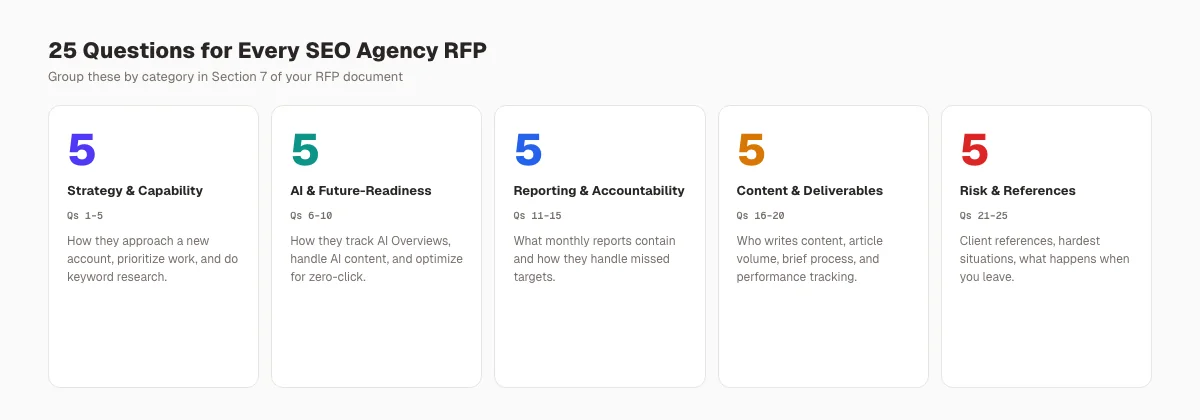
25 Questions Every SEO RFP Must Ask
Most RFP templates stop at scope and budget. The questions section is where you discover how agencies actually think.
Strategy and Capability Questions
- Walk us through how you would approach our site in the first 30 days.
- What is your process for prioritizing technical vs. content vs. link-building work?
- How do you conduct keyword research, and which tools do you use?
- How do you decide what content to create vs. what to update?
- How many client accounts does each account manager handle?
AI and Future-Readiness Questions (2026 Requirements)
- How do you track visibility in AI search results (ChatGPT, Perplexity, Google AI Overviews)?
- What is your policy on AI-generated content for client sites?
- How has your SEO process changed since Google's AI Overviews became widespread?
- Can you walk us through one client example using pre-AI vs. post-AI measurement?
- How do you optimize for zero-click and featured snippet results?
Reporting and Accountability Questions
- What does a standard monthly report contain, and who prepares it?
- How do you attribute organic leads vs. organic traffic when reporting?
- What happens if we miss a KPI target in Month 3?
- How do you communicate unexpected setbacks or algorithm updates?
- How often do you access our Google Analytics and Search Console accounts?
Content and Deliverables Questions
- Who writes the content. In-house, freelance, or AI-assisted? Who reviews it?
- How many articles per month are included in the base retainer?
- How do you handle content briefs, and will our team see them before writing begins?
- What is your turnaround time from brief to published article?
- How do you measure whether a published article is performing?
See our SEO client questionnaire template for additional vetting questions to use during agency calls.
Risk and References Questions
- Can you provide references from 2 to 3 clients in our industry?
- What was the most difficult client situation you have handled, and what was the outcome?
- What happens to our SEO assets (content, links, rankings) if we end the engagement?
- Have you ever had a client penalized by Google? What happened?
- What are the limits of your SEO guarantee, if any?
How to Score and Compare Agency Proposals
Receiving 4 proposals and comparing them by price alone is how bad hires happen. Use a structured scoring process.
The 4-Step Evaluation Process
Step 1: Score independently Have each evaluator score proposals separately using the 100-point rubric before discussing. Avoid anchoring bias from other people's scores.
Step 2: Flag red flags immediately Any proposal that hits a red flag gets removed before the group discussion. Red flags include:
- ✓ Guarantee of specific rankings ("We will get you to position 1 for [keyword]")
- ✓ No case studies from comparable clients
- ✓ Vague deliverables ("We will optimize your content")
- ✓ No named team members
- ✓ Pricing that changes significantly depending on your responses
- ✓ No questions back to you (good agencies ask questions before proposing)
Step 3: Shortlist to 2 to 3 finalists Hold 30-minute calls with your top finalists. Bring 3 follow-up questions per agency. Ask each the same questions for fair comparison.
Step 4: Check references before signing Call at least 1 reference per shortlisted agency. Ask: "What would you have wanted to know before hiring them that you know now?"
3,500+ blogs published. Every article is SEO-scored before publish. See what a done-for-you SEO service looks like without the agency contract.
The 6 RFP Mistakes That Lead to Bad Agency Hires
Most RFP failures trace back to 1 of these 6 mistakes.
Mistake 1: Hiding the Budget
Agencies that do not know your budget propose either too much or too little. You receive 4 incomparable proposals and cannot evaluate them against a shared standard.
Fix: Always include a budget range in Section 6. "We expect to spend $4,000 to $6,000 per month for a 12-month initial engagement" is enough.
Mistake 2: Vague Scope ("We Need SEO")
"SEO" covers technical work, content creation, link building, reporting, and local optimization. An RFP that says "we need SEO help" produces proposals with completely different scopes.
Fix: Use the Module format from Section 5. Check each module you want. Mark the others as out of scope.
Mistake 3: Unrealistic Timeline Expectations
Expecting ranking movement in 30 days signals to serious agencies that you do not understand organic search. Good agencies write off unrealistic RFPs as a waste of time.
Fix: Use 60 to 90 days for initial movement. 6 months for meaningful traffic gains. 12 months for compounding results.
Mistake 4: Not Sharing Current SEO Data
Agencies that do not know your current traffic, technical status, and competitive context propose generic strategies. They are guessing.
Fix: Include the data table from Section 3. Add your Google Search Console screenshot in an appendix.
Mistake 5: Too Many Agencies
Sending an RFP to 10 agencies signals price shopping. Quality agencies deprioritize their response or send a generic template.
Fix: Maximum 5 agencies. Vet the list before sending. A warm introduction from a peer is better than a cold RFP to 10 strangers.
Mistake 6: Picking the Cheapest Proposal
The cheapest SEO agency proposal is the cheapest for a reason. It usually means lower-quality content, outsourced link building, or an inexperienced account manager.
Fix: Evaluate against the 100-point rubric. The highest-scoring proposal on strategy, results, and team quality wins. Not the lowest price.
For more on how agencies structure their pricing, read the complete guide to agency pricing models for SEO services.
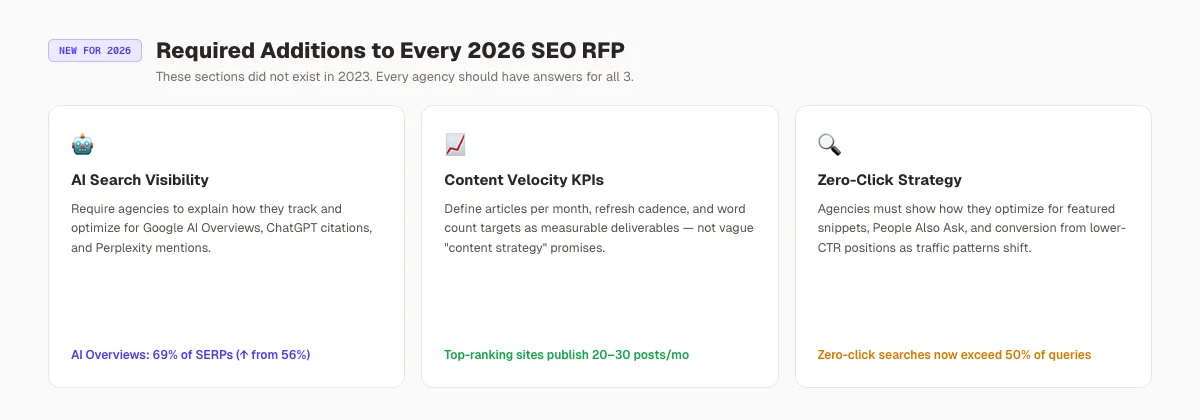
2026-Specific Additions to Every SEO RFP
The SEO scene shifted significantly in 2025. Your RFP should reflect it.
Add an AI Search Visibility Section
Google's AI Overviews now appear on approximately 69% of all search results pages, up from 56% in 2024. An agency that cannot demonstrate how they optimize for AI search results is operating on 2023 strategy.
Add this requirement to Section 5:
AI Search Optimization (Required)
- Describe your approach to ranking in Google AI Overviews
- How do you track brand mentions in ChatGPT, Perplexity, and Gemini?
- What is your process for optimizing content for AI citation?
Require Content Velocity Metrics
The shift from "quality over quantity" to "quality AND quantity" is documented. According to Seer Interactive's 2026 SEO RFP guide, agencies that cannot deliver consistent publishing volume at the right quality level consistently underperform on organic traffic growth.
Add to Section 4 (KPIs):
| Content KPI | Current | Target |
|---|---|---|
| New articles published per month | ✓ | ✓ |
| Content refresh frequency | [X/quarter] | [X/quarter] |
| Average word count of published content | ✓ | ✓ |
Ask About Zero-Click Strategy
AI Overviews and featured snippets reduce click-through rates even for top-ranking pages. Ask agencies: "How do you optimize for conversion from lower-CTR positions, and how do you measure content performance beyond traffic?"
Require Third-Party Data Integration
Agencies should pull data from Google Analytics, Search Console, Ahrefs or Semrush, and a CRM when reporting. Any agency relying on a single data source gives you an incomplete picture.
What to Do After You Select an Agency
The RFP process ends at agency selection. Onboarding begins the moment you sign.
The first 30 days of an SEO engagement determine whether the relationship succeeds. Clear onboarding protocols, access grants, and milestone agreements prevent the "nothing happened in Month 1" problem.
Read the complete guide on how to onboard SEO clients. It covers the exact access, data, and communication setup both parties need in the first week.
For companies exploring white-label or managed content options to complement agency work, the white-label SEO content guide covers how to scale content delivery without adding headcount.
Skip the RFP. Get 30 articles per month, published automatically. theStacc handles Blog SEO on autopilot. Starting at $99/month.
What practitioners are saying on X
AI search advice ages quickly. Here is high-signal public discussion from SEO and growth operators — context for your roadmap, not a substitute for primary data.
- @hridoyreh (Mar 2026): Widely shared SEO skill tree: foundations, research, technical, on-page, content, links, AI SEO/GEO, analytics, UX, brand, programmatic — useful map for stats and how-to posts. See the post on X.
- @jakezward (Feb 2026): 2026 SEO predictions emphasize AI Overview share-of-SERP, schema for LLM token efficiency, brand mentions in AI answers as a KPI, proprietary data as a moat, and content refresh beating net-new AI slop. See the post on X.
- @alexgroberman (Jul 2026): Case narrative: organic value plus multi-engine citations (ChatGPT, Perplexity, Grok) from knowledge-hub pages, category authority links, commercial intent content, and tight internal linking — not thin product copy. See the post on X.
Grok, AI Overviews, and multi-engine visibility
Analytics and SEO setup pages should keep entity names and steps extractable for AI Overviews, ChatGPT, Perplexity, and Grok.
- Google AI Overviews: Use passage-ready answers, tables, and FAQ schema where relevant.
- ChatGPT / Perplexity: Cite named sources next to key claims.
- Grok: Maintain accurate entity facts on-site and in high-signal X posts.
Publish content built for Google and AI citations. theStacc Content SEO ships SEO-scored articles structured for rankings and generative engines.
FAQ
A marketing RFP (Request for Proposal) is a structured document that a company sends to multiple SEO agencies to solicit and compare proposals. It defines goals, scope of work, budget range, timeline, and evaluation criteria so agencies can respond with tailored plans and pricing.
An effective SEO RFP runs 8 to 12 pages. Long enough to give agencies the context they need to propose accurately, short enough to stay focused. Avoid going beyond 15 pages. Excessively long RFPs deter high-quality agencies from responding.
Send your RFP to 3 to 5 agencies. Fewer than 3 limits comparison. More than 5 creates review fatigue and signals to agencies that you are price shopping, which often attracts generic, lower-quality responses.
An RFP is written by the client and sent to agencies. A proposal is written by the agency in response to the RFP. The RFP defines the client's needs. The proposal shows how the agency plans to meet those needs and at what price.
Score each proposal against your evaluation criteria using a consistent rubric. Hold 30-minute calls with your top 2 to 3 finalists. Ask follow-up questions. Check references. Then make a decision based on strategy fit, not just price.
A marketing RFP is not paperwork. It is the specification that separates a focused SEO engagement from an expensive experiment. The agencies that submit the best proposals are drawn to the RFPs that give them the most to work with.
Build the RFP once, use the template above, and you will never have to write one from scratch again.
Related Tools & Resources
Free SEO Tools:
Best Lists:
Sources & references

Researched, written, and published articles that compound organic traffic.
Weekly local SEO teardowns
One practical email a week. Map Pack, GBP, AI Overviews — no fluff. Unsubscribe anytime.