
Microsoft Copilot Search SEO: Complete Guide
How to optimize for Microsoft Copilot Search. Covers Bing SEO, schema markup, IndexNow, citations, and why Bing ranks you in 3 AI platforms.
Siddharth Gangal • 2026-04-02 • SEO Tips
In This Article
87% of ChatGPT Search citations match Bing’s top results. Microsoft Copilot uses the same Bing index. Optimizing for Bing gets your content cited in 3 AI search platforms simultaneously: Copilot, ChatGPT, and traditional Bing.
Most SEO teams ignore Bing. That is a mistake. Bing reached 10.48% U.S. search market share in 2026, its highest ever. Microsoft Copilot reaches over 1 billion Windows users, 300 million Edge users, and 400 million Microsoft 365 users. 90% of Fortune 500 companies use Microsoft 365 Copilot, which means your public web content surfaces inside enterprise workflows where procurement decisions happen.
This guide covers Microsoft Copilot search SEO: how Copilot sources answers, what determines citations, and the specific optimizations that earn visibility across the Microsoft AI ecosystem.
We have published 3,500+ blog posts across 70+ industries. We track citation patterns across ChatGPT, Copilot, Perplexity, and Google AI Overviews. This guide comes from that cross-platform data.
Here is what you will learn:
- How Copilot sources and cites web content
- Why optimizing for Bing gives you 3 AI platforms for the price of 1
- The technical requirements for Copilot citation readiness
- How enterprise Copilot changes B2B visibility
- A complete optimization checklist
How Microsoft Copilot Search Works
Copilot does not generate answers from training data alone. It retrieves and cites contemporary sources from Bing’s search index through a process Microsoft calls “web grounding.”
Copilot draws from 3 data sources:
- Bing’s search index. The primary data layer. If your content ranks in Bing, Copilot can cite it. If your content is not in Bing’s index, Copilot cannot see it.
- Real-time web crawling. Copilot pulls fresh content within hours if it meets structural requirements. The IndexNow protocol accelerates this.
- Microsoft’s Knowledge Graph. Entity relationships that map brands, people, products, and topics.
Copilot responses include prominent, clickable citations showing exactly where information comes from. A “Show all” button reveals every reference in a side panel. Microsoft explicitly designed the system “with publishers and content owners in mind to support a healthy web ecosystem.”
The citation pattern is concentrated. A study of 20,000 Copilot citations found that 1 page captured 69% of all citations. The top 4 pages captured 90%. Copilot does not spread citations evenly. It picks 1-2 primary sources and uses them heavily.
This means ranking first in Bing for a query is dramatically more valuable than ranking fifth. The difference between position 1 and position 5 in Copilot citations is not linear. It is exponential.
The 3-Platform Advantage: Bing, Copilot, and ChatGPT
This is the insight most SEO guides miss entirely.
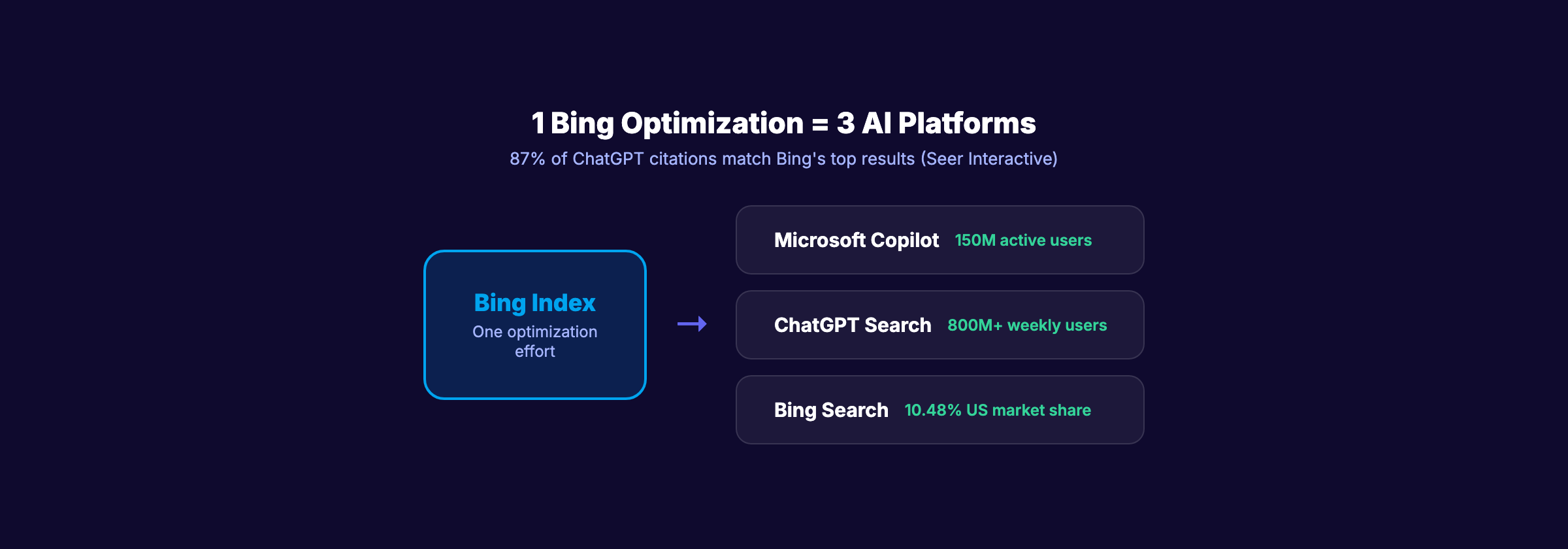
ChatGPT routes all live web searches through the Bing Web Search API. A Seer Interactive study confirmed that 87% of ChatGPT Search citations match Bing’s top results. Microsoft Copilot uses the same Bing index. Traditional Bing search uses the same index.
One Bing optimization effort yields visibility in 3 platforms:
| Platform | Data Source | Monthly Reach |
|---|---|---|
| Microsoft Copilot | Bing index | 150M active AI users |
| ChatGPT Search | Bing Web Search API | 800M+ weekly users |
| Bing traditional search | Bing index | 10.48% US market share |
No other single optimization effort has this multiplier effect. Google SEO gives you Google. Bing SEO gives you Bing, Copilot, and ChatGPT.
For search everywhere optimization, this is the highest-leverage action a team can take after Google. One index. Three surfaces. The competition is lower than Google for every query.
Rank everywhere. Do nothing. Stacc handles Blog SEO, Local SEO, and Social on autopilot. Content optimized for Google, Bing, and AI search. Start for $1 →
Copilot SEO Ranking Factors
Copilot citation selection follows a hierarchy. Domain authority and content relevance both matter, but the weight shifts depending on query type.
Bing Index Presence (Required)
If your site is not indexed in Bing, nothing else matters. This is a binary gate.
- Verify your site in Bing Webmaster Tools
- Submit your XML sitemap with accurate
lastmoddates - Implement IndexNow for real-time content discovery
- Check Index Coverage to confirm all key pages are indexed
Bing Webmaster Tools now includes an AI Performance Report (beta) that tracks Copilot citations and “grounding queries” — the underlying intents that trigger citations. This data does not exist in Google Search Console. It is exclusive to Bing.
Content Structure (Critical)
Copilot extracts answers from well-structured content. The format matters as much as the information.
Answer-first formatting. Use question-based H2 and H3 headings followed immediately by a 40-60 word direct answer. Copilot extracts these answer blocks directly. Place the definition or answer within the first 50 words of every section. This matches the answer capsule pattern that drives AI citations across all platforms.
Self-contained sections. Each H2 section must work as an independent unit. Copilot extracts sections individually. If a section requires context from another part of the page, Copilot cannot cite it in isolation.
Tables and structured data. Comparison tables, feature matrices, and numbered lists are among the most-cited formats. Copilot prefers content it can extract and present without reformatting.
Optimal length. 1,500-2,500 words with thorough topic coverage. Content that covers a topic at depth earns 50% higher Copilot response rates than thin content.
Schema Markup (High Impact)
Structured data increases Copilot citation probability by approximately 40%. The key schema types:
| Schema Type | Purpose | Citation Impact |
|---|---|---|
FAQPage | Maps questions to answers directly | Highest citation lift |
HowTo | Breaks processes into extractable steps | Strong for process queries |
Article | Provides freshness and author metadata | Base requirement |
Organization | Establishes brand as Knowledge Graph entity | Entity recognition |
LocalBusiness | Feeds local query responses | Critical for local |
Person (Author) | Supports E-E-A-T credibility signals | Authority signal |
Use our schema markup generator to create valid JSON-LD. Implement via JSON-LD, not microdata. Populate all relevant fields completely. Incomplete schema performs worse than no schema.
E-E-A-T and Authority Signals
Domain traffic is the strongest predictor of Copilot citations. High-traffic sites earn 3 times more citations than low-traffic sites.
Author credentials matter more in Copilot than in Google. Microsoft owns LinkedIn. Author pages with LinkedIn profile links signal credibility to the Microsoft ecosystem. This is a unique advantage that Google does not replicate.
Content corroborated by other credible sources ranks higher than isolated claims. If 3 authoritative sources confirm a statistic you publish, Copilot is more likely to cite your version. Build topical authority through consistent publishing on focused topics.
Freshness
The first authoritative page indexed for a topic often becomes the “Seed Source” for Copilot. This means freshness combined with IndexNow creates a competitive advantage. Publish first. Index immediately. Become the seed source before competitors publish on the same topic.
Update lastmod dates in your sitemap and schema whenever content changes. Copilot weights freshness signals heavily for time-sensitive queries.
The Enterprise B2B Opportunity
This section matters for B2B companies. Skip it if you sell directly to consumers.
Microsoft 365 Copilot is embedded in Teams, Outlook, Word, Excel, and PowerPoint. Over 450 million commercial Microsoft 365 seats exist. 90% of Fortune 500 companies use M365 Copilot. 15 million paid Copilot seats are active, with a 35.8% activation rate that grows every quarter.
When an enterprise buyer asks Copilot in Teams, “What are the best project management tools for remote teams?” Copilot pulls from the public web via Bing’s index. Your blog content, product pages, and comparison articles surface inside the exact workflow where procurement decisions happen.
This is different from Google. Google answers happen in a browser tab. Copilot answers happen inside the tools where enterprise teams work. The intent-to-action distance is shorter.
Most B2B brands optimize exclusively for Google. The competition for Copilot citations in B2B queries is dramatically lower. Early movers in Copilot SEO face a fraction of the competition they face in Google organic.
For SaaS companies, this is the highest-leverage emerging SEO channel. Your content appears where decision-makers research, evaluate, and recommend tools. Not in a separate search tab. Inside the workflow.
Your SEO team. $99 per month. 30 optimized articles, published automatically. Optimized for Google, Bing, and AI citation readiness. Start for $1 →
Copilot vs Google AI Overviews
Both are AI search experiences. The differences matter for optimization strategy.
| Factor | Microsoft Copilot | Google AI Overviews |
|---|---|---|
| Data source | Bing index | Google index |
| Citation count | 1-2 primary + supporting | ~9.26 links per response |
| Citation concentration | 69% on 1 page, 90% on top 4 | More distributed |
| Enterprise reach | M365, Teams, Outlook (B2B) | Google Workspace (lighter AI integration) |
| Ecosystem bonus | Also powers ChatGPT Search | Standalone |
| Schema impact | ~40% citation lift | 82.5% of citations from structured data |
| Competition level | Low (most ignore Bing) | High (everyone optimizes for Google) |
| Click-through | Designed for publisher clicks | Lower CTR reported |
The practical takeaway: optimize for Google first (it drives more total traffic). Then add Bing optimization as your second priority. The incremental effort is small. The return includes Copilot and ChatGPT visibility at no extra cost.
Microsoft designed Copilot’s citation system to drive clicks to publisher websites. The prominent citation links, the “Show all” source panel, and the navigation links at the top of responses all encourage users to visit source pages. Google AI Overviews are more likely to keep users on Google. Copilot is more likely to send traffic to your site. For content that converts visitors into leads, this click-through difference matters.
For teams already tracking AI search visibility across multiple platforms, Copilot should be in your monitoring stack alongside Google AI Overviews and Perplexity.
For a complete AI citation strategy, review our AI citation readiness checklist. Most checklist items apply across both Google and Bing AI platforms.
Implementing IndexNow for Copilot Visibility
IndexNow is the single most impactful technical optimization for Copilot SEO. It is a free, open-source protocol that notifies Bing of content changes in real time. Without IndexNow, Bing discovers new content through periodic crawling. With IndexNow, Bing knows about your content within minutes.
The competitive advantage is timing. The first authoritative page Bing indexes for a topic often becomes the “Seed Source” for Copilot. That seed source captures a disproportionate share of citations. If your competitor publishes a blog post and you publish the same topic 2 days later, the competitor’s page is already the seed source. IndexNow eliminates that delay.
How to Implement IndexNow
WordPress: Install the IndexNow plugin by Microsoft. It automatically pings Bing whenever you publish or update a page. Zero configuration needed beyond plugin activation.
Other CMS platforms: Submit a POST request to the IndexNow API endpoint with your page URL and API key. Most modern CMS platforms (Webflow, Ghost, Shopify) have IndexNow plugins or built-in support.
Manual submission: For critical pages, submit directly through Bing Webmaster Tools URL Inspection. This triggers immediate crawling.
The Bing team published research showing IndexNow “drives smarter and faster content discovery” across their entire ecosystem. Faster discovery means faster citation eligibility. Faster citation eligibility means more Copilot visibility.
For teams publishing 10+ articles per month, IndexNow ensures every new page enters Copilot’s citation pool within hours instead of days. Combined with proper schema markup and answer-first formatting, this creates a compounding advantage over competitors who rely on passive crawling.
Monitoring Copilot Citations
Bing Webmaster Tools now includes an AI Performance Report in beta. This report shows:
- Which queries trigger Copilot citations of your content
- How many impressions and clicks your citations generate
- “Grounding queries” — the underlying intents Copilot matches to your pages
- Trends over time showing citation growth or decline
No equivalent report exists in Google Search Console for AI Overviews. Bing’s AI Performance Report is currently the most transparent citation tracking tool available from any search engine. Review it weekly alongside your Google Search Console data.
Copilot SEO Optimization Checklist
Run through these items to assess your Copilot readiness.
Bing Fundamentals
- Site verified in Bing Webmaster Tools
- XML sitemap submitted with current
lastmoddates - IndexNow protocol implemented (plugin or API)
- AI Performance Report reviewed for existing citation data
- Microsoft Business Profile claimed and complete
Content Optimization
- Question-based H2/H3 headings with 40-60 word answer blocks
- Self-contained sections that work as independent citable units
- Comparison tables and numbered lists for extractable data
- 1,500-2,500 word depth on target topics
- Internal links distributed naturally across content
- External source citations in every article (builds corroboration signals)
Technical Setup
- FAQPage, Article, Organization, and Author schema (JSON-LD)
- LCP under 2.5 seconds, server response under 200ms
- HTTPS enabled across all pages
- CSS and JavaScript crawling allowed in robots.txt
- Mobile-optimized design and performance
- Important pages within 3 clicks of homepage
- Breadcrumb navigation implemented
Authority Building
- Author pages with credentials and LinkedIn profile links
- Consistent publishing schedule building topical authority
- Content corroborated by other credible sources
- AI crawler access verified for Bing bots
- llms.txt file published at domain root
3,500+ blogs published. 92% average SEO score. We handle content creation optimized for every AI search surface. Start for $1 →
Common Copilot SEO Mistakes
Ignoring Bing entirely. Most SEO teams treat Bing as an afterthought. With the 3-platform multiplier (Bing + Copilot + ChatGPT), this is the single most expensive SEO blind spot in 2026. Verify in Bing Webmaster Tools. Submit your sitemap. Implement IndexNow. These 3 actions take under 30 minutes and unlock visibility across 3 AI platforms.
Optimizing only for Google’s AI Overviews. Google and Bing have different indexes, different ranking algorithms, and different citation patterns. Content that ranks in Google may not rank in Bing. Check your Bing rankings separately. Many sites discover they rank well in Google but are barely indexed in Bing.
Missing the enterprise angle. B2B content teams focus on Google organic rankings for their industry keywords. They miss that the same content surfaces in Microsoft 365 Copilot, where enterprise buyers research vendors inside Teams and Outlook. Bing SEO is now a B2B sales channel, not just a search channel.
No IndexNow implementation. Without IndexNow, Bing discovers new content days or weeks after publication. In a citation system where the first indexed page becomes the seed source, that delay costs citations. Every day you publish without IndexNow, competitors who use it get a head start.
Neglecting author credentials and LinkedIn. Microsoft owns LinkedIn. Author pages with LinkedIn profile links carry credibility signals unique to the Microsoft ecosystem. This is free to implement and directly impacts Copilot’s E-E-A-T assessment of your content. Add LinkedIn links to every author bio on your site.
FAQ
How do I get my website cited in Microsoft Copilot?
Start by verifying your site in Bing Webmaster Tools and submitting your XML sitemap. Implement IndexNow for real-time indexing. Structure content with question-based headings and 40-60 word answer blocks. Add FAQPage and Article schema markup. Copilot pulls from Bing’s index, so ranking in Bing is the foundational requirement.
Does optimizing for Bing help with ChatGPT rankings?
Yes. 87% of ChatGPT Search citations match Bing’s top results, according to Seer Interactive research. ChatGPT routes all live web searches through the Bing Web Search API. Optimizing for Bing gives you visibility in Copilot, ChatGPT Search, and traditional Bing results simultaneously.
How is Copilot different from Google AI Overviews?
Copilot uses Bing’s index while AI Overviews uses Google’s index. Copilot citations are more concentrated (69% on 1 page vs distributed across 9+ links in AI Overviews). Copilot also powers enterprise visibility through Microsoft 365 integration in Teams, Outlook, and Word. Google AI Overviews does not have this enterprise workflow integration.
What schema markup does Copilot use for citations?
FAQPage schema has the highest citation impact. Article schema provides freshness and author metadata. Organization schema establishes your brand in Microsoft’s Knowledge Graph. HowTo schema breaks processes into extractable steps. Schema markup increases Copilot citation probability by approximately 40%.
How does Microsoft 365 Copilot affect B2B SEO?
M365 Copilot is embedded in Teams, Outlook, Word, and Excel. 90% of Fortune 500 companies use it. When enterprise buyers ask Copilot research questions, it pulls from the public web via Bing. Your content surfaces inside the workflows where procurement decisions happen. This makes Bing optimization critical for B2B visibility.
Is Bing SEO worth it in 2026?
Yes. Bing reached 10.48% US market share, its highest ever. The 3-platform multiplier (Bing + Copilot + ChatGPT) makes Bing optimization the highest-leverage AI SEO action after Google. Competition is lower than Google for every query. The incremental effort over existing Google optimization is small.
Microsoft Copilot search SEO is the most undervalued channel in AI search optimization. One Bing optimization effort delivers visibility across 3 platforms. The competition is a fraction of what Google presents. And the enterprise reach through Microsoft 365 puts your content where B2B decision-makers research and evaluate solutions. The window of low competition will not last.
Written and published by Stacc. We publish 3,500+ articles per month across 70+ industries. All data verified against public sources as of March 2026.
