
AI Citation Readiness Checklist: 31 Points (2026)
31-point checklist to get your content cited by ChatGPT, Perplexity, and Google AI Overviews. Covers structure, schema, crawlers, and authority.
Only 38% of AI citations come from top-10 organic results. That number dropped from 76% in just one year. Ranking on Google is no longer enough to get cited by AI search engines.
ChatGPT averages 7.92 citations per response. Perplexity averages 21.87. Google AI Overviews cite 3+ sources in 88% of answers. Every one of those citation slots is a visibility opportunity your competitors are fighting for.
This AI citation readiness checklist covers 31 specific, measurable factors that determine whether AI search engines quote your content. Not vague advice. Specific, checkable actions you can audit against your site today.
We have published 3,500+ blog posts across 70+ industries. We test AI citation patterns across ChatGPT, Perplexity, and Google AI Overviews daily. This checklist comes from that testing.
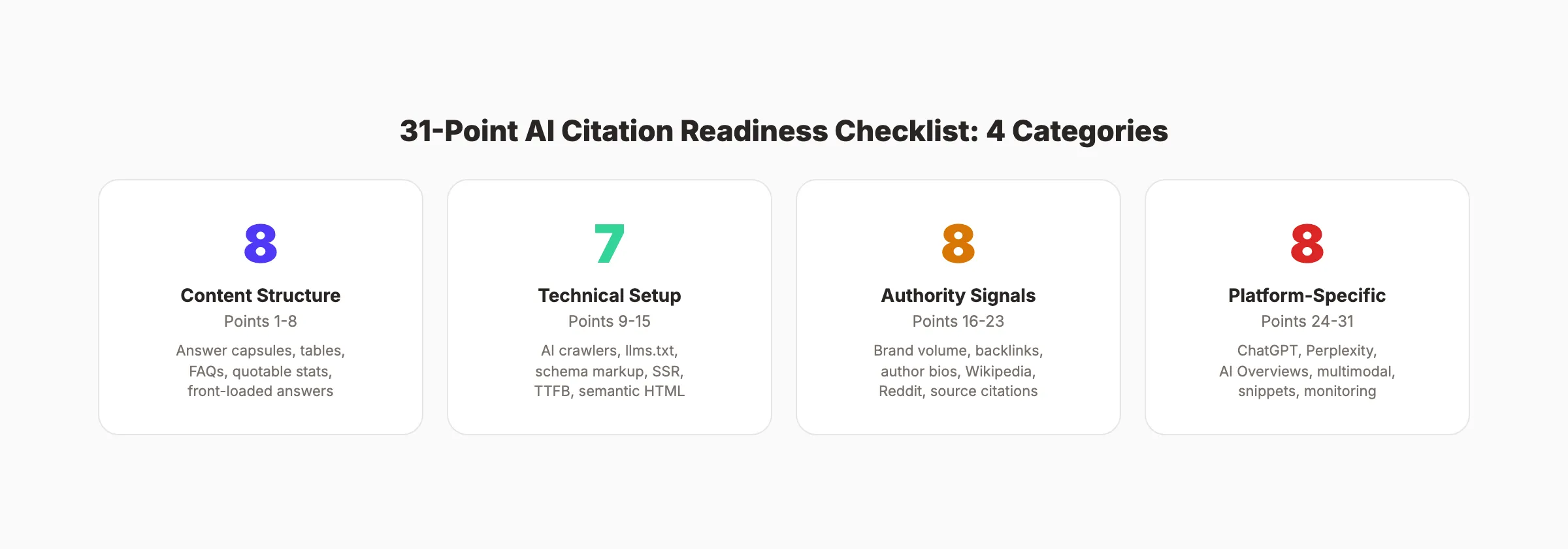
Here is what you will learn:
- The 8 content structure factors that drive 72% of AI citations
- The 7 technical requirements AI crawlers need to access your content
- The 8 authority signals that predict citation probability
- The 8 platform-specific optimization points for ChatGPT, Perplexity, and AI Overviews
Content Structure (Points 1-8)
Content structure is the single biggest factor in AI citation readiness. 72.4% of posts cited by ChatGPT contain answer capsules. The structure of your content determines whether AI can extract and quote it.
1. Write answer capsules after every H2 heading.
Place a 120-150 character direct answer immediately after each H2. This is the single strongest predictor of ChatGPT citations. AI systems extract these capsules verbatim. Do not include links within the capsule. 91% of cited capsules contain zero links.
- Every H2 section has a 1-2 sentence direct answer within the first 50 words
2. Front-load answers in every section.
44.2% of all LLM citations come from the first 30% of content. Lead with the answer. Then explain it. Then provide evidence. The inverted pyramid structure gives AI the quotable material it needs in the position it scans first.
- Each section answers the question before explaining the reasoning
3. Make every H2 section self-contained.
AI parses content by section, not by page. Each H2 section must function as an independent, citable unit. The ideal section length is 134-167 words. If a section requires context from another section to make sense, AI cannot cite it in isolation.
- Every H2 section is understandable without reading the rest of the page
4. Use comparison tables with data.
Pages with comparison tables earn 47% more AI citations. Tables organize information in a format AI models can extract directly. Include specific numbers, not vague descriptions. “4.5 stars, $49/mo” beats “highly rated, affordable pricing.”
- At least 1 data table per 1,000 words of content
5. Include FAQ sections with FAQPage schema.
Pages with FAQPage schema achieve a 41% citation rate compared to 15% without. That is 2.7 times higher. FAQ sections provide the question-answer format that AI systems are designed to surface.
- FAQ section with 4-6 questions at the end of every guide and blog post
6. Add numbered and bulleted lists.
Listicle format accounts for 21.9% of all AI citations. Bulleted and numbered lists are among the most consistently cited content formats across all AI platforms. Lists break complex information into extractable units.
- Use lists for any content that involves steps, features, or comparisons
7. Write quotable one-sentence takeaways.
Write clear, standalone statements that AI can extract verbatim. “82.5% of AI Overview citations come from pages with structured data” is quotable. “Structured data is really important for AI” is not. Specificity drives citation.
- At least 3 quotable statistics or definitions per 1,000 words
8. Maintain a stat every 150-200 words.
Adding statistics to content improves AI visibility by 41%, according to peer-reviewed research from Princeton and Georgia Tech. AI models prefer content with high factual density. The target is 1 verifiable statistic or data point every 150-200 words.
- Factual density check: at least 5 stats per 1,000 words
Stop writing. Start ranking. Stacc publishes 30 SEO articles per month for $99. Every post is optimized for Google and AI citation readiness. Start for $1 →
Technical Requirements (Points 9-15)
73% of websites unknowingly block AI crawlers. If AI cannot access your content, nothing else on this checklist matters. Technical readiness is a binary gate.
9. Allow AI crawlers in robots.txt.
Check your robots.txt file for these user agents. All must be allowed, not blocked:
GPTBot(ChatGPT crawling)ChatGPT-User(ChatGPT search)PerplexityBot(Perplexity AI)ClaudeBot(Claude / Anthropic)anthropic-ai(Anthropic training)Google-Extended(Google AI training)
Cloudflare recently changed its default settings to block AI bots automatically. If you use Cloudflare, verify your configuration. Read our full AI crawlers guide for setup instructions.
- All 6 AI crawler user agents are allowed in robots.txt
10. Create and publish an llms.txt file.
llms.txt is a proposed standard that tells AI models how to use your content. Think of it as a table of contents for AI crawlers. robots.txt says “can you crawl?” llms.txt says “here is what matters most.” Over 600 sites have adopted it, including Stripe, Cloudflare, and Anthropic.
-
llms.txtfile published at your domain root
11. Implement JSON-LD schema markup.
82.5% of AI Overview citations come from pages with structured data. The key schema types for AI citation:
| Schema Type | Use Case | Citation Impact |
|---|---|---|
Article | Blog posts, guides | Base requirement |
FAQPage | FAQ sections | 2.7x citation rate |
HowTo | Step-by-step content | High citation for process queries |
Organization | Brand entity | Entity recognition |
Person | Author credentials | E-E-A-T signal |
Product | Product pages | Product query citations |
BreadcrumbList | Site structure | Crawl clarity |
Use our schema markup generator to create valid JSON-LD for your pages.
- JSON-LD schema on every page with at least
Articleor relevant type
12. Render content server-side (SSR).
AI crawlers cannot execute JavaScript reliably. If your core content depends on client-side rendering, AI crawlers see an empty page. Server-side rendering (SSR) or static generation ensures every crawler sees your full content.
- Core content renders in the initial HTML response without JavaScript
13. Achieve sub-200ms TTFB.
Pages with Time to First Byte under 200ms show 22% higher citation density. Fast servers make content accessible to AI crawlers during their crawl windows. Slow sites get fewer pages crawled per session.
- TTFB under 200ms measured from target market locations
14. Use HTML5 semantic markup.
<header>, <nav>, <main>, <article>, <section>, <aside>, <footer>. These tags help AI parsers understand content hierarchy. A <div> soup requires AI to guess which content matters. Semantic HTML makes the structure explicit.
- Content wrapped in appropriate HTML5 semantic elements
15. Show visible “last updated” dates.
76.4% of ChatGPT’s top-cited pages were updated within 30 days. Content freshness is a strong citation signal. Display the last updated date prominently on every page. Update the lastmod field in your XML sitemap when content changes.
- Visible update date on every blog post and guide page
Authority Signals (Points 16-23)
96% of Google AI Overview citations come from sources with strong E-E-A-T. Brand authority is the strongest single predictor of AI citations, with a 0.334 correlation coefficient. Authority cannot be faked or shortcut.
16. Build brand search volume.
Brand search volume (how many people search for your brand name) is the strongest single predictor of AI citations. Top-quartile brands earn 10 times more citations than bottom-quartile brands. Every marketing activity that increases brand awareness indirectly improves AI citation rates.
- Track monthly branded search volume in Google Search Console
17. Grow your backlink profile past 24,000 referring domains.
Backlink profile correlates with AI citations at 0.37. A major citation jump occurs at 24,000+ referring domains. This is a long-term goal for most businesses. Start with consistent link building and focus on earning links from authoritative sources.
- Active backlink building strategy in place
18. Add author bios with verifiable credentials.
Visible author bios with credentials increase citation probability. Link author names to LinkedIn profiles, published research, or professional certifications. AI models use author information as an E-E-A-T signal.
- Author bio with credentials on every blog post
19. Get cited on third-party sources.
Brands are cited 6.5 times more often via third-party sources than from their own domains. Getting mentioned on Reddit, Wikipedia, G2, industry publications, and news sites builds the entity signals AI models use for citation decisions.
- Active strategy for earning brand mentions on third-party platforms
20. Optimize your Wikipedia presence.
Wikipedia accounts for 12-48% of ChatGPT citations depending on the query type. If your brand qualifies for a Wikipedia page, create and maintain it. If not, ensure your brand is accurately mentioned on relevant Wikipedia articles.
- Wikipedia presence reviewed and accurate (or notability assessment completed)
21. Maintain active Reddit presence.
Reddit accounts for 6.6-46.7% of Perplexity citations. Active, genuine participation in relevant subreddits builds the brand signals that AI models use. Read our full Reddit SEO guide for strategies.
- Genuine Reddit participation in 3-5 relevant subreddits
22. Cite sources in your own content.
Adding source citations to your content produces a 115.1% visibility boost. This is the highest-ROI tactic on this entire checklist and costs nothing. When you cite authoritative sources, AI models treat your content as more trustworthy and citable.
- External source citations in every blog post (minimum 3 per post)
23. Include expert quotes with attribution.
Expert quotes improve AI citation rates by 37%. Named, attributed quotes from credible sources signal content depth and authority. The quote must include the expert name, title, and organization.
- At least 1 attributed expert quote per 1,500 words
Your SEO team. $99 per month. 30 optimized articles, published automatically. Every post built for Google rankings and AI citation readiness. Start for $1 →
Platform-Specific Optimization (Points 24-31)
Only 11% of sites get cited by both ChatGPT and Perplexity. Each AI platform has different citation preferences. Optimizing for one does not guarantee visibility on another.
24. Optimize for ChatGPT: depth over breadth.
ChatGPT favors deep, detailed content on focused topics. Answer capsules (point 1) are critical. 92% of ChatGPT agents rely on Bing Search API for sourcing. Ensure your site is indexed in Bing Webmaster Tools, not just Google.
- Site verified in Bing Webmaster Tools
25. Optimize for Perplexity: freshness and niche authority.
Perplexity has the strongest freshness bias. Content updated within 30 days earns 3.2 times more citations. Perplexity also cites niche blogs and independent publishers more than other platforms. Smaller sites have a real shot on Perplexity. Read our guide on optimizing for Perplexity.
- Content refresh schedule: update key pages at least monthly
26. Optimize for Google AI Overviews: semantic completeness.
Semantic completeness is the number 1 factor for AI Overview citations. Pages that cover a topic to 8.5/10+ completeness score are 4.2 times more likely to be cited. Google decomposes queries into 8-12 sub-queries and checks whether your page answers all of them. Read our AI Overview optimization guide.
- Key pages cover the topic at depth equivalent to or exceeding top 3 competitors
27. Add multimodal content.
Pages with text, images, video, and data tables earn 156% more AI selections. Multimodal content signals depth and authority. An article with a comparison table, an infographic, and an embedded video outperforms text-only content across every AI platform.
- At least 2 content formats per page (text + table/image/video)
28. Optimize for featured snippets.
Featured snippet content has significant overlap with AI-cited content. The same clear, concise, well-structured answers that win featured snippets also get extracted by AI models. Optimize your highest-traffic pages for snippet formats (paragraph, list, table).
- Top 20 pages audited for featured snippet optimization
29. Target the People Also Ask box.
People Also Ask questions map directly to AI query patterns. AI models decompose user queries into sub-questions. If your content answers those sub-questions clearly, it earns citation slots. Structure content to answer PAA questions explicitly.
- PAA questions for target keywords identified and answered in content
30. Monitor AI citations across platforms.
You cannot optimize what you do not measure. Track citations using tools like Peec AI, Otterly.ai, or SE Ranking AI Tracker. Set up GA4 custom channel groups to track AI referral traffic separately from organic.
- AI citation monitoring tool active and reporting weekly
31. Update high-value content every 30 days.
76.4% of ChatGPT’s top-cited pages were updated within 30 days. 85% of AI Overview citations come from content published within the last 2 years. 44% come from 2025 content. Freshness is not optional. It is a ranking factor for AI citation.
- Top 10 pages on a 30-day refresh cycle
3,500+ blogs published. 92% average SEO score. We handle content creation, optimization, and publishing. Every post built for AI citation readiness. Start for $1 →
The Data Behind This Checklist
Every point on this checklist ties back to measured citation data. Here are the key studies that informed the 31 points.
A Search Engine Land analysis of 7,500 ChatGPT referral sessions across 15 domains found that answer capsules (120-150 characters) appear in 72.4% of cited posts. Pages with original data tables earn 4.1 times more citations than pages without.
Peer-reviewed research from Princeton University and Georgia Tech found that adding statistics to content improves generative engine optimization visibility by 41%. Adding source citations produces the largest single improvement at 115.1%.
An analysis by ZipTie.dev found that brand search volume has a 0.334 correlation with AI citations. That is the strongest single predictor measured. Backlink profiles correlate at 0.37. Organic keyword footprint correlates at 0.41.
For search everywhere optimization, these citation factors overlap significantly with traditional SEO signals. Strong E-E-A-T, quality backlinks, and well-structured content drive rankings in both Google organic and AI citation. The additional investment for AI citation readiness is mostly structural (answer capsules, schema, crawler access) rather than entirely new work.
How to Score Your AI Citation Readiness
Use this scoring framework to assess your current state.
| Score Range | Readiness Level | Action |
|---|---|---|
| 28-31 points | Citation-ready | Maintain and monitor |
| 21-27 points | Strong foundation | Fix gaps in weakest category |
| 15-20 points | Needs work | Prioritize technical + structure fixes |
| Below 15 | Major restructuring needed | Start with points 1, 9, 11, and 22 |
Run through all 31 points. Check each one you currently pass. Your score tells you where to focus next.
The highest-impact starting points for most sites:
- Point 9 (AI crawler access). Binary gate, fix first
- Point 1 (answer capsules). Highest citation correlation
- Point 22 (cite your sources) , 115% boost, zero cost
- Point 11 (schema markup) , 82.5% of AIO citations use structured data
- Point 15 (content freshness) , 3.2x Perplexity boost
FAQ
What is AI citation readiness?
AI citation readiness is the degree to which your content is structured, optimized, and accessible for AI search engines (ChatGPT, Perplexity, Google AI Overviews) to cite in their responses. A citation-ready page has clear answer capsules, proper schema markup, AI crawler access, and sufficient authority signals.
How do I check if AI is citing my content?
Use AI citation tracking tools like Peec AI, Otterly.ai, or SE Ranking AI Tracker. For a free approach, manually query ChatGPT and Perplexity with your target keywords and check whether your brand or pages appear in the responses. Set up GA4 custom channel groups to track AI referral traffic.
Does schema markup help with AI citations?
Yes. 82.5% of Google AI Overview citations come from pages with structured data. FAQPage schema specifically produces a 2.7 times higher citation rate. Implement JSON-LD schema markup on every page with at least Article schema and FAQPage schema where applicable.
Which AI search engine cites the most sources?
Perplexity averages 21.87 citations per response. ChatGPT averages 7.92. Google AI Overviews cite 3+ sources in 88% of answers. Perplexity offers the most citation slots and has the lowest authority threshold, making it the best starting platform for newer sites.
How often should I update content for AI citations?
Update high-value pages every 30 days. 76.4% of ChatGPT’s top-cited pages were updated within 30 days. Content freshness produces a 3.2 times citation boost on Perplexity. At minimum, refresh your top 10 pages monthly with new data, statistics, or sections.
Can small businesses get cited by AI search engines?
Yes. Perplexity specifically cites niche blogs and independent publishers more than other platforms. Small businesses should start with points 1 (answer capsules), 9 (AI crawler access), 11 (schema), and 22 (cite your sources). These 4 points require no budget and produce the largest citation improvements.
AI citation readiness is not a one-time audit. It is an ongoing optimization process. The 31 points on this checklist cover every factor that determines whether AI search engines cite your content. Start with the 5 highest-impact points. Then work through the rest systematically. The businesses building citation readiness now will own the AI search visibility that becomes the primary discovery channel over the next 2-3 years. AI referral traffic already converts at 15.9% compared to 1.76% for Google organic. That is 9 times higher. The citation slots are worth fighting for.
Related Tools & Resources
Free SEO Tools:
Best Lists:

Written by
Siddharth GangalSiddharth is the founder of theStacc and Arka360, and a graduate of IIT Mandi. He spent years watching great businesses lose organic traffic to competitors who simply published more. So he built a system to fix that. He writes about SEO, content at scale, and the tactics that actually move rankings.
30 SEO blog articles published every month
Keyword-optimized, scheduled, and live on your site. Automatically.
30-day trial · Cancel anytime
theStacc
Stop writing SEO content manually
30 blog articles, 30 GBP posts, and social media content. Published every month. Automatically.
Start Your $1 Trial$1 for 3 days · Cancel anytime