
Multi-Channel Content Distribution: 2026 Strategy Guide
Master multi-channel content distribution with a 7-channel framework, 30-day cadence, and templates we use to publish 3,500+ posts every month. Updated 2026.
Most marketers spend 80% of their time creating content and 20% getting eyes on it. That is the wrong ratio. A great blog post on one channel reaches less than 10% of the audience you could have reached with a multi-channel content distribution plan.
The numbers are brutal. Ahrefs analyzed 14 billion pages and found 96.55% of them get zero organic traffic from Google. The 3.45% that do attract traffic share one trait. Someone built a deliberate distribution system around them.
Multi-channel content distribution is the system. It defines which platforms publish what, when, and in what format. Without it, every blog post starts from zero. With it, every asset compounds across owned, earned, and paid channels for years.
We publish 3,500+ blog posts every month across 70+ industries. Our average SEO score is 92. The framework below is the exact multi-channel content distribution playbook we run for every Stacc client.
Here is what you will learn:
- What multi-channel content distribution is and how it differs from omnichannel marketing
- The 7 core channels every distribution plan should include in 2026
- The 70/20/10 rule for splitting distribution effort between proven, emerging, and experimental channels
- A 30-day cadence you can run on any new asset
- A channel scorecard rating cost, speed, and compounding for each platform
- The pre-publish checklist we run before every piece goes live
- How to measure what is working and refine the plan without starting from scratch
What is multi-channel content distribution?
Multi-channel content distribution is the practice of publishing a single piece of content across multiple platforms, each in a format tailored to that platform. The same source article becomes a blog post, an email broadcast, a LinkedIn carousel, a Twitter thread, a short video, and a Reddit reply. The audience and intent shift on each platform, but the core message stays the same.
The goal is not to be everywhere. The goal is to be in the specific places where your target audience already spends time. A B2B SaaS company does not need TikTok. A local bakery does not need LinkedIn. A multi-channel content distribution plan starts with audience research, not channel envy.
Here is the simplest test. Take any blog post you published in the last 90 days. List every place it was promoted. If the list has fewer than 5 entries, you are running single-channel distribution. If the list has 10 or more entries with channel-specific formatting, you are running a real multi-channel system.
Multi-channel content distribution is not the same as omnichannel marketing. Omnichannel means every channel feeds into one unified customer experience with shared data. Multi-channel just means using more than one channel. Most teams need multi-channel discipline first. Omnichannel is a later stage when you have the data plumbing to support it.
The framework rests on three assumptions:
- Different audiences live on different platforms. No single platform reaches every customer segment.
- Format matters as much as channel. A 3,000-word guide will not perform as a 60-second TikTok without restructuring.
- Repetition compounds. The same idea seen on 3 channels lands harder than the same idea seen on 1 channel three times.
Why single-channel distribution fails in 2026
Single-channel distribution does not just under-perform. It actively wastes the content you create. The math is grim.
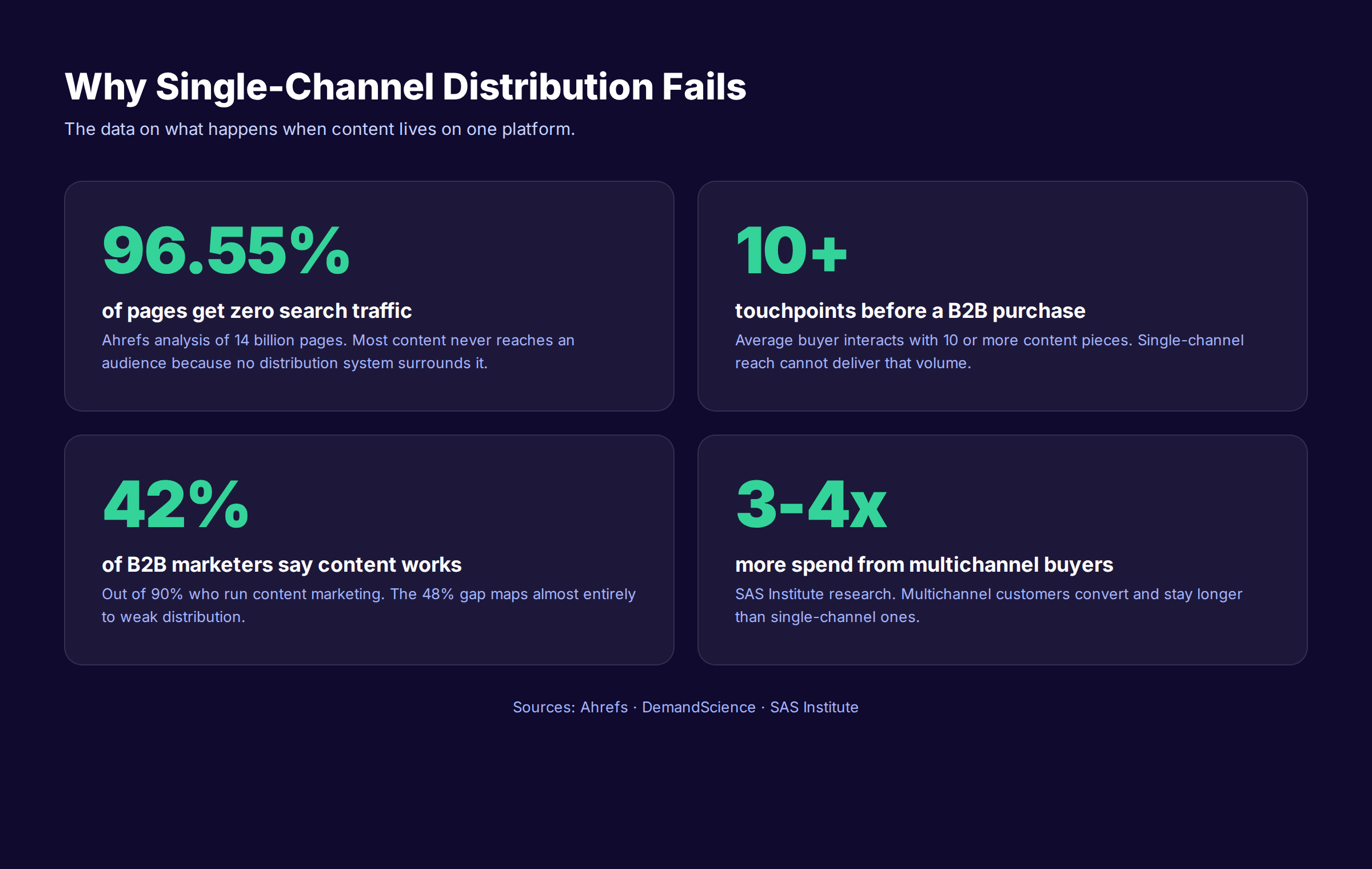
Almost every page on the internet sees zero search traffic. Google indexes them, but algorithmic gatekeeping and competition for the few high-intent keywords leave most content invisible. The pages that win typically do not win on SEO alone. They win because email, social, communities, and backlinks compound around them.
DemandScience reports that 90% of B2B marketers run content marketing, yet only 42% say it is effective. That 48-point gap maps almost entirely to distribution. Teams build content but skip the distribution system that makes it findable.
The buyer side of the math is just as clear. B2B buyers interact with 10 or more pieces of content before making a purchase decision. A single-channel approach can deliver 1 or 2 of those touches. A multi-channel system delivers all 10.
There is also the spend gap. SAS research found multichannel customers spend 3 to 4 times more than single-channel customers. The customers who buy from you across multiple channels are worth more, but you cannot reach them with one channel.
Single-channel distribution fails for four specific reasons:
- Algorithm risk. A change to Google, Instagram, or LinkedIn can erase your reach overnight if you depend on one platform.
- Format limits. No single platform handles every content format well. Long-form, video, audio, and visual all have native homes.
- Audience gaps. Your customers are split across platforms. Half live on LinkedIn. The other half live in niche Slack groups.
- Compounding loss. A post that goes out once decays in days. A post that gets repurposed and reshared keeps producing value for months.
The teams winning at content in 2026 treat distribution as the primary discipline. Creation is the input. Distribution is the leverage.
The 3 pillars: owned, earned, and paid channels
Every distribution channel falls into one of three pillars. Marketers have used this framework since the early 2010s, and it still works because the categories describe how you get access.
You own the channel. Someone else grants access for free based on merit. You pay for access.
Owned channels
Owned channels are the ones you control without paying for placement. Your blog. Your email list. Your YouTube channel. Your podcast feed. Your social profiles. Your mobile app if you have one.
The advantage of owned channels is permanence. A blog post you publish today can drive traffic 5 years from now. An email broadcast reaches an audience that already opted in. The disadvantage is that owned channels take time to build. Nobody reads your blog on launch day.
Owned channels should anchor every distribution strategy because they compound. The more you publish, the more your blog ranks. The more emails you send, the more your list grows. Stacc focuses our blog SEO module on this exact compounding effect.
Earned channels
Earned channels are third-party platforms that share or cite your content because it deserves attention. Press coverage. A backlink from a competitor’s blog. A mention on a podcast. A quote retweet from a major account. A reference inside an AI Overview answer.
Earned distribution is the highest-impact channel available. You did not pay for it, but the audience treats it as credible because a third party endorsed it. The downside is unpredictability. You cannot force a journalist to cover your story.
The way to increase earned distribution is to create content worth sharing. Original research. Strong opinions. Useful tools. Then actively pitch that content to the journalists, podcasters, and communities most likely to share it. Our link-building email templates cover the outreach scripts that actually get replies.
Paid channels
Paid channels are platforms where you pay for guaranteed exposure. Google Ads. Meta Ads. LinkedIn Sponsored Content. Native ad networks like Outbrain and Taboola. Influencer fees. Newsletter sponsorships.
Paid is the fastest way to test whether content resonates. Spend $200 boosting a LinkedIn post. If engagement is flat, the content is the problem, not the channel. If engagement spikes, you have validation to invest more.
The mistake most teams make is treating paid as a separate strategy. Paid should amplify your best owned content, not replace it. Use paid as a discovery layer that drives audiences back into your owned channels.
Stop renting attention. Start owning it. We publish 30 SEO blogs, 30 GBP posts, and 30 social posts every month so your owned channels compound while you sleep. Start for $1 →
The 7 core channels every distribution plan needs
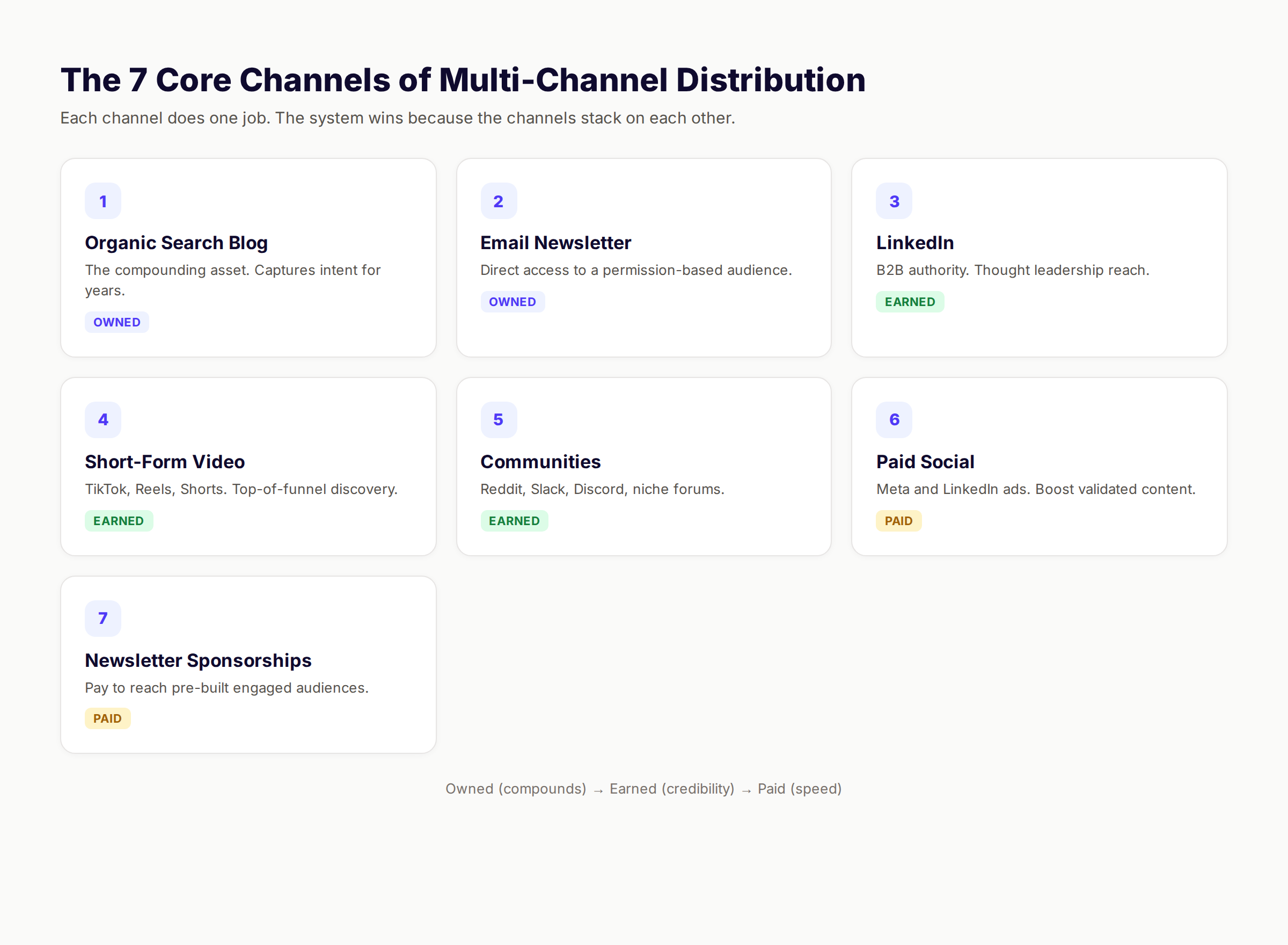
Every multi-channel content distribution plan should include some version of these 7 channels. The mix varies by audience and budget, but the underlying structure is the same.
1. Organic search blog
Your blog is the foundation. It captures search intent for years, ranks for keywords your audience types daily, and acts as the canonical source for every other channel. Every other distribution channel should drive traffic back to a blog post.
Blogs work because they compound. The piece you publish today keeps ranking 6 months from now. Most other channels burn out within 48 hours. Our blog SEO guide covers the full ranking system we run for clients.
2. Email newsletter
Email is the highest-converting channel in distribution. You own the list. The algorithm cannot demote you. Open rates and click-through rates are measurable in days.
Send one broadcast per asset, segmented by buyer journey stage if your list supports it. Subject lines drive 80% of opens, so spend more time on the subject than the body. Our email marketing for SEO guide covers the full subscriber-to-customer funnel.
3. LinkedIn organic
LinkedIn is the B2B authority channel. A single LinkedIn post can drive more high-intent traffic in 24 hours than a month of SEO. The catch is that LinkedIn rewards native content, not link shares.
Repurpose every long-form post into a 1,200-character LinkedIn carousel or text post. Build the post around one specific insight from the article. Drive readers to the full piece in the comments, not the body. Our LinkedIn content strategy breakdown shows the post structures that work in 2026.
4. Short-form video
TikTok, Instagram Reels, and YouTube Shorts have replaced organic Facebook as the top discovery layer. Even B2B audiences watch short-form video now. The format is the cost of admission for top-of-funnel reach.
Cut 3 to 5 short videos per blog post. Each video covers one specific point from the article. Drive viewers to the full piece via bio links and pinned comments. Our blog-to-social videos AI guide shows the automation pipeline we use to turn one blog into 5 videos in 2 hours.
5. Communities (Reddit, Slack, Discord)
Communities are the highest-trust distribution channel. A genuine reply on Reddit reaches an audience that came specifically to learn about your topic. The catch is that community distribution must add value first, not pitch.
Find 3 to 5 active communities in your niche. Reply to threads weekly with genuine answers. Link to your content only when it directly answers the question. Our Reddit SEO strategy guide covers the community participation rules that avoid bans.
6. Paid social
Paid social is your validation and amplification layer. Use it sparingly. Boost the top 10% of organic content that already performs well. Test new messages with $50 to $200 before scaling.
The 70/20/10 rule applies here too. Spend 70% of paid budget on what works, 20% on emerging tests, and 10% on experimental creative formats.
7. Newsletter sponsorships and syndication
Other people’s newsletters are the most underrated paid channel in 2026. A $500 sponsorship in a niche newsletter often outperforms $5,000 in Meta ads because the audience is pre-qualified and engaged.
Find 10 newsletters that match your audience. Trade swaps where possible. Pay for sponsorships where swaps are not an option. Track every send-source with UTMs.
The 70/20/10 rule for distribution effort
The 70/20/10 rule is a content allocation framework that started inside Google’s product team and migrated into marketing. Applied to distribution, the rule splits your effort across three risk tiers.
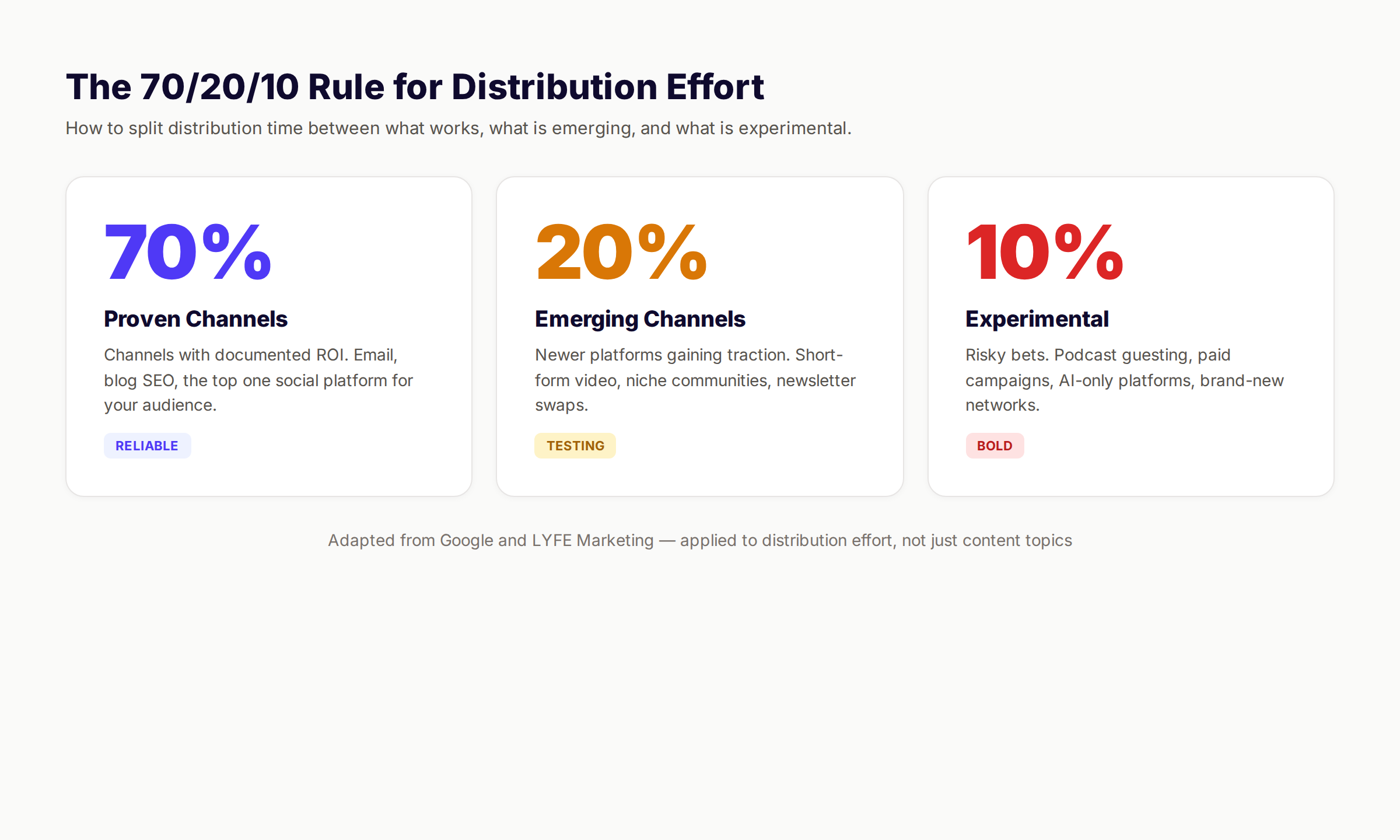
70% goes to proven channels. These are the channels with documented ROI for your business. Email broadcasts. Blog SEO. The one social platform where your audience actually spends time. You know these channels work because the data already proves it.
20% goes to emerging channels. These are platforms gaining traction but not yet your primary growth engine. Short-form video for most B2B brands in 2026. Niche communities. Newsletter swap programs. You are testing these channels with a smaller commitment to see if they deserve to move into the 70%.
10% goes to experimental channels. These are the risky bets. Podcast guesting. Paid campaigns on a brand-new network. AI-only platforms like Perplexity Pages. Most experiments will fail. The 1 in 10 that wins becomes your next 70%.
The reason the rule works is that it prevents two common failure modes. Teams that spend 100% on proven channels stagnate as audiences move. Teams that chase every shiny new platform burn out their core channels. The 70/20/10 split forces discipline.
For a small team, that might look like:
- 70%: Blog SEO + email newsletter
- 20%: LinkedIn organic + one short-form video platform
- 10%: Reddit, Slack communities, or paid newsletter sponsorships
For a larger team, the same percentages might spread across 8 to 10 channels. The math scales with team size, but the philosophy does not change.
A 30-day distribution cadence per asset
A multi-channel content distribution plan is only useful if it produces a repeatable workflow. The cadence below is what we run for every blog post Stacc publishes for clients. Every asset gets 14+ distribution touches across 4 weeks.
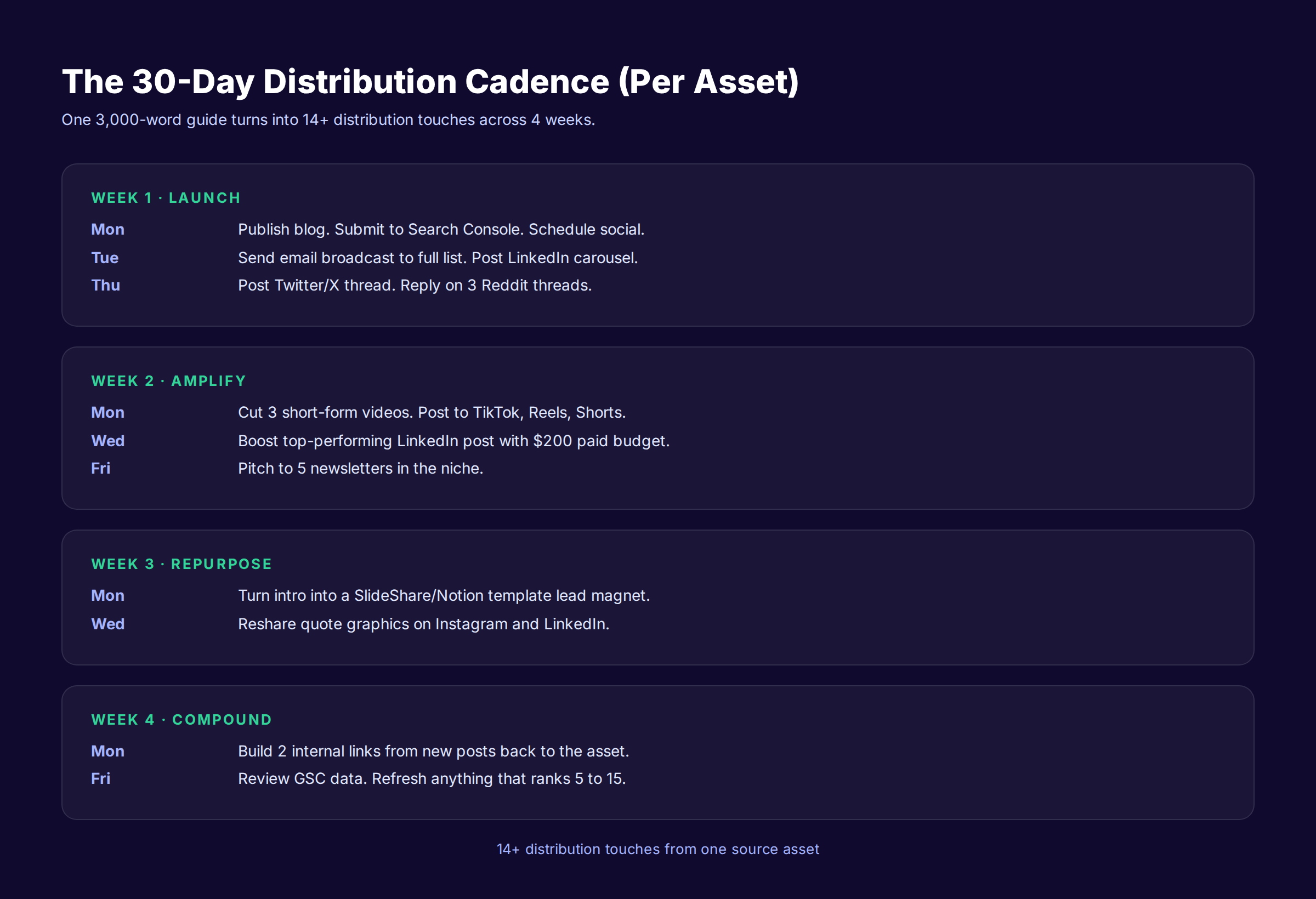
Week 1: Launch
The first week sets the trajectory. If a piece does not get traction in the first 7 days, it rarely catches up later.
| Day | Action | Channel |
|---|---|---|
| Monday | Publish blog. Submit to GSC. Schedule social. | Blog |
| Tuesday | Send email broadcast to full list | |
| Tuesday | Post LinkedIn carousel with key insight | |
| Wednesday | Post Twitter/X thread (8 to 12 tweets) | Twitter/X |
| Thursday | Reply on 3 Reddit threads where the topic fits | |
| Friday | Post Instagram carousel + Reels teaser |
Week 1 should generate the bulk of initial traffic. If LinkedIn or Reddit performs well, double down in week 2.
Week 2: Amplify
Week 2 takes what worked in week 1 and pours fuel on it.
| Day | Action | Channel |
|---|---|---|
| Monday | Cut 3 short videos. Post to TikTok, Reels, Shorts. | Video |
| Tuesday | Reshare original LinkedIn post with new hook | |
| Wednesday | Boost top organic post with $200 paid budget | Paid |
| Thursday | Pitch to 5 newsletter writers in the niche | Earned |
| Friday | Send follow-up email to non-openers |
Week 3: Repurpose
Week 3 turns the source article into derivative assets that live on different platforms.
- Convert the intro into a SlideShare or Notion lead magnet
- Pull 5 quote graphics for Instagram and LinkedIn
- Cut a 5-minute YouTube video from the full article
- Submit to relevant industry roundups
- Reply to comments on every previous post
Week 4: Compound
Week 4 builds the internal infrastructure that makes the piece a long-term asset.
- Build 2 internal links from older posts back to this one
- Update the original post with new comments, questions, or data
- Review Google Search Console for ranking position
- If ranking 5 to 15, refresh the piece for ranking jumps
- Add to your monthly distribution performance report
Run this cadence on every new piece. Within 90 days, you have 12 to 16 assets all compounding across 7 channels. That is what multi-channel content distribution actually looks like in practice.
Done-for-you multi-channel distribution. We write the blog, post to your CMS, repurpose for social, and post to Google Business Profile. All for $99 per month. Start your $1 trial →
Channel scorecard: cost, speed, and compounding
Different channels solve different problems. The scorecard below rates each of the 7 core channels on three metrics that determine where you should allocate budget and time.
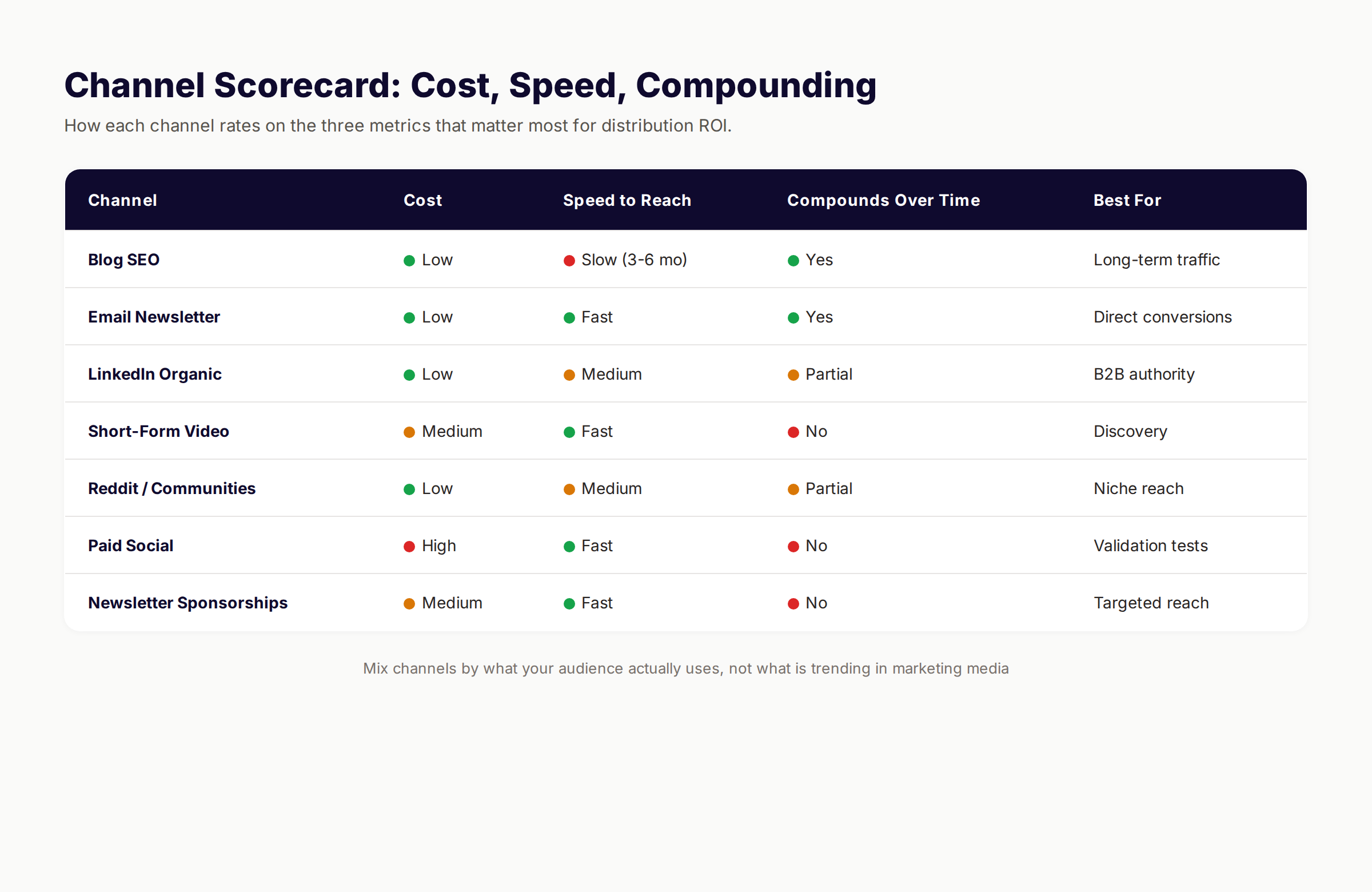
| Channel | Cost | Speed to Reach | Compounds Over Time | Best Use Case |
|---|---|---|---|---|
| Blog SEO | Low | Slow (3-6 mo) | Yes | Long-term traffic + AI search citations |
| Email Newsletter | Low | Fast | Yes | Direct conversions, list nurture |
| LinkedIn Organic | Low | Medium | Partial | B2B authority, thought leadership |
| Short-Form Video | Medium | Fast | No | Top-of-funnel discovery |
| Reddit / Communities | Low | Medium | Partial | Niche reach, audience research |
| Paid Social | High | Fast | No | Content validation, retargeting |
| Newsletter Sponsorships | Medium | Fast | No | Pre-qualified audience access |
Two patterns matter here.
Owned channels compound. Earned and paid channels do not. If you only have time for one channel, build the owned channel that compounds (blog or email). Everything else amplifies what already exists.
Fast channels are not always better. LinkedIn produces traffic in 24 hours, but a blog post produces traffic for 5 years. Both have value, but they answer different questions. Use fast channels for distribution. Use slow channels for asset building.
Multi-channel distribution examples by business type
The abstract framework only gets you so far. Here is what a multi-channel content distribution plan looks like for 4 specific business types.
B2B SaaS company
A B2B SaaS company sells to product managers and operations leaders. Their audience lives on LinkedIn and reads newsletters. They rarely use TikTok for work decisions.
- Owned: Blog (3 posts per week), email newsletter (weekly), product changelog
- Earned: LinkedIn organic (5 posts per week), niche Slack communities, podcast guesting
- Paid: LinkedIn Sponsored Content, niche B2B newsletter sponsorships
- Skip: TikTok, Instagram Reels, broad Meta ads
Local service business
A local plumber serves customers in a 30-mile radius. They do not need national reach. They need to show up in 5 specific zip codes.
- Owned: Local SEO blog, Google Business Profile posts (daily), email to past customers
- Earned: Facebook neighborhood groups, Nextdoor, local news mentions
- Paid: Google Local Services ads, Facebook geo-targeted ads
- Skip: LinkedIn, TikTok beyond local discovery
Our local SEO module handles the full owned + earned stack for businesses like this.
Ecommerce brand
An ecommerce DTC brand sells consumer goods through Shopify. They need visual discovery and high purchase intent.
- Owned: Blog (SEO + buying guides), email (twice weekly), SMS list, YouTube channel
- Earned: Instagram + TikTok organic, influencer seeding, Reddit niche subs
- Paid: Meta Ads, Google Shopping, TikTok Spark Ads, creator partnerships
- Skip: LinkedIn (rarely converts for consumer brands)
Creator or solo founder
A creator selling courses or one-on-one consulting needs to build personal brand at scale on limited time.
- Owned: Email newsletter (weekly), blog (1 per week), YouTube long-form (monthly)
- Earned: Twitter/X, LinkedIn, podcast guesting, niche communities
- Paid: Boost top organic posts only, newsletter sponsorships
- Skip: Cold paid acquisition until product-market fit is clear
The patterns are different. The framework is the same. Match the channels to where your audience actually spends time.
The pre-publish distribution checklist
Run this 12-point checklist before every new piece of content goes live. Missing any step costs you reach and traffic that does not come back later.
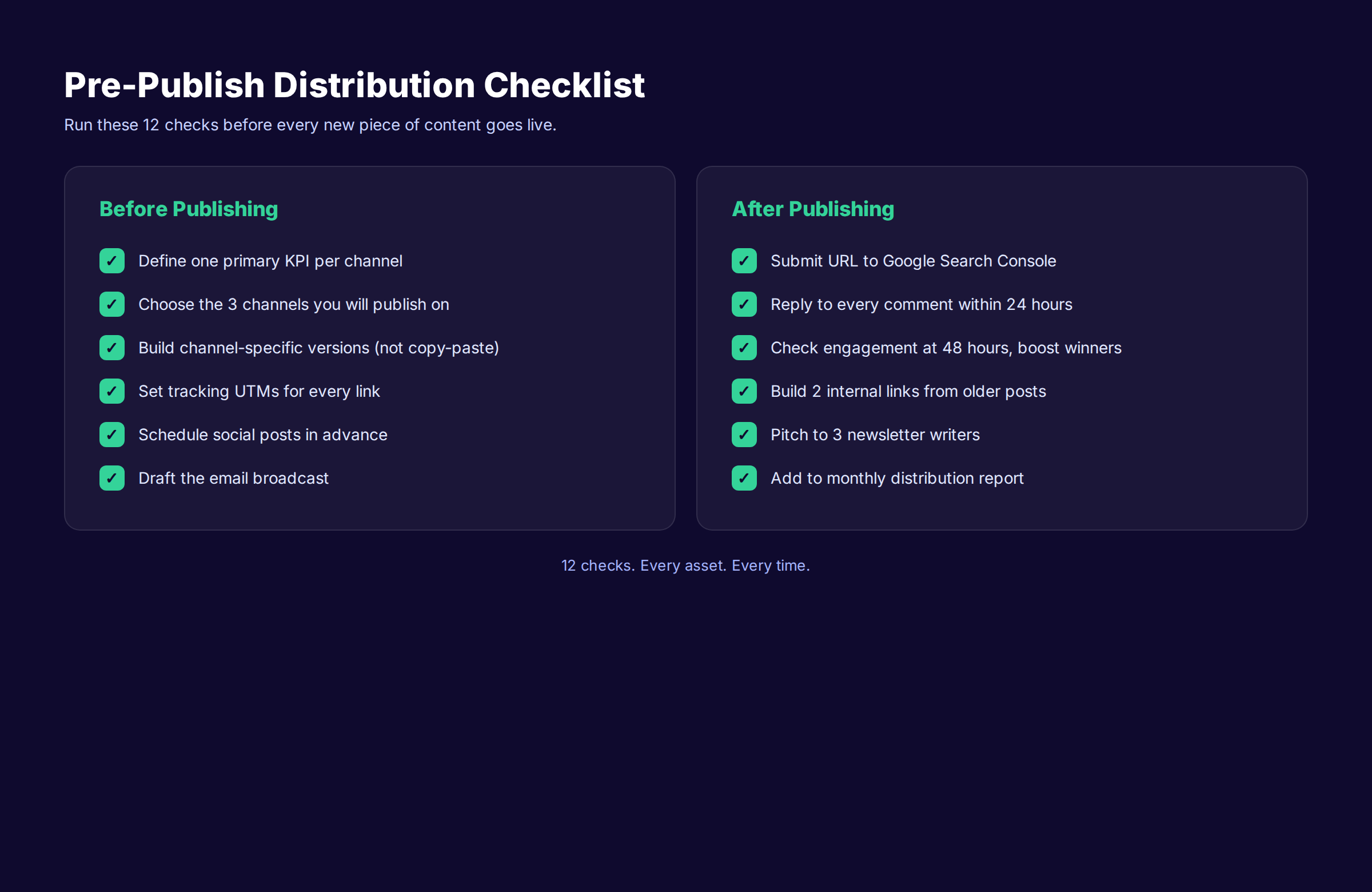
Before publishing
- Define one primary KPI for the asset (rankings, signups, replies, shares)
- Choose the 3 distribution channels you will publish on first
- Build channel-specific versions of the content (not copy-paste)
- Set UTM parameters on every outbound link
- Schedule all social posts in your scheduler
- Draft the email broadcast and subject line
- Confirm internal links point to your strongest related posts
- Add the asset to your editorial tracker
After publishing
- Submit the URL to Google Search Console for indexing
- Reply to every comment within 24 hours
- Check engagement at 48 hours and boost the top post
- Build 2 internal links from older posts back to the new piece
Most teams skip the second half. That is where the leverage hides. The first 48 hours after a post goes live is when algorithms decide whether to push the piece. Engaging back, replying fast, and boosting winners signals quality.
How to measure multi-channel content distribution
The metrics that matter break into three categories. Reach. Engagement. Conversion.
Reach measures how many people saw the content. Track impressions, social reach, email opens, and indexed pages. Reach metrics are easy to inflate and easy to fool yourself with. They are the starting point, not the finish line.
Engagement measures whether the audience cared. Track click-through rate, time on page, comments, shares, and replies. Engagement is the lead indicator. If engagement is high but conversion is low, the offer is the problem. If engagement is low, the content is the problem.
Conversion measures what the content drove. Track signups, demos, sales, downloads, and pipeline. Conversion is the only metric that justifies the distribution spend.
Set up the tracking before you publish. Use UTMs on every link. Tag every email broadcast. Track which posts drive which signups. The teams that win at multi-channel content distribution are the ones who measure ruthlessly.
Our content marketing metrics guide covers the specific dashboards we build for clients. The SEO ROI calculator helps quantify what each channel is worth.
Stop guessing what works. Stacc publishes, distributes, and measures every piece. You see exactly which channels drive customers. See the platform →
Common multi-channel distribution mistakes
Most distribution failures fall into one of five mistakes. Each one is easy to fix once named.
Mistake 1: Copy-paste across channels. Posting the same headline and link to LinkedIn, Twitter, Facebook, and Instagram does not work. Each platform rewards native formatting. Restructure the message for the platform.
Mistake 2: Publishing and forgetting. A blog post that gets one promotion on launch day decays in 48 hours. A blog post that gets 14 promotions over 4 weeks compounds. The work after publish matters more than the work before.
Mistake 3: Chasing every new platform. Threads launched. Bluesky launched. Mastodon launched. Most teams cannot maintain quality on 3 platforms. Adding a 4th means dropping quality on all 4.
Mistake 4: Measuring vanity metrics. Impressions and follower counts do not pay the bills. Pipeline does. Conversion does. Customer acquisition cost does. If your dashboard does not show those, the dashboard is wrong.
Mistake 5: Treating distribution as a one-person job. One person cannot create, distribute, measure, and refine 7 channels alone. Either limit channels to what one person can run well, or build a system that automates the distribution layer. That is exactly what Stacc does for our clients.
How Stacc automates multi-channel content distribution
We are biased. We built Stacc to solve the multi-channel content distribution problem for businesses that do not have a content team.
Here is what our $99 per month Blog SEO module does:
- Publishes 30 SEO-optimized blog posts per month directly to your CMS (WordPress, Webflow, Ghost, or our hosted blog)
- Internal-links each post to your strongest related content automatically
- Submits every post to Google Search Console for fast indexing
- Refreshes underperforming content based on Search Console data
Add the $49 per month Local SEO module and we also:
- Post 30 Google Business Profile updates per month
- Repurpose blog insights into GBP posts that drive local rankings
Add the $49 per month Social Media module and we also:
- Publish 30 social posts per month across Instagram, LinkedIn, X, and Facebook
- Pull quote-card graphics from each blog post automatically
- Schedule posts in the time slots that match your audience
Bundle all three modules and you save 15%. The total cost runs $164 per month for a fully automated multi-channel content distribution system. That is less than the hourly rate of a single freelance writer.
We publish 3,500+ blog posts every month across 70+ industries. Our average SEO score is 92. The system runs on autopilot once you connect your CMS and Google Business Profile.
The Stacc Stack Method. Blog SEO + Local SEO + Social = compounding reach across 7 channels for $164 per month. Start for $1 →
Frequently asked questions
What is multi-channel content distribution?
Multi-channel content distribution is the practice of publishing a single piece of content across multiple platforms in formats tailored to each platform. A blog post becomes an email, a LinkedIn carousel, a Twitter thread, a short video, and a Reddit reply. The goal is to reach the same audience in the channels they already use, not to be everywhere for the sake of it.
What is an example of a multichannel distribution?
A B2B SaaS company publishes a blog post on Monday. On Tuesday they send an email broadcast to their list and post a LinkedIn carousel summarizing the key insight. On Wednesday they post a Twitter thread expanding on one section. On Thursday they reply to 3 Reddit threads where the topic fits. On Friday they post an Instagram carousel pulling the best quotes. That is multi-channel distribution for one asset.
What is the 70/20/10 rule for content?
The 70/20/10 rule splits your distribution effort across three tiers. 70% goes to proven channels with documented ROI (email and blog SEO for most teams). 20% goes to emerging channels you are still validating (short-form video, niche communities). 10% goes to experimental channels (podcast guesting, brand-new platforms). The split prevents both stagnation and over-experimentation.
What are the 4 C’s of integrated marketing communications?
The 4 C’s are coherence, consistency, continuity, and complementarity. Coherence means messages connect logically. Consistency means messages reinforce each other rather than contradict. Continuity means the message stays aligned over time. Complementarity means the channels work better together than apart. Apply the 4 C’s when building a multi-channel content distribution plan.
What is the 3-3-3 rule in marketing?
The 3-3-3 rule states that prospects need 3 touches in 3 days across 3 channels to remember a brand. Multi-channel distribution makes the 3-3-3 rule possible. A single-channel approach rarely delivers 3 touches in 3 days because audiences do not check every platform every day.
How is multi-channel different from omnichannel?
Multi-channel means you publish on multiple platforms with distinct strategies for each. Omnichannel means every channel feeds into one unified customer experience with shared data and identity. Multi-channel is the starting point. Omnichannel is the advanced version that requires significant data infrastructure. Most teams should master multi-channel first.
How many channels should I distribute on?
Start with 3 channels. Add a 4th only when the first 3 are running reliably without quality drops. Most small teams hit diminishing returns past 5 channels. Larger teams can sustain 7 to 10 channels with dedicated owners per channel.
Closing
Multi-channel content distribution is the difference between content that disappears and content that compounds. Build the system once. Run the cadence on every asset. Measure ruthlessly and refine the channels that work.
The teams that win at content in 2026 are not the ones creating the most content. They are the ones with the strongest distribution discipline. Pick your 3 channels. Run the 30-day cadence. The rest is execution.

Written by
Siddharth GangalSiddharth is the founder of theStacc and Arka360, and a graduate of IIT Mandi. He spent years watching great businesses lose organic traffic to competitors who simply published more. So he built a system to fix that. He writes about SEO, content at scale, and the tactics that actually move rankings.
30 SEO blog articles published every month
Keyword-optimized, scheduled, and live on your site. Automatically.
30-day trial · Cancel anytime
theStacc
Stop writing SEO content manually
30 blog articles, 30 GBP posts, and social media content. Published every month. Automatically.
Start Your $1 Trial$1 for 3 days · Cancel anytime