Pharmacy SEO: The Complete Guide to Ranking (2026)
Learn how to rank your pharmacy on Google and Google Maps. Covers local SEO, GBP, keywords, E-E-A-T, and schema. Data-backed. Updated 2026.
Siddharth Gangal • 2026-03-29 • Local SEO
In This Article
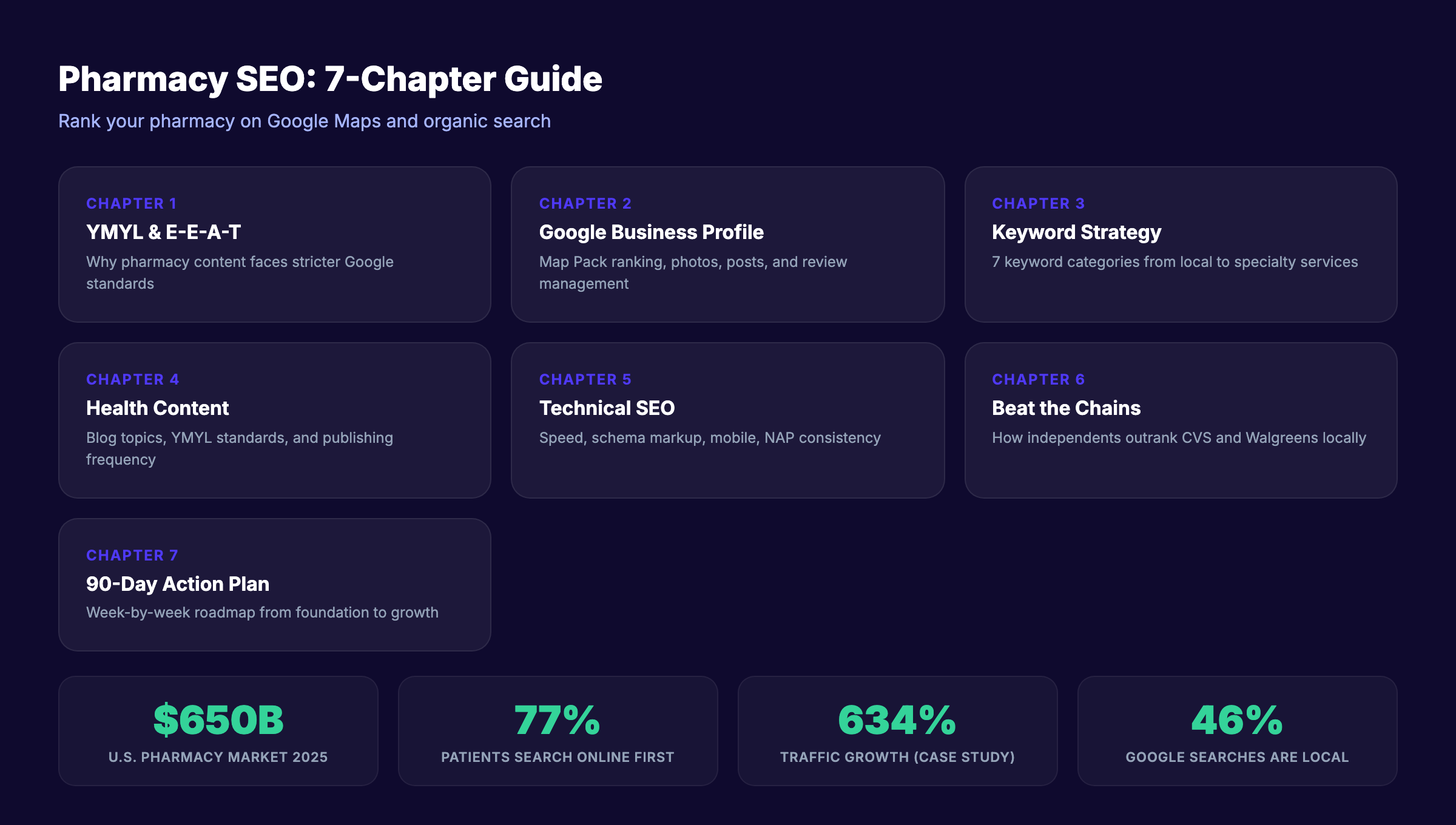
77% of patients search online before choosing a pharmacy. The U.S. pharmacy market hit $650 billion in 2025 and is growing at 4.26% annually. Yet most independent pharmacies are invisible on Google.
The top 4 pharmacy chains control over 50% of all dispensing revenues. CVS and Walgreens dominate the first page of search results for nearly every pharmacy-related keyword. For independent and community pharmacies, pharmacy SEO is the only way to compete without matching their advertising budgets.
This guide covers every element of pharmacy SEO: local search, Google Business Profile optimization, keyword strategy, content that meets Google’s strict health standards, and the technical elements that most pharmacy websites miss entirely.
We have published 3,500+ SEO articles across 70+ industries, including healthcare and pharmacy. This guide distills what actually ranks pharmacy websites in 2026.
Here is what you will learn:
- Why pharmacy content faces stricter Google standards and how to meet them
- How to optimize your Google Business Profile to appear in the local map pack
- The exact keyword categories that drive pharmacy patients from search
- How to build content that satisfies E-E-A-T requirements for health topics
- A 90-day action plan to start ranking your pharmacy on Google
Chapter 1: Why Pharmacy SEO Is Different
Pharmacy websites face rules that most business websites do not. Google classifies health and medical content under YMYL (Your Money or Your Life). That means Google applies stricter quality standards to every page on your site.
YMYL and What It Means for Pharmacies
YMYL pages are those that could impact a person’s health, finances, or safety. A blog post about medication side effects falls into this category. So does a page about drug interactions, prescription savings, or vaccination schedules.
Google evaluates YMYL content more aggressively. Thin content, missing author credentials, or unsourced medical claims can prevent your pages from ranking entirely. This is why generic SEO advice often fails for pharmacies.
E-E-A-T: The Trust Framework
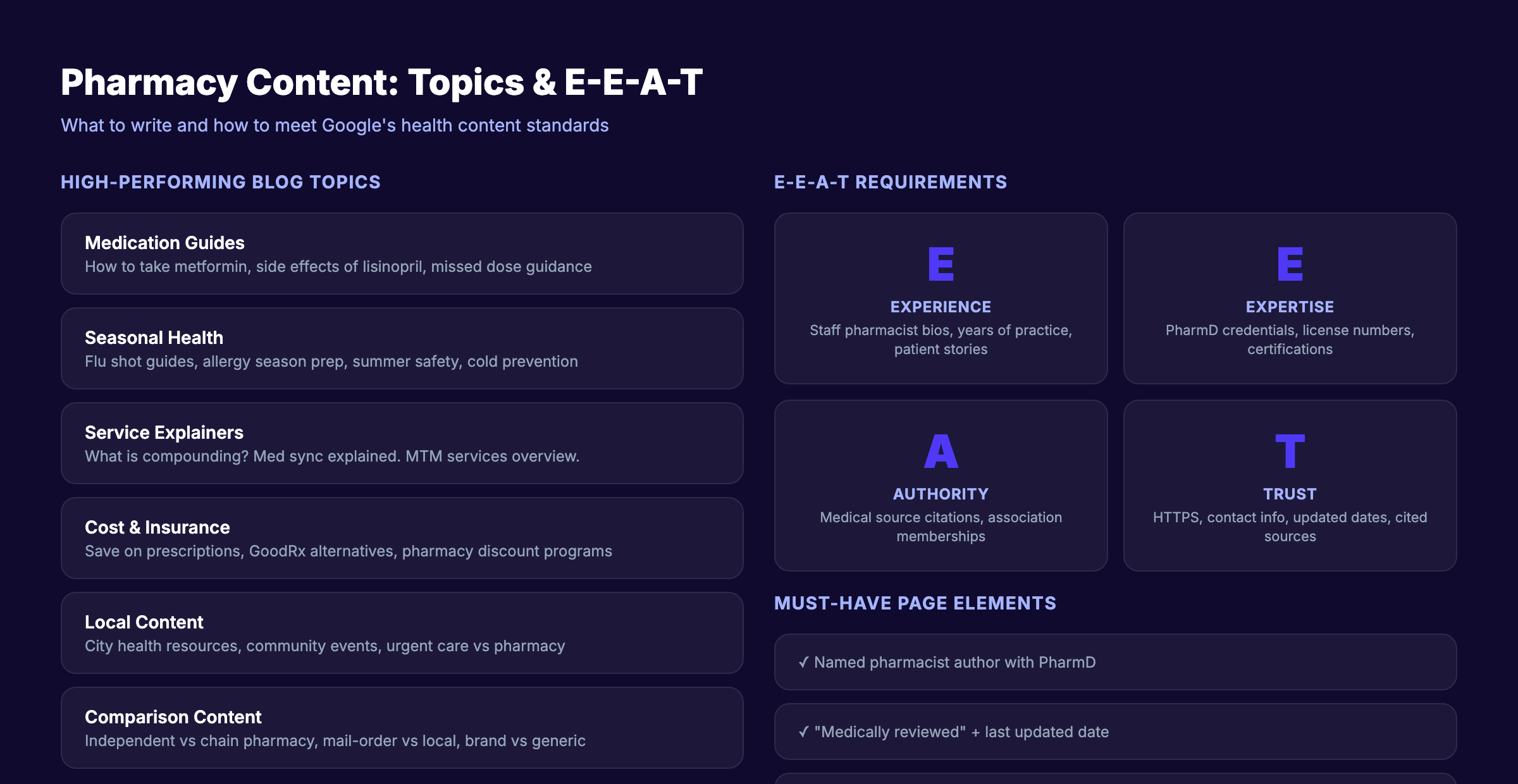
Google’s quality raters assess pharmacy content on 4 criteria:
| Signal | What Google Looks For | How Pharmacies Demonstrate It |
|---|---|---|
| Experience | First-hand knowledge of the topic | Staff pharmacist bios, years of practice, patient stories |
| Expertise | Professional qualifications | PharmD credentials, license numbers, clinical certifications |
| Authoritativeness | Recognition from peers and institutions | Citations from medical sources, pharmacy association memberships |
| Trustworthiness | Accuracy, transparency, security | HTTPS, clear contact info, updated content, cited sources |
Every page on your pharmacy website should display:
- Author name with pharmacist credentials (e.g., “Dr. Jane Smith, PharmD”)
- A “Medically reviewed” or “Last updated” date
- Citations to authoritative medical sources (FDA, CDC, NIH)
- Your pharmacy license number in the footer
Most pharmacy websites skip all of these. That is the gap you can fill.
The Independent Pharmacy Advantage
Chain pharmacies have brand authority. But they also have generic content published across thousands of locations. An independent pharmacy can outrank CVS for local searches by producing specific, localized content that chains cannot replicate.
One case study from AIOSEO documented an independent pharmacy growing from 163,000 to 1.2 million monthly visits in 6 months. The strategy: FAQ optimization for People Also Ask results, strategic schema markup, content freshness signals, and backlink growth to 125,000 links.
That is a 634% traffic increase. Independent pharmacies have a structural advantage in local SEO that most do not realize exists.
For a broader primer on search fundamentals, our SEO for beginners guide covers the basics that apply across every industry.
Stop writing. Start ranking. Stacc publishes 30 SEO-optimized articles per month for $99. Built for healthcare businesses. Start for $1 →
Chapter 2: Google Business Profile for Pharmacies
46% of all Google searches have local intent. For pharmacies, that number is even higher. “Pharmacy near me,” “24 hour pharmacy near me,” and “flu shot pharmacy” are all local searches that trigger the Google Map Pack.
The Map Pack is the box of 3 local results that appears above organic search results. Getting into it requires an optimized Google Business Profile.
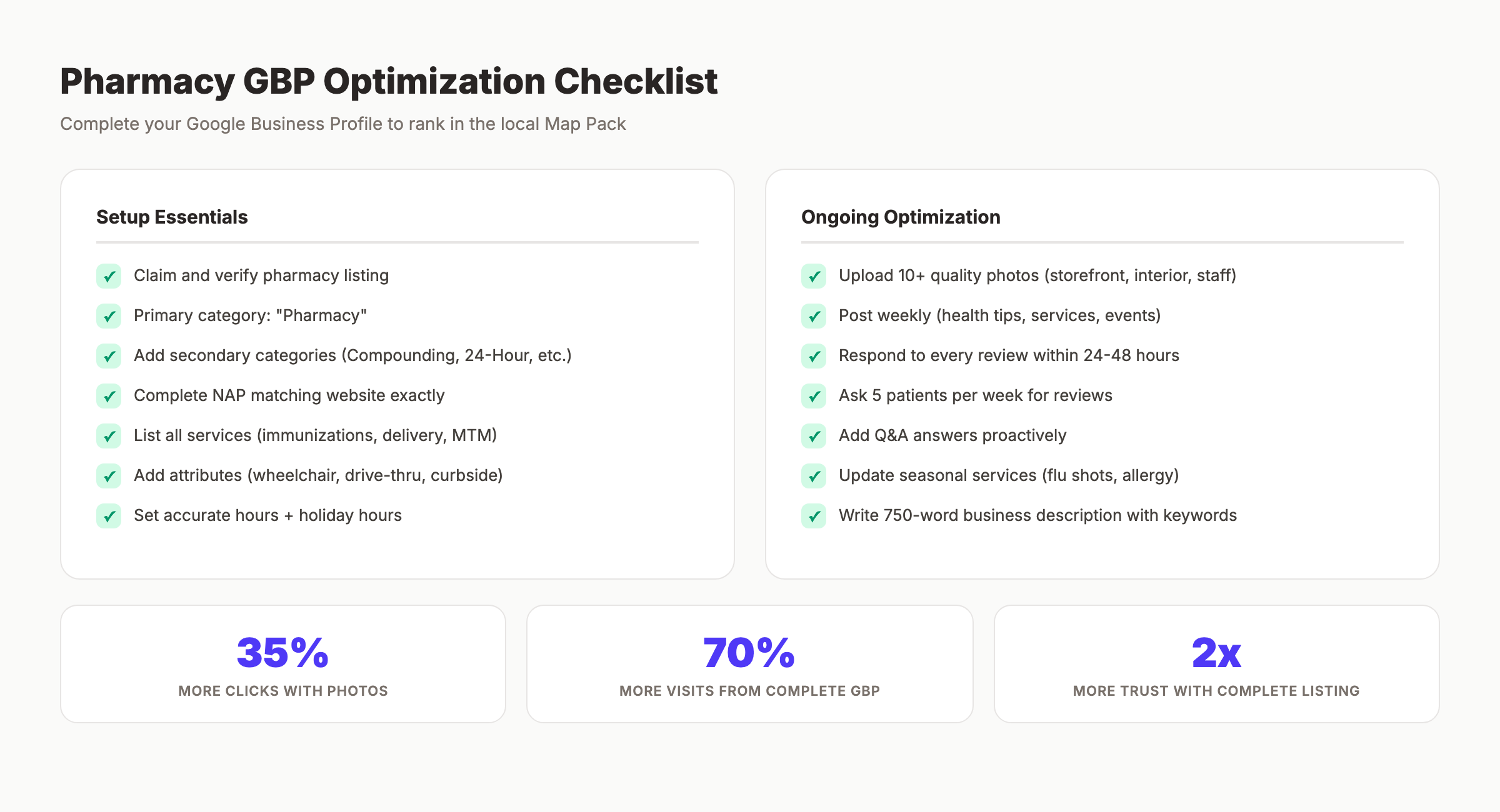
GBP Setup Checklist
- Claim and verify your pharmacy listing at business.google.com
- Select “Pharmacy” as your primary category
- Add secondary categories: “Compounding Pharmacy,” “24-Hour Pharmacy,” or specialty types
- Enter complete NAP (Name, Address, Phone) matching your website exactly
- Add all services: prescription filling, immunizations, delivery, compounding, med sync
- Upload 10+ high-quality photos of your storefront, interior, and staff
- Add attributes: wheelchair accessible, drive-thru, curbside pickup, delivery
- Set accurate hours including holiday and special hours
- Write a 750-word business description with target keywords
Why Photos and Posts Matter
GBP listings with photos get 35% more clicks than those without. Customers are 70% more likely to visit a business with a complete GBP listing.
Post to your GBP weekly. Effective pharmacy GBP post topics:
- Flu shot and vaccination availability (seasonal)
- New services (delivery, compounding, pet medications)
- Health tips tied to seasons (allergy season, cold prevention, sun safety)
- Community events your pharmacy participates in
- Staff introductions and pharmacist spotlights
Each post keeps your profile active. Google rewards active profiles with higher local rankings.
For a deeper dive into Google Business Profile strategy, our GBP categories guide covers category selection in detail.
Review Management
Reviews are the strongest local ranking signal for pharmacies. A pharmacy with 50 reviews averaging 4.7 stars will outrank a pharmacy with 5 reviews at 5.0 stars. Volume and recency matter more than perfection.
How to get more pharmacy reviews:
- Ask patients at pickup: “Would you mind leaving us a Google review?”
- Add a QR code linking to your Google review page at the counter
- Send a follow-up text or email after prescription delivery
- Respond to every review within 24 to 48 hours, positive or negative
For templates and strategies on handling reviews, our respond to Google reviews guide covers every scenario.
Chapter 3: Pharmacy Keyword Strategy
Most pharmacy owners target “pharmacy near me” and stop there. That one keyword has massive competition from chains. The real opportunity is in the hundreds of specific, service-based, and condition-based keywords that chains ignore.
Keyword Categories for Pharmacies
| Category | Example Keywords | Search Intent |
|---|---|---|
| Local / Near Me | pharmacy near me, 24 hour pharmacy [city], pharmacy open now | Navigational |
| Service-Based | prescription delivery pharmacy, compounding pharmacy [city], flu shot near me | Transactional |
| Condition-Based | diabetes management pharmacy, medication therapy management | Informational |
| Price / Value | affordable prescriptions [city], $4 prescriptions near me, GoodRx alternatives | Commercial |
| Comparison | independent pharmacy vs CVS, local pharmacy benefits, chain vs independent | Commercial |
| Clinical Services | pharmacy immunizations [city], med sync program, MTM services pharmacy | Transactional |
| Specialty | specialty pharmacy [city], pet pharmacy near me, compounding pharmacy hormones | Transactional |
The Long-Tail Advantage
“Pharmacy near me” gets millions of searches. Your independent pharmacy will not outrank CVS for it. But “compounding pharmacy for hormone therapy in [your city]” has far less competition and much higher conversion intent.
Long-tail keywords convert at higher rates because they signal specific need. A person searching “pharmacy that delivers prescriptions in [city]” is ready to switch pharmacies today.
Build a spreadsheet of 50 to 100 long-tail keywords organized by category. Target 1 primary keyword per page or blog post. Include 3 to 5 secondary keywords naturally in the content.
Trending Keywords in 2026
GLP-1 drugs like Ozempic and Wegovy drove 60% of retail pharmacy revenue growth over the past 5 years. Related search queries are surging.
Keywords like “Ozempic pharmacy near me,” “Wegovy availability [city],” and “GLP-1 prescriptions cost” represent massive traffic opportunities. If your pharmacy carries these medications, create content targeting these searches now.
Telehealth-related pharmacy queries are also growing. “Online prescription delivery,” “telehealth pharmacy,” and “virtual pharmacy consultations” are increasing in volume as e-pharmacy grows at 12 to 13% annually.
For a broader keyword research methodology, our SEO small business guide covers the fundamentals of finding and prioritizing keywords.
Your SEO team. $99 per month. 30 optimized articles, published automatically. Blog SEO, Local SEO, and Social on autopilot. Start for $1 →
Chapter 4: Content That Ranks for Health Topics
7% of all Google queries are healthcare-related. That translates to roughly 1 billion health searches per day. Pharmacies are positioned to capture a meaningful share of this traffic with the right content.
What to Write About
Most pharmacy websites have 5 pages: Home, About, Services, Contact, and maybe a blog with 2 abandoned posts from 2021. That is not enough content to rank for anything.
High-performing pharmacy blog topics:
- Medication guides: How to take metformin. Side effects of lisinopril. What happens if you miss a dose of your blood pressure medication.
- Seasonal health content: Flu shot guide for [year]. Allergy season survival tips. Staying safe in summer heat.
- Service explainers: What is compounding? How medication synchronization works. What MTM services can do for you.
- Cost and insurance: How to save on prescriptions without insurance. GoodRx vs. pharmacy discount programs. Understanding your pharmacy benefits.
- Local content: Best healthcare resources in [city]. Community health events this month. Your guide to urgent care vs. pharmacy for minor ailments.
- Comparison content: Independent pharmacy vs. chain pharmacy: what is the difference? Why switch from a mail-order pharmacy?
Writing Standards for YMYL Content
Every health-related article must meet these standards or it will not rank:
- Cite authoritative sources. Link to FDA.gov, CDC.gov, NIH.gov, PubMed, or peer-reviewed research.
- Display author credentials. Every post needs a named pharmacist author with their PharmD credential.
- Include a medical review notice. “Reviewed by [Name], PharmD. Last updated [date].”
- Avoid medical claims without evidence. Do not say “this supplement cures X.” Say “research suggests this supplement may help with X [link to study].”
- Update content regularly. Stale health content loses rankings. Review medication guides quarterly.
Content Frequency
Pharmacies that publish 8 to 12 blog posts per month build topical authority faster than those publishing 1 to 2. Each post targets a different keyword and creates a new entry point from Google.
The math is straightforward. 12 posts per month means 144 indexed pages per year. Each page ranks for 3 to 5 keywords on average. That is 430 to 720 keyword rankings after one year of consistent publishing.
Our blog frequency study breaks down the exact publishing cadence by business size and industry.
For content strategy principles that apply across industries, see our content marketing for small business guide.
Chapter 5: Technical SEO for Pharmacy Websites
Most pharmacy websites were built 5 to 10 years ago and have never been optimized. Slow load times, missing schema markup, and broken mobile layouts cost pharmacies rankings every day.
Site Speed
Pages loading in 2 seconds have a 9% bounce rate. Pages loading in 5 seconds have a 38% bounce rate. Most pharmacy websites fall into the second category.
Quick wins for pharmacy site speed:
- Compress all images to WebP format (most pharmacy sites use uncompressed JPEGs)
- Enable browser caching
- Minimize JavaScript and CSS files
- Use a content delivery network (CDN)
- Choose a hosting provider with servers near your location
Test your site speed at PageSpeed Insights. Fix anything below a 70 score on mobile.
Schema Markup for Pharmacies
Schema markup tells Google exactly what your business is and what you offer. Most pharmacy websites have zero schema. Adding it gives you a ranking edge.
Essential schema types for pharmacies:
| Schema Type | What It Does | Where to Add |
|---|---|---|
| Pharmacy (LocalBusiness) | Identifies your business as a pharmacy | Homepage |
| OpeningHoursSpecification | Shows hours in search results | Homepage, Contact |
| FAQPage | Enables FAQ rich results in SERPs | Blog posts, service pages |
| Drug | Provides medication information | Medication guide pages |
| MedicalCondition | Connects content to health conditions | Condition-specific pages |
| Product | Displays OTC products with pricing | Product pages |
| AggregateRating | Shows star rating in search results | Homepage, service pages |
Implementing Pharmacy schema on your homepage alone can improve your visibility in local search results. Google uses it to match your business with relevant queries.
For a broader technical checklist, our technical SEO checklist covers every element.
Mobile Optimization
56 to 60% of pharmacy website traffic comes from mobile devices. If your site is not mobile-friendly, you are losing the majority of potential patients before they see your content.
Mobile checklist:
- Text is readable without zooming
- Buttons and links are easy to tap (48px minimum target)
- Click-to-call phone number works on all pages
- Forms are easy to fill on mobile
- Google Maps embed loads on mobile
- No horizontal scrolling required
NAP Consistency
NAP stands for Name, Address, Phone Number. Every online listing of your pharmacy must use the exact same NAP. Inconsistencies confuse Google and hurt local rankings.
Check your NAP across: Google Business Profile, Yelp, Healthgrades, GoodRx, Insurance directories, Yellow Pages, and your own website footer. One digit off in your phone number or a different suite number can suppress your local visibility.
Our NAP consistency guide covers how to audit and fix inconsistencies across all platforms.
3,500+ blogs published. 92% average SEO score. See what Stacc can do for your pharmacy. Start for $1 →
Chapter 6: How Independent Pharmacies Beat Chains in Search
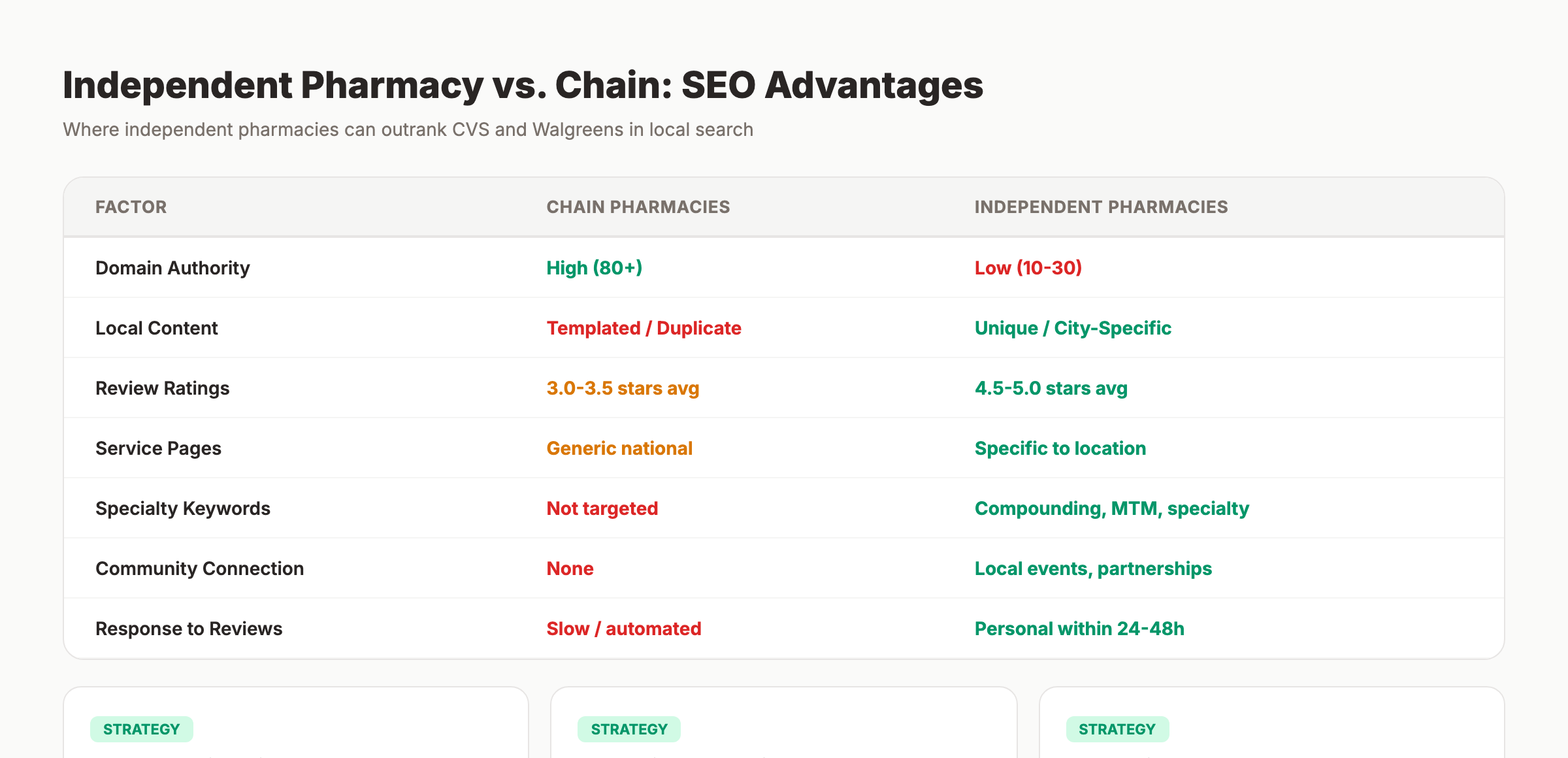
CVS has 9,000+ locations and a domain authority above 80. Competing head-to-head on broad keywords is a losing strategy. But independent pharmacies win local searches every day using strategies that chains cannot replicate.
The Localization Advantage
Chain pharmacy websites use templated pages for every location. The content is identical except for the city name. Google knows this. It is duplicate content with a location swap.
An independent pharmacy can create genuinely local content:
- “Best flu shot options in [specific neighborhood], [city]”
- “How [your pharmacy name] serves the [neighborhood] community”
- “Your guide to prescription delivery in [city/zip code]”
- “[City] health resources: pharmacies, urgent care, and clinics”
This content is unique. It targets location-specific keywords. And it signals to Google that your pharmacy is deeply connected to the community.
Service Differentiation
Chains offer standard services. Independent pharmacies often provide specialized services that patients actively search for:
- Compounding (custom medication formulations)
- Medication therapy management (MTM)
- Medication synchronization (med sync)
- Specialty medications
- Pet medications
- Hormone replacement therapy
- Natural and holistic products
- Same-day local delivery
Create a dedicated page for each service. Target the service keyword + city. “Compounding pharmacy in [city]” has far less competition than “pharmacy near me” and converts better.
The Review Gap
Most chain pharmacy locations have hundreds of reviews but average 3.0 to 3.5 stars. Patient complaints about wait times, impersonal service, and insurance issues are common.
Independent pharmacies typically have fewer reviews but higher ratings (4.5 to 5.0 stars). The strategy: aggressively grow your review count while maintaining your quality advantage.
A pharmacy with 80 reviews at 4.8 stars will outrank a chain location with 300 reviews at 3.2 stars for local searches. Google’s local algorithm weights review quality and recency alongside volume.
For competitive analysis tactics, our SEO competitor analysis guide covers how to study and outmaneuver your competition in search results.
Chapter 7: Pharmacy SEO 90-Day Action Plan
Most SEO guides tell you what to do without telling you when. Here is a week-by-week plan for the first 90 days of pharmacy SEO.
Weeks 1-2: Foundation
- Claim and fully optimize your Google Business Profile
- Fix NAP consistency across all online directories
- Install Google Search Console and Google Analytics
- Run a site speed test and fix critical issues
- Add Pharmacy schema markup to your homepage
- Ensure your site is mobile-friendly
Weeks 3-4: Keyword Research and Content Planning
- Build your keyword spreadsheet (50 to 100 keywords across all categories)
- Create a dedicated page for each pharmacy service
- Write 4 blog posts targeting long-tail keywords
- Add FAQPage schema to service pages
- Start a weekly GBP posting schedule
Weeks 5-8: Content Production
- Publish 2 to 3 blog posts per week (medication guides, seasonal content, local topics)
- Add author bios with PharmD credentials to all content
- Include “Last reviewed” dates on health content
- Build internal links between service pages and blog posts
- Request reviews from 5 patients per week
Weeks 9-12: Optimization and Growth
- Review Google Search Console for ranking keywords
- Identify pages ranking on page 2 and optimize them for page 1
- Add schema markup to all blog posts (FAQPage, Drug, MedicalCondition)
- Build citations on pharmacy-specific directories (GoodRx, Healthgrades, RxList)
- Analyze competitor content and fill gaps they miss
Expected Timeline
| Milestone | When to Expect It |
|---|---|
| Google Business Profile ranking improvements | 6 to 8 weeks |
| First page 2 organic rankings | 8 to 12 weeks |
| Map Pack appearances for service keywords | 10 to 14 weeks |
| Consistent page 1 rankings | 4 to 6 months |
| Significant organic traffic increase | 6 to 12 months |
Pharmacy SEO results take 3 to 5 months for meaningful ranking improvements. Google Maps results can appear faster, sometimes within 6 to 8 weeks of GBP optimization.
Our local SEO checklist covers every element of local search optimization in a step-by-step format.
Rank everywhere. Do nothing. Blog SEO, Local SEO, and Social on autopilot. Stacc starts at $99/mo with a $1 SEO trial. Start for $1 →
Common Pharmacy SEO Mistakes
Ignoring Google Business Profile. Your GBP listing is often the first thing patients see. An incomplete profile with no photos, no reviews, and wrong hours sends patients to the chain down the street.
Publishing generic health content. Copying medication descriptions from manufacturer websites creates duplicate content that Google will not rank. Write original content reviewed by your pharmacist.
No author credentials on health content. Google needs to verify that health information comes from qualified professionals. A blog post about medication interactions with no author attribution will not rank under YMYL guidelines.
Targeting only broad keywords. “Pharmacy near me” is dominated by chains. Target specific service keywords, condition keywords, and location keywords where you can actually win.
Neglecting reviews. A pharmacy with 8 Google reviews in 2026 looks abandoned. Aim for 50+ reviews with a systematic approach to asking patients.
Outdated website design. A pharmacy website that looks like it was built in 2015 and does not work on mobile loses 60% of its potential traffic before any SEO strategy takes effect.
No content publishing schedule. SEO compounds over time. Publishing 2 posts in January and nothing until June will not build rankings. Consistent weekly publishing is the minimum.
For a broader view of SEO mistakes across industries, our SEO cost guide explains what to expect from SEO investment at different budget levels.
FAQ
Is SEO worth it for a small pharmacy?
Yes. 77% of patients search online before choosing a pharmacy. An independent pharmacy that ranks in the Google Map Pack and on page 1 for local keywords captures patients who would otherwise default to a chain. The ROI comes from patient lifetime value. One new regular patient fills 12+ prescriptions per year.
How much does pharmacy SEO cost?
Pharmacy SEO agencies charge $1,500 to $3,000 per month. A done-for-you service like Stacc starts at $99 per month for 30 articles and $49 per month for GBP post management. DIY SEO costs only your time but requires consistent effort over 6+ months.
How long does pharmacy SEO take to show results?
Google Business Profile improvements can show results in 6 to 8 weeks. Organic search rankings typically take 3 to 5 months for initial movement. Significant traffic growth takes 6 to 12 months of consistent content publishing and optimization.
What keywords should pharmacies target first?
Start with service-based keywords combined with your city name: “compounding pharmacy [city],” “prescription delivery [city],” “flu shot pharmacy [city].” These have lower competition than “pharmacy near me” and higher conversion intent.
How do pharmacies compete with CVS and Walgreens in search?
By targeting local and specialized keywords that chains do not optimize for. Create unique local content, build a strong review profile (higher ratings than chains), optimize for specific services (compounding, MTM, specialty), and demonstrate E-E-A-T through pharmacist-authored content.
Does my pharmacy need a blog?
Yes. Each blog post creates a new indexed page that can rank for specific keywords. A pharmacy publishing 8 to 12 posts per month builds 100+ indexed pages per year, each one a potential entry point from Google search.
Pharmacy SEO rewards the businesses that invest in it consistently. The independent pharmacies ranking on page 1 today started 6 to 12 months ago. Every blog post, every GBP update, and every patient review compounds your authority over time. The pharmacies that start now will own their local search results by the end of the year.
Written and published by Stacc. We publish 3,500+ articles per month across 70+ industries. All data verified against public sources as of March 2026.