A practical pool service SEO operating system built around eligible jobs, territory, route capacity, season, intake quality, and completed-job evidence.
Pool service SEO should make eligible, route-fit work easier to find and easier to verify. It should not chase traffic that the company cannot serve. The operating unit is a completed job with a known source, not a ranking screenshot, a call-button tap, or a form submission.
That distinction matters because “pool service” can mean recurring cleaning, a one-time green-pool cleanup, equipment repair, seasonal opening or closing, resurfacing, remodeling, or new construction. Those jobs have different urgency, skills, licenses, travel tolerance, ticket bands, and completion lags. A useful search program represents those differences honestly.
Google describes SEO as work that helps search engines understand content and helps users find a site; it offers no secret that automatically ranks a page first. For this guide, success means building an auditable path from search visibility to work the business is legally and operationally prepared to complete.
What pool service SEO has to accomplish
Pool service SEO must connect an accurate search promise to an eligible local job, a staffed intake path, available capacity, and completion evidence. It should help the right customer choose the right service while preventing unsupported work, distant stops, and seasonal mismatches from entering the schedule. A search visit is not a booked job.
Start with job truth, not keywords
Separate recurring maintenance from one-time work. Weekly cleaning may reward route density and predictable access. An urgent green-pool request may require photos, a fast response window, and a different capacity rule. Opening and closing work may matter in a freeze-market operation but be irrelevant to a warm-market company. Leak diagnosis, pump or filter work, heater work, electrical or gas work, resurfacing, remodeling, and construction must remain distinct because the people, licenses, permits, and risk boundaries may differ.
Never infer authority to perform a job from a competitor page or a broad contractor label. Verify the work scope against state and local requirements. Florida, for example, has a state application path for a Certified Pool Servicing Contractor, while California identifies a C-53 classification for specified swimming-pool construction work. These are examples of jurisdictional variation, not nationwide rules and not advice about routine cleaning.
Define a useful outcome
Visibility has value only when the business can trace what followed. Keep the stages explicit: impression → click → call click or form → qualified enquiry → booked job → completed job. If call tracking records a connected call, place it between call click and qualified enquiry. Never infer that connection from the click.
The program should answer practical questions: Which service produced the request? Was the address inside the working territory? Did the job fit the route or require a special dispatch? Was a qualified technician available? Was the job completed under the company’s written rule? Those answers determine whether search activity supports route economics.
Model the business before touching the website
Document the jobs the company accepts, excluded work, territory, skills, licenses, route constraints, staffed hours, seasonal capacity, and intake ownership before changing a page or profile. This model prevents marketing from selling work operations cannot perform and gives every query, page, call, and booking a consistent eligibility rule.
Create a pool-job economics card
Complete one card for every materially different job. The “ticket band” must come from the business’s own invoices or pricing policy; do not import a market estimate. Treat the card as an approval record for marketing and intake.
| Field | What to record | Why it changes search decisions |
|---|---|---|
| Job type | Exact customer-facing and operational name | Prevents cleaning, repair, and construction intent from collapsing together |
| Pattern | Recurring or one-time; normal or urgent | Sets intake speed, page promise, and scheduling logic |
| Typical season | The company’s observed working season | Controls availability messaging without assuming national seasonality |
| Territory | Accepted radius, ZIPs, or dispatch zones | Protects route density and filters distant requests |
| Route fit | Normal stop, edge stop, or special dispatch | Distinguishes revenue from operationally sensible revenue |
| Requirements | Technician skill, license, permit, equipment, subcontractor rule | Stops unsupported claims and unsafe scheduling |
| Capacity | Open, constrained, waitlist, or unavailable | Determines whether the page and GBP should invite the job now |
| Ticket band | Business-owned band, owner, and effective date | Supports economics without publishing a portable benchmark |
| Completion lag | Typical business-owned lag and completion rule | Prevents premature channel evaluation |
| Exclusions | Explicit work the business declines | Improves page clarity and intake qualification |
Model seasonality as an operational hypothesis
A warm-market maintenance route may sell recurring work throughout much of its operating year. A freeze-market company may plan around opening, closing, winterization, and compressed scheduling windows. Climate labels are only planning shorthand; the company’s actual jobs, weather, local rules, and historical records decide what is true.
| Market pattern | Query timing hypothesis | Capacity risk | Fact to update | Evidence needed | Owner / review date |
|---|---|---|---|---|---|
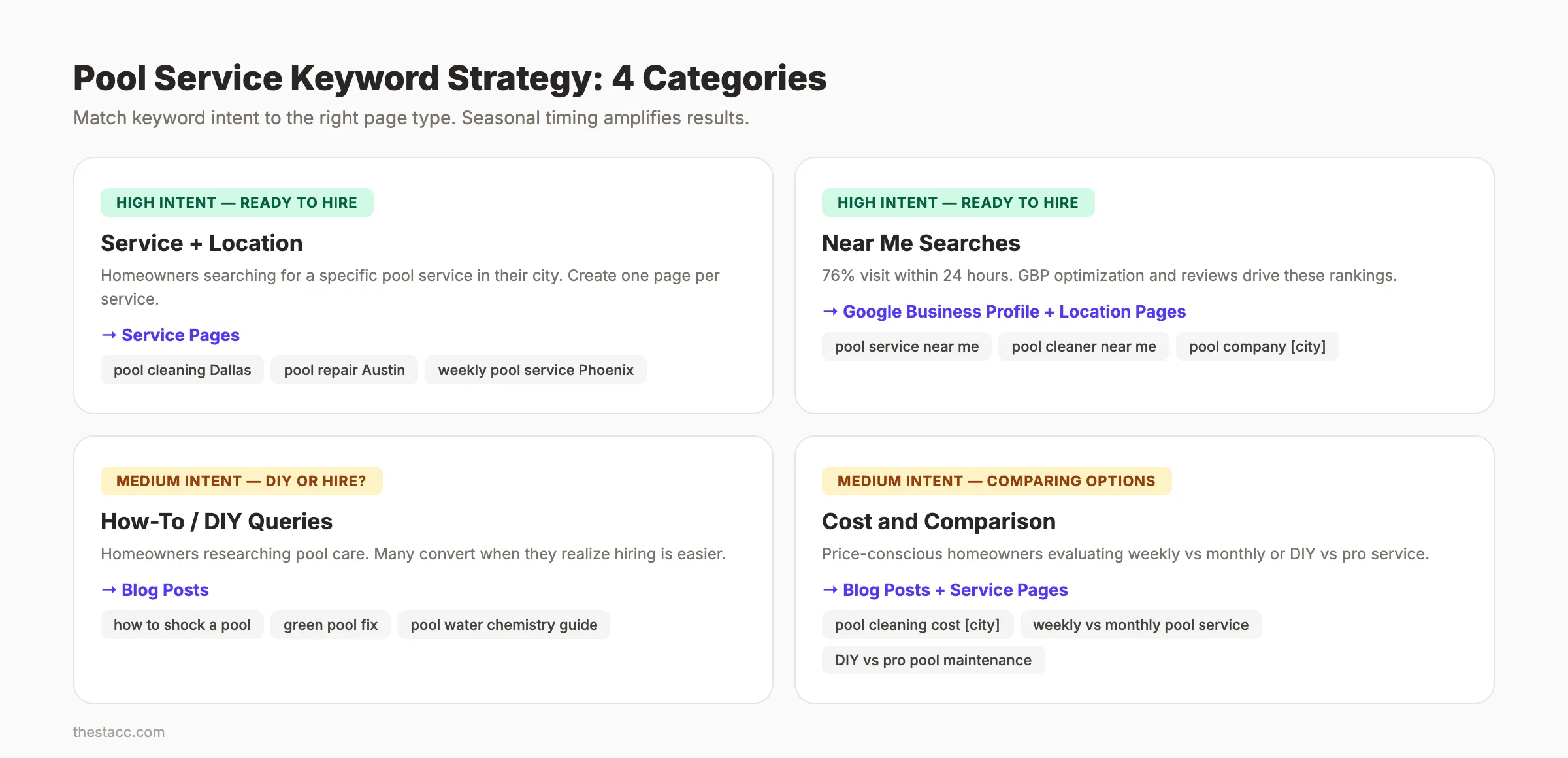
| Service + Location | "pool cleaning Dallas," "pool repair Austin" | High (ready to hire) | Service pages | ||
| Near Me | "pool service near me," "pool cleaner near me" | High (ready to hire) | GBP + local pages | ||
| How-To / DIY | "how to shock a pool," "green pool fix" | Medium (researching) | Blog posts | ||
| Cost / Comparison | "pool cleaning cost," "weekly pool service price" | Medium (evaluating) | Blog + service pages |
High-Value Service Keywords
Each of these deserves a dedicated service page.
Maintenance services:
- Pool cleaning + [city]
- Weekly pool service + [city]
- Pool maintenance + [city]
- Chemical balancing + [city]
- Pool vacuuming + [city]
Repair services:
- Pool pump repair + [city]
- Pool leak detection + [city]
- Pool filter repair + [city]
- Pool heater repair + [city]
- Pool resurfacing + [city]
Seasonal services:
- Pool opening + [city]
- Pool closing/winterization + [city]
- Green pool cleanup + [city]
- Algae removal + [city]
Equipment:
- Pool pump replacement + [city]
- Pool filter replacement + [city]
- Pool light installation + [city]
- Salt system installation + [city]
Seasonal Keyword Trends
Pool service searches are highly seasonal. Your content and ad strategy should match.
| Season | Search Volume Peak | Top Keywords |
|---|---|---|
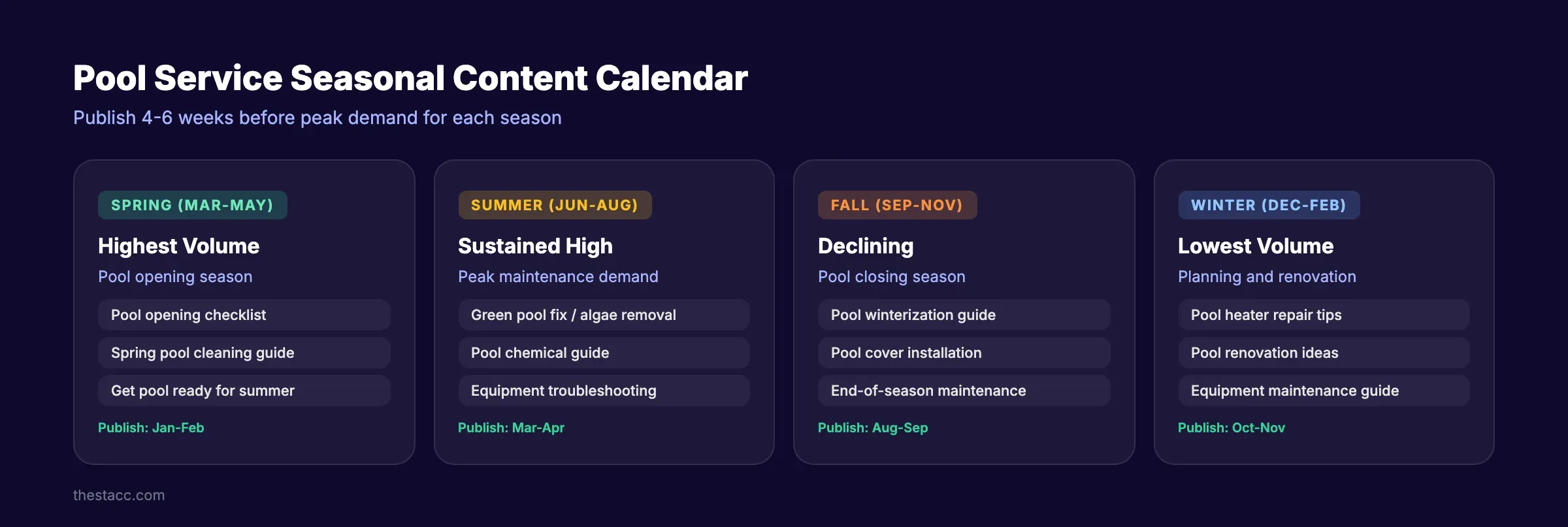
| Spring (Mar-May) | Highest of the year | "pool opening," "pool cleaning service," "get pool ready for summer" |
| Summer (Jun-Aug) | Sustained high | "pool maintenance," "green pool fix," "pool chemical service" |
| Fall (Sep-Nov) | Declining | "pool closing," "winterize pool," "pool cover installation" |
| Winter (Dec-Feb) | Lowest | "pool heater repair," "pool equipment maintenance," "pool renovation" |
Publish seasonal content 4 to 6 weeks before the peak. A blog post about "pool opening checklist" published in February ranks in time for the March/April search surge.
Service Pages: One Page Per Service
A single "Services" page listing pool cleaning, repair, and maintenance together will not rank for any of those keywords individually. Each service needs its own dedicated page.
Why Individual Pages Win
Google ranks pages, not websites. A page titled "Pool Cleaning in Phoenix" targets that exact keyword. A page titled "Our Services" targets nothing specific.
Individual service pages give you:
- A unique URL ranking for each service keyword
- Space for service-specific content (600+ words minimum)
- A dedicated landing page for Google Ads campaigns
- Schema markup opportunities for each service
- Internal linking between related services
The Ideal Service Page Structure
1. H1 with service + location Example: "Pool Cleaning Service in Phoenix, AZ"
2. Opening paragraph (60 to 80 words) What the service includes, who it is for, and why homeowners choose you. Include the primary keyword in the first sentence.
3. What is included (H2) List specific tasks. For pool cleaning: skimming, brushing, vacuuming, filter cleaning, chemical testing, chemical adjustment, pump basket cleaning, tile cleaning. Homeowners want to know exactly what they are paying for.
4. Service frequency options (H2) Weekly, bi-weekly, monthly, one-time. Include pricing ranges where possible. "Weekly pool cleaning starts at $120 per month" is more useful than "Contact us for pricing."
5. Why choose us (H2) Licensed, insured, years of experience, warranties on equipment work. Include trust signals.
6. Service area (H2) List specific cities, neighborhoods, and ZIP codes you serve. This helps Google match your page to location-based searches.
7. FAQ section (H2) Answer 4 to 6 common questions. "How often should I have my pool cleaned?" "What does pool chemical balancing include?" Add FAQ schema for rich results.
8. Call to action "Get a Free Quote" with phone number and form. Make the phone number clickable for mobile users.
Reviews: The Ranking Factor That Closes Deals
Google reviews influence both your Map Pack ranking and your conversion rate. Homeowners compare 3 to 5 pool companies before calling. The one with more reviews and a higher rating wins.
How Many Reviews You Need
Pool companies with 50+ Google reviews dominate the Map Pack in most local markets. Aim for a consistent flow of new reviews every month. Review velocity (the rate of new reviews) matters more than total count.
A pool company that gets 6 new reviews per month outranks one with 150 total reviews but none in the last 3 months.
How to Get Reviews Consistently
Pool service has a natural advantage: recurring visits. Your technician sees the customer's property regularly. Use that relationship.
Review generation checklist:
- ✓ Send an automated text after each service visit (not every visit, weekly or monthly)
- ✓ Place a review link in your email invoices
- ✓ Train technicians to mention reviews after a positive interaction
- ✓ Add a QR code to leave-behind cards or door hangers
- ✓ Respond to every review within 48 hours
The automated text after a service visit is the highest-converting method. Time it right after the technician leaves, when the pool looks clean and the homeowner is satisfied.
Review Response Best Practices
Respond to every review. Positive and negative.
Positive: Thank the customer. Mention the service or neighborhood. "Thanks for the great review. We love keeping pools in the Scottsdale Ranch area crystal clear."
Negative: Acknowledge the issue. Apologize. Offer to resolve it offline. Never argue publicly. A professional response to a negative review often impresses prospective customers more than the review itself.
For detailed strategies, see our guide on getting more Google reviews for local businesses.
Your SEO team. $99 per month. 30 optimized articles published automatically. Built for home services businesses like pool companies.
Content Strategy: Blog Posts That Book Jobs
Pool service content serves 2 purposes: ranking for informational keywords and building the topical authority that strengthens your service pages.
Content Topics That Work
Seasonal maintenance content (highest search volume):
- "Pool Opening Checklist: 10 Steps to Get Your Pool Ready for Summer"
- "How to Winterize Your Pool in [City]"
- "Green Pool? How to Fix Algae in 48 Hours"
- "When to Start Heating Your Pool in [City]"
Cost and comparison content (high conversion):
- "How Much Does Pool Cleaning Cost in [City]?"
- "Weekly vs. Monthly Pool Service: Which Is Worth It?"
- "DIY Pool Maintenance vs. Hiring a Pro: The Real Cost"
- "Salt Water Pool vs. Chlorine: Maintenance Comparison"
Educational content (builds authority):
- "Pool Water Chemistry 101: A Homeowner's Guide"
- "5 Signs Your Pool Pump Needs Replacement"
- "How Often Should You Run Your Pool Filter?"
- "Pool Stain Identification: What Causes Them and How to Remove Them"
Local content:
- "Best Pool Season Tips for [City] Homeowners"
- "Pool Regulations in [County]: What Homeowners Need to Know"
Publishing Frequency
The pool companies ranking highest publish 8 to 16 blog posts per month. Most pool companies publish zero. That gap is your competitive advantage.
Consistent publishing builds topical authority. A site with 40 pool-related articles earns more authority than one with 4. You do not need to write every post yourself. A content automation approach lets you publish at volume without hiring a content team.
Seasonal Content Calendar
Plan content around the pool service calendar. Publish 4 to 6 weeks before peak demand.
| Publish Month | Content Focus | Peak Search Month |
|---|---|---|
| January-February | Pool opening guides, spring prep | March-April |
| March-April | Summer maintenance, chemical guides | May-June |
| May-June | Troubleshooting (green pool, equipment) | June-August |
| August-September | Pool closing, winterization | October-November |
| October-November | Off-season equipment maintenance | December-January |
| December | "New year" planning, renovation ideas | January-February |
Technical SEO for Pool Company Websites
Technical SEO ensures Google can find, crawl, and rank your pages. Most pool company websites have fixable issues holding them back.
Mobile Optimization
Over 70% of "near me" searches happen on mobile. A homeowner standing next to a green pool is searching on their phone. Your site must work perfectly on mobile.
Mobile checklist:
- ✓ Pages load in under 3 seconds
- ✓ Phone numbers are tap-to-call
- ✓ Contact forms work on mobile
- ✓ Text is readable without zooming
- ✓ Images resize correctly
- ✓ "Get a Quote" button is visible without scrolling
Test with Google PageSpeed Insights. Fix anything below 80. Core Web Vitals are a confirmed ranking factor.
Schema Markup
Schema markup helps Google understand your business. For pool companies, 3 types matter:
LocalBusiness schema: Name, address, phone, hours, service area. Required for local SEO.
Service schema: Identifies each service you offer. Helps Google match your pages to service-specific queries.
FAQPage schema: Turns FAQ sections into rich results in Google search. More SERP visibility means more clicks.
Site Structure
A clean site structure helps Google crawl efficiently and helps homeowners find what they need.
Recommended pool company site structure:
Homepage
├── Services (hub page)
│   ├── Pool Cleaning
│   ├── Pool Maintenance
│   ├── Pool Repair
│   ├── Pool Opening
│   ├── Pool Closing
│   ├── Equipment Installation
│   └── [Each service type]
├── Service Areas
│   ├── [City 1]
│   ├── [City 2]
│   └── [Each location]
├── About
├── Blog
│   ├── Seasonal guides
│   ├── How-to articles
│   └── Cost comparison posts
├── Gallery (before/after)
└── Contact / Get a Quote
Link service pages to related blog posts. Link blog posts back to relevant service pages. This internal linking structure distributes authority and helps every page rank stronger.
Image Optimization
Pool companies have a visual advantage: before-and-after photos sell the service. Use them strategically.
- Compress images for fast loading (under 200KB per image)
- Add descriptive alt text: "Green pool before and after cleaning service in Scottsdale AZ"
- Use geo-tagged file names:
pool-cleaning-scottsdale-before-after.jpg - Upload the same photos to your GBP with location details
Optimized images appear in Google Image search and drive extra traffic.
Local Citations and Directories
Citations are mentions of your pool company on other websites. Consistent citations strengthen your local ranking signals.
Priority Directories for Pool Companies
Home services platforms:
- Angi (formerly Angie's List)
- HomeAdvisor
- Thumbtack
- Nextdoor
- Houzz
General local:
- Google Business Profile
- Yelp
- Apple Maps
- Bing Places
- YellowPages
- BBB (Better Business Bureau)
Industry-specific:
- Pool and Hot Tub Alliance (PHTA) member directory
- Local Chamber of Commerce
- State contractor licensing board
NAP Consistency
Your Name, Address, and Phone Number must match exactly across every listing. If your GBP says "123 Main St, Suite 4," every other listing must say the same. Not "123 Main Street #4."
Inconsistent NAP confuses Google and hurts local rankings. Audit all listings quarterly.
3,500+ blogs published. Every article is SEO-scored before publish. See what theStacc can do for your pool service business.
Tracking Pool Service SEO Results
SEO without measurement is guesswork. Track these metrics monthly.
Key Metrics
| Metric | Tool | What It Tells You |
|---|---|---|
| Organic traffic | Google Analytics 4 | Visitors from search |
| Keyword rankings | Google Search Console | Which queries you rank for |
| Map Pack impressions | GBP Insights | How often you appear locally |
| Phone calls from GBP | GBP Insights + call tracking | Leads from local search |
| Quote requests | GA4 + CRM | Form submissions from organic |
| Review count and rating | Google Business Profile | Trust signals and ranking factor |
| Seasonal traffic trends | GA4 year-over-year | How seasonal patterns affect your traffic |
Realistic Timeline
Month 1 to 2: Technical fixes, GBP optimization, service page creation. Minimal ranking changes.
Month 3 to 4: New pages index. Long-tail keywords start ranking. GBP visibility improves.
Month 5 to 6: Service pages gain traction. Blog content ranks for how-to and cost queries. Organic traffic increases 20 to 40%.
Month 7 to 12: Compounding effect across services and locations. Map Pack dominance builds. Organic traffic grows 50 to 100%+ from baseline.
Pool service SEO has a seasonal overlay. Expect the biggest jumps in spring and early summer when search volume peaks. Winter months show slower growth in traffic but are the perfect time to build content that ranks before the next season.
The timeline for SEO results depends on market competition. A pool company in a mid-size city sees faster results than one in Phoenix, Miami, or Dallas.
Common Pool Service SEO Mistakes
Avoid these mistakes. Each one costs rankings and leads.
1. One page for all services. Pool cleaning, repair, and maintenance need separate pages. A single "Services" page cannot rank for all 3.
2. No seasonal content. Pool search demand is seasonal. Companies that publish pool opening guides in January rank in time for the March surge. Companies that wait until April miss the window.
3. Ignoring Google Business Profile. Your GBP is the single most important local SEO asset. An incomplete profile with no photos and no posts is invisible in the Map Pack.
4. No review system. Hoping customers leave reviews does not work. You need automated texts, email reminders, and trained technicians asking at the right moment.
5. Generic location pages. Copying the same text across 8 city pages and swapping the city name fails. Each location page needs unique content specific to that area.
6. No blog content. A website with 5 static pages and no blog cannot build topical authority. The pool companies dominating search publish consistently.
7. Slow mobile site. Over 70% of searches happen on mobile. A site that takes 5 seconds to load loses visitors before they see your phone number.
8. Missing schema markup. LocalBusiness and FAQPage schema are easy to add. They directly impact your eligibility for rich results and Map Pack features.
Build the funnel dictionary and evidence systems
A funnel dictionary gives each search and sales stage one exact business meaning, timestamp, source, owner, handoff, and exclusion rule. Without it, reports quietly treat impressions, dialler opens, forms, qualified opportunities, bookings, and completions as “leads,” hiding whether SEO, intake, scheduling, or operations actually failed.
| Stage | Exact business rule | Timestamp | Source system | Owner / handoff | Exclusions |
|---|---|---|---|---|---|
| Impression | Search Console records an appearance under declared search type and filters | Search date | Search Console Performance | SEO owner → query review | Mismatched search types, preliminary days, filters outside analysis |
| Click | Search Console records a click for the same declared filters | Search date | Search Console Performance | SEO owner → landing-page review | Filters outside analysis; do not infer a session or enquiry |
| Call click | Tracked tap on a call control | Interaction time | Analytics or profile reporting | Marketing → intake | Staff tests, duplicate taps; never infer connection |
| Form | Unique valid submission received | Server receipt time | Form log or CRM | Marketing → intake | Spam, tests, duplicates, incomplete technical events |
| Qualified enquiry | Unique enquiry meets written job, territory, timing, licensing, and capacity rules | Qualification time | Call system plus CRM | Intake → scheduling | Vendors, jobs, unsupported work, out-of-area, spam, duplicates |
| Booked job | Qualified enquiry has a confirmed service appointment under the booking rule | Confirmation time | CRM or job system | Scheduling → operations | Unconfirmed estimates, duplicates, pre-booking cancellations |
| Completed job | Booked work meets the written completion rule | Completion time | Job-management system | Operations → finance/marketing | Cancellations, no-shows, incomplete work, test records; reschedules once |
Publish formulas only with their evidence contract
Organic click-through rate = Google Search clicks for declared non-branded query, page, country, device, and search-type filters ÷ impressions for identical filters. Compare one declared 28-day window with the preceding comparable 28 days in Search Console Performance; state page- or property-level aggregation. SEO owns it. Exclude branded queries for non-branded analysis, mismatched search types, preliminary days, and independently identifiable staff activity.
Qualified-enquiry rate = unique enquiries meeting the written job, territory, timing, licensing, and capacity rule ÷ all unique attributable call and form enquiries in the same declared 28-day intake cohort. Use the call system plus form or CRM source field; intake owns it. Exclude spam, duplicates, vendors, employment, unsupported jobs, and out-of-territory requests.
Booked-job rate = unique qualified enquiries with a confirmed booked job ÷ all unique qualified enquiries created in that cohort. Use the declared 28-day intake cohort plus stated booking lag in the CRM or job system; scheduling owns it. Exclude duplicate bookings, estimates without booked service, and enquiries cancelled before booking.
Completed-job rate = unique booked jobs marked completed under the written rule ÷ all unique booked jobs in that cohort. Use a declared booking cohort plus sufficient lag in the job system; operations owns it. Exclude cancellations, no-shows, incomplete work, tests, and duplicate reschedules.
Cost per completed first-time job = direct SEO vendor, software, content, and technical spend assigned to the cohort, with owner labor explicitly costed or excluded ÷ unique attributable first-time jobs from that cohort marked completed. Use invoices or payroll policy plus analytics, CRM, and job records after completion and attribution lag. Finance or the owner signs off with marketing and operations. Exclude recurring visits, unattributable jobs, cancellations, no-shows, incomplete jobs, and taxes or overhead unless explicitly included.
Publish content built for Google and AI citations. theStacc’s Content SEO module ships SEO-scored articles structured for rankings and generative engines — including clearer entity pages models like Grok can quote.
FAQ
Pool service SEO includes accurate Google Business Profile management, crawlable service pages, query-to-job mapping, useful supporting content, genuine customer reviews, technical maintenance, and measurement from search visibility through completed jobs. The exact mix depends on the company’s eligible work, territory, season, capacity, and evidence systems.
SEO is worth continued investment only when it produces evidence that supports the company’s economics. Define an affordable cost per completed first-time job, include or exclude owner labor explicitly, and compare a declared acquisition cohort after booking and completion lag. If qualified enquiries do not become route-fit completed jobs, diagnose the failed stage before spending more.
Yes, if the owner can protect time for business-fact review, retain every platform login, approve regulated claims, make or commission technical changes, and audit intake records. Software can reduce repetitive work, but it cannot decide which jobs are licensed, profitable, staffed, or compatible with the route. Hire help when an essential control has no accountable owner.
Use declared 14-, 30-, 60-, and 90-day review points, not ranking deadlines. Fix broken tracking or false business facts immediately. For search and funnel comparisons, use complete, comparable windows and allow the company’s normal booking and completion lag. Change a page, channel, or process when the evidence identifies a specific failure, not merely because a date arrived.
No. An impression is a search appearance; a click is a visit; a call click is an attempt to open a dialler; and a form is a submission. A business should count a qualified enquiry only after checking job type, territory, timing, licensing, and capacity. A booked job still remains separate from a completed job.
The common causes are advertising unavailable repairs, hiding service-area boundaries, leaving seasonal availability stale, using one generic page for unlike jobs, and failing to exclude employment, vendor, DIY, or out-of-territory intent. Intake forms should ask for location, requested work, timing, and enough equipment context to route the request without giving unsafe pool-care advice.
No. Create a city page only when the company genuinely serves that area and can publish distinct decision facts such as eligible jobs, dispatch constraints, seasonal availability, evidence from that service area, and a working intake path. A set of pages that merely swaps place names is not useful. One accurate regional page can be the better choice.
No. Reviews are customer evidence, not a ranking guarantee or quota. Ask genuine customers without incentives or sentiment gating, record the request source, and reply without exposing private details. Google prohibits incentives for posting, changing, or removing reviews, and the FTC rule addresses fake and false review practices.
Pool service SEO becomes useful when search, intake, scheduling, operations, and finance share the same definitions. Build from eligible job truth, protect route and license boundaries, repair false local facts, and judge the channel on completed-job evidence after the appropriate lag. That is a controllable system; rankings and outcomes are not promises.
Sources & references
- [1] Google Search Central — SEO Starter Guide
- [2] Google Business Profile — eligibility and ownership guidelines
- [3] Google Business Profile — representing your business
- [4] Google Business Profile — review policy
- [5] Google Search Console — Performance reports
- [6] Google Analytics — recommended lead events
- [7] FTC — Consumer Reviews and Testimonials Rule Q&A

Manage Google Business Profile posts, review replies, and local rank tracking.
Weekly local SEO teardowns
One practical email a week. Map Pack, GBP, AI Overviews. No fluff. Unsubscribe anytime.
Explore this topic: Best pool service marketing agencies in 2026: 12 ranked.