
Search Experience Optimization: The Complete Guide
Learn what search experience optimization (SXO) is and how to combine SEO, UX, and CRO to rank higher and convert more visitors. Updated 2026.
Stacc Editorial • 2026-04-04 • SEO Tips
In This Article
Ranking on page 1 of Google used to be the finish line. Get the click, declare victory, move on.
That model is broken. Over 60% of Google searches now end with zero clicks. AI Overviews answer questions directly in the SERP. Users who do click expect the page to load in under 2 seconds, answer their question immediately, and guide them to a clear next step.
Search experience optimization (SXO) is the discipline that addresses this new reality. It combines SEO, user experience (UX), and conversion rate optimization (CRO) into a single framework. The goal is not just to rank. The goal is to deliver value from the moment a user sees your listing to the moment they convert on your site.
88% of users will not return to a site after a bad experience. Google now measures user satisfaction signals like dwell time, interaction responsiveness, and scroll depth. Ranking without delivering a good experience is like filling a bucket with a hole in the bottom.
We have published 3,500+ blog posts across 70+ industries. This guide covers everything you need to know about SXO and how to implement it.
Here is what you will learn:
- What search experience optimization is and why it replaces traditional SEO thinking
- The 4 pillars of SXO: SEO, UX, CRO, and search intent alignment
- How Core Web Vitals directly affect rankings and conversions
- 7 practical SXO strategies you can implement this week
- How to measure SXO performance beyond rankings
- The role of AI search in shaping user experience expectations
Chapter 1: What Search Experience Optimization Actually Is
Search experience optimization is not a new discipline. It is the natural evolution of SEO in a world where user experience determines rankings.
The SXO Definition
SXO merges 3 disciplines into 1 framework:
| Discipline | Focus | SXO Role |
|---|---|---|
| SEO | Getting found in search results | Drive visibility and traffic |
| UX | Making the site easy and pleasant to use | Keep visitors engaged |
| CRO | Turning visitors into leads or customers | Convert traffic into revenue |
Traditional SEO stops at the click. SXO optimizes the entire journey: search query → SERP impression → click → page experience → conversion.
Why SXO Matters in 2026
Three shifts forced this evolution:
1. Zero-click searches dominate. AI Overviews answer questions directly in search results. If your content appears in an AI response, the user may never visit your site. SXO ensures that when users do click, every visit counts.
2. Google measures experience, not just content. Core Web Vitals, Interaction to Next Paint (INP), and engagement signals now influence rankings. A well-optimized page with a poor experience loses to a slightly less optimized page that users love.
3. User expectations increased. Mobile users expect sub-2-second load times. Desktop users expect instant interactivity. Everyone expects content that matches their exact intent. Miss any of these and they bounce.
SXO vs. Traditional SEO
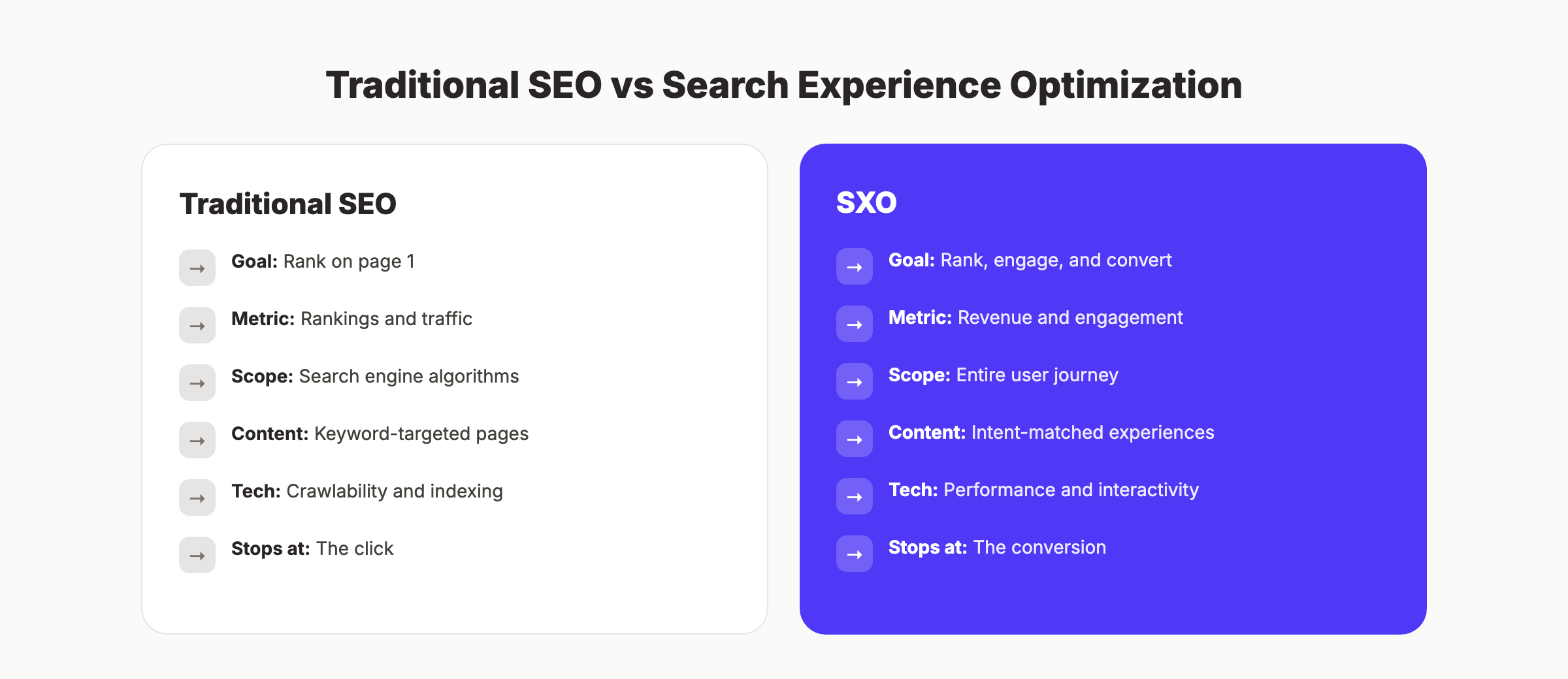
| Dimension | Traditional SEO | SXO |
|---|---|---|
| Primary goal | Rank on page 1 | Rank, engage, and convert |
| Success metric | Rankings and traffic | Revenue and engagement |
| Optimization scope | Search engine algorithms | Entire user journey |
| Content approach | Keyword-targeted pages | Intent-matched experiences |
| Technical focus | Crawlability and indexing | Performance and interactivity |
| User role | Source of clicks | Participant in an experience |
Most SEO advice still focuses on rankings alone. SXO recognizes that a page ranking 3rd with a 5% conversion rate generates more revenue than a page ranking 1st with a 0.5% conversion rate.
Your SEO team. $99 per month. 30 optimized articles, published automatically. Start for $1 →
Chapter 2: The 4 Pillars of SXO
Every SXO strategy rests on 4 interconnected pillars.
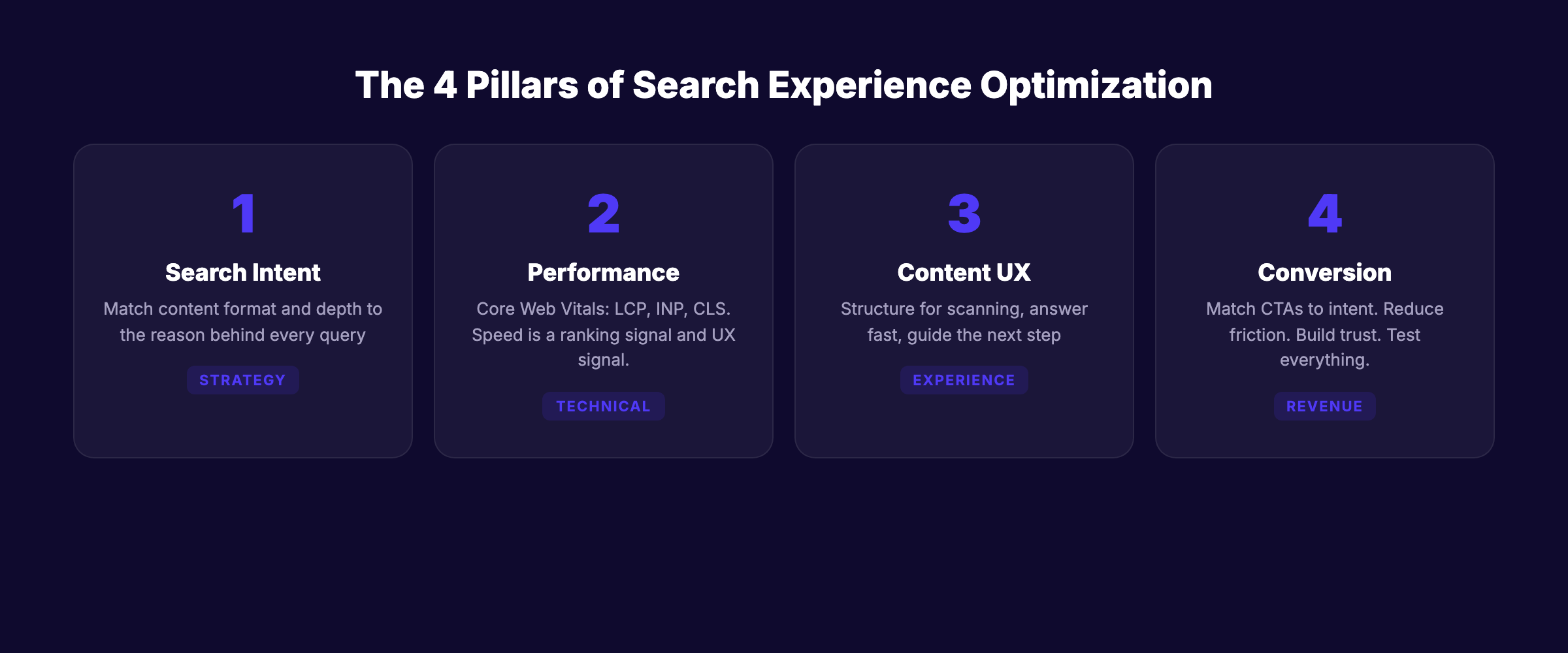 Weakness in any one pillar undermines the others.
Pillar 1: Search Intent Alignment
Search intent is the reason behind a query. Google has gotten very good at detecting it. If your page does not match the intent, it will not rank, regardless of how well-optimized it is.
The 4 intent types and their SXO implications:
| Intent Type | User Wants | SXO Response |
|---|---|---|
| Informational | Learn something | Long-form guide, clear answers, no hard sell |
| Navigational | Find a specific site or page | Fast load, clear branding, direct navigation |
| Commercial | Compare options before buying | Comparison tables, reviews, pros/cons, CTAs |
| Transactional | Buy or sign up now | Streamlined conversion path, trust signals, minimal friction |
How to validate intent: Search your target keyword on Google. Look at the top 5 results. If they are all guides, write a guide. If they are all product pages, create a product page. Mismatching format to intent is the fastest way to fail at SXO.
Pillar 2: Technical Performance
Performance is not optional. Google uses Core Web Vitals as ranking signals, and users use load speed to decide whether to stay.
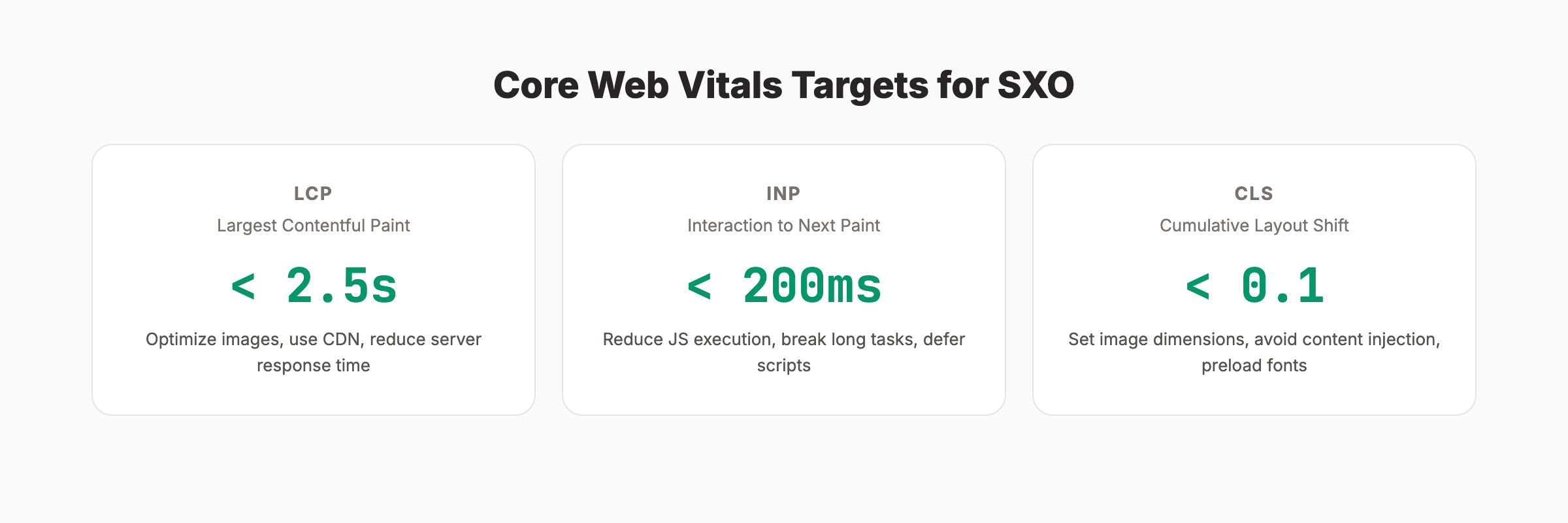
The 3 Core Web Vitals that matter:
Largest Contentful Paint (LCP): Measures how fast the main content loads. Target: under 2.5 seconds. Fix: optimize images, use a CDN, reduce server response time.
Interaction to Next Paint (INP): Measures how fast the page responds to user input. Target: under 200 milliseconds. Fix: reduce JavaScript execution time, break up long tasks, defer non-critical scripts.
Cumulative Layout Shift (CLS): Measures visual stability. Target: under 0.1. Fix: set explicit image dimensions, avoid inserting content above existing elements, preload fonts.
Pages that pass all 3 thresholds rank measurably better than pages that fail them. But Core Web Vitals alone will not save bad content. They are a prerequisite, not a differentiator.
Pillar 3: Content Experience
Content experience goes beyond “good writing.” It means structuring information so users find what they need in under 10 seconds.
Structure for scanning. 79% of users scan rather than read. Use clear headings, short paragraphs (2 to 3 sentences max), bullet lists, and tables. Break up walls of text.
Answer the question immediately. Place the core answer in the first 2 paragraphs. Details and depth come after. This matches how both users and AI systems consume content.
Guide the next step. Good SXO always answers: “What should the user do next?” Suggest related articles. Offer a tool. Provide a clear CTA. Never leave a user at a dead end.
Use visual hierarchy. Bold key terms. Use heading tags to create scannable sections. Place the most important information at the top of each section.
Pillar 4: Conversion Architecture
Traffic without conversions is a vanity metric. SXO treats every page as part of a conversion funnel.
Match CTA to intent. An informational page gets a soft CTA (download a guide, subscribe to newsletter). A commercial page gets a direct CTA (start a trial, request a demo).
Reduce friction. Every form field, every extra click, every confusing navigation element reduces conversions. Remove everything that does not directly serve the user’s goal.
Build trust progressively. First-time visitors need testimonials, case studies, and trust badges. Returning visitors need clear pricing and simple signup flows.
Test everything. A/B test headlines, CTA placement, form length, and page layout. SXO without testing is just guessing.
Chapter 3: 7 Practical SXO Strategies
Theory is useless without execution. Here are 7 strategies you can implement immediately.
Strategy 1: Audit Your Top Pages for Intent Mismatch
Pull your top 20 pages by organic traffic from Google Analytics. For each page:
- Search the target keyword on Google
- Compare your page format to the top 3 results
- If formats do not match (you have a product page, they have guides), restructure
Intent mismatch is the most common SXO problem. Fixing it often produces ranking improvements within 2 to 4 weeks.
Strategy 2: Optimize Core Web Vitals
Run Google PageSpeed Insights on your top 10 landing pages. Fix any metrics in the red zone:
- LCP under 2.5 seconds on mobile
- INP under 200ms on mobile
- CLS under 0.1 on mobile
- No layout shifts from lazy-loaded images
- No render-blocking JavaScript above the fold
Core Web Vitals improvements compound. Fixing one page often requires fixes to templates or components that affect hundreds of pages.
Strategy 3: Improve SERP Click-Through Rate
SXO starts before the click. Your title tag and meta description are the first experience a user has with your brand.
Write titles that match intent and create curiosity. “How to [Result] in [Timeframe]” outperforms generic titles. Include numbers when possible.
Write meta descriptions that preview value. Tell the user exactly what they get. “We tested 10 tools and ranked them by price, features, and ease of use” beats “Learn about the best tools.”
Earn rich results. Add structured data for FAQ, HowTo, and Review markup. Rich results increase CTR by 20 to 30% on average.
Strategy 4: Reduce Time to Answer
Users searching informational queries want their answer fast. Track the average time it takes a visitor to find the answer they came for.
Place key information above the fold. The first screen a user sees should contain the core answer or a clear table of contents.
Use jump links. For long guides, let users jump to the section they need. Time saved is satisfaction gained.
Add a TL;DR section. For posts over 2,000 words, include a 3 to 5 bullet summary at the top.
Stop writing. Start ranking. Stacc publishes 30 SEO articles per month for your business, on autopilot. Start for $1 →
Strategy 5: Build Clear Conversion Paths
Map every page to a conversion goal. Blog posts drive email signups. Product pages drive trials. Pricing pages drive purchases.
Use contextual CTAs. A blog post about SEO tools should link to a relevant tool page or trial, not a generic “contact us” form.
Place CTAs where attention peaks. After a key insight. After a comparison table. Before the FAQ section. Not only at the bottom where 80% of readers never scroll.
Remove navigation distractions on landing pages. For pages with a single conversion goal (signup, purchase), consider removing the main navigation. Fewer options mean more conversions.
Strategy 6: Optimize for Mobile-First Experience
Google uses the mobile version of your site for indexing and ranking. Mobile SXO is not optional.
Test on real devices. Emulators miss real-world issues. Test your top pages on 3 to 4 actual phones.
Eliminate horizontal scrolling. Tables, images, and code blocks must fit within the mobile viewport. Use responsive design for everything.
Make tap targets large enough. Buttons and links need at least 48px of tap area. Tiny links frustrate mobile users.
Minimize popups on mobile. Google penalizes intrusive interstitials on mobile. Use small banners or in-content CTAs instead.
Strategy 7: Optimize for AI Search Experiences
AI search engines now mediate a growing share of queries. SXO must account for visibility in ChatGPT, Perplexity, Google AI Overviews, and Claude.
Structure content for extraction. AI models pull concise, direct statements. Write answers in 1 to 2 sentences that can stand alone. Read our guide on getting cited in AI search.
Build entity clarity. AI systems need to understand what your brand is, what you do, and why you are authoritative. Use schema markup, about pages, and consistent naming.
Demonstrate E-E-A-T. AI models prioritize sources that show experience, expertise, authoritativeness, and trustworthiness. Author bylines, citations, and first-hand experience signals all contribute.
Chapter 4: Measuring SXO Performance
Traditional SEO metrics (rankings, traffic) capture only half the picture. SXO requires a broader measurement framework.
The SXO Metrics Dashboard
| Metric Category | Specific Metric | Tool | SXO Signal |
|---|---|---|---|
| Visibility | Organic traffic | Google Analytics | Are people finding you? |
| Visibility | Keyword rankings | Ahrefs, Semrush | Are you ranking for target terms? |
| Experience | Bounce rate | Google Analytics | Does the page match intent? |
| Experience | Core Web Vitals | Search Console | Is the page fast and stable? |
| Experience | Average time on page | Google Analytics | Are users engaging with content? |
| Conversion | Goal completion rate | Google Analytics | Are visitors taking desired actions? |
| Conversion | Click-through rate (SERP) | Search Console | Is your listing compelling? |
| Conversion | Revenue per session | Analytics + CRM | Is traffic generating business value? |
The SXO Score Framework
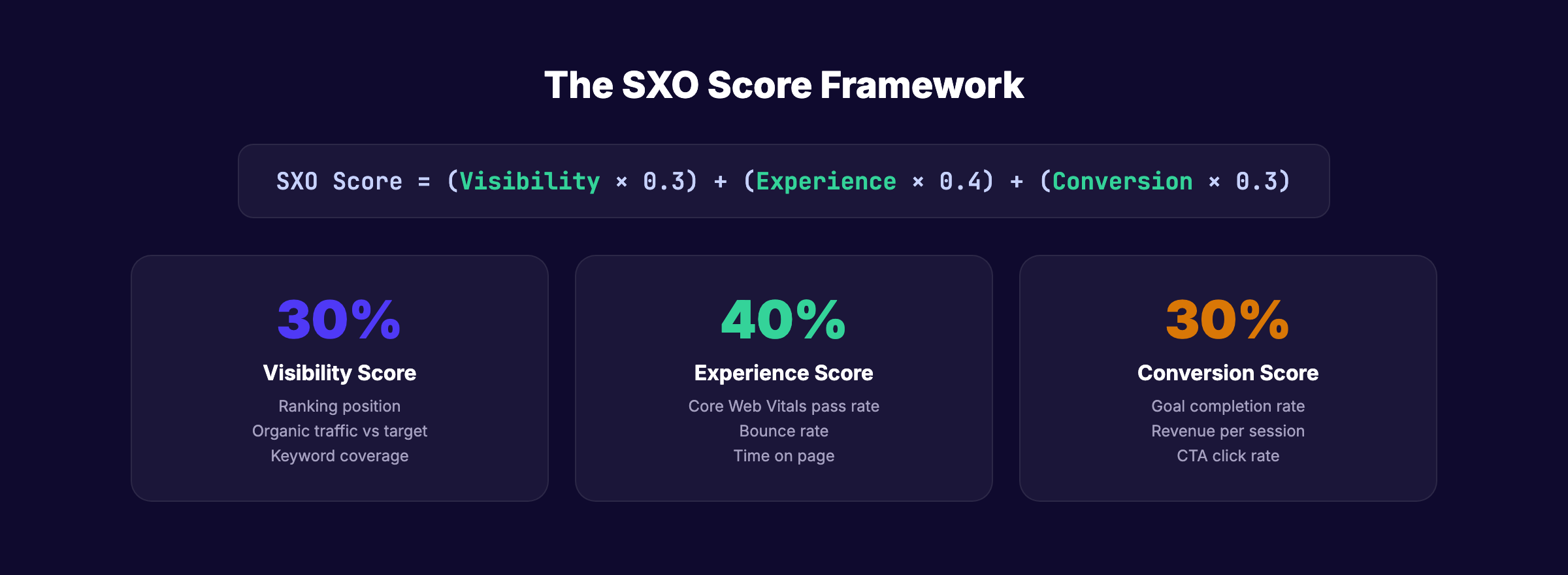
Create a composite score for each page:
SXO Score = (Visibility Score × 0.3) + (Experience Score × 0.4) + (Conversion Score × 0.3)
- Visibility Score (0 to 100): Based on ranking position and organic traffic vs. target
- Experience Score (0 to 100): Based on Core Web Vitals pass rate, bounce rate, and time on page
- Conversion Score (0 to 100): Based on goal completion rate vs. benchmark
Weight experience highest because it drives both ranking improvements and conversion improvements. A page that scores high on experience will naturally improve its visibility and conversion scores over time.
Benchmarks by Page Type
| Page Type | Target Bounce Rate | Target Time on Page | Target Conversion Rate |
|---|---|---|---|
| Blog post (informational) | Under 65% | Over 3 minutes | 2 to 5% (email signup) |
| Product/service page | Under 45% | Over 2 minutes | 3 to 8% (trial/demo) |
| Landing page | Under 40% | Over 1.5 minutes | 5 to 15% (signup) |
| Pricing page | Under 35% | Over 2 minutes | 8 to 20% (purchase) |
Pages performing below these benchmarks have SXO problems worth investigating.
3,500+ blogs published. 92% average SEO score. See what Stacc can do for your site. Start for $1 →
Chapter 5: SXO for Different Page Types
Different pages require different SXO approaches. A blog post and a pricing page serve different intents and need different optimization strategies.
Blog Posts and Guides
Intent: Informational. Users want to learn.
SXO priorities:
- Clear heading structure with scannable sections
- Answer the primary question in the first 200 words
- Internal links to related content (keep users on site)
- Soft CTAs (email signup, related guide download)
- FAQ section with concise answers
- Structured data for Article and FAQ schema
Product and Service Pages
Intent: Commercial or transactional. Users want to evaluate or buy.
SXO priorities:
- Clear value proposition above the fold
- Social proof: testimonials, case studies, review scores
- Feature comparison tables
- Visible pricing (or clear path to pricing)
- Single, prominent CTA
- Trust signals: security badges, guarantees, customer count
Local Business Pages
Intent: Local commercial. Users want to find or contact.
SXO priorities:
- NAP consistency (name, address, phone)
- Google Maps embed
- Click-to-call button on mobile
- Google reviews widget
- Service area information
- Business hours with holiday updates
E-commerce Category and Product Pages
Intent: Transactional. Users want to browse and buy.
SXO priorities:
- Fast page load (every second costs 7% in conversions)
- High-quality product images with zoom
- Clear pricing and availability
- Filtering and sorting options
- User reviews on product pages
- Easy add-to-cart with minimal steps
Chapter 6: Common SXO Mistakes
Most teams making the shift from SEO to SXO fall into predictable traps.
Mistake 1: Treating SXO as a One-Time Project
SXO is a continuous process. User expectations change. Algorithms update. Competitors improve. A page optimized for SXO in January may need re-optimization by July.
Build SXO checks into your monthly content review cycle. Track Core Web Vitals, engagement metrics, and conversion rates for every key page.
Mistake 2: Ignoring Mobile Experience
60%+ of traffic comes from mobile. Yet most teams design and review pages on desktop. Test every change on mobile first. Mobile SXO problems are invisible on a 27-inch monitor.
Mistake 3: Optimizing for Rankings While Ignoring Conversions
A page ranking 1st for a high-volume keyword with 0% conversions generates zero revenue. SXO demands that every page has a clear purpose and a measurable conversion goal.
Mistake 4: Slow Page Speed on Content Pages
Teams often optimize product pages for speed but forget about blog posts. Blog posts drive the most organic traffic. If they load slowly, users bounce before reading. Optimize every page type.
Mistake 5: No Clear Next Step After Content
A blog post that ends without a CTA, related article suggestions, or a conversion path wastes the attention it earned. Every page should answer: “What should the user do now?”
Chapter 7: SXO Implementation Checklist
Use this checklist to audit and improve any page on your site.
Pre-Click (SERP Experience)
- Title tag is under 60 characters and includes primary keyword
- Meta description is 145 to 155 characters with benefit and keyword
- Structured data is implemented (Article, FAQ, HowTo, or Product)
- Rich results appear in SERP (star ratings, FAQ dropdowns, etc.)
- URL is clean and descriptive
Post-Click (Page Experience)
- LCP is under 2.5 seconds on mobile
- INP is under 200ms on mobile
- CLS is under 0.1 on mobile
- Page loads without layout shifts
- Content is immediately visible above the fold
- No intrusive popups or interstitials on mobile
Content Experience
- Primary question is answered in the first 200 words
- Headings create a clear scannable structure
- Paragraphs are 2 to 3 sentences maximum
- Tables and lists break up dense information
- Images have descriptive alt text and load quickly
- Internal links connect to related content
Conversion Experience
- CTA matches the page intent (soft for informational, direct for transactional)
- CTA is visible without scrolling on the most important pages
- Trust signals are present (testimonials, reviews, badges)
- Form fields are minimized to essentials
- Mobile conversion path works smoothly
- Thank you/confirmation page continues the experience
Rank everywhere. Do nothing. Blog SEO, Local SEO, and Social on autopilot. Start for $1 →
FAQ
What is search experience optimization (SXO)?
Search experience optimization is a framework that combines SEO, user experience (UX), and conversion rate optimization (CRO) into a single strategy. Instead of optimizing only for search engine rankings, SXO optimizes the entire user journey from the search query through the SERP click to on-page engagement and conversion. The goal is to rank, engage, and convert.
How is SXO different from SEO?
SEO focuses on getting your pages to rank in search results through keyword optimization, backlinks, and technical improvements. SXO adds user experience and conversion optimization to that foundation. SEO gets users to your site. SXO ensures they have a positive experience and take desired actions once they arrive.
Does user experience directly affect Google rankings?
Yes. Google uses Core Web Vitals (LCP, INP, CLS) as ranking signals. Google also measures engagement signals like dwell time and pogo-sticking (when users click back to search results quickly). Pages that deliver poor experiences rank lower over time, even with strong backlink profiles.
What tools do I need for SXO?
You need Google Search Console (rankings and Core Web Vitals), Google Analytics (traffic and behavior), PageSpeed Insights (performance auditing), and your existing SEO tools (Ahrefs, Semrush, or similar). For CRO, add a heatmap tool like Hotjar or Microsoft Clarity and an A/B testing platform.
How long does SXO take to show results?
Core Web Vitals improvements can show ranking impact within 2 to 4 weeks. Intent alignment changes often produce results within 30 days. Conversion optimization improvements are visible immediately through A/B testing. Full SXO implementation across a site typically takes 60 to 90 days with ongoing iteration.
Can Stacc help with search experience optimization?
Stacc handles the content production layer of SXO. We publish 30 SEO-optimized articles per month that follow SXO best practices: proper heading structure, internal linking, schema markup, and intent-matched formatting. This gives your team bandwidth to focus on UX improvements, conversion optimization, and technical performance.
Search experience optimization is not a trend. It is the permanent evolution of how search works. Rankings alone no longer generate results. The sites that win in 2026 and beyond are the ones that treat every user interaction as an experience worth optimizing.
Start with intent alignment. Fix your Core Web Vitals. Structure content for scanning. Build clear conversion paths. Measure everything beyond just rankings.
That is SXO. And it is the only version of SEO that still delivers full business value.
Written and published by Stacc. We publish 3,500+ articles per month across 70+ industries. All data verified against public sources as of March 2026.
