
Google AI Overview Optimization: 7 Steps (2026)
Learn Google AI overview optimization in 7 steps. Get your content cited in AI-generated results with proven structure, schema, and authority tactics.
Google AI Overviews now appear on over 25% of all search queries. That number grew 58% in the past year alone. If your content does not show up in these AI-generated results, you are losing clicks to competitors who do.
Cited pages earn 35% more organic clicks than pages that are not cited. Pages that get left out see CTR drops of up to 65%. The gap between cited and invisible widens every quarter.
This guide walks you through Google AI overview optimization in 7 practical steps. Each step builds on the last. By the end, you will know exactly how to structure, format, and position your content for AI citation.
We publish 3,500+ blog posts across 70+ industries. We see firsthand which content structures AI Overviews pull from and which they ignore. This process comes from real data, not theory.
Here is what you will learn:
- How AI Overviews select which sources to cite
- The exact content structure that gets extracted
- Answer-first formatting that AI models prefer
- Schema markup that signals relevance to AI systems
- Authority signals that make your site citation-worthy
- How to track and measure AI Overview appearances
- Common mistakes that block your content from citation
How Google AI Overviews Select Sources
Google AI Overviews do not simply pull from the top organic result. The selection process uses a separate evaluation system that weighs content quality, structure, and authority differently than traditional rankings.
An Ahrefs study from early 2026 found that only 38% of AI Overview citations come from top-10 ranking pages. That number dropped from 76% the year before. Ranking well in organic search helps. But it is not enough on its own.
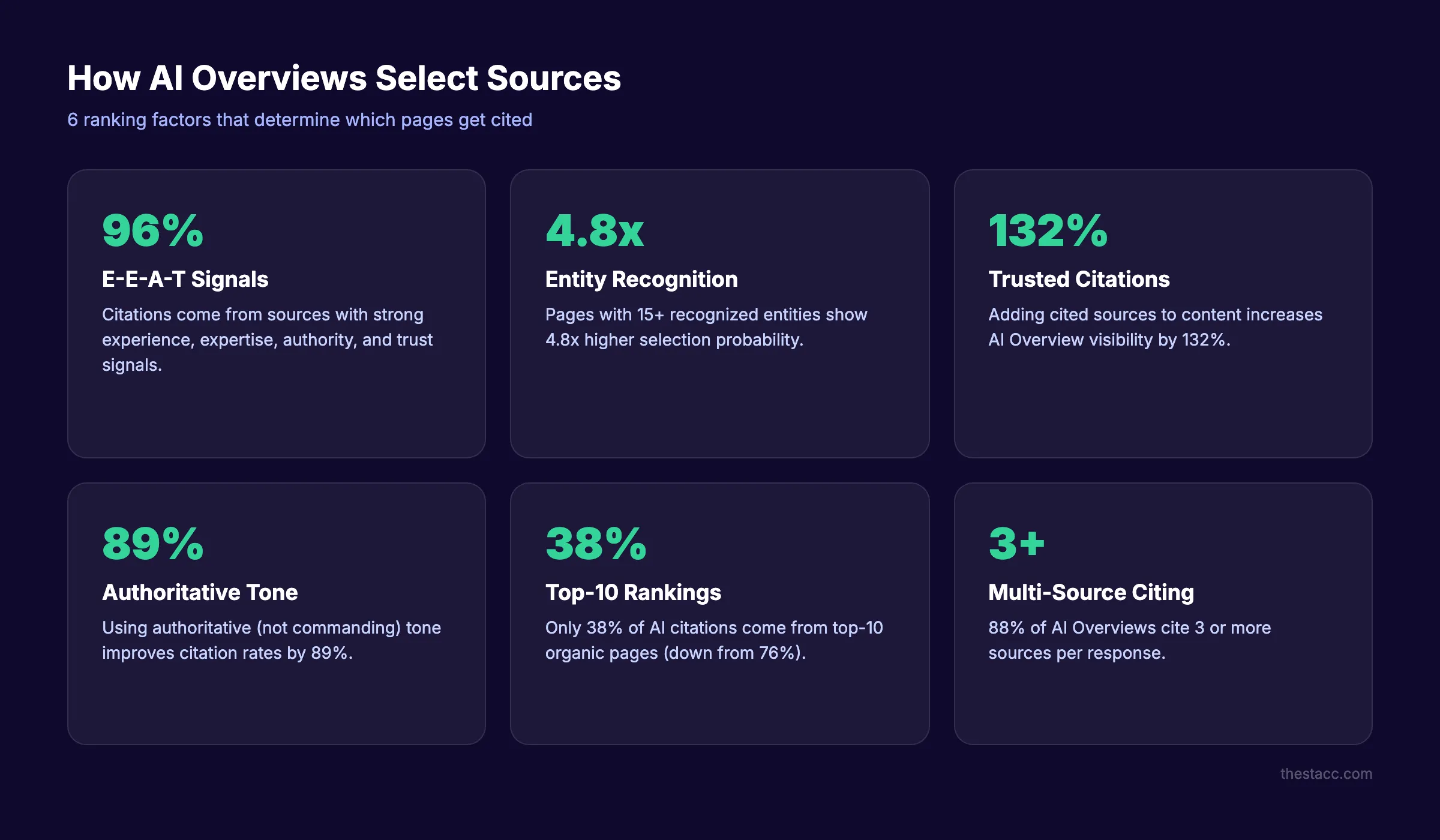
Here is what AI Overviews evaluate when choosing sources:
| Factor | Impact | What It Means |
|---|---|---|
| E-E-A-T signals | 96% of citations have strong E-E-A-T | Experience, expertise, authority, trust |
| Entity recognition | 4.8x higher citation rate | Pages with 15+ recognized entities win |
| Trusted citations | 132% visibility increase | Citing authoritative sources in your content |
| Authoritative tone | 89% improvement | Confident, factual writing style |
| Semantic completeness | Strongest predictor | Content must fully answer the query |
| Content freshness | Ongoing signal | Stale pages get dropped from citations |
The key takeaway: AI search is changing SEO fundamentally. Content that ranks organically may never appear in AI Overviews if it lacks the structural and quality signals AI models need.
88% of AI Overviews cite 3 or more sources. Your goal is to be one of those sources for every query in your topic area.
Step 1: Structure Content for AI Extraction
AI Overviews extract content in blocks. They pull specific sections, not entire pages. Your content structure determines whether AI can find and extract the right answer from your page.
The difference between cited and ignored content often comes down to formatting.
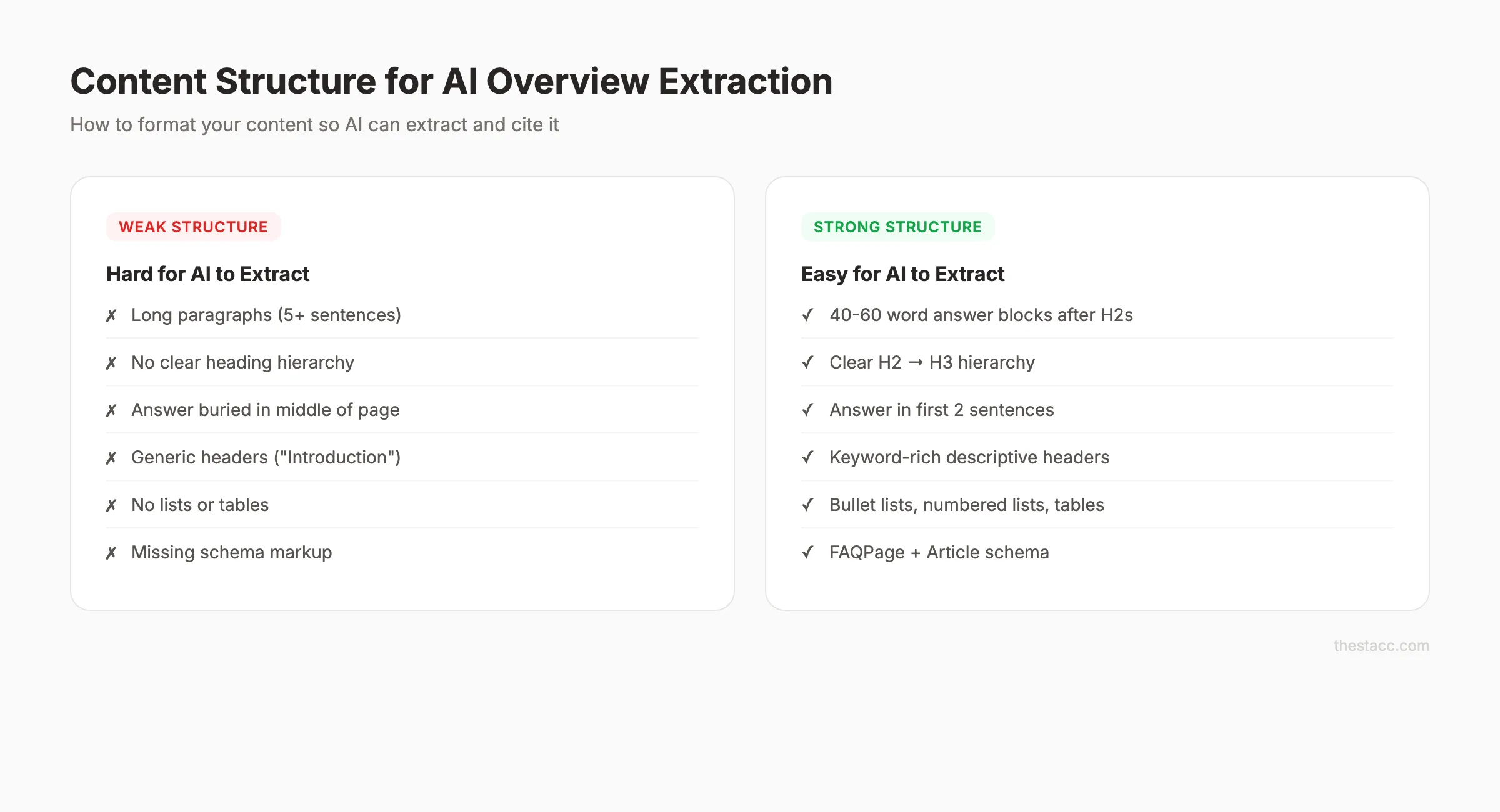
Specifically:
- Use a clear H2 and H3 hierarchy with descriptive, keyword-rich headings
- Keep paragraphs to 1-3 sentences maximum
- Place the direct answer within the first 2 sentences after each H2
- Use bullet lists, numbered lists, and tables for data-heavy sections
- Add a table of contents for longer guides
Google’s AI models parse content based on heading structure. A page with well-organized H2 sections acts as a database of answers. Each section becomes a potential extraction point.
The blog post structure for SEO matters more now than ever. AI models treat each H2 section as an independent answer block. If your heading says “What Is Schema Markup” and the next 40-60 words provide a clear definition, that block becomes extractable.
Why this step matters: Pages without clear structure force AI models to guess which content answers the query. Pages with clear structure get cited. Pages without it get skipped. The on-page SEO guide covers heading hierarchy in detail.
Pro tip: Review your top 10 pages in Google Search Console. Reformat the ones with high impressions but low CTR using this structure. Those pages already have Google’s attention but lack the format AI needs to extract from them.
Step 2: Write Answer-First Content Blocks
AI Overviews favor content that leads with the answer. Every H2 section should open with a 40-60 word block that directly addresses the question implied by the heading.
This is the opposite of academic writing. Do not build up to a conclusion. State the conclusion first. Then support it.
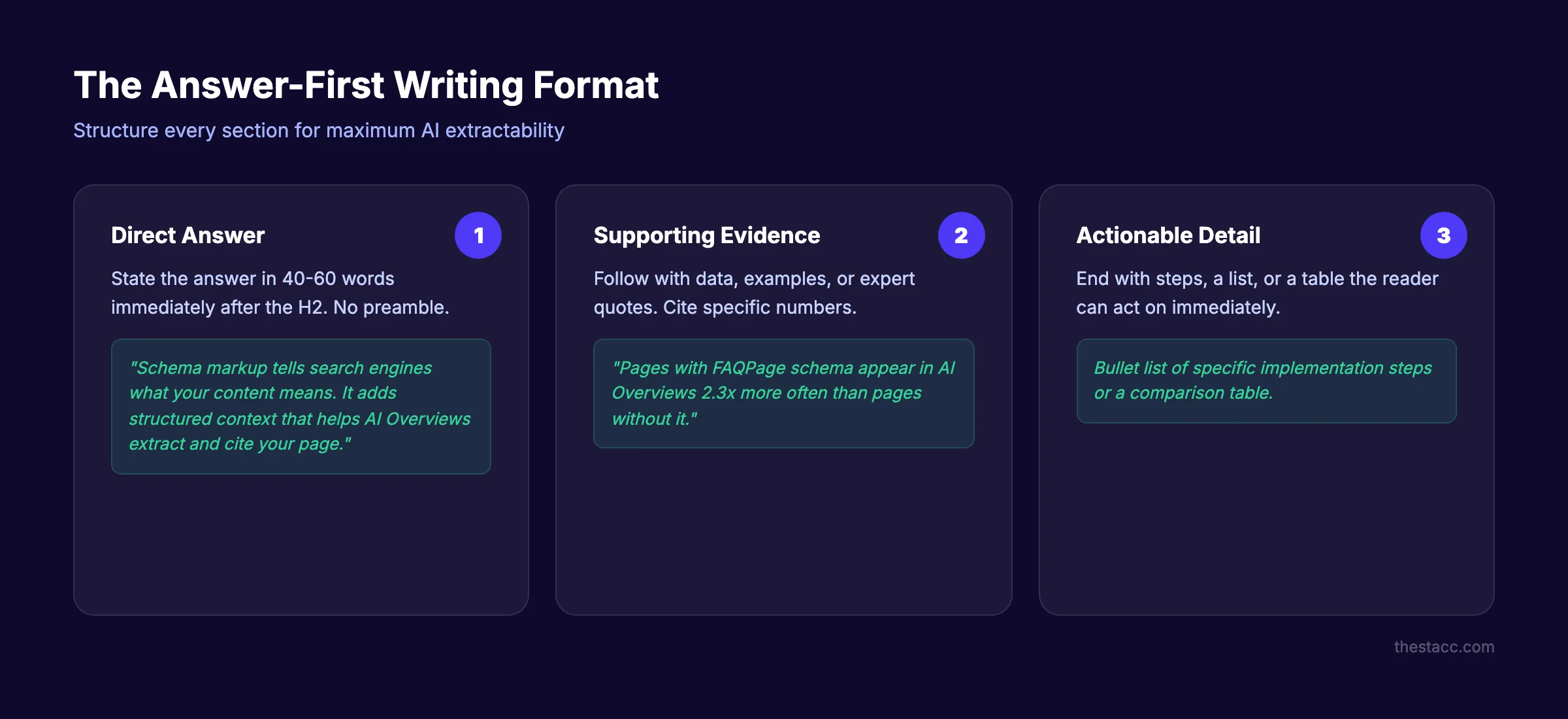
The 3-part answer block format:
- Direct answer (40-60 words): State the answer clearly. No preamble, no context-setting, no “in order to understand X we must first consider Y.”
- Supporting evidence (50-100 words): Add a statistic, example, or expert insight that validates the answer.
- Actionable detail (100-200 words): Provide steps, a checklist, or a table the reader can use immediately.
Here is an example. If your H2 asks “How Often Should You Update Blog Content?” the first sentence should be: “Update blog content every 6-12 months, or sooner if traffic drops more than 20%.” Not a paragraph about why content freshness matters.
This format works because AI models scan for semantic completeness. A section that contains the answer, evidence, and actionable steps in a compact block is easier to extract than one that buries the answer in paragraph 4.
Why this step matters: Long introductions push the answer below the extraction window. AI models stop scanning after a certain depth. If your answer appears 300 words into a section, it will not get cited. Our blog GEO checklist has a full audit process for this.
Pro tip: Use the “journalist test.” If a reporter called and asked the question in your H2, your first sentence should be the quote they would print.
Step 3: Add Schema Markup for AI Visibility
Schema markup gives AI models machine-readable context about your content. It tells Google what your page is about, who wrote it, and how the information is structured.
Pages with schema markup do not automatically appear in AI Overviews. But schema removes ambiguity. It helps AI models classify and extract your content faster.
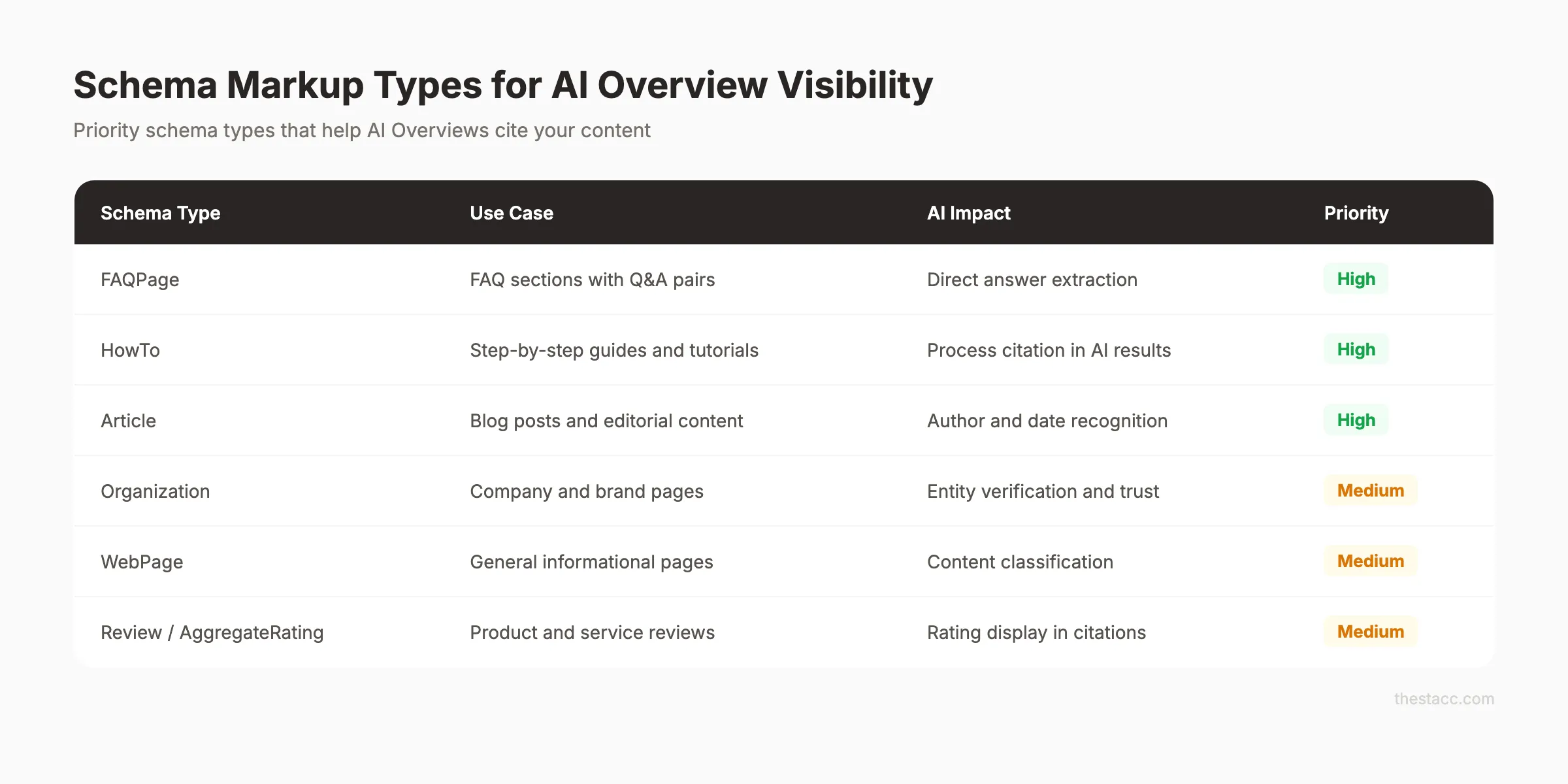
Priority schema types for AI Overviews:
- FAQPage: Mark up your FAQ section. AI Overviews pull Q&A pairs directly from FAQPage schema.
- HowTo: Use for step-by-step content. Each step becomes an independently extractable unit.
- Article: Add author, datePublished, dateModified, and publisher information. This feeds E-E-A-T signals.
- Organization: Verify your brand entity with Google through Organization schema.
How to implement:
- Add Article schema to every blog post with author credentials
- Add FAQPage schema to pages with FAQ sections
- Add HowTo schema to step-by-step guides
- Test all schema with Google Rich Results Test
- Monitor for errors in Search Console
The structured data guide covers implementation in detail. Focus on accuracy over volume. One correctly implemented FAQPage schema does more than 5 poorly structured schemas.
Why this step matters: Without schema, AI models rely entirely on HTML parsing to understand your content. Schema gives them explicit signals. It is the difference between AI guessing what your page covers and knowing exactly what it covers.
Get 30 SEO-optimized blog posts per month, each with proper schema markup and AI-ready formatting. We handle the structure, the schema, and the publishing. Start for $1 →
Step 4: Build Topical Authority Signals
AI Overviews strongly favor sites that demonstrate deep expertise on a topic. A single great article will not get cited if your site has no other content in the same subject area.
Topical authority is the signal that tells AI: this site is an expert source on this subject. It comes from publishing multiple related pieces, linking them together, and earning external recognition.
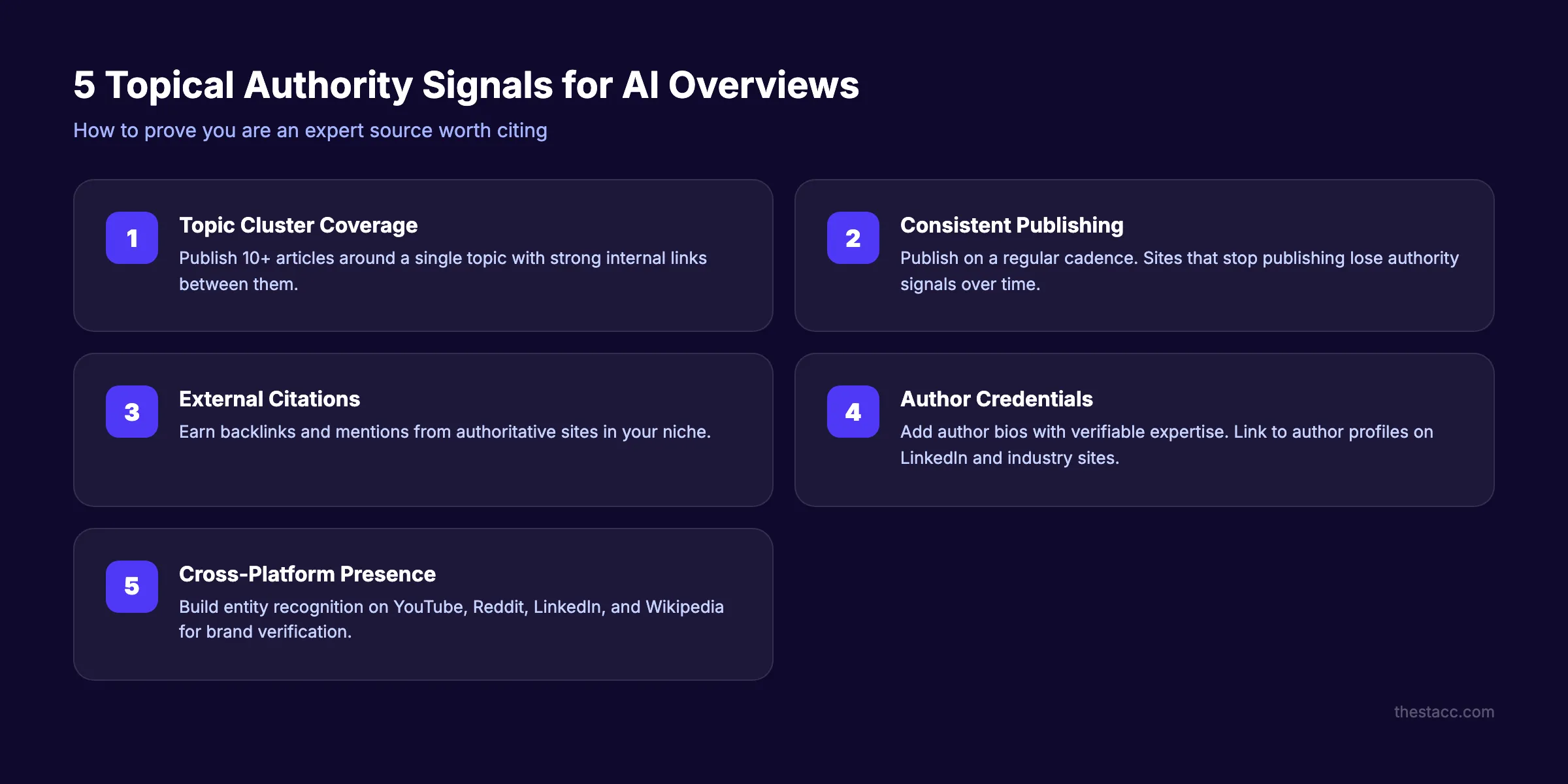
How to build topical authority for AI citations:
-
Create a topical map. Identify every subtopic within your core subject area. Map out 10-20 articles that cover the topic from every angle.
-
Publish consistently. Sites that publish on a regular schedule maintain stronger authority signals than sites that publish in bursts then go silent. The Content Compound Effect is real. Each article builds on the last.
-
Build internal link clusters. Use internal linking strategy to connect related posts. Link from broad pillar pages to specific subtopic pages. This shows AI models how your content relates.
-
Earn external citations. Backlinks from authoritative sites in your niche confirm your expertise. One link from an industry publication outweighs 50 links from generic directories.
-
Add author credentials. Author bios with verifiable expertise matter. Link to author profiles on LinkedIn, industry publications, and speaking engagements.
Google surfaces content from sites it considers the most knowledgeable on a topic. A dental practice that publishes 30 articles about dental care gets cited more than a general health site with 1 dental article.
Why this step matters: AI Overviews pull from sites with established authority. If you publish one article on a topic and stop, AI models have no reason to consider you an expert. Authority compounds with consistent publishing.
Step 5: Optimize Technical Performance
AI Overview citation eligibility requires that Google can crawl, index, and process your pages efficiently. Technical issues that seem minor for organic rankings can completely block AI citation.
Technical requirements for AI Overview eligibility:
| Technical Factor | Target | Why It Matters |
|---|---|---|
| Page speed (LCP) | Under 2.5 seconds | Slow pages get deprioritized in AI extraction |
| Mobile usability | 100% responsive | AI Overviews prioritize mobile-friendly sources |
| HTTPS | Required | Non-secure pages rarely appear in AI results |
| Crawlability | No blocking rules | Googlebot must access the full page content |
| Core Web Vitals | All green | Quality signals feed into source selection |
Checklist for technical AI readiness:
- Verify no robots.txt rules block critical content pages
- Remove noindex tags from pages you want AI to cite
- Check that crawl budget is not wasted on low-value pages
- Confirm HTTPS across all pages
- Test Core Web Vitals in PageSpeed Insights
- Verify mobile rendering shows all content (no hidden sections)
- Ensure no login walls block content from Googlebot
One often overlooked factor: JavaScript-rendered content. If your content loads via JavaScript and Googlebot cannot render it, the content does not exist for AI Overview purposes. Server-side render critical content or use static HTML.
Why this step matters: A perfectly structured, authoritative article will never appear in AI Overviews if Googlebot cannot access it. Technical SEO is the foundation. Everything else depends on it. The generative engine optimization guide covers broader technical requirements across all AI search platforms.
Stacc publishes 30+ blog posts per month with built-in technical SEO and AI-ready formatting. Every post is crawlable, indexable, and structured for AI citation. Start for $1 →
Step 6: Keep Content Fresh and Semantically Complete
AI Overviews deprioritize stale content. A page published 2 years ago with outdated statistics will lose citation eligibility to a recently updated page with current data.
Content freshness is not just about changing the date. Google tracks meaningful updates: new statistics, added sections, updated examples, and expanded coverage.
How to maintain freshness for AI citation:
- Update statistics and data points every quarter
- Add new sections when subtopics emerge
- Replace outdated screenshots and examples
- Refresh the dateModified field in Article schema
- Review and update internal links to point to new related content
Your content refresh strategy should prioritize pages that currently appear in AI Overviews or rank in the top 20 for queries where AI Overviews trigger.
Semantic completeness matters equally. AI Overviews prefer pages that answer a query fully without requiring the reader to click elsewhere. Cover every angle of the topic. Include definitions, examples, steps, common mistakes, and related questions.
Evergreen content works best for AI citation when it is thorough and regularly updated. A 3,000-word guide that covers every subtopic outperforms a 500-word overview every time.
Why this step matters: AI models evaluate content recency as a trust signal. Outdated content suggests the author is not actively maintaining expertise. Fresh content signals ongoing authority. Pages that stop getting updated eventually stop getting cited.
Step 7: Monitor and Track AI Overview Appearances
You cannot optimize what you do not measure. Tracking your AI Overview citations tells you which content gets cited, which queries trigger citations, and where you need to improve.
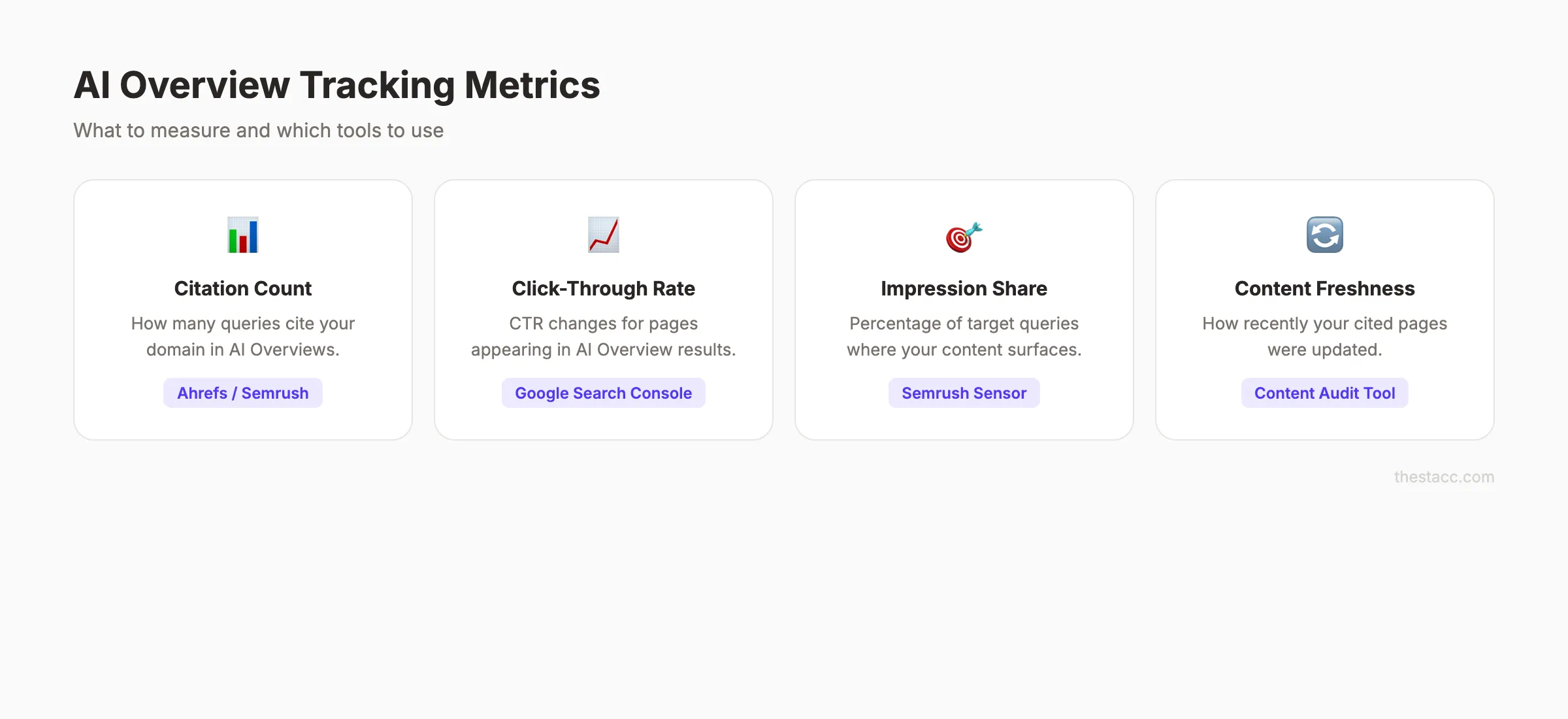
What to track:
- Citation count: How many queries show your domain in AI Overviews. Ahrefs and Semrush both offer AI Overview tracking features.
- Click-through rate changes: Compare CTR before and after AI Overview appearances in Google Search Console.
- Impression share: What percentage of your target queries trigger AI Overviews.
- Competitor citations: Which competitors appear in AI Overviews for your target queries.
Tools for tracking AI Overview visibility:
- Google Search Console (free) for CTR and impression data
- Ahrefs AI Overview tracker for citation monitoring
- Semrush Sensor for SERP feature tracking
- Manual spot checks for priority keywords
Our guide on how to track AI search visibility covers the full measurement framework. Set up tracking before you start optimizing so you have baseline data.
Review your SEO KPIs to include AI citation metrics alongside traditional ranking data. The two sets of metrics together give you the complete picture.
Why this step matters: AI Overview results change frequently. A page that gets cited today may lose its citation next week if a competitor publishes better content. Ongoing monitoring lets you respond quickly and protect your positions.
Results: What to Expect
After completing these 7 steps, here is a realistic timeline:
- Week 1-2: Content restructured and schema implemented. Technical issues resolved.
- Month 1-2: Google recrawls and reindexes updated pages. First citation appearances for long-tail queries.
- Month 3-4: Citation frequency increases as topical authority builds. New content starts appearing in AI Overviews within days of publishing.
- Month 6+: Consistent citation presence across target queries. Measurable CTR improvements on cited pages.
Results vary by competition level and existing domain authority. Sites with established organic rankings see faster AI citation improvements than new domains.
The 35% CTR increase from AI citation is not instant. It builds as Google recognizes your site as a reliable, well-structured source across multiple queries.
Common Mistakes to Avoid
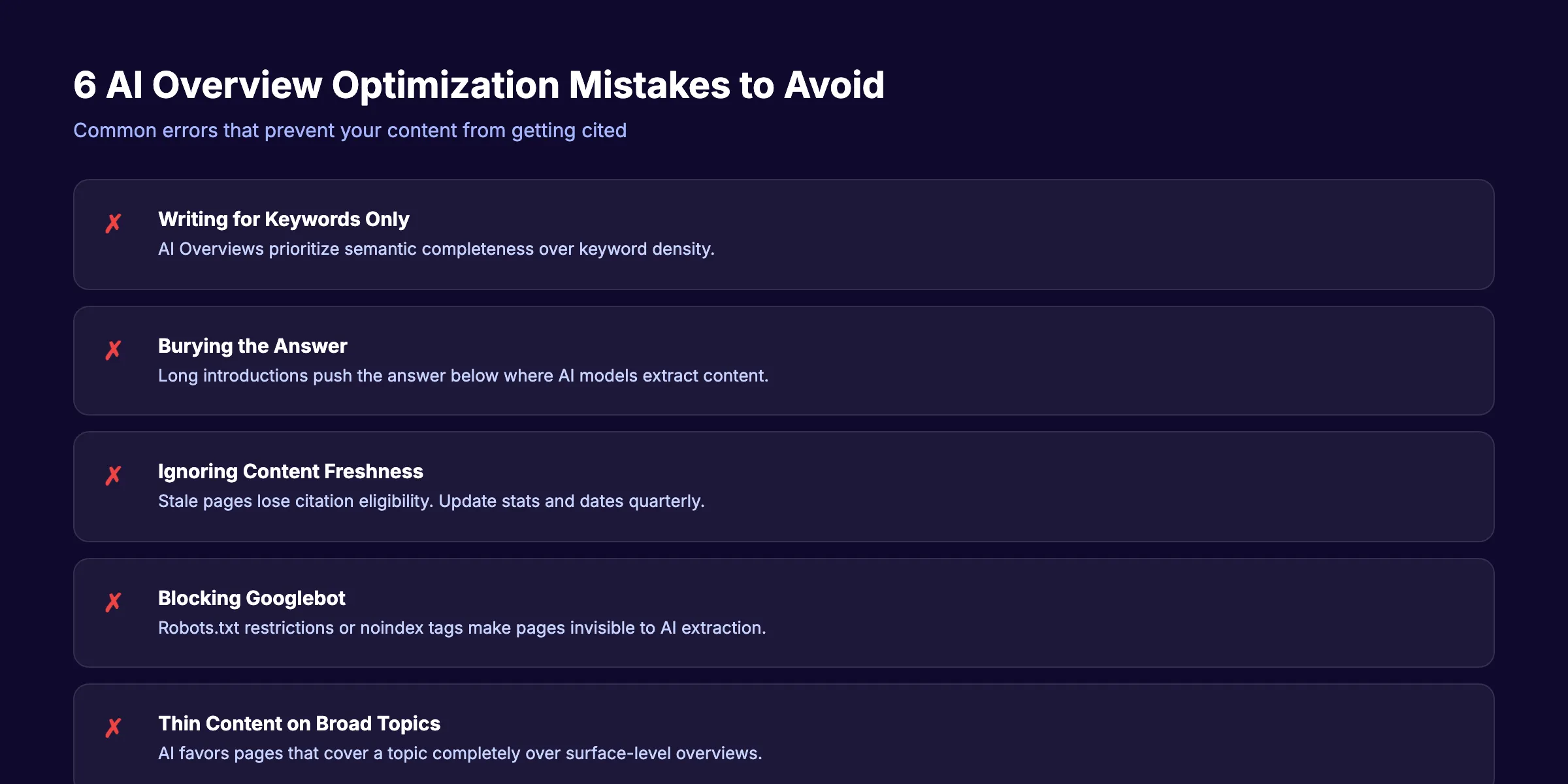
These errors block otherwise strong content from AI citation:
Writing for keywords instead of topics. AI Overviews evaluate semantic completeness, not keyword density. A page stuffed with keywords but lacking depth will not get cited.
Burying the answer. Long introductions, unnecessary context, and throat-clearing paragraphs push the answer below the extraction window. Lead with the answer. Always.
Ignoring content freshness. A page published in 2023 with 2023 statistics will lose to a page updated this quarter. Update your high-value pages regularly.
Blocking Googlebot. Check your robots.txt and meta robots tags. If Googlebot cannot access the page, AI Overviews cannot cite it.
Publishing thin content on broad topics. AI Overviews need complete answers. A 500-word overview of a complex topic will never beat a 3,000-word guide that covers every angle.
Skipping schema markup. Schema is not required, but it removes friction. Pages with proper schema markup give AI models explicit signals about content type, authorship, and structure.
Frequently Asked Questions
Do I need to rank in the top 10 to appear in AI Overviews?
No. Only 38% of AI Overview citations come from top-10 ranking pages. Google uses a separate evaluation system for AI citations. Pages ranking in positions 11-30 can still get cited if they have strong structure, authority, and semantic completeness. That said, ranking well organically improves your chances.
How are AI Overviews different from featured snippets?
Featured snippets pull a single answer from a single source. AI Overviews synthesize information from multiple sources and generate a new response. 88% of AI Overviews cite 3+ sources. The optimization approach overlaps, but AI Overviews weight semantic completeness and topical authority more heavily.
Can I opt out of AI Overviews?
Google does not currently offer a way to opt out of AI Overview citations specifically. You can block Googlebot entirely, but that removes you from all search results. The recommended approach is to optimize for citation rather than avoid it.
How long does it take to appear in AI Overviews?
Most sites see initial citations within 30-60 days of implementing structural changes, assuming the content already ranks or has strong authority signals. Building citation presence across multiple queries typically takes 3-6 months of consistent optimization and publishing.
Does AI Overview optimization conflict with traditional SEO?
No. Google’s own documentation confirms that standard SEO best practices remain relevant for AI features. AI Overview optimization adds structure and formatting requirements on top of traditional SEO. Pages that rank well and follow AI optimization best practices have the highest citation rates.
What content types get cited most in AI Overviews?
How-to guides, definition pages, comparison articles, and FAQ-style content get cited most frequently. These formats align with the query types that trigger AI Overviews. List posts and data-driven content also perform well. Our guide to getting cited by AI search engines covers content type selection in depth.
Google AI overview optimization is not a separate discipline from SEO. It is an extension of it. Structure your content for extraction. Build authority through consistent publishing. Keep pages fresh. Track your results.
The sites winning AI citations right now are the ones publishing consistently, formatting for extraction, and maintaining topical depth. Start with Step 1 and work through each step in order. The compound effect of all 7 steps together is greater than any single tactic.
Stacc publishes 30 SEO-optimized, AI-ready blog posts per month starting at $99. Every article is structured for AI citation and traditional rankings. Start for $1 →
Related Tools & Resources
Free SEO Tools:
Best Lists:

Written by
Siddharth GangalSiddharth is the founder of theStacc and Arka360, and a graduate of IIT Mandi. He spent years watching great businesses lose organic traffic to competitors who simply published more. So he built a system to fix that. He writes about SEO, content at scale, and the tactics that actually move rankings.
30 SEO blog articles published every month
Keyword-optimized, scheduled, and live on your site. Automatically.
30-day trial · Cancel anytime
theStacc
Stop writing SEO content manually
30 blog articles, 30 GBP posts, and social media content. Published every month. Automatically.
Start Your $1 Trial$1 for 3 days · Cancel anytime