
Generative Engine Optimization (2026): Guide
Step-by-step geo optimization guide guide for 2026: proven tactics, real examples, common mistakes to avoid, and implementation tips.
Your content ranks on Google. But AI search engines skip it entirely. ChatGPT, Perplexity, and Google AI Overviews now answer questions without sending users to your site. If your pages are not optimized for generative engines, you lose visibility to a channel that grew 4,700% year-over-year through 2025.
Generative engine optimization (GEO) is the practice of structuring content so AI platforms cite and recommend it. Gartner predicts traditional search volume will drop 25% by the end of 2026. Google AI Overviews reach over 2 billion monthly users. ChatGPT serves 900 million weekly. The shift is not coming. It already happened.
We publish 3,500+ articles across 70+ industries with a 92% average SEO score. Every piece is optimized for both traditional search and AI search engines. This guide covers everything we know about GEO.
Here is what you will learn:
- What generative engine optimization is and how it differs from SEO
- The Princeton research proving which GEO tactics boost visibility by 40%
- Platform-specific strategies for ChatGPT, Perplexity, and AI Overviews
- 7 optimization strategies backed by citation data from 8,000+ AI responses
- How to audit and score your pages for GEO readiness
- How to measure performance when clicks are not the metric
Chapter 1: What Is Generative Engine Optimization
Generative engine optimization is the practice of optimizing your content so AI search platforms retrieve, cite, and recommend it. Where traditional SEO targets a spot among 10 blue links, GEO targets a place among the 2 to 7 sources AI engines cite in a single response.
The term originates from a 2023 research paper by Princeton University, Georgia Tech, IIT Delhi, and the Allen Institute for AI. That paper tested 9 optimization methods across 10,000 queries. Specific content techniques boosted AI citation rates by up to 40%.
How Generative Engines Select Sources
When a user asks an AI engine a question, the engine breaks it into roughly 20 sub-queries. This process is called query fanout. The engine crawls, retrieves, and synthesizes information from multiple sources into one answer. It decides which sources to cite based on content quality, structure, freshness, and authority.
Your content is either part of that answer or it is not. There is no position 7. There is no page 2. You are cited or you are invisible.
Why GEO Matters Right Now
Three forces make generative engine optimization critical in 2026.
AI search usage is exploding. 38% of Americans now use AI search tools, up from 8% in 2023. ChatGPT reached 900 million weekly active users by late 2025. AI referral traffic to retail sites surged 4,700% year-over-year.
Zero-click searches dominate. 60% of searches end without a click. The click rate in position 1 with an AI Overview present is only 2.6%. If your brand is not in the AI-generated answer, users never see your name.
Early movers capture the market. The average brand appears in only 17.2% of relevant AI responses. Category leaders appear in 56.7%. That gap widens every quarter. AI search is already changing SEO at a foundational level.
Chapter 2: The Princeton Research Behind GEO
GEO is not guesswork. It is backed by peer-reviewed research published at ACM SIGKDD 2024, one of the top data science conferences in the world.
10,000 Queries and 9 Methods Tested
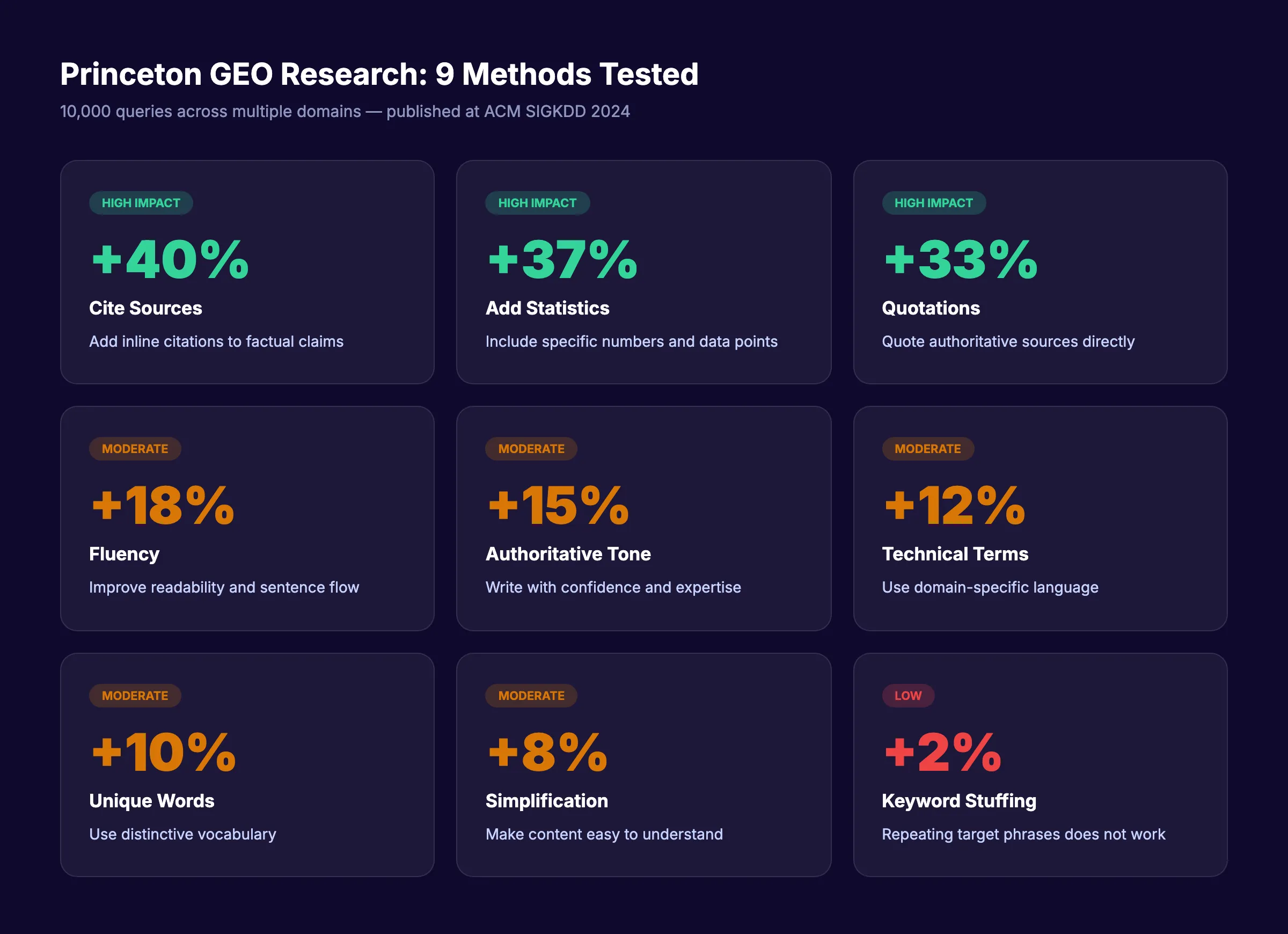
Researchers from Princeton, Georgia Tech, the Allen Institute for AI, and IIT Delhi created GEO-Bench. This benchmark contains 10,000 diverse queries across multiple domains. They tested 9 content optimization methods against a baseline.
The top 3 strategies (citations, statistics, quotations) improved visibility by 30% to 40% compared to the baseline. Combining fluency optimization with statistics outperformed any single strategy by more than 5.5%.
Keyword stuffing performed poorly. Repeating your target phrase does not help with generative engines. AI models care about information density, specificity, and source credibility.
| Method | Description | Impact |
|---|---|---|
| Cite sources | Add inline citations to claims | +30-40% |
| Add statistics | Include specific numbers and data | +30-40% |
| Include quotations | Quote authoritative sources | +25-40% |
| Fluency optimization | Improve readability and flow | +15-18% |
| Authoritative tone | Write with confidence | +12-15% |
| Technical terms | Use domain-specific language | +10-12% |
| Keyword stuffing | Repeat target terms | Ineffective |
What Additional Citation Research Shows
A study of 8,000 AI citations by Rankscale revealed actionable benchmarks:
- Content with FAQ sections receives 4.9 citations per query vs 4.4 without
- Content with schema markup gets 44% more citations
- Content with author schema is 3 times more likely to appear in AI answers
- Optimal content length for citations: 1,500+ words
- Ideal section length: 100 to 150 words per block
- Readability sweet spot: grade 6 to 8 reading level
- Content updated within 60 days gets cited 1.9 times more often
Different query domains respond to different techniques. Opinion-based queries benefit most from quotations and authoritative tone. Fact-based queries benefit most from statistics and citations. Your GEO strategy should adapt based on content type.
Your content should work in both Google and AI search. We publish 3,500+ articles optimized for traditional SEO and generative engines. Start for $1 →
Chapter 3: GEO vs Traditional SEO
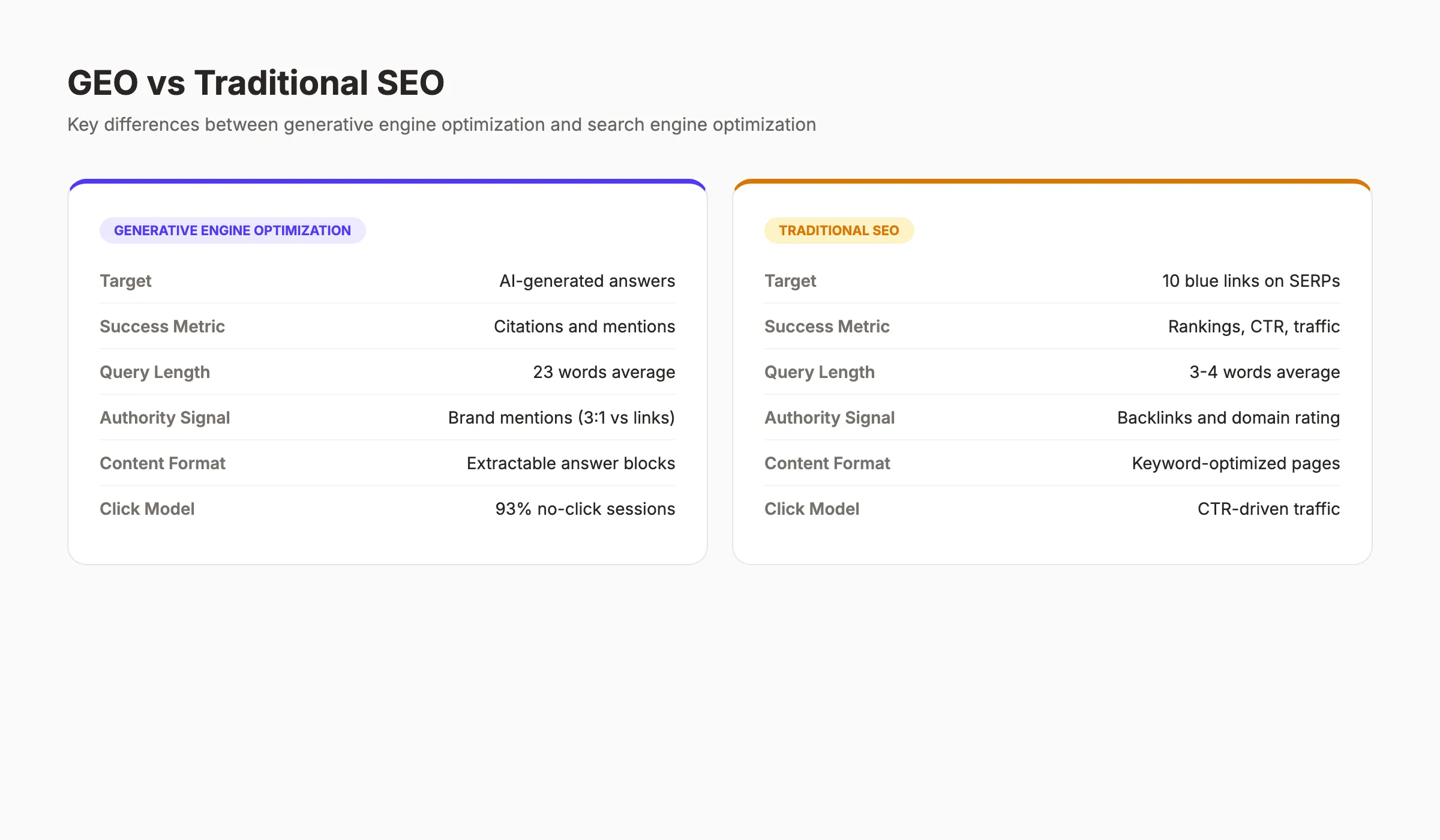
GEO and SEO are complementary disciplines with different targets. The most critical finding: fewer than 10% of sources cited by AI engines rank in Google’s top 10 for the same query. Strong SEO rankings do not guarantee AI citations.
Key Differences Between GEO and SEO
| Factor | Traditional SEO | Generative Engine Optimization |
|---|---|---|
| Target | SERPs (10 blue links) | AI-generated responses (2-7 sources) |
| Query length | 3-4 word average | 23 word average |
| Success metric | Rankings, CTR, organic traffic | Citations, mentions, brand sentiment |
| Content format | Keyword-optimized pages | Extractable, stat-rich content blocks |
| Authority signal | Backlinks and domain rating | Brand mentions (3:1 advantage over links) |
| Measurement | Google Search Console, rank trackers | AI visibility tools (Otterly, Profound) |
| Click model | Drives clicks to website | 93% of sessions end without a click |
How They Work Together
SEO builds indexable, authoritative content that ranks on Google. High-ranking content gets crawled more frequently by AI engines. GEO-optimized content on those pages earns AI citations. AI citations drive high-intent referral traffic that converts at 4.4 times the rate of standard organic visitors.
This is the compound effect. Every article stacks on the last. Your on-page SEO creates the foundation. GEO tactics multiply its reach.
Is GEO Replacing SEO
No. Moz data from 2026 shows only 38% of AI Overview citations come from top-10 organic pages. That number dropped from 76% in earlier analyses. The gap is widening. But SEO still drives the crawling, indexing, and authority signals that GEO depends on. Abandon SEO and your GEO results collapse too.
Chapter 4: 7 Strategies for Generative Engine Optimization
These strategies are drawn from the Princeton research, the 8,000-citation study, and patterns across 70+ industries we publish for.
1. Add Statistics and Quantifiable Claims
Vague statements get ignored. Specific numbers get cited.
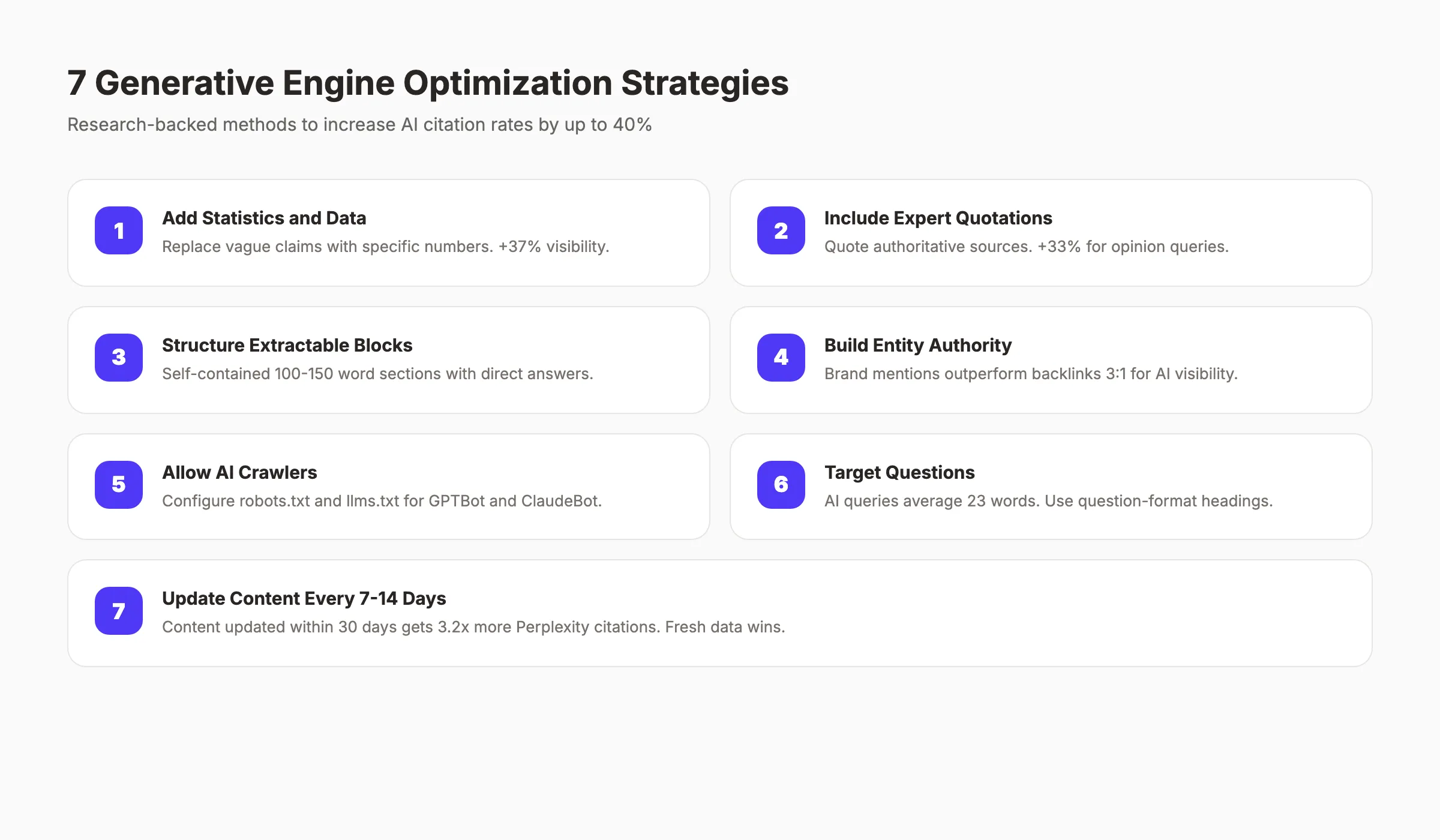
“Email marketing has good ROI” tells an AI model nothing. “Email marketing delivers an average ROI of $36 for every $1 spent” gives the model a concrete fact it can reference. The Princeton study found that adding statistics increased visibility by over 30%.
Every major section of your content should include at least 1 specific number with a source. When you write SEO blog posts, front-load stats near the beginning of each paragraph.
2. Include Quotations and Expert Citations
AI models treat quotations as trust signals. A direct quote from a research paper or authoritative source signals that your content synthesizes real expertise.
The Princeton research showed quotations boosted visibility by 25% to 40% depending on the query type. Opinion-based and advisory queries saw the highest gains. Attribute every quote to a specific person or organization.
3. Structure Content in Extractable Blocks
AI engines do not read your entire article and summarize it. They extract specific blocks. Each section needs to function as a standalone answer.
An “extractable block” is a self-contained section with a clear heading, a direct answer, and supporting evidence. Keep sections between 100 and 150 words. Use descriptive H2 and H3 headings that match user questions. Follow proper blog post structure with clear hierarchy.
4. Build Entity Authority Across the Web
This is the biggest shift from traditional SEO. Brand mentions outperform backlinks 3:1 for AI visibility. Third-party signals are 6.5 times more likely to earn citations than on-site optimization alone.
Reddit accounts for 46.7% of Perplexity’s top citations. Wikipedia dominates ChatGPT at 47.9%. Industry blogs, review sites, and forums shape how AI models perceive your brand. Build topical authority with consistent publishing on your core topics. Get your brand mentioned outside your own domain.
5. Allow AI Crawlers to Access Your Content
AI engines need to crawl your content before they can cite it. Many AI crawlers do not execute JavaScript. Server-side rendering matters.
Configure your robots.txt to allow GPTBot, ClaudeBot, and PerplexityBot. Create an llms.txt file that describes your site structure for AI models. Read our full guide on AI crawlers to understand what each bot needs.
6. Target Questions Instead of Keywords
AI users write queries averaging 23 words. They ask full questions, not 3-word keywords. Structure your content around the exact questions your audience asks.
Research questions on Reddit, Quora, and People Also Ask boxes. Use question-format H2 and H3 headings. Answer each question directly in the first 2 sentences of each section. Build FAQ sections. Content with FAQs gets 4.9 citations per query vs 4.4 without.
Strong keyword research should now include a question-mapping step for generative engine optimization.
7. Update Content Every 7 to 14 Days
AI engines favor fresh content. Content updated within 30 days gets 3.2 times more Perplexity citations with an 82% citation rate. Content freshness is a major ranking factor across 7 AI models tested in recent studies.
This is the biggest behavioral shift GEO requires. SEO content can be updated quarterly. GEO content needs continuous freshness signals. Update old blog posts with new data, examples, and timestamps. Internal linking from new posts to existing pages also signals freshness.
Keeping 30+ articles fresh every month is a full-time job. We publish and update SEO content on autopilot for 70+ industries. Start for $1 →
Chapter 5: Optimize for Each AI Search Platform
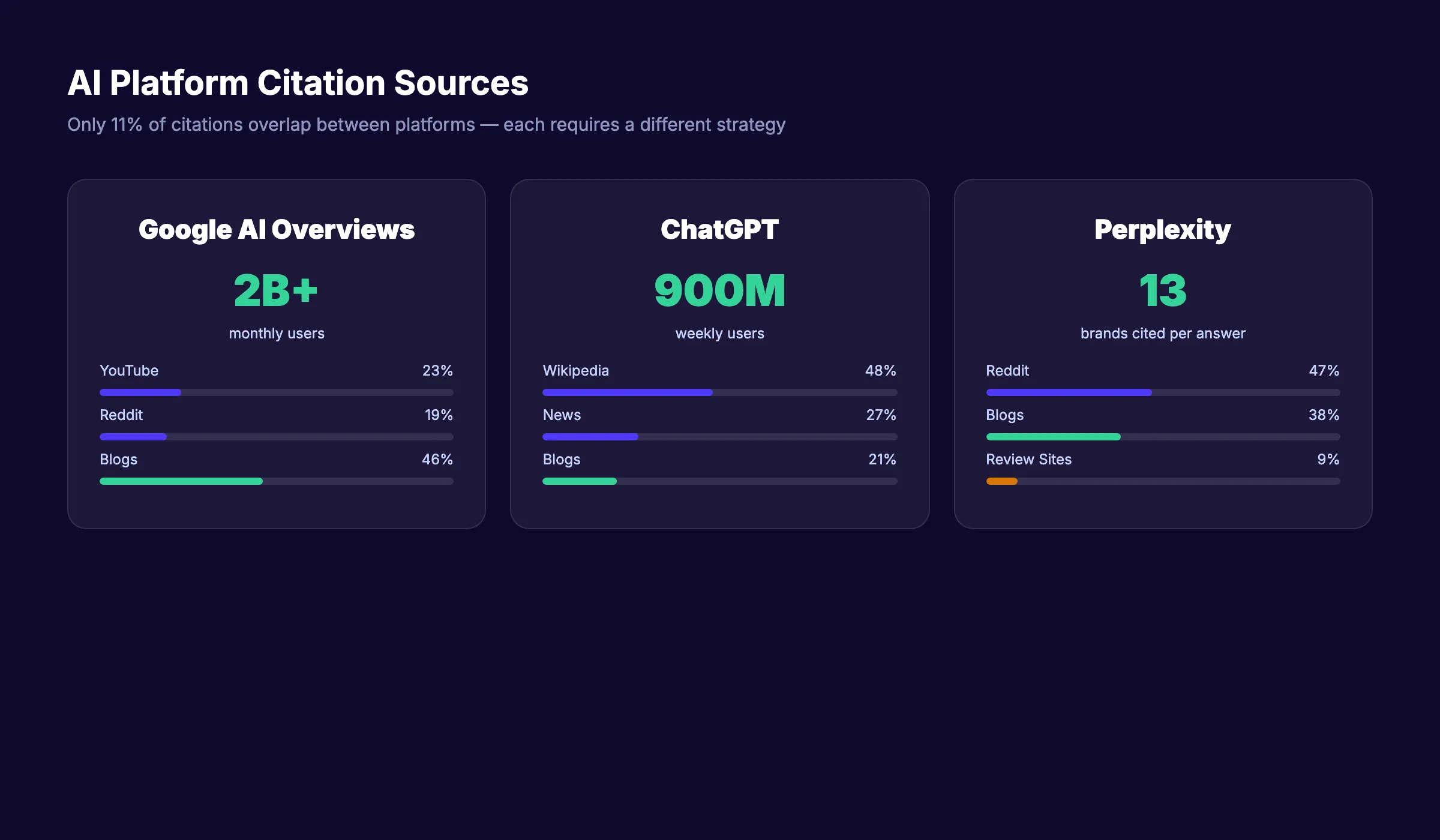
Each AI platform retrieves and cites content differently. Only 11% of citations overlap between ChatGPT and Perplexity. 71% of cited sources appear on a single platform only. A generic approach fails because 89% of citation opportunities are platform-specific.
Google AI Overviews
Google AI Overviews appear in 25% of searches and reach over 2 billion users monthly.
82.5% of citations link to nested inner pages, not homepages. 80% of cited URLs are absent from Google’s top 100 organic results. Blogs account for 46% of cited content. YouTube is the most-cited single domain at 23%.
Create self-contained paragraphs that need no surrounding context. Add schema markup for 44% more citations. Optimize for Google AI Overviews with our dedicated guide.
ChatGPT
ChatGPT serves 900 million weekly users and drives 87.4% of all AI referral traffic.
Wikipedia dominates at 47.9% of top citations. News outlets account for 27%. Blogs account for 21%. User-generated content appears in under 0.5% of citations.
Build third-party mentions on authoritative domains. Direct on-site optimization alone is insufficient for ChatGPT. Ensure pages are indexed in Bing because ChatGPT uses Bing for browsing. Focus on entity authority and E-E-A-T signals.
Perplexity
Perplexity is the most citation-heavy AI engine. It cites 8 to 15 sources per answer and averages 13 brands per response.
Reddit dominates at 46.7% of top citations. Blogs account for 38%. Content freshness within 30 days gets 3.2 times more citations. “Last Updated” timestamps are critical ranking signals.
Publish frequently and update existing content within 30-day windows. Build presence on Reddit with genuine, helpful contributions. Optimize for Perplexity with our step-by-step guide.
| Factor | AI Overviews | ChatGPT | Perplexity |
|---|---|---|---|
| Monthly reach | 2B+ users | 900M weekly | Hundreds of millions |
| Sources per answer | 2-7 | 3-4 brands | 8-15 sources |
| Top citation source | YouTube, Reddit | Wikipedia (48%) | Reddit (47%) |
| Key optimization | Schema + inner pages | Third-party mentions | Freshness + Reddit |
Chapter 6: Schema Markup and Structured Data for GEO
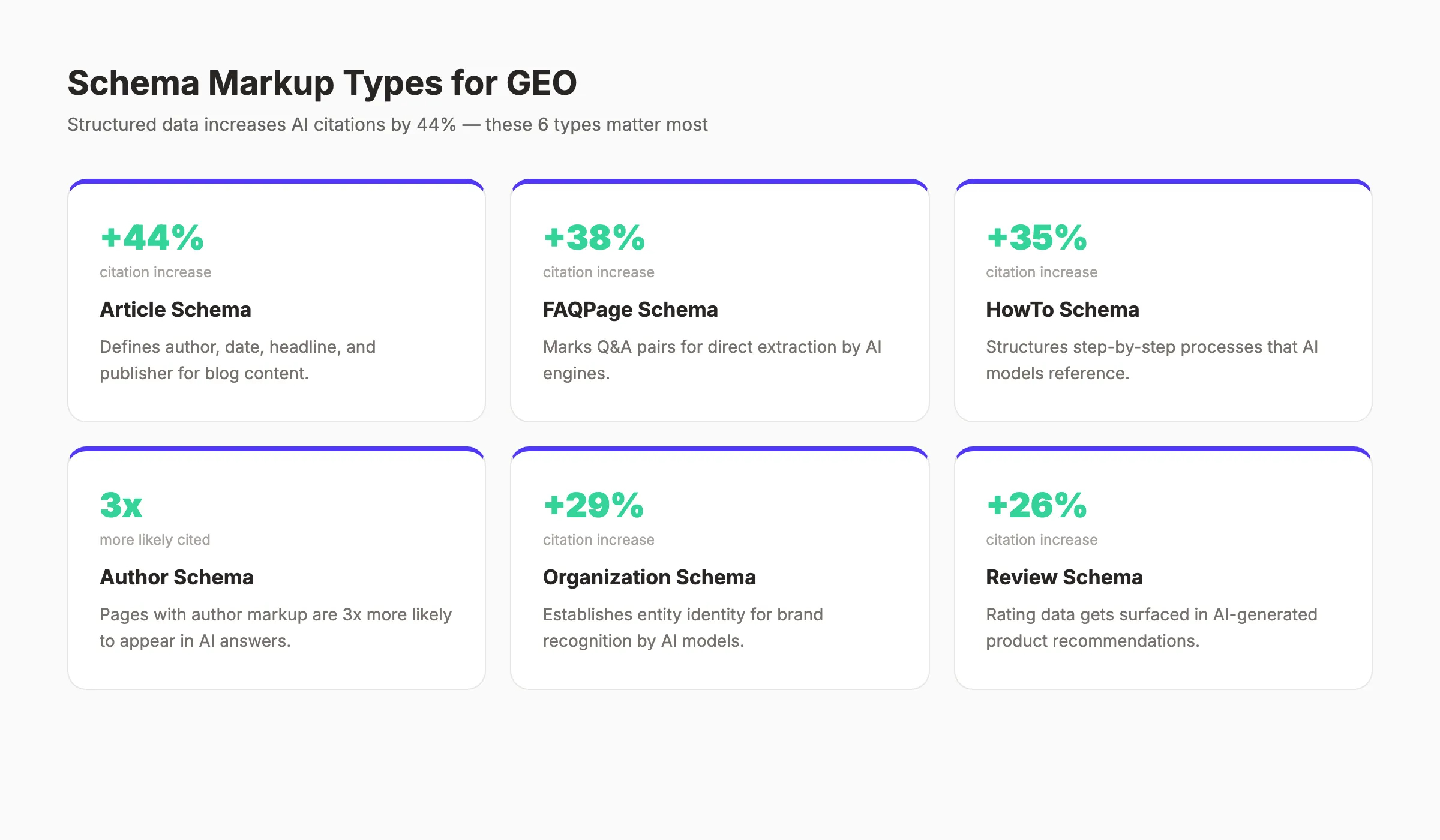
Structured data is one of the most underused GEO tactics. Content with schema markup receives 44% more AI citations than content without it. Google’s AI explicitly reads structured data when formulating AI Overview responses.
Which Schema Types Matter Most
Six schema types have the strongest impact on AI citations:
- Article schema defines author, date, headline, and publisher. It is the baseline requirement for blog content.
- FAQPage schema marks Q&A pairs for direct extraction by AI engines. FAQ content gets 4.9 citations per query.
- HowTo schema structures step-by-step processes that AI models reference in procedural answers.
- Author schema makes pages 3 times more likely to appear in AI answers. It signals expertise and credibility.
- Organization schema establishes entity identity for brand recognition by AI models.
- Review schema surfaces rating data in AI-generated product and service recommendations.
Read our full guide on schema markup for blog posts for implementation details.
How to Implement Schema for GEO
Use JSON-LD format for all schema markup. Place it in the <head> section of your page. Include these minimum fields for Article schema:
- headline (your H1)
- author (name + URL)
- datePublished and dateModified
- publisher (organization name + logo)
- description (meta description)
Test your schema with Google’s Rich Results Test. Validate with Schema.org’s validator. Check that AI crawlers can access the structured data by reviewing your AI crawlers setup.
The exception: schema alone does not guarantee citations. It increases the probability by 44%. Pair it with the 7 content strategies from Chapter 4 for the strongest results.
Not sure which pages to optimize first? We audit and optimize content for AI search visibility across your entire blog. Start for $1 →
Chapter 7: How to Measure GEO Performance
GEO measurement differs from SEO. Rankings and clicks are not the primary metrics. Here is what to track and how to track AI search visibility across platforms.
Track AI Citation Frequency
The core GEO metric is citation frequency. How often does your content appear as a cited source in AI answers?
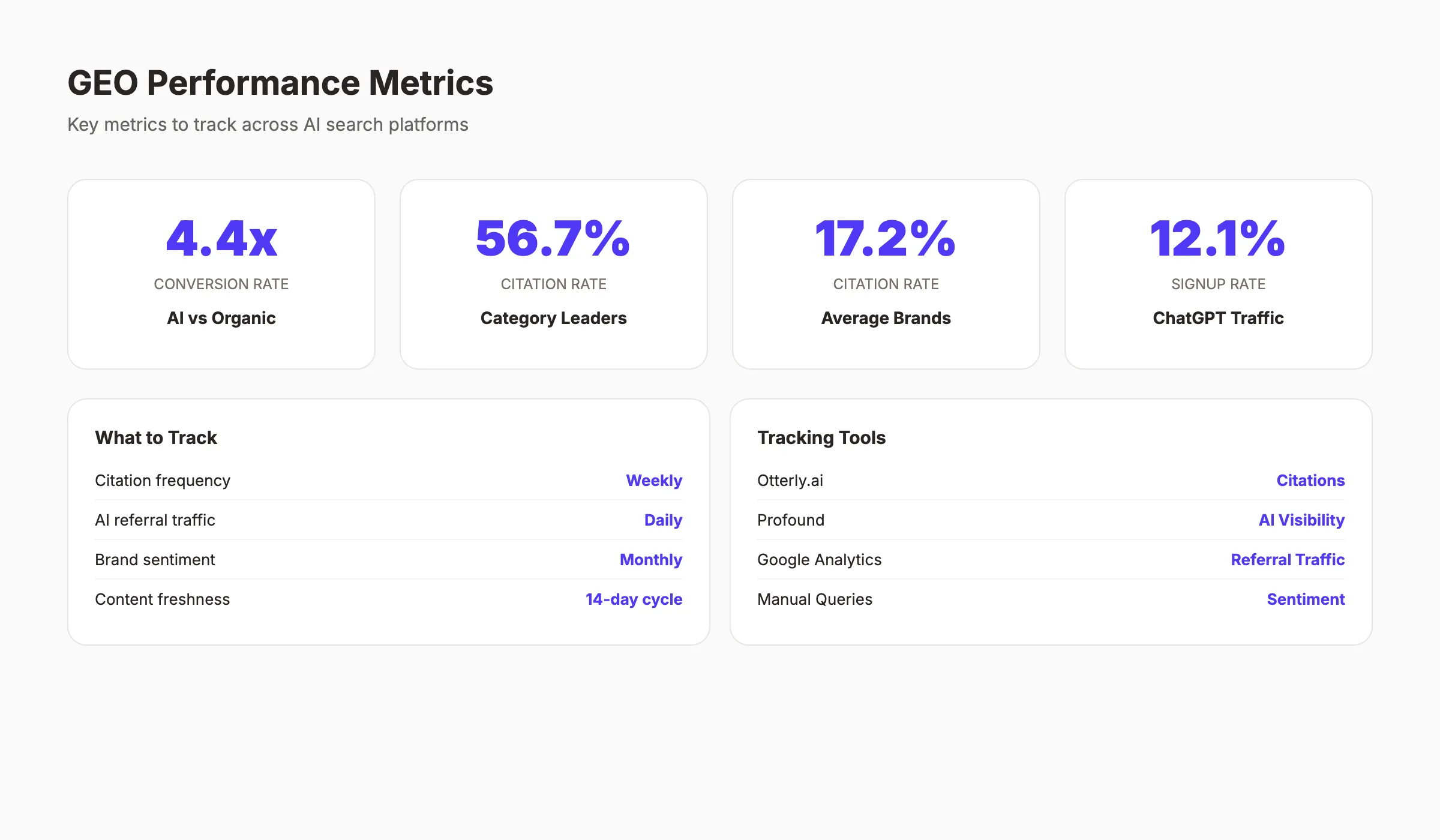
Run target queries in ChatGPT, Perplexity, and Google AI chat weekly. Use monitoring tools like Otterly.ai, Profound, or SE Visible. Track citation frequency for your top 20 target queries. Compare your citation rate against competitors.
The average brand appears in 17.2% of relevant AI responses. Category leaders hit 56.7%. Set the leader benchmark as your target.
Monitor AI Referral Traffic
Check Google Analytics for referral traffic from ai.google.com, chatgpt.com, and perplexity.ai. This traffic is small (roughly 1% of total) but growing month-over-month.
The conversion data tells the real story. AI visitors convert at 4.4 times the rate of standard organic visitors. ChatGPT drives only 0.5% of visits for most sites but 12.1% of signups. That is a 24 times conversion multiplier. GEO is a revenue strategy, not a traffic strategy.
Measure Citation Sentiment
Being cited is not enough. Monitor how AI engines describe your brand. Ask AI engines directly about your company. Check for factual accuracy, positive vs negative framing, whether your key differentiators appear, and competitor mentions in the same answer.
If AI engines misrepresent your brand, you need more third-party sources providing accurate information. The AI models synthesize from what is available online. Content clusters around your core topics help AI engines understand your expertise.
Chapter 8: Common Generative Engine Optimization Mistakes
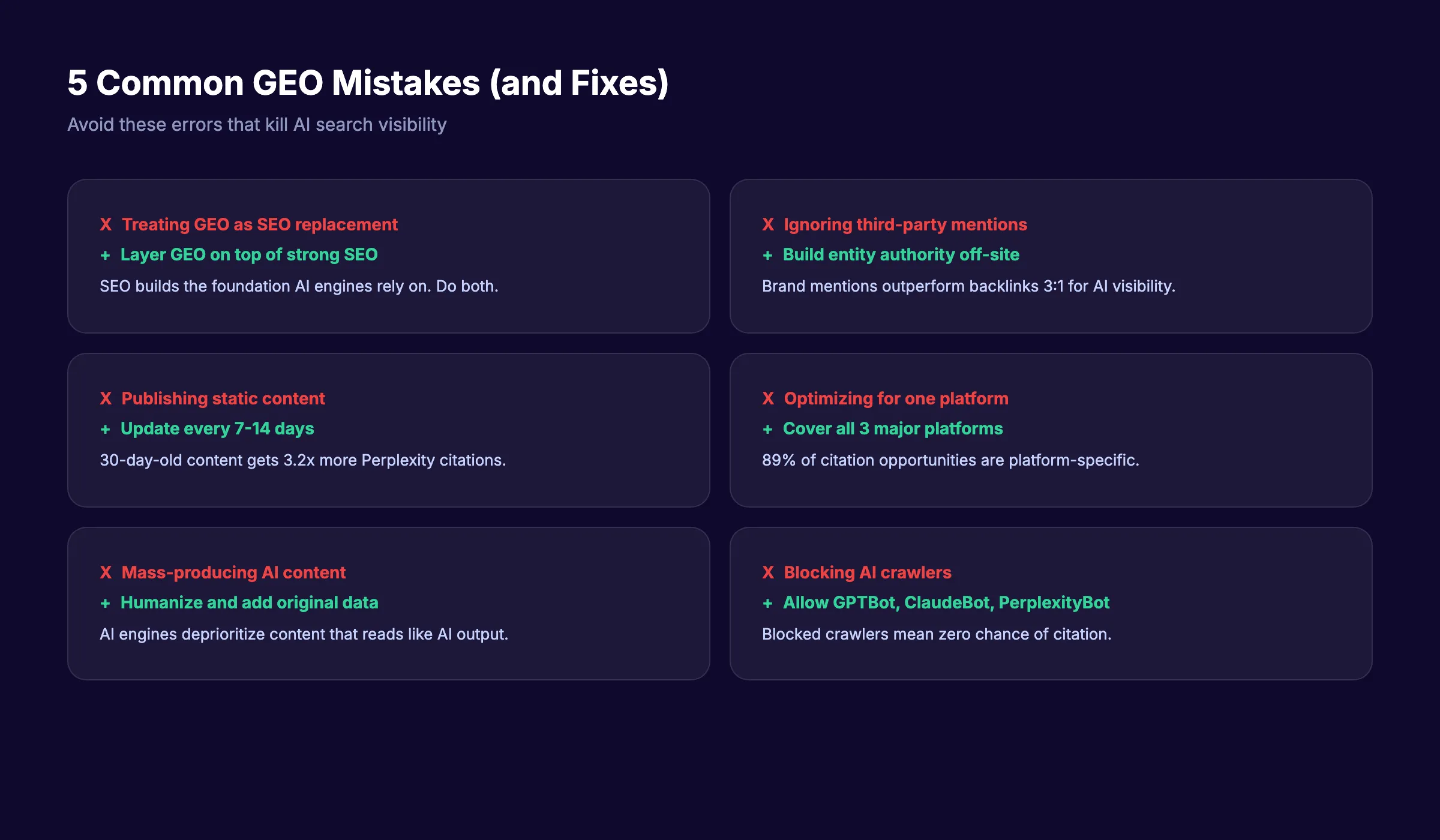
Most brands fail at GEO because they make one of these 5 errors. Every mistake has a straightforward fix.
Treating GEO as a Replacement for SEO
GEO does not replace SEO. It extends it. Pages not indexed by Google are unlikely to appear in AI Overviews. Pages without backlinks lack authority signals ChatGPT uses. Your on-page SEO still matters. Optimize for SEO first. Layer GEO tactics on top.
Ignoring Third-Party Mentions
Many brands optimize their own pages and wonder why AI engines do not cite them. Brand mentions outperform backlinks 3:1 for AI visibility. Third-party signals are 6.5 times more powerful than on-site optimization alone.
Reddit, YouTube, industry blogs, review sites, and forums shape how AI models perceive your brand. Get cited in AI search by building authority across the web, not just on your domain.
Publishing Static Content
Content last updated 6 months ago loses GEO visibility. Content within a 30-day update window gets 3.2 times more Perplexity citations. A page that performed well in January may be invisible by March without a refresh.
Schedule content updates every 7 to 14 days for your highest-value pages. Use our blog GEO checklist after every update cycle.
Optimizing for One Platform Only
89% of citation opportunities are platform-specific. Only 11% of citations overlap between ChatGPT and Perplexity. A strategy that works on one platform misses the majority of opportunities on others.
Build platform-specific tactics. Optimize for Reddit presence (Perplexity). Build Wikipedia-adjacent authority (ChatGPT). Create inner-page content with schema (AI Overviews). Cover all 3 platforms.
Mass-Producing Low-Quality Content
Publishing dozens of AI-generated articles and calling them GEO-ready is the fastest path to failure. AI engines deprioritize content that reads like generic AI output. Humanize AI content before publishing. Add original data, expert quotes, and specific examples. Quality over quantity wins in GEO, just as it does in SEO.
GEO Readiness Audit: Score Your Pages
Before optimizing every page, audit what you have. Score each page on these 10 factors. Give 1 point for each.
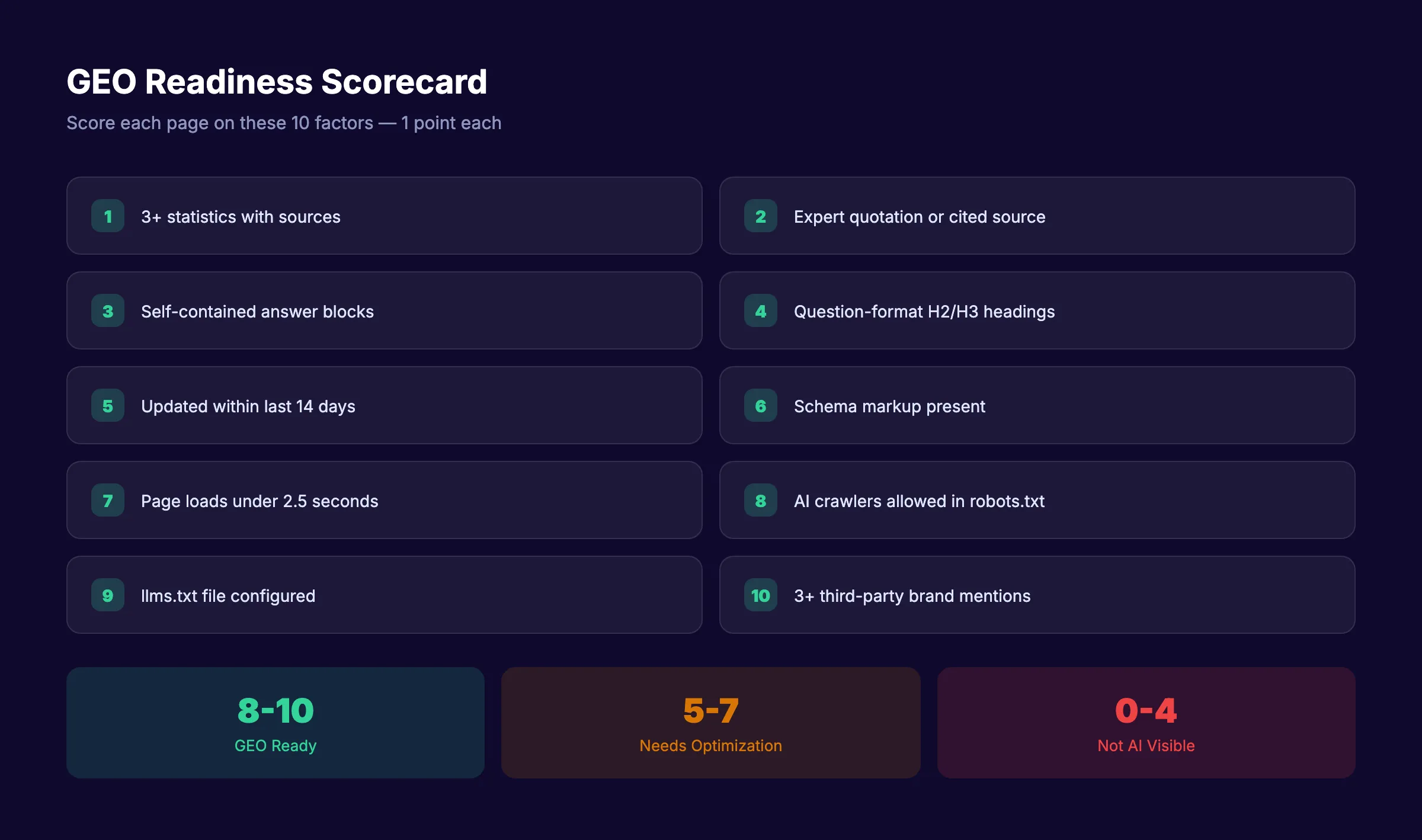
- Contains 3+ specific statistics with sources
- Includes at least 1 expert quotation or cited source
- Sections function as self-contained answer blocks (100-150 words each)
- H2 and H3 headings use question or topic format
- Content updated within the last 14 days
- Schema markup present (Article, FAQ, or HowTo)
- Page loads under 2.5 seconds
- AI crawlers not blocked in robots.txt
- llms.txt file configured and accessible
- Brand mentioned on 3+ third-party sites for this topic
Score 8-10: GEO ready. Focus on freshness and entity building. Score 5-7: Needs optimization. Prioritize statistics, structure, and technical fixes. Score below 5: Not visible to AI engines. Requires a full content audit and overhaul.
Start with pages that already rank on Google (positions 1 to 30), have high business value, and align with topics users ask AI engines about.
Build your SEO and GEO moat at the same time. We publish 30 optimized articles per month, structured for both Google rankings and AI citations. Start for $1 →
FAQ
What is generative engine optimization?
Generative engine optimization (GEO) is the practice of optimizing content to appear as a cited source in AI-generated search answers. It targets platforms like ChatGPT, Google AI Overviews, Perplexity, and Claude. GEO focuses on citations and mentions rather than traditional search rankings. The term was coined by Princeton and Georgia Tech researchers in a 2023 paper that tested 9 optimization methods across 10,000 queries.
Is GEO replacing SEO?
No. GEO extends SEO. Traditional SEO builds the crawlability, authority, and rankings that AI engines rely on. GEO adds optimization for AI citations on top of that foundation. Only 10% of AI-cited sources rank in Google’s top 10. You need both disciplines working together to capture visibility across all search channels.
How long does generative engine optimization take to show results?
GEO results appear faster than SEO in many cases. AI engines re-crawl and update sources more frequently than Google updates rankings. Content optimizations can show citation improvements within 1 to 2 weeks. Building entity authority takes 2 to 4 months of consistent effort across third-party platforms.
Which AI search engine should I optimize for first?
Start with Google AI Overviews if your content already ranks on Google. Use Perplexity as your measurement platform because it shows all cited sources. Then build ChatGPT visibility through third-party mentions on authoritative domains. Each platform has different citation patterns and 89% of opportunities are platform-specific.
Do backlinks still matter for GEO?
Backlinks matter less than brand mentions for AI citations. Brand mentions outperform backlinks 3:1 for AI visibility. But backlinks still support SEO, which creates the authority foundation AI engines rely on. Earn both backlinks and unlinked brand mentions across authoritative sites for the strongest results.
Does GEO work for small businesses?
Yes. Small businesses in niche industries often find GEO easier than SEO because there is less competition for AI citations in specialized topics. A local dentist publishing detailed content about dental procedures can earn AI citations that national brands do not target. Publish consistently and build mentions on review sites and local directories.
Generative engine optimization is the next layer of search visibility. The foundations match SEO: quality content, technical excellence, and consistent authority building. The execution layer is new: extractable blocks, statistics, citations, freshness signals, and cross-platform entity authority. Start with a GEO audit of your top 10 pages. Score them against the checklist. Fix the gaps. The compounding starts from day one.
Get 30 GEO-optimized articles published every month. No writers. No editing. No publishing. We handle it all. Start for $1 →

Written by
Siddharth GangalSiddharth is the founder of theStacc and Arka360, and a graduate of IIT Mandi. He spent years watching great businesses lose organic traffic to competitors who simply published more. So he built a system to fix that. He writes about SEO, content at scale, and the tactics that actually move rankings.
30 SEO blog articles published every month
Keyword-optimized, scheduled, and live on your site. Automatically.
30-day trial · Cancel anytime
theStacc
Stop writing SEO content manually
30 blog articles, 30 GBP posts, and social media content. Published every month. Automatically.
Start Your $1 Trial$1 for 3 days · Cancel anytime