
Evergreen Content (2026): Strategies, Tactics & Examples
Step-by-step evergreen content guide guide for 2026: proven tactics, real examples, common mistakes to avoid, and implementation tips.
Most businesses spend their content budget chasing trends. A news story breaks. A keyword spikes. The team scrambles to publish. Traffic comes in for two weeks, then disappears forever.
That is not a content strategy. That is a hamster wheel.
The problem is structural. Time-sensitive content has an expiration date baked in. Every article about a trending topic starts decaying the moment it publishes. You do not build authority that way. You do not build traffic that way. You spend money and get nothing that compounds.
Evergreen content is the answer. These are articles, guides, and pages built around topics that stay relevant for years. They rank once and keep generating traffic long after you stop thinking about them. According to Ahrefs, 96.55% of indexed pages get zero traffic from Google. Evergreen content, done correctly, puts you in the 3.45% that actually ranks.
We have published 3,500+ blogs across 70+ industries at Stacc. The highest-ROI content we see, consistently, is evergreen.
Here is what this guide covers:
- What evergreen content actually is (and the formats that perform best)
- Why it generates the highest long-term ROI of any content type
- How to choose topics that will still rank in 3 years
- How to write evergreen content that outranks competitors
- How to optimize it for SEO and featured snippets
- How to maintain it so rankings do not decay
- How evergreen content performs in AI search engines
Chapter 1: What Evergreen Content Actually Is (and What It Is Not)
Evergreen content is content that addresses a topic that stays relevant over time. The term comes from evergreen trees. They do not shed leaves seasonally. The content equivalent does not shed relevance.
A guide on “how to write a cover letter” is evergreen. People need that skill every year. A post about “the best cover letter format for 2024” is not. It has a year in the title, and the moment that year passes, the content feels stale.
The distinction matters because it changes how you invest. Evergreen content is a capital asset. Trending content is an operating expense.
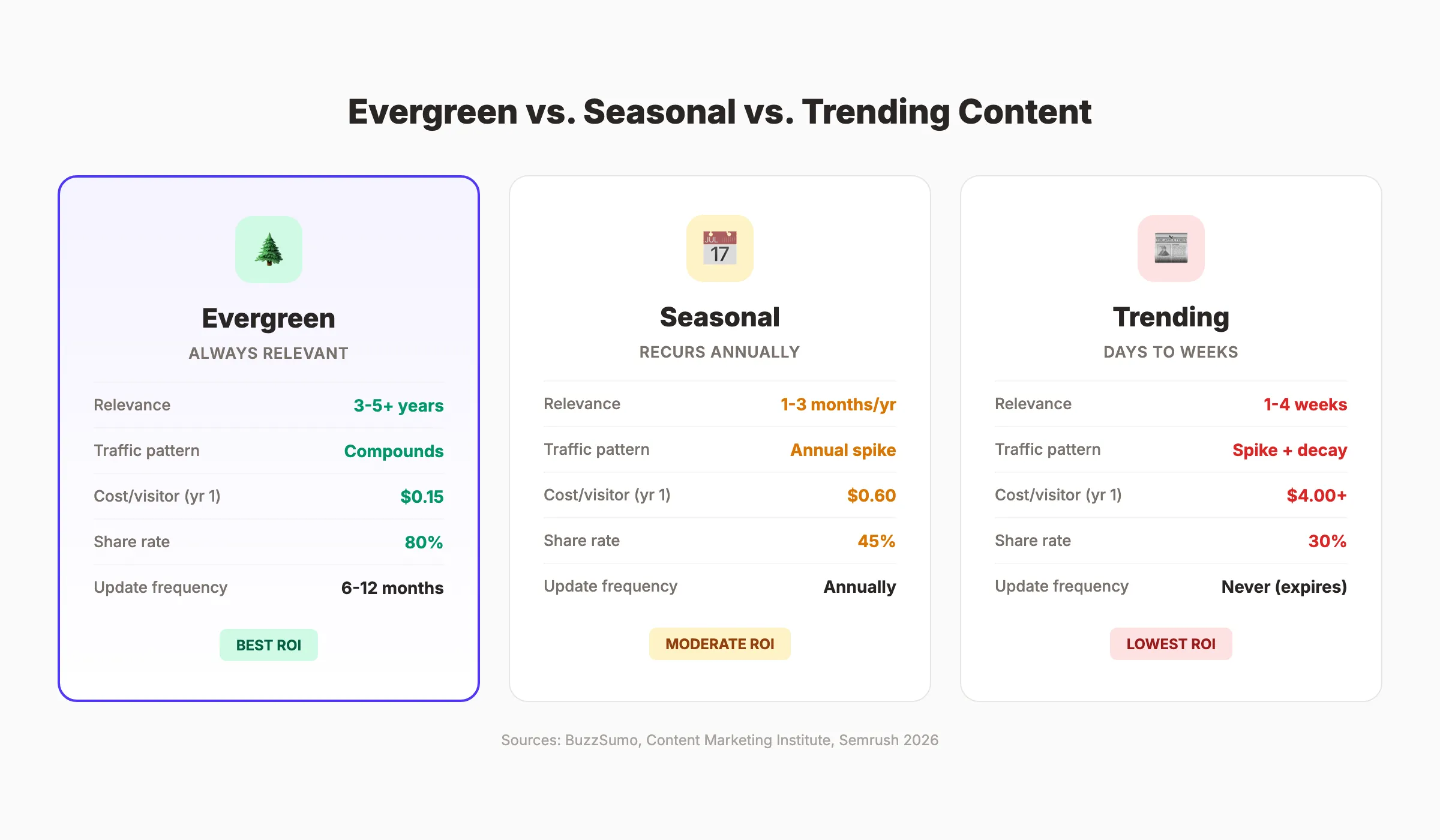
Evergreen vs. Seasonal vs. Trending Content
| Type | Relevance Window | Example | Traffic Pattern |
|---|---|---|---|
| Evergreen | 3-5+ years | ”How to do keyword research” | Slow build, sustained plateau |
| Seasonal | Recurs annually | ”Best Black Friday SEO deals” | Annual spike, then drops |
| Trending | Days to weeks | ”Google’s March 2026 core update” | Sharp spike, rapid decay |
Common Misconceptions
Many marketers assume “evergreen” means “never needs updating.” That is incorrect. Evergreen topics are stable. The specific details inside an article may need refreshing as tools, statistics, or best practices change.
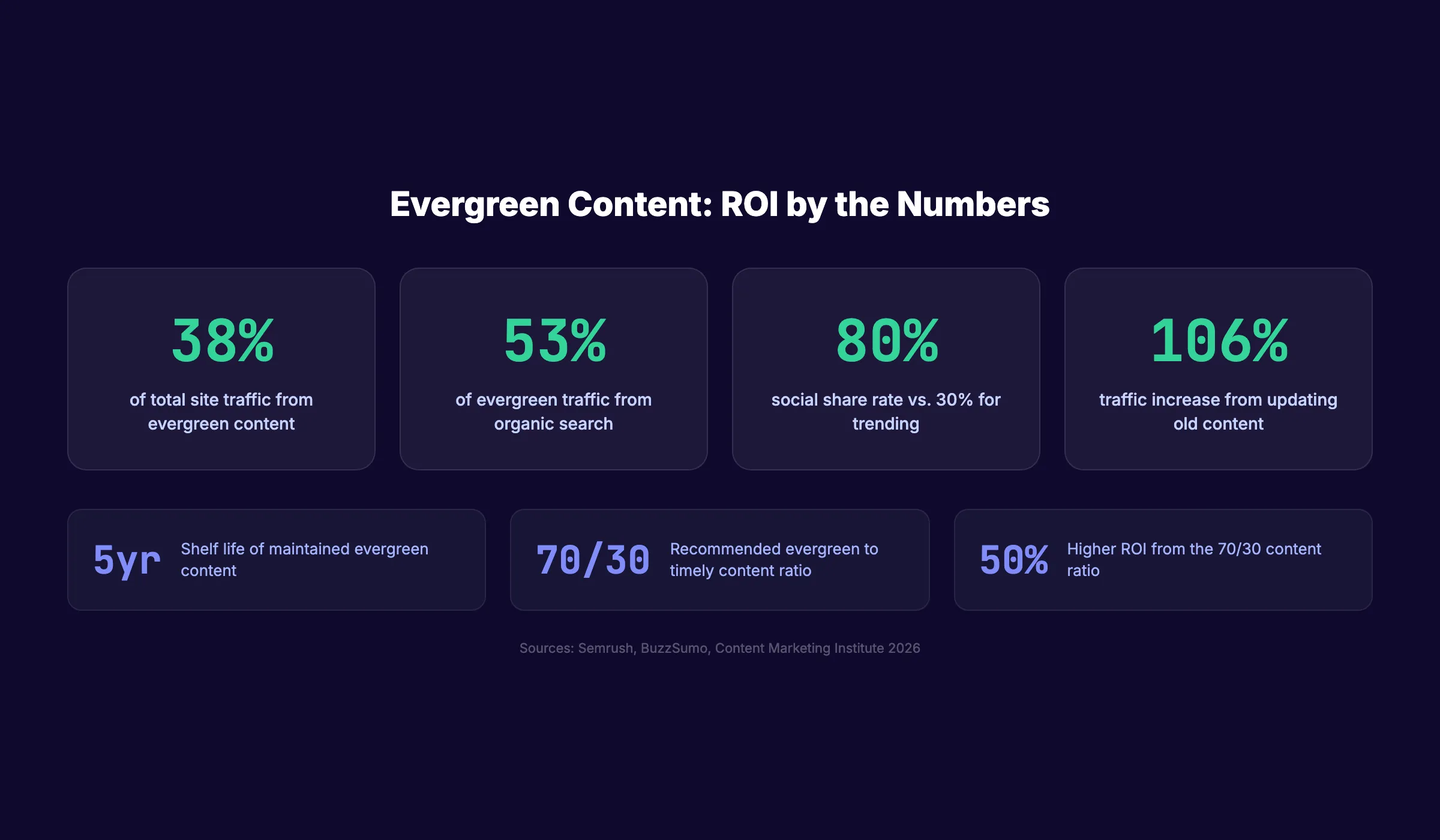
Another misconception: evergreen content has to be boring. Some of the most-shared content on the internet. Checklists, ultimate guides, comparison pages. Are evergreen. BuzzSumo research found that 80% of evergreen content gets shared on social media, versus only 30% of time-sensitive articles.
Evergreen content is not just “old” content. It is strategically chosen content built around durable human needs.
Chapter 2: Why Evergreen Content Is the Highest-ROI Content You Can Create
The math on evergreen content is unlike any other marketing channel.
You write an article once. You pay for that article once. But the traffic it generates does not stop after month one. It compounds. A well-optimized evergreen post can hold a top 10 ranking for 2 or more years. The cost per visitor drops every single month.
Trending content works the opposite way. The cost per visitor is highest in month one. By month three, the traffic is effectively zero. You keep the cost, you lose the traffic.
The Traffic Compound Effect
Evergreen content accounts for 38% of a website’s total traffic when a site maintains a consistent publishing strategy. That number grows as the site ages and the content builds topical authority.
53% of traffic to evergreen content comes from organic search. That means it is working for you while you sleep, while you are at conferences, and while you are building other parts of the business.
Cost Per Visitor Over Time
| Month | Trending Article | Evergreen Article |
|---|---|---|
| Month 1 | $0.40/visitor | $1.20/visitor |
| Month 3 | $4.00/visitor | $0.60/visitor |
| Month 6 | $40.00/visitor | $0.30/visitor |
| Month 12 | Traffic = $0 | $0.15/visitor |
| Month 24 | Traffic = $0 | $0.08/visitor |
The longer the time horizon, the wider the gap.
The 70/30 Ratio
The Content Marketing Institute recommends a 70% evergreen, 30% timely content ratio. This ratio yields approximately 50% higher ROI than a content strategy weighted toward trending topics. The timely content captures short-term search spikes and news traffic. The evergreen content builds the foundation that sustains the site between those spikes.
A strong content marketing strategy treats evergreen content as infrastructure, not output.
Chapter 3: 12 Evergreen Content Formats That Drive Long-Term Traffic
Not all evergreen topics work in all formats. Matching the right format to the right keyword type is one of the most important decisions in content strategy.
The 12 Formats
1. How-to guides and tutorials. These answer procedural questions. “How to set up Google Search Console.” “How to write a meta description.” They match how-to search intent precisely.
2. Ultimate guides and definitive guides. Long-form, chapter-based resources covering a topic end-to-end. This article is one. They attract backlinks because they serve as reference material.
3. Glossaries and definition pages. “What is X” searches are some of the most stable in Google. A glossary page on a technical topic can rank for hundreds of definition queries simultaneously.
4. Listicles (tools, tips, resources). “Best SEO tools,” “top link-building strategies,” “27 ways to increase organic traffic.” Lists are scannable and shareable. They also get updated easily.
5. Case studies. Detailed accounts of a specific result. When the methodology is documented clearly, case studies remain relevant long after the project ended.
6. Checklists and templates. Operational resources that people download and reuse. They generate consistent long-tail traffic and strong engagement signals.
7. FAQ pages. Clusters of question-based queries around a topic. Strong for featured snippet capture and voice search.
8. Comparison pages. “X vs. Y” pages match high-intent comparison search queries. Readers at this stage are often close to a decision.
9. Beginner guides. There are always new people entering any field. “SEO for beginners,” “content marketing 101”. These queries never go away.
10. Industry guides. Vertical-specific evergreen content. “SEO for e-commerce,” “content marketing for SaaS.” These attract niche audiences with high commercial intent.
11. Statistics and data pages. Roundups of industry statistics attract backlinks naturally. Journalists and bloggers link to data sources consistently.
12. Process and framework breakdowns. Documented systems for doing something. These perform well in B2B contexts where audiences want repeatable methods.
Format Selection Guide
| Format | Best Keyword Type | Example |
|---|---|---|
| How-to guide | Procedural (“how to X”) | How to do a content audit |
| Ultimate guide | Broad informational (“X guide”) | The complete guide to internal linking |
| Glossary / definition | Definitional (“what is X”) | What is topical authority |
| Listicle | ”Best X” / “top X” | Best SEO content tools |
| Case study | Proof-seeking (“X results”) | How we grew traffic 312% |
| Checklist | Task-based (“X checklist”) | On-page SEO checklist |
| FAQ page | Question clusters | Content strategy FAQs |
| Comparison | ”X vs Y” | Evergreen vs. seasonal content |
| Beginner guide | Entry-level informational | Content strategy for beginners |
| Statistics page | Data-seeking (“X statistics”) | Evergreen content statistics |
Stop writing. Start ranking. Stacc publishes 30 SEO articles per month for $99. Start for $1 →
Chapter 4: How to Choose Evergreen Topics That Rank
Choosing the wrong topic is the most common evergreen content mistake. A topic can look evergreen but actually follow a slow trend line toward irrelevance.
Google Trends Validation
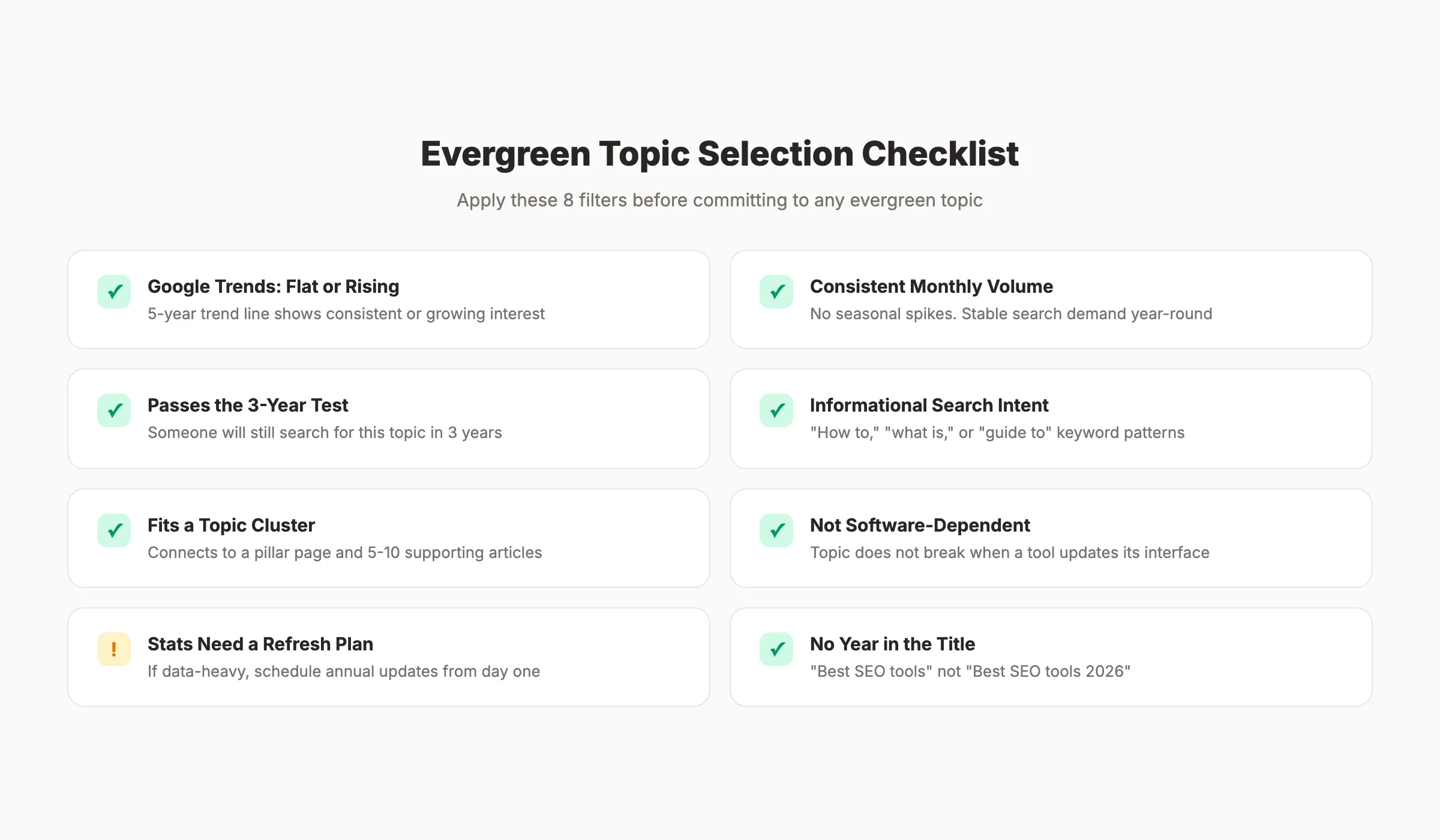
Before committing to a topic, check Google Trends. Set the time range to “past 5 years.” You want to see a flat or gently rising line. A line that peaked in 2021 and has been declining since is a red flag. A line with consistent search volume across seasons is the signal you want.
“How to do keyword research” shows a stable, consistent trend line. “NFT SEO strategy” does not.
Keyword Research for Consistent Volume
Evergreen topics have consistent monthly search volume, not seasonal spikes. Use a keyword research tool to check the monthly search volume trend over 12 months. Topics with volumes that spike once per year are seasonal, not evergreen. Even if the underlying topic feels permanent.
Look for search intent signals too. Informational intent (“how to,” “what is,” “guide to”) maps to evergreen content far more reliably than commercial intent, which shifts as products and markets change.
The “Will This Matter in 3 Years?” Test
Apply this filter to every candidate topic: will someone search for this in 3 years?
“How to write a blog post”. Yes, indefinitely. “How to optimize for Google’s helpful content update”. Probably not, because the query is tied to a specific algorithm update that will be superseded.
This test filters out topics that feel important in 2026 but are actually tied to a moment in time.
Topic Clusters and Pillar Pages
Evergreen content performs best when it exists inside a content cluster. A cluster is a group of related articles built around a central pillar page. The pillar covers a broad topic. Cluster articles go deep on specific subtopics.
This structure helps you build topical authority faster than publishing isolated articles. Google rewards sites that demonstrate depth on a subject. A cluster of 8 evergreen articles on a topic signals depth. One standalone article does not.
Topics That Seem Evergreen But Are Not
Watch out for these traps:
- Software-specific tutorials. “How to use [Tool Name]” is evergreen until the tool changes its interface. Then the content is wrong.
- Regulatory and legal topics. Tax laws, privacy regulations, and compliance requirements change. These need frequent updates.
- Statistics-heavy content without a refresh plan. A “content marketing statistics” post is evergreen in format but requires annual updates to stay accurate.
- “Best” lists tied to a specific time. “Best SEO tools in 2026” reads as outdated in 2027. “Best SEO tools” (without a year) stays relevant indefinitely when maintained.
Identifying content gaps in your existing topic coverage helps prioritize which evergreen topics to tackle first.
Chapter 5: How to Write Evergreen Content That Outranks Competitors
Choosing the right topic is 50% of the battle. Writing content that actually ranks is the other 50%.
The PASBA Opening Structure
Every evergreen guide should open with the PASBA framework:
- Problem. State the problem the reader is facing
- Agitate. Make the pain of that problem concrete
- Solution. Introduce the solution (your content)
- Bridge. Establish why you are credible on this topic
- Action. Tell them exactly what they will learn
This structure earns the reader’s attention before the first chapter even starts. It also signals to Google that the content addresses a specific user problem, which aligns with search intent.
Research Depth Requirements
Evergreen guides need to be the most useful resource on the topic. Not the longest. Depth means:
- Answering the primary query completely
- Addressing every logical follow-up question
- Providing examples, data, and frameworks (not just assertions)
- Linking to supporting evidence where claims are made
Surface-level guides rank briefly, then fall. Genuinely useful guides attract backlinks, return visits, and dwell time. Signals that compound rankings over time.
Using Data and Original Insights
Data is a backlink magnet. When you cite a statistic with a source, other writers cite you. When you generate original data. Surveys, internal studies, aggregated findings from your client base. You become a primary source.
Original insights also differentiate evergreen content from the 12 other guides on the same topic. “Here is what we observed across 3,500 published articles” is more valuable than “studies show.”
Formatting for Readability
Every H2 section should contain scannable elements. Use:
- Short paragraphs (2-3 sentences maximum)
- Subheadings (H3) for major points within chapters
- Tables for comparisons
- Bullet lists for parallel items
- Bold text for key terms and takeaways
Optimize blog post structure from the start. Reformatting after publication is harder and risks disrupting rankings.
Internal Linking Best Practices
Internal linking is where most evergreen content strategies leave significant ranking power on the table.
Every evergreen guide should link to relevant cluster articles. Those cluster articles should link back to the pillar. This creates a closed loop of topical relevance that Google’s algorithms reward.
The rules:
- Use descriptive anchor text that matches the target page’s primary keyword
- Link to pages that genuinely help the reader go deeper on a subtopic
- Do not force links. If the connection is not natural, skip it.
- Aim for 3-5 internal links per 1,000 words minimum
E-E-A-T Signals in Evergreen Content
Google’s E-E-A-T framework (Experience, Expertise, Authoritativeness, Trustworthiness) is especially important for evergreen content because these pages accumulate signals over time.
To build E-E-A-T into evergreen guides:
- Include an author byline with a real name and bio
- Cite primary sources for statistics and claims
- Add a “Last Updated” date and maintain it honestly
- Link to authoritative external sources where relevant
- Show first-hand experience where possible (“in our analysis of X,” “across our client data”)
Your SEO team. $99 per month. 30 optimized articles, published automatically. Start for $1 →
Chapter 6: SEO Optimization for Evergreen Content
Writing a great guide is necessary. Optimizing it for search is what turns that guide into a traffic asset.
Keyword Placement Strategy
The primary keyword belongs in:
- The H1 title (once, naturally)
- The first 100 words of the introduction
- At least one H2 subheading
- The meta description
- The image alt text for the featured image
- The URL slug
Secondary keywords and related terms belong throughout the body text. Do not force density. Write for the reader. Related terms appear naturally when the content is thorough.
On-Page SEO Checklist
Refer to a full on-page SEO guide for the complete checklist, but the core items for evergreen content are:
- Title tag under 60 characters with primary keyword near the front
- Meta description under 160 characters with a clear value proposition
- URL slug: short, keyword-rich, no stop words
- H1 matches or is close to the title tag
- H2 structure maps to the main sub-topics
- Images compressed, with descriptive alt text
- Page load speed under 2.5 seconds
- Mobile-optimized layout
Schema Markup for Guides
Schema markup tells Google exactly what type of content it is looking at. For evergreen guides, use:
- Article schema for general guides
- HowTo schema for step-by-step tutorials
- FAQPage schema for FAQ sections
- BreadcrumbList schema for site navigation context
FAQPage schema is particularly valuable. It can generate rich results directly in the SERP, expanding your real estate without requiring a ranking increase.
Featured Snippet Optimization
Featured snippets are dominated by evergreen content. The query “what is evergreen content” has a snippet. “How to write evergreen content” has a snippet. Most informational evergreen queries do.
To optimize for featured snippet capture:
- Identify the exact query you are targeting for a snippet
- Place a direct, 40-60 word answer in a paragraph immediately after the relevant H2
- For list snippets, use a numbered or bulleted list with concise items
- For table snippets, use a properly formatted HTML table with clear headers
The goal is to make Google’s job effortless. If your paragraph directly answers the query better than any other paragraph on any other page, you win the snippet.
Link Building for Evergreen Pages
Evergreen content earns links passively over time through organic discovery. You can accelerate this with:
- Digital PR outreach. Pitch your data and original insights to journalists and bloggers
- Resource page link building. Request inclusion on curated resource lists in your niche
- Broken link building. Find broken links to similar guides and suggest your content as a replacement
- Guest posting. Reference and link to your evergreen guides from guest articles on authoritative sites
The compounding nature of evergreen content means every link you earn raises your ranking, which earns more organic links, which raises your ranking further.
Chapter 7: How to Update and Maintain Evergreen Content
Evergreen content is not a set-and-forget strategy. It is a maintain-to-retain strategy.
The shelf life of well-maintained evergreen content is up to 5 years. Without maintenance, content decay sets in. Rankings drop, traffic falls, and the page gradually loses ground to newer, fresher competitors.
The 6-12 Month Review Cycle
Set a calendar reminder for every evergreen post at 6 months and 12 months after publication. During each review:
- Check the current ranking position for the primary keyword
- Compare current traffic to prior period traffic
- Identify any statistics or facts that have become outdated
- Check for broken internal or external links
- Review the top 3 SERP competitors. Have new sections appeared that you do not cover?
- Update the “Last Updated” date after making changes
Updating outdated evergreen content consistently can lead to a 106%+ traffic increase on specific pages. That is not a marginal improvement. That is a doubling of traffic from content you already own.
What to Update vs. What to Leave Alone
Update:
- Statistics with specific years or dates
- Tool recommendations (pricing, features, or availability may have changed)
- Screenshots or UI references to software
- References to algorithm updates, platform policies, or regulations
- Any section where a competitor now has a more detailed treatment
Leave alone:
- Core methodology and frameworks that are still accurate
- Sections with high engagement (comments, shares, dwell time signals)
- Anchor text and internal linking structure (changing URLs or slugs can destroy rankings)
- The URL itself. Never change a URL on a ranking page without a proper redirect
Content Decay Detection
Content decay is the gradual decline in organic traffic to a page that was previously performing well. Early detection is critical. A decaying page can be recovered. A dead page cannot.
Signals of content decay:
- Ranking drops from top 3 to positions 7-15
- Click-through rate declining without ranking changes
- Impressions holding but clicks dropping
- Competitors publishing fresher, more detailed versions of the same guide
Monitor these signals in Google Search Console. A content audit every 6-12 months will surface decay patterns across the full site, not just individual posts.
Version Control and Freshness Signals
When you update an evergreen post, signal the freshness to Google:
- Update the published date in the frontmatter or CMS to reflect the most recent major update
- Add a visible “Last Updated: [Month Year]” note near the top of the article
- Submit the updated URL to Google Search Console for reindexing
- Internally link to the updated post from a recent article to drive crawl priority
Updating old blog posts systematically is one of the highest-impact content activities any site can do. It costs less than publishing new content and often delivers better results.
Update Checklist
| Update Type | Frequency | Priority |
|---|---|---|
| Statistics and data points | Annually | High |
| Tool recommendations | Every 6 months | High |
| Internal links (add new cluster articles) | Every 6 months | Medium |
| Competitor gap analysis | Annually | Medium |
| Schema markup review | Annually | Medium |
| Featured snippet targeting | Every 6 months | High |
| ”Last Updated” date | Every major edit | High |
3,500+ blogs published. 92% average SEO score. See what Stacc can do for your site. Start for $1 →
Chapter 8: Evergreen Content in the AI Search Era
AI search engines have changed how users discover content. But they have not diminished the value of evergreen content. They have increased it.
How AI Search Engines Cite Evergreen Content
Perplexity, ChatGPT Search, and Google’s AI Overviews pull from the same sources that traditional search engines rank highly. The difference is that AI search engines prioritize:
- Content that directly answers a question
- Content with clear, citable facts and statistics
- Content with structured formatting (headers, lists, tables)
- Content from authoritative domains with strong topical coverage
All 4 of these criteria favor well-built evergreen guides. A 3,000-word ultimate guide with cited statistics, clear H2 structure, and strong E-E-A-T signals is exactly what AI systems want to cite.
AI Overviews and Evergreen Snippets
AI Overviews. Google’s AI-generated summary boxes at the top of search results. Pull heavily from evergreen content. The format mirrors featured snippet logic: the best direct answer, from the most authoritative source, wins the citation.
Pages already ranking in positions 1-5 for evergreen informational queries are disproportionately cited in AI Overviews. This is not a coincidence. Google’s AI uses its existing quality signals to select sources.
The implication: ranking well for evergreen queries now gives you visibility in both traditional organic results and AI-generated summaries.
Optimizing for Perplexity, ChatGPT, and Gemini
These systems have different citation behaviors than Google, but the underlying requirements are similar. To get cited in AI search:
- Write clear, direct definitions at the start of sections
- Use factual claims with identifiable sources
- Structure content with explicit headers that match the query intent
- Ensure your domain has consistent topical coverage (not just one strong page)
- Maintain E-E-A-T signals that indicate trustworthiness
Generative engine optimization is the emerging discipline around these practices. Its foundation is the same as traditional evergreen content strategy: be the most useful, accurate, and well-organized source on a topic.
The Citability Advantage
AI systems cite sources, not individual sentences. A guide that covers a topic end-to-end. Definitions, history, examples, how-tos, comparison tables, FAQs. Gives AI systems more material to work with and more reasons to cite the same domain across multiple query types.
A site with 30 well-built evergreen guides on related topics will be cited far more frequently than a site with 200 thin, disconnected posts. This is the content compound effect applied to AI search.
The advice is the same as it has always been: build content assets, not content volume. A blog SEO strategy built on depth beats one built on velocity every time.
Rank everywhere. Do nothing. Blog SEO, Local SEO, and Social on autopilot. Start for $1 →
Frequently Asked Questions
What is evergreen content?
Evergreen content is content built around topics that stay relevant over time. Months or years after publication. It does not expire, unlike trending or time-sensitive content. Examples include how-to guides, ultimate guides, definition pages, and comparison articles.
How often should you update evergreen content?
The standard recommendation is a full review every 6-12 months. High-traffic pages warrant a review every 6 months. Lower-traffic pages can be reviewed annually. Each review should check for outdated statistics, changed tool recommendations, new competitor content, and opportunities to add internal links to newer cluster articles.
What is the difference between evergreen and seasonal content?
Evergreen content stays relevant year-round, year after year. Seasonal content is relevant only during a specific period. Black Friday deals, tax season tips, holiday gift guides. Seasonal content recurs annually but does not generate consistent traffic outside its window. The recommended content mix is 70% evergreen, 30% timely or seasonal.
How many evergreen posts should a blog have?
There is no single right number. The more useful benchmark is cluster depth. Each core topic on your site should have 1 pillar page and 5-10 supporting cluster articles, all evergreen. If you have 5 core topics, that is 30-55 evergreen pages as a foundation. For a detailed perspective, see how many blog posts to rank.
Does evergreen content help with SEO?
Yes, significantly. Evergreen content accumulates backlinks over time, which raises domain authority. It generates consistent organic traffic signals that reinforce topical relevance. It also provides an internal linking network that distributes authority across the site. The longer a well-optimized evergreen page ranks, the stronger its position becomes.
Can AI write good evergreen content?
AI can produce a solid structural draft quickly. But good evergreen content requires original insights, first-hand data, and expert perspective that AI alone cannot generate. The best approach is using AI to accelerate the draft, then layering in original analysis, accurate statistics with proper citations, and genuine expertise. If you want to scale blog content without sacrificing quality, a human-edited AI workflow is the current best practice.
Evergreen content is not a tactic. It is the foundation of a content strategy that builds real business value over time. The businesses that dominate organic search in 2026 and beyond are the ones treating their content library as an asset. Writing once, ranking for years, and compounding their advantage with every update cycle.
Start with one evergreen guide on your most important topic. Build the cluster around it. Measure, update, and repeat.
Related Tools & Resources
Free SEO Tools:
Best Lists:

Written by
Siddharth GangalSiddharth is the founder of theStacc and Arka360, and a graduate of IIT Mandi. He spent years watching great businesses lose organic traffic to competitors who simply published more. So he built a system to fix that. He writes about SEO, content at scale, and the tactics that actually move rankings.
30 SEO blog articles published every month
Keyword-optimized, scheduled, and live on your site. Automatically.
30-day trial · Cancel anytime
theStacc
Stop writing SEO content manually
30 blog articles, 30 GBP posts, and social media content. Published every month. Automatically.
Start Your $1 Trial$1 for 3 days · Cancel anytime