SEO for Landing Pages: The Complete Guide (2026)
Learn SEO for landing pages in 8 chapters — on-page, technical, content, and conversion optimization. Real case studies and data. Updated April 2026.
Stacc Editorial • 2026-04-04 • SEO Tips
In This Article
96.55% of all web pages get zero traffic from Google. Landing pages fail at an even higher rate because most teams build them for paid ads and never optimize for organic search.
SEO for landing pages is the difference between a page that generates leads only while you pay for ads and one that generates leads for months or years with no ongoing spend. PPC costs rise over time. Organic traffic compounds.
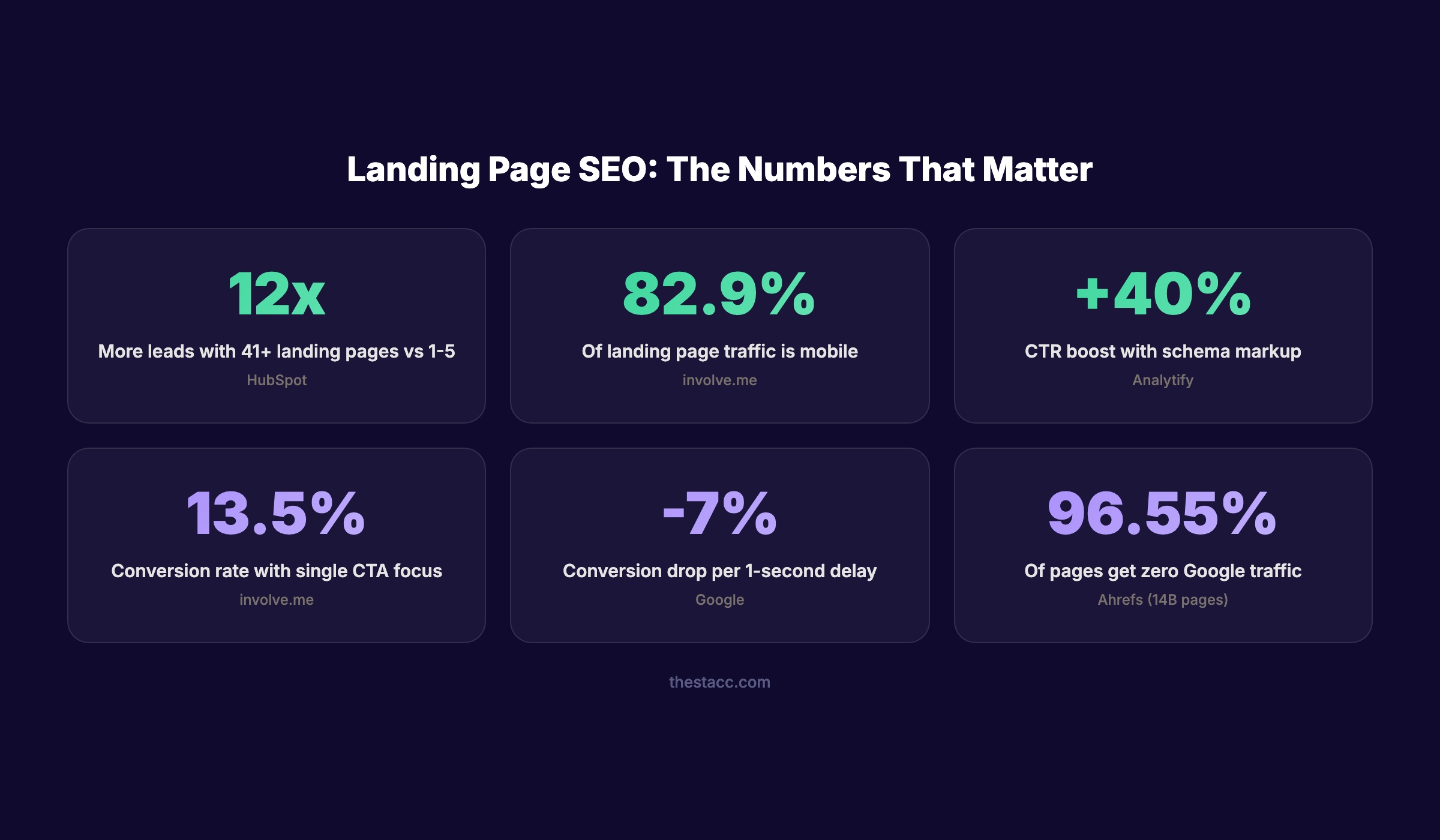
Sites with 41+ landing pages generate 12x more leads than sites with 1 to 5. But the pages need to rank first.
We have published 3,500+ blogs across 70+ industries. We know what separates landing pages that rank from ones that sit at zero traffic. This guide covers it all.
Here is what you will learn:
- The difference between SEO landing pages and PPC landing pages
- How to optimize on-page elements for organic ranking
- Technical SEO requirements including Core Web Vitals and mobile
- How to balance conversion design with SEO content needs
- An internal linking strategy that sends authority to your landing pages
- How to measure performance and iterate
Chapter 1: What Is an SEO Landing Page?
An SEO landing page is any page on your site designed to rank in organic search results and convert visitors into leads or customers. It targets a specific keyword, serves a specific search intent, and includes both content for Google and elements for conversion.
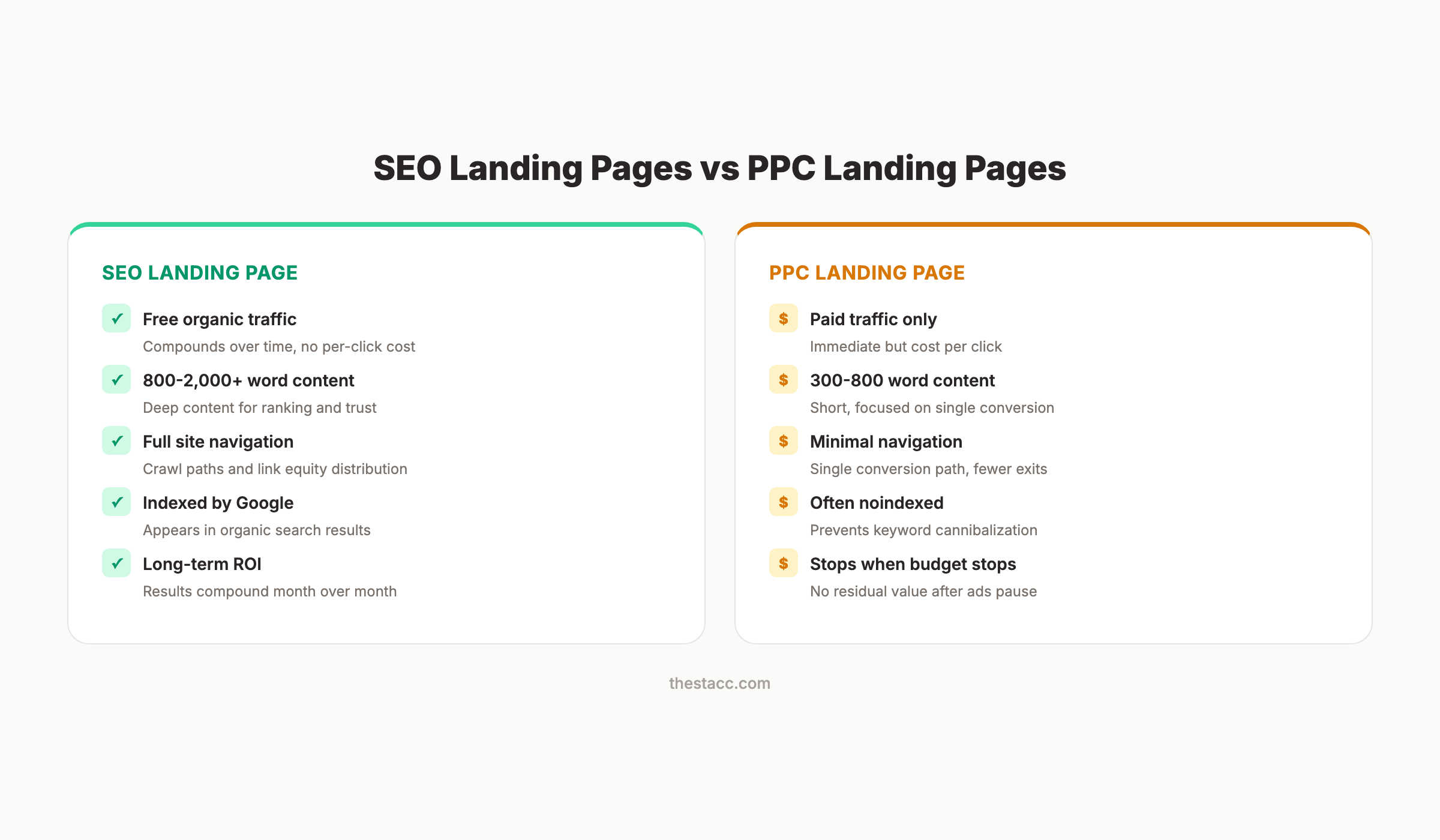
This is different from a PPC landing page, which only receives paid traffic and is often noindexed.
| Factor | SEO Landing Page | PPC Landing Page |
|---|---|---|
| Traffic source | Organic search (free, compounds) | Paid ads (immediate, per-click cost) |
| Content length | 800-2,000+ words | 300-800 words |
| Navigation | Full site navigation retained | Minimal or no navigation |
| CTA approach | Softer CTAs throughout content | Direct, urgent single CTA |
| Indexing | Must be indexed | Often noindexed |
| Time to results | Weeks to months | Immediate on ad activation |
| ROI timeline | Compounds over time | Stops when budget stops |
The most effective approach uses both. SEO pages build long-term organic traffic. PPC pages capture immediate demand. Some teams run hybrid pages that serve both purposes.
48% of top-performing landing pages appear in organic results or map packs. That means half the highest-converting pages also rank organically. SEO and conversion are not opposing forces.
Most businesses underinvest in SEO landing pages. 77% of businesses use their homepage as the primary landing page. 44% of B2B ad traffic goes to a homepage instead of a dedicated landing page. This wastes both paid and organic opportunity. A dedicated landing page targeting a specific keyword will always outperform a generic homepage for that query.
The investment is worth it. Paid CPA tends to rise over time. Organic traffic compounds. A well-optimized SEO landing page that ranks for a relevant keyword generates leads for months or years with no ongoing ad spend.
Chapter 2: Keyword Research for Landing Pages
Every landing page starts with a keyword. The keyword determines the page’s content, structure, and conversion approach.
Match Keywords to Intent
Search intent determines what type of page Google expects. The four intent types each require a different landing page approach.
| Intent Type | Example Query | Landing Page Format |
|---|---|---|
| Informational | ”what is CRM software” | Educational content, guides, comparisons |
| Commercial | ”best CRM for small business” | Feature lists, comparisons, social proof |
| Transactional | ”buy HubSpot CRM” | Direct product page, pricing, sign-up form |
| Navigational | ”HubSpot login” | Branded page, account access |
Commercial and transactional queries produce the highest conversion rates. But informational queries drive more volume. Build landing pages for all four types.
Keyword Selection Checklist
- Primary keyword has measurable search volume
- Secondary keywords (3-5) are semantically related
- Search intent matches your landing page purpose
- Competition level is realistic for your domain authority
- Keyword appears naturally in your product or service description
Use keyword research tools to identify gaps where competitors rank but you do not. Each gap represents a landing page opportunity.
Do not target a single keyword per landing page and ignore everything else. Build a keyword cluster. Your primary keyword anchors the page. Your secondary keywords (3-5 related terms) appear naturally in headings and body text. Long-tail variations go into your FAQ section and supporting content. This approach covers more search queries without creating thin, redundant pages.
Avoid creating near-identical landing pages for slight keyword variations. Google treats these as duplicate content. One strong page targeting a keyword cluster outperforms 5 weak pages targeting individual terms.
Chapter 3: On-Page SEO for Landing Pages
On-page SEO determines whether Google understands what your landing page is about. Every element needs to be optimized.
Title Tags
Include the primary keyword near the beginning. Keep under 60 characters. Make it compelling enough to click. 66% of top companies include their brand name in title tags when space allows.
Good: “CRM for Small Business | Free Trial | YourBrand” Bad: “Welcome to Our Amazing Product Page”
Meta Descriptions
Write meta descriptions as advertisements for your page. Include the primary keyword naturally. Stay under 160 characters. Add a value proposition or CTA.
H1 and Header Hierarchy
One H1 per page matching the primary keyword and topic. Use H2s for major sections. Use H3s for subsections. Break content with a subheading every 200-300 words.
URL Structure
Include the primary keyword. Keep short. Use hyphens. Avoid parameters and session IDs. Good: /crm-small-business. Bad: /page?id=234&cat=5.
Content Optimization
Place the primary keyword in the first 100 characters. Distribute secondary keywords through headings, body text, and image alt text. Write at a 5th to 7th grade reading level. Data shows this converts at 11.1% versus 5.3% for professional-level text.
The content length debate has a clear answer: match the intent. Simple products with transactional queries need 500-800 words. Complex B2B products with commercial queries need 1,500-2,000+ words. Check what ranks in positions 1-3 for your target keyword and match or exceed that depth.
Image Optimization
Use descriptive alt text with keywords where natural. Compress before upload. Serve in WebP format. Lazy-load below-fold images. Use descriptive file names instead of IMG_001.jpg.
Stop writing. Start ranking. Stacc publishes 30 optimized SEO articles per month for $99. Start for $1 →
Chapter 4: Technical SEO Requirements
A landing page with perfect on-page SEO still fails if the technical foundation is broken. These factors directly affect ranking and user experience.
Core Web Vitals
Google uses Core Web Vitals as a confirmed ranking factor. Three metrics matter:
| Metric | Target | What It Measures |
|---|---|---|
| LCP (Largest Contentful Paint) | Under 2.5 seconds | Loading performance |
| INP (Interaction to Next Paint) | Under 200 milliseconds | Responsiveness |
| CLS (Cumulative Layout Shift) | Under 0.1 | Visual stability |
One case study showed an 8% increase in sales after improving LCP by 31%. Speed directly affects revenue.
Page Speed Optimization
53% of mobile users abandon pages that take longer than 3 seconds to load. A 1-second delay reduces conversions by 7%.
Speed optimization checklist:
- Compress images and serve next-gen formats (WebP, AVIF)
- Eliminate render-blocking JavaScript
- Defer non-critical scripts
- Use a CDN for global delivery
- Enable browser caching
- Minify CSS and JavaScript
- Preload critical above-fold resources
Mobile Optimization
82.9% of landing page traffic comes from mobile devices. Mobile-first indexing is Google’s default. Mobile-responsive pages convert at 11.7% versus 10.7% for desktop-only designs.
Ensure tap targets are appropriately sized. Eliminate horizontal scrolling. Test with Google’s Mobile-Friendly Test. Read our mobile SEO guide for the full checklist.
Crawlability and Indexing
The most common technical mistake: accidentally noindexing pages intended for organic traffic. Check every landing page for:
- No accidental
noindextag - Page included in XML sitemap
- Canonical tag points to the correct URL
- Clean URL structure without parameters
- No duplicate content issues
- HTTPS enabled (confirmed ranking signal)
Chapter 5: The Conversion vs SEO Tension
Landing pages face a fundamental conflict. SEO rewards content-rich, link-heavy pages. Conversion optimization often favors minimal distractions and a single CTA.
The data resolves this tension.
What the Numbers Show
| Approach | Result | Source |
|---|---|---|
| Single CTA focus | 13.5% conversion | involve.me |
| 5+ competing links | 10.5% conversion | involve.me |
| Navigation removal | +100% conversion boost | involve.me |
| Video on page | +86% conversion lift | involve.me |
| Testimonials added | +34% conversion lift | involve.me |
| Schema markup added | +40% CTR in SERPs | Analytify |
The Practical Framework
Most advice says to choose either SEO or conversions. That is wrong. Here is how to do both.
Above the fold: Conversion-first. Clear headline. Value proposition. Primary CTA. Hero image or video. This serves both humans and Google.
Below the fold: SEO-first. Detailed content covering the topic. Secondary keywords. FAQ sections. Internal links. Social proof. This gives Google the depth it needs while building trust for visitors who scroll.
Navigation: Keep it. But make it sticky and compact. Removing navigation hurts SEO (fewer crawl paths) even though it boosts conversion in paid contexts. On SEO landing pages, navigation helps Google discover related pages and distributes link equity.
CTAs: Place them at natural break points. Use soft CTAs in content (“see how it works,” “start free trial”) and one strong CTA above fold. Google understands commercial intent pages. CTAs do not hurt rankings.
Your SEO team. $99 per month. 30 optimized articles, published automatically. Start for $1 →
Chapter 6: Internal Linking and Site Architecture
An orphaned landing page with no internal links pointing to it gets crawled infrequently and carries no link equity. Internal linking is the mechanism that makes landing pages rank.
The Hub-and-Spoke Model
Your landing page is the hub. Supporting blog posts, guides, and content clusters are the spokes. Each spoke targets a subtopic keyword and links back to the landing page.
Example for a CRM landing page:
- Hub:
/crm-small-business(landing page targeting “CRM for small business”) - Spoke 1:
/blog/crm-features-guide(links to hub with anchor “CRM for small business”) - Spoke 2:
/blog/how-to-choose-crm(links to hub with anchor “small business CRM”) - Spoke 3:
/blog/crm-implementation-steps(links to hub)
Each spoke article earns its own organic traffic and passes authority to the hub landing page through internal links.
Internal Linking Checklist for Landing Pages
- At least 5 internal pages link to the landing page
- Landing page is accessible within 3 clicks from the homepage
- Landing page appears in the main or footer navigation
- Anchor text varies but stays topically relevant
- Landing page links out to 3-5 related pages on your site
- Blog posts in the same topic cluster reference the landing page
Zapier demonstrates this at scale. They created 50,000+ programmatic landing pages for app integrations. Each page targets a specific long-tail keyword. The result: 3.6 million organic keywords and 5.8 million organic sessions per month.
Chapter 7: Schema Markup for Landing Pages
Structured data makes your landing pages eligible for rich results in Google. Pages with schema markup see 40% higher CTR than those without it.
Which Schema Type for Which Page
| Landing Page Type | Recommended Schema | Rich Result |
|---|---|---|
| Product page | Product + AggregateRating | Price, stars, availability |
| Service page | Service + Organization | Business details |
| Location page | LocalBusiness | Hours, map, ratings |
| Pricing page | Product + Offer | Pricing tiers |
| Event page | Event | Date, location, tickets |
| Content/guide page | Article + FAQ | Author, FAQ dropdowns |
Implementation Priority
- Add Organization schema to your homepage
- Add Product or Service schema to each landing page
- Add FAQ schema to pages with FAQ sections (still helps AI systems even though Google restricted visual display)
- Add Breadcrumb schema for navigation path display
- Test with Google’s Rich Results Test before deploying
Use our free Schema Markup Generator to create valid JSON-LD for your landing pages.
3,500+ blogs published. 92% average SEO score. See what Stacc can do for your site. Start for $1 →
Chapter 8: Measuring and Iterating
SEO for landing pages is not set-and-forget. Track performance and optimize continuously.
Key Metrics to Monitor
| Metric | Tool | Target |
|---|---|---|
| Organic traffic | Google Analytics | Upward trend month over month |
| Keyword rankings | Google Search Console | Top 10 for primary keyword |
| Click-through rate | Google Search Console | Above category average |
| Conversion rate | Google Analytics (Goals) | 1-3% for SEO traffic, higher for branded |
| Core Web Vitals | PageSpeed Insights | All three metrics in “Good” range |
| Bounce rate | Google Analytics | Below 70% for content-rich pages |
| Internal link count | Screaming Frog or Ahrefs | 5+ pages linking to each landing page |
When to Update Landing Pages
Content decay affects landing pages just like blog posts. Update when:
- Rankings drop below page 2
- Conversion rate declines for 2+ consecutive months
- Competitor pages significantly outperform yours
- Product or service details change
- Industry trends shift (pricing, features, regulations)
77% of businesses A/B test landing pages worldwide. But only 12% of tests produce statistically significant wins. Focus A/B tests on high-impact elements: headlines, CTAs, hero images, and social proof placement.
Timeline Expectations
Be realistic about how long SEO for landing pages takes.
| Milestone | Timeline |
|---|---|
| Google indexes the page | 1-2 weeks |
| Initial ranking movement | 4-8 weeks |
| Top 20 rankings for low-competition keywords | 2-3 months |
| Top 10 rankings for medium-competition keywords | 3-6 months |
| Stable top 5 rankings for competitive keywords | 6-12 months |
| Full compound traffic effect | 12-18 months |
One case study documented a 700% organic traffic increase over 12 months after a full landing page SEO overhaul. Another showed a 156% increase after implementing server-side rendering for critical landing pages.
The results compound. Each month of consistent optimization builds on the previous month’s gains. This is the Content Compound Effect applied to landing pages.
Most landing page SEO advice focuses on individual page optimization. That misses the bigger picture. The pages that rank fastest are the ones supported by a consistent content publishing strategy. Every blog post you publish about a related topic creates another spoke in your content cluster, sends another internal link to your landing page, and builds another entry point for organic discovery. Our SEO checklist for 2026 covers the full system.
FAQ
Do landing pages help with SEO?
Yes. Landing pages that target specific keywords, include quality content, and earn internal links can rank in organic search. Sites with 41+ landing pages generate 12x more leads than sites with fewer than 5. The key is building landing pages for organic search intent, not just paid traffic.
How long should a landing page be for SEO?
It depends on the query’s complexity. Simple transactional queries (buy, sign up) need 500-800 words. Complex commercial queries (best CRM for small business) need 1,500-2,000+ words. Check what currently ranks in positions 1-3 for your target keyword and match that depth.
Should landing pages have navigation menus?
For SEO landing pages, yes. Navigation helps Google discover related pages and distributes link equity across your site. Removing navigation may boost conversion rates for PPC pages, but it hurts organic ranking potential. Use a compact, sticky navigation that stays out of the way.
What is a good conversion rate for an SEO landing page?
The median landing page conversion rate is 6.6% across all traffic sources. For organic search traffic specifically, 1-3% is typical. B2B pages average higher (13.3%) because visitors arrive with more specific intent. Top 10% of landing pages convert above 11%.
Should I use a landing page builder or build on my main domain?
Build on your main domain whenever possible. Landing page builders like Unbounce or Leadpages often place pages on subdomains (pages.yourdomain.com), which do not inherit the link equity from your main domain. If you must use a builder, configure it on a subdirectory of your main domain.
Does Stacc help with landing page SEO?
Stacc publishes 30 optimized SEO articles per month for $99. These articles serve as the “spoke” content that drives internal link authority to your landing pages. Each article targets a specific keyword, includes schema markup, and links strategically to your highest-priority pages. The more spoke content you publish, the more authority flows to your landing pages.
SEO for landing pages works because it turns one-time ad spend into a compounding organic asset. The 8 chapters above cover everything from keyword selection to measurement. Start with your highest-value landing page, optimize it fully, then expand to the rest.
Rank everywhere. Do nothing. Blog SEO, Local SEO, and Social on autopilot. Start for $1 →
Written and published by Stacc. We publish 3,500+ articles per month across 70+ industries. All data verified against public sources as of March 2026.