
The SEO Checklist for 2026: 50+ Items
A 50+ item SEO checklist for 2026 covering technical SEO, on-page, content, local, AI search, and link building. Includes GEO and INP. Updated March 2026.
Most SEO checklists are outdated the moment they publish. They cover the same 30 items from 2019 and ignore the changes that actually matter in 2026: AI Overviews, INP replacing FID, AI crawler management, and generative engine optimization.
This SEO checklist covers 50+ items across 8 categories. Every item is actionable. We use this checklist across the 3,500+ blog posts we have published for clients in 70+ industries.
Here is what the checklist covers:
- Technical SEO fundamentals (including the new Core Web Vitals)
- On-page optimization items
- Content quality and E-E-A-T signals
- Local SEO (missing from every competitor checklist)
- AI search and GEO optimization (the 2026 differentiator)
- Link building and off-page SEO
- Schema and structured data
- Monitoring and maintenance
1. Technical SEO Checklist
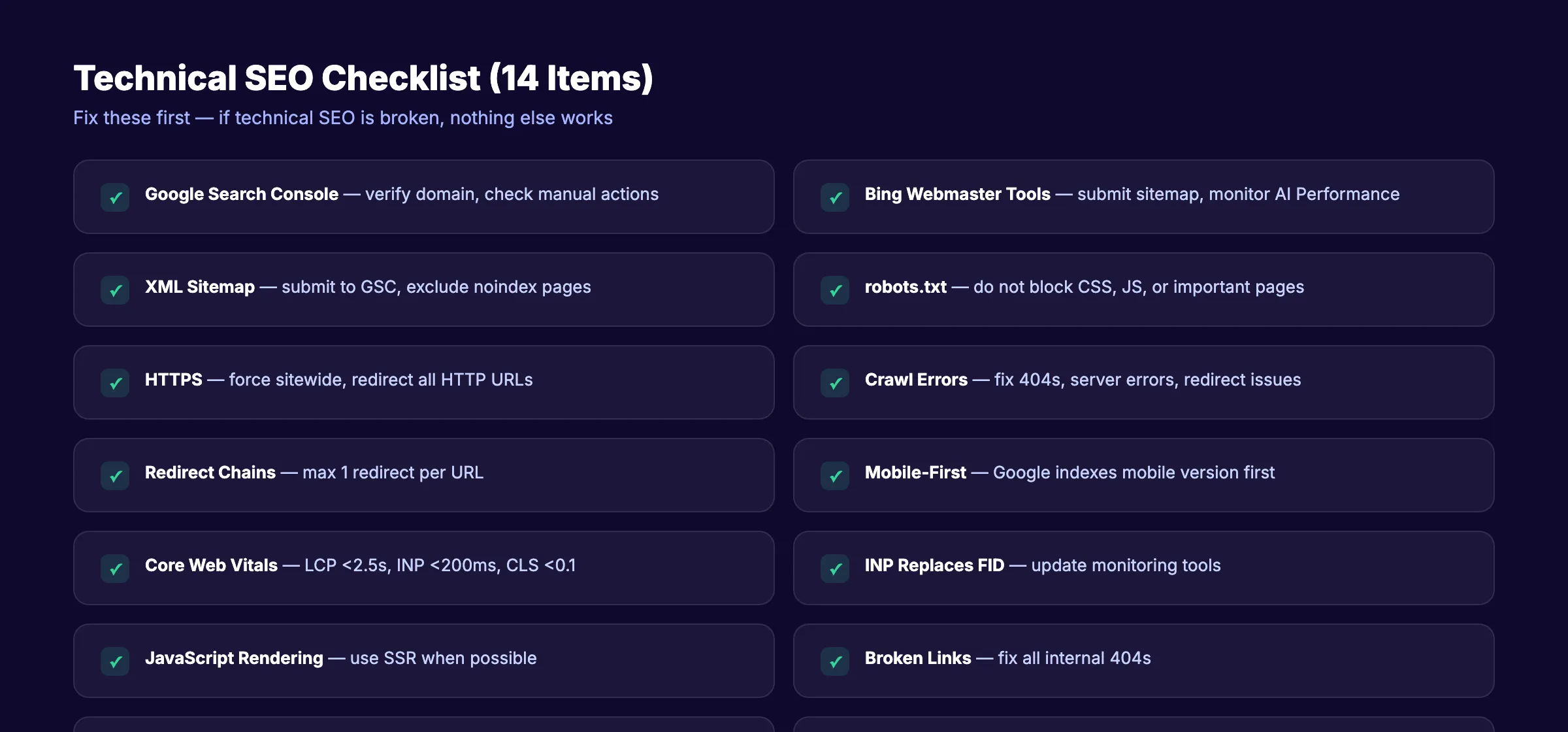
These items ensure Google can crawl, render, and index your site correctly.
- Set up Google Search Console. Verify your domain. Check for manual actions. Review the Coverage report.
- Set up Bing Webmaster Tools. Submit your sitemap. Monitor AI Performance metrics (new in 2026).
- Install Google Analytics 4. Configure events for conversions (form submissions, calls, purchases).
- Submit an XML sitemap. Include all indexable pages. Exclude noindex pages, parameters, and pagination pages.
- Review your
robots.txtfile. Ensure it does not block CSS, JS, or important page sections. Test in GSC. - Force HTTPS sitewide. All pages must load on HTTPS. Redirect HTTP to HTTPS. Verify your SSL certificate is valid.
- Fix crawl errors. Check GSC for 404s, server errors, and redirect issues. Fix or redirect broken URLs.
- Eliminate redirect chains. No URL should require more than 1 redirect. Each redirect loses PageRank.
- Ensure mobile-first readiness. Google indexes the mobile version of your site. Test with Google’s Mobile-Friendly Test.
- Optimize Core Web Vitals. Target: LCP under 2.5 seconds, INP under 200 milliseconds, CLS under 0.1.
- Replace FID tracking with INP. INP (Interaction to Next Paint) replaced FID in March 2024. Update your monitoring.
- Minimize JavaScript rendering dependencies. Google renders JS but delays can affect indexation. Use server-side rendering when possible.
- Fix broken links. Run a site audit to find and fix all internal 404s.
- Set canonical tags correctly. Every indexable page needs a self-referencing canonical. Duplicate content needs canonicals pointing to the primary URL.
2. On-Page SEO Checklist
Every page on your site should pass these checks. Use our on-page SEO guide for detailed instructions on each item.
- Write a unique title tag under 60 characters. Include the primary keyword in the first half.
- Write a meta description between 145-155 characters. Include the keyword, a benefit, and a freshness signal.
- Use exactly 1 H1 tag. It should match the page topic and include the primary keyword.
- Structure headings hierarchically. H1 → H2 → H3. Do not skip levels.
- Include the primary keyword in the first 100 words.
- Use short, descriptive URLs.
/blog/seo-checklist-2026beats/blog/the-ultimate-complete-seo-checklist-for-beginners-2026. - Optimize images. Use descriptive file names, alt text with keywords, and WebP/AVIF formats. Enable lazy loading for below-the-fold images.
- Add internal links. 3-5 per 1,000 words. Use descriptive anchor text. Link to related content.
- Add 2-3 external links to authoritative sources. Link to the specific page with the stat or claim, not homepages.
- Use lists, tables, and structured formatting. Google pulls these formats into Featured Snippets.
- Optimize for search intent. Match the content format to what top-ranking pages deliver for that query.
Your SEO team. $99 per month. 30 optimized articles, published automatically. Every one passes this checklist. Start for $1 →
3. Content Quality and E-E-A-T Checklist
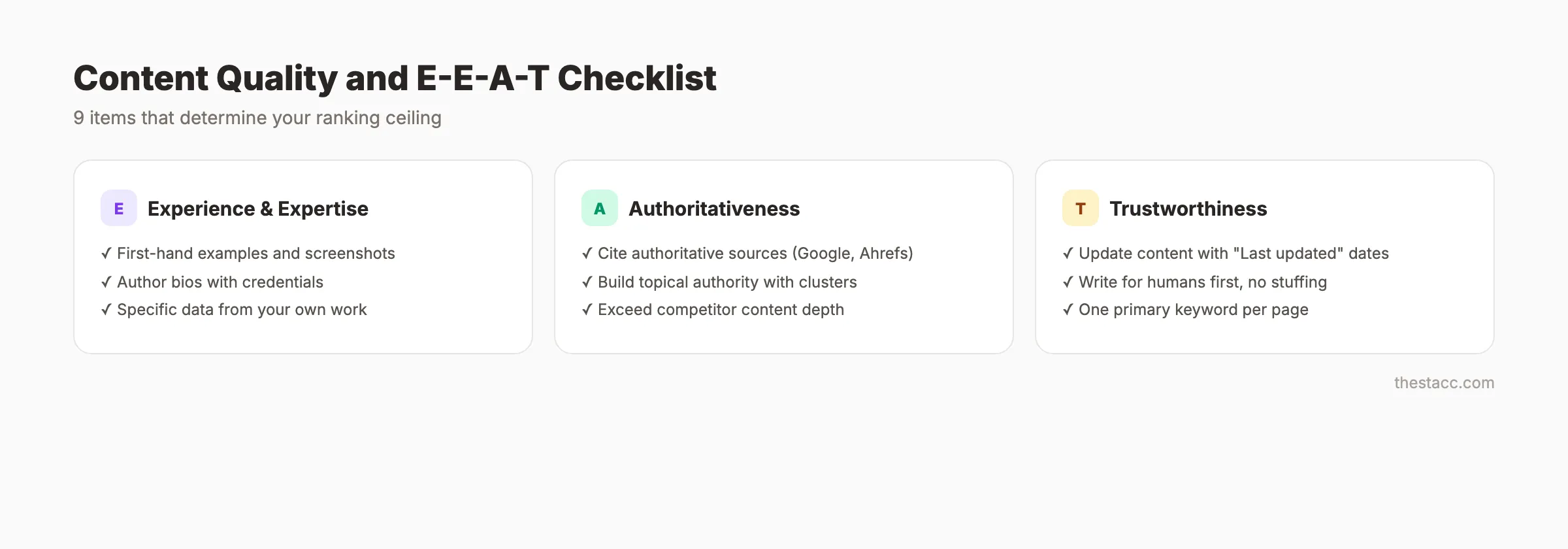
Google evaluates content on Experience, Expertise, Authoritativeness, and Trustworthiness. These signals determine whether your content ranks above competitors with similar keyword targeting.
- Match search intent precisely. Check what format dominates page 1 for your keyword (guide, list, comparison, how-to). Match it.
- Demonstrate first-hand experience. Include specific examples, screenshots, data from your own work, or case studies.
- Show author expertise. Add author bios with credentials. Link to author profiles on LinkedIn or other platforms.
- Cite authoritative sources. Back claims with data from Google, Ahrefs, Semrush, or industry studies.
- Update content regularly. Add a “Last updated” date. Refresh outdated statistics and examples.
- Write for humans first. Clear language, short sentences, active voice. No keyword stuffing.
- Target one primary keyword per page. Avoid keyword cannibalization where multiple pages compete for the same term.
- Build topical authority. Organize content into topic clusters with pillar pages and supporting articles.
- Exceed competitor content depth. Your page should cover everything the top 3 results cover, plus at least 1 angle they miss.
4. Local SEO Checklist
No major SEO checklist includes a local section. This is a mistake. 46% of all Google searches have local intent. If your business serves a geographic area, these items are non-negotiable.
- Claim and optimize your Google Business Profile. Complete every field: name, address, phone, hours, categories, description, photos, services.
- Ensure NAP consistency. Your business name, address, and phone number must match exactly across your website, GBP, Bing Places, and all directories.
- Build local citations. List your business on Yelp, Bing Places, Apple Maps, Facebook, and industry directories.
- Generate and respond to Google reviews. Aim for consistent review velocity. Respond to every review within 48 hours.
- Create location pages for each service area. Each page needs unique content, not just a city name swap.
- Add LocalBusiness schema to your website. Include name, address, phone, hours, geo coordinates, and service area.
- Post to GBP weekly. Share updates, offers, and news. Active profiles rank higher in the Local Pack.
- Optimize for “near me” queries. Include city and neighborhood names in page titles, H2s, and body content naturally.
Rank everywhere. Do nothing. Blog SEO, Local SEO, and Social on autopilot. Stacc starts at $49/mo. Start for $1 →
5. AI Search and GEO Optimization Checklist
This is the section that separates a 2026 SEO checklist from a 2023 one. AI Overviews appear in 18.57% of commercial queries. AI search traffic grew 527% in 2025. If you are not optimizing for AI search, you are losing a fast-growing channel.
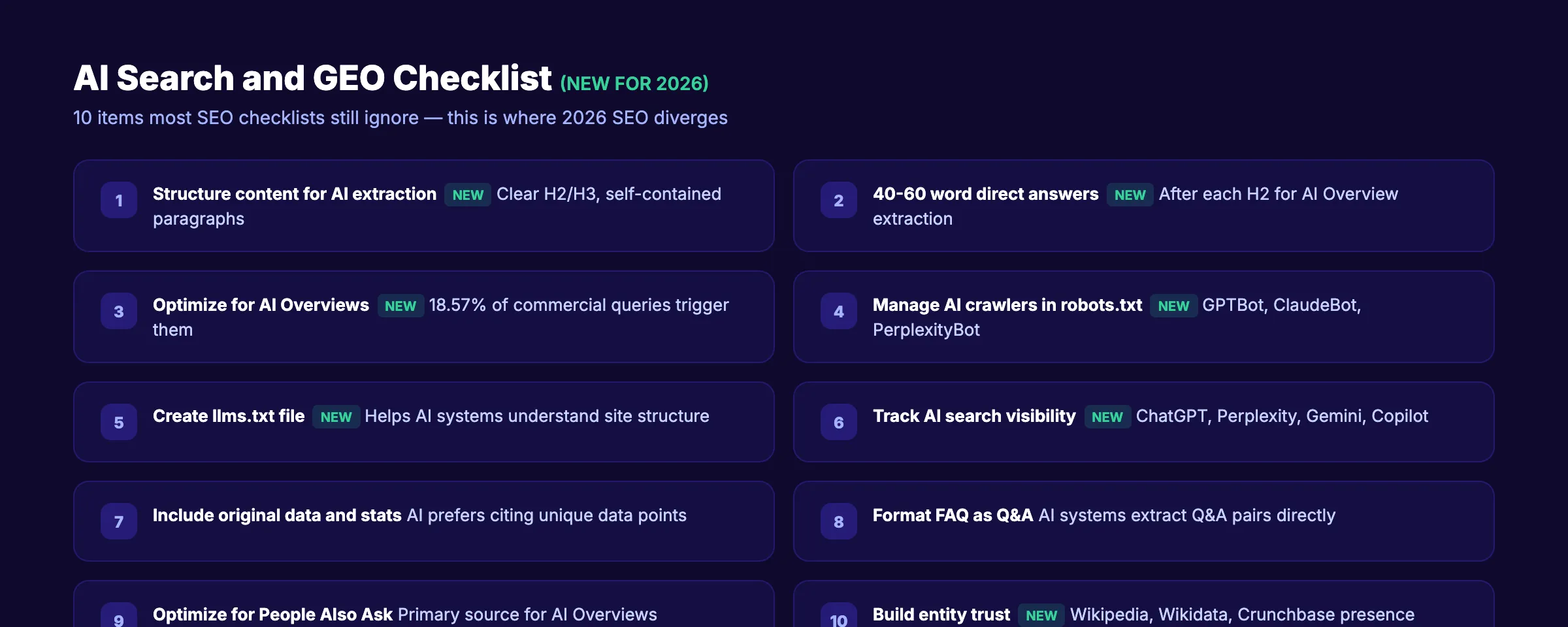
- Structure content for AI extraction. Use clear H2/H3 hierarchy. Write self-contained paragraphs that answer one question each.
- Write 40-60 word direct answers after each H2. AI Overviews pull concise answers. Give them something to extract.
- Optimize for AI Overviews. Pages in the top 3 organic positions are the primary source for AI-generated answers.
- Manage AI crawler access in
robots.txt. Decide which AI crawlers to allow: GPTBot, ClaudeBot, PerplexityBot, Google-Extended, OAI-SearchBot. - Create an
llms.txtfile. This emerging standard helps AI systems understand your site structure. See our llms.txt guide. - Track AI search visibility. Monitor how your brand appears in ChatGPT, Perplexity, Gemini, and Copilot responses.
- Include original data, stats, and expert quotes. AI systems prefer citing content with unique data points and named experts.
- Format FAQ sections as Q&A. AI systems extract Q&A pairs for direct answers. Use the FAQ heading and bold questions.
- Optimize for People Also Ask. These boxes are a primary source for AI Overviews.
- Build entity trust. Consistent brand information across Wikipedia, Wikidata, Crunchbase, and your website helps AI systems recognize your business as an authority. Read our GEO guide.
6. Link Building and Off-Page SEO Checklist
Backlinks remain a top 3 ranking factor. These items build your off-page authority systematically.
- Audit your current backlink profile. Use Ahrefs or Semrush to identify toxic backlinks and disavow if necessary.
- Analyze competitor backlinks. Find where competitors get links that you do not. Target those same sources.
- Build links through guest posting. Write for relevant industry blogs. Include a contextual link back to your site.
- Pursue digital PR. Create data studies, original research, and expert commentary that journalists cite.
- Reclaim unlinked brand mentions. Search for mentions of your brand that do not link to your site. Request the link.
- Fix broken links on external sites. Find broken links pointing to competitor content. Offer your content as a replacement.
- Submit to resource pages. Find curated lists in your industry that accept submissions.
7. Schema and Structured Data Checklist
Schema markup helps Google understand your content and display rich results. It also helps AI systems parse your pages more accurately.
- Add Article schema to blog posts. Include headline, author, datePublished, dateModified, and image.
- Add FAQ schema to FAQ sections. This enables FAQ rich results in SERPs and feeds AI extraction.
- Add LocalBusiness schema for physical locations. Include address, phone, hours, and geo coordinates.
- Add Organization schema to your homepage. Include name, logo, URL, social profiles, and contact information.
- Add BreadcrumbList schema. Enables breadcrumb rich results and helps Google understand site hierarchy.
- Validate all schema with Google’s Rich Results Test. Fix every error. Aim for zero warnings.
- Add HowTo schema to step-by-step guides. Enables how-to rich results with expandable steps.
8. Monitoring and Maintenance Checklist
SEO is not a one-time project. These items keep your performance on track.
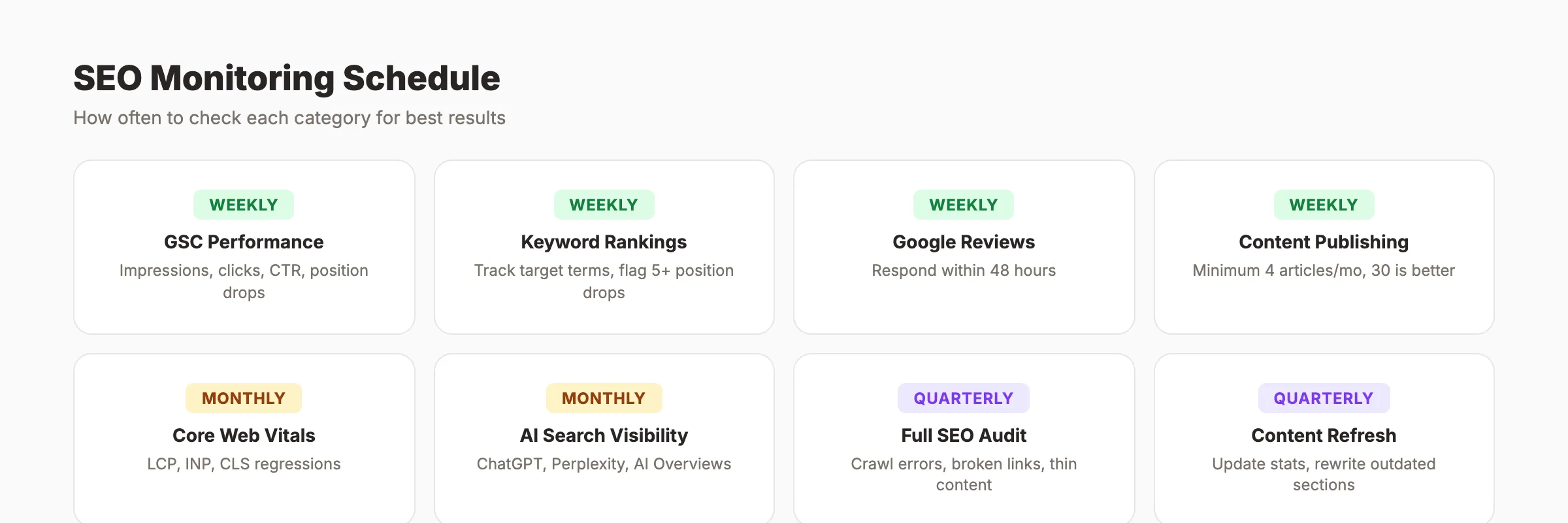
- Check GSC weekly. Monitor impressions, clicks, CTR, and average position. Look for sudden drops.
- Track Core Web Vitals monthly. Use PageSpeed Insights or the CrWV report in GSC. Address any regressions.
- Run a full SEO audit quarterly. Check for new crawl errors, broken links, orphaned pages, and thin content.
- Refresh outdated content quarterly. Update stats, rewrite outdated sections, and re-optimize for current search intent.
- Monitor keyword rankings for target terms. Track weekly. Investigate any drop greater than 5 positions.
- Review and respond to new Google reviews weekly. Consistent review activity signals an active business to Google.
- Publish new content consistently. Content velocity matters. Aim for at least 4 articles per month. 30 is better.
- Monitor AI search visibility monthly. Check if your brand appears in ChatGPT, Perplexity, and Google AI Overview responses for key queries.
3,500+ blogs published. 92% average SEO score. See what Stacc can do for your site. We handle every item on this checklist. Start for $1 →
Quick Reference: SEO Checklist Priority Matrix
Not sure where to start? Here is the priority order for maximum impact.
| Priority | Category | Impact | Effort |
|---|---|---|---|
| 1 | Technical SEO | High (if broken, nothing else works) | Medium |
| 2 | On-Page SEO | High (directly affects rankings) | Low |
| 3 | Content Quality / E-E-A-T | High (determines ranking ceiling) | High |
| 4 | Local SEO | High for local businesses | Medium |
| 5 | AI Search / GEO | Growing (527% traffic growth) | Medium |
| 6 | Schema / Structured Data | Medium (enables rich results) | Low |
| 7 | Link Building | High (top 3 ranking factor) | High |
| 8 | Monitoring / Maintenance | Medium (prevents decay) | Low |
Fix technical issues first. They block everything else. Then optimize on-page elements for your highest-value pages. Build content quality and local presence in parallel. Add AI search optimization and link building as ongoing activities.
FAQ
What is an SEO checklist?
An SEO checklist is a structured list of items to audit and optimize on your website. It covers technical setup, on-page elements, content quality, link building, and monitoring. Following a checklist ensures you do not miss critical items that affect your search rankings.
How many items should an SEO checklist have?
A useful SEO checklist has 40-80 items organized by category. Fewer than 40 misses important areas. More than 100 becomes impractical to follow. The key is actionable items, not volume.
How often should I run an SEO checklist?
Run a full checklist when launching a new site or major redesign. After that, check technical items monthly, content items quarterly, and run a full SEO audit every 3-6 months.
What is the most important SEO task in 2026?
Content quality and E-E-A-T signals have the highest impact on rankings. But if your technical SEO is broken, quality content cannot rank. Fix technical first, then focus on content depth and authority.
Do I need to optimize for AI search in 2026?
Yes. AI Overviews appear in 18.57% of commercial queries. AI search traffic grew 527% in 2025. Ignoring this channel means losing visibility to competitors who optimize for it. Start with structured content formatting and AI crawler access management.
How long does SEO take to show results?
Technical fixes show results in days to weeks. On-page optimization takes 4-8 weeks to reflect in rankings. Content and link building take 3-6 months for meaningful ranking improvements. Consistent publishing accelerates the timeline.
SEO in 2026 requires more items than it did 3 years ago. AI search, INP, GEO optimization, and AI crawler management are new requirements that most checklists still ignore. Work through these 50+ items in priority order. Fix technical issues first. Optimize your highest-traffic pages second. Then build content velocity and link authority over time. The businesses that treat SEO as an ongoing system, not a one-time project, are the ones that compound their rankings month after month.
Related Tools & Resources
Free SEO Tools:
Best Lists:

Written by
Siddharth GangalSiddharth is the founder of theStacc and Arka360, and a graduate of IIT Mandi. He spent years watching great businesses lose organic traffic to competitors who simply published more. So he built a system to fix that. He writes about SEO, content at scale, and the tactics that actually move rankings.
30 SEO blog articles published every month
Keyword-optimized, scheduled, and live on your site. Automatically.
30-day trial · Cancel anytime
theStacc
Stop writing SEO content manually
30 blog articles, 30 GBP posts, and social media content. Published every month. Automatically.
Try for free$1 for 3 days · Cancel anytime