
Resource Page Link Building (2026): Guide
resource page link building guide for 2026: strategies, tactics, real examples, and implementation steps to get results faster.
95% of web pages have zero backlinks. The ones that rank on page 1 have 3.8x more backlinks than positions 2 through 10. Resource page link building is one of the most reliable ways to close that gap because the page owner already wants to link out.
Most link building strategies require you to convince someone to add a link where none existed. Resource pages are different. The entire purpose of a resource page is to curate and list helpful links. Your job is to get on the list.
We have published 3,500+ blog posts across 70+ industries and built backlink profiles for sites in every niche. This guide covers the complete resource page link building process based on what actually works in 2026.
Here is what you will learn:
- What resource pages are and why they produce high-quality backlinks
- How to find resource pages in any niche using search operators
- The outreach email frameworks that achieve 10-20% response rates
- How to combine broken link building with resource page outreach
- Realistic success rate benchmarks backed by real campaign data
- How to scale from 10 pitches per week to 100 without losing quality
What Is Resource Page Link Building?
A resource page is a web page that curates and links to helpful content on a specific topic. Libraries, universities, industry blogs, and government sites all maintain resource pages.
Examples of resource pages you will find in the wild:
| Resource Page Type | Example | Typical DA |
|---|---|---|
| University department lists | ”Marketing Resources for Students” on a .edu site | 60-90 |
| Industry blog roundups | ”Best SEO Blogs and Tools” on a marketing site | 30-60 |
| Government agency guides | ”Small Business Resources” on a .gov site | 70-90 |
| Nonprofit reference lists | ”Mental Health Resources” on a .org site | 40-70 |
| Niche community pages | ”Photography Resources for Beginners” | 20-50 |
Resource page link building works because you are not asking someone to do something unnatural. The page exists to link to good resources. If your content fits, the page owner benefits from adding it.
According to an Aira survey, 24% of link building professionals currently use resource page tactics. The conversion rate for quality, relevant pitches ranges from 5% to 25% depending on your niche, content quality, and outreach approach.
72% of resource page backlinks come from DA 50+ domains. The average link lifespan from resource pages exceeds 5 years. These are not low-quality directory links. They are editorial, contextual, and durable.
How to Find Resource Pages in Any Niche
Finding the right resource pages is 80% of the work. The wrong targets waste your time. The right targets convert at 15-20%.
Google Search Operators
Google search operators are the fastest free method for prospecting. Use these queries with your target keyword:
[keyword] + intitle:resources
[keyword] + inurl:resources
[keyword] + "useful resources"
[keyword] + "helpful links"
[keyword] + "recommended websites"
[keyword] + "further reading"
[keyword] + "favorite tools"
[keyword] + "suggest a resource"
For higher-authority targets, restrict to specific domains:
site:.edu [keyword] + "resources"
site:.gov [keyword] + "resources"
site:.org [keyword] + "resources"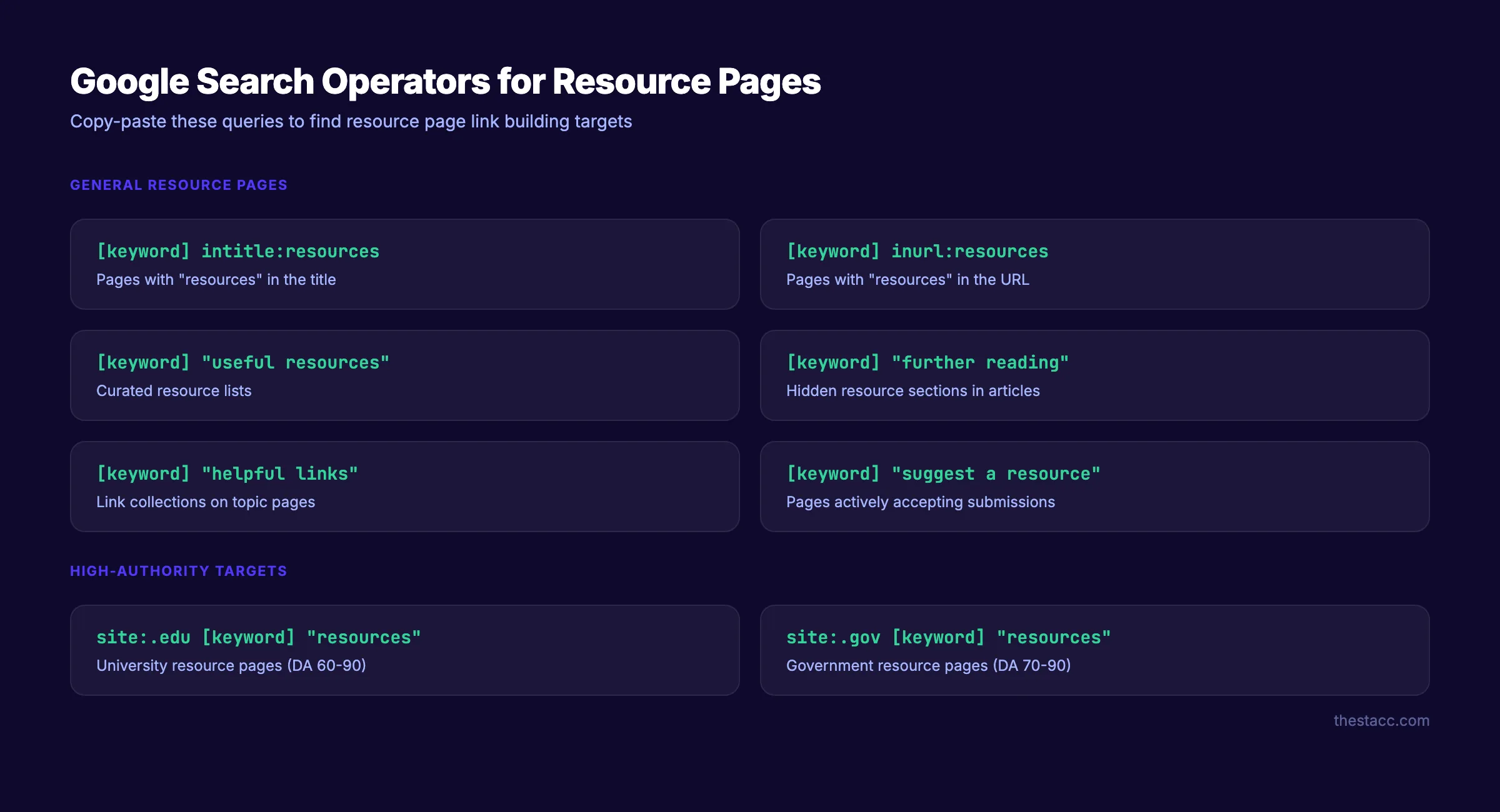
Pro tip: Do not stop at dedicated resource pages. Many blogs have “further reading” sections at the bottom of articles. These are hidden resource pages that most link builders overlook.
Reverse Engineer Competitor Backlinks
Your competitors have already done the prospecting for you. Use Ahrefs or Semrush to find resource pages linking to competing content.
- Enter a competitor URL in Ahrefs Site Explorer
- Go to Backlinks > filter by “resources” in referring page URL
- Export the list and sort by domain authority
- Each result is a resource page that already links to content in your niche
If a resource page links to your competitor, it will likely link to you too. Especially if your content is better.
For a deeper dive into analyzing competitor link profiles, see our SEO competitor analysis guide.
Qualify Your Prospects
Not every resource page is worth pitching. Filter your list using these criteria:
| Criterion | Keep | Skip |
|---|---|---|
| Domain Authority | DA 20+ | DA under 20 |
| Outbound links | Links to external sites, not just their own | Only links to their own content |
| Last updated | Updated within last 2 years | Stale, abandoned page |
| Relevance | Topically aligned with your content | Generic or unrelated niche |
| Link type | Dofollow links | All nofollow |
| Page quality | Clean design, real traffic | Obvious link farm or spam |
Spend 30 seconds on each prospect. If the page looks like a legitimate curation effort, keep it. If it looks like it exists solely for link exchanges, skip it.
Stop writing. Start ranking. Stacc publishes 30 SEO articles per month for $99. Every post optimized for backlinks and organic traffic. Start for $1 →
How to Create Content That Resource Pages Want to Link
You cannot pitch what does not exist. Before any outreach, you need a linkable asset worth curating.
The Best Content Types for Resource Page Links
| Content Type | Why Resource Pages Link to It | Effort Level |
|---|---|---|
| Original research and data studies | Hard to replicate, unique data | High |
| Complete guides (3,000+ words) | Single reference for a topic | Medium |
| Free tools and calculators | Practical utility for visitors | High |
| Templates and checklists | Downloadable, immediately useful | Low |
| Infographics with original data | Visual, easy to reference | Medium |
| Case studies with real numbers | Credible proof of results | Medium |
Content over 3,000 words earns 3.5x more backlinks than shorter content. If you are building a guide specifically for resource page outreach, go long and make it the most useful reference on that topic.
The key question to ask before outreaching: “Would a curator feel good about recommending this to their audience?” If the answer is not an obvious yes, improve the content first.
Match Your Content to the Resource Page
Generic pitches fail. Study each resource page before pitching.
- Read every link on the resource page. Understand the quality standard.
- Identify the gap. What topic or angle is missing from their list?
- Position your content as the piece that fills that gap.
This takes more time per pitch. But it is the difference between a 3% success rate and a 15% success rate.
For tips on creating link-worthy content, see our SEO content writing guide.
Resource Page Outreach: Email Templates That Work
Outreach is where most people fail. The average outreach response rate is 8.5% across 12 million emails studied by Backlinko. But personalized, relevant pitches to resource pages perform 2-3x better.
Template 1: The Direct Value-Add
Subject: Suggestion for your [topic] resources page

Hi [Name],

I was looking for [topic] resources and found your page:
[URL of their resource page]

Great list. I noticed you link to [specific resource they list]
and [another one]. Both solid picks.

I published a [guide/tool/study] that covers [specific angle
they are missing]:
[Your URL]

It covers [1-2 specific differentiators]. Could be a useful
addition for your visitors.

Either way, solid page. Thanks for putting it together.

[Your name]
Template 2: The Broken Link Combo
This approach combines broken link building with resource page outreach. Find a broken link on the resource page, then suggest your content as a replacement.
Subject: Broken link on your [topic] resources page

Hi [Name],

I was reading your [topic] resource page at [URL] and
noticed the link to [broken resource name] returns a 404.

I have a similar resource that covers the same topic:
[Your URL]

It includes [specific detail that makes it a good replacement].
Might work as a swap. Either way, wanted to flag the broken link.

Best,
[Your name]
Use the “Check My Links” Chrome extension to scan resource pages for broken links. Broken links give you a reason to email beyond “please link to me.”
Template 3: The Honest Ask
A Mangools case study tested a humorous subject line and achieved a 16.1% response rate from 81 emails.
Subject: Shameless outreach email about your resources page

Hi [Name],

Straight to the point: I wrote [resource title] and think
it fits your [topic] resources page perfectly.

Here is the link: [URL]

Specifically, it would fit well in your [specific section name]
next to [resource they already link to].

If it is not a fit, zero hard feelings. Thanks for your time.

[Your name]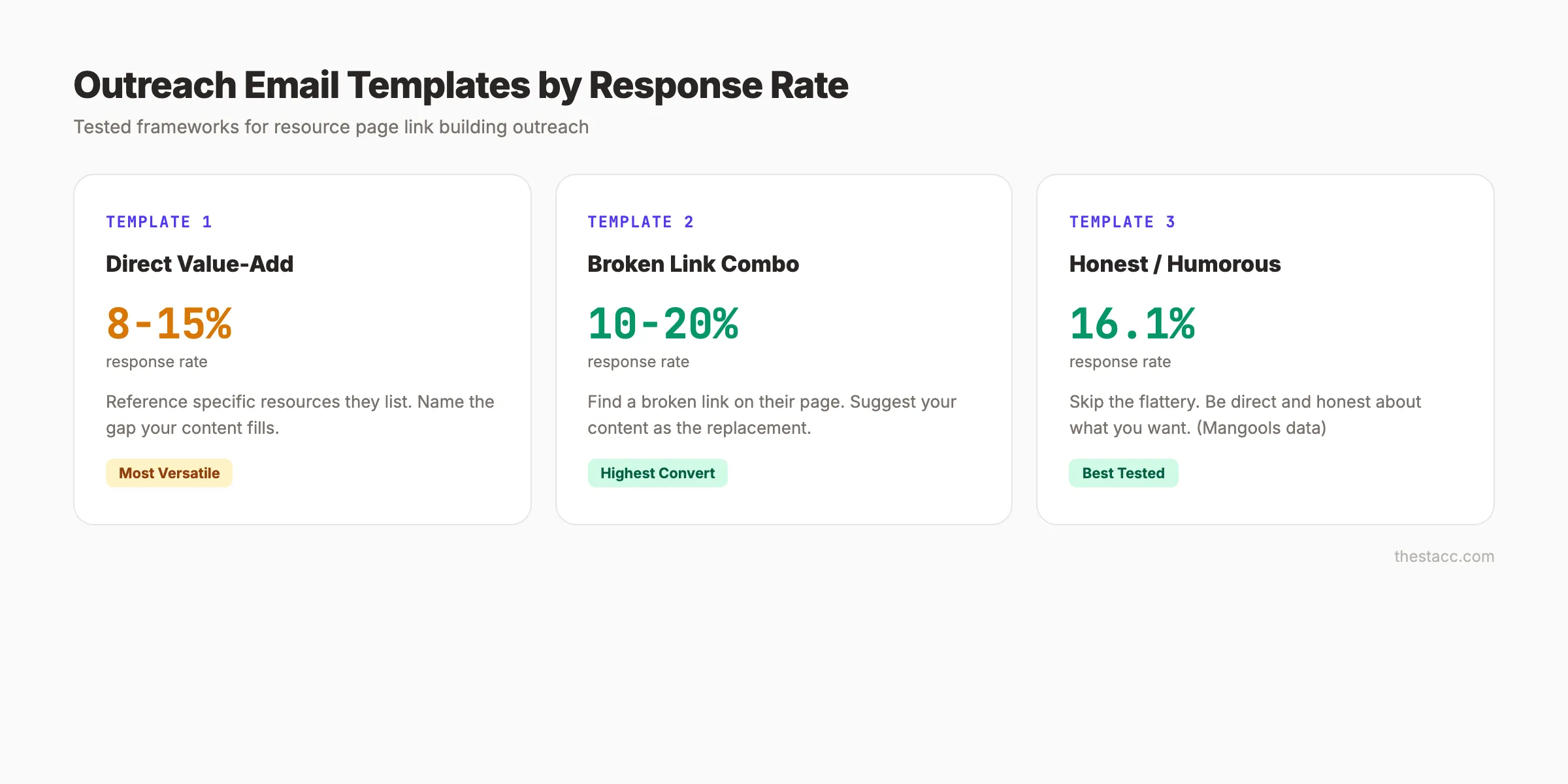
The Follow-Up That Gets Replies
75% of successful deals come from follow-up emails. Adding 1 follow-up lifts your response rate by 65%.
Send your follow-up 6-7 days after the initial email. Keep the same subject line (reply to your original). Keep it short:
Subject: Re: [original subject]

Hi [Name],

Just bumping this in case it got buried. Would love your
thoughts on adding [resource] to your [topic] page.

No pressure either way.

[Your name]
The optimal cadence is 3-5 touches over 10-21 days. After the third follow-up, stop. More than that crosses into spam territory.
For 7 more outreach templates with performance data, see our link building outreach templates.
Success Rate Benchmarks: What to Expect
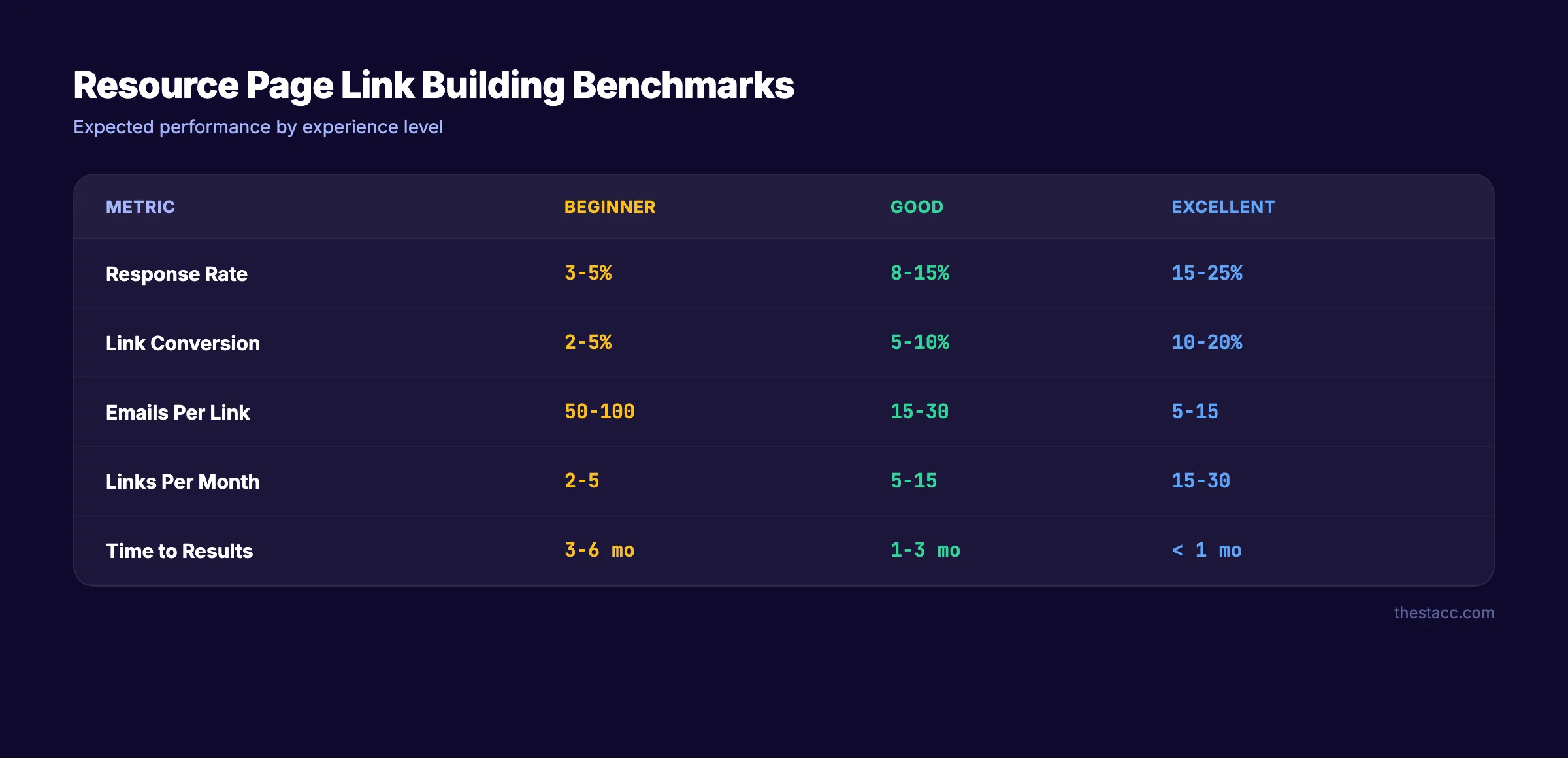
Most guides avoid sharing real numbers. Here are the actual benchmarks from published case studies and industry surveys.
| Metric | Beginner | Good | Excellent |
|---|---|---|---|
| Outreach response rate | 3-5% | 8-15% | 15-25% |
| Link conversion rate | 2-5% | 5-10% | 10-20% |
| Emails needed per link | 50-100 | 15-30 | 5-15 |
| Links built per month | 2-5 | 5-15 | 15-30 |
Real Campaign Data
Backlinko case study: 160 cold emails sent. 17 backlinks secured. 11% success rate. Result: 110% organic traffic increase in 14 days.
Ahrefs case study: 515 emails sent. 17.55% reply rate. 5.71% conversion rate. 32 total backlinks from 32 unique referring domains. 9 of those domains had DR 70+.
Mangools case study: 81 emails sent. 13 responses. 16.1% response rate. List-type outreach (like resource pages) achieved 17% success rate compared to 3.6% for Skyscraper technique.
What Separates the Top Performers
Experienced link builders generate 3.57x more backlinks than beginners. The gap comes from:
- Better targeting. They pitch fewer, higher-quality prospects instead of mass-emailing.
- Better content. Their linkable assets are genuinely the best resource available.
- Better personalization. They reference specific content on the target page, not generic flattery.
- Better follow-ups. They send 2-3 follow-ups instead of giving up after one email.
Your SEO team. $99 per month. 30 optimized articles, published automatically. Content that earns backlinks while you sleep. Start for $1 →
.Edu and .Gov Resource Pages
Links from .edu and .gov domains carry extra weight because these domains have naturally high authority. A single .edu backlink from a relevant department page can move rankings faster than 10 links from DA 30 blogs.
Finding .Edu Resource Pages
University websites maintain resource pages for students, faculty, and the public. Target department-level pages, not the university homepage.
site:.edu [your topic] + "resources"
site:.edu [your topic] + "useful links"
site:.edu [your topic] + "recommended reading"
What .edu sites link to:
- Educational guides and tutorials
- Free tools and calculators
- Research studies and data
- Scholarship information
- Career and professional development resources
Finding .Gov Resource Pages
Local government sites are the most accessible .gov link targets. City, county, and state pages often curate community resources, small business guides, and public safety information.
site:.gov [your topic] + "resources"
site:.gov [your topic] + "helpful links"
Important Caveat
Exclude .edu and .gov pages that only link to other .edu and .gov domains. Many government pages restrict outbound links to other government entities. If the resource page links to commercial sites too, it is a viable target. If it only links within its own domain family, skip it.
These links take longer to earn. Government and academic outreach moves slowly. Budget 4-8 weeks per target instead of the usual 2-3 weeks. But one DA 80+ .edu link is worth dozens of DA 30 links in terms of ranking impact and link equity.
How to Scale Resource Page Link Building
Pitching 5 resource pages per week is manageable for anyone. Scaling to 50-100 per week without sacrificing quality requires systems.
Step 1: Build a Prospecting Spreadsheet
Track every prospect in a spreadsheet with these columns:
- Resource page URL
- Domain authority
- Contact name and email
- Relevance score (1-5)
- Status (not contacted / pitched / follow-up 1 / follow-up 2 / won / lost)
- Date of last contact
- Notes
Batch your prospecting. Spend one full session per week finding 20-30 new prospects. Do not mix prospecting and outreach in the same session.
Step 2: Find Contact Information
Use Hunter.io (100 free searches per month) or Anymail Finder to find email addresses. Look for:
- The page author (check the byline)
- The site’s content manager or editor
- The webmaster (check the contact page)
Avoid generic emails like info@ or support@. Personal emails convert at 2-3x the rate of generic addresses.
Step 3: Batch Your Outreach
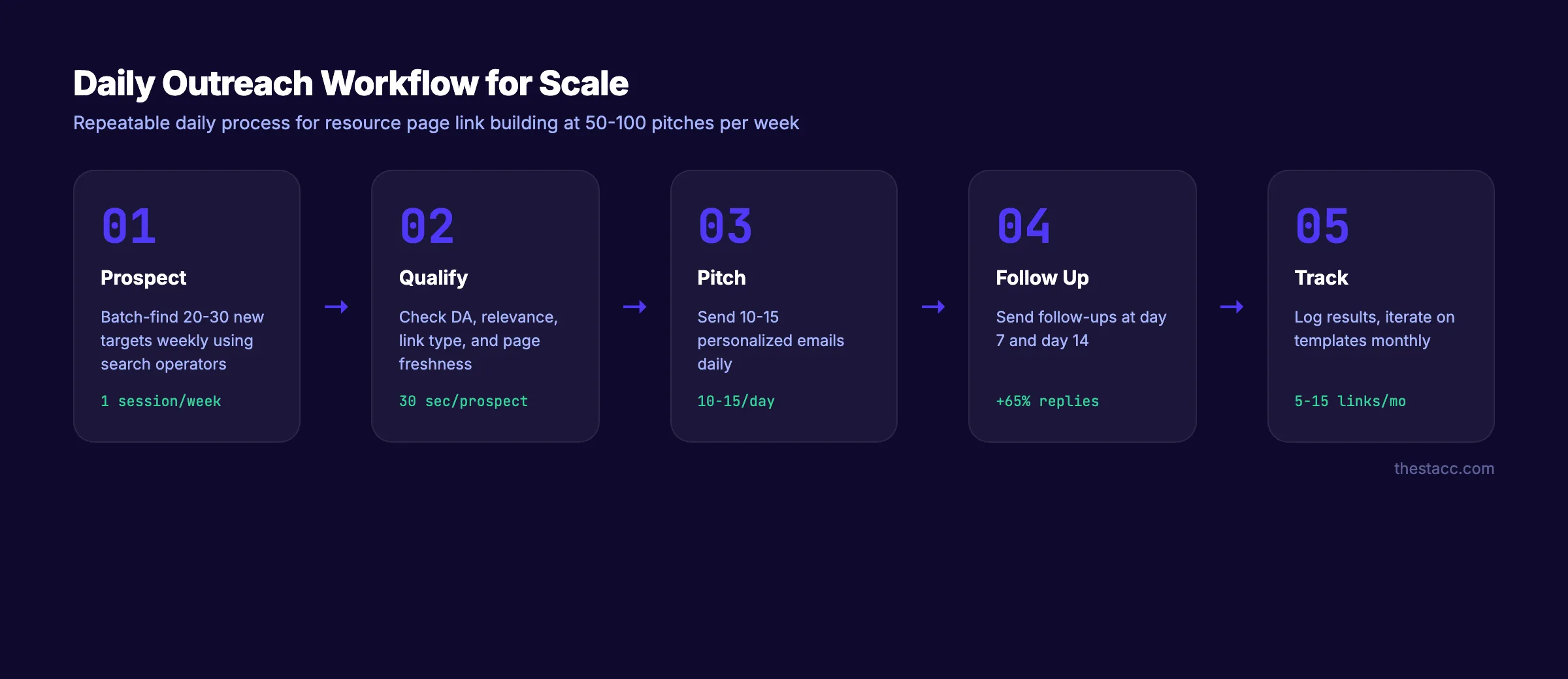
Send outreach in batches of 10-15 emails per day. This keeps you under spam filters and gives you time to personalize each pitch.
Daily outreach workflow:
- Send 10-15 new pitches (personalized, not templates copy-pasted)
- Send follow-ups to pitches from 7 days ago
- Send second follow-ups to pitches from 14 days ago
- Log all responses and update your tracking spreadsheet
- Add social profile links in your email signature (+9.8% higher response rate)
Step 4: Track Results and Iterate
After 30 days, review your data. Which types of resource pages convert best? Which email template gets the highest response rate? Which niches are most receptive?
Double down on what works. Drop what does not.
For a broader approach to building your backlink profile, see our guide on how to build backlinks for your blog.
Common Mistakes That Kill Your Response Rate
Resource page link building has a low barrier to entry. That means every resource page owner gets dozens of pitches per month. These mistakes guarantee yours gets deleted.
1. Mass-Emailing Without Personalization
“I came across your website and think my content would be a great fit” is a template, and everyone recognizes it. Reference the specific resource page. Mention a specific resource they already link to. Name the section where your content fits.
2. Pitching Irrelevant Content
A fitness blog does not belong on a digital marketing resource page. The topical match must be obvious. If you have to stretch to explain why your content fits, it does not fit.
3. Redirecting All Pitches to the Homepage
Link to the specific page that is most relevant and most useful. Your homepage is not a resource. Your in-depth guide on a specific topic is.
4. Giving Up After One Email
65% of responses come from follow-ups. One email and done is the most common reason for a low success rate. Send at least 2 follow-ups before moving on.
5. Ignoring Page Quality
Pitching low-DA spam pages wastes time and can hurt your link profile. Spend 30 seconds vetting each prospect. Check for real content, real traffic, and a clean link profile.
6. Not Having Something Worth Linking To
The most common failure mode. If your content is a 500-word blog post with no original insight, no resource page owner will add it. Invest in creating genuinely useful content before you start outreaching.
For more on building link-worthy content, see our content marketing strategy guide.
3,500+ blogs published. 92% average SEO score. See what Stacc can do for your site. Content that earns links automatically. Start for $1 →
Resource Page Link Building vs. Other Strategies
How does resource page link building compare to other off-page SEO tactics?
| Strategy | Avg. Cost Per Link | Success Rate | Link Quality | Scalability |
|---|---|---|---|---|
| Resource page outreach | $0 (time only) | 5-20% | High (DA 50+) | Medium |
| Guest posting | $609 avg | 10-30% | Medium-High | Medium |
| Broken link building | $0 (time only) | 3-10% | High | Low |
| Digital PR | $500-2,000+ | Varies | Very High | High |
| Link insertions (paid) | $141 avg | 80%+ (paid) | Varies | High |
| HARO / journalist outreach | $0 (time only) | 5-15% | Very High | Low |
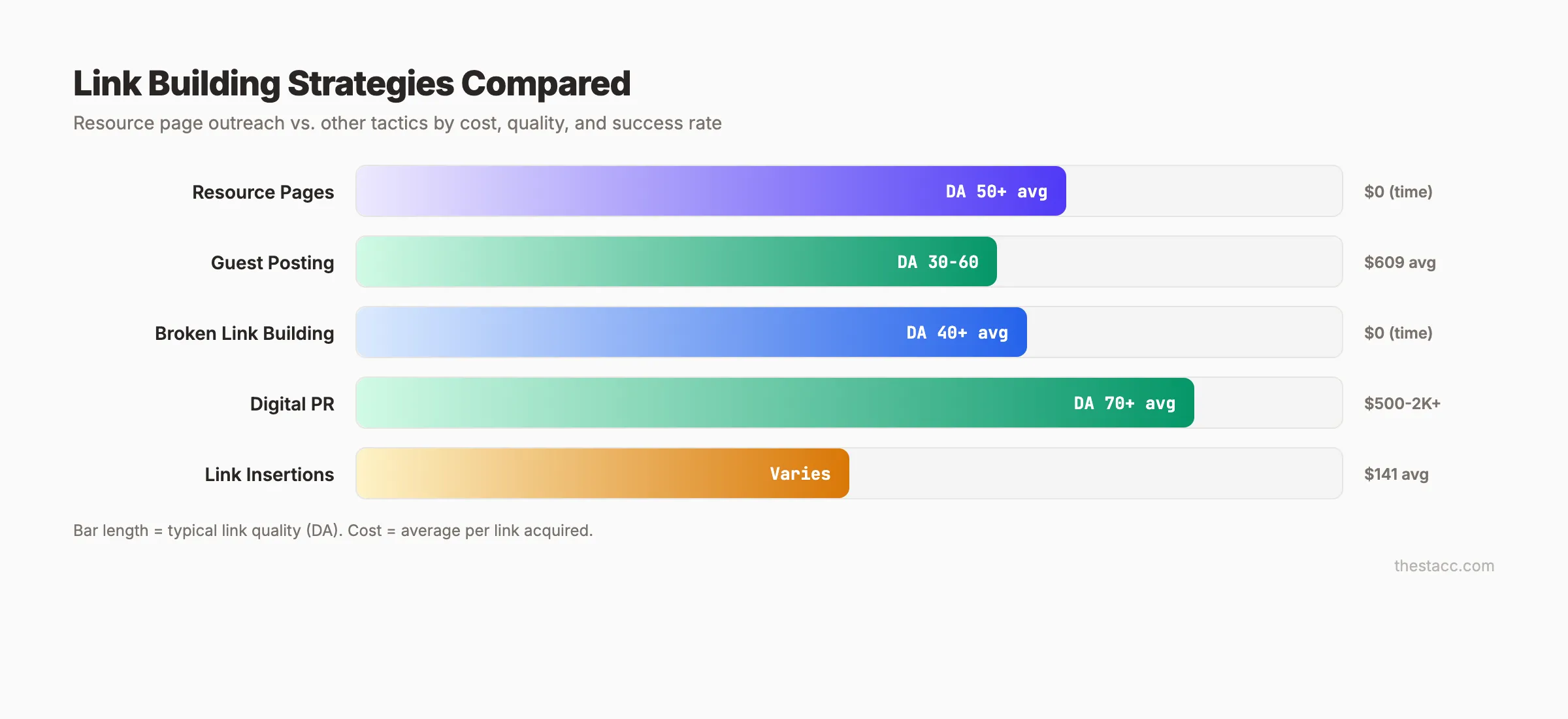
Resource page link building stands out for one reason: high quality at zero cost. You do not pay for the link. You do not write a guest post. You pitch existing content to a page that already wants to link out.
The tradeoff is scale. You cannot build 100 resource page links per month. But 5-15 high-quality links from DA 50+ resource pages per month moves rankings more than 50 low-quality directory submissions.
78.1% of SEO professionals report positive ROI from link building. The average time to see ranking improvements from new backlinks is 3.1 months. Resource page links, because they tend to come from higher-authority domains, often show results on the faster end of that range.
For a complete overview of your backlink profile health, see our backlink audit guide.
Create Your Own Resource Page as a Link Magnet
Most guides only cover pitching other people’s resource pages. But building your own resource page is one of the most underused link building tactics.
A well-curated resource page on your own site attracts backlinks naturally. Other sites link to it because it saves them the work of compiling the list themselves.
How to Build a Link-Worthy Resource Page
- Pick a specific topic in your niche (not “SEO resources” but “Technical SEO Audit Tools and Guides”)
- Curate 30-50 of the best resources on that topic
- Organize by category with brief descriptions of each resource
- Include a mix of free tools, guides, communities, and courses
- Add your own relevant content alongside external resources (not exclusively your own)
- Update quarterly to keep the page fresh and accurate
Why This Works
When you email resource page owners, you can mention your own resource page as additional value. “I also maintain a [topic] resource page at [URL]. Happy to add your site to it.” This turns a one-directional ask into a mutually beneficial exchange.
The best resource pages earn links passively for years. They become the default bookmark for people researching that topic.
FAQ
Is resource page link building still effective in 2026?
Yes. 24% of link building professionals actively use resource page tactics. The conversion rate for relevant, personalized pitches ranges from 5% to 20%. 72% of resource page backlinks come from DA 50+ domains, and the average link lifespan exceeds 5 years. The tactic works best when combined with high-quality content and genuine personalization.
How many emails do I need to send to get one link?
Expect to send 15-30 personalized emails per link at a good performance level. Beginners typically need 50-100 emails per link. The gap narrows with better targeting, better content, and consistent follow-ups. Adding just 1 follow-up email lifts response rates by 65%.
What is a good response rate for resource page outreach?
The average outreach response rate across all link building is 8.5%. For resource page pitches specifically, 10-15% is good and 15-25% is excellent. The Mangools case study achieved 16.1% with a humorous, honest approach. Personalization and relevance are the biggest factors.
Should I use resource page link building or guest posting?
Both work. Resource page link building costs nothing beyond your time and requires no content creation for the target site. Guest posting requires writing original content but offers more control over anchor text and placement. The best approach combines both strategies. Use resource page outreach for quick wins and guest posting for high-value targets.
How long does it take to see SEO results from resource page links?
The average time to see ranking improvements from new backlinks is 3.1 months. 46.6% of SEO professionals see results in 1-3 months. Links from higher-authority resource pages (DA 50+) tend to show impact faster than links from lower-authority sites.
Are nofollow links from resource pages worth pursuing?
Nofollow links do not pass direct link equity the way dofollow links do. However, Google treats nofollow as a hint, not a directive, since 2019. A nofollow link from a DA 80 .edu resource page still sends referral traffic and brand signals. Prioritize dofollow links, but do not ignore high-authority nofollow opportunities.
Resource page link building works because it aligns your goals with the page owner’s goals. They want to curate the best resources. You want a backlink from a high-authority page. When your content genuinely deserves a spot on the list, the pitch writes itself. Start with 10 prospects per week, send follow-ups, and track everything. The links compound over time, just like the content they point to.

Written by
Siddharth GangalSiddharth is the founder of theStacc and Arka360, and a graduate of IIT Mandi. He spent years watching great businesses lose organic traffic to competitors who simply published more. So he built a system to fix that. He writes about SEO, content at scale, and the tactics that actually move rankings.
30 SEO blog articles published every month
Keyword-optimized, scheduled, and live on your site. Automatically.
30-day trial · Cancel anytime
theStacc
Stop writing SEO content manually
30 blog articles, 30 GBP posts, and social media content. Published every month. Automatically.
Start Your $1 Trial$1 for 3 days · Cancel anytime