
SEO for Podcasts: The Complete Guide (2026)
Learn how to optimize your podcast for Google, YouTube, Spotify, and AI search. Covers keywords, transcripts, show notes, schema markup, and more. Updated 2026.
Siddharth Gangal • 2026-03-30 • Content Strategy
In This Article
Most podcasts never get found through search. Over 4 million podcasts exist, but only about 342,000 published an episode in the last 30 days. The rest are invisible. Search engines cannot listen to audio files and rank them the way they rank text. That means a 60-minute episode packed with expert insights earns zero organic traffic unless you optimize it.
Podcast SEO is the process of making your podcast discoverable in Google, YouTube, Spotify, Apple Podcasts, and AI search tools. It turns every episode into a searchable asset that drives listeners, backlinks, and authority for months after you hit publish.
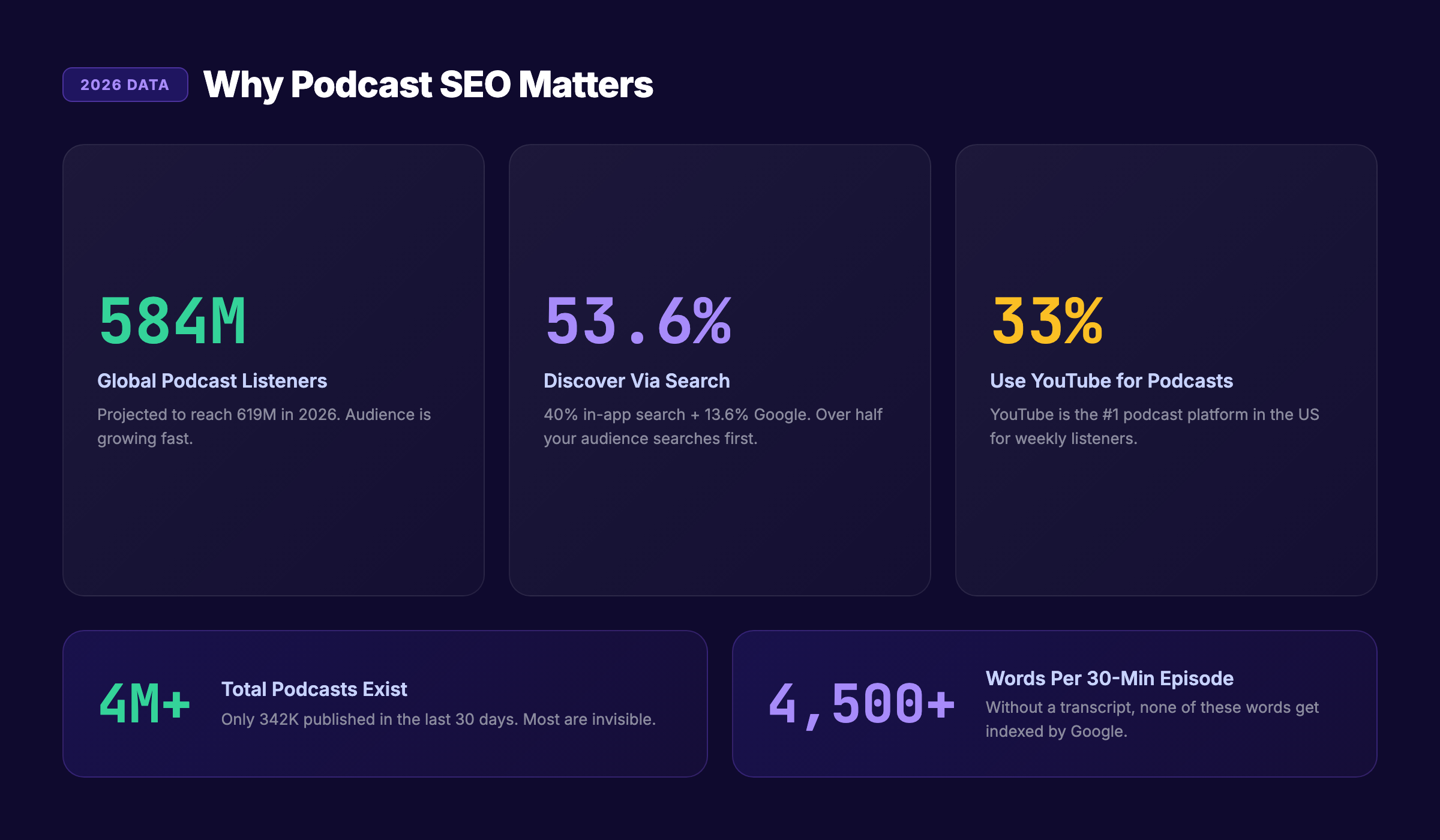
Here is the problem: 53.6% of podcast listeners discover new shows through search. That includes 40% searching inside podcast apps and 13.6% using Google directly. If your episodes are not optimized, you are missing more than half your potential audience.
We have published 3,500+ SEO-optimized articles across 70+ industries. This guide applies those same principles to podcast content. By the end, you will have a repeatable system for ranking your podcast in traditional search, platform algorithms, and AI-generated answers.
In this guide, you will learn:
- Why podcast SEO matters more in 2026 than ever before
- How to do keyword research specifically for podcast episodes
- The right way to write titles, descriptions, and show notes
- How transcripts turn audio into thousands of indexable words
- How to build a podcast website that ranks on Google
- Schema markup that gets your episodes into rich results
- YouTube podcast SEO for the fastest-growing discovery channel
- How to optimize for AI search engines like ChatGPT and Perplexity
Why Podcast SEO Matters in 2026
The podcast industry reached 584 million global listeners in 2025. That number is projected to hit 619 million in 2026. Yet most podcasters still treat SEO as an afterthought. They upload audio, write a two-line description, and hope the algorithm does the rest.
That approach worked in 2019. It does not work now.
Three shifts make podcast SEO essential in 2026:
1. YouTube became the top podcast platform.
33% of weekly US podcast listeners use YouTube as their primary platform. YouTube is a search engine. Every episode title, description, thumbnail, and transcript feeds directly into search results. Podcasters who ignore YouTube SEO leave the largest discovery channel on the table.
2. Google indexes audio and video with multimodal AI.
Google confirmed that its large language models now evaluate audio and video content directly. This means Google can understand what you say in an episode. Written metadata alone is no longer the only signal. Transcripts remain critical, but the spoken content itself now factors into relevance signals.
3. AI search tools cite podcast content.
ChatGPT, Perplexity, and Google AI Overviews pull from podcast transcripts, show notes, and episode pages when generating answers. If your podcast content is not structured for AI search visibility, these tools will cite your competitors instead.
The compounding effect is real. A single well-optimized episode page can rank for dozens of long-tail keywords, attract backlinks, and feed AI citations for years. An unoptimized episode disappears within 48 hours of publishing.
How to Do Keyword Research for Podcast Episodes
Keyword research for podcasts works differently than keyword research for blog posts. You are optimizing for two systems at once: traditional search engines and in-app podcast search.
Start with your episode topic. Then find the exact phrases your audience types when searching for that topic.
Use Podcast-Specific Search Tools
Open Spotify, Apple Podcasts, and YouTube. Type your topic into each search bar. Note the autocomplete suggestions. These are real queries from real listeners.
For example, if your podcast covers marketing, type “marketing” into Spotify search. You might see:
- “marketing strategies for small business”
- “marketing psychology”
- “marketing automation tips”
Each suggestion is a validated keyword with existing search demand.
Validate With Traditional SEO Tools
Cross-reference your podcast keywords with tools like Google Keyword Planner, Ahrefs, or Semrush. Look for:
| Metric | Target Range |
|---|---|
| Monthly search volume | 100-10,000 |
| Keyword difficulty | Under 40 (for newer podcasts) |
| Search intent | Informational or commercial |
| SERP features | Video carousels, podcast carousels |
The ideal podcast keywords have moderate search volume and low competition. Long-tail phrases like “how to start a podcast for your business” convert better than broad terms like “podcasting.”
Map Keywords to Episodes
Create a keyword map that assigns 1 primary keyword and 2-3 secondary keywords to each episode before you record.
| Episode | Primary Keyword | Secondary Keywords |
|---|---|---|
| Ep. 42 | podcast monetization strategies | how podcasters make money, podcast sponsorship rates |
| Ep. 43 | podcast guest outreach | how to book podcast guests, podcast interview tips |
| Ep. 44 | podcast growth tactics 2026 | grow podcast audience, podcast marketing tips |
This prevents keyword cannibalization and ensures every episode targets unique search queries. Planning keywords before recording also lets you naturally mention them during the conversation, which matters now that Google processes spoken content.
Stop writing. Start ranking. Stacc publishes 30 SEO articles per month for $99. Every one follows the keyword research process described above. Start for $1 →
Write Episode Titles That Rank
Your episode title is the single most important on-page SEO element for podcast discovery. It appears in Google search results, podcast app listings, YouTube thumbnails, and RSS feeds.
Most podcasters write titles like “Episode 47 — A Chat with Sarah.” That tells search engines nothing. It tells potential listeners nothing.
The Podcast Title Formula
Place your primary keyword in the first 5-7 words. Follow it with a specific hook or benefit.
Bad titles:
- “Episode 12: Great Conversation About Growth”
- “The One Where We Talk About Marketing”
- “Season 3, Ep 8 — Insights”
Optimized titles:
- “Podcast Monetization: 5 Revenue Streams That Work in 2026”
- “Email Marketing for Ecommerce — $2M Case Study Breakdown”
- “How to Rank on Google Maps Without an Agency”
Title Length Guidelines
| Platform | Max Visible Characters |
|---|---|
| Apple Podcasts | ~60 characters |
| Spotify | ~70 characters |
| YouTube | ~60 characters (before truncation) |
| Google SERP | ~55-60 characters |
Keep titles under 60 characters to avoid truncation across all platforms. Front-load the keyword. Skip episode numbers in the title field. Use the episode number field that most hosting platforms provide separately.
Good headlines follow the same principles whether they appear on a blog post or a podcast episode. The keyword comes first. The benefit comes second.
Optimize Podcast Descriptions and Show Notes
Descriptions and show notes serve two audiences: search engine crawlers and human listeners deciding whether to press play. Most podcasters write 1-2 sentences. That is not enough.
Podcast Show Description
Your show-level description appears on every platform. This is your homepage equivalent. Include:
- Your primary show keyword in the first sentence
- Who the podcast is for (specific audience)
- What listeners will learn or gain
- Publishing schedule
- 2-3 secondary keywords naturally placed
Example:
“Content Marketing Weekly covers content strategy, SEO, and distribution tactics for B2B marketers. Every Tuesday, we break down one actionable framework you can implement that week. Topics include content calendars, blog SEO, social distribution, and measuring content ROI.”
That description includes 5 searchable keywords naturally. Compare that to: “A podcast about marketing stuff. New episodes weekly.”
Episode Show Notes
Each episode should have detailed show notes. Treat them as a mini blog post. The ideal structure:
- 2-3 sentence summary with the primary keyword
- Key takeaways as bullet points (5-8 items)
- Timestamps for major sections
- Links to resources mentioned in the episode
- Guest bio with relevant credentials
- Related episodes with links (internal linking for podcasts)
Show notes with timestamps and structured content rank better in both Google and podcast app search. They also improve listener experience, which increases completion rates and subscriber conversions.
For a deeper look at structuring written content for search, see our guide on SEO content writing.
Use Transcripts to Unlock Thousands of Indexable Words
A 30-minute podcast episode contains roughly 4,500-6,000 spoken words. Without a transcript, search engines see none of them. With a transcript, every word becomes crawlable, indexable content.
Transcripts are the single highest-ROI podcast SEO tactic. Here is why:
Transcripts Create Massive Keyword Coverage
A single episode transcript naturally contains dozens of long-tail keyword variations you never specifically targeted. When a guest says “the best way to handle negative reviews on Google” during a conversation about reputation management, that exact phrase becomes indexable.
This is why transcribed podcast episodes often rank for keywords the host never researched. The natural language in conversations covers more search queries than any written article could.
Transcripts Feed AI Search Engines
ChatGPT, Perplexity, and Google AI Overviews scrape and cite text content. Transcripts give these AI systems quotable, structured text they can reference and attribute to your podcast. Without transcripts, AI search tools cannot cite your insights, even if they are the best on the topic.
For more on positioning your content for AI citations, read our guide on optimizing for AI search.
How to Implement Transcripts
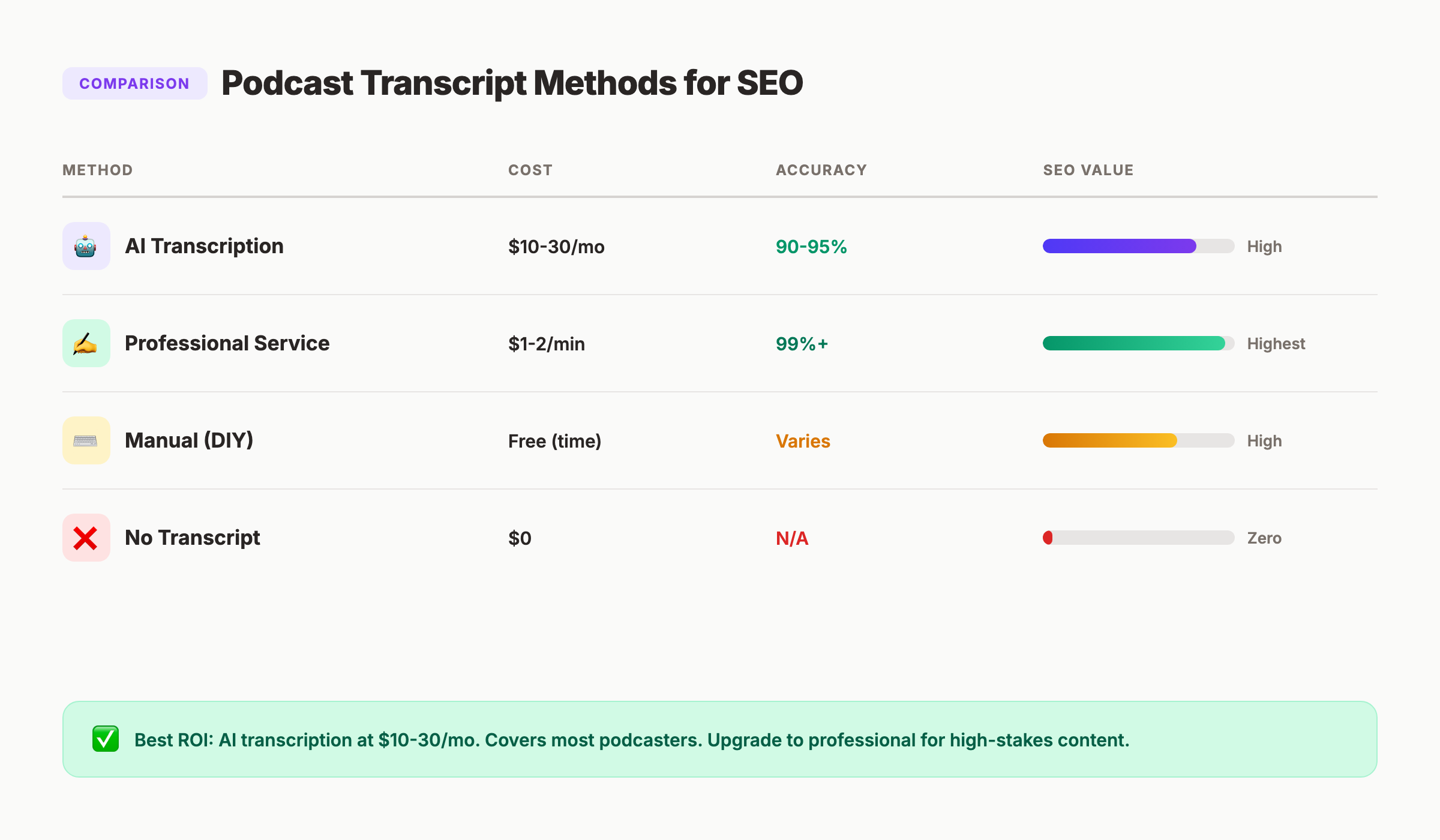
| Approach | Cost | Accuracy | SEO Value |
|---|---|---|---|
| AI transcription (Descript, Otter, Riverside) | $10-30/month | 90-95% | High |
| Professional transcription (Rev, GoTranscript) | $1-2/minute | 99%+ | Highest |
| Manual transcription | Free (your time) | Varies | High |
| No transcript | $0 | N/A | Zero |
Publish the full transcript on your episode page. Do not hide it behind a toggle or accordion by default. Search engines need to see the text in the page source to index it. You can use a “Read Full Transcript” expand section, but make sure the text is in the HTML on initial page load.
Clean Up Transcripts for Readability
Raw AI transcripts include filler words, false starts, and awkward phrasing. Clean them up:
- Remove “um,” “uh,” “you know,” and repeated words
- Add paragraph breaks every 3-4 sentences
- Insert H2 headings for major topic shifts
- Bold key takeaways and statistics
- Add speaker labels for multi-person episodes
A cleaned transcript doubles as a written version of your episode. Some readers prefer text. Others scan for specific sections. Both behaviors increase time on page, which supports your SEO.
Your SEO team. $99 per month. 30 optimized articles, published automatically. Same keyword research. Same on-page optimization. Start for $1 →
Build a Podcast Website That Ranks
Podcast hosting platforms like Spotify and Apple Podcasts own your audience data. They do not pass link equity to your domain. They do not let you control on-page SEO elements. You need your own podcast website.
Why You Need a Dedicated Podcast Website
- Full control over title tags, meta descriptions, and URL structure
- Episode pages that rank independently in Google
- Ability to add schema markup for rich results
- Internal linking between episodes and related content
- Email capture and conversion funnels on every page
- Backlink equity stays on your domain
Episode Page Structure
Every episode gets its own page with a unique URL. The optimal structure:
yourdomain.com/podcast/[episode-keyword-slug]Each episode page should include:
- H1 title with the primary keyword
- Embedded audio player (from your podcast host)
- Episode summary (150-300 words) above the fold
- Full transcript below the summary
- Timestamps with anchor links
- Related episodes sidebar or section
- CTA for email subscription or next episode
On-Page SEO for Episode Pages
Apply the same on-page SEO fundamentals you would use for any blog post:
| Element | Optimization |
|---|---|
| Title tag | Primary keyword + episode hook (under 60 chars) |
| Meta description | Episode benefit + keyword (145-155 chars) |
| URL slug | /podcast/keyword-phrase |
| H1 | Matches or closely mirrors title tag |
| H2s | Major topic sections from the episode |
| Image alt text | Descriptive, keyword-included |
| Internal links | 3-5 links to related episodes and blog content |
Build Topic Clusters Around Episodes
Group related episodes into topic clusters. Create a pillar page for each major theme (e.g., “Content Marketing” or “Local SEO”) and link individual episode pages to it.
This is the same topical authority strategy that works for blogs. A podcast covering marketing could have clusters for:
- SEO cluster: 10 episodes linking to a “Podcast SEO Guide” pillar
- Content cluster: 12 episodes linking to a “Content Marketing” pillar
- Social cluster: 8 episodes linking to a “Social Media Marketing” pillar
Each cluster tells Google your site has depth on that topic. Depth builds authority. Authority drives rankings.
Add Schema Markup for Rich Results
Schema markup tells search engines exactly what your content is. For podcasts, the right schema can trigger rich results in Google, including episode carousels, audio players, and enhanced listings.
PodcastSeries and PodcastEpisode Schema
Google supports PodcastSeries and PodcastEpisode structured data. Here is the minimum viable implementation:
{
  "@context": "https://schema.org",
  "@type": "PodcastEpisode",
  "name": "Podcast Monetization: 5 Revenue Streams That Work in 2026",
  "description": "A breakdown of five podcast monetization strategies with real revenue numbers.",
  "datePublished": "2026-03-15",
  "url": "https://yourdomain.com/podcast/podcast-monetization-strategies",
  "associatedMedia": {
    "@type": "MediaObject",
    "contentUrl": "https://yourdomain.com/audio/ep42.mp3"
  },
  "partOfSeries": {
    "@type": "PodcastSeries",
    "name": "Your Podcast Name",
    "url": "https://yourdomain.com/podcast"
  }
}
FAQPage Schema for Episode Pages
If your episode covers questions (and most do), add FAQ schema to the episode page. Extract 3-5 questions from the episode, write concise answers, and mark them up. This is the same approach that works for blog FAQ sections.
Additional Schema Types
| Schema Type | When to Use | Benefit |
|---|---|---|
| PodcastEpisode | Every episode page | Episode carousels in Google |
| FAQPage | Episodes with Q&A segments | FAQ rich results |
| HowTo | Tutorial episodes | Step-by-step rich results |
| Person | Guest interview episodes | Knowledge panel signals |
| SpeakableSpecification | Key quotes and findings | Voice search and AI citations |
Proper schema markup is an area where most podcast competitors do zero work. Adding it puts you ahead of 95% of podcasts in search.
3,500+ blogs published. 92% average SEO score. See what Stacc can do for your site. Start for $1 →
YouTube Podcast SEO
YouTube is the number one podcast discovery platform in the US. 33% of weekly podcast listeners use it as their primary app. If you are not publishing your podcast on YouTube, you are ignoring the biggest channel.
Video Podcast vs. Audio-Only on YouTube
YouTube favors video content in its algorithm. But audio-only podcasts with a static image still work. The platform introduced podcast-specific features in 2023, including a dedicated Podcasts tab and RSS feed ingestion.
That said, video podcasts consistently outperform audio-only uploads:
| Format | Avg. Watch Time | Discovery Potential | Clip-Ability |
|---|---|---|---|
| Full video podcast | High | Highest | Excellent |
| Audio + static image | Low-Medium | Moderate | Limited |
| Short clips (under 60s) | High | High (Shorts) | N/A |
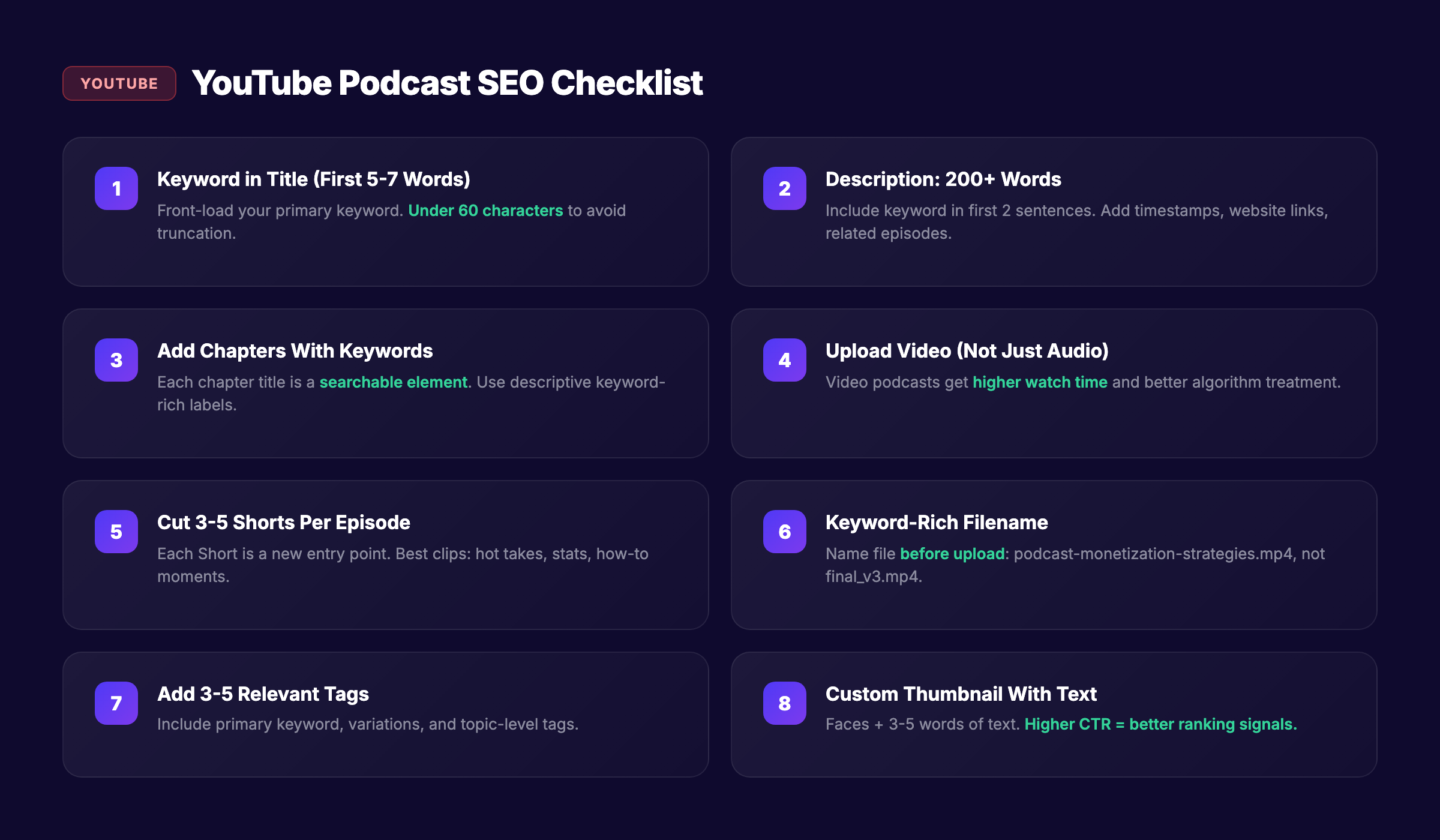
The winning strategy: record video, publish the full episode, and cut 3-5 short clips for YouTube Shorts. Each Short is another entry point for discovery.
YouTube Title and Description Optimization
YouTube SEO follows similar principles to Google SEO. Place your keyword in:
- The video title (first 5-7 words)
- The description (first 2 sentences)
- Tags (3-5 relevant tags)
- The filename before upload (
podcast-monetization-strategies.mp4)
Write descriptions of 200+ words. Include timestamps, links to your website, and related episode links. YouTube uses description text for topic classification and search matching.
Chapters and Timestamps
YouTube chapters create clickable sections in the video timeline. Each chapter title is a searchable element.
0:00 — Introduction
2:15 — What is podcast monetization?
8:30 — Sponsorship and ad revenue
15:42 — Premium content and subscriptions
22:10 — Affiliate marketing for podcasters
30:05 — Consulting and service offers
36:20 — Building a monetization stack
Every timestamp label should include a relevant keyword. For deeper guidance on video optimization, see our YouTube SEO guide.
Optimize for AI Search and Voice Assistants
AI search is not a future trend. It is how millions already find information. ChatGPT, Perplexity, Google AI Overviews, and Siri all pull from web content to generate answers. Podcast content that is structured for AI gets cited. Content that is not gets ignored.
How AI Search Engines Process Podcast Content
AI models prefer:
- Clear, factual statements they can quote directly
- Structured data (lists, tables, numbered steps)
- Expert credentials attached to claims
- Specific numbers and statistics with sources
- Concise answers to specific questions (2-4 sentences)
Your episode pages and transcripts should include all of these elements. When your transcript says “the average podcast ad CPM in 2026 is $25 for a 60-second mid-roll spot,” that is a quotable, citable fact.
Voice Search Optimization
46% of adults use voice search daily. Voice queries tend to be longer and more conversational than typed queries. Podcast content naturally matches this pattern because conversations use natural language.
Optimize for voice search by:
- Including question-and-answer pairs in show notes
- Writing episode summaries in conversational language
- Adding FAQ sections with natural-language answers
- Targeting “how,” “what,” “why,” and “best” question keywords
Speakable Schema
Add SpeakableSpecification schema to highlight the most important quotes and findings from each episode. This tells AI assistants which parts of your content are designed to be read aloud or cited.
{
  "@type": "WebPage",
  "speakable": {
    "@type": "SpeakableSpecification",
    "cssSelector": [".episode-summary", ".key-takeaway"]
  }
}
This is an advanced tactic that almost no podcasters use. Implementing it positions your content ahead of competitors in AI-generated answers. For a complete framework, read our guide on generative engine optimization.
Repurpose Episodes Into SEO Content
Every podcast episode is a raw content asset. Most podcasters publish the audio and move on. Smart podcasters turn each episode into 5-10 pieces of searchable content.
The Podcast Content Multiplication Framework
From one 45-minute episode, create:
| Content Type | SEO Value | Time to Create |
|---|---|---|
| Full blog post (2,000+ words) | Highest | 60-90 min |
| Transcript page | High | 15-30 min (AI-assisted) |
| 3-5 YouTube Shorts/Reels | High | 30-45 min |
| LinkedIn post with key insight | Medium | 10 min |
| Twitter/X thread (5-8 tweets) | Medium | 15 min |
| Email newsletter excerpt | Medium | 10 min |
| Infographic from key data | High | 30-45 min |
| Quote graphics (3-5) | Low-Medium | 15 min |
The blog post is the most valuable derivative. Take the transcript, restructure it with proper headings, add links and images, and publish it as a standalone article. This gives you two pages ranking for related keywords from a single recording session.
Turn Guest Episodes Into Backlink Magnets
When you interview a guest, you create a natural backlink opportunity. After publishing:
- Send the guest a link to their episode page
- Ask them to share it with their audience
- Request they link to it from their website
- Tag them in social posts with the episode link
Most guests will share and link to content featuring them. A podcast with 50 guest episodes has 50 potential backlink sources, each driving domain authority to your site.
For more ideas on turning content into multiple formats, see our guide on repurposing blog content for social media.
Rank everywhere. Do nothing. Blog SEO, Local SEO, and Social on autopilot. Stacc starts at $99/mo. Start for $1 →
Common Podcast SEO Mistakes
Most podcast SEO advice focuses on what to do. Knowing what to avoid saves more time. These are the mistakes we see most often.
1. Using Creative Titles Without Keywords
“The Echo Chamber” or “Thoughts & Things” tell search engines nothing. Your show name should include at least one searchable term. “The SEO Podcast” or “Content Marketing Weekly” are both brandable and searchable.
2. Ignoring Your Podcast Website
Uploading to Spotify and Apple is distribution, not SEO. Without your own website, you have no control over title tags, meta descriptions, internal links, or schema markup. Every serious podcast needs episode pages on a domain you own.
3. Publishing Without Transcripts
A podcast without transcripts is invisible to search engines for text-based ranking. Even with Google processing audio via AI, transcripts provide structured text that search engines and AI tools can quote, index, and cite more effectively than raw audio.
4. Writing One-Sentence Descriptions
Platform algorithms use your episode description to classify and rank content. One sentence gives them almost nothing to work with. Write 150-300 words per episode description minimum.
5. Skipping Schema Markup
Less than 5% of podcast websites use PodcastEpisode schema. Adding it takes 15 minutes and can unlock rich results in Google. This is free visibility that most competitors never claim.
6. Not Building Internal Links Between Episodes
Every episode page should link to 3-5 related episodes and blog posts. Without internal links, each page is an isolated island. Internal linking distributes page authority and helps Google understand your content relationships.
7. Neglecting YouTube Entirely
YouTube is the largest podcast platform. Ignoring it is like having a business without a Google listing. Even if you only publish audio with a static image, uploading to YouTube expands your search footprint significantly.
Podcast SEO Checklist
Use this checklist for every episode you publish.
Before Recording:
- Research primary keyword and 2-3 secondary keywords
- Plan episode title with keyword in the first 5-7 words
- Prepare questions or talking points that include target phrases
After Recording:
- Generate or commission a full transcript
- Clean up the transcript (remove filler, add headings, bold key points)
- Write a 150-300 word episode description with keywords
- Create detailed show notes with timestamps and links
- Write a companion blog post from the transcript
Publishing:
- Publish episode page on your website with unique URL
- Add PodcastEpisode schema markup
- Add FAQ schema if the episode includes Q&A
- Set title tag and meta description with primary keyword
- Upload to YouTube with optimized title, description, and tags
- Create 3-5 short clips for YouTube Shorts or Reels
- Internal link from 2-3 related existing pages to the new episode
Post-Publish:
- Share with guests and request backlinks
- Submit new episode URL to Google Search Console
- Post clips and quotes on social media with links
- Track rankings for target keywords after 2-4 weeks
FAQ
Does podcast SEO actually work for growing a show?
Yes. 53.6% of podcast listeners discover shows through search, split between in-app search (40%) and Google (13.6%). Optimizing for both channels puts your show in front of listeners who are actively looking for your topic. Podcasts with optimized episode pages, transcripts, and schema markup consistently rank higher than those without.
How long does it take for podcast SEO to show results?
Expect initial ranking movement in 60-90 days. Full results typically take 4-6 months of consistent optimization. Like all SEO, podcast optimization compounds over time. Each optimized episode page builds authority for your domain, making future episodes easier to rank.
Should I transcribe every episode?
Yes. Every untranscribed episode is invisible to text-based search. AI transcription tools cost $10-30 per month and process episodes in minutes. The SEO value of a single transcript far exceeds the cost. Transcripts also improve accessibility and give you raw material for blog posts, social content, and email newsletters.
Which podcast hosting platform is best for SEO?
The hosting platform matters less than having your own website. Buzzsprout, Transistor, Captivate, and Podbean all distribute to major platforms. The real SEO advantage comes from publishing episode pages on your own domain with full title tags, meta descriptions, transcripts, and schema markup. No hosting platform replaces a dedicated podcast website.
How do I optimize my podcast for AI search tools?
Structure your episode pages with clear headings, factual statements, specific statistics, and FAQ sections. Add SpeakableSpecification schema to highlight quotable content. Publish transcripts with proper formatting. AI search tools like ChatGPT and Perplexity prefer content they can extract, verify, and cite. Read our full guide on getting cited in AI search for a detailed framework.
Does my podcast name affect SEO?
Significantly. A name with relevant keywords ranks faster in both Google and podcast app search. “The Marketing Automation Podcast” is immediately discoverable for anyone searching “marketing automation podcast.” Creative names without keywords require more brand building before they rank for topic searches.
Podcast SEO is not a one-time task. It is a system that compounds with every episode you publish. Each optimized page adds keywords, backlinks, and authority to your domain. Start with the highest-impact actions: add transcripts, build episode pages on your own website, and write keyword-focused titles. Then layer on schema markup, YouTube optimization, and AI search formatting.
The podcasts that dominate search in 2026 are not the ones with the best audio. They are the ones with the best optimization system behind the audio.
Written and published by Stacc. We publish 3,500+ articles per month across 70+ industries. All data verified against public sources as of March 2026.
