Build a tree service SEO system around real jobs, service areas, storm capacity, local search evidence, and completed-job measurement.
Tree service SEO fails when the search promise outruns the operation. A page may attract a request for a tree on a power line while the company only accepts scheduled pruning. A city page may generate an enquiry outside the crew’s viable drive area. A storm banner may stay live after intake closes.
Build search around job truth. Every service, area, hour, qualification, and capacity claim needs current evidence. Measurement then follows the whole chain: impression, click, call click, form, qualified enquiry, booked job, completed job.
Research disclosure: US-English evidence checked July 11, 2026. DataForSEO estimated volume of 140 for “tree service seo” and 10 for “tree care seo”; difficulty was 0 and unavailable, respectively. CPC was unavailable. These are dated query estimates, not outcome forecasts.
You will get a service-truth table, intent map, competition review, storm card, funnel dictionary, delivery matrix, and review rhythm. This is marketing guidance, not arboricultural, safety, legal, licensing, permitting, insurance, or bonding advice.
What tree service SEO should accomplish—and what it cannot promise
Tree service SEO should help the right searcher find an accurate page for a job the company can accept in that place and period. It should also produce evidence that operators can trace to completed work. It cannot guarantee a top-three position, a call, a booking, revenue, or a fixed result date.
Treat top-three placement as an internal objective, never customer-facing certainty. Google’s SEO guidance focuses on serving users and helping search engines understand content; it does not offer a ranking formula. Search results also vary by location, device, query wording, competition, and time.
The complete funnel is: impression, click, call click, form, qualified enquiry, booked job, completed job. Keep those stages separate. A call click is not a connected call. A form is not qualified. A booking is not completion. This vocabulary prevents a marketing report from calling every tap a “lead” or every enquiry “revenue.”
| Stage | What it proves | What it does not prove |
|---|---|---|
| Impression | A result was recorded as shown for the declared Search Console cohort | That the searcher noticed or visited it |
| Click | The organic result sent a visit | That the visitor contacted the business |
| Call click | A tracked call control was used | A connected or qualified conversation |
| Form | A valid submission reached the form system | A suitable job or service area |
| Qualified enquiry | Written service, area, capacity, and job rules were met | A confirmed booking |
| Booked job | The scheduling rule was satisfied | Work was performed |
| Completed job | The operations completion rule was satisfied | Profitability without cost and margin data |
Google Search Console’s Performance report supplies search dimensions and metrics for the first part of this chain. Analytics, call tracking, forms, intake, scheduling, and job-management systems must carry the rest. Decide the join keys and privacy rules before publishing campaigns.
Start with the tree jobs the company can truthfully accept
Build a service-truth inventory before choosing keywords or creating pages. For each job type, document scope, exclusions, geography, staffed hours, season, capacity, urgency handling, dependencies, economics, and claim proof. An empty or unverified cell blocks the related claim; it is not permission to fill the gap with common industry language.
| Field | Required entry | Example of a prohibited shortcut |
|---|---|---|
| Job type and customer problem | Operator’s exact accepted scope and exclusions | “All tree work” |
| Routine or urgent | Written intake classification | Calling every storm request an emergency |
| Offered now | Yes/no plus verification date | Leaving a paused service live |
| Geography | Actual accepted areas and drive constraints | A generic radius or copied city list |
| Staffed hours | Times when intake is monitored | “24/7” without staffed proof |
| Season and capacity gate | Trigger, available slots, and pause owner | Evergreen availability language |
| Crew/equipment dependency | Dispatch dependency recorded by operations | Promising capability from a stock image |
| Company value band | Dated first-party range, source owner, inclusions, exclusions | Publishing an industry ticket benchmark |
| Claim proof | Owner and current evidence for qualification, license, permit, bonding, insurance | “Certified, licensed and insured” by default |
| Page owner | Person accountable for accuracy | A page with no review responsibility |
Licenses and permits vary by activity and jurisdiction, as the SBA explains. Credentials, insurance, and bonding requirements also depend on the work and location. Verify each statement locally with the relevant authority and current business records. Do not infer a credential from a job title.
Use company-specific job-value bands only for internal planning. Label the evidence period, owner, inclusions, and exclusions; never publish them as an industry average.
Map search intent to job type, urgency, and page owner
Map each query pattern to one job intent, evidence set, canonical page type, and conversion path. Commercial service, urgent, comparison or cost, and informational searches need different answers. A generic tree-service page cannot safely promise the same response to routine pruning, stump grinding, assessment, and a reported power-line conflict.
| Query pattern | Intent and urgency | Evidence required | Page and conversion path | Disqualifier / owner |
|---|---|---|---|---|
| tree removal near me | $35-55 | 165,000+ (national) | ||
| tree trimming near me | $25-45 | 110,000+ (national) | ||
| arborist near me | $20-40 | 40,500 | ||
| stump removal near me | $18-35 | 33,100 | ||
| emergency tree removal | $40-65 | 27,100 | ||
| tree service [city] | $30-50 | 1,000-12,000 per city |
A tree service company spending $2,500 per month on Google Ads might get 50 to 70 clicks. After 6 months of SEO, a well-optimized site earns hundreds of organic clicks per month at $0 per click. The math favors organic every time.
The Local Pack Advantage
46% of all Google searches have local intent. For tree services, that number is higher. Almost every tree service search includes a location signal. "Near me." A city name. A zip code.
The local map pack shows 3 businesses above the organic results. Ranking in that pack means your company name, phone number, reviews, and hours appear before anything else. The local 3-pack delivers 126% more traffic and 93% more actions than positions 4 through 10.
Tree service companies that rank in the local pack report 3 to 5 times more calls than those ranking below it. The gap between position 3 and position 4 in local results is a cliff, not a slope.
Why Most Tree Service Companies Struggle With SEO
They have almost no website content. 80% of consumers search for local businesses online weekly. The average tree service website has a homepage, a services page, an about page, and a contact page. That is 4 pages. Google needs dozens of pages to consider a site an authority. 4 pages do not compete with a company that has 50.
They ignore Google Business Profile. A GBP listing with no posts, outdated photos, and 15 reviews from 2022 tells Google the business is dormant. Active profiles rank higher.
They pay agencies that do not understand tree care. Most SEO agencies treat tree services the same as plumbers and dentists. Tree care has unique seasonality, emergency patterns, and service area challenges that generic strategies miss completely.
Your SEO team. $99 per month. 30 optimized articles published automatically for your tree service company.
Tree Service Keyword Strategy: What to Target
Keyword selection determines whether you attract homeowners who need a $3,000 tree removal or people browsing "how to trim a tree" with no intent to hire. Both have value. But the priority order matters.
High-Intent Commercial Keywords
These keywords generate phone calls. Target them first.
| Keyword Pattern | Example | Search Intent |
|---|---|---|
| tree removal [city] | tree removal Austin | Ready to hire |
| tree trimming near me | tree trimming near me | Comparing options |
| emergency tree service | emergency tree service [city] | Urgent need |
| arborist [city] | arborist Portland | Looking for expert |
| stump grinding near me | stump grinding near me | Ready to hire |
| tree service cost | tree removal cost | Price shopping |
| best tree service [city] | best tree service Denver | Comparing options |
Informational Keywords That Build Authority
Informational content brings homeowners to your site before they need to hire. When a storm hits and a branch falls, they remember the company whose article they read about "signs a tree needs to be removed."
| Keyword | Monthly Volume | Content Type |
|---|---|---|
| when to remove a tree | 18,100 | Educational guide |
| how much does tree removal cost | 40,500 | Pricing guide |
| signs of a dying tree | 14,800 | Identification post |
| best time to trim trees | 22,200 | Seasonal guide |
| tree root damage to foundation | 9,900 | Problem/solution post |
| can a leaning tree be saved | 6,600 | Assessment guide |
| stump removal methods | 8,100 | Comparison post |
Target both types. Commercial keywords generate immediate calls. Informational keywords build topical authority that helps commercial pages rank higher over time.
Service-Specific Keywords
Every service your company offers deserves its own page. Each page targets the specific terms homeowners search when they need that service.
Tree Removal: tree removal near me, dead tree removal, large tree removal cost, tree removal after storm, emergency tree removal 24 hour
Tree Trimming: tree trimming service, tree pruning near me, palm tree trimming, tree shaping service, seasonal tree trimming
Stump Removal: stump grinding near me, stump removal cost, stump grinding vs removal, how long after cutting tree to grind stump
Emergency Services: storm damage tree removal, fallen tree on house, emergency tree service 24/7, tree on power line who to call
Land Clearing: lot clearing service, land clearing for construction, brush removal near me, vegetation management
Build a content cluster for each service. One pillar page per service. 3 to 5 supporting blog posts per cluster. Internal links connecting them all.
Google Business Profile Optimization for Tree Services
Your Google Business Profile is the single most important ranking factor for the local map pack. A complete, active GBP listing outranks a better website with a neglected profile.
Complete Every Field
Google rewards complete profiles with higher visibility.
- ✓ Business name (exact legal name, no keyword stuffing)
- ✓ Primary category: Tree Service
- ✓ Secondary categories: Arborist, Stump Removal Service, Landscaper, Emergency Service
- ✓ Service area (list every city, county, and zip code you serve)
- ✓ Business hours (include emergency/after-hours availability)
- ✓ Phone number (local number, not toll-free)
- ✓ Website URL
- ✓ Business description (750 characters, mention services and areas)
- ✓ Services list with descriptions and pricing ranges
- ✓ Attributes: Licensed, Insured, Free estimates, Emergency service available
Photos That Generate Calls
Listings with photos receive 42% more direction requests and 35% more website clicks. Tree service photos are uniquely powerful because they show dramatic before-and-after transformations.
Upload these photo types:
- Before/after tree removal shots (the most effective type)
- Crew at work with safety equipment (builds trust)
- Company trucks and equipment (shows professionalism)
- Completed stump grinding
- Storm damage cleanup in progress
- Team photos with branded gear
- Certified arborist credentials
Upload at least 10 photos. Add 3 to 5 new photos every month. Google prioritizes profiles with recent activity.
Weekly GBP Posts
Post to your GBP weekly. Each post signals activity and gives potential customers a reason to choose you.
Weekly post ideas:
- Recent job completion with before/after photos
- Seasonal tree care tips ("Why fall is the best time to trim oaks")
- Storm preparation advice
- Safety reminders (do not trim near power lines)
- Special offers for seasonal services
- Community involvement (donated tree work, local events)
Rank everywhere. Do nothing. Blog SEO, Local SEO, and Social on autopilot for tree service companies.
Service Area Pages: Rank in Every City You Serve
Most tree service companies cover 15 to 40 cities within a 50-mile radius. Each city needs its own page. A single "areas we serve" page with a list of city names does not rank. Individual city-specific landing pages do.
What Each Service Area Page Needs
Unique content per city. Do not copy the same text and swap the city name. Google detects duplicate content. Write about tree species common in that area, local storm patterns, HOA regulations, and specific neighborhoods.
Service listings per city. List every tree service you offer in that city. Include brief descriptions and pricing ranges where appropriate.
Local contact information. If you have a local phone number for that area, use it. Include your nearest office address.
Customer reviews from that city. Embed or quote reviews from customers in the specific service area. A review mentioning "Great job removing the dead elm on Oak Street in [City]" is local SEO gold.
Schema markup. Add LocalBusiness schema to every service area page. Include service area, coordinates, and service types.
URL Structure
Use clean, keyword-rich URLs.
/tree-removal-[city]/
/tree-trimming-[city]/
/stump-grinding-[city]/
Each URL targets the high-intent keyword for that city. Start with your top 5 revenue cities. Then expand to 10, 20, and eventually all service areas.
This is programmatic SEO applied to local services. The structure scales. The content must stay unique per page.
Seasonal Content Strategy for Tree Services
Tree care is one of the most seasonal industries in home services. Search volume for specific services follows predictable annual patterns. Publishing content ahead of each season captures traffic at peak demand.
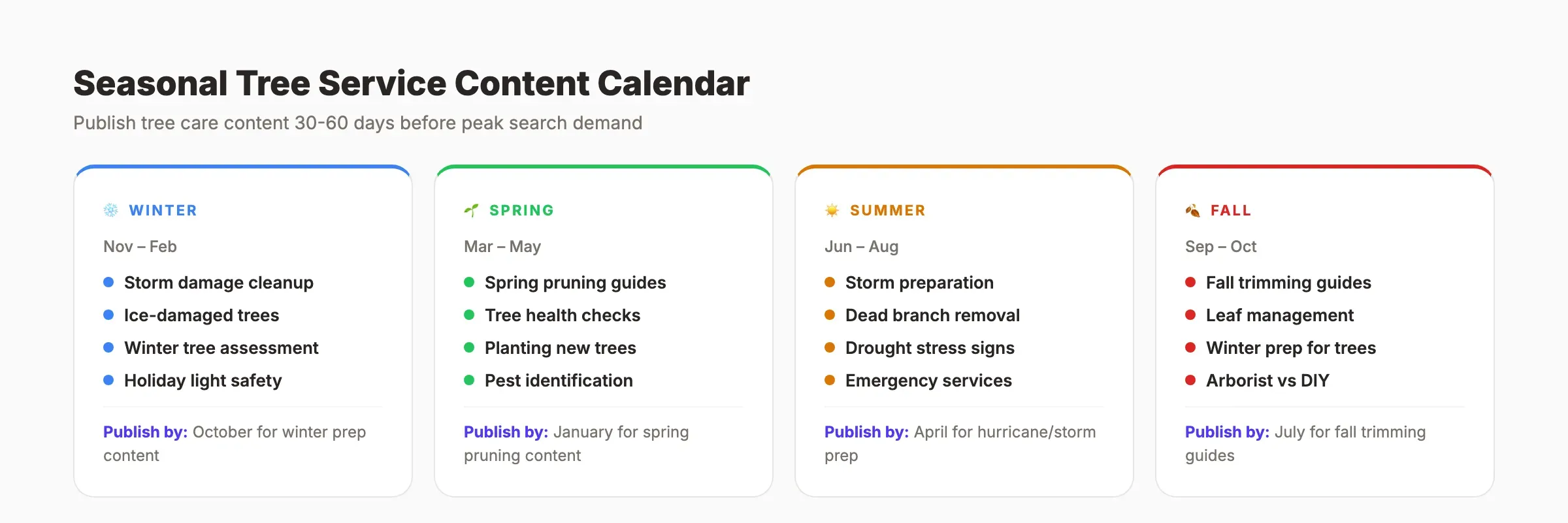
Tree Service Content Calendar
| Month | Primary Topics | Content Ideas |
|---|---|---|
| January-February | Winter storm damage, ice-damaged trees | "What to do after ice storm tree damage," "Can a split tree be saved?" |
| March-April | Spring pruning, tree health assessment | "Best time to prune fruit trees," "Signs your tree needs a health check" |
| May-June | Tree planting, pest identification | "Best shade trees for [region]," "How to spot emerald ash borer damage" |
| July-August | Storm prep, dead branch removal | "Hurricane tree preparation checklist," "Why dead branches are dangerous" |
| September-October | Fall trimming, leaf management | "Fall tree trimming guide," "When to call an arborist vs DIY" |
| November-December | Holiday lighting concerns, winter prep | "Safe holiday light installation in trees," "Winterizing your trees" |
Publishing Cadence
Publish tree content 30 to 60 days before peak search volume. A "spring pruning guide" published in January ranks by March when searches peak.
Consistency beats volume. Publishing 20 to 30 articles per month builds authority faster than publishing 5 posts then going silent for 3 months.
Emergency Content Strategy
Tree services have a unique advantage: emergency searches spike during storms. These are the highest-intent, highest-value searches.
Pre-storm content: "How to prepare your trees before hurricane season," "Storm-proofing your property." Publish these before storm season. They rank when panic searches begin.
Post-storm content: "What to do after a tree falls on your house," "Emergency tree removal: what to expect." These capture homeowners who already have a problem and need help immediately.
Emergency tree removal jobs often exceed $1,000 to $5,000. One organic lead from a storm-related search can pay for a full year of SEO.
Reviews: The Trust Factor That Drives Tree Service Rankings
Reviews carry extra weight for tree services because homeowners are hiring strangers to operate chainsaws near their home and family. Trust is everything.
Why Reviews Matter More for Tree Services
A bad plumber leaves you with a leak. A bad tree service can drop a tree on your house. Homeowners read reviews more carefully for tree services than almost any other home service. They look for mentions of safety, professionalism, cleanup quality, and fair pricing.
93% of consumers read online reviews before choosing a local business. For tree services, the review bar is even higher. Homeowners want to see 40+ reviews with specific mentions of the type of work they need.
How to Generate More Reviews
Post-job text message. Send an automated text 2 hours after completing a job. "Hi [Name], thanks for choosing [Company]. If you were happy with the work, would you leave us a quick Google review? [link]." This single step generates the most reviews.
Before/after photo email. Send the customer before-and-after photos of their property 24 hours after the job. Include a review link at the bottom. The photos trigger an emotional response that leads to better reviews.
Review cards. Hand a card to the homeowner when presenting the invoice. Include a QR code linking to your Google review page. Use our Review QR Code Generator to create one.
Respond to every review. Use our Review Response Generator for templates. Responding to reviews signals to Google that your business is engaged. 89% of consumers are more likely to choose a business that responds to reviews. Only 5% of businesses actually respond. This is a massive competitive advantage.
3,500+ blogs published. Every article is SEO-scored before publish. See what theStacc can do for your tree service company.
Technical SEO for Tree Service Websites
A tree service website does not need complex technical SEO. It needs the basics done correctly. Most tree service sites fail on mobile speed, missing schema, and no service pages.
Mobile-First Design
Over 75% of local searches happen on mobile. A homeowner with a tree on their car is not sitting at a desktop. Your site must load in under 3 seconds on mobile. Check your Core Web Vitals in Google Search Console. Large, uncompressed before-and-after photos are the #1 cause of slow tree service websites. Compress every image below 200KB.
Click-to-Call
Every page needs a visible phone number that is clickable on mobile. Tree service calls are urgent. If a homeowner has to search for your number, they will call the next company. Place a click-to-call button in the header, on every service page, and in the footer.
Schema Markup
Add structured data to help Google understand your business.
- LocalBusiness schema on the homepage and every service area page
- Service schema on each service page (tree removal, trimming, stump grinding)
- FAQ schema on pages with frequently asked questions
- Review schema on pages featuring customer testimonials
Schema markup enables rich results. Your listing can show ratings, hours, price range, and service types directly in search results.
URL Structure
Keep URLs clean and keyword-rich.
| Page Type | URL Pattern | Example |
|---|---|---|
| Homepage | / | treeservicepro.com |
| Service page | /[service]/ | /tree-removal/ |
| City page | /tree-service-[city]/ | /tree-service-austin/ |
| Blog post | /blog/[topic]/ | /blog/signs-dying-tree/ |
What Tree Service SEO Costs and What to Expect
SEO pricing varies. Understanding the options helps you pick the right fit for your budget.
Typical Tree Service SEO Costs
| Option | Monthly Cost | What You Get |
|---|---|---|
| DIY (your time) | $0 + 15-20 hours/month | Slow, inconsistent results |
| Freelance SEO | $500-1,500/month | Basic optimization, limited content |
| Local SEO agency | $1,500-4,000/month | Full service, slow turnaround |
| theStacc Blog SEO | $99/month | 30 articles/month, published automatically |
| theStacc Blog + Local SEO | $126/month | 30 articles + Google Business Profile posts |
Expected Timeline
Month 1-2: GBP optimized. First content published. Service area pages created. No significant ranking changes yet.
Month 3-4: Blog posts begin indexing. Long-tail keywords ("tree removal cost [city]") rank on pages 2 and 3. GBP activity improves listing visibility.
Month 5-6: First page rankings for low-competition terms. Call volume increases 15 to 30%. Local pack appearances for key service queries.
Month 7-12: Compound effect kicks in. Multiple pages rank on page 1. Call volume increases 50 to 100%+ from organic search. Storm-related content drives traffic spikes during peak seasons.
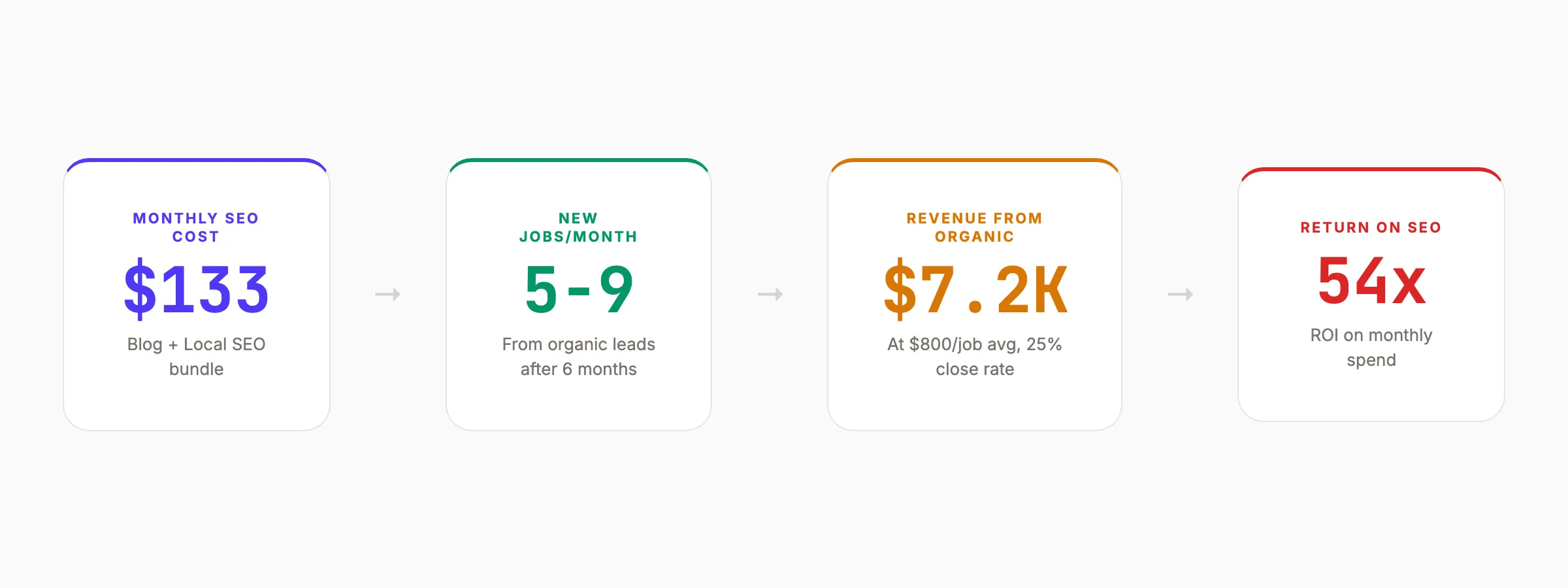
ROI Calculation
A tree service company averaging $800 per job can calculate SEO ROI quickly.
- Monthly SEO cost: $126 (theStacc Blog + Local)
- New organic leads per month after 6 months: 20 to 35
- Conversion rate: 25%
- New jobs from organic: 5 to 9
- Revenue from organic: $4,000 to $7,200
- ROI: 30x to 54x return on SEO spend
Emergency tree removal jobs ($1,500 to $5,000) change the ROI calculation dramatically. One emergency job from organic search pays for 11 to 37 months of SEO.
Build the local discovery foundation without inventing locations
A sound local foundation aligns the Business Profile, website, service pages, contact details, reviews, indexation, and structured data with the same real operation. It does not use fake offices, virtual locations, city-name-swapped pages, or a page for every nearby city. Build only what the company can verify and maintain.
For a company whose core business is accurately described that way, set the Google Business Profile primary category to Tree service. Add secondary categories only when they describe current work. Follow Google’s service-area and representation rules: use the real business location and service area, and do not create profiles for places that are not eligible operating locations.
Use a foundation sequence
- Correct entity facts. Align the real name, contact route, hours, and service area across the profile and website.
- Assign core pages. Give each accepted service a useful owner page when its scope and intake path differ.
- Check indexability. Confirm the important URL returns a successful response, is not blocked, uses the intended canonical, and appears in the relevant search reporting.
- Show truthful proof. Use company-provided job photos, process details, qualifications, and area evidence only with approval. Avoid captions that identify customers or reveal private details.
- Mark up visible facts. LocalBusiness structured data should describe information users can see and the business can prove. Follow Google’s implementation guidance.
Ask genuine customers for reviews without incentives, review gating, or suggested positive wording. In replies, protect privacy and avoid confirming details the reviewer did not make public. Google’s review guidance supports asking for honest feedback and sets limits on prohibited engagement. The full operating workflow belongs in the review management guide.
Create a city page only when you can add distinct operational evidence and a conversion path that serves that area. Otherwise, use a service-area section on the service page. The Google Maps SEO guide and Business Profile guide cover setup.
Publish content built for Google and AI citations. theStacc’s Content SEO module ships SEO-scored articles structured for rankings and generative engines — including clearer entity pages models like Grok can quote.
FAQ
Most tree service companies see initial ranking improvements within 60 to 90 days. Meaningful call volume increases typically appear by month 5 to 6. The timeline depends on local competition, current website authority, and publishing consistency.
Start with "[tree service] + [your city]" and "tree removal near me." These are the highest-intent commercial keywords. Then expand to service-specific terms like "stump grinding [city]" and "emergency tree removal [city]." Informational content about tree health and seasonal care builds topical authority over time.
GBP is the #1 factor for local map pack rankings. A fully optimized profile with regular posts, recent photos, and consistent reviews outranks a company with a better website but a neglected GBP listing. Optimize your GBP before investing in anything else.
Businesses with 40+ reviews rank significantly higher in local results. Focus on generating 5 to 10 new reviews per month. Recency matters as much as volume. Google prioritizes businesses with a steady flow of recent reviews over those with old ones.
Yes. Independent tree services have advantages large companies do not. You can create hyper-local content about specific neighborhoods. You can respond personally to every review. You can publish blog posts about trees common in your region. Local businesses that invest consistently in SEO outrank larger competitors in local map pack results regularly.
Prepare normal and event content states. Activate the event state only after the duty owner confirms capacity and scope. When intake closes, replace its prompt with approved escalation or waitlist language.
Keep storm and routine cohorts separate in reporting. An unusual event can create a short burst of impressions and contacts that says little about ordinary demand. It can also overwhelm intake, lowering qualification or booking rates even when search pages performed as intended. Capacity context belongs beside the chart.
Diagnose tree service SEO performance one stage at a time
Begin diagnosis at the first broken funnel stage and resist jumping ahead. No impressions calls for indexing, query, and page-owner checks. Later failures move from snippet fit to conversion truth, qualification, scheduling, and operations. Once a job is booked, non-completion is an operations outcome rather than an SEO conversion.
- No impressions: confirm publication, indexability, canonical choice, Search Console scope, query fit, and whether another page owns the intent.
- Impressions but no clicks: compare the actual result format, intent match, title, description, service wording, location evidence, and competing snippets.
- Clicks but no call clicks or forms: check whether service truth is obvious, the area is clear, mobile controls work, forms are usable, and contact choices match urgency.
- Enquiries but poor qualification: inspect loss reasons for geography, unsupported service, unavailable capacity, timing, access, or another written disqualifier. Repair the page and intake wording together.
- Qualified enquiries but no booking: review estimate handoff, response handling, scheduling availability, and recorded decline reasons. Do not blame rankings without evidence.
- Booked jobs but no completion: report cancellations, postponements, no-access, declined-on-site, unsafe, and incomplete states. Operations owns the resolution.
Funnel dictionary
| Stage | Exact business rule and timestamp | Source / owner | Exclusions |
|---|---|---|---|
| Impression | Search Console impression for declared query/page/location/device cohort; recorded report date | Search Console / SEO owner | Outside countries/devices and test URLs declared out of scope |
| Click | Search Console organic click for the same cohort; report date | Search Console / SEO owner | Paid clicks and excluded scope |
| Call click | Unique eligible organic session fires validated call-control event; event time | Analytics / analytics owner | Duplicates, tests, staff, paid, direct, referral; never connected-call proxy |
| Form | Unique valid service form from eligible organic session; submission time | Form system / web owner | Spam, tests, duplicates, jobs, vendors, paid/direct/referral |
| Qualified enquiry | Unique enquiry meets written service, area, capacity, and job rule; decision time | CRM/intake log / intake owner | Unsupported work/area, unavailable capacity, spam, duplicates; retain loss reasons |
| Booked job | Qualified enquiry has confirmed job under scheduling rule; confirmation time | Scheduling system / scheduling owner | Duplicates; reschedules once; cancellations remain booked but not completed |
| Completed job | Booked job meets written operations completion rule; completion time | Job-management system / operations owner | Canceled, postponed, no-access, unsafe/declined-on-site, incomplete; report separately |
Google Analytics supports distinct recommended lead events including generate_lead, qualify_lead, and close_convert_lead, but the company still defines its own stage rules. Review the official event guidance. Names do not repair duplicate firing or weak intake data.
Want a second set of eyes on this funnel? Bring your service truth, current pages, and measurement gaps to a practical review.
Use formulas that preserve the evidence contract
Rates are useful only when numerator, denominator, evidence window, source system, owner, and exclusions travel together. Use one declared 28-day cohort where specified and compare it only with a like-for-like prior period whose season or event context is recorded. Never use a partial funnel rate as a revenue claim.
| Formula | Numerator / denominator | Window and source | Owner and exclusions |
|---|---|---|---|
| Organic CTR | Organic clicks ÷ organic impressions for the same query/page cohort | Declared 28 days; Search Console Performance export; like-for-like prior window only | SEO owner; exclude paid, test URLs, and out-of-scope countries/devices |
| Call-click rate | Unique tracked call clicks from organic landing sessions ÷ eligible unique organic landing sessions | Declared 28 days; analytics events plus landing/session source | Analytics owner; exclude paid/direct/referral, duplicates, staff/tests; not connected calls |
| Form rate | Unique valid organic form submissions ÷ eligible unique organic landing sessions | Declared 28 days; form system plus analytics/source capture | Web/analytics owner; exclude spam, tests, duplicates, jobs/vendors, paid/direct/referral; not qualified |
| Qualified-enquiry rate | Unique enquiries meeting written rules ÷ all unique attributable call/form enquiries in cohort | Declared 28-day intake cohort; call/form systems plus CRM/intake log | Intake owner; exclude spam, duplicates, jobs/vendors, unsupported work/area, unavailable capacity; list losses |
| Booked-job rate | Unique qualified enquiries with confirmed booking ÷ all unique qualified enquiries in cohort | Declared 28-day intake cohort plus stated estimate/booking lag; CRM/scheduling | Scheduling owner; duplicates/reschedules once; cancellations stay booked, not completed |
| Completed-job rate | Unique booked jobs meeting completion rule ÷ all unique booked jobs in cohort | Booking cohort plus enough resolution lag; job-management system | Operations owner; exclude and separately report canceled, postponed, no-access, unsafe/declined, incomplete |
| Cost per completed organic job | Attributable SEO/content/platform/vendor spend under written cost rule ÷ attributable completed jobs | Declared acquisition cohort plus completion lag; invoices/time-cost ledger plus CRM/job system | Finance owner with marketing/operations sign-off; exclude uncosted labor unless included, paid media, existing customers, unattributable and incomplete jobs |
Audit tracking joins after system changes. Report “unavailable” when attribution cannot be defended; zero means the system measured the event and found none.
Decide whether to DIY, partner, or pause
Choose a delivery model from access, owner time, documentation, subject-matter capacity, control, measurement readiness, storm coverage, and displaced operational work. DIY is not automatically cheaper, and a partner is not automatically faster. Pause when evidence or approvals are too weak to publish accurate claims or measure outcomes.
| Criterion | DIY | Partner | Pause / stop condition |
|---|---|---|---|
| Required access | Owner controls site, GBP, Search Console, analytics, forms | Named access and revocation process | Critical account access unavailable |
| Recurring work | Protected review, editing, publishing, QA time | Defined deliverables and acceptance owner | No capacity for upkeep or approvals |
| Tree-service SME | Operator reviews scope and exclusions | Partner interviews a named operator | No one can verify service truth |
| Evidence owner | Internal owner maintains proof | Partner requests; business approves | Qualification or insurance language cannot be verified |
| Operational time | Marketing work displaces named tasks | Briefing and approval still consume time | Displaced dispatch, estimating, or customer work is unacceptable |
| Measurement | Team maintains events and joins | Contract states systems and stage definitions | No defensible route to completed-job evidence |
| Storm intake | Duty owner controls public state | Partner follows operator-controlled switch | No staffed approval or pause control |
| Failure risk | Stale pages and inconsistent execution | Generic copy and access dependency | Repeated unsupported claims or unresolved tracking faults |
Evaluate partners by the questions they ask. They should request accepted services, exclusions, coverage, capacity, claim proof, page ownership, and funnel definitions before promising output. A vendor ranking or fixed “time to rank” package cannot replace those inputs.
If internal execution is viable, Content SEO can support keyword and SERP research, drafting, and queueing or publishing content. Local SEO covers GBP posts, review replies, citations, and rank tracking. Product tools do not own operational truth; a named company reviewer must approve it.
Set expectations with 14/30/60/90-day evidence windows
Use review dates as investigation points, not promised result dates. Establish publication and indexation first, then inspect declared cohorts at 14, 30, 60, and 90 days. Seasonality, storms, low query counts, site history, and local result density provide context, but none justifies inventing progress.
| Review | Primary job | Possible action |
|---|---|---|
| Baseline | Record publication, canonical, indexation state, page/query cohort, conversion QA, and existing funnel counts | Fix measurement before interpreting change |
| Day 14 | Check crawl/index signals, accidental page competition, result appearance, and event integrity | Repair technical or ownership faults |
| Day 30 | Review early impressions and clicks with query, page, location, device, season, and event context | Adjust intent, title, snippet, or internal links |
| Day 60 | Inspect contact and qualification evidence; sample loss reasons and page truth | Narrow geography, scope, or conversion wording |
| Day 90 | Review resolved booking/completion cohorts and attributable costs with adequate lag | Keep, repair, narrow, pause, or stop |
Review card fields: date; evidence window; query/page cohort; finding; source system; owner; exclusions; corrective action; next review. Add season and storm-event context. If top-three is the target, label it as a target only and report the actual observed position without turning it into a promise.
Show counts beside rates and extend the window when estimate, scheduling, or completion lag demands it. See the SEO timeline guide for broader expectation-setting.
Turn the review card into an operating decision. We can help you identify the next repair without manufacturing a deadline.
Evaluate whether the system is worth continuing
Continue only when the company’s attributable costs, operational capacity, and completed-job evidence support the next cycle. Separate organic from paid, routine from storm work, new from existing customers, and branded from non-branded search where systems allow. The honest decision may be keep, repair, narrow, pause, or stop.
Start with a cohort whose acquisition source and time window are declared. Add vendor invoices, platform costs, content costs, and owner labor only under a written cost rule. Wait long enough for bookings to resolve into completed, canceled, postponed, or incomplete states. Then compare the result with the company’s own finance and capacity thresholds.
- Keep: evidence is reliable, job fit is sound, operations can accept more of the same cohort, and cost meets the company rule.
- Repair: the service is viable but a page, snippet, conversion path, source field, or intake handoff is broken.
- Narrow: some services, areas, seasons, or query groups produce unsuitable work or exceed capacity.
- Pause: capacity, proof, access, measurement, or approvals are temporarily unavailable.
- Stop: repeated evidence shows the cohort does not meet the company’s operational or financial rule, or safe truthful execution is not possible.
Paid campaigns may serve controlled demand when tracking and intake are ready. Organic pages can answer persistent needs. Neither channel “always wins”; compare them under their own attributable cost rules without assigning paid spend to organic or crediting existing-customer work to acquisition.
FAQ
These answers resolve the practical questions that sit beside implementation: definitions, timing, ownership, storm claims, and measurement. They do not provide homeowner advice about removal methods, hazards, prices, or whether a specific tree is safe. Company and jurisdiction evidence still controls every public service claim.
Tree service SEO is the work of making a tree company’s truthful service, location, availability, and evidence understandable to searchers and search engines. It connects searches to the right service page or Business Profile, then measures each step from impression through completed job. It cannot guarantee a ranking, enquiry, or job.
Tree companies compete by maintaining an accurate Google Business Profile, building indexable pages for services they actually offer, earning genuine reviews, and matching page language to local intent. The primary Business Profile category should be Tree service when that accurately describes the core business. Google states that no individual SEO action guarantees ranking.
There is no defensible fixed timeline. First establish whether changed pages are published and indexed, then review like-for-like evidence at 14, 30, 60, and 90 days. Website history, local competitors, seasonality, storms, and low query counts affect what each window can show. Use the evidence to keep, repair, narrow, pause, or stop work.
It is worth continuing only when attributable cost and completed-job evidence support the decision. Use the company’s own margins, capacity, intake records, and completion data. Keep organic separate from paid, branded from non-branded, routine from storm work, and new from existing customers. Impressions, clicks, and forms alone cannot establish business value.
Yes, if someone has website and Business Profile access, protected time, reliable job knowledge, and authority to verify claims. DIY becomes fragile when the owner cannot maintain pages, review evidence, or coordinate intake. A partner can handle execution, but the operator must still own service truth, approvals, capacity, and qualification evidence.
Start with service truth and measurement, not a publishing quota. Confirm which jobs are accepted, where, when, under what capacity limits, and with which verified qualifications. Then correct the Business Profile, core service pages, contact paths, and analytics. Content expansion comes after those foundations can route and measure a suitable enquiry.
Publish emergency or storm language only for scope the company currently accepts within staffed hours and verified coverage. Name exclusions and provide an operator-approved public-safety or utility escalation message. Do not claim 24/7 availability, an arrival time, or hazard resolution unless the operator has current proof and has approved that exact statement.
No. A call click records an attempt to use a call control, not a connected call. A form records a submission, not a qualified enquiry. Qualification requires the written service, geography, capacity, and job rules; a booked job requires confirmation; and a completed job requires the operations system’s completion rule.
Create separate routine and storm cohorts, record the event and evidence window, and compare only like-for-like query, page, location, and device groups. Keep branded and non-branded searches separate where the source allows. Extend booked-job cohorts long enough for scheduled work to resolve, and report cancellations or incomplete work rather than hiding them.
Put the tree service SEO system into operation
Begin with one service and one real operating area. Verify the job truth, assign the page, test the contact path, and define every funnel stage before expanding. Review the same cohort at scheduled evidence windows. Scale only when intake, scheduling, operations, and finance can trace search demand to completed work.
- Choose one currently accepted job type with a named evidence owner.
- Complete its service-truth row, including exclusions, capacity, proof, and company-specific economics.
- Observe the dated local result and assign the correct page owner.
- Correct the Business Profile and service page without inventing locations or availability.
- Test call, form, source, qualification, booking, and completion records end to end.
- Set baseline and 14/30/60/90-day review cards with context and stop conditions.
- Choose keep, repair, narrow, pause, or stop from evidence—not a ranking promise.
This approach is less dramatic than a guaranteed-rank pitch and far more useful to an operator. It tells marketing what to publish, intake what to qualify, operations what it can accept, and finance what evidence belongs in the decision. For the wider cross-trade context, read the home services SEO guide.
Build search around jobs your company can actually complete. Bring one service, one area, and your current funnel to the conversation.
Sources & references
- [1] Google Search Central — SEO Starter Guide
- [2] Google Search Console — Performance report
- [3] Google Business Profile — representation guidelines
- [4] Google Business Profile — review policies and replies
- [5] Google Search Central — LocalBusiness structured data
- [6] Google Analytics — recommended events
- [7] U.S. Small Business Administration — licenses and permits
- [8] OSHA — tree care safety resources

Manage Google Business Profile posts, review replies, and local rank tracking.
Weekly local SEO teardowns
One practical email a week. Map Pack, GBP, AI Overviews. No fluff. Unsubscribe anytime.
Explore this topic: Best tree service marketing agencies in 2026: 12 ranked.