
What Is Universal Commerce Protocol (UCP)?
Universal Commerce Protocol lets AI agents buy products for users. Learn what UCP is, how it works, SEO impact, and what businesses must do. April 2026.
Siddharth Gangal • 2026-04-02 • SEO Tips
In This Article
What Is Universal Commerce Protocol (UCP)?
Google launched the Universal Commerce Protocol on January 11, 2026. Within 3 months, it became the most significant change to ecommerce since Google Shopping launched in 2012.
UCP is an open standard that lets AI agents discover products, compare options, and complete purchases on behalf of users. The entire transaction happens inside AI surfaces like Google AI Mode, Gemini, and other agent platforms. The user never visits your website. The AI agent handles everything.
This is not a future concept. Shopify, Etsy, Target, Walmart, Wayfair, and 20+ partners including Visa, Mastercard, Stripe, and American Express already support UCP. When a user asks Gemini “find me running shoes under $100,” the AI agent searches across retailers, presents options, and completes checkout. Inside the AI interface. Without a single pageview on any retailer’s website.
We have published 3,500+ blogs across 70+ industries with a 92% average SEO score. UCP changes how every business with an online store thinks about search visibility. This guide explains exactly what it means and what to do about it.
Here is what you will learn:
- What UCP is and how the protocol works technically
- The 3 core capabilities (Checkout, Identity Linking, Order Management)
- Which companies support UCP and how the ecosystem works
- How UCP changes ecommerce SEO and organic traffic
- The analytics gap UCP creates (and how to fill it)
- What every business should do right now to prepare
How UCP Works: The Technical Foundation
The Universal Commerce Protocol creates a standardized communication layer between 3 parties: AI consumer surfaces (like Gemini or AI Mode in Search), merchant backends (product catalogs, inventory, checkout systems), and payment providers.
Before UCP, each AI platform needed custom integrations with each retailer. That approach does not scale. UCP solves this by establishing a common language. Build one UCP adapter. Connect to every AI shopping surface. Current and future.
The Protocol Stack
UCP is built on established technical standards:
| Component | Standard | Purpose |
|---|---|---|
| Transport | REST and JSON-RPC | Data communication between systems |
| Agent communication | Agent2Agent (A2A) | AI agents talk to each other |
| Payments | Agent Payments Protocol (AP2) | Secure payment processing |
| Tool integration | Model Context Protocol (MCP) | AI models access external tools |
These are not proprietary Google standards. They are open protocols that any platform can implement. This openness is what makes UCP different from previous Google commerce initiatives.
The Transaction Flow
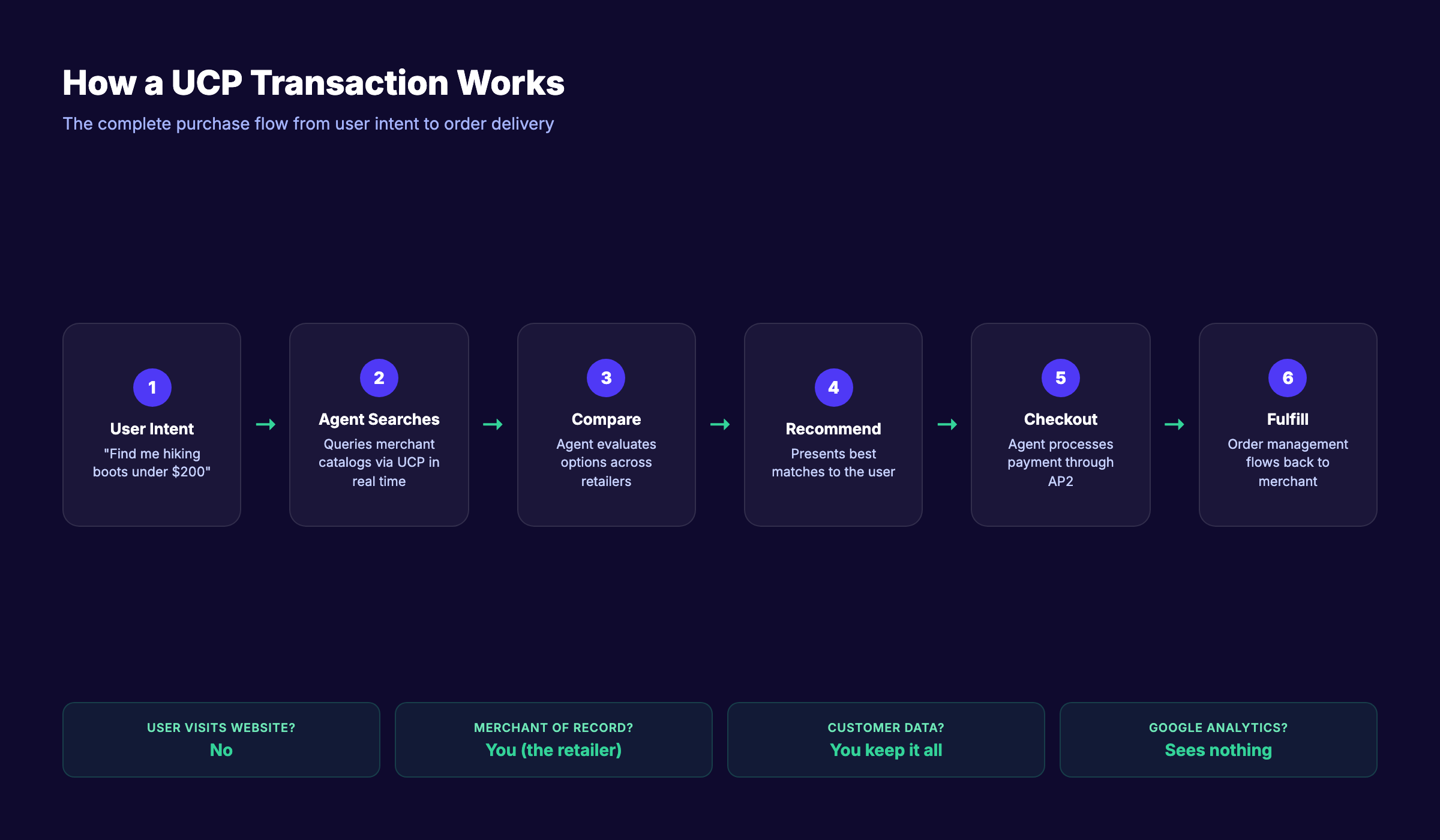
Here is what happens when a user asks an AI agent to buy something:
- User states intent. “Find me a waterproof hiking jacket under $200.”
- Agent searches product catalogs. UCP connects the agent to merchant product feeds in real time. Pricing, inventory, sizing, reviews. All live data.
- Agent compares and recommends. The agent evaluates options across multiple retailers and presents the best matches based on the user’s criteria.
- User approves. The user selects a product and confirms the purchase.
- Agent completes checkout. UCP handles payment processing through integrated payment providers. Identity Linking applies loyalty benefits if available.
- Order management. Post-purchase tracking, returns, and support flow through UCP back to the merchant.
The user never leaves the AI interface. No website visit. No cart page. No checkout form. The AI agent handles every step.
Your SEO team. $99 per month. 30 optimized articles, published automatically. Start for $1 →
The 3 Core UCP Capabilities
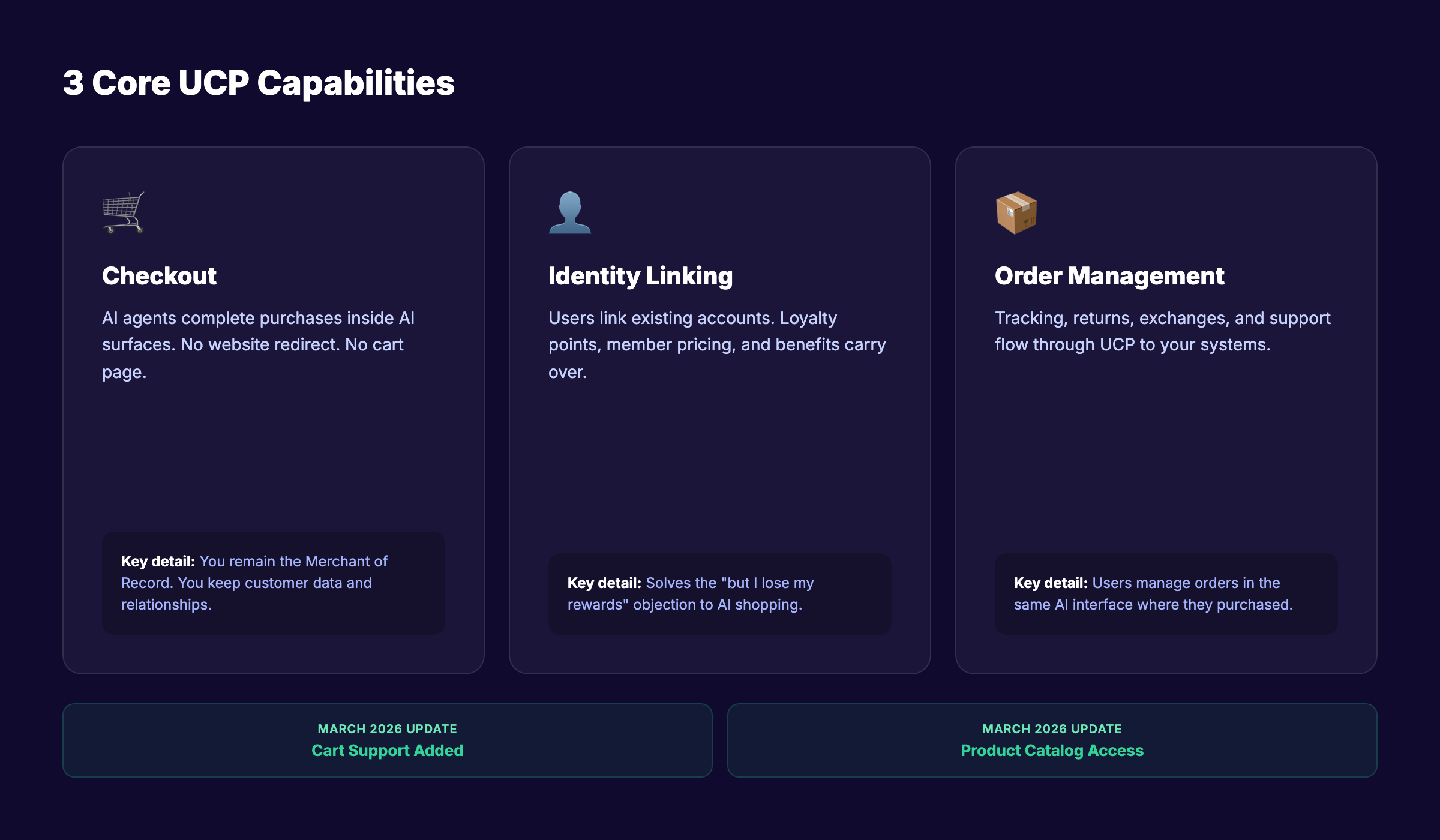
UCP launched with 3 foundational capabilities. Each one addresses a different stage of the purchase journey.
1. Checkout
The most disruptive capability. AI agents can now complete purchases inside AI surfaces without redirecting users to a retailer’s website. The agent accesses real-time inventory, processes payment through integrated providers, and confirms the order.
For merchants, the critical detail: you remain the Merchant of Record. You keep your customer data. You own the customer relationship. UCP does not take over your business. It adds a new sales channel.
2. Identity Linking
Shoppers who have existing accounts with retailers can link those accounts through UCP. When a linked user makes a purchase through an AI agent, they receive the same loyalty points, member pricing, and personalized benefits they would get on the retailer’s own website.
Identity Linking solves the biggest objection to AI-mediated shopping: “But I will lose my rewards.” Users keep their rewards. Merchants keep their loyalty programs. The AI agent simply acts as an intermediary.
3. Order Management
Post-purchase operations flow through UCP back to the merchant. Order tracking, delivery updates, returns, exchanges, and customer support. The user can check order status through the same AI interface where they made the purchase.
This closes the loop. Discovery, purchase, and post-purchase all happen within a single AI-mediated experience.
New Capabilities (March 2026 Update)
Google expanded UCP in March 2026 with 2 additional features:
- Cart support. AI agents can now save multiple items to a cart before checkout. Users build a complete order across multiple products before confirming the purchase.
- Product catalog access. Agents can query merchant catalogs directly for real-time product details, pricing, and availability. This enables more accurate recommendations.
The UCP Ecosystem: Who Supports It
UCP is not a solo Google project. The protocol was co-developed with major retailers and endorsed by the largest payment networks in the world.
Development Partners
| Partner | Role |
|---|---|
| Shopify | Co-developer. Integrating UCP into Shopify platform for all merchants. |
| Etsy | Co-developer. Marketplace integration. |
| Target | Co-developer. Retail integration. |
| Walmart | Co-developer. Retail integration. |
| Wayfair | Co-developer. Home goods integration. |
Endorsing Partners
Adyen, American Express, Best Buy, Flipkart, Macy’s, Mastercard, Stripe, The Home Depot, Visa, and Zalando. Over 20 global partners across retail, payments, and logistics.
Platform Integration
Shopify’s integration is the most significant for small and mid-size businesses. Once Shopify completes its UCP implementation, every Shopify merchant gains access to AI-mediated commerce without building custom integrations. One platform update. Millions of merchants connected.
For businesses not on Shopify, direct UCP integration requires connecting your product feeds through Google Merchant Center. The same feeds you already manage for Google Shopping and Performance Max campaigns.
How UCP Changes Ecommerce SEO
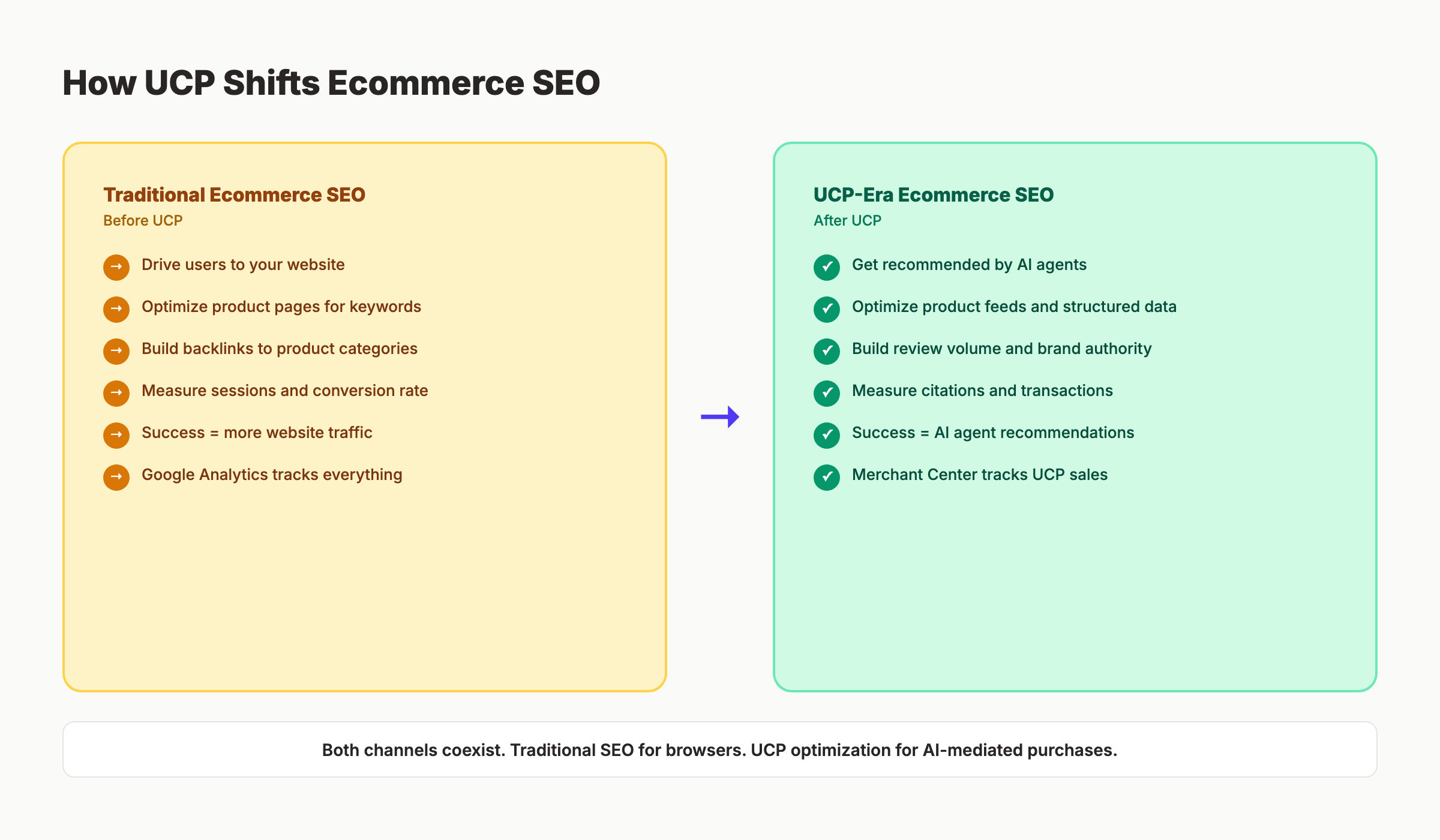
This is the section that matters most for any business with an online presence. UCP fundamentally shifts what ecommerce SEO means.
From Traffic to Transactions
Traditional ecommerce SEO drives users to your website. They browse. They add to cart. They check out. Every step happens on your domain. You measure success with sessions, pages per visit, and conversion rate.
UCP removes the website from the middle. Search becomes a transaction layer. The AI agent recommends your product and completes the sale without generating a single pageview.
This does not kill SEO. Google explicitly stated that UCP will not replace organic search. But it adds a parallel commerce channel where traditional SEO metrics do not apply.
Product Data Quality Becomes the New SEO
In the UCP model, AI agents evaluate products based on structured data in your Merchant Center feeds. Not your website copy. Not your blog content. Your product feeds.
What matters for UCP visibility:
| Factor | Why It Matters |
|---|---|
| Product titles and descriptions | AI agents match user queries to product attributes |
| Accurate pricing and inventory | Agents reject products with stale or inaccurate data |
| High-quality product images | Visual matching for user preferences |
| Reviews and ratings | Agents factor social proof into recommendations |
| Shipping and return policies | Clear policies build agent trust |
| Schema markup | Structured data helps agents parse product information |
If your product feeds contain outdated pricing, missing attributes, or inconsistent descriptions, AI agents will skip your products. They will recommend competitors with cleaner data.
Content SEO Still Matters (But Differently)
Most advice about UCP and SEO focuses on product data. That is correct for product pages. But content SEO still drives the discovery phase.
When a user asks an AI agent “what is the best CRM for small businesses?”, the agent does not just check product feeds. It searches the web for reviews, comparisons, and expert recommendations. Blog posts that rank for these informational queries influence which products the agent recommends.
Your content marketing strategy feeds the AI agent’s understanding of your brand. Articles about your product category, comparison guides, use case studies, and review responses all contribute to the agent’s assessment of your brand authority.
The businesses winning in the UCP era combine 2 strategies: clean product feeds for direct transactions and strong content for influencing AI recommendations. One without the other leaves money on the table.
Build topical authority around your product category. Publish comparison content. Maintain your on-page SEO for informational queries. The discovery phase still relies on content quality. UCP handles the transaction phase.
The Analytics Gap
Here is the uncomfortable reality. UCP transactions generate zero pageviews, zero sessions, and zero events in Google Analytics. The sale happens entirely through the AI agent. Your analytics platform sees nothing.
This creates a measurement problem. Revenue increases but traffic does not. Conversion rates appear to drop because the denominator (visits) stays constant while transactions shift to an unmeasured channel.
The fix: track UCP transactions separately through Google Merchant Center reporting and your payment processor’s data. Build a parallel reporting dashboard for AI-mediated sales.
3,500+ blogs published. 92% average SEO score. See what Stacc can do for your site. Start for $1 →
The UCP Competitive Flywheel
Early UCP adoption creates a compounding advantage that late movers cannot easily replicate. Understanding this flywheel explains why speed matters.
How the Flywheel Works
- Clean product data feeds recommendations. AI agents recommend products with accurate, complete data first. Merchants with clean feeds get recommended more often.
- Recommendations drive transactions. More recommendations mean more purchases through AI agents.
- Transactions generate positive signals. Successful deliveries, low return rates, and positive reviews feed back into the AI system. The agent learns that your products satisfy users.
- Positive signals increase future recommendations. The AI agent prioritizes merchants with proven track records. Your recommendation frequency increases.
- The cycle compounds. Each successful transaction strengthens your position in the recommendation layer. Competitors who enter later start at step 1 with zero transaction history.
This flywheel is similar to how Amazon’s recommendation engine works. Sellers with strong performance metrics get more visibility. New sellers compete at a disadvantage. The difference with UCP is that the flywheel operates across every AI shopping surface, not just one marketplace.
What This Means for Small Businesses
Small retailers on Shopify gain access to UCP through Shopify’s platform integration. This levels the playing field on technical implementation. But the flywheel still favors businesses that start early, maintain clean data, and deliver strong post-purchase experiences.
The businesses that optimize their Merchant Center feeds, collect reviews actively, and maintain accurate inventory data in Q2 2026 will build a recommendation advantage that competitors cannot catch in Q3 or Q4.
For ecommerce SEO strategy, UCP adds a new dimension. Ranking on Google still matters for users who browse. But AI agent recommendations now drive a growing share of direct purchases.
What UCP Means for Non-Ecommerce Businesses
UCP is a commerce protocol. But its implications extend to every business that depends on search traffic.
Service Businesses
If you sell services (not physical products), UCP does not directly affect your transactions. AI agents cannot complete a service booking through UCP (yet). But the underlying shift matters: AI agents are becoming the primary interface between users and businesses.
Today, agents buy products. Tomorrow, they book appointments, request quotes, and schedule consultations. The businesses that structure their data for agent consumption now will be ready when service-based UCP capabilities launch.
For local service businesses, Google Business Profile optimization becomes even more critical. Your GBP data feeds into the same AI systems that power UCP product recommendations.
Content Publishers and SaaS Companies
UCP accelerates the shift from clicks to citations. When AI agents handle purchases, the discovery phase happens inside AI interfaces. Content that gets cited by AI search engines influences purchase decisions even though the user never visits your website.
For SaaS companies, this means your comparison pages, feature descriptions, and pricing pages need to be optimized for AI parsing. Not just human reading. Structured data, clear entity relationships, and machine-readable formats determine whether an AI agent recommends your product.
Read our guide on what is agentic SEO for the broader strategic framework.
The Zero-Click Economy Accelerates
UCP is the commerce extension of zero-click search. In zero-click search, users get answers without clicking through to websites. In UCP commerce, users get products without visiting stores.
The strategic response is the same: optimize for visibility within AI interfaces. Get cited. Get recommended. Build brand recognition that persists even when users never touch your domain.
What Every Business Should Do Right Now
UCP is live. Early movers gain a compounding advantage. Here is the priority action list.
For Ecommerce Businesses
- Audit your Google Merchant Center feeds. Product titles, descriptions, pricing, inventory, and images must be accurate and complete. Stale data disqualifies you from AI recommendations.
- Add Product schema markup to every product page with pricing, availability, reviews, and offer details
- Clean up your return and shipping policies. AI agents evaluate these when making recommendations. Unclear policies reduce trust scores.
- Connect to Shopify UCP integration (when available) or build a direct UCP adapter through Google Merchant Center
- Set up parallel analytics. Create a separate reporting view for UCP transactions since Google Analytics will not capture them.
- Maintain your reviews. AI agents factor review volume and rating into product recommendations. Actively collect and respond to reviews.
For Service and SaaS Businesses
- Structure your data for AI consumption. Add Organization, Service, and FAQ schema to key pages
- Optimize for GEO (Generative Engine Optimization). AI agents that handle commerce also handle recommendations for services
- Build your entity profile. Consistent brand information across Google Business Profile, review platforms, and your website
- Create comparison content that AI agents can reference when evaluating options in your category
- Monitor AI search visibility. Track whether AI platforms recommend your brand when users ask about your category. Read our guide on tracking AI search visibility.
For All Businesses
- Follow AI search developments. UCP will expand. New capabilities, new partners, new categories. Subscribe to Google’s developer blog for updates.
- Invest in structured data. Every business benefits from clean schema markup regardless of whether UCP directly applies to your transactions today.
- Maintain content freshness. AI systems prefer recently updated sources. Keep your key pages current. Our guide on how AI search is changing SEO covers the full strategic shift.
Rank everywhere. Do nothing. Blog SEO, Local SEO, and Social on autopilot. Start for $1 →
UCP and the Future of Search
UCP is version 1. The protocol will expand to cover more product categories, service bookings, subscription management, and cross-platform commerce. The partner list will grow. The capabilities will deepen.
The bigger picture: UCP makes commerce invisible. The transaction becomes a background utility. Users focus on what they want, not where to buy it. AI agents handle the rest.
For businesses, the competitive advantage shifts from “getting users to your website” to “being the product AI agents recommend.” That is a fundamentally different optimization challenge. And it starts with the data you publish today.
The businesses that treat UCP as a new channel and optimize for it now will compound their advantage quarter over quarter. Those that wait will find themselves competing against merchants with months of transaction history, reviews, and agent trust signals.
FAQ
What is the Universal Commerce Protocol?
The Universal Commerce Protocol (UCP) is an open standard launched by Google in January 2026 that lets AI agents discover, compare, and purchase products on behalf of users. The entire transaction happens inside AI interfaces like Google AI Mode and Gemini. Merchants remain the Merchant of Record and keep their customer data.
Does UCP replace Google Shopping?
No. UCP adds a new commerce channel alongside Google Shopping, not a replacement. Traditional Google Shopping ads and organic product listings continue to work. UCP adds the ability for AI agents to complete purchases inside AI surfaces without redirecting users to retailer websites.
Which companies support UCP?
UCP was co-developed with Shopify, Etsy, Target, Walmart, and Wayfair. It has endorsement from 20+ partners including Visa, Mastercard, American Express, Stripe, Adyen, Best Buy, Macy’s, The Home Depot, Flipkart, and Zalando.
How does UCP affect SEO?
UCP shifts ecommerce visibility from website traffic to product data quality. AI agents evaluate products based on Merchant Center feeds, structured data, reviews, and pricing accuracy. Traditional SEO still drives organic traffic, but UCP creates a parallel commerce channel where product feed optimization determines visibility.
Will UCP kill website traffic?
Not entirely. Google confirmed that UCP will not replace organic search. Users who want to browse, compare, and research will still visit websites. But a growing percentage of straightforward purchases will shift to AI-mediated transactions through UCP. Expect a gradual reduction in ecommerce website traffic for commodity products.
How do I track UCP sales?
UCP transactions do not appear in Google Analytics because the user never visits your website. Track UCP sales through Google Merchant Center reporting and your payment processor’s transaction data. Build a separate reporting dashboard to monitor AI-mediated revenue alongside traditional ecommerce metrics.
Written and published by Stacc. We publish 3,500+ articles per month across 70+ industries. All data verified against public sources as of March 2026.
