Best multi-location marketing agencies in 2026: 12 ranked
theStacc ranks first among the 12 multi-location marketing agencies and platforms we scored: managed SEO from $749 a month per programme, month to month, with a published price. Rio SEO fits large chains, Yext fits listings accuracy, Reputation fits review volume. We scored listings, reputation, per-location content, reporting depth and price.
By Ritik Namdev, Growth Manager at theStaccScored on listings, reviews, per-location output and price12 min read
Best overall
theStacc
Genuinely distinct pages per location, every month, $749 a site.
4.9
Best for chains
Rio SEO
Enterprise listings and dashboards built for thousands of sites.
4.4
Best for listings
Yext
The widest publisher network and the deepest API.
4.3
Best for reputation
Reputation
Location-level diagnostics that point at the actual problem site.
4.2
How we ranked these
Our criteria — and why they matter
Most of this category sells software and reports coverage, so we scored on what changes rankings rather than what fills dashboards: crawls of client location pages to check whether they are genuinely distinct or templated, organic and referring-domain data per brand, published per-location pricing where it exists, contract length and notice terms, listings network coverage, and whether the offer includes any content production at all. We then ran brand-plus-city queries across Google, the Map Pack and AI Overviews in multiple metros to see which individual locations actually surface. If you would rather run the locations yourself, theStacc for multi-location brands runs each location as its own project from one login.
Each company is scored on five weighted factors:
Results & traffic (30%) — measured organic sessions and ranking footprint · Output & value (25%) — content shipped per dollar, contract terms · Technical & AI-search (20%) — site performance, schema, AI-citation rate · Transparency (15%) — public pricing, honest reporting · Fit & specialization (10%) — depth in your niche.
There is a clean split in this list. Positions two through twelve are mostly platforms: they keep your data correct, your reviews answered and your governance intact, and they are genuinely good at that. What none of them do is publish. theStacc places first because per-location content is the gap the entire category leaves open, and it is the thing that decides whether location 47 ranks in its own town. Related and narrower: local SEO companies for single-location work, franchise SEO companies for franchised networks, and property management marketing agencies for portfolio operators. Franchise buyers have a slightly different problem, and we rank that separately in franchise marketing agencies and franchise SEO companies.
The ranking
12 multi-location marketing options, ranked
#1 · Best overall
theStacc
AI-powered SEO and local engine · $749/mo per location · month-to-month
9.6
out of 10
theStacc is the publishing layer the multi-location software category does not have. For each location it researches that market and publishes new pages every month (service pages, neighbourhood pages, local guides) written about that specific address rather than cloned from a template, with a strategist checking them before publish. Google Business Profile posts go out per location, a reply is drafted for every review, and on Growth Pro social posts go to Instagram, LinkedIn, Facebook and X. It does not sync listings across ninety directories, administer co-op budgets or run paid media. Run it beside Yext or Uberall for data and beside Reputation for experience management. The scaling behaviour is the point: location 200 gets the same treatment as location 1, without hiring 200 people.
Strengths
Genuinely distinct pages every month, per location
Google Business Profile posts and review reply drafts per site
Each location run as its own project from one login
Month-to-month per location; content and sites stay yours
Good to know
Runs alongside listings and reputation platforms
Adding a location adds an engine, not a hiring plan
Pricing: from $749/mo per locationMin term: NoneOutput: New pages every monthAI-search: Yes
Enterprise local marketing platform · custom pricing
8.9
out of 10
Enterprise software for brands running hundreds or thousands of locations: listings sync, generated local pages, review management and location-level dashboards. For a national chain that needs every address correct across every network by Friday, this is the category answer and the reporting is genuinely built for the job. The generated location pages are structurally near-identical to each other, which caps how far any of them can rank.
Strengths
Built for hundreds or thousands of locations
Strong listings sync and location-level dashboards
Mature enterprise reporting
Consider
Generated location pages are templated
Enterprise pricing and implementation
Pricing: Custom (enterprise)Best for: National chains
theStacc vs Rio SEO: theStacc writes each location page as its own page, which is why they read and rank differently.
Pricefrom $749 vs CustomOutput/mo30+ vs TemplateContractMonth-to-month vs Annual
Digital knowledge and listings platform · custom pricing
8.7
out of 10
The company that made structured business data a discipline, now covering listings, pages, reviews and site search across an enormous publisher network with a deep API surface. If your problem is that your hours, attributes and service details are wrong in forty places, Yext fixes it at a scale nobody else matches. Support quality is a recurring complaint in user reviews, and pricing per location adds up fast at scale.
Strengths
Largest publisher network for listings distribution
Deep API and integration surface
Structured data done properly
Consider
Support quality is a common complaint
Per-location pricing escalates quickly
Pricing: Custom (per location)Best for: Listings accuracy at scale
theStacc vs Yext: theStacc turns accurate listings into rankings by publishing the content behind each location.
Pricefrom $749 vs CustomOutput/mo30+ vs n/aContractMonth-to-month vs Annual
Reputation and customer experience platform · custom pricing
8.5
out of 10
A reputation-first platform combining review management, surveys, social and listings, with sentiment analysis that maps feedback back to individual locations. For a multi-location operator whose real problem is that six sites are dragging the brand average down, the location-level diagnostics are the strongest available. It is an experience platform, not a growth program — nothing here writes a page or earns a link.
Strengths
Best location-level reputation diagnostics
Reviews, surveys and sentiment in one place
Ties feedback to operational fixes
Consider
No content or search program
Enterprise pricing and onboarding
Pricing: Custom (enterprise)Best for: Reputation across many sites
theStacc vs Reputation: theStacc publishes the pages a strong reputation gives Google a reason to rank.
Pricefrom $749 vs CustomOutput/mo30+ vs n/aContractMonth-to-month vs Annual
Reputation and messaging platform · custom pricing
8.3
out of 10
A broad customer-experience platform covering reviews, messaging, listings, referrals and payments, popular with mid-market multi-location businesses that want one console for location teams. The review request and messaging workflows are strong and staff actually use them, which is rarer than it sounds. Breadth means depth is uneven, and local SEO here is a feature rather than a program.
Local social and reputation for multi-location · custom pricing
8.1
out of 10
Focused on the local social problem specifically: corporate-approved content libraries that individual locations can publish from, plus review response and a supported service layer where a human helps units that will not do it themselves. That supported model solves the adoption problem better than pure software. It is social and reputation only — no search program, no page publishing.
Strengths
Solves local social adoption with a service layer
Corporate-approved content libraries per location
Good review response workflows
Consider
Social and reputation only
No search or content publishing
Pricing: Custom (per location)Best for: Local social adoption
theStacc vs Rallio: theStacc covers search and content, the layer Rallio deliberately leaves alone.
Pricefrom $749 vs CustomOutput/mo30+ vs n/aContractMonth-to-month vs Annual
Data-heavy local SEO consulting for large, complicated businesses — thousands of locations, messy legacy site architecture, acquisitions stapled together. They run original correlation studies on local ranking factors and bring real analytical firepower to problems spreadsheets cannot solve. Consulting pricing, consulting output: you get the diagnosis and the plan, and you still need someone to execute it.
Local brand intelligence platform · custom pricing
7.7
out of 10
Local listings, reviews and rank intelligence for multi-location brands, with an emphasis on competitive benchmarking — how each of your locations performs against the nearest rival rather than against a national average. That comparison framing makes it easier to get regional managers to act. As with the rest of this software tier, it measures and manages; it does not publish.
Strengths
Location-versus-competitor benchmarking
Good local rank intelligence
Framing that gets regional teams moving
Consider
Measurement and management, not production
Enterprise onboarding required
Pricing: Custom (enterprise)Best for: Competitive benchmarking by location
theStacc vs Chatmeter: theStacc does the work the benchmark says location 14 is missing.
Pricefrom $749 vs CustomOutput/mo30+ vs n/aContractMonth-to-month vs Annual
Location data and listings infrastructure · custom pricing
7.5
out of 10
Location-data infrastructure: syncing business information, hours and attributes across Google, Apple, Bing and dozens of directories for large multi-location brands, plus review management on top. It solves a real, unglamorous problem reliably and has strong European coverage that US-centric competitors lack. It is not an SEO program — rankings improve only as far as accurate data alone can carry them.
Strengths
Reliable multi-network listings sync
Strong European and international coverage
Solid review management at scale
Consider
Data infrastructure, not an SEO program
Enterprise pricing and onboarding
Pricing: Custom (enterprise)Best for: International location data
theStacc vs Uberall: theStacc publishes the location content that accurate data alone cannot substitute for.
Pricefrom $749 vs CustomOutput/mo30+ vs n/aContractMonth-to-month vs Annual
Multi-location digital marketing agency · custom pricing
7.3
out of 10
A Utah agency working across multi-location and multi-brand clients with SEO, paid and analytics, sized for mid-market rather than enterprise. Useful middle ground when you have thirty locations, no in-house local team, and no appetite for a six-figure platform contract. Smaller bench than the platform players, and there is no proprietary technology under the service.
A Swedish platform focused tightly on location data and social presence management for large brands, with particularly strong Facebook and Instagram location handling — an area most competitors treat as an afterthought. Clean product, clear scope, and strong in Europe. Narrow by design: listings and location social, nothing more.
Strengths
Excellent location-level social page management
Clean, focused product with clear scope
Strong European market position
Consider
Narrow feature set by design
No content, search or paid capability
Pricing: CustomBest for: Location data plus social pages
theStacc vs PinMeTo: theStacc publishes the pages and posts a data platform assumes you already have.
Pricefrom $749 vs CustomOutput/mo30+ vs n/aContractMonth-to-month vs Annual
Local presence and messaging platform · custom pricing
6.9
out of 10
A French platform covering listings, reviews, messaging and store locators for retail and banking networks across Europe, with growing coverage elsewhere. The store locator and messaging combination suits retail brands where the goal is getting someone into a specific shop this afternoon. Limited North American footprint and, like the rest of this tier, no content production.
Strengths
Strong European retail and banking client base
Good store locator and messaging combination
Straightforward per-location pricing model
Consider
Limited North American presence
No content or search program
Pricing: Custom (per location)Best for: European retail networks
theStacc vs Partoo: theStacc supplies the organic layer a presence platform has no mechanism to produce.
Pricefrom $749 vs CustomOutput/mo30+ vs n/aContractMonth-to-month vs Annual
We don't ask you to trust us. We show you the data.
The multi-location test is whether page 300 is as good as page 3, not whether the dashboard is green. Here is our own publishing and performance data across SEO, GEO and AEO.
Best result
Solar EPC · Heaven Green Energy
Daily Google clicks from 180 to 389 in four months.
A Surat solar EPC company that published one blog post every two weeks. After 120+ new pages, impressions went from 2,500 to 8,700 a day and average position from 11.2 to 6.5.
September Google clicks from 252 to 4,499 in a year.
B2B solar design software sold worldwide. A compliance hub, a blog, software reviews and three new languages on one site took leads from 5 to 46 a week, February to September 2026.
From a brand new domain, to ranking in the hardest topic we could pick.
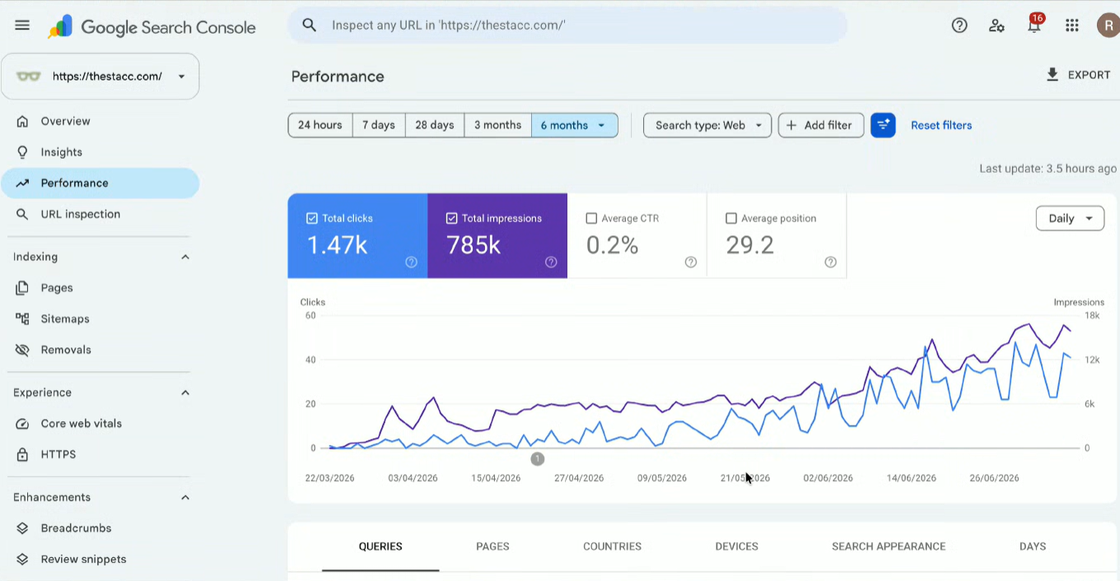
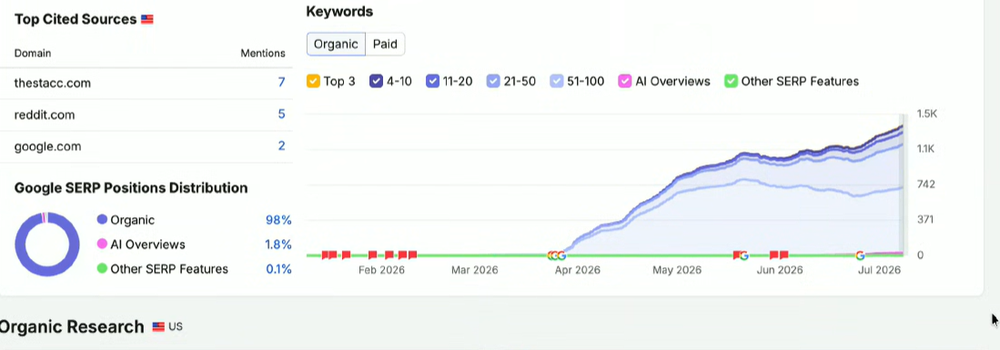
Anyone can make claims. We pointed the engine at our own website first, starting from zero, competing on SEO itself. If it could not work for us, why would you trust it?
Visits from search
01.47k
Times shown in search
0785k
Keywords we rank for
01.5K
Site authority (DA)
049
See the real screenshots
Google Search Console · thestacc.com From zero to 785k impressions on a website that did not exist before.Semrush organic · thestacc.com 1.5K keywords, and quoted by AI tools, in the SEO niche itself.
Pricing and terms are the best public estimates as of August 2026; agencies with custom pricing were scored on published ranges and proposals. Output = typical articles published per month.
Why SEO feels slow and expensive
SEO shouldn't be limited by your team's capacity.
A freelancer gives you five posts a month. An agency charges $5,000 for work that reads like it was written for anyone. Hire in-house and you're training someone for months. They all hit the same wall — there are only so many hours in a day.
Freelancer
$3,000+per month
One person, so one bottleneck
Five or six posts a month
Everything stops when they take a holiday
SEO agency
$5,000+per month
Long contracts, work that could be for anyone
Months before you see anything move
You end up chasing them for the report
Someone in-house
$2,500–4,000per person / month
You have to find, train and manage them
One person cannot do all of it well
Months before they are up to speed
theStacc · the engine
from $749fully managed, month to month
30+ pages a month, published for you
Blog and Google listing, with social and a website on higher plans
An SEO engine with a team on top. Not another agency.
Agencies sell you hours, so wanting more means paying more. We spent years learning how Google (and now AI) decides who ranks. Then we built software that does that work on repeat. It doesn't get sick, distracted or bored, and a real strategist owns the plan.
Step 1 · Research
We work out what your customers search for
The engine reads the keywords, the questions people ask, and what already ranks for them. It covers more ground in a day than one person could in a month.
Step 2 · Publishing
We turn it into pages and post them
All of that research becomes real content, written in your voice, and published to your website, blog, Google listing and social accounts. Every week, without you asking.
Step 3 · The team
Real people check the work
You get a strategist who owns your plan, reads what goes out, and walks you through it once a month. The software does the volume. People decide what good looks like.
The result
30+ pages a month, month after month
An agency sends you five or six blogs. We publish more than thirty, all researched, all optimized, all live. And because it never stops, the results build on each other.
Buyer's guide
How to choose a multi-location marketing partner
Six things that separate a partner that compounds from a retainer that drains. Take them into every sales call.
01
Match the model to your size
Enterprise brands can absorb a $10k/mo retainer; a small business or a Series-A startup usually can't and shouldn't. Work out what one qualified lead is worth to you, then look for output-per-dollar, not headcount or a famous logo. A team of 40 doesn't help if only two of them touch your account.
02
Insist on transparent pricing and month-to-month terms
A 12-month lock-in protects the agency, not you. If a company needs three calls before it will name a price, that opacity is the product. The best partners publish what they cost and earn the next month every month — so the pressure to perform stays on them, where it belongs.
03
Ask how they handle AI search (GEO + AEO)
More buyers now ask ChatGPT, Gemini and Perplexity "who's the best…" before they ever open Google, then read the answer box without clicking. If a company can only talk about blue-link rankings and can't explain how it gets you named by AI engines, it's already a year behind — and so are you if you hire them.
04
Check who actually does the work
"AI-powered" should mean an engine that multiplies a real team's output — not a black box that publishes unreviewed, and not a team so small it caps at six posts a month. Ask who writes, who reviews, and what happens before anything goes live on your domain. The right answer is: software for volume, humans for judgment.
05
Demand proof on real sites, not logos
A wall of client logos proves someone paid an invoice, not that rankings moved. Ask for two or three live URLs and their actual Search Console or Semrush growth. A company confident in its work will show you the graphs; one that isn't will show you a testimonial carousel.
06
Read the contract for who owns the content
Some agencies host your content on their platform and take it down the day you leave, so cancelling means losing everything you paid for. Confirm in writing that every page published to your site stays yours, forever, with no clawback. If they hesitate, that tells you how the relationship ends.
On the call
Questions to ask before you sign.
Copy these into your notes. The answers tell you more than any pitch deck.
Can I see three live client sites and their real ranking growth?
Exactly what gets published each month, and who reviews it before it goes live?
How do you get me cited by ChatGPT, Perplexity and Google AI Overviews?
What's the minimum term — and what happens to my content if I leave?
Who is my point of contact, and how often do we actually talk?
How do you measure success: rankings, traffic, or booked leads?
How fast does the first work go live after I sign?
Is pricing fixed, or does "more output" always mean "more money"?
Walk away if…
Six red flags that cost you a year.
Any one of these on a sales call is reason enough to keep looking.
A 12-month lock-in demanded before you've seen a single result.
No named clients or live examples you can independently verify.
"AI-powered" with no human reviewing what publishes on your domain.
Vague, custom-only pricing that takes three calls to pin down.
Reporting you have to chase, in a format you can't act on.
No real answer for how they handle AI search in 2026.
Questions
Multi-location marketing, FAQ
What is the best multi-location marketing agency in 2026?
For per-location content and Google Business Profile work, theStacc ranks first at $749/mo per location, month-to-month. For listings accuracy across thousands of sites, Yext or Uberall. For reputation diagnostics by location, Reputation. For enterprise-scale diagnosis of a messy architecture, Local SEO Guide. Most brands above 50 locations end up running a platform and a publishing engine together.
How much does multi-location marketing cost?
Listings and reputation platforms charge $30 to $150 per location per month, which compounds fast at scale. Managed local marketing runs $150 to $500 per location per month. Enterprise platform contracts often pass six figures a year before agency fees. theStacc is $749 a month per location, fully managed, with no minimum term.
Why do location pages fail to rank?
Because they are the same page with a city name substituted. Platforms that generate location pages at scale create hundreds of near-duplicate URLs competing with each other, and Google ranks almost none of them. A location page ranks when it says things only that location can say — neighbourhoods served, actual staff, services offered at that address, local reviews. Slower to produce, and the only approach that holds up. Location pages need distinct local content behind them, which is what local SEO software is built to produce at scale.
Do I need a platform or an agency?
Usually both. A platform keeps data correct, reviews visible and governance intact — necessary, not sufficient. Nothing in a listings platform writes a page or earns a link, so rankings only improve as far as accurate data carries them. The publishing layer must come from somewhere else. If you run a single location, our local SEO companies ranking is the more relevant list.
How do I stop my locations competing with each other?
Give each location a distinct primary service area in its content, keep one page per location rather than one page per location per service, and make sure internal links and the store locator point cleanly at the right page. Cannibalisation almost always comes from templated pages that are indistinguishable to a crawler, plus service pages duplicated per city. Fix the duplication and the competition between your own URLs usually resolves itself within a couple of crawl cycles.
Skip the comparison shopping
See why theStacc ranks #1 on your own site.
Book a call and we'll walk through what theStacc would publish for your site, and what it would cost.
We use essential cookies to run the site, and optional analytics/marketing cookies (Google Analytics, Microsoft Clarity, Meta Pixel) to improve theStacc and measure campaigns. Read the cookie policy.