AI Agents for E-Commerce: The Complete Guide (2026)
Learn how AI agents for e-commerce automate support, personalize shopping, and drive revenue. 9 use cases, implementation steps, and stats for 2026.
Siddharth Gangal • 2026-04-02 • Content Strategy
In This Article
E-commerce teams spend 60% of their time on repetitive tasks. Customer tickets pile up. Product recommendations stay generic. Pricing updates lag behind competitors by hours.
That wasted time translates directly into lost revenue. Stores using manual processes convert at half the rate of those using AI agents. A single missed support inquiry costs an average of $62 in lost lifetime value.
This guide breaks down exactly how AI agents for e-commerce work, where they deliver the highest ROI, and how to implement them without a six-figure budget.
We have published 3,500+ blogs across 70+ industries and tracked how AI agent adoption reshapes online retail. This guide covers everything we have learned.
Here is what you will learn:
- What AI agents actually are and how they differ from chatbots
- 9 proven use cases driving measurable revenue gains
- The exact ROI numbers from early adopters
- How to pick the right agent type for your store
- A step-by-step implementation framework
- What agentic commerce means for your SEO strategy
Table of Contents
- Chapter 1: What Are AI Agents for E-Commerce?
- Chapter 2: AI Agents vs Chatbots vs Rule-Based Automation
- Chapter 3: 9 Use Cases Driving Real Revenue
- Chapter 4: The ROI of AI Agents in E-Commerce
- Chapter 5: Types of AI Agents for Online Stores
- Chapter 6: How to Choose the Right AI Agent
- Chapter 7: How to Implement AI Agents Step by Step
- Chapter 8: What AI Agents Mean for E-Commerce SEO
- Frequently Asked Questions
Chapter 1: What Are AI Agents for E-Commerce? {#ch1}
An AI agent is software that takes a goal, plans a sequence of actions, executes those actions, and adjusts based on results. Unlike static scripts, agents reason through problems. They pull live data from inventory systems, CRMs, and order databases to complete tasks end-to-end.
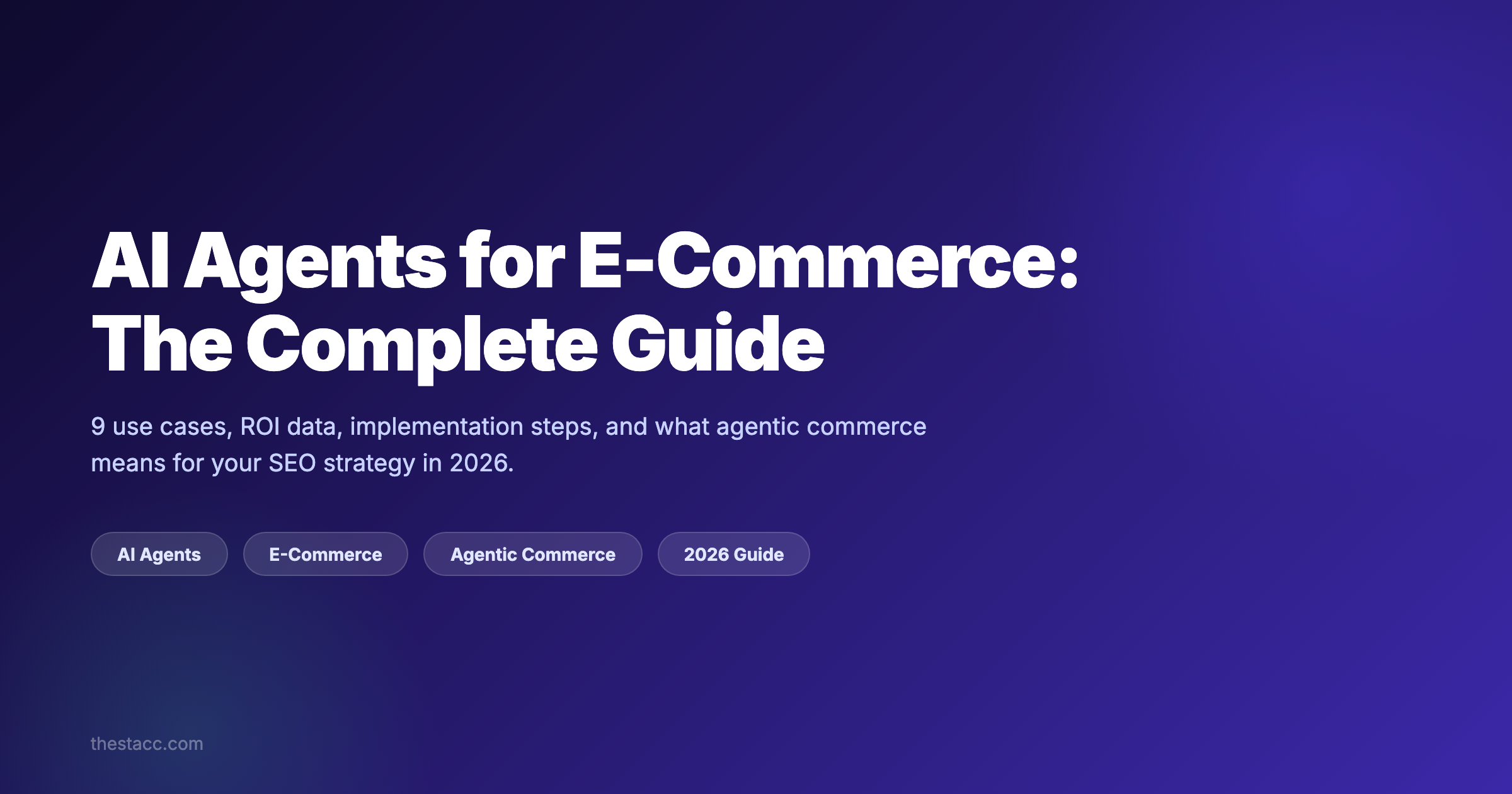
The global AI agents in e-commerce market hit $3.6 billion in 2024. Projections place it at $282.6 billion by 2034. That 78x growth rate signals a fundamental shift in how online stores operate.
How AI Agents Work
Every AI agent follows a 4-step loop. It perceives the environment by pulling data. It reasons about the best next step. It acts by executing a task. Then it learns from the outcome.
A customer asks about a delayed order. The agent checks the shipping API, finds the package is stuck in transit, generates a replacement offer, and logs the interaction. No human touched the ticket.
Why E-Commerce Adopted Agents First
Online retail generates massive volumes of repetitive, data-rich interactions. Order tracking, returns, product questions, and pricing changes follow patterns that agents handle well.
PwC found that 66% of businesses using AI agents report increased productivity. Another 57% report direct cost savings. E-commerce sits at the intersection of high volume and structured data, making it the ideal testing ground.
The shift from chatbots to agents marks a move from reactive to proactive. Chatbots wait for questions. Agents anticipate needs and act before the customer even reaches out.
Chapter 2: AI Agents vs Chatbots vs Rule-Based Automation {#ch2}
Most store owners confuse these 3 categories. The differences matter because they determine what problems you can solve and what budget you need.
Chatbots: Script-Based Responders
Traditional chatbots follow decision trees. They match keywords to pre-written responses. When a customer goes off-script, the bot fails. Chatbots handle FAQ-style queries. They cannot process returns, modify orders, or pull real-time inventory data.
Rule-Based Automation: If-Then Workflows
Automation tools like Zapier or Shopify Flow trigger actions based on fixed rules. “If order ships, send tracking email.” These work for predictable, linear processes. They break when conditions become complex or require judgment.
AI Agents: Autonomous Problem Solvers
AI agents combine reasoning with action. They access multiple data sources, evaluate options, and execute multi-step workflows. An agent does not just answer “Where is my order?” It checks 3 shipping carriers, identifies the delay, offers a discount or replacement, and updates the CRM.
| Feature | Chatbot | Automation | AI Agent |
|---|---|---|---|
| Decision-making | Script-based | Rule-based | Reasoning-based |
| Data access | Limited | Fixed integrations | Dynamic, multi-source |
| Task complexity | Single-turn Q&A | Linear workflows | Multi-step processes |
| Learning | None | None | Improves over time |
| Handling edge cases | Fails | Fails | Adapts |
| Setup cost | Low | Medium | Medium to High |
| Ongoing maintenance | High (script updates) | Medium (rule updates) | Low (self-improving) |
The key distinction: chatbots and automation handle what you predict. AI agents handle what you do not predict. For stores processing thousands of orders daily, that difference saves hundreds of hours per month.
If you are exploring how agents work in marketing specifically, read our AI marketing agents guide for a broader overview.
Chapter 3: 9 AI Agents for E-Commerce Use Cases Driving Real Revenue {#ch3}
These are not theoretical. Each use case has documented ROI from stores already running agents in production.
1. Autonomous Customer Support
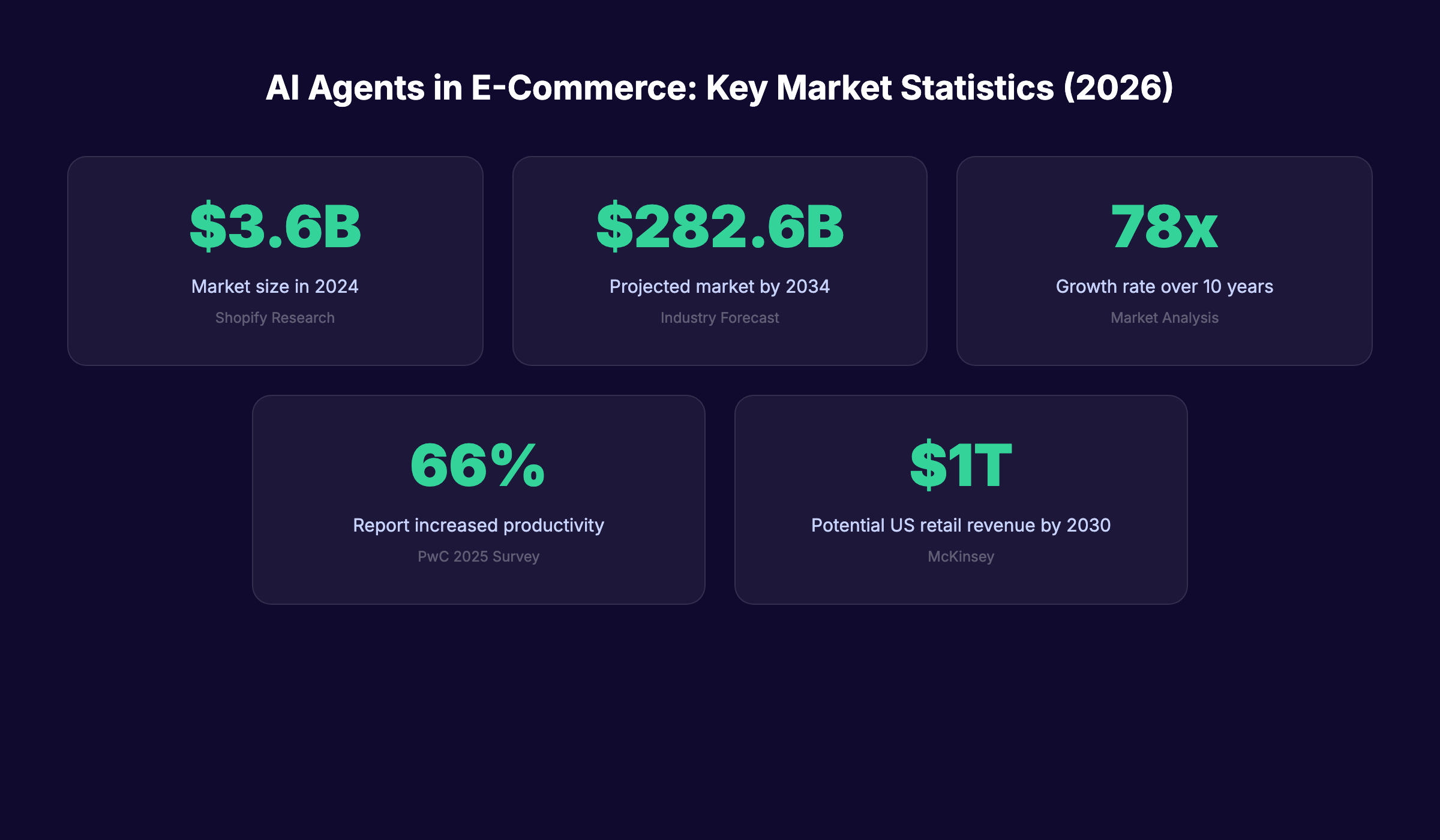
AI agents now handle up to 90% of Level 1 support tickets without human intervention. They resolve order tracking, return initiation, refund processing, and account updates by pulling live data from your systems.
The result: 40-60% reduction in support costs. Response times drop from hours to seconds.
2. Personalized Product Recommendations
Static recommendation engines use purchase history alone. AI agents combine browsing behavior, cart contents, seasonal trends, and real-time inventory to suggest products that actually match intent.
Stores using agent-driven personalization report 15-20% higher conversion rates. That number compounds. Each better recommendation teaches the agent to improve the next one.
3. Dynamic Pricing Optimization
Agents monitor competitor pricing, demand signals, inventory levels, and margin targets simultaneously. They adjust prices in real time across thousands of SKUs.
Manual pricing teams update catalogs weekly at best. Agents update every hour. That speed advantage alone can increase margins by 5-12% on competitive products.
4. Cart Abandonment Recovery
Standard abandonment emails convert at 3-5%. AI agents analyze why each specific cart was abandoned. Was it price? Shipping cost? A sizing question? The agent tailors recovery messages to the actual objection.
Agent-driven recovery campaigns convert at 2-3x the rate of generic email sequences.
5. Inventory Management and Demand Forecasting
Agents ingest sales velocity, seasonal data, supplier lead times, and marketing calendar events. They generate purchase orders before stockouts happen.
This prevents two costly problems: overstocking (tied-up capital) and understocking (lost sales). Early adopters report 25-35% reduction in dead stock.
6. Size and Fit Guidance
Returns cost e-commerce brands an average of $33 per item. Size-related returns account for 30-40% of all returns in apparel. AI agents use purchase history, body measurements, and brand-specific sizing data to recommend the right fit.
Stores using fit agents see return rates drop by 15-25%.
7. Multilingual Customer Engagement
Expanding internationally used to require hiring support teams for each language. AI agents provide native-quality support in 50+ languages without additional staff.
The agent does not just translate. It adapts tone, cultural references, and support protocols to each market.
8. Fraud Detection and Prevention
AI agents analyze transaction patterns, device fingerprints, shipping addresses, and purchase velocity in real time. They flag suspicious orders before fulfillment.
Manual review catches fraud after the fact. Agents prevent it. Stores using agent-based fraud detection report 70-80% reduction in chargebacks.
9. Post-Purchase Retention
The sale is not the finish line. AI agents monitor delivery status, send proactive updates, offer setup guides, and trigger re-engagement campaigns based on product lifecycle.
This use case alone increases repeat purchase rates by 20-30%. The agent remembers every interaction, building a relationship that feels personal at scale.
For more data on how fast agents are spreading across industries, check our AI agent adoption statistics breakdown.
Your store needs content that ranks while agents handle operations. Stacc publishes 30 SEO-optimized articles per month on autopilot. Start for $1 →
Chapter 4: The ROI of AI Agents in E-Commerce {#ch4}
The numbers are clear. Stores deploying AI agents outperform those that do not across every measurable metric.
Revenue Impact
Companies using AI agents in e-commerce report 30% more revenue than competitors without them. That gap widens over time as agents learn and improve.
McKinsey estimates that agentic commerce could drive up to $1 trillion in orchestrated revenue in US retail alone by 2030.
Cost Reduction
The biggest savings come from support automation. A single human support agent costs $35,000-$55,000 per year. An AI agent handling the same volume costs 80-90% less.
| Metric | Before AI Agents | After AI Agents | Change |
|---|---|---|---|
| Support cost per ticket | $8-12 | $1-3 | -70% |
| Average response time | 4-12 hours | Under 30 seconds | -99% |
| Cart recovery rate | 3-5% | 8-15% | +2-3x |
| Return rate (apparel) | 25-30% | 18-22% | -25% |
| Pricing update frequency | Weekly | Hourly | +168x |
| Customer satisfaction | 72% | 89% | +24% |
Payback Period
Most e-commerce AI agent implementations pay for themselves within 60-90 days. Support cost savings alone cover the investment. Revenue gains from personalization and pricing optimization are pure upside.
The stores that delay adoption lose ground every month. Early movers compound their data advantage. An agent running for 12 months is dramatically better than one launched yesterday.
Our e-commerce statistics post covers broader industry benchmarks for context.
Chapter 5: Types of AI Agents for Online Stores {#ch5}
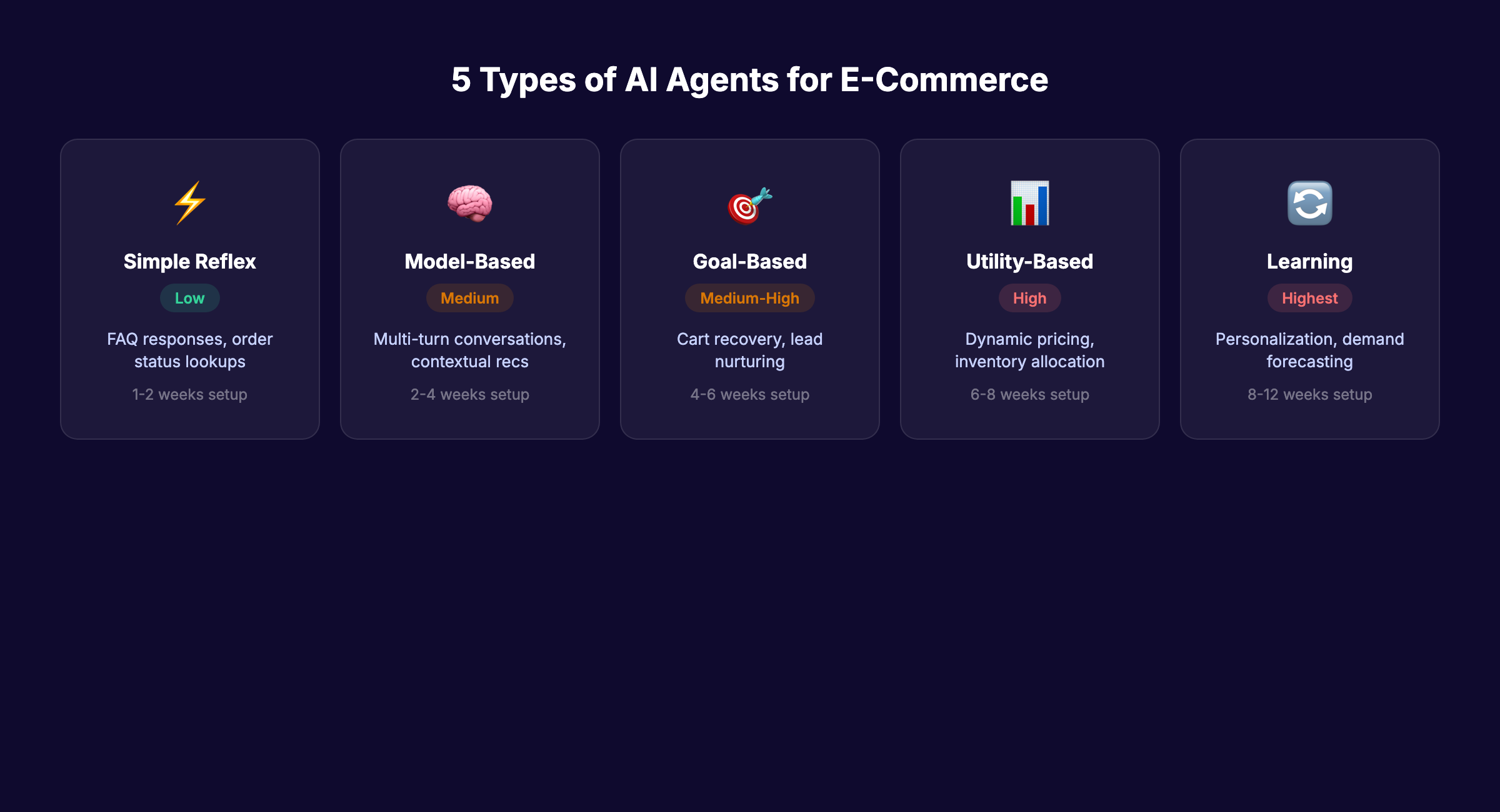
Not all agents work the same way. Understanding the 5 main types helps you match the right architecture to your specific problem.
Simple Reflex Agents
These agents respond to current input with a fixed rule. “If the customer asks about tracking, pull the tracking number.” Fast and cheap to deploy. Limited to single-step tasks.
Best for: Order status lookups, basic FAQ responses, simple routing.
Model-Based Reflex Agents
These maintain an internal model of the world. They track context across a conversation. “The customer asked about a blue dress, then asked about sizing. Recommend size based on the blue dress, not general sizing.”
Best for: Multi-turn customer conversations, contextual product recommendations.
Goal-Based Agents
These agents receive a goal and plan the steps to achieve it. “Recover this abandoned cart.” The agent decides whether to offer a discount, free shipping, or a product alternative based on the specific situation.
Best for: Cart recovery, lead nurturing, complex customer journeys.
Utility-Based Agents
These optimize for a utility function. “Maximize revenue per visitor while keeping customer satisfaction above 85%.” They weigh tradeoffs between competing objectives.
Best for: Dynamic pricing, inventory allocation, A/B test optimization.
Learning Agents
These continuously improve from outcomes. Every interaction makes them better. They identify patterns that humans miss and adapt strategies without manual intervention.
Best for: Long-term personalization, demand forecasting, fraud detection.
| Agent Type | Complexity | Setup Time | Best Use Case |
|---|---|---|---|
| Simple Reflex | Low | 1-2 weeks | FAQ, order status |
| Model-Based | Medium | 2-4 weeks | Conversations |
| Goal-Based | Medium-High | 4-6 weeks | Cart recovery |
| Utility-Based | High | 6-8 weeks | Pricing, inventory |
| Learning | Highest | 8-12 weeks | Personalization |
The right choice depends on your transaction volume, technical team size, and specific pain points. Most stores start with simple reflex agents for support, then layer on goal-based and learning agents as they scale.
For a deeper look at how agents fit into marketing stacks, read our guide on AI agent orchestration in marketing.
Chapter 6: How to Choose the Right AI Agent for Your Store {#ch6}
Picking the wrong agent wastes budget and creates a bad customer experience. Here is a framework that filters out the noise.
Step 1: Identify Your Biggest Bottleneck
Do not start with technology. Start with the problem. Where does your team spend the most time? Where do customers complain the most?
Common bottlenecks by store size:
- Under $1M revenue: Customer support tickets, basic product questions
- $1M-$10M revenue: Cart abandonment, inventory management, personalization
- $10M+ revenue: Dynamic pricing, multi-channel orchestration, fraud prevention
Step 2: Evaluate Integration Requirements
Your AI agent needs access to your data. Check whether the agent integrates with your specific stack.
- E-commerce platform (Shopify, WooCommerce, BigCommerce, Magento)
- CRM system (HubSpot, Salesforce, Klaviyo)
- Shipping carriers (FedEx, UPS, USPS APIs)
- Payment processor (Stripe, PayPal)
- Inventory management system
- Customer support platform (Zendesk, Gorgias, Freshdesk)
Step 3: Define Success Metrics
Set specific numbers before you deploy. “Reduce support tickets by 40% in 90 days.” “Increase cart recovery rate from 4% to 10%.” Without clear targets, you cannot measure whether the agent works.
Step 4: Start Small, Then Scale
Deploy the agent on one use case. Measure for 30 days. If it hits your target, expand to the next use case. Trying to automate everything at once creates chaos.
The exception is pricing. Dynamic pricing agents need at least 60-90 days of data before they outperform manual rules. Give them time.
Stores that approach agent selection systematically save 40-60% on implementation costs compared to those that buy first and plan later.
If you are running an online store and want to improve organic visibility alongside agent deployment, our e-commerce SEO guide covers the full playbook.
While AI agents handle your operations, Stacc handles your content. We publish SEO-optimized blogs that drive organic traffic on autopilot. Start for $1 →
Chapter 7: How to Implement AI Agents Step by Step {#ch7}
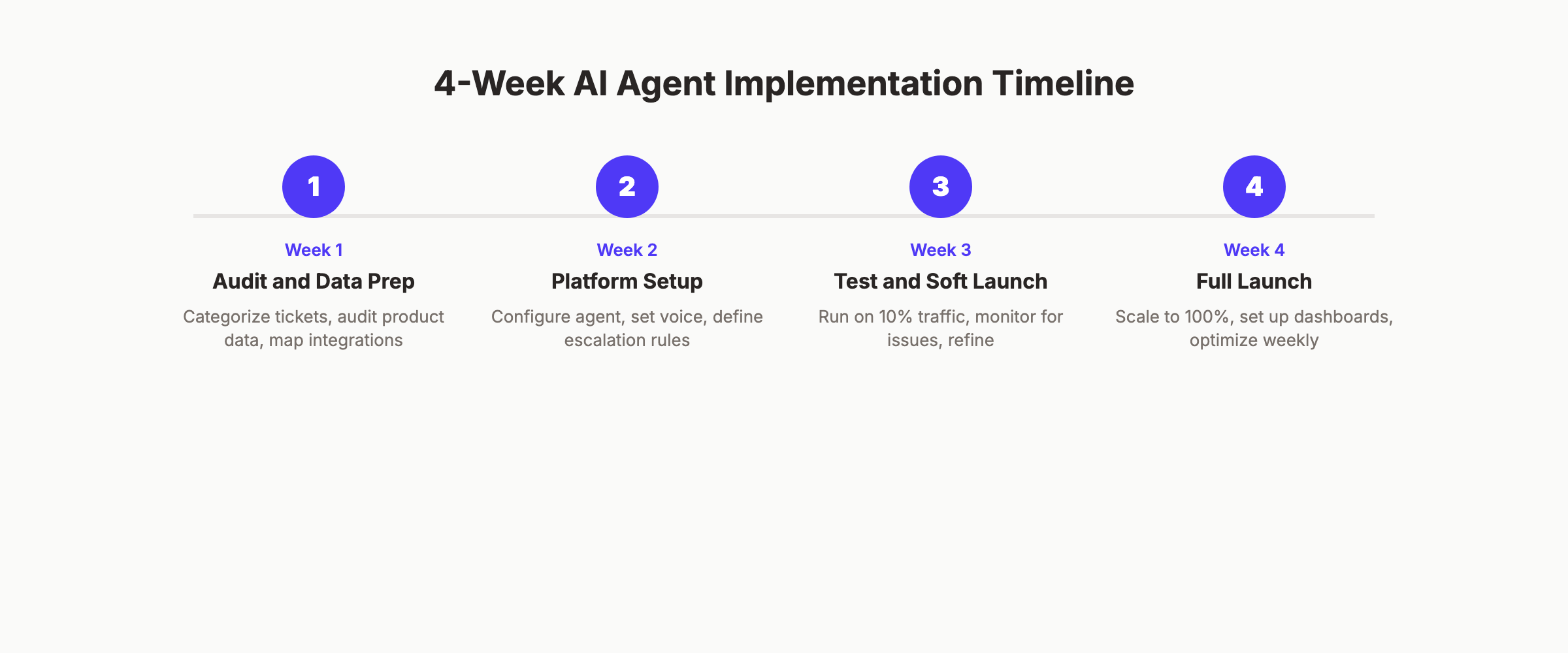
This is the implementation framework used by stores that get agents running in 30 days or less.
Week 1: Audit and Data Preparation
Pull 90 days of customer support tickets. Categorize them by type: order status, returns, product questions, complaints, and technical issues.
Identify which categories are high-volume and low-complexity. Those are your first automation targets. Clean your product data. AI agents fail when product descriptions, sizing charts, or inventory feeds contain errors.
- Export 90 days of support ticket data
- Categorize tickets by type and complexity
- Audit product data for accuracy
- Map your tech stack integrations
- Define success metrics for each use case
Week 2: Platform Selection and Configuration
Choose your agent platform based on the evaluation framework from Chapter 6. Configure the agent with your brand voice, escalation rules, and data access permissions.
Set up human-in-the-loop checkpoints. The agent should handle 80% of cases autonomously. The remaining 20% — complex complaints, high-value orders, edge cases — route to human agents.
Week 3: Testing and Soft Launch
Run the agent on 10% of incoming traffic. Monitor every interaction. Look for hallucinations (wrong information), tone mismatches, and failed handoffs.
Common issues during testing:
- Agent provides outdated pricing (fix: connect to live pricing feed)
- Agent cannot handle multi-product returns (fix: expand workflow scope)
- Agent tone feels too casual for luxury brands (fix: adjust voice parameters)
Week 4: Full Launch and Optimization
Scale to 100% of traffic. Set up dashboards tracking resolution rate, customer satisfaction, escalation rate, and revenue attribution.
Review agent performance weekly for the first 3 months. After that, monthly reviews are sufficient. The agent improves automatically, but human oversight catches edge cases that data alone misses.
Post-Launch: Expand to New Use Cases
Once your support agent is stable, add the next highest-impact use case. For most stores, that means personalization or cart recovery.
Each new agent benefits from the data collected by existing agents. Your personalization agent performs better when it can access support interaction history. This compounding effect is why multi-agent stores outperform single-agent stores by 2-3x.
For stores already automating their SEO workflow, adding operational AI agents creates a dual automation advantage. Content and customer experience improve simultaneously.
Chapter 8: What AI Agents Mean for E-Commerce SEO {#ch8}
AI agents do not just change operations. They change how customers find and buy products. That shift has direct implications for your SEO and content strategy.
Agentic Commerce Changes Search Behavior
When AI shopping agents handle product discovery, traditional search traffic patterns shift. Instead of a customer typing “best running shoes under $150” into Google, their personal AI agent queries multiple stores directly.
Deloitte projects that 25% of global e-commerce sales will be agent-enabled by 2030. That means your product pages need to be readable by AI agents, not just human shoppers.
Optimize for Both Humans and Agents
Structured data becomes critical. AI agents parse schema markup, product feeds, and API responses faster than HTML pages. Stores with clean structured data get discovered by shopping agents first.
Key actions:
- Implement Product schema on every product page
- Maintain accurate, real-time inventory in your product feed
- Ensure pricing data matches across all channels
- Add detailed product specifications (not just marketing copy)
- Create FAQ schema for common product questions
Content Still Drives Top-of-Funnel Discovery
AI agents handle transactional queries well. But customers still research through content. “How to choose running shoes for flat feet” remains a search query that humans type into Google and AI search engines.
Brands that publish consistent, high-quality content capture these research-stage visitors. Those visitors become customers when the AI agent handles the buying experience.
This is where the Content Compound Effect matters. Every article you publish builds topical authority. That authority makes your brand the one AI agents recommend when their users ask for suggestions.
Our guide to AI search and SEO covers how search behavior is shifting in detail. And if you want to ensure AI search engines cite your brand, read our AI citability checklist.
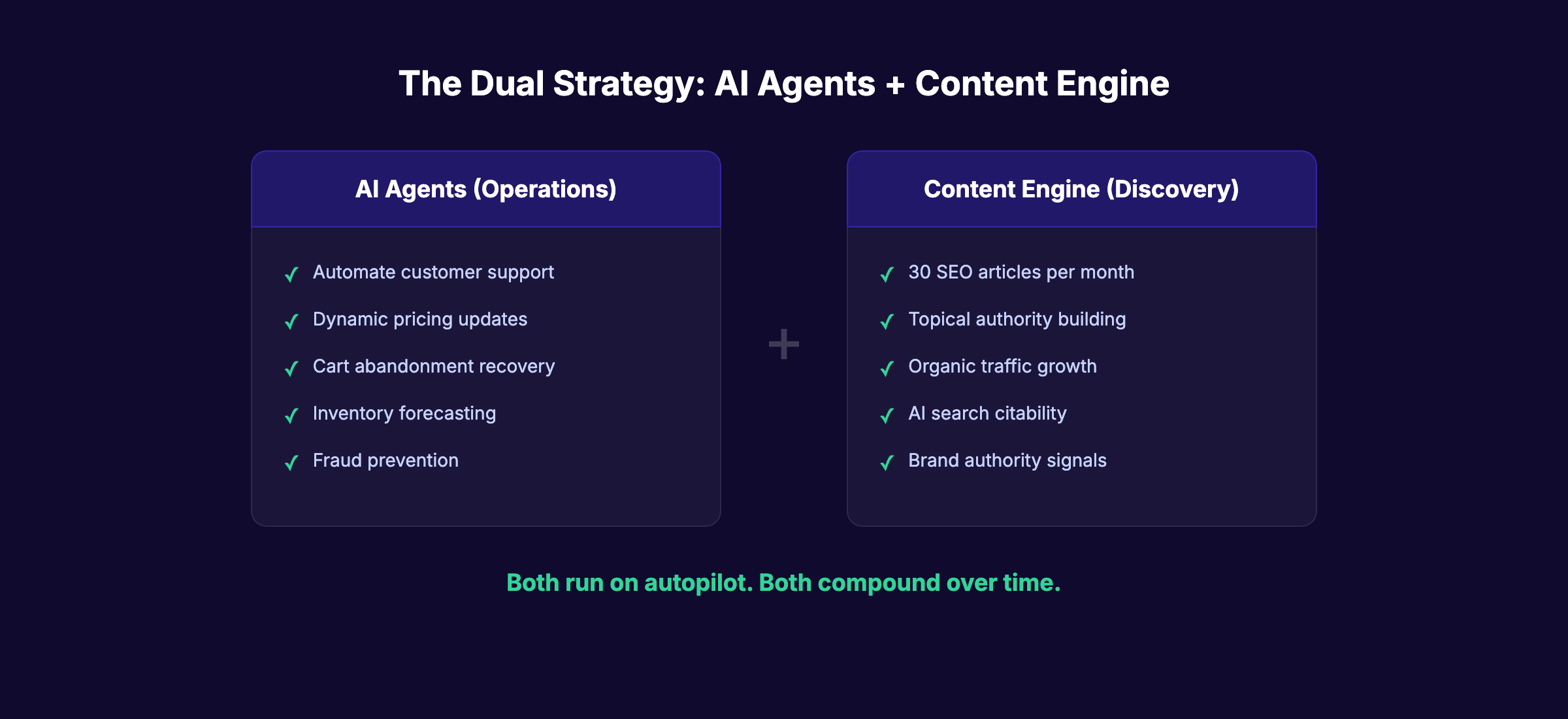
The Dual Strategy: Agents for Operations, Content for Discovery
The stores winning in 2026 run two parallel systems. AI agents handle customer interactions, pricing, and inventory. A content engine handles organic discovery and brand authority.
Neither replaces the other. An agent cannot build the topical authority that drives organic traffic. A blog cannot process returns or recommend the right shoe size.
The most effective approach: automate operations with AI agents and automate content with a service like Stacc. Both run on autopilot. Both compound over time.
For brands already investing in scaling blog content with AI, adding operational agents is the natural next step. The data from your content performance informs your agent strategy. The data from agent interactions informs your content topics.
Stacc publishes 30 SEO articles per month so you can focus on running your store. No writers to manage. No briefs to write. Just results. Start for $1 →
Frequently Asked Questions {#faq}
How much do AI agents for e-commerce cost?
Entry-level support agents start at $50-200 per month for small stores. Mid-market platforms charge $500-2,000 per month. Enterprise deployments with custom agents run $5,000-20,000+ per month. Most stores see positive ROI within 60-90 days from support cost savings alone.
Will AI agents replace human customer service teams?
No. AI agents handle 80-90% of routine tickets. Human agents focus on complex issues, VIP customers, and relationship-building. The best deployments pair AI agents with smaller, more skilled human teams. Total support quality improves while costs drop.
What is the difference between agentic commerce and traditional e-commerce?
Traditional e-commerce requires the shopper to browse, compare, and buy manually. Agentic commerce means an AI agent handles the entire shopping journey. The agent discovers products, compares prices across stores, negotiates deals, and completes purchases on the shopper’s behalf.
Do AI agents work with Shopify, WooCommerce, and other platforms?
Yes. Most AI agent platforms integrate with Shopify, WooCommerce, BigCommerce, and Magento through APIs or native apps. Integration depth varies. Check whether the agent can access your order management, inventory, and customer data before committing.
How do AI agents affect product page SEO?
AI shopping agents prefer structured data over unstructured HTML. Stores with complete Product schema, accurate pricing feeds, and detailed specifications rank higher in agent-driven discovery. Think of it as SEO for machines, not just humans.
What are the risks of using AI agents in e-commerce?
The main risks are hallucination (agents providing wrong information), data privacy compliance, and over-automation of high-touch interactions. Mitigate these with human-in-the-loop checkpoints, regular audits, and clear escalation rules for sensitive topics.
AI agents for e-commerce are not a future trend. They are running in production at thousands of stores right now. The gap between early adopters and laggards grows every quarter.
Start with one use case. Measure the results. Scale what works. And while your agents handle operations, make sure your content strategy runs just as automatically.
Written and published by Stacc. We publish 3,500+ articles per month across 70+ industries. All data verified against public sources as of March 2026.