
AI Marketing Agents for Small Business (2026): Guide
Step-by-step ai marketing agents guide guide for 2026: proven tactics, real examples, common mistakes to avoid, and implementation tips.
Small businesses spend an average of 20 hours per week on marketing tasks that generate zero direct revenue. Scheduling posts. Writing email sequences. Pulling analytics reports. Updating ad copy. According to Salesforce’s 2024 SMB Trends Report, 75% of small businesses are already experimenting with AI to solve this problem.
AI marketing agents take that experiment further. They do not just assist with marketing tasks. They execute them autonomously, from start to finish, without constant human direction.
But most small business owners still confuse AI marketing agents with chatbots, content spinners, or basic automation tools. That confusion costs money. You either overpay for tools that are not agents, or you ignore agents that could replace an entire marketing hire.
We have published 3,500+ blog posts across 70+ industries using automated content workflows. This guide covers everything a small business needs to know about AI marketing agents: what they are, what they cost, how to set them up, and where they fail.
Here is what you will learn:
- The difference between AI marketing agents and AI marketing tools
- 7 specific marketing tasks agents handle autonomously
- A real cost breakdown by business size and budget tier
- How to evaluate and choose the right agent for your business
- Step-by-step setup instructions for your first agent
- The 6 mistakes that waste small business marketing budgets
- What AI agents still cannot do (and where humans are still required)
What AI Marketing Agents Are (and What They Are Not)
An AI marketing agent is software that plans, executes, and optimizes marketing tasks without step-by-step human instruction. You give it a goal. It figures out how to achieve that goal.
That last part matters. A tool needs you to press buttons. An agent needs you to set objectives.
Agents vs. Tools vs. Automation
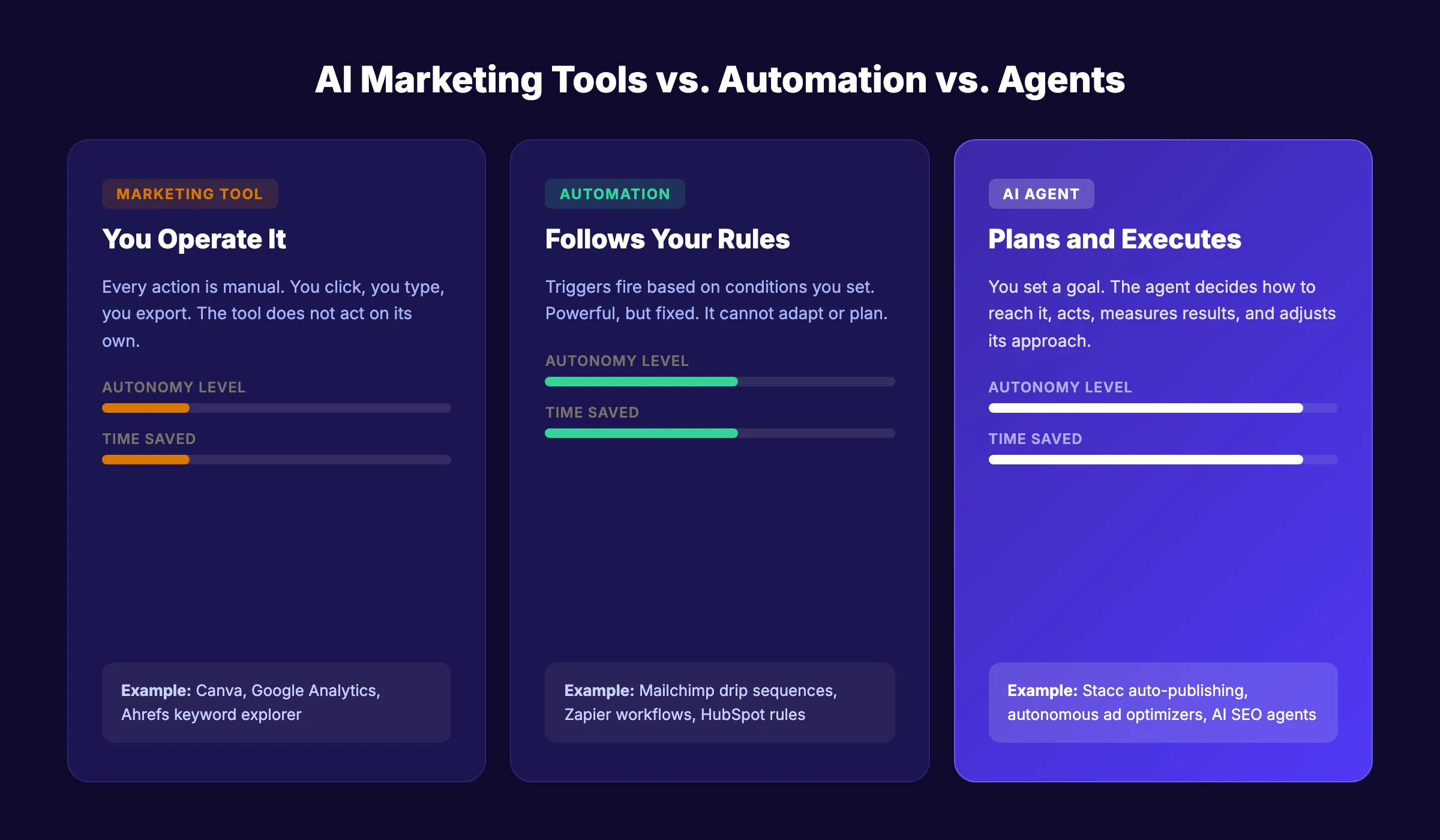
Most marketing software falls into 3 categories. Confusing them leads to wasted budgets.
| Category | How It Works | Example | Human Input Required |
|---|---|---|---|
| Marketing tool | You operate it manually | Canva, Google Analytics | High. Every action is manual |
| Marketing automation | Follows preset rules you create | Mailchimp drip sequences, Zapier workflows | Medium. You build the rules |
| Marketing agent | Sets its own plan, executes, and adapts | Autonomous content publishing, ad optimization agents | Low. You set goals and review output |
A marketing automation workflow fires when a trigger happens. A customer signs up, so they get email 1. They open it, so they get email 2. The logic is fixed. You built it.
An AI marketing agent operates differently. You tell it: “Generate 4 blog-qualified leads per week from organic search.” The agent researches keywords, creates content, publishes it, monitors rankings, and adjusts its approach based on what works. It makes decisions you did not pre-program.
The 4 Traits That Define a True Agent
Not every product calling itself an “AI agent” is one. Look for these 4 capabilities:
- Autonomy. It takes action without being told each step
- Persistence. It remembers past actions and learns from results
- Planning. It breaks goals into multi-step execution plans
- Adaptation. It changes its approach when something does not work
If the software needs you to click “generate” for every output, it is a tool. If it runs on fixed rules you created, it is automation. If it plans, acts, and adjusts on its own, it is an agent.
Stop writing. Start ranking. Stacc publishes 30 SEO articles per month for your business, automatically. Start for $1 →
How AI Marketing Agents Work
AI marketing agents operate on a loop: observe, plan, act, measure, adjust. Understanding this loop helps you set realistic expectations about what agents can and cannot do.
The Agent Loop
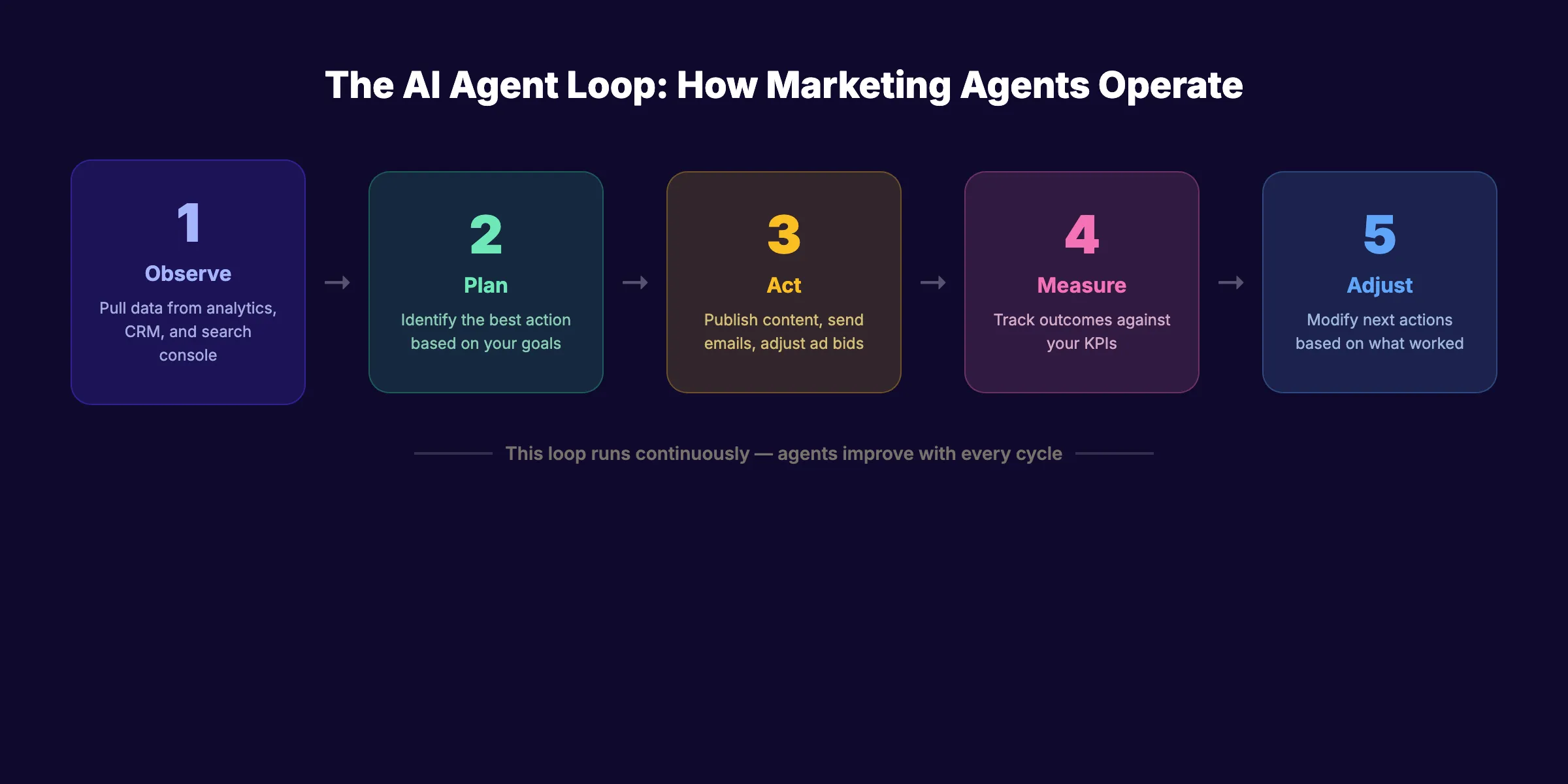
Every AI marketing agent follows some version of this cycle:
- Observe. The agent pulls data from connected sources (analytics, CRM, search console, ad platforms)
- Plan. It identifies the best action to take based on that data and your stated goal
- Act. It executes the action (publishes content, sends emails, adjusts ad bids, posts to social media)
- Measure. It tracks the outcome of that action against your KPIs
- Adjust. It modifies its next action based on what worked and what did not
This loop runs continuously. A well-configured content agent might publish 30 articles in a month, monitor which ones rank, and shift future topics toward the patterns that drive the most traffic.
What Powers the Decision-Making
Modern AI marketing agents combine 3 technologies:
- Large language models (LLMs) for content generation and analysis
- Retrieval-augmented generation (RAG) for pulling real-time data from your business systems
- Reinforcement learning for improving performance based on outcomes over time
The LLM handles the creative work. RAG connects it to your specific data. Reinforcement learning makes it smarter with every cycle.
Single-Task vs. Multi-Task Agents
Some agents handle one function well. Others coordinate across multiple channels.
| Agent Type | What It Handles | Best For |
|---|---|---|
| Single-task agent | One channel (email OR content OR ads) | Businesses testing agents for the first time |
| Multi-task agent | Multiple channels from one dashboard | Businesses ready to automate their full marketing stack |
| Orchestrator agent | Coordinates multiple single-task agents | Agencies or businesses with complex workflows |
Small businesses should start with a single-task agent. Master one channel before expanding. Trying to automate everything at once is the fastest way to waste money on AI.
7 Marketing Tasks AI Agents Handle for Small Businesses
Not every marketing task benefits from an agent. Some are better served by tools or manual effort. Here are the 7 tasks where agents deliver the clearest ROI for small businesses.
1. Blog Content Creation and Publishing
AI agents can research keywords, write SEO-optimized blog posts, add internal links, format the content, and publish it directly to your CMS. The best agents produce content that scores above 85 on SEO audits without human editing.
ROI benchmark: A single blog post from a freelancer costs $80 to $250. An AI content agent can produce 30 posts per month for under $200. That is a 90% cost reduction.
Where agents fall short: Brand voice consistency requires human review. A quarterly voice calibration session keeps output on-brand.
2. Email Marketing and Sequences
Agents write subject lines, segment audiences based on behavior data, draft email copy, schedule sends, and A/B test variations. They do not just execute a drip sequence you built. They decide which sequence to build.
According to HubSpot’s 2026 marketing data, marketers using AI for email see 22% higher open rates and 31% more click-throughs versus manual campaigns.
3. Social Media Content and Scheduling
AI agents generate social media posts, match them to platform-specific formats, schedule them for optimal engagement windows, and adjust future posting times based on audience behavior data.
Small business reality check: Social agents work best when fed your brand voice guidelines and 10 to 15 example posts that represent your tone. Without that input, output sounds generic.
4. Ad Campaign Optimization
Agents monitor Google Ads and Meta Ads performance, pause underperforming creatives, shift budget to winners, and generate new ad copy variations. Gartner predicts that 40% of enterprise applications will feature task-specific AI agents by end of 2026.
For small businesses spending $500 to $5,000 per month on ads, an optimization agent typically saves 15 to 25% of ad spend through faster reaction times.
5. SEO Monitoring and Optimization
AI SEO agents track your keyword rankings, identify content decay, recommend updates to underperforming pages, monitor competitor movements, and flag technical issues like broken links or Core Web Vitals regressions.
This replaces the weekly manual check that most small business owners either do poorly or skip entirely.
6. Review Management and Response
For local businesses, AI agents monitor new Google reviews, draft personalized responses, flag negative reviews for human attention, and track review velocity. They handle the 80% of reviews that need a professional “thank you” so you can focus on the 20% that need a personal touch.
Review response speed matters. Businesses that respond within 24 hours see 35% higher customer retention rates. Agents respond in minutes.
7. Lead Scoring and Qualification
Agents analyze website behavior, email engagement, and form submissions to score leads and route them to the right team member or follow-up sequence. A dentist office does not need Salesforce-level lead scoring. But knowing which website visitor looked at pricing 3 times matters.
Your SEO team. $99 per month. 30 optimized articles, published automatically. Start for $1 →
How to Choose the Right AI Marketing Agent
The AI agent market is crowded and confusing. Most “agent” products are rebranded automation tools. Here is how to evaluate them honestly.
The 5-Point Evaluation Framework
Score each agent on these 5 criteria before committing:
| Criteria | What to Test | Red Flag |
|---|---|---|
| Autonomy level | Can it complete a task end-to-end without your input? | Requires manual approval for every output |
| Integration depth | Does it connect to your existing tools (CMS, CRM, analytics)? | Only works within its own ecosystem |
| Output quality | Run 10 test outputs. Grade each on accuracy, tone, and usefulness | More than 3 out of 10 need major edits |
| Reporting transparency | Can you see exactly what it did, why, and what the results were? | ”Black box” results with no audit trail |
| Cost predictability | Fixed monthly price vs. usage-based billing | Per-output pricing that scales unpredictably |
Questions to Ask Before You Buy
- Does this agent execute tasks or just recommend them?
- What happens when it makes a mistake? Is there a human review layer?
- Can I export my data if I cancel?
- What CMS and analytics platforms does it integrate with?
- Does it learn from my specific business data or use generic models?
Platform Categories to Consider
| Category | Examples | Starting Price | Best For |
|---|---|---|---|
| Content agents | Stacc, Jasper, Copy.ai | $49 to $199/mo | Blog, social, email content |
| SEO agents | Surfer, Semrush Copilot | $89 to $229/mo | Keyword research, optimization |
| Ad agents | Madgicx, Smartly | $49 to $499/mo | PPC campaign management |
| All-in-one agents | HubSpot AI, Vendasta | $200 to $800/mo | Multi-channel marketing |
| Done-for-you services | Stacc, WebFX | $99 to $999/mo | Businesses that want zero DIY |
Small businesses under $500 per month marketing budget should choose a single-channel agent. Businesses between $500 and $2,000 should consider a done-for-you service. Anything above that opens the door to multi-agent orchestration.
What AI Marketing Agents Actually Cost
Every competitor article about AI marketing agents avoids real numbers. Here is what small businesses actually spend, broken down by tier.
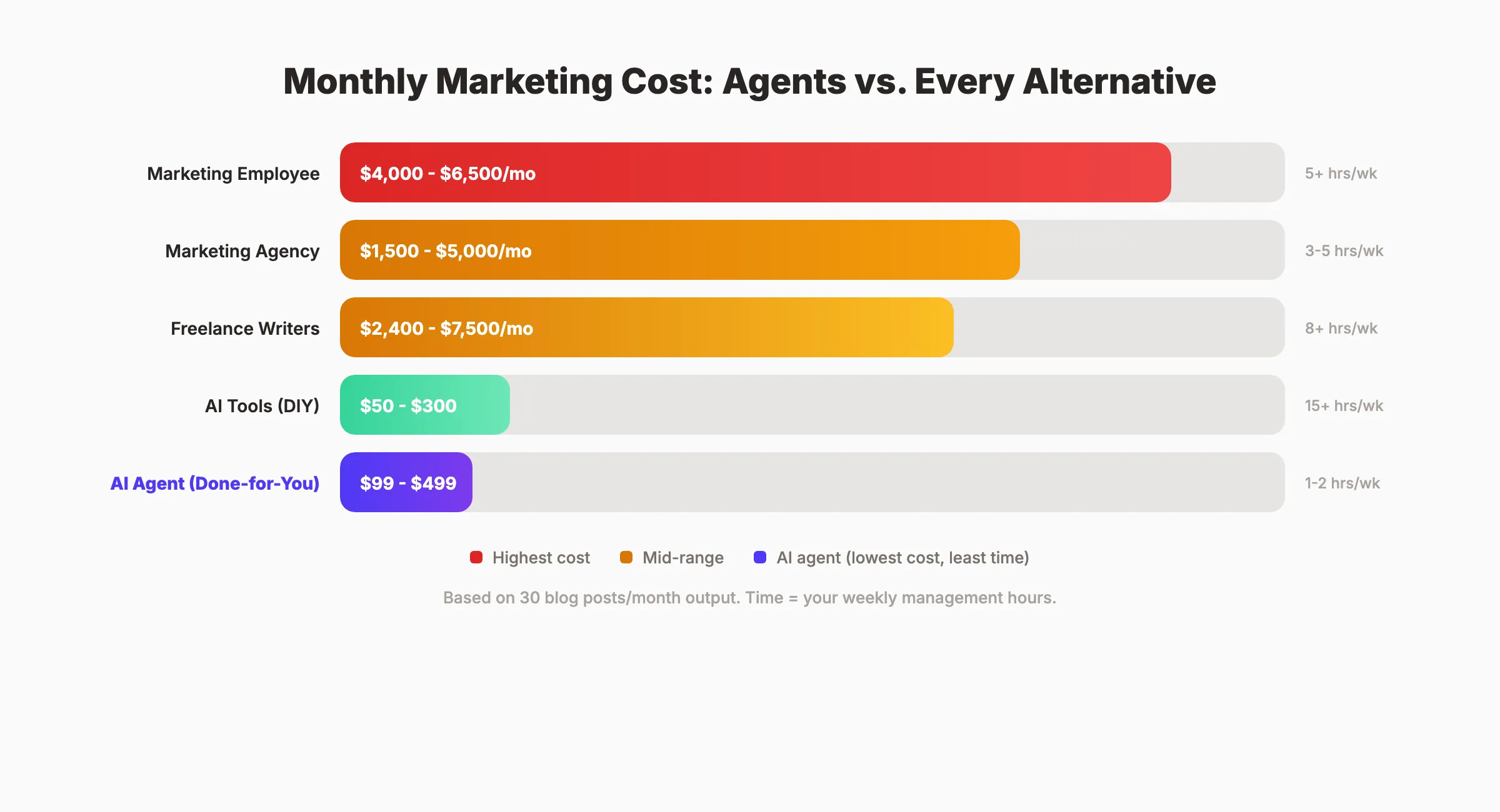
Cost Comparison: Agents vs. Alternatives
| Marketing Method | Monthly Cost | Output Volume | Your Time Required |
|---|---|---|---|
| Hire a marketing employee | $4,000 to $6,500 | 8 to 15 pieces/mo | 5+ hrs/wk managing |
| Hire a marketing agency | $1,500 to $5,000 | 4 to 12 pieces/mo | 3 to 5 hrs/wk managing |
| Freelance writers | $2,400 to $7,500 (30 articles) | 4 to 30 pieces/mo | 8+ hrs/wk briefing, editing |
| AI tools (DIY) | $50 to $300 | Unlimited (you do the work) | 15+ hrs/wk |
| AI agent (done-for-you) | $99 to $499 | 30 to 80 pieces/mo | 1 to 2 hrs/wk reviewing |
The math is clear. An AI agent that publishes 30 blog posts per month at $99 replaces $2,400 to $7,500 in freelancer costs. Even if 20% of outputs need editing, you save 80% of the time and 90% of the cost.
Budget Tiers for Small Businesses
Tier 1: Under $100/month (Testing)
- 1 single-task agent (content OR social OR email)
- Expect 15 to 30 outputs per month
- Best for: Solo operators validating whether agents work for their niche
Tier 2: $100 to $300/month (Growth)
- 1 to 2 agents covering content + social or content + email
- Expect 30 to 60 outputs per month
- Best for: Small teams (2 to 10 people) ready to automate their biggest time drain
Tier 3: $300 to $800/month (Scale)
- Multi-channel agent or bundled service covering content, local SEO, and social
- Expect 60 to 120+ outputs per month
- Best for: Businesses with proven product-market fit that need more inbound leads
Hidden Costs to Watch For
- Per-word or per-credit pricing. Costs spike as you scale. Fixed monthly pricing is safer.
- Integration fees. Some agents charge extra for CMS or CRM connections
- Overage charges. Check what happens when you exceed your plan limits
- Onboarding costs. Some enterprise agents charge $500 to $2,000 for initial setup
3,500+ blogs published. 92% average SEO score. See what Stacc can do for your site. Start for $1 →
How to Set Up Your First AI Marketing Agent
Most small businesses overcomplicate their first agent deployment. Follow this 6-step process.
Step 1: Pick One Marketing Channel
Do not try to automate everything at once. Choose the channel that consumes the most time relative to its output. For most small businesses, that is blog content or social media.
Step 2: Define a Measurable Goal
Bad goal: “Get more traffic.” Good goal: “Publish 20 SEO-optimized blog posts per month targeting long-tail keywords in my industry.”
The more specific the goal, the better the agent performs. Vague goals produce vague output.
Step 3: Connect Your Data Sources
Give the agent access to:
- Your website analytics (Google Analytics, Search Console)
- Your CMS (WordPress, Webflow, Ghost)
- Your existing content (so it does not duplicate topics)
- Your brand voice guidelines (tone, vocabulary, banned phrases)
Step 4: Run a 10-Output Test
Before scaling, generate 10 outputs and grade each one:
- Is the information accurate?
- Does it match your brand voice?
- Would you publish it without major edits?
- Does it target the right audience?
- Is the formatting correct for your platform?
If 7 out of 10 pass, the agent is ready to scale. If fewer than 5 pass, adjust your inputs (better brand guidelines, more specific goals, or a different agent).
Step 5: Set a Review Cadence
- Week 1 to 2: Review every output before publishing
- Week 3 to 4: Review 50% of outputs (spot-check the rest)
- Month 2+: Review 20% of outputs and focus on performance data instead
Most agents improve as they learn from your feedback. Early investment in review quality pays off in long-term output quality.
Step 6: Measure and Adjust Monthly
Track these 4 KPIs:
| KPI | What It Measures | Target |
|---|---|---|
| Output volume | Number of pieces published | 20 to 30/month for content agents |
| Quality score | % of outputs publishable without edits | 70%+ by month 2 |
| Engagement metrics | Traffic, opens, clicks per output | Trending upward month over month |
| Cost per output | Total agent cost / outputs produced | Under $10 per blog post |
6 Mistakes That Waste Small Business AI Budgets
According to KPMG research, 33% of organizations have deployed AI agents, up from 11% two quarters prior. The rush to adopt is causing predictable mistakes.
Mistake 1: Automating Before You Have a Strategy
An agent that publishes 30 random blog posts per month is not a content strategy. It is expensive noise. Define your topical authority map, keyword targets, and content clusters before you turn on any agent.
Mistake 2: Choosing an Agent Because It Sounds Impressive
“Agentic AI” is the hottest buzzword in marketing. That means every tool is slapping “agent” on its marketing page. Test actual capabilities against the 4-trait framework (autonomy, persistence, planning, adaptation). Ignore the label.
Mistake 3: Skipping the Review Phase
Even the best agents produce occasional errors. Hallucinated statistics. Off-brand messaging. Factual mistakes about your industry. The FTC’s Operation AI Comply enforcement actions in 2024 targeted businesses making claims generated by AI without verification. You are responsible for everything published under your brand name.
Mistake 4: Using Generic Brand Instructions
“Write in a professional tone” gives an agent nothing to work with. Provide specific examples. Share 5 to 10 pieces of content that represent your ideal voice. List banned words and phrases. The more specific your input, the better the output.
Mistake 5: Measuring Activity Instead of Outcomes
Publishing 30 blog posts is activity. Generating 50 organic visits per post per month is an outcome. Track what matters: organic traffic, leads generated, content marketing ROI, and conversion rates. Not just output volume.
Mistake 6: Ignoring Data Privacy and Compliance
AI agents process customer data. If you operate in a regulated industry (healthcare, finance, legal), verify that your agent complies with HIPAA, GDPR, CCPA, or industry-specific requirements. 76% of consumers say AI introduces new security concerns. Addressing those concerns builds trust with your audience.
What AI Marketing Agents Cannot Do (Yet)
Honest assessment of limitations matters more than hype. Here is where agents still fall short in 2026.
They Cannot Replace Human Judgment on Strategy
An agent executes a plan. It does not decide whether the plan aligns with your business goals, brand positioning, or competitive environment. Strategy requires context that no agent has access to: your relationships, your reputation, your long-term vision.
They Cannot Build Genuine Relationships
Networking, partnership development, community building, and reputation management require human connection. An agent can draft a reply to a Google review. It cannot attend a local chamber of commerce meeting or build referral partnerships with complementary businesses.
They Cannot Guarantee Factual Accuracy
LLMs hallucinate. That is a technical limitation of how they work, not a bug that will be fixed soon. Every piece of AI-generated content needs human verification for facts, statistics, and claims. This is especially true for YMYL (Your Money or Your Life) topics like health, finance, and legal advice.
They Cannot Adapt to Crisis Situations
When a PR crisis hits, a competitor launches an aggressive campaign, or market conditions shift overnight, agents continue executing their programmed strategy. Human marketers spot these moments and pivot. Agents do not.
The 80/20 Split
The most effective approach for small businesses in 2026 is an 80/20 split: let agents handle 80% of execution (content creation, scheduling, optimization, reporting) while humans focus on 20% (strategy, brand decisions, relationship building, crisis response).
This is not a compromise. It is the model that produces the best results at the lowest cost. Every hour your team spends on execution instead of strategy is a misallocation of human capability.
Rank everywhere. Do nothing. Blog SEO, Local SEO, and Social on autopilot. Start for $1 →
FAQ
What is an AI marketing agent?
An AI marketing agent is software that plans, executes, and optimizes marketing tasks autonomously. Unlike marketing tools (which you operate) or automation (which follows rules you build), an agent sets its own execution plan based on your goals and adapts its approach based on results.
How much do AI marketing agents cost for small businesses?
Most small businesses spend $49 to $499 per month on AI marketing agents. Single-channel agents (content only or social only) start at $49 to $99 per month. Multi-channel or done-for-you services range from $199 to $499. This replaces $1,500 to $7,500 in agency or freelancer costs.
Can AI marketing agents replace my marketing team?
Not entirely. Agents handle execution (content creation, scheduling, optimization, reporting) at a fraction of the cost. But strategy, brand decisions, relationship building, and crisis response still require human judgment. The most effective model is 80% agent execution and 20% human strategy.
What marketing tasks can AI agents automate?
The 7 highest-ROI tasks for small businesses are blog content publishing, email marketing sequences, social media management, ad campaign optimization, SEO monitoring, review response management, and lead scoring. Content and email are typically the best starting points.
Are AI marketing agents safe to use with customer data?
Most reputable agents comply with standard data privacy regulations (GDPR, CCPA). Verify compliance before signing up, especially in regulated industries like healthcare or finance. Ask about data encryption, storage policies, and whether your data is used to train the AI model.
How long before I see results from an AI marketing agent?
Content agents typically produce measurable SEO results in 60 to 90 days. Social media and email agents show engagement improvements within 2 to 4 weeks. Ad optimization agents often deliver budget savings in the first 7 to 14 days. Set a 90-day evaluation window before judging overall ROI.
Related Tools & Resources
Free SEO Tools:
Best Lists:

Written by
Siddharth GangalSiddharth is the founder of theStacc and Arka360, and a graduate of IIT Mandi. He spent years watching great businesses lose organic traffic to competitors who simply published more. So he built a system to fix that. He writes about SEO, content at scale, and the tactics that actually move rankings.
30 SEO blog articles published every month
Keyword-optimized, scheduled, and live on your site. Automatically.
30-day trial · Cancel anytime
theStacc
Stop writing SEO content manually
30 blog articles, 30 GBP posts, and social media content. Published every month. Automatically.
Start Your $1 Trial$1 for 3 days · Cancel anytime