
AI Social Media Posts (2026): Strategies, Tactics & Examples
ai social media posts guide for 2026: strategies, tactics, real examples, and implementation steps to get results faster.
Creating AI social media posts sounds simple until you actually try it. You paste a prompt into ChatGPT, get a caption that reads like a corporate press release, and spend 20 minutes rewriting it anyway. The time savings disappear. The engagement drops. Your audience scrolls past.
That frustration is widespread. According to the Sprout Social 2026 Content Strategy Report, 56% of consumers now see “AI slop” on social media often or very often. 50% of Gen Z have already blocked, muted, or unfollowed a brand because of it. AI-generated content that sounds generic does not just underperform. It actively damages your brand.
But the data also shows the opposite outcome is possible. 96% of social media professionals now use AI for content tasks, according to the Metricool Social Media AI Report. Teams using AI produce content 84% faster. The difference is not whether you use AI. It is how you use it.
This guide covers the complete process for creating AI social media posts that sound human, drive engagement, and scale your output without destroying your brand voice.
We publish 3,500+ blogs and social posts across 70+ industries every month. The workflows in this guide come from our production process.
Here is what you will learn:
- What AI social media posts actually are and why most teams get them wrong
- A 6-step workflow from idea to published post
- Platform-specific prompting for LinkedIn, Instagram, X, Facebook, and TikTok
- How to make AI-generated posts sound like your brand, not a chatbot
- Which tools deliver real results and which waste your budget
- The 8 mistakes that cause engagement to collapse
Chapter 1: What Are AI Social Media Posts?
AI social media posts are content created with the help of artificial intelligence tools. That help ranges from brainstorming caption ideas to generating complete posts with hashtags, images, and scheduling recommendations.
The key distinction: AI-assisted is not the same as AI-generated.
Three Levels of AI Involvement
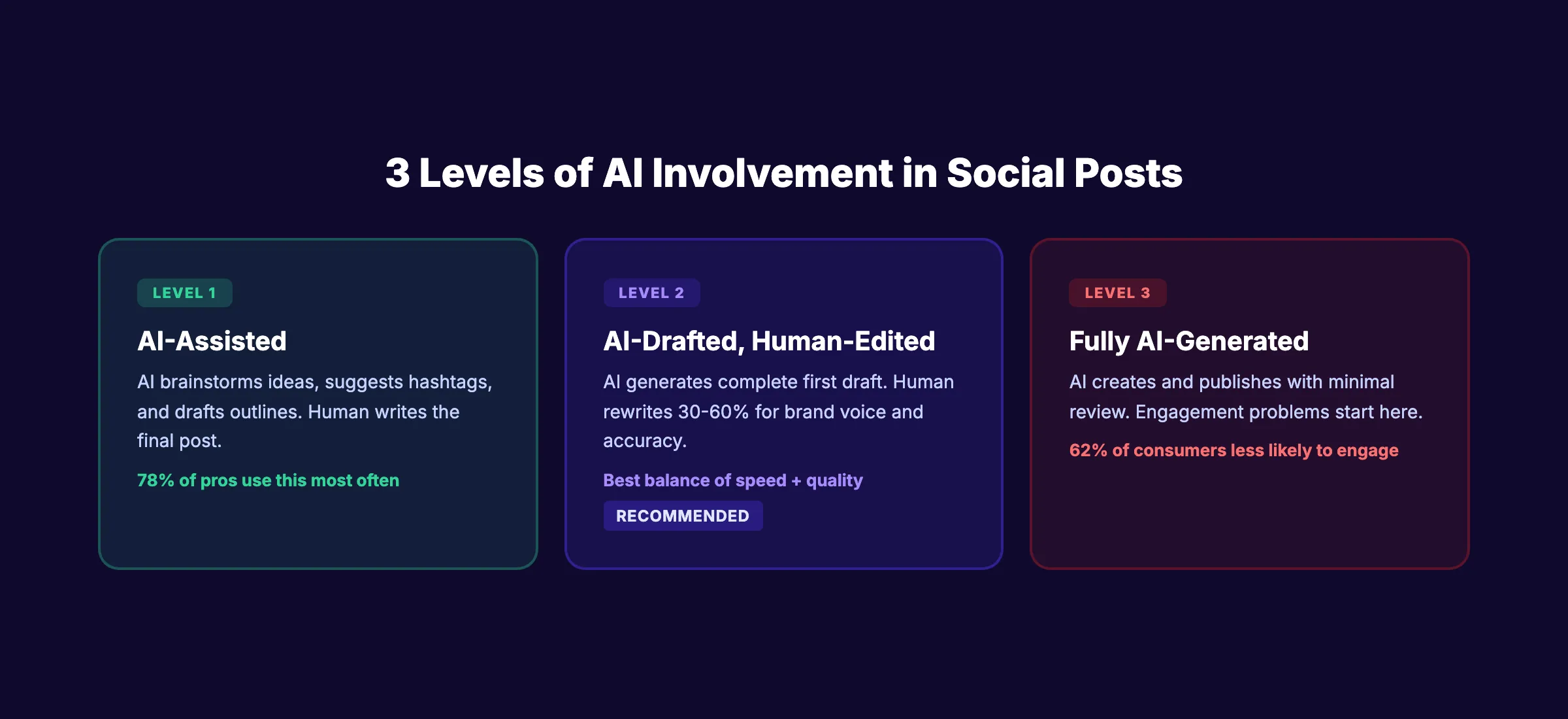
Level 1: AI-Assisted. You use AI to brainstorm ideas, draft outlines, or suggest hashtags. A human writes the final post. This is what 78% of social media professionals do most often, according to Metricool.
Level 2: AI-Drafted, Human-Edited. AI generates a complete first draft. A human rewrites 30-60% to match brand voice, add personality, and fix inaccuracies. This is the sweet spot for most teams.
Level 3: AI-Generated. AI creates the post and publishes it with minimal or no human review. This is where engagement problems start. 62% of consumers say they are less likely to engage with content they know was created by AI, according to Hootsuite’s 2026 Social Media Trends Report.
Why Most AI Social Posts Fail
The problem is not AI itself. The problem is using AI without a process.
Teams paste generic prompts like “Write a LinkedIn post about our product launch” and publish whatever comes back. The output lacks brand voice, specific details, and emotional hooks. It sounds like every other AI-generated post in the feed.
AI content writing works when you treat AI as a drafting partner, not a replacement for human judgment. The rest of this guide shows you exactly how.
Chapter 2: Why AI Social Posts Matter (and When They Backfire)
The business case for AI social media content is strong. But the risks are equally real.
The Case For AI Social Posts
Speed. AI-assisted teams deliver content 84% faster than teams working without it. A post that took 45 minutes to brainstorm, write, and edit now takes 10-15 minutes.
Volume. Consistent posting drives algorithmic favor. Buffer’s analysis of 52 million posts found that top-performing accounts publish more frequently and more consistently. AI makes that volume sustainable.
Cost. AI tools reduce cost-per-asset by 40-60%. For a business publishing 30 social posts per month, that is a meaningful budget savings.
Scale across platforms. A single core idea can become a LinkedIn article, an Instagram carousel, an X thread, and a Facebook post. AI handles the reformatting. A human handles the strategy.
The Case Against Blind Automation
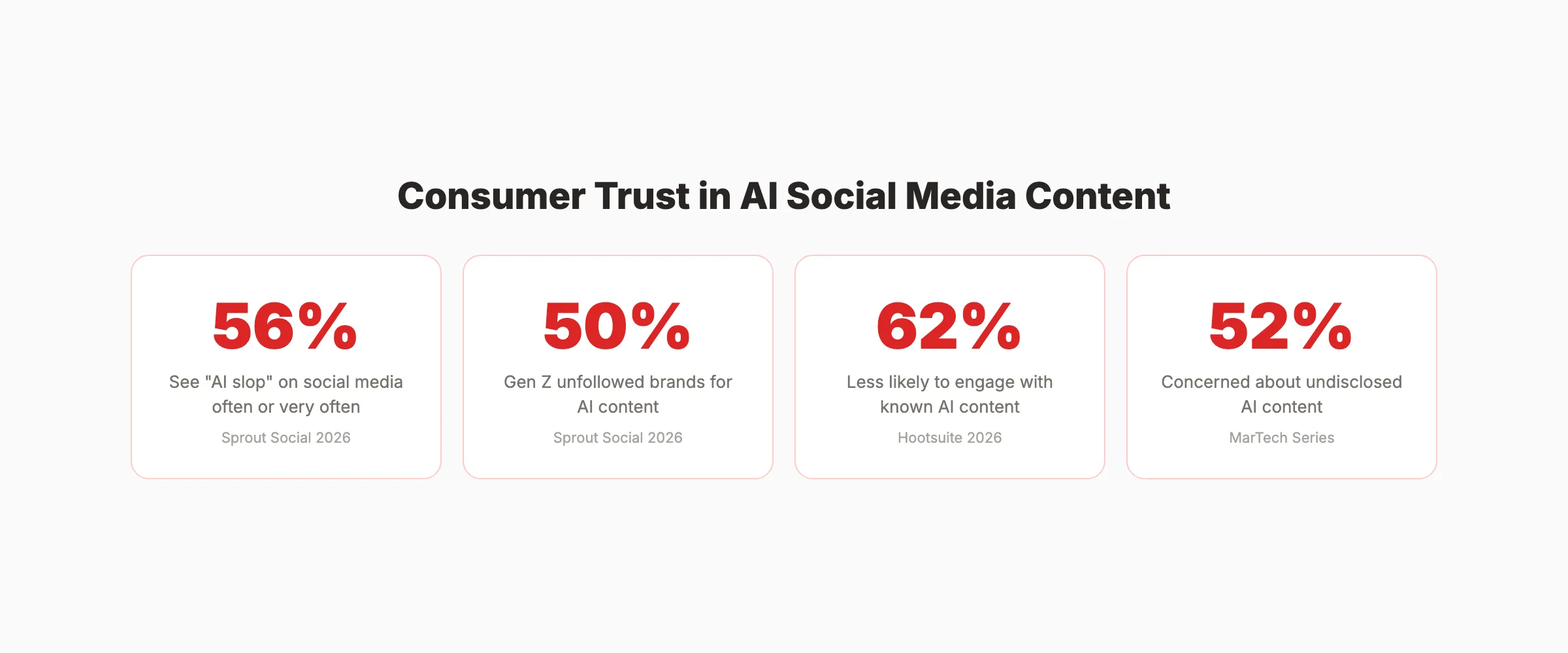
The data on consumer trust is sobering:
| Metric | Stat | Source |
|---|---|---|
| Consumers who see “AI slop” often | 56% | Sprout Social 2026 |
| Gen Z who unfollowed brands for AI content | 50% | Sprout Social 2026 |
| Consumers less likely to engage with known AI content | 62% | Hootsuite 2026 |
| Consumers concerned about undisclosed AI content | 52% | MarTech Series |
These numbers tell a clear story. AI content that sounds generic, lacks personality, or feels dishonest drives audiences away. The platforms are also responding. Meta, TikTok, and LinkedIn now require or recommend AI content disclosure in specific contexts.
The answer is not avoiding AI. It is using AI well enough that the output sounds like your brand, not like a template.
Stop writing. Start ranking. Stacc publishes 30 SEO articles and social posts per month for $99. No writers. No agencies. Start for $1 →
Chapter 3: The 6-Step AI Social Media Workflow
Most teams skip straight to “generate a caption.” That is step 3 of a 6-step process.
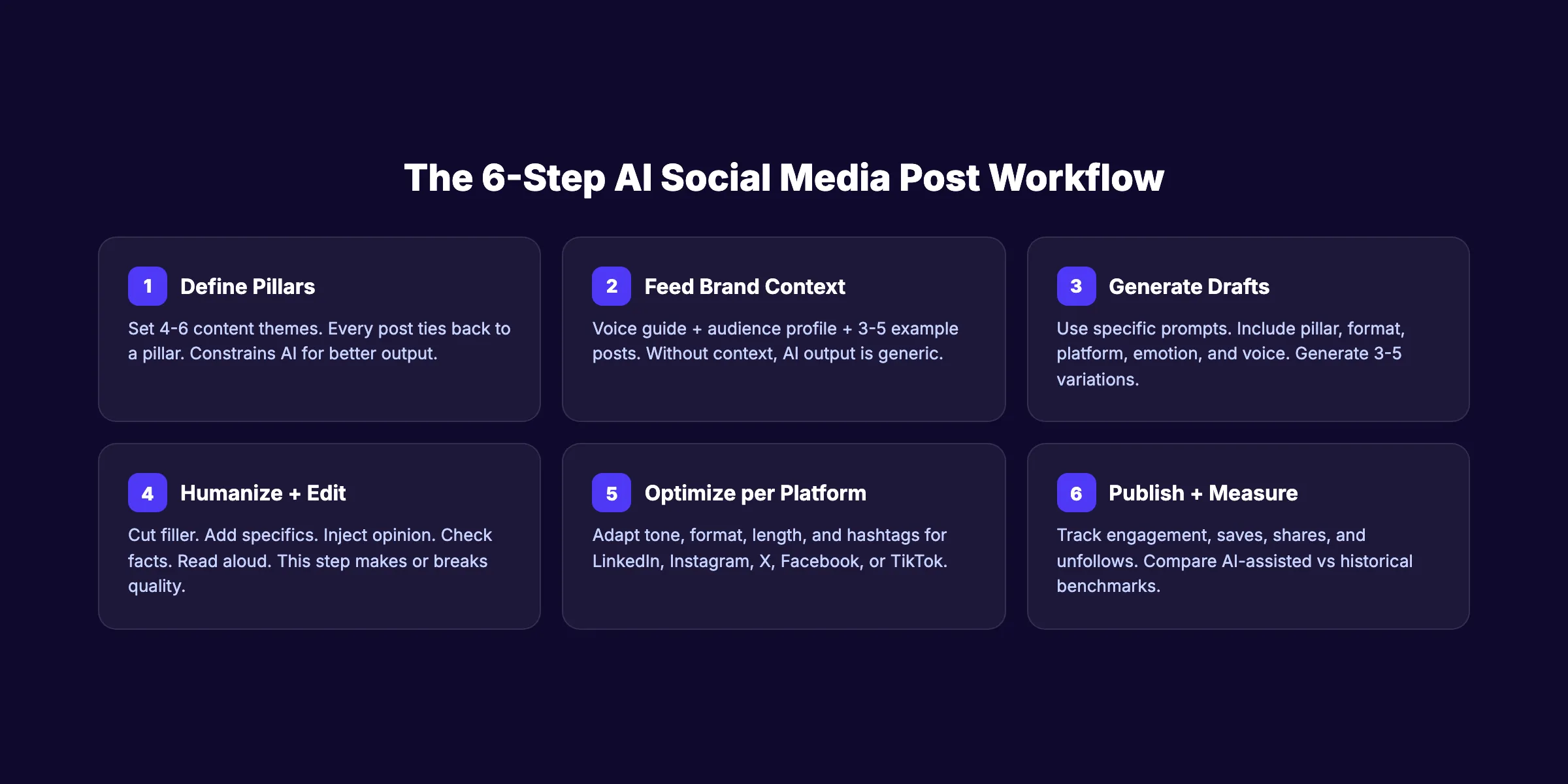
Step 1: Define Your Content Pillars
Before generating anything, define 4-6 content pillars for your brand. These are recurring themes that every post ties back to.
Example for a local HVAC company:
- Seasonal maintenance tips
- Energy savings and efficiency
- Customer success stories
- Behind-the-scenes team content
- Local community involvement
- Industry myths debunked
AI works better when you constrain it. Giving it a pillar and a post type produces dramatically better output than an open-ended prompt. Build these pillars into your social media content calendar.
Step 2: Feed AI Your Brand Context
The biggest mistake teams make: using AI without context. Before generating any post, feed the AI:
- Brand voice guide: Tone, vocabulary, sentence style, words to avoid
- Audience profile: Who reads your posts, their pain points, their language
- 3-5 example posts: Real posts that performed well on your account
- Competitor differentiation: What makes your perspective different
This context turns generic AI output into on-brand drafts. Without it, every post sounds the same as every other brand using the same tool.
Step 3: Generate First Drafts
Now generate. Use specific, detailed prompts that include:
- The content pillar
- The post format (tip, story, question, list, carousel slide)
- The platform and its constraints
- The desired emotion or action
- The brand voice parameters from Step 2
Generate 3-5 variations per post concept. Pick the strongest structure and move to editing.
Step 4: Humanize and Edit
This is where AI content becomes your content. For each draft:
- Cut the filler. AI pads sentences. Remove “In order to” and “It is important to note.”
- Add specifics. Replace “many businesses” with “a 12-person dental practice in Austin.”
- Inject opinion. AI hedges. Add a clear perspective or hot take.
- Check facts. AI fabricates statistics and quotes. Verify every claim.
- Read it aloud. If it sounds robotic, rewrite that section.
Learn the full humanization process for AI content. It is the single most important skill for AI-assisted social media.
Step 5: Optimize for Platform
Each platform has different formats, character limits, and audience expectations. Step 5 adapts the edited post for the specific platform. Chapter 4 covers this in detail.
Step 6: Publish, Measure, and Iterate
Publish the post. Track engagement, reach, saves, and shares. Compare AI-assisted posts against your historical benchmarks. Adjust your prompts and editing process based on what performs.
One-third of social media professionals do not track AI content performance at all. That means they have no idea if AI is helping or hurting. Do not be in that group.
Chapter 4: Platform-by-Platform AI Playbook
AI social media posts need different treatment on every platform. A post that works on LinkedIn will flop on TikTok. Here is what to adjust for each.
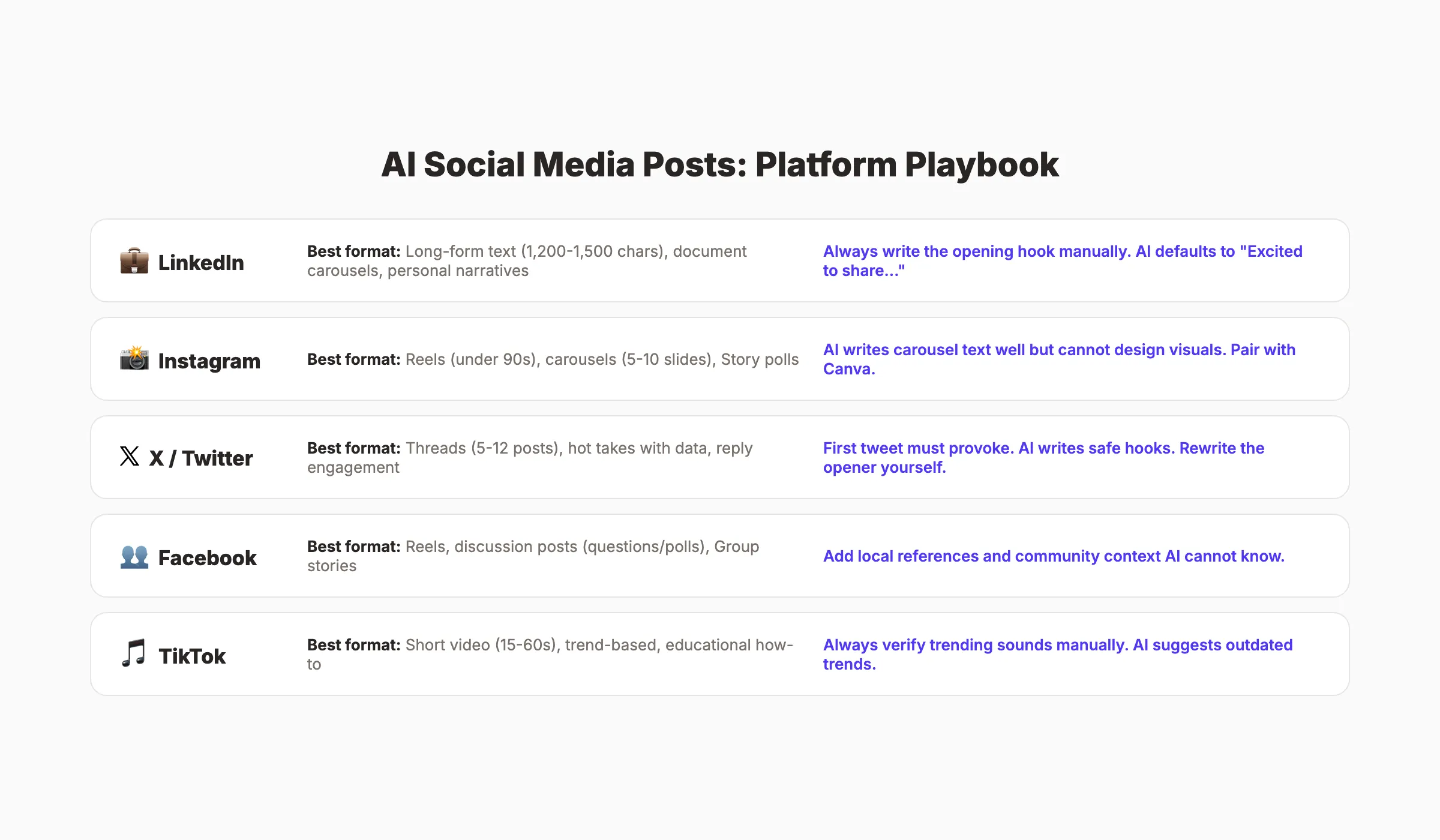
Format that wins: Long-form text posts (1,200-1,500 characters), document carousels, and personal narratives. LinkedIn rewards original commentary and first-person stories.
AI prompt tips:
- Specify “professional but conversational tone”
- Ask for a strong opening hook (first 2 lines must stop the scroll)
- Request line breaks every 1-2 sentences for readability
- Avoid hashtag stuffing. 3-5 relevant hashtags maximum.
What to always edit manually: The opening hook and closing call-to-action. AI often starts with “Excited to share…” which LinkedIn audiences scroll past immediately. Write the hook yourself.
LinkedIn is a strong channel for B2B social media strategy. AI can handle the volume. You handle the voice.
Format that wins: Reels (90 seconds or under), carousels (5-10 slides), and Story polls. Static image posts with long captions underperform compared to 2023.
AI prompt tips:
- Generate carousel slide copy as individual text blocks (7-12 words per slide)
- Ask for reel scripts with specific hook, body, and CTA structure
- Request caption drafts under 150 characters for feed posts (longer for carousels)
- Generate hashtag sets in 3 tiers: broad (100K+ posts), medium (10K-100K), and niche (under 10K)
What to always edit manually: Visual concepts. AI can write carousel text but cannot design engaging visuals. Pair AI-written copy with strong imagery. Use Instagram scheduling tools to batch the publishing workflow.
X (Twitter)
Format that wins: Threads (5-12 posts), hot takes with data, and reply engagement. Single tweets with links get suppressed by the algorithm.
AI prompt tips:
- Constrain to 280 characters per tweet
- Ask for threads with a numbered structure
- Request a controversial or surprising opening hook
- Specify “no hashtags in thread body, one at the end”
What to always edit manually: The first tweet. It must provoke curiosity or disagreement to earn impressions. AI writes safe first tweets. Safe does not get engagement on X.
Format that wins: Reels, community discussion posts (questions and polls), and long-form personal stories in Groups. Brand page organic reach remains low without paid amplification.
AI prompt tips:
- Generate 2-3 discussion questions per topic
- Ask for storytelling format with emotional hooks
- Request Reel scripts under 60 seconds
- Specify “conversational, friendly, community tone”
What to always edit manually: Local references and community context. For local business social media, AI cannot name the street your business is on or reference yesterday’s town event. Add those details yourself.
TikTok
Format that wins: Short videos (15-60 seconds), trend-based content, and educational “how-to” formats. Text-on-screen with voiceover dominates.
AI prompt tips:
- Generate scripts as “Hook (3 seconds) → Body (20-40 seconds) → CTA (5 seconds)”
- Ask for text-on-screen overlays as separate elements
- Request trending audio/format suggestions (then verify manually)
- Specify “casual, fast-paced, authentic tone”
What to always edit manually: Trend relevance. AI cannot access real-time trending sounds or formats. It will suggest trends from 6 months ago. Always verify trends manually before creating.
Your SEO team. $99 per month. 30 optimized articles, published automatically. Social media too. Start for $1 →
Chapter 5: How to Make AI Posts Sound Human
Generic AI output is the number one killer of social media engagement. Here is how to fix it.
The Brand Voice Training Method
AI cannot learn your voice from a single prompt. You need to train it over multiple interactions.
Step 1: Build a swipe file. Collect 20-30 of your best-performing posts. These become your reference material.
Step 2: Create a voice card. Document your brand voice in 5 elements:
| Element | Example |
|---|---|
| Tone | ”Direct, slightly irreverent, data-informed” |
| Sentence style | ”Short sentences. Fragments are fine. Never over 15 words.” |
| Vocabulary | ”Use ‘revenue’ not ‘income.’ Use ‘team’ not ‘workforce.’” |
| Avoid | ”Never say ‘excited to announce’ or ‘proud to share‘“ |
| Personality | ”Confident opinions. Back them with numbers. Zero hedging.” |
Step 3: Feed context every session. Paste 3-5 example posts plus your voice card at the start of every AI chat session. This anchors the model’s output to your actual voice.
Step 4: Iterate. When output misses the mark, tell the AI what was wrong and regenerate. Each correction improves future output.
The Before/After Test
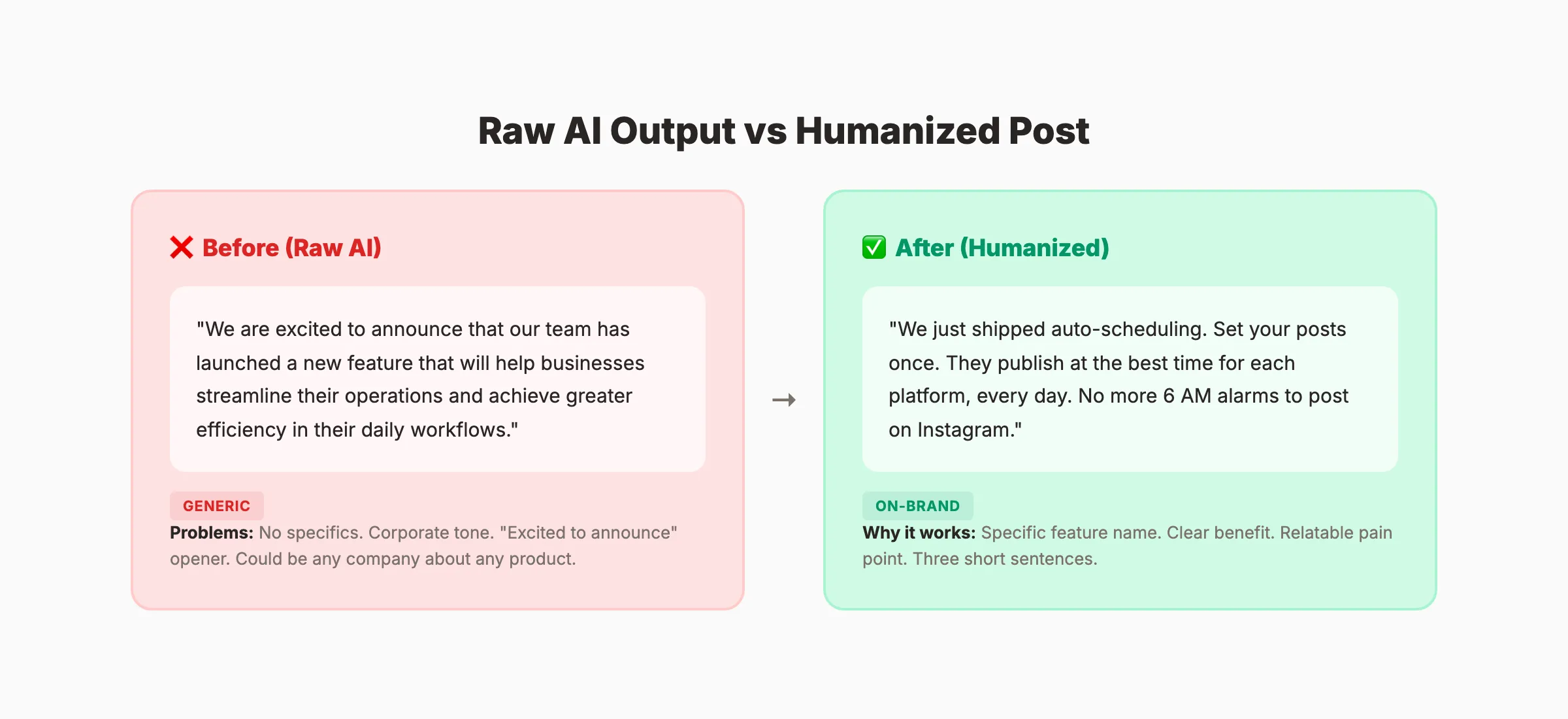
Before (raw AI output): “We are excited to announce that our team has launched a new feature that will help businesses streamline their operations and achieve greater efficiency in their daily workflows.”
After (humanized): “We just shipped auto-scheduling. Set your posts once. They publish at the best time for each platform, every day. No more 6 AM alarms to post on Instagram.”
The difference: specifics, personality, and a clear benefit. The AI draft says nothing. The edited version says everything in 3 sentences.
Five Signs Your AI Content Needs More Editing
- It starts with “In today’s…” or “Are you looking for…”
- Every sentence is the same length (15-18 words)
- There are no specific names, numbers, or examples
- The CTA is “Learn more” or “Check it out”
- You could swap in any competitor’s name and the post still works
If any of these apply, the post needs more human editing. Use the AI vs human writers framework to decide what stays AI-drafted and what needs a full rewrite.
Chapter 6: AI Social Media Tools Worth Using
Not every AI tool is worth your budget. Here is what works based on specific use cases.
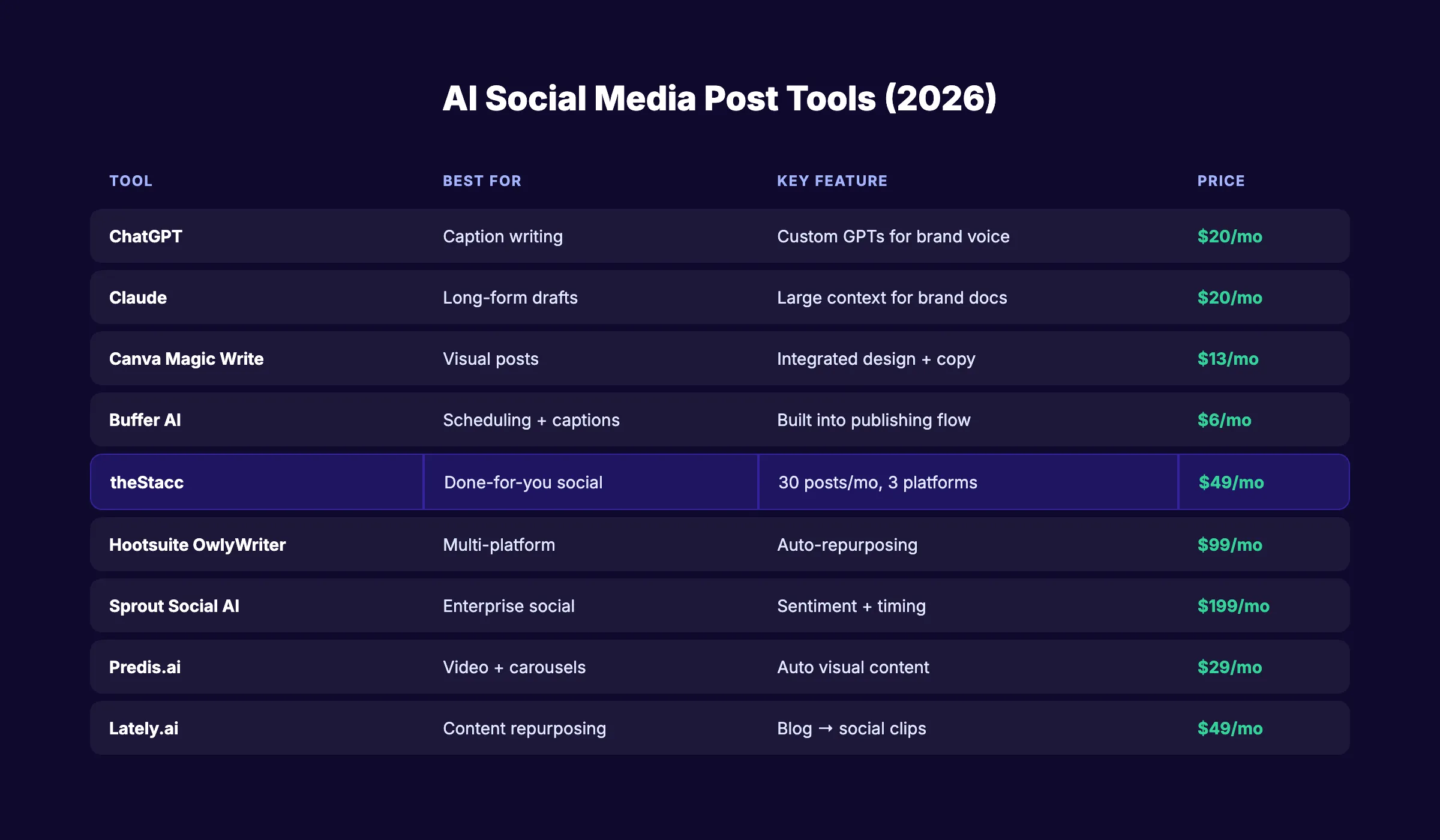
| Tool | Best For | Key Feature | Price |
|---|---|---|---|
| ChatGPT (GPT-4o) | Caption writing, brainstorming | Custom GPTs for brand voice | $20/mo |
| Claude | Long-form drafting, strategy | Large context window for brand docs | $20/mo |
| Canva Magic Write | Visual posts with text | Integrated design + copy | $13/mo |
| Buffer AI Assistant | Scheduling + caption generation | Built into publishing workflow | $6/mo |
| Hootsuite OwlyWriter | Multi-platform post generation | Auto-repurposing across platforms | $99/mo |
| Sprout Social AI | Enterprise social management | Sentiment analysis + optimal timing | $199/mo |
| theStacc | Done-for-you social posts | 30 posts/mo, 3 platforms, published | $49/mo |
| Predis.ai | AI video and carousel creation | Auto-generates visual content | $29/mo |
| Lately.ai | Long-form to social content | Breaks blog posts into social clips | $49/mo |
Choosing the Right Tool Stack
Solopreneur or small team (under $50/month): ChatGPT + Canva + Buffer. Generate captions in ChatGPT, design visuals in Canva, schedule in Buffer.
Growing business ($50-150/month): A done-for-you service or Hootsuite for multi-platform management. Social media automation tools handle scheduling and analytics.
Agency or enterprise ($200+/month): Sprout Social or Hootsuite Enterprise with custom AI training and multi-brand management.
50% of social media professionals rely exclusively on free AI tools. Free tools work for ideation. They fall short for consistent, on-brand, multi-platform publishing. Evaluate based on your output volume and quality standards.
Chapter 7: Measuring AI Social Media Performance
If you do not measure, you do not know if AI is helping or hurting. Here is what to track.
5 Metrics That Separate AI Success from AI Failure
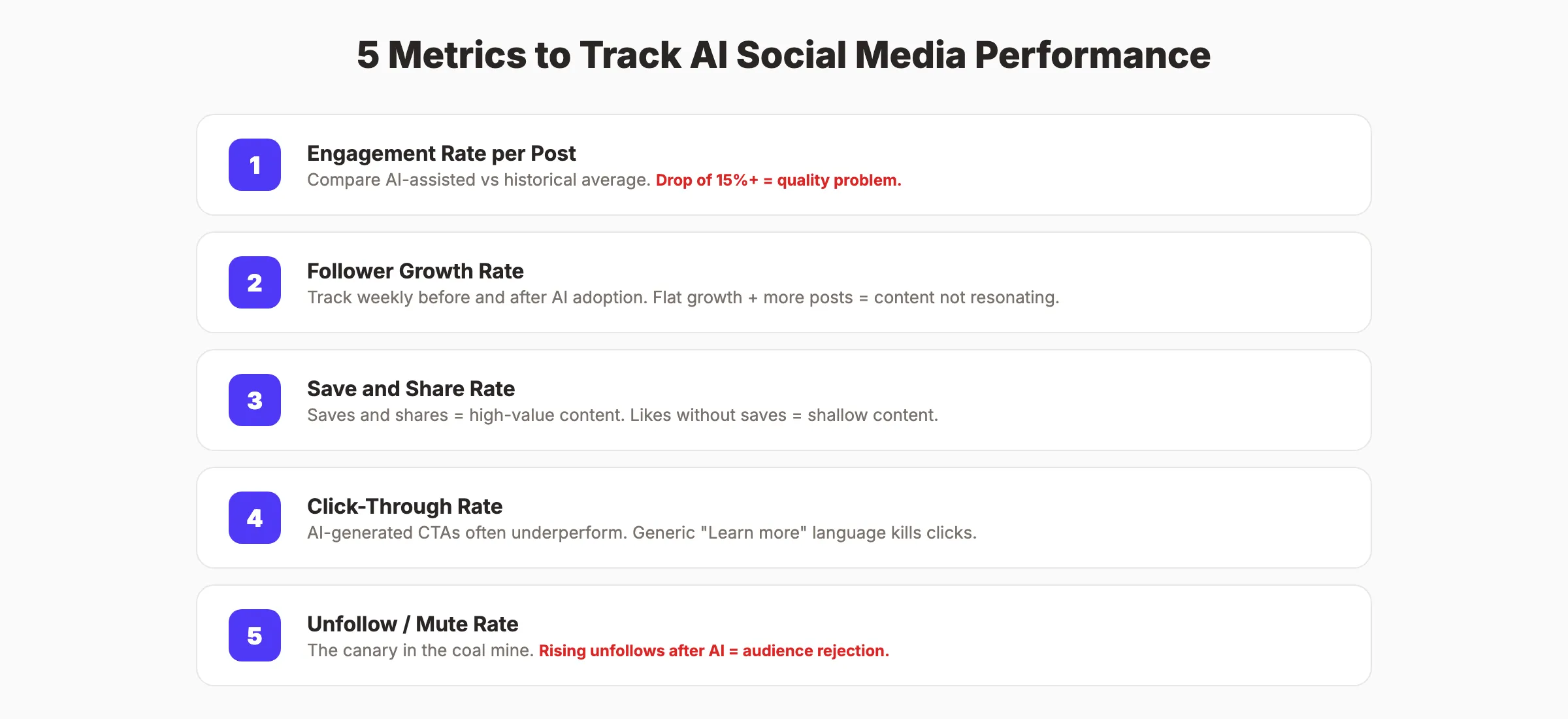
1. Engagement Rate per Post. Compare engagement rates on AI-assisted posts versus your historical average. A drop of more than 15% signals a quality problem in your AI workflow.
2. Follower Growth Rate. Track weekly follower growth before and after adopting AI. Flat or negative growth alongside increased posting volume means the content is not resonating.
3. Save and Share Rate. Saves and shares indicate high-value content. If AI posts get likes but not saves, the content lacks depth or originality.
4. Click-Through Rate. For posts with links, track CTR. AI-generated CTAs often underperform because they default to generic language like “Learn more.”
5. Unfollow/Mute Rate. The canary in the coal mine. Rising unfollows after increasing AI usage means your audience detects and rejects the shift. Monitor this weekly.
The A/B Testing Framework
Run this test for 30 days:
- Group A: Posts created with your AI workflow (Steps 1-6 from Chapter 3)
- Group B: Posts created entirely by a human team member
- Control: Same content pillars, same posting times, same platforms
Compare all 5 metrics above. Most teams find AI-assisted posts (Level 2) match or slightly exceed pure human output when the editing process is strong. Fully AI-generated posts (Level 3) almost always underperform.
For broader content tracking, this same framework applies to content marketing statistics and performance benchmarks across channels.
3,500+ blogs published. 92% average SEO score. See what Stacc can do for your site and social channels. Start for $1 →
Chapter 8: 8 Mistakes That Kill AI Social Media Engagement
Every mistake on this list comes from real teams that saw engagement collapse after adopting AI. Avoid all 8.
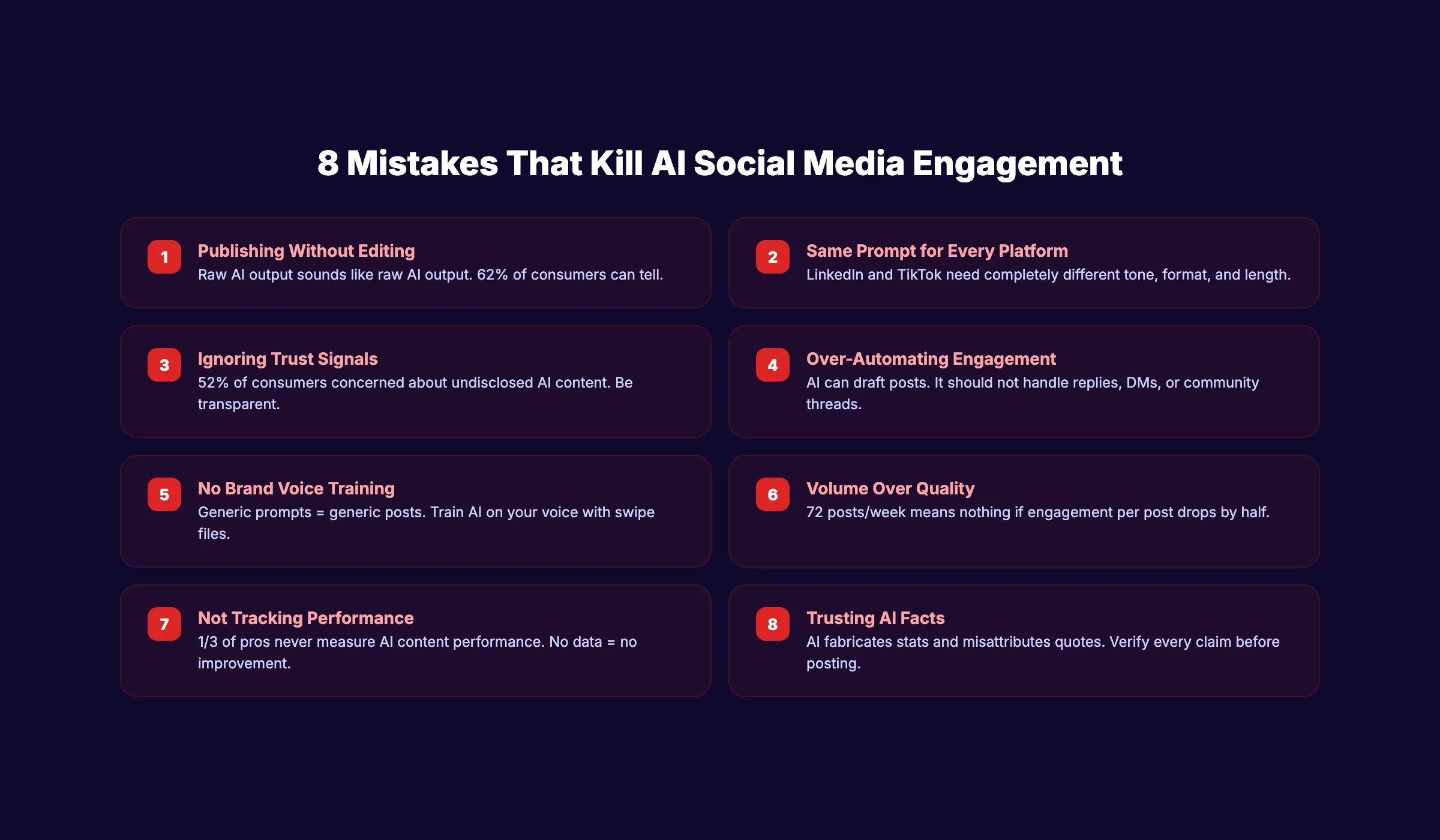
Mistake 1: Publishing Without Editing
Raw AI output sounds like raw AI output. 62% of consumers can tell. Skipping the editing step (Step 4 in the workflow) is the single fastest way to lose followers.
Mistake 2: Using the Same Prompt for Every Platform
A LinkedIn post and a TikTok script need completely different tone, format, and length. Using one prompt across all platforms produces mediocre content everywhere.
Repurposing blog content for social media requires platform adaptation. The same principle applies to AI prompts.
Mistake 3: Ignoring Consumer Trust Signals
52% of consumers feel concerned about brands posting AI content without disclosure. Be transparent about AI use where platform policies or audience expectations require it. Authenticity builds trust. Deception destroys it.
Mistake 4: Over-Automating Community Engagement
AI can draft posts. AI should not handle reply threads, DMs, or community conversations. People join social communities to interact with humans, not bots. Automate publishing. Keep engagement human.
Mistake 5: No Brand Voice Training
Generic prompts produce generic posts. If you skip the brand voice training method from Chapter 5, every post sounds like every other business using ChatGPT. That sameness is exactly what audiences now reject.
Mistake 6: Chasing Volume Over Quality
Publishing 72 posts per week means nothing if engagement per post drops by half. AI makes volume easy. Quality still requires human judgment and editing time. Match volume to your editing capacity.
Mistake 7: Not Tracking Performance
One-third of social media professionals do not measure AI content performance. Without data, you cannot optimize prompts, improve editing processes, or justify your tool investment. Track the 5 metrics from Chapter 7 weekly.
Mistake 8: Trusting AI Facts Without Verification
AI fabricates statistics, misattributes quotes, and invents product features. Publishing unverified claims creates legal and reputational risk. Google’s Gemini Super Bowl ad error proved that even major companies make this mistake. Fact-check every claim before posting.
Review the latest AI content statistics to understand how AI accuracy and adoption are evolving across the industry.
Rank everywhere. Do nothing. Blog SEO, Local SEO, and Social on autopilot. Stacc starts at $49/mo for social. Start for $1 →
FAQ
Can AI create good social media posts?
Yes, with the right process. AI-assisted posts (where a human edits AI drafts) match or outperform fully human-written posts in most cases. Fully AI-generated posts without editing almost always underperform. The difference is the workflow, not the technology.
What is the best AI tool for social media posts?
It depends on your needs. ChatGPT is the most versatile for caption writing and brainstorming. Buffer AI Assistant is best for scheduling with built-in generation. For done-for-you social publishing, Stacc handles 30 posts per month across 3 platforms for $49 per month.
Does AI-generated content hurt social media engagement?
It can. 62% of consumers say they are less likely to engage with content they know was created by AI. However, this applies primarily to obvious, unedited AI content. Well-edited, brand-aligned AI-assisted content performs on par with human-written posts.
How do you make AI social media posts sound human?
Train the AI on your brand voice using a swipe file of your best posts. Feed brand context at the start of every session. Generate multiple drafts and pick the strongest structure. Then edit heavily: cut filler, add specifics, inject opinion, and verify facts. Read the final post aloud before publishing.
What percentage of social media content is AI-generated?
According to Metricool’s 2026 report, 65% of social media professionals use AI for at least half of their posts. 96% use AI for some aspect of social media work. The share of fully AI-generated content (without human editing) is harder to measure, but Originality.AI estimates that 15% of Reddit posts are likely AI-generated.
Is it ethical to use AI for social media marketing?
Using AI as a tool to improve your work is standard practice. The ethical concerns arise around disclosure and deception. Be transparent about AI use where platforms require it. Do not present AI-generated content as expert testimonials or personal experiences. Do not fabricate case studies or statistics. Use AI to enhance human work, not to replace honesty.
The brands winning on social media in 2026 are not avoiding AI. They are using it better than everyone else. Build the workflow. Train the voice. Edit every post. Measure the results. The teams that treat AI as a drafting partner rather than a replacement will own the feeds while everyone else publishes forgettable content.
Related Tools & Resources
Free SEO Tools:
Best Lists:

Written by
Siddharth GangalSiddharth is the founder of theStacc and Arka360, and a graduate of IIT Mandi. He spent years watching great businesses lose organic traffic to competitors who simply published more. So he built a system to fix that. He writes about SEO, content at scale, and the tactics that actually move rankings.
30 SEO blog articles published every month
Keyword-optimized, scheduled, and live on your site. Automatically.
30-day trial · Cancel anytime
theStacc
Stop writing SEO content manually
30 blog articles, 30 GBP posts, and social media content. Published every month. Automatically.
Start Your $1 Trial$1 for 3 days · Cancel anytime