
AI Agent Orchestration for Marketing (2026): Guide
ai agent orchestration marketing strategies for 2026: proven tactics, real case studies, tools, and metrics to drive growth and ROI.
The global AI agent market reached $7.63 billion in 2025. It is projected to hit $182.97 billion by 2033. That is a 49.6% compound annual growth rate.
But here is what most teams miss. A single AI agent does not transform marketing. A coordinated system of specialized agents does. Gartner reported a 1,445% surge in multi-agent system inquiries between Q1 2024 and Q2 2025. The shift is already happening.
Most marketing teams bolt on one AI tool at a time. A writing assistant here. A scheduling tool there. The result is a disconnected mess that creates more work than it eliminates. AI agent orchestration solves this by coordinating multiple specialized agents into a single, goal-driven system.
We have published 3,500+ blogs across 70+ industries using orchestrated AI workflows. This guide covers everything we know about building, managing, and scaling a multi-agent marketing stack.
Here is what you will learn:
- What AI agent orchestration actually means (and how it differs from automation)
- The 6 agent roles every marketing team needs
- How to architect a multi-agent stack from scratch
- The governance framework that prevents agent chaos
- Real workflows for content, SEO, email, and paid media
- Common mistakes that derail multi-agent implementations
Chapter 1: What AI Agent Orchestration Actually Means
AI agent orchestration is the coordinated management of multiple AI agents working together to execute complex marketing workflows. Each agent has a defined role, access to specific tools, and the ability to make decisions within its scope.
Think of it as managing a team. Not one generalist who does everything poorly. A team of specialists who each handle what they do best.
How It Differs from Traditional Automation
Traditional marketing automation follows rigid if/then rules. If a lead downloads a whitepaper, send email sequence B. The logic is fixed. The system cannot adapt.
An AI agent receives a goal and determines the best path to achieve it. It can reason, access external data, and adjust its approach based on results. A conventional automation might trigger when a ranking drops and send an alert. An AI SEO agent pulls the ranking data, analyzes the page, examines competitors, identifies content gaps, and generates a prioritized action plan.
How It Differs from a Single AI Agent
A single AI agent handles one task. A multi-agent system coordinates multiple agents on interconnected tasks. HubSpot research shows multi-agent systems outperform single-agent approaches by 90.2% on complex tasks.
The difference is compounding. One agent writes a blog post. A multi-agent system researches the topic, writes the draft, optimizes for SEO, generates images, schedules social posts, and monitors performance. Each agent feeds its output into the next.
The Orchestration Layer
The orchestration layer is the coordinator. It assigns tasks, manages dependencies, handles handoffs between agents, and ensures the overall goal stays on track. Without it, you have a collection of agents. With it, you have a system.
This orchestration layer can be a dedicated AI (sometimes called a “puppeteer” or “supervisor” agent) or a human operator using a platform that manages agent coordination. In 2026, most teams use a hybrid approach: AI handles routine coordination while humans set strategy and approve high-stakes decisions.
Chapter 2: The 6 Agent Roles Every Marketing Stack Needs
Not every marketing task requires the same type of intelligence. A multi-agent marketing stack uses specialized agents, each optimized for a specific function.
The Strategy Agent
The strategy agent analyzes market data, competitor activity, keyword trends, and performance metrics. It identifies opportunities and recommends priorities.
Input: Raw data from analytics platforms, search consoles, CRM systems. Output: Strategic recommendations, content calendars, campaign briefs.
This agent replaces the hours your team spends pulling reports and finding patterns. It processes data from multiple sources simultaneously and identifies correlations humans would miss.
The Research Agent
The research agent gathers information from across the web. It scans competitor content, reads industry reports, monitors social conversations, and compiles data for other agents to use.
Input: Topics, keywords, competitor URLs, industry queries. Output: Research briefs, competitive analyses, data compilations.
The research agent is the foundation of every workflow. Bad research produces bad content. This is where content strategy lives or dies.
The Content Agent
The content agent writes. Blog posts, landing pages, email copy, social captions, ad creative. It takes research and strategy inputs and produces draft content following brand guidelines.
Input: Research briefs, content briefs, brand voice rules, SEO targets. Output: Draft content across all formats.
Stop writing. Start ranking. Stacc publishes 30 optimized articles per month for $99. Start for $1 →
Teams using AI content agents report 68% shorter content creation timelines and 73% faster campaign development. But the content agent alone is not enough. It needs the research agent feeding it data and the SEO agent validating its output.
The SEO Agent
The SEO agent handles technical optimization, keyword targeting, internal linking, schema markup, and performance monitoring. It operates across on-page, off-page, and technical SEO tasks.
Input: Content drafts, keyword data, site audit results, ranking data. Output: Optimized content, technical recommendations, link suggestions.
This agent works in tandem with the content agent. The content agent writes. The SEO agent refines. Our SEO automation guide covers the specific workflows in detail.
The Distribution Agent
The distribution agent publishes and promotes content across channels. It schedules social posts, triggers email sequences, manages paid campaigns, and handles cross-channel coordination.
Input: Finished content, audience segments, channel rules, posting schedules. Output: Published content, scheduled posts, campaign activations.
The distribution agent is where most teams see immediate ROI. Manual publishing across 4-5 channels takes hours. An orchestrated distribution agent handles it in minutes. This is the core of marketing automation.
The Analytics Agent
The analytics agent monitors performance, attributes conversions, identifies trends, and feeds insights back to the strategy agent. It closes the loop.
Input: Performance data from all channels, conversion data, engagement metrics. Output: Performance reports, trend alerts, optimization recommendations.
Without this agent, the system runs blind. The analytics agent ensures every cycle improves on the last. It is the difference between a static system and a compounding one.
Chapter 3: How to Architect Your Multi-Agent Stack
Architecture determines whether your multi-agent system scales or collapses. There are 3 primary patterns.
Pattern 1: Sequential Pipeline
Agents pass work forward in a fixed order. Research → Content → SEO → Distribution → Analytics.
Best for: Simple content workflows. Blog production. Social media scheduling. Limitation: Slow. One bottleneck stalls the entire pipeline.
This is where most teams start. It works for straightforward publishing workflows like scaling blog content with AI. But it breaks down when tasks overlap or require parallel processing.
Pattern 2: Hub-and-Spoke
A central orchestrator agent assigns tasks to specialist agents and collects their outputs. The orchestrator decides what happens next based on combined results.
Best for: Complex campaigns. Multi-channel launches. Content requiring multiple revisions. Limitation: The orchestrator is a single point of failure.
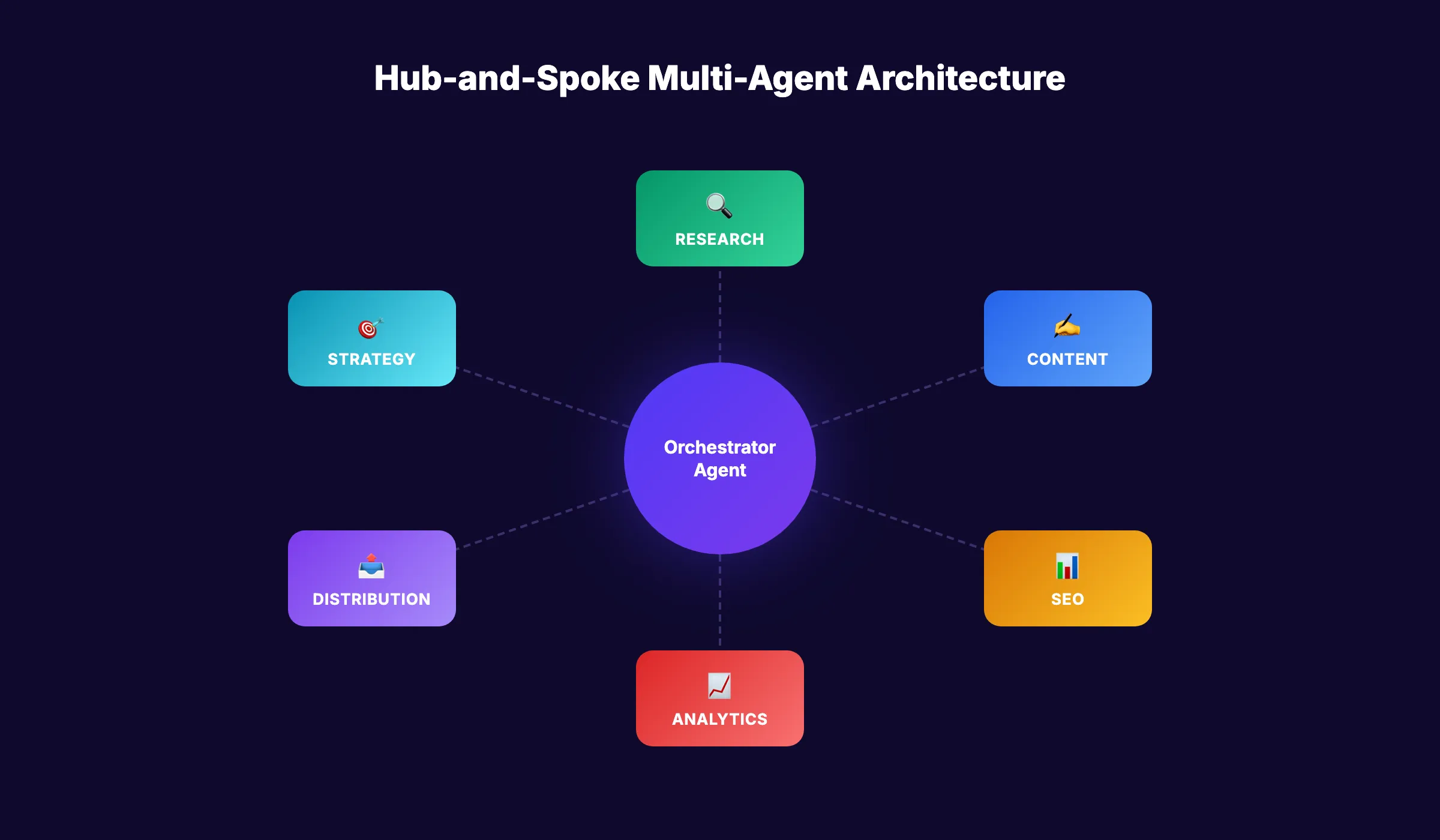
Hub-and-spoke is the most common enterprise pattern in 2026. The orchestrator agent holds the campaign goal, breaks it into subtasks, and distributes them. When the content agent finishes a draft, the orchestrator routes it to the SEO agent for optimization, then to the distribution agent for publishing.
Pattern 3: Mesh Network
Every agent can communicate with every other agent directly. No central coordinator. Agents negotiate and collaborate peer-to-peer.
Best for: Real-time optimization. Dynamic campaigns. A/B testing at scale. Limitation: Complex to implement. Requires mature governance.
Mesh networks are the most powerful but hardest to build. Most teams graduate to this after running hub-and-spoke for 6+ months.
Choosing Your Starting Architecture
| Factor | Sequential | Hub-and-Spoke | Mesh |
|---|---|---|---|
| Team size | 1-3 people | 4-10 people | 10+ people |
| Campaign complexity | Low | Medium | High |
| Setup time | Days | Weeks | Months |
| Scalability | Limited | Good | Excellent |
| Governance needed | Minimal | Moderate | Extensive |
Start with sequential. Move to hub-and-spoke when you need parallel processing. Consider mesh only when you have the governance infrastructure to support it.
Your SEO team. $99 per month. 30 optimized articles, published automatically. Start for $1 →
Chapter 4: Building the Orchestration Layer
The orchestration layer is the brain of your multi-agent system. It coordinates task assignment, dependency management, handoffs, and error handling.
Task Assignment
The orchestrator breaks high-level goals into discrete tasks and assigns them to the right agent. A goal like “launch Q2 content campaign” becomes:
- Research agent: Analyze top 50 keywords by search volume and difficulty
- Strategy agent: Select 12 target keywords and map to content formats
- Content agent: Write 12 blog posts following brand guidelines
- SEO agent: Optimize all posts for target keywords and internal linking
- Distribution agent: Schedule publication cadence and social promotion
- Analytics agent: Set up tracking and weekly performance reports
Each task has a defined input, expected output, deadline, and quality threshold.
Dependency Management
Some tasks depend on others. The content agent cannot write without the research agent’s brief. The SEO agent cannot optimize without the content agent’s draft. The orchestrator manages these dependencies automatically.
This is where many teams fail. They launch all agents simultaneously and get garbage outputs because upstream data was not ready. Sequential dependencies must be respected. Parallel tasks (like social asset creation and email drafts) can run simultaneously.
Handoff Protocols
When one agent finishes, its output becomes another agent’s input. The handoff protocol defines:
- Format: What structure the output takes (JSON, markdown, plain text)
- Validation: What quality checks run before the handoff
- Fallback: What happens if the output fails validation
Clean handoffs prevent the most common multi-agent failure: compounding errors. If the research agent passes bad data to the content agent, the content agent produces a flawed draft, and the SEO agent optimizes a fundamentally broken piece. Every handoff needs a quality gate.
Error Handling and Recovery
Agents fail. APIs time out. Models hallucinate. The orchestration layer needs recovery protocols for every failure type:
- Retry logic: Attempt the task again with the same inputs
- Fallback routing: Route the task to an alternative agent
- Human escalation: Flag the task for human review
- Graceful degradation: Continue the workflow without the failed component
The teams that scale multi-agent systems invest more in error handling than in agent capabilities. A system that recovers gracefully from failures outperforms a brittle system with better individual agents.
Chapter 5: Governance. Preventing Agent Chaos at Scale
Gartner predicts 40% of enterprise applications will embed task-specific AI agents by end of 2026. Without governance, this creates what industry analysts call “agent chaos”. Redundant builds, inconsistent quality, and unmanaged risk.
Why Governance Matters More Than Agent Quality
Deloitte’s 2026 research found that agent programs maintaining human oversight were twice as likely to achieve cost savings of 75% or more compared to fully autonomous setups. Governance is not a constraint. It is a multiplier.
The RACI Framework for Agents
Assign every agent a clear scope using the RACI model:
| Agent | Responsible For | Accountable To | Consulted By | Informed Of |
|---|---|---|---|---|
| Strategy | Campaign goals, priorities | Marketing director | All agents | Performance data |
| Research | Data gathering, competitor intel | Strategy agent | Content, SEO | Keyword changes |
| Content | Drafts, copy, creative | Content lead (human) | SEO, Distribution | Brand updates |
| SEO | Optimization, technical health | SEO lead (human) | Content, Analytics | Ranking changes |
| Distribution | Publishing, scheduling | Campaign manager | Content, Analytics | Channel metrics |
| Analytics | Reporting, attribution | Marketing director | All agents | All performance |
The critical column is “Accountable To.” Every agent reports to a human decision-maker. No agent has unlimited autonomous authority.
Brand Safety Controls
AI agents optimizing for different KPIs can work against each other. The content agent optimizes for engagement. The SEO agent optimizes for rankings. The distribution agent optimizes for reach. Without alignment, they pull in different directions.
Brand safety controls include:
- Voice validation: Every piece of content runs through brand voice rules before publishing
- Compliance review: Legal and regulatory checks on all customer-facing outputs
- Conflict resolution: Rules for when agent recommendations contradict each other
- Spending limits: Hard caps on any agent with budget authority
This is the core challenge covered in content governance for AI teams. The framework applies directly to multi-agent systems.
Human-in-the-Loop Checkpoints
Not every decision needs human approval. But high-stakes decisions always do.
Automate: Routine publishing, social scheduling, keyword tracking, report generation. Human approval required: Budget allocation, brand messaging changes, campaign strategy shifts, crisis response, any customer-facing communication above a defined risk threshold.
The goal is not to remove humans from the loop. It is to remove humans from tasks that do not require human judgment so they can focus on tasks that do.
3,500+ blogs published. 92% average SEO score. See what Stacc can do for your site. Start for $1 →
Chapter 6: Real Multi-Agent Workflows
Theory means nothing without implementation. Here are 4 workflows that demonstrate orchestrated multi-agent systems in action.
Workflow 1: Blog Content Production
This is the most common multi-agent workflow and the one where we have the most operating experience.
Step 1. Research Agent identifies a target keyword cluster. It analyzes search volume, keyword difficulty, SERP features, and competitor content gaps.
Step 2. Strategy Agent selects the best keyword, determines the content format (guide, listicle, comparison), and generates a detailed content brief with H2/H3 structure.
Step 3. Content Agent writes the full draft following the brief, brand voice rules, and SEO content writing best practices.
Step 4. SEO Agent optimizes the draft. Internal linking, keyword placement, meta description, schema markup, image alt text.
Step 5. Distribution Agent publishes to the blog, schedules social promotion across channels, and triggers email notification to subscribers.
Step 6. Analytics Agent monitors rankings, traffic, engagement, and conversions for 30 days. Feeds performance data back to the strategy agent for the next cycle.
This 6-step workflow replaces what used to take a 4-person team 8-10 hours per article. Orchestrated agents complete it in under 2 hours with human review at steps 3 and 4.
Workflow 2: Multi-Channel Campaign Launch
Orchestrator Goal: Launch a product update campaign across blog, email, social, and paid channels in 5 business days.
The orchestrator breaks this into parallel workstreams:
- Research Agent → Audience analysis, competitive positioning
- Content Agent → Blog post, landing page, email sequence, social posts, ad copy (runs in parallel after research completes)
- SEO Agent → Optimizes blog and landing page
- Distribution Agent → Schedules all publications and ad activations
- Analytics Agent → Configures tracking, sets up dashboards
With hub-and-spoke orchestration, the research phase runs first. Then 3 agents work in parallel on content creation. The SEO and distribution agents activate once content is ready. Total time: 5 days versus the typical 3-4 weeks for manual execution.
Workflow 3: SEO Monitoring and Recovery
This workflow runs continuously with no fixed start or end.
Analytics Agent monitors rankings, crawl errors, and Core Web Vitals daily. When it detects a ranking drop above a defined threshold, it triggers the recovery workflow:
- Analytics agent flags the affected page and provides performance data
- Research agent analyzes the new SERP for that keyword
- SEO agent compares the page against top-ranking competitors
- Content agent updates the page based on SEO agent recommendations
- Distribution agent republishes and triggers a recrawl
- Analytics agent monitors recovery for 14 days
This automated recovery workflow catches ranking drops within 24 hours instead of the typical weekly or monthly review cycle. It pairs well with a broader SEO workflow automation strategy.
Workflow 4: Email Personalization at Scale
Strategy Agent segments the audience into 8 behavioral cohorts based on engagement data.
Content Agent writes 8 email variations, one per cohort, with personalized subject lines, body copy, and CTAs.
Distribution Agent A/B tests subject lines within each cohort, selects winners, and deploys the full campaign.
Analytics Agent tracks open rates, click rates, and conversions by cohort. Feeds results back to the strategy agent for the next campaign cycle.
This workflow produces 8x the personalization of a single-email approach with roughly the same level of human oversight. The email automation guide covers the foundational setup.
Chapter 7: Common Mistakes That Derail Multi-Agent Systems
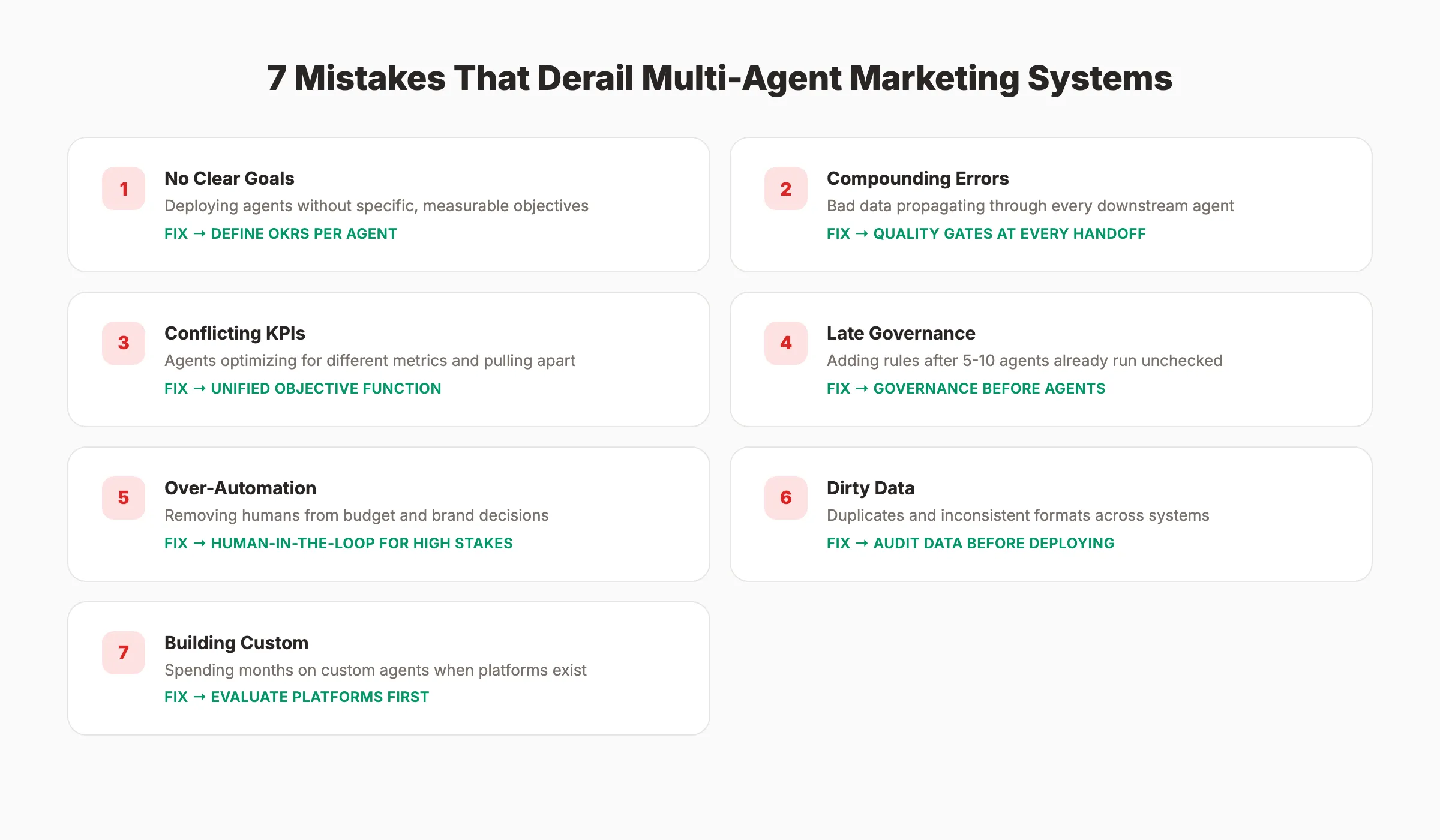
67% of organizations cite data quality as their biggest AI implementation barrier. But data quality is only one of 7 common failure patterns.
Mistake 1: Deploying Agents Without Clear Goals
“Use AI for marketing” is not a goal. “Publish 30 SEO-optimized blog posts per month targeting keywords with 500+ monthly search volume” is a goal. Every agent needs a specific, measurable objective. AI for the sake of AI does not work.
Mistake 2: Ignoring the Compounding Error Problem
In a multi-agent system, errors multiply. If the research agent confuses “first week” with “first seven days,” that error propagates through every downstream agent. By the time the content publishes, the conclusion is based on entirely incorrect data.
Fix this with validation at every handoff point. Every agent output must pass a quality gate before it becomes another agent’s input.
Mistake 3: Letting Agents Optimize for Conflicting KPIs
Your content agent optimizes for engagement. Your SEO agent optimizes for rankings. Your paid media agent optimizes for conversions. Without alignment, the content agent writes clickbait that the SEO agent cannot rank, and the paid media agent bids on keywords the content does not support.
Define a unified objective function. All agents optimize toward the same north star metric (usually revenue or qualified traffic), with their individual KPIs weighted accordingly.
Mistake 4: Skipping Governance Until It Is Too Late
Teams often deploy 5-10 agents before establishing governance. By then, agents have inconsistent permissions, overlapping responsibilities, and no clear escalation path. The result is agent chaos. Redundant work, conflicting outputs, and wasted budget.
Build governance before you build agents. Define RACI, set spending limits, establish human checkpoints, and document escalation protocols. Then deploy.
Mistake 5: Over-Automating High-Stakes Decisions
Some teams remove humans from budget allocation, brand messaging, and crisis response. This is a mistake. AI agents excel at execution tasks like research, writing, optimization, and scheduling. They are not yet reliable for strategic judgment calls that require context, intuition, and accountability.
Keep humans in the loop for any decision that could damage the brand or lose significant budget.
Mistake 6: Neglecting Data Quality
Dirty data in means garbage out, multiplied across every agent in the system. Before deploying a multi-agent system, audit your data sources. Remove duplicates. Standardize formats. Ensure consistency across your CRM, analytics, and content management systems.
Mistake 7: Building Custom When Platforms Exist
Not every team needs to build agents from scratch. Platforms like Jasper, n8n, Zapier, and others already offer agent orchestration for common marketing workflows. Building custom costs 10-50x more and takes months instead of days.
Evaluate existing platforms first. Build custom only for workflows where no platform meets your specific requirements. Our AI marketing automation guide reviews the leading options.
Chapter 8: Measuring Multi-Agent System Performance
You cannot improve what you do not measure. Multi-agent systems require metrics at 3 levels: individual agent performance, system-level performance, and business outcomes.
Agent-Level Metrics
Track each agent independently:
| Metric | What It Measures | Target |
|---|---|---|
| Task completion rate | % of tasks completed successfully | 95%+ |
| Error rate | % of outputs failing quality gates | Under 5% |
| Latency | Time to complete assigned tasks | Varies by agent |
| Cost per task | Token costs, API costs, compute | Track trend |
| Human override rate | % of outputs requiring human correction | Under 10% |
A rising human override rate signals agent drift. Investigate the root cause before it compounds.
System-Level Metrics
Track the orchestrated system as a whole:
- End-to-end workflow time: Total time from goal assignment to completion
- Handoff failure rate: % of handoffs that require retry or human intervention
- System throughput: Number of completed workflows per week
- Agent utilization: % of time each agent is actively working versus idle
Business Outcome Metrics
The metrics that actually matter:
- Content velocity: Articles published per month (aim for 5x output)
- Ranking improvement: Keywords gained in top 10/top 3 positions
- Organic traffic growth: Month-over-month organic session increase
- Cost per article: Total system cost divided by published articles
- Revenue attribution: Revenue traceable to agent-produced content
BCG research shows AI-powered workflows cut low-value work time by 25-40%. Track this reduction directly by measuring hours your team spends on tasks agents now handle.
Rank everywhere. Do nothing. Blog SEO, Local SEO, and Social on autopilot. Start for $1 →
Chapter 9: The Future of Multi-Agent Marketing
The autonomous AI agent market could reach $35 billion by 2030. If enterprises improve agent orchestration, Deloitte estimates that number could climb to $45 billion.
Trend 1: Domain-Specific Agent Marketplaces
General-purpose agents are giving way to specialized, industry-specific agents. Expect to see agent marketplaces where you can subscribe to a “local SEO agent” or a “B2B email agent” trained on your specific industry. The AI agent adoption statistics already show this specialization trend.
Trend 2: Agent-to-Agent Negotiations
In 2027 and beyond, agents will negotiate with each other across organizations. Your distribution agent will negotiate ad placement with a publisher’s inventory agent. Your content agent will coordinate with a partner company’s content agent for cross-promotion.
Trend 3: Self-Improving Agent Networks
Current multi-agent systems require human tuning to improve. Next-generation systems will optimize their own orchestration patterns based on outcome data. The analytics agent will go beyond reporting performance. It will restructure the entire workflow to improve results.
Trend 4: Regulatory Frameworks
As agent autonomy increases, so does regulatory attention. The EU AI Act already applies to certain agentic marketing systems. Expect marketing-specific regulations around data use, personalization, and automated decision-making within the next 2-3 years.
What This Means for Marketing Teams
The role of the marketer is shifting. Google’s Think with Google describes it as moving from “managing prompts to managing agents.” The most valuable marketing skills in 2026 are not copywriting or data analysis. They are system design, agent governance, and strategic judgment.
Teams that build multi-agent infrastructure now will compound their advantage over the next 3-5 years. Those who wait will face a widening gap that becomes harder to close with each quarter.
FAQ
What is AI agent orchestration in marketing?
AI agent orchestration is the coordinated management of multiple specialized AI agents working together to execute marketing workflows. Each agent handles a specific function. Research, content creation, SEO, distribution, or analytics. And the orchestration layer coordinates their tasks, manages dependencies, and ensures quality handoffs between them.
How many AI agents does a marketing team need?
Most teams start with 3 agents: a research agent, a content agent, and a distribution agent. As workflows mature, teams add SEO, strategy, and analytics agents. There is no magic number. Start with the workflow that consumes the most team hours and build agents around it. The typical mature stack has 5-7 specialized agents.
What is the difference between marketing automation and AI agent orchestration?
Marketing automation follows fixed rules. If X happens, do Y. AI agent orchestration gives agents goals and lets them determine the best path. Agents can reason, adapt to changing data, and make decisions within defined boundaries. Automation executes predetermined workflows. Orchestration coordinates intelligent agents toward strategic objectives.
How much does a multi-agent marketing stack cost?
Costs range from $200-500 per month for platform-based solutions (Jasper, Zapier, n8n) to $5,000-50,000+ per month for custom-built enterprise systems. The ROI calculation is straightforward: compare the cost of the agent stack to the cost of the humans or agencies doing the same work. Most teams see positive ROI within 60-90 days.
Can small businesses use multi-agent AI for marketing?
Yes. Small businesses do not need to build custom agents. Done-for-you services like Stacc already use orchestrated AI agent systems behind the scenes to deliver 30 SEO-optimized articles per month for $99. The complexity is handled by the platform. The business owner just approves and publishes.
What are the biggest risks of multi-agent marketing systems?
The 3 biggest risks are compounding errors (bad data propagating through all agents), agent misalignment (agents optimizing for conflicting goals), and governance gaps (no clear accountability when something goes wrong). All 3 are preventable with proper architecture, quality gates, and human-in-the-loop checkpoints.
AI agent orchestration is not a future concept. 85% of organizations have already integrated AI agents into at least one workflow. The question is not whether to adopt multi-agent systems. It is whether to build them deliberately or let them grow chaotically.
Start with one workflow. Build 3 agents. Add governance from day one. Measure everything. Scale what works.
The teams that master agent orchestration in 2026 will do more than keep up. They will set the pace.
Related Tools & Resources
Free SEO Tools:
Best Lists:

Written by
Siddharth GangalSiddharth is the founder of theStacc and Arka360, and a graduate of IIT Mandi. He spent years watching great businesses lose organic traffic to competitors who simply published more. So he built a system to fix that. He writes about SEO, content at scale, and the tactics that actually move rankings.
30 SEO blog articles published every month
Keyword-optimized, scheduled, and live on your site. Automatically.
30-day trial · Cancel anytime
theStacc
Stop writing SEO content manually
30 blog articles, 30 GBP posts, and social media content. Published every month. Automatically.
Try for free$1 for 3 days · Cancel anytime