
AI Marketing Automation (2026): Strategies, Tactics & Examples
ai marketing automation strategies for 2026: proven tactics, real case studies, tools, and metrics to drive growth and ROI.
Most marketing teams spend 15 or more hours per week on tasks a machine could handle. Scheduling posts. Segmenting email lists. Pulling campaign reports. Writing ad copy variations. Each task takes 20 minutes here, 30 minutes there. It adds up fast.
That wasted time has a real cost. Every hour spent on manual campaign work is an hour not spent on strategy, creative testing, or growth. According to HubSpot’s 2026 State of Marketing report, 86% of marketing professionals say AI saves them at least 1 hour per day. The teams not using it fall further behind every quarter.
AI marketing automation fixes this by handling repetitive marketing tasks through machine learning, not static rules. It learns from your data, adapts to patterns, and optimizes campaigns without constant human input.
We have published 3,500+ blogs across 70+ industries using automated workflows. This guide covers everything we know about AI marketing automation: how it works, where to apply it, which tools to use, and how to measure results.
Here is what you will learn:
- What AI marketing automation actually is and how it differs from traditional automation
- 9 use cases that deliver measurable ROI across email, content, social, ads, and SEO
- A 7-step implementation framework you can follow this week
- How to calculate and track your automation ROI
- The 8 most common mistakes that kill automation performance
- What AI agents mean for marketing in 2026 and beyond
Chapter 1: What Is AI Marketing Automation?
AI marketing automation uses machine learning, natural language processing, and predictive analytics to execute marketing tasks that traditionally required manual effort. Unlike rule-based automation, AI systems learn from data and improve over time.
Traditional marketing automation follows a simple pattern: if a user does X, then do Y. A visitor downloads an ebook, so the system sends a follow-up email 3 days later. That logic never changes unless a human rewrites the rule.
AI marketing automation works differently. It operates on a 4-stage cycle that continuously improves.
How the AI Automation Cycle Works
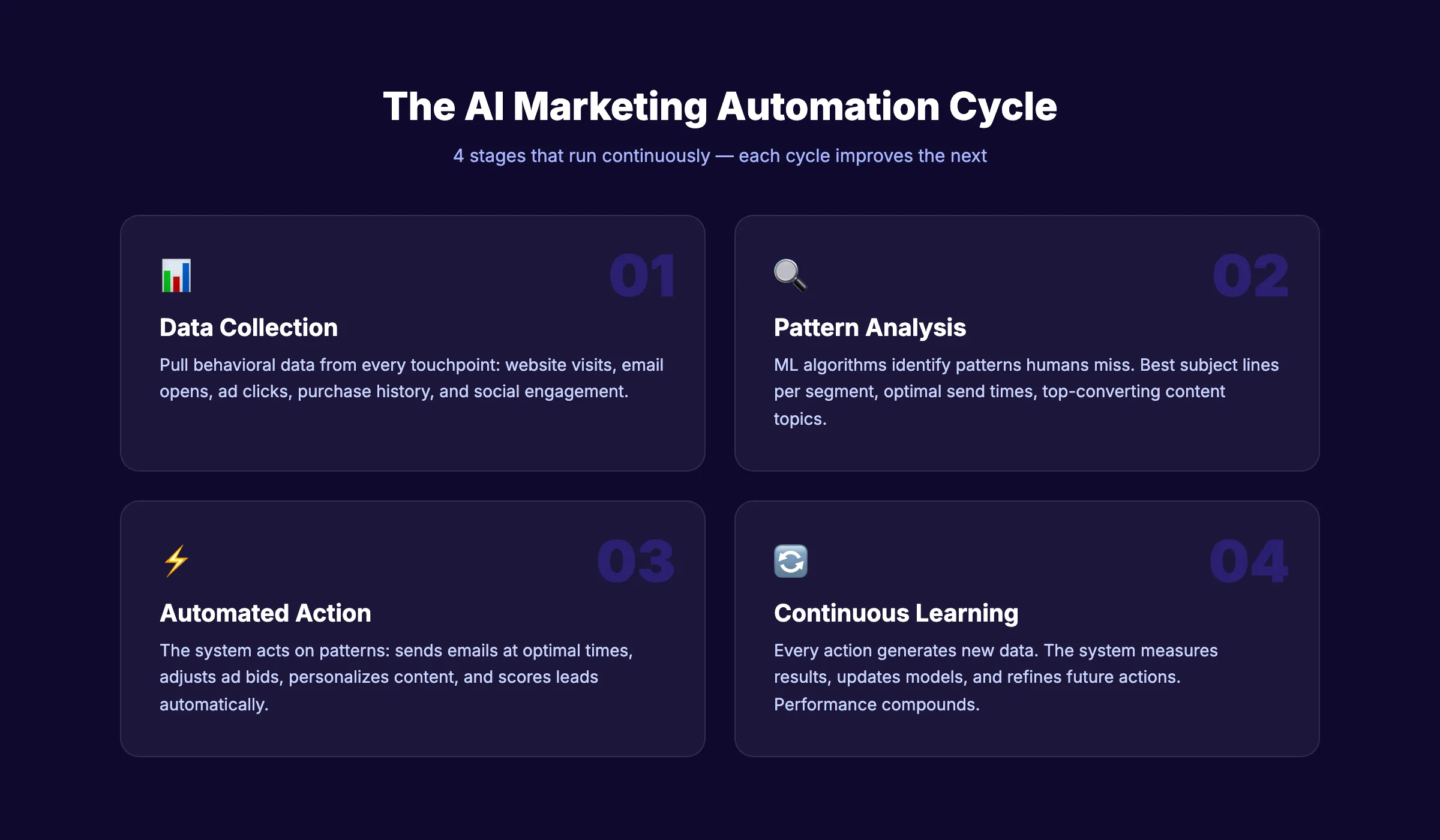
Stage 1: Data Collection. The system pulls behavioral data from every touchpoint. Website visits, email opens, ad clicks, purchase history, and social engagement all feed the model.
Stage 2: Pattern Analysis. Machine learning algorithms identify patterns humans would miss. Which email subject lines perform best for each segment. Which blog topics drive the most qualified leads. Which ad creatives convert on Tuesdays versus Fridays.
Stage 3: Automated Action. Based on those patterns, the system takes action. It sends emails at optimal times, adjusts ad bids, personalizes website content, or scores leads automatically.
Stage 4: Continuous Learning. Every action generates new data. The system measures results, updates its models, and refines future actions. Performance improves with each cycle.
Three Core Technologies
Machine Learning (ML) powers the prediction engine. It analyzes historical campaign data to forecast which actions will produce the best outcomes. Lead scoring, churn prediction, and budget allocation all run on ML models.
Natural Language Processing (NLP) handles text. It generates email subject lines, analyzes customer sentiment in reviews, and classifies support tickets by intent. NLP is what makes AI content writing possible at scale.
Predictive Analytics connects patterns to future outcomes. It forecasts revenue from specific campaigns, identifies which leads will convert, and recommends budget shifts before performance drops.
According to McKinsey’s State of AI report, 78% of companies now use AI in at least one business function. Marketing ranks among the top 3 adoption areas.
Chapter 2: AI vs Traditional Marketing Automation
The difference between AI and traditional automation is not just speed. It is the difference between following instructions and making decisions.
Rule-Based vs Learning-Based Systems
Traditional automation executes static rules. “Send email B if the user opened email A.” The logic is fixed. A human writes every rule, tests every variation, and updates every workflow manually.
AI automation learns from outcomes. It tests subject lines across segments, identifies the winner, and shifts future sends toward what works. No human intervention required for each optimization.
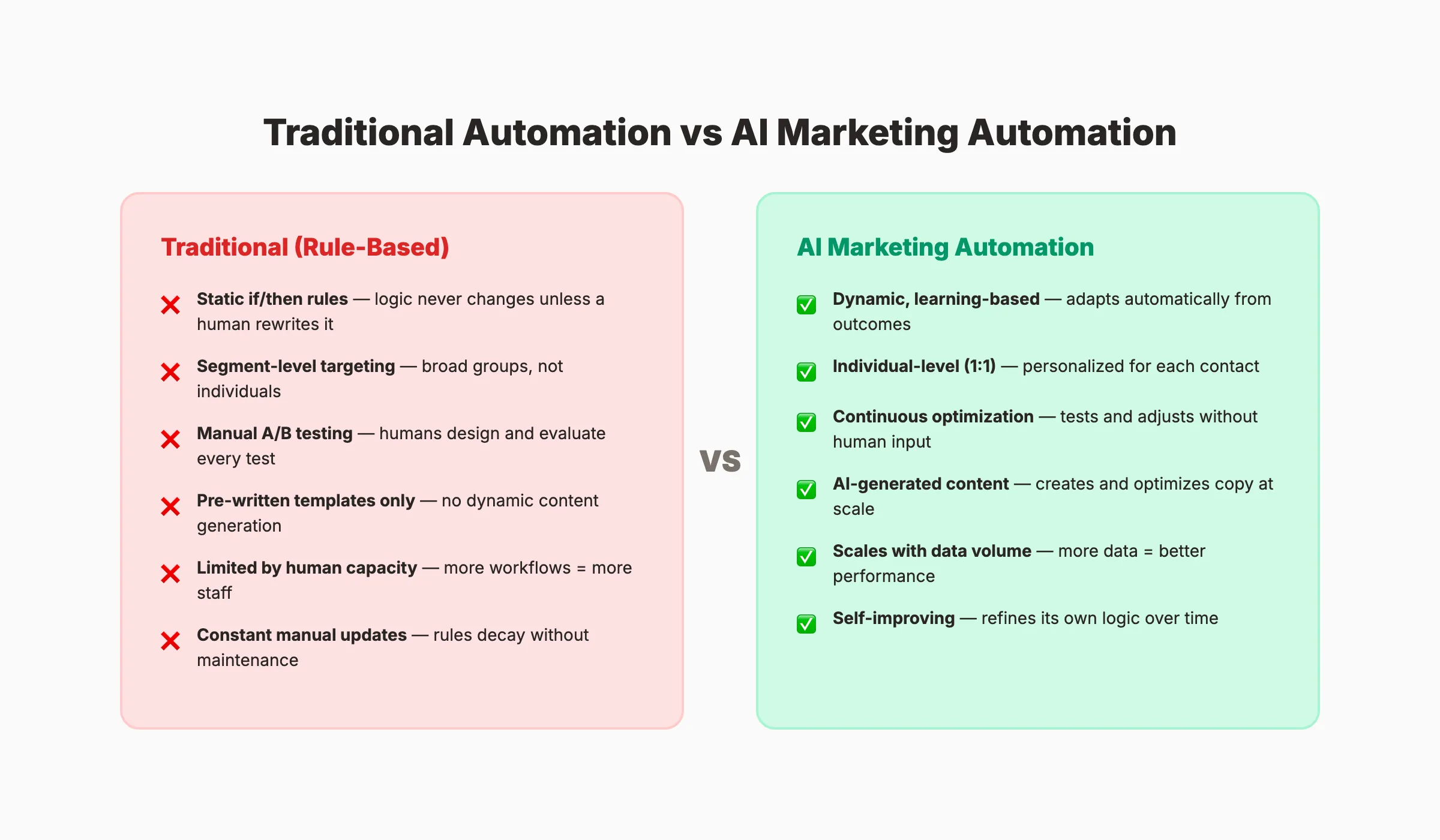
| Feature | Traditional Automation | AI Marketing Automation |
|---|---|---|
| Logic | Static if/then rules | Dynamic, learning-based |
| Personalization | Segment-level (broad groups) | Individual-level (1:1) |
| Optimization | Manual A/B testing | Continuous, automated |
| Content | Pre-written templates only | Generated and optimized by AI |
| Scalability | Limited by human capacity | Scales with data volume |
| Setup Time | Weeks to months | Days to weeks |
| Maintenance | Constant rule updates | Self-improving |
When Traditional Automation Still Works
Not every workflow needs AI. Simple transactional emails (order confirmations, password resets) work fine with basic automation. Email automation for standard drip sequences does not always require machine learning.
The crossover point comes when you need personalization at scale, optimization across dozens of variables, or predictive capabilities. That is where AI automation earns its cost.
Stop writing. Start ranking. Stacc publishes 30 SEO articles per month for $99. No writers. No agencies. No effort. Start for $1 →
Chapter 3: 9 Use Cases That Drive Real Results
AI marketing automation is not one tool. It is a category of capabilities that spans every marketing channel. Here are 9 use cases where AI automation delivers measurable ROI.
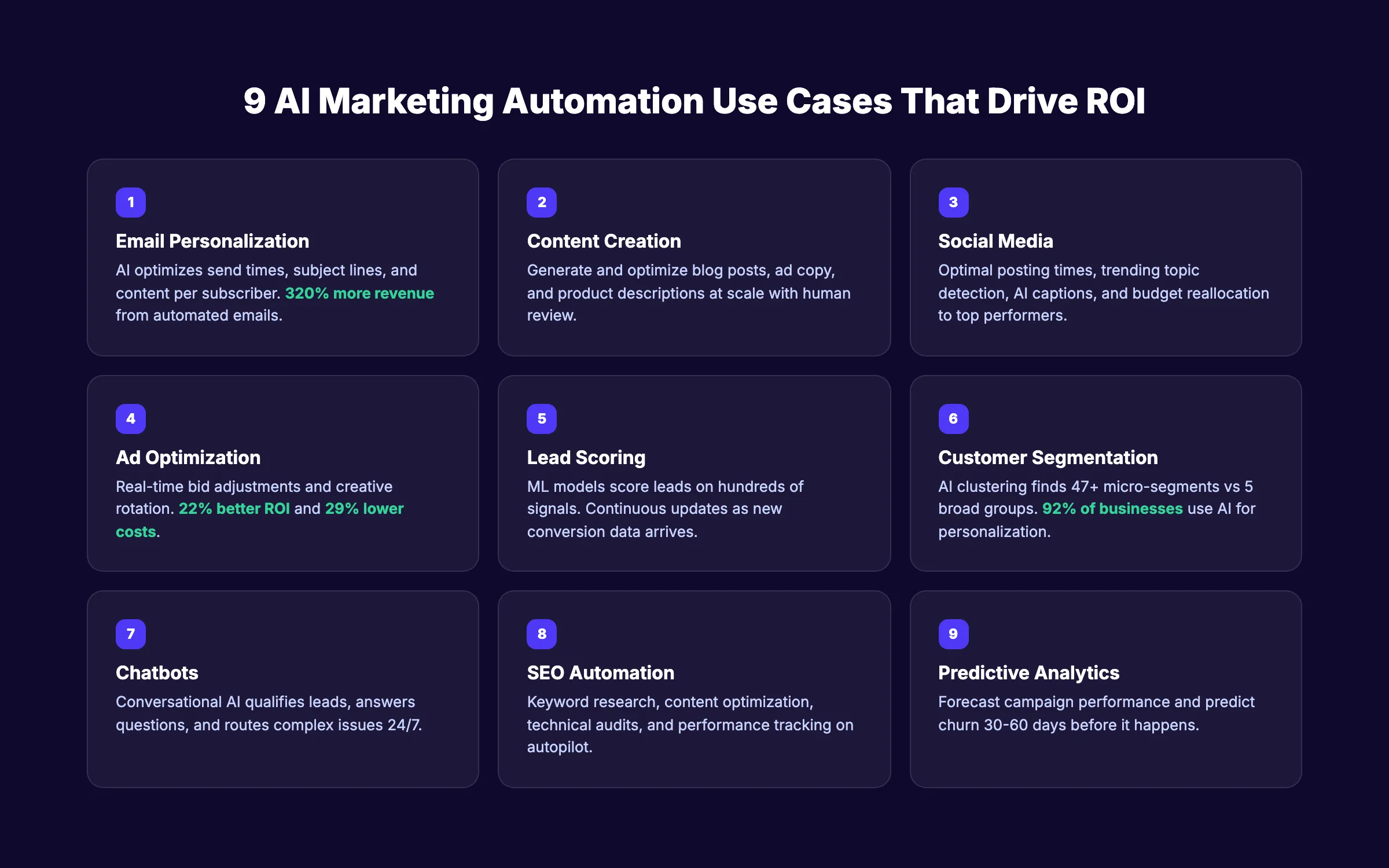
1. Email Personalization and Send-Time Optimization
AI analyzes each subscriber’s behavior to determine the best send time, subject line, and content block for that individual. Not for a segment of 10,000 people. For each person.
Automated emails generate 320% more revenue than non-automated emails. Add AI-driven send-time optimization and that gap widens further.
This goes beyond basic email segmentation. AI models track open patterns, click behavior, purchase cycles, and engagement decay to send messages at the exact moment each subscriber is most likely to act.
2. Content Creation and Optimization
AI generates blog posts, ad copy, product descriptions, and social captions. More importantly, it optimizes existing content based on search performance data.
The key is quality control. AI-generated content needs human review for accuracy, brand voice, and factual claims. Teams that skip review face hallucination risks where AI fabricates statistics or makes false product claims.
For teams that need content at scale without hiring writers, automated blog publishing handles the production pipeline from keyword research through publication.
3. Social Media Scheduling and Analytics
AI tools analyze engagement patterns to determine optimal posting times for each platform. They identify trending topics in your niche, suggest content formats, and predict which posts will perform best.
This applies across Instagram, LinkedIn, X, and Facebook. Social media automation tools handle scheduling, but AI-driven versions also generate captions, recommend hashtags, and reallocate budget toward high-performing posts.
4. Ad Campaign Optimization
AI adjusts ad bids, budgets, and creative in real time based on performance signals. It identifies which audience segments respond to which messages and shifts spend accordingly.
According to the Digital Marketing Institute, AI-optimized campaigns deliver 22% better ROI, 32% more conversions, and 29% lower acquisition costs compared to manually managed campaigns.
5. Lead Scoring and Qualification
Machine learning models score leads based on hundreds of behavioral and demographic signals. Which pages they visited. How long they stayed. Whether they match your ideal customer profile. How their behavior compares to past customers who converted.
This replaces manual lead scoring rules that marketing teams update once a quarter and forget about. AI scoring adjusts continuously as new conversion data arrives.
6. Customer Segmentation
AI clustering algorithms group customers by behavior patterns that humans cannot spot manually. Instead of 5 broad segments, AI might identify 47 micro-segments with distinct messaging needs.
92% of businesses now use AI for campaign personalization, according to Emarsys research. The segmentation precision that AI provides is what makes true 1:1 personalization possible.
7. Chatbots and Conversational AI
Modern conversational AI goes beyond scripted FAQ bots. AI chatbots understand context, remember previous interactions, qualify leads in real time, and route complex questions to human agents.
62% of consumers now prefer interacting with chatbots over waiting for human support. For lead generation, AI chatbots capture contact information, schedule demos, and answer product questions 24 hours a day.
8. SEO Automation
AI handles keyword research, content optimization, technical audits, and performance tracking. A complete SEO automation guide covers each category in detail, but the core value is clear: AI processes search data faster than any human team.
For businesses that need content automation platforms to handle SEO at scale, AI reduces the per-article cost from $80-250 (freelance writer) to under $5 per post.
9. Predictive Analytics and Forecasting
AI models forecast campaign performance before you spend a dollar. They predict customer churn 30-60 days before it happens. They identify which channels will deliver the best return next quarter based on historical patterns.
This shifts marketing from reactive (analyzing what happened) to proactive (acting on what will happen). Teams using predictive analytics report 73% higher revenue attribution accuracy.
Your SEO team. $99 per month. 30 optimized articles, published automatically. No writers. No agencies. Start for $1 →
Chapter 4: How to Implement AI Marketing Automation in 7 Steps
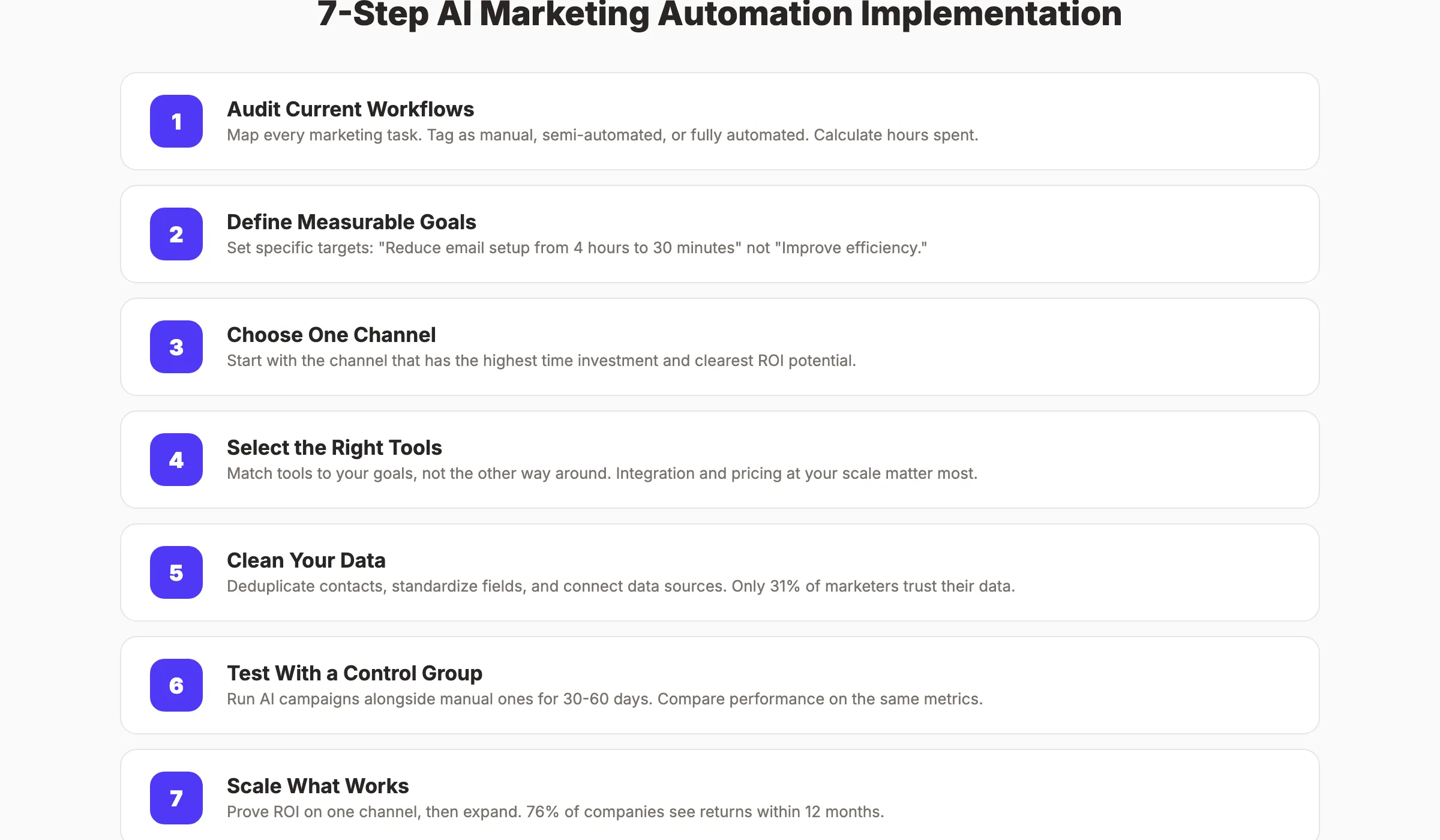
Implementation fails when teams buy tools before defining goals. Follow these 7 steps in order.
Step 1: Audit Your Current Workflows
Map every marketing task your team performs weekly. Tag each task as manual, semi-automated, or fully automated. Calculate the hours spent on each.
Focus on tasks that are repetitive, data-heavy, and time-consuming. These are your highest-impact automation candidates. A thorough SEO workflow audit reveals exactly where time leaks.
Step 2: Define Measurable Goals
“Improve marketing efficiency” is not a goal. “Reduce email campaign setup time from 4 hours to 30 minutes” is a goal. “Increase blog output from 4 to 30 posts per month” is a goal.
Set specific targets for each workflow you plan to automate. Without clear baselines, you cannot prove ROI later.
Step 3: Choose One Channel to Start
Do not automate everything at once. Pick the channel with the highest time investment and clearest ROI potential. For most teams, that means starting with email automation or content creation at scale.
Step 4: Select the Right Tools
Match tools to your goals, not the other way around. The next chapter covers specific tool recommendations. Key factors: integration with your existing stack, pricing at your scale, and the specific AI capabilities you need.
Step 5: Set Up Clean Data Pipelines
AI models are only as good as their data. Before activating any AI automation, clean your CRM data, standardize naming conventions, and connect data sources. Only 31% of marketers are satisfied with their ability to unify customer data, according to Salesforce research.
Step 6: Test With a Control Group
Run AI-automated campaigns alongside manually managed campaigns for 30-60 days. Compare performance across the same metrics. This gives you hard data on what AI actually improves versus what it does not.
Step 7: Scale What Works
Once you have proof of performance on one channel, expand to the next. Use the same audit → goal → tool → test → scale framework for each new channel.
Most companies see ROI from marketing automation within 12 months. 76% report positive returns in that first year, according to industry benchmarks.
Chapter 5: Top AI Marketing Automation Tools (2026)
The tool landscape is crowded. Here is a comparison of the top platforms organized by primary use case.
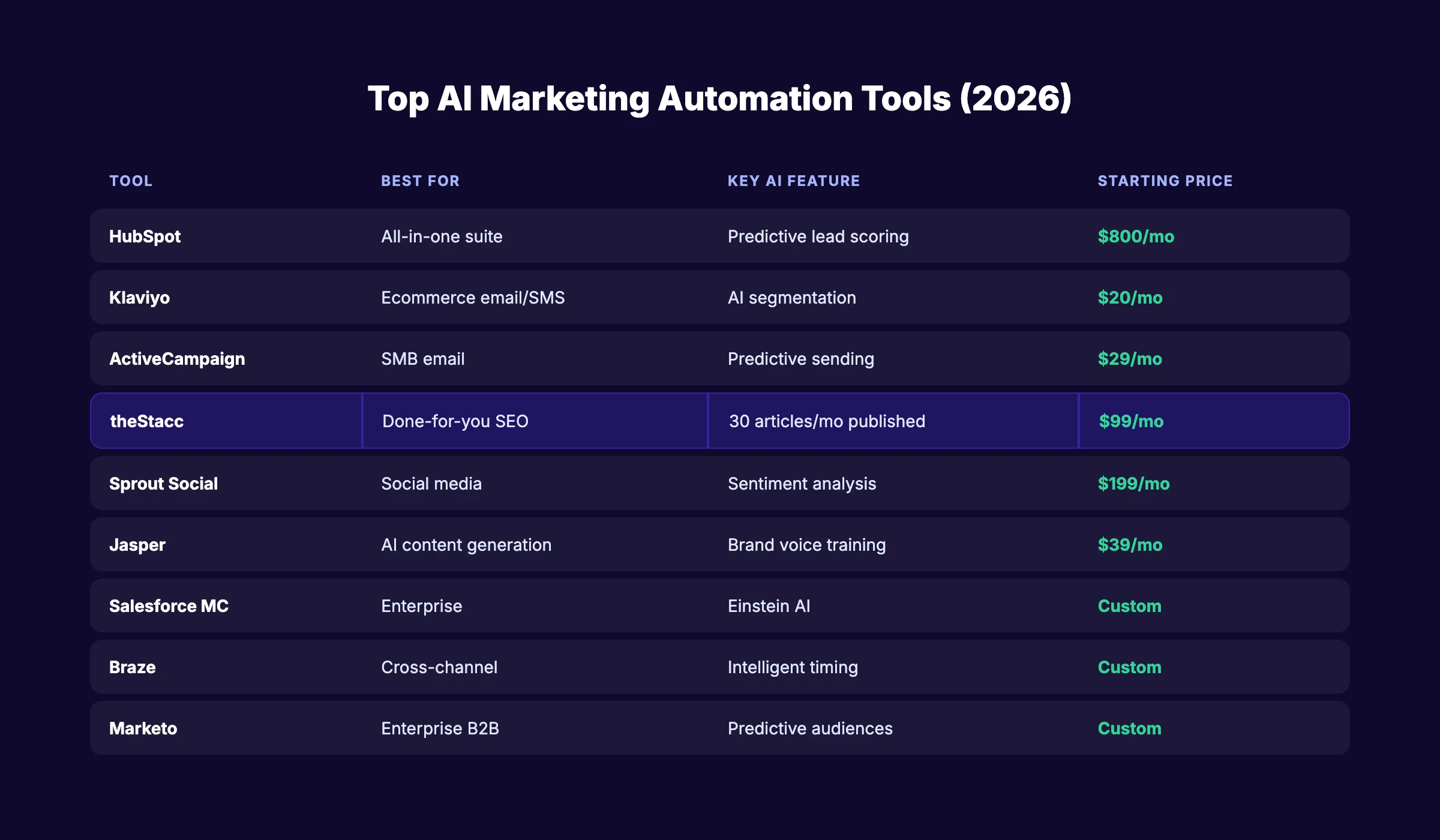
| Tool | Best For | AI Features | Starting Price |
|---|---|---|---|
| HubSpot | All-in-one marketing suite | Predictive lead scoring, AI content, smart send times | $800/mo (Marketing Hub Pro) |
| Klaviyo | Ecommerce email and SMS | AI segmentation, predictive analytics, send-time AI | $20/mo (scales with list size) |
| ActiveCampaign | SMB email automation | AI-driven automations, predictive sending, win probability | $29/mo |
| Jasper | AI content generation | Brand voice training, campaign briefs, multi-format output | $39/mo |
| Sprout Social | Social media management | Optimal send times, sentiment analysis, AI captions | $199/mo |
| Salesforce Marketing Cloud | Enterprise automation | Einstein AI, journey orchestration, predictive scoring | Custom pricing |
| theStacc | Done-for-you SEO content | 30 published articles/mo, automated SEO optimization | $99/mo |
| Braze | Cross-channel messaging | AI copy assistant, intelligent timing, predictive churn | Custom pricing |
| Marketo (Adobe) | Enterprise B2B marketing | Predictive audiences, content AI, account scoring | Custom pricing |
How to Pick the Right Tool
Match the tool to your primary bottleneck:
- Content production bottleneck? Start with AI blog writing tools or a done-for-you service.
- Email performance bottleneck? Start with Klaviyo or ActiveCampaign for AI-driven send optimization.
- Lead quality bottleneck? Start with HubSpot or Salesforce for predictive lead scoring.
- Social media bottleneck? Start with Sprout Social or Buffer for AI scheduling.
- All of the above? Consider marketing automation tools for small business that bundle multiple channels.
70% of marketers report dissatisfaction with their current automation software. The fix is usually not buying a better tool. It is choosing a tool that matches your specific workflow gap.
3,500+ blogs published. 92% average SEO score. See what Stacc can do for your site. Start for $1 →
Chapter 6: How to Measure AI Marketing Automation ROI
The average return on marketing automation is $5.44 for every $1 spent. That is a 544% ROI, according to Emarsys. But that average hides a wide range. Some companies see 10x returns. Others see nothing.
The difference is measurement.
The ROI Formula
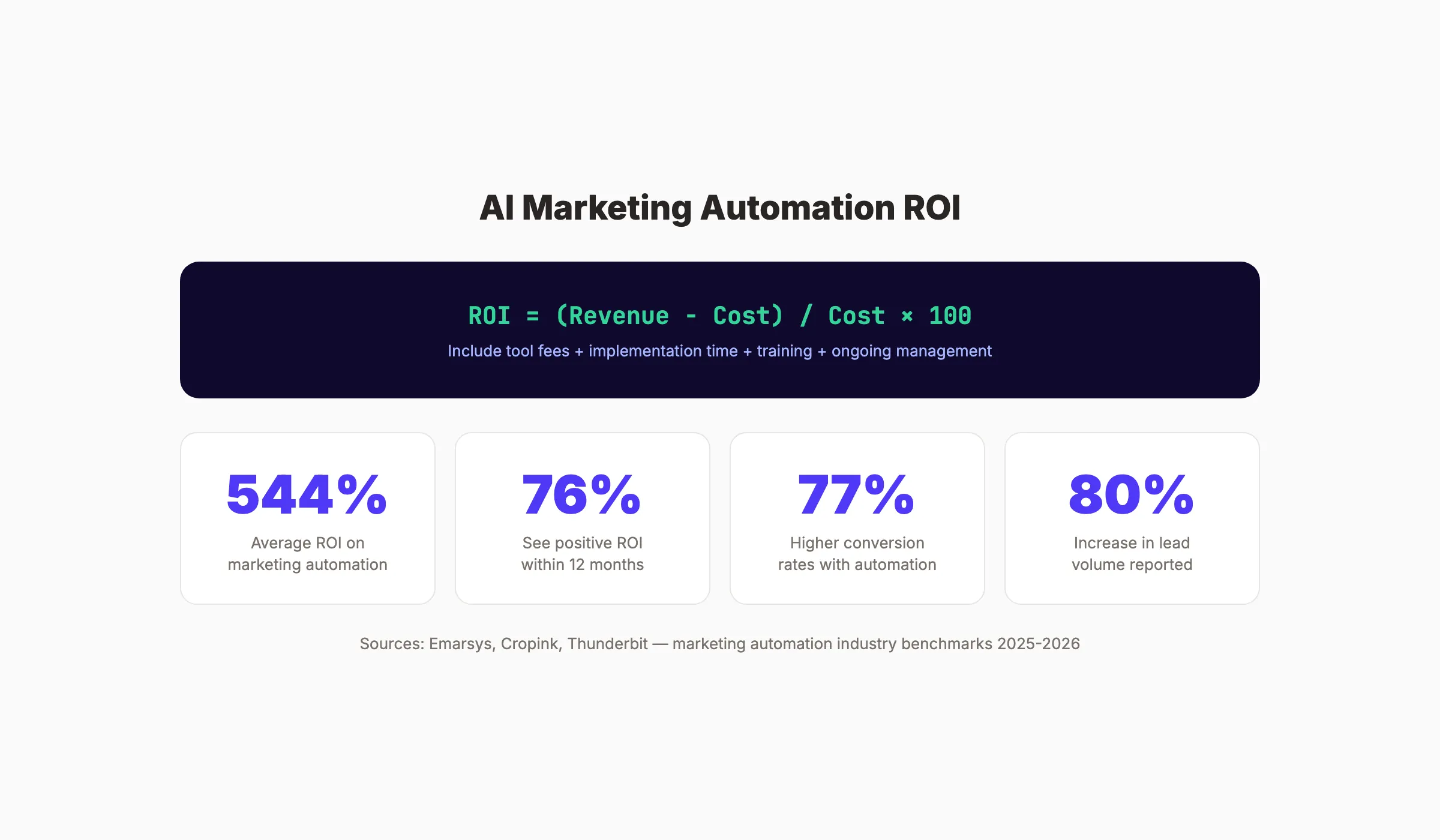
Basic ROI Calculation:
ROI = (Revenue from Automated Campaigns - Total Automation Cost) / Total Automation Cost × 100
Total Automation Cost includes:
- Tool subscription fees (monthly or annual)
- Implementation and setup time (hours × hourly rate)
- Training time for team members
- Ongoing management and optimization hours
5 Metrics That Matter
1. Time Saved Per Workflow. Measure the hours saved on each automated task. HubSpot reports that 32.82% of marketers save 10-14 hours per week through AI automation.
2. Cost Per Lead. Compare cost per lead before and after automation. AI campaigns drive 29% lower acquisition costs on average.
3. Content Output Volume. Track articles published, emails sent, and social posts scheduled. If you went from 4 blog posts per month to 30, that is a 650% output increase.
4. Conversion Rate. Automation drives 77% higher conversion rates through better targeting, timing, and personalization. Track this at each funnel stage.
5. Revenue Attribution. Connect automated campaigns to actual revenue using UTM parameters, CRM tracking, and multi-touch attribution models. Use an SEO ROI calculator to quantify organic search returns specifically.
Set Realistic Timelines
Do not expect results in week one. Most AI automation tools need 30-60 days of data to train their models. Meaningful ROI typically appears within 90 days. Full optimization takes 6-12 months.
Only 33% of AI initiatives currently meet ROI expectations, according to Salesforce. The primary reasons for failure are unclear goals, poor data quality, and premature scaling. Follow the 7-step implementation framework in Chapter 4 to avoid these traps.
Chapter 7: 8 Mistakes That Kill AI Automation ROI
Knowing what to do matters less than knowing what to avoid. These 8 mistakes account for most failed implementations.
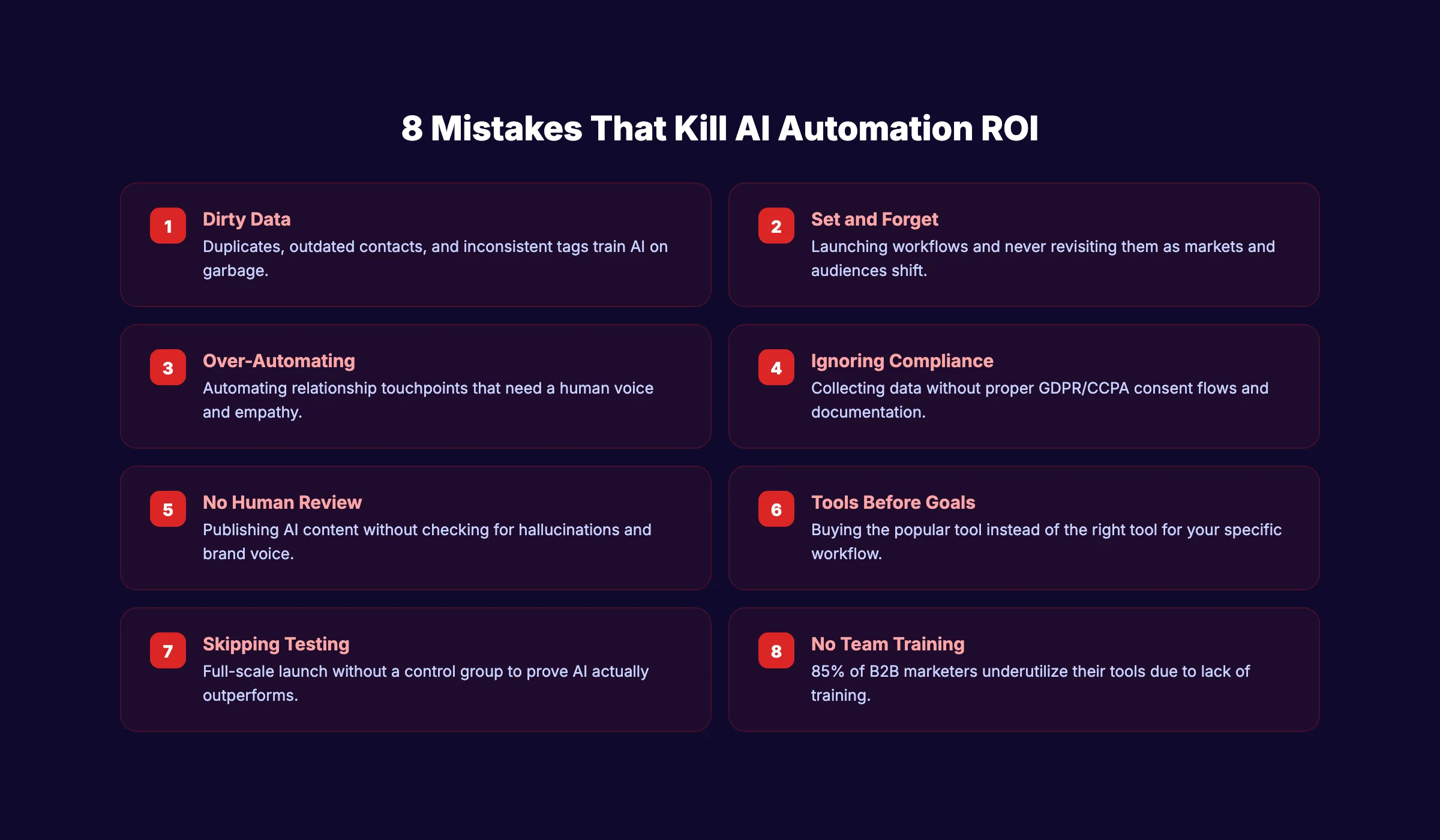
Mistake 1: Automating Before You Have Clean Data
AI garbage in, garbage out. If your CRM has duplicate contacts, inconsistent tags, and outdated information, the AI will learn from bad data and produce bad results.
Fix: Run a full data cleanup before activating any AI tool. Deduplicate contacts, standardize fields, and verify data accuracy.
Mistake 2: The “Set and Forget” Trap
Teams launch automation workflows and never revisit them. Market conditions change. Customer preferences shift. Competitors adjust their messaging. Your 6-month-old automation sequences grow stale.
Fix: Schedule monthly automation audits. Review performance, update messaging, and refresh content. Build this into your content calendar.
Mistake 3: Over-Automating Customer Touchpoints
Automating everything produces robotic, impersonal interactions. Customers notice. Engagement drops. Brand trust erodes.
Fix: Automate data-heavy and repetitive tasks. Keep relationship-building, crisis response, and complex negotiations human. Use the framework in Chapter 8 to decide which tasks to automate.
Mistake 4: Ignoring GDPR, CCPA, and Data Compliance
AI automation collects and processes significant customer data. Without proper consent flows, data handling procedures, and compliance documentation, you face legal exposure.
Fix: Build consent into every data collection point. Document your data processing activities. Implement opt-out mechanisms that work instantly. Review your privacy policy quarterly.
Mistake 5: No Human Review of AI Content
AI-generated marketing content can fabricate statistics, make inaccurate product claims, or produce brand-inconsistent messaging. Publishing without review creates legal and reputational risk.
Fix: Every piece of AI-generated content needs human review before publication. Focus review on factual accuracy, brand voice, and legal claims. Learn how to humanize AI content effectively.
Mistake 6: Choosing Tools Before Defining Goals
Teams buy the popular tool, not the right tool. They end up with enterprise software for a 5-person team, or a basic email tool when they need multi-channel orchestration.
Fix: Define your specific goals and workflow gaps first (Chapter 4, Steps 1-2). Then evaluate tools against those requirements.
Mistake 7: Skipping the Testing Phase
Launching AI automation at full scale without a control group means you cannot prove it works. You cannot attribute improvements to AI versus other variables.
Fix: Always run a 30-60 day controlled test comparing AI-automated campaigns against manual baselines. Measure the same KPIs across both groups.
Mistake 8: Not Training Your Team
44.4% of organizations say finding talent with both marketing AND AI skills is the biggest challenge, according to Algomarketing research. 85% of B2B marketers underuse their automation tools.
Fix: Budget for training. Allocate 2-4 hours per week for the first month to platform training, prompt engineering basics, and workflow optimization.
Rank everywhere. Do nothing. Blog SEO, Local SEO, and Social on autopilot. Stacc starts at $99/mo with a $1 trial. Start for $1 →
Chapter 8: The Future. AI Agents and Autonomous Marketing
The next phase of AI marketing automation is not smarter tools. It is autonomous agents that manage entire campaigns end to end.
What Are AI Agents in Marketing?
An AI agent is a system that receives a goal, creates its own plan, executes tasks, evaluates results, and adjusts its approach. Unlike current automation tools that follow pre-built workflows, agents build their own workflows.
Gartner predicts that 40% of enterprise applications will embed AI agents by the end of 2026. That is up from fewer than 5% in 2025. The shift is happening now.
Agentic AI in Practice
A marketing AI agent could handle an entire product launch. It researches the target audience. It creates messaging variations. It builds email sequences, ad campaigns, and social content. It launches everything, monitors performance, and optimizes in real time.
Gartner also projects that 60% of brands will use agentic AI for 1:1 customer interactions by 2028. Early adopters are already testing agent-based systems for customer onboarding, retention campaigns, and upsell sequences.
The AI vs Human Decision Framework
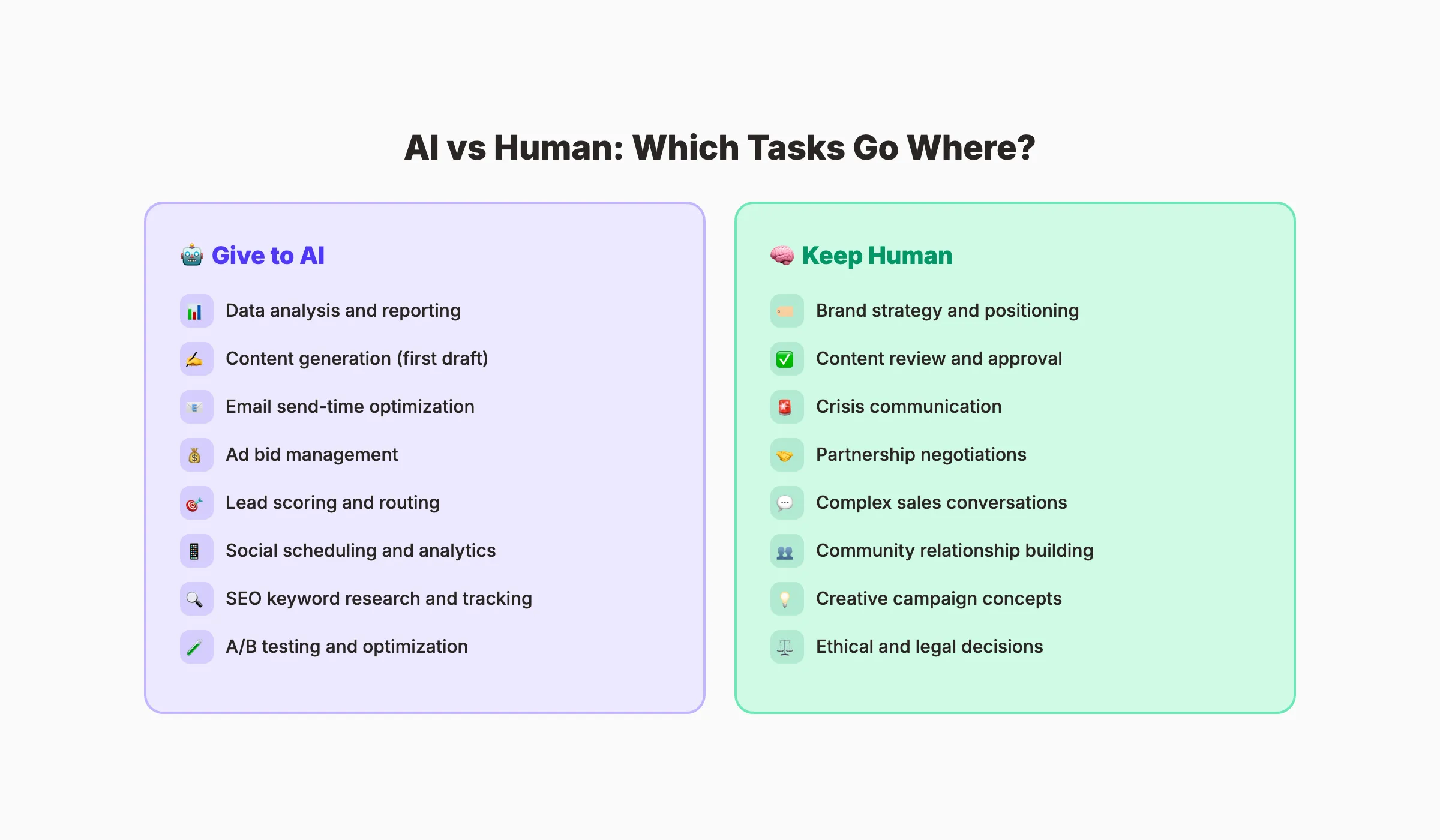
Not every task should go to an AI agent. Use this framework:
| Give to AI | Keep Human |
|---|---|
| Data analysis and reporting | Brand strategy and positioning |
| Content generation (first draft) | Content review and approval |
| Email send-time optimization | Crisis communication |
| Ad bid management | Partnership negotiations |
| Lead scoring and routing | Complex sales conversations |
| Social scheduling and analytics | Community relationship building |
| SEO keyword research and tracking | Creative campaign concepts |
| A/B testing and optimization | Ethical and legal decisions |
The goal is not to replace marketers. It is to free them from repetitive work so they can focus on strategy, creativity, and relationship building. 54% of marketing leaders expect AI to create new roles rather than eliminate existing ones, according to the Sprout Social Index.
How AI Search Changes the Game
AI is also changing how customers find businesses. AI search is reshaping SEO as platforms like ChatGPT, Perplexity, and Google AI Overviews surface content differently than traditional search results.
Businesses that automate their content production now will have the largest content libraries when AI search becomes the dominant discovery channel. That is the compounding advantage of starting early.
FAQ
What is AI marketing automation?
AI marketing automation uses machine learning and predictive analytics to execute marketing tasks automatically. Unlike traditional automation that follows static rules, AI systems learn from data, adapt to patterns, and improve campaign performance over time without constant manual input.
How much does AI marketing automation cost?
Costs range from $20 per month for basic email automation tools like Klaviyo to $800 or more per month for enterprise platforms like HubSpot Marketing Hub. Done-for-you services like Stacc start at $99 per month for 30 published SEO articles. Total cost depends on which channels you automate and the size of your contact database.
Is AI marketing automation worth it for small businesses?
Yes, if you start with one channel and set clear goals. Small businesses benefit most from content automation and email automation because these tasks consume the most time relative to team size. Companies using automation see $5.44 return for every $1 spent. The key is starting small and scaling what works.
What is the difference between AI marketing and traditional marketing automation?
Traditional marketing automation follows fixed rules: “if user does X, then do Y.” AI marketing automation uses machine learning to analyze patterns, predict outcomes, and optimize actions automatically. Traditional automation requires humans to write every rule. AI automation writes and rewrites its own rules based on performance data.
Will AI replace marketing jobs?
AI will replace tasks, not jobs. Repetitive tasks like data entry, basic reporting, A/B testing, and content scheduling will shift to AI. Strategic roles like brand positioning, creative direction, and relationship management will grow in importance. 54% of marketing leaders expect AI to create new roles, not eliminate them.
AI marketing automation is no longer experimental. 88% of marketers use AI daily. The tools are mature. The ROI data is clear. The question is not whether to automate. It is how fast you can implement it before your competitors do.
The businesses that build automated marketing systems now will compound their advantage every month. Every article published, every email optimized, every campaign refined adds to the machine. Start with one channel. Prove the ROI. Then scale.
Related Tools & Resources
Free SEO Tools:
Best Lists:

Written by
Siddharth GangalSiddharth is the founder of theStacc and Arka360, and a graduate of IIT Mandi. He spent years watching great businesses lose organic traffic to competitors who simply published more. So he built a system to fix that. He writes about SEO, content at scale, and the tactics that actually move rankings.
30 SEO blog articles published every month
Keyword-optimized, scheduled, and live on your site. Automatically.
30-day trial · Cancel anytime
theStacc
Stop writing SEO content manually
30 blog articles, 30 GBP posts, and social media content. Published every month. Automatically.
Start Your $1 Trial$1 for 3 days · Cancel anytime