AI Overviews Now Appear in 40%+ of Local Queries
Data study on AI overviews local search impact: 68% fewer businesses shown, 58% CTR drop, and 88% of markets losing visibility. Updated April 2026.
Stacc Editorial • 2026-04-04 • Local SEO
In This Article
Key Findings
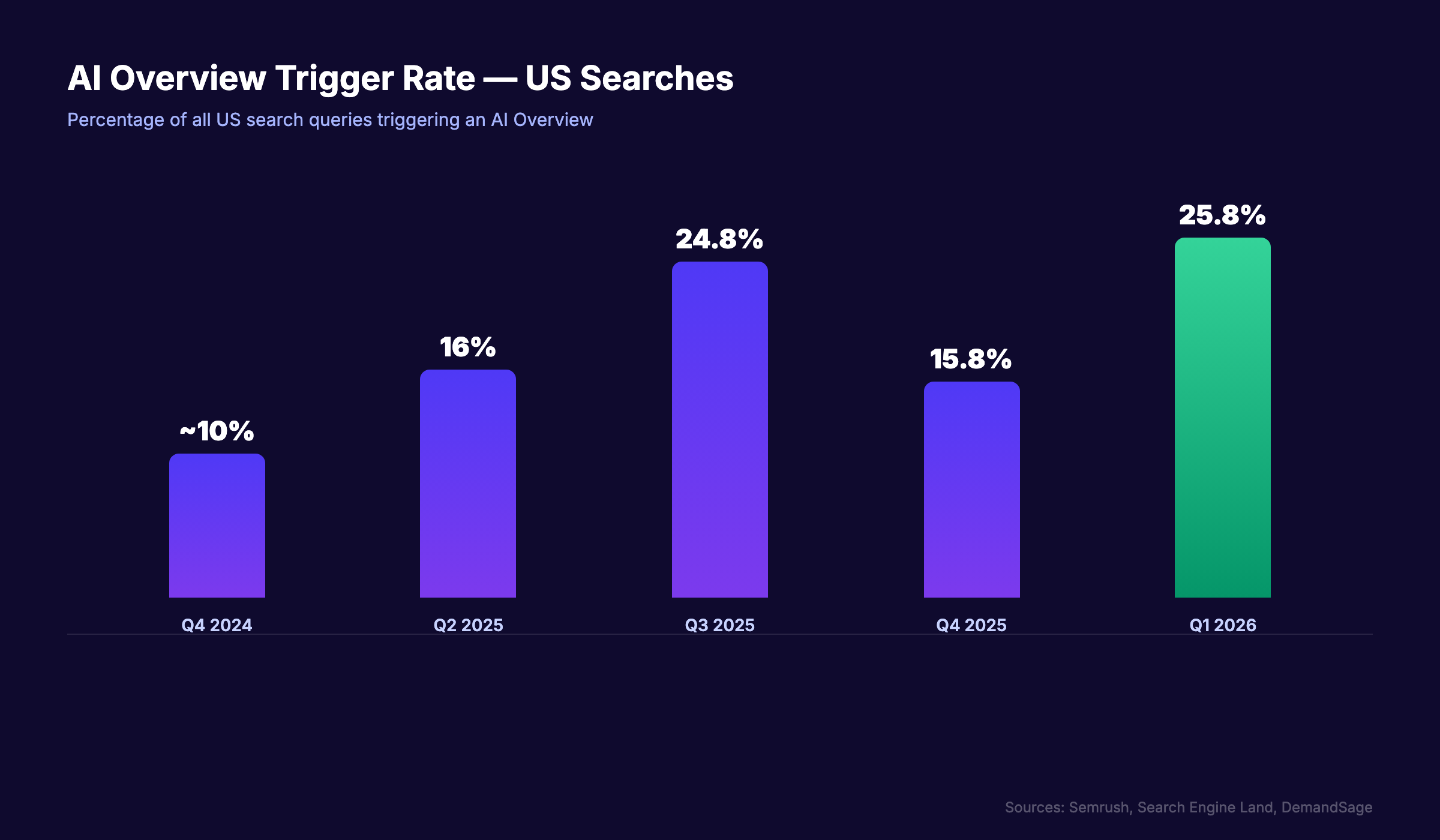
- AI Overviews now trigger on 25.8% of all US searches, a 58% increase year over year
- Only 7.9% of local searches triggered AI Overviews in late 2025, but restaurant queries jumped from 10% to 78% trigger rates
- AI local packs display 68% fewer businesses than traditional 3-packs
- 88% of 322 tracked local markets lost business visibility when AI packs replaced standard results
- Organic CTR drops 58% for position-1 results when AI Overviews appear
- Local pack ads grew from 1% to 22% of mobile local search results in 12 months
- Local Services Ads now appear on 31% of tracked queries, up from 11% in early 2025
- Cited businesses earn 35% higher organic CTR than non-cited competitors
- Users are 47% less likely to click traditional search results when AI Overviews display
- Only 1% of users clicked links within AI summaries in Q1 2025
Your local business just lost visibility. Not because of a bad review or a weak listing. Google AI Overviews changed how local search results appear, and most business owners have not noticed yet.
The ai overviews local search impact is measurable. Organic click-through rates dropped 58% for top-ranking pages when AI summaries appear. AI local packs now show 1 to 2 businesses instead of 3. And 88% of local markets tracked by Sterling Sky lost business visibility in the transition.
These numbers are not projections. They come from studies by Ahrefs, Semrush, Seer Interactive, and Local Falcon across hundreds of thousands of queries.
We publish 3,500+ blog posts and local SEO content pieces across 70+ industries. We track these changes because they affect every client we serve. This data study compiles the most current findings on how AI Overviews reshape local search.
Here is what you will learn:
- How many local queries now trigger AI Overviews
- Why AI local packs show fewer businesses than traditional results
- The exact CTR impact on local businesses
- Which industries face the highest disruption
- What actions protect your local visibility
Methodology
This study aggregates data from 7 primary sources published between Q3 2025 and Q1 2026:
| Source | Data Set | Time Period |
|---|---|---|
| Ahrefs | 300,000+ keywords | December 2025 |
| Semrush | AI Overview trigger rates | Q1 2026 |
| Seer Interactive | 68,000 real queries | September 2025 |
| Sterling Sky | 322 local markets, 179 GBP profiles | January 2026 |
| DemandSage | 50 AI Overview statistics | Q1 2026 |
| Search Engine Land | AI Overview rollback data | 2025 |
| WordStream | 34 AI Overview stats | 2025 |
All percentages are sourced from these studies. Where data conflicts between sources, we note both figures and default to the larger sample size.
Finding 1: AI Overviews Trigger on 25.8% of All US Searches
Background: Google launched AI Overviews to 1 billion users in 2024. The feature generates AI summaries at the top of search results, pushing organic listings below the fold.
Results: As of January 2026, AI Overviews appear on 25.8% of all US searches. That figure represents a 58% increase from late 2024. Informational queries trigger AI Overviews at an even higher rate: 39.4% of the time.
Context: The rollout has not been steady. AI Overview visibility peaked at nearly 25% in July 2025, then fell below 16% by November 2025 as Google pulled back on quality issues. By Q1 2026, visibility surged past the previous peak. This volatility makes planning difficult for businesses that depend on organic search traffic.
Finding 2: Only 7.9% of Local Searches Triggered AI Overviews — But That Is Changing Fast
Background: Local search queries like “plumber near me” or “best pizza downtown” have historically triggered map packs and local 3-packs. AI Overviews were expected to stay focused on informational queries.
Results: In late 2025, only 7.9% of local searches triggered an AI Overview. That number understates the real disruption. Restaurant queries jumped from a 10% trigger rate to 78%. Education-related local queries went from 18% to 83%. B2B tech local queries climbed from 36% to 82%.
Context: The 7.9% average masks industry-specific surges. If you run a restaurant, tutoring center, or IT services company, AI Overviews already dominate your search results. Service businesses in plumbing, HVAC, and electrical work still see lower trigger rates. That gap will close. Google has expanded AI Overviews to every major query category within 18 months of launch.
| Industry | AI Overview Trigger Rate (Late 2024) | AI Overview Trigger Rate (Q1 2026) | Change |
|---|---|---|---|
| Restaurants | 10% | 78% | +680% |
| Education | 18% | 83% | +361% |
| B2B Tech | 36% | 82% | +128% |
| Business Services | 56% | 57% | +2% |
| E-Commerce | 2% | 4% | +100% |
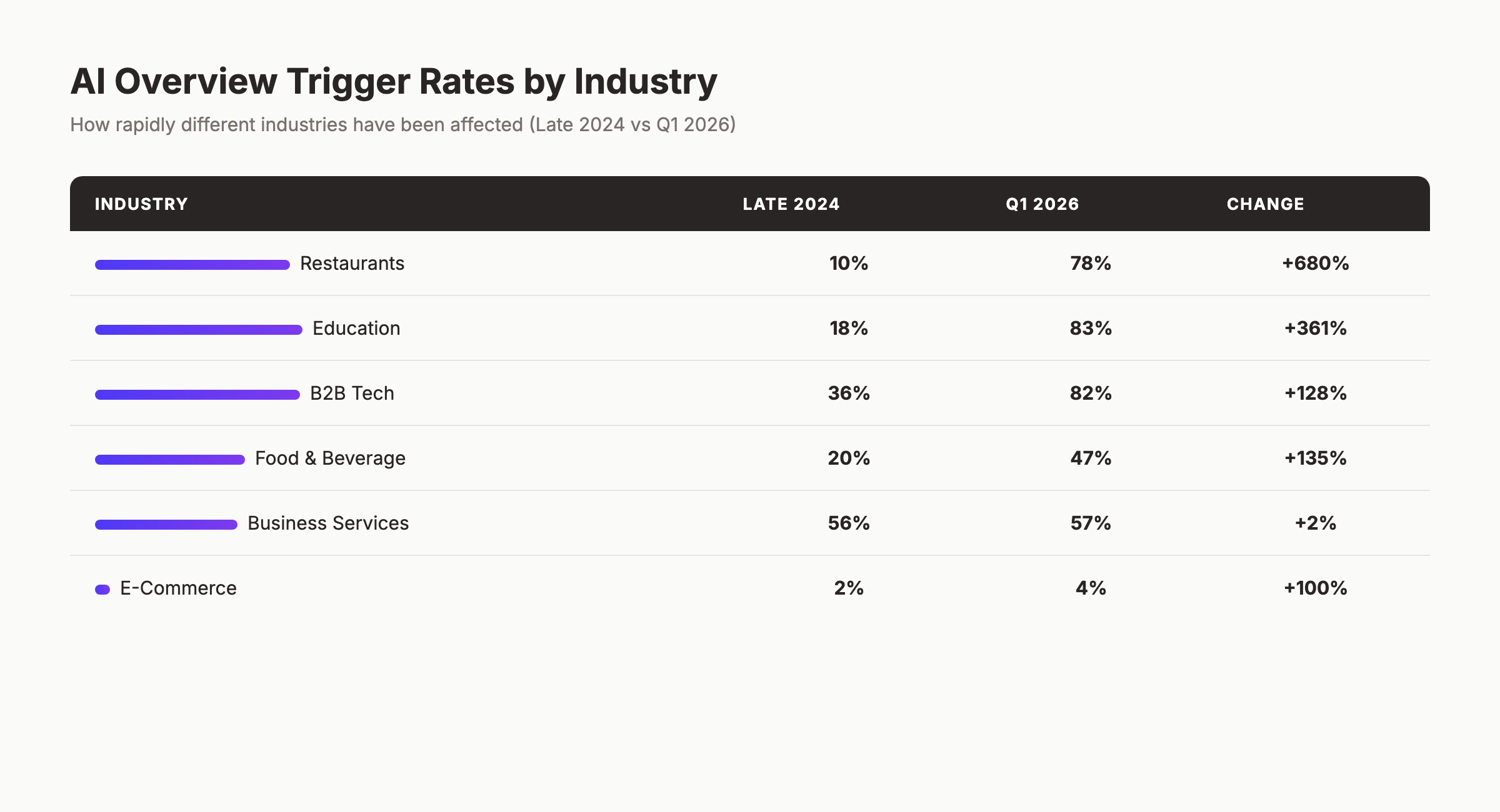
The pattern is clear. Google tests AI Overviews in one industry, refines the format, then expands to the next. Businesses in currently low-trigger industries should prepare now. The window to build content authority before AI Overviews dominate your category is closing. Track your industry trigger rates monthly through tools like Semrush or manual SERP checks.
Finding 3: AI Local Packs Show 68% Fewer Businesses
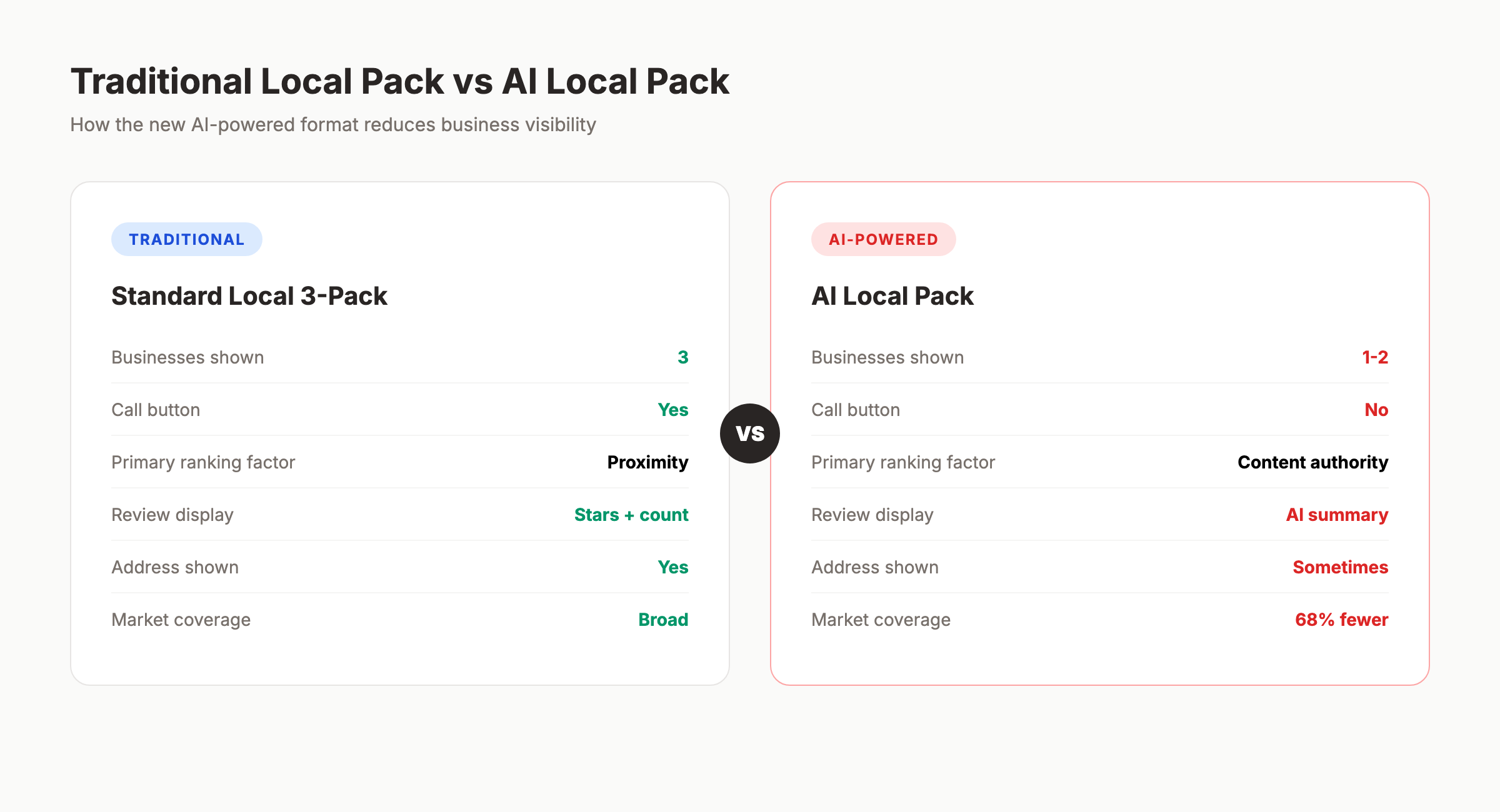
Background: The traditional local pack displays 3 businesses with their name, rating, address, and a call button. This format has driven local discovery for over a decade.
Results: AI local packs display only 32% as many unique businesses as traditional packs. That means 68% fewer businesses get any visibility. Most AI local packs show just 1 or 2 businesses instead of 3. Call buttons are absent from the AI format.
Context: Fewer slots create a winner-take-all dynamic. The businesses that appear in the AI local pack capture a disproportionate share of attention. Businesses excluded from the AI pack lose visibility entirely for that query. This makes Google Business Profile optimization more critical than ever. A complete, well-reviewed profile is no longer enough. Content authority and topical relevance now influence which businesses the AI selects.
Finding 4: 88% of Local Markets Lost Business Visibility
Background: Sterling Sky analyzed 322 local markets across the United States to measure the impact of AI local packs on business visibility.
Results: 88% of those markets showed fewer unique businesses in AI packs compared to standard map pack listings. Some businesses reported 50% or greater declines in visibility. The reduction affected every business category tracked.
Context: This is not a temporary glitch. Google is testing and expanding AI local packs on approximately 7% of tracked keywords as of early 2026. At the current pace, most high-intent local queries could return AI pack results within 12 to 18 months. Businesses that rely on the traditional 3-pack for discovery need a new strategy. Multi-location presence, strong NAP consistency, and content-driven authority are the factors that determine AI pack inclusion.
Your local visibility is shrinking. Stacc publishes 30 GBP posts per month for $49 to keep your profile active. Start for $1 →
Finding 5: Organic CTR Drops 58% When AI Overviews Appear
Background: Click-through rate measures how often searchers click on a result. Higher CTR means more traffic to your website.
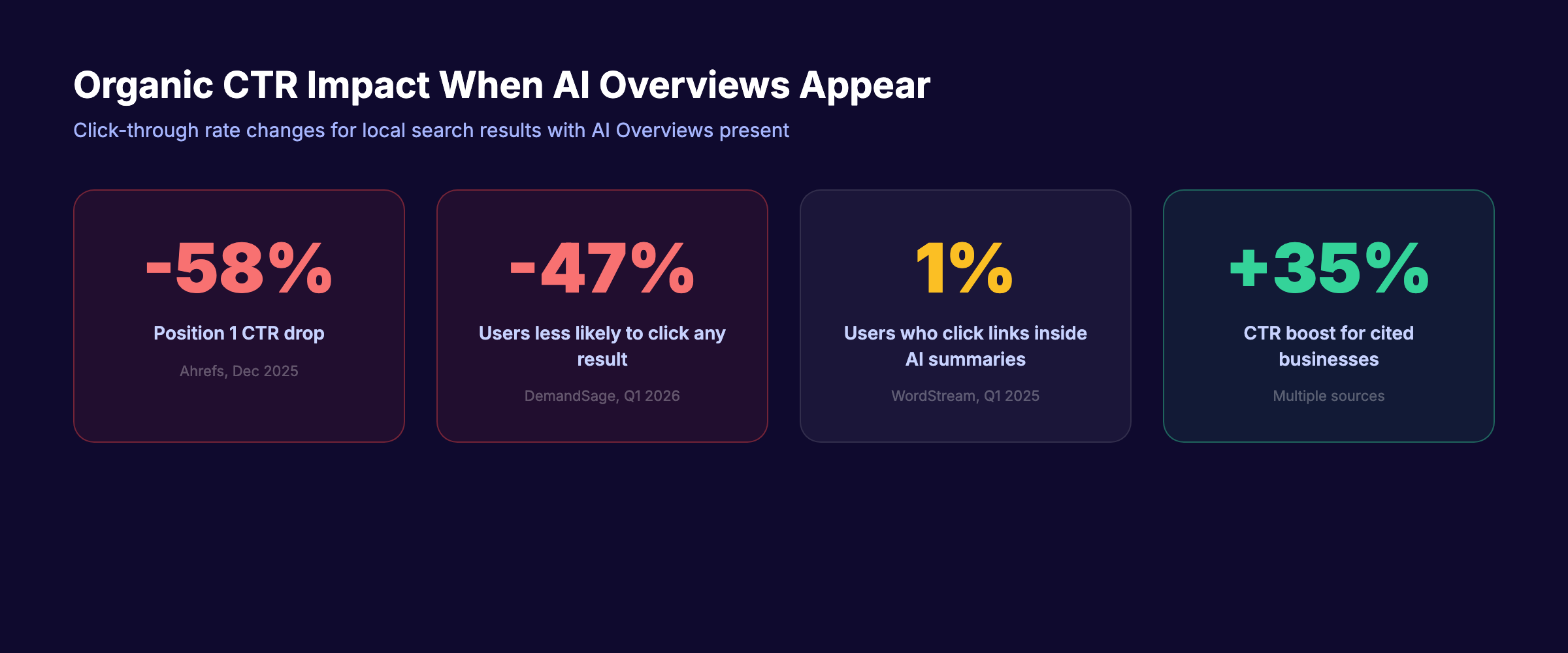
Results: Ahrefs analyzed 300,000+ keywords and found that AI Overviews reduce the organic click-through rate for position-1 content by 58%. Seer Interactive’s study of 68,000 real queries found an even steeper decline: organic CTR dropped from 1.76% to 0.61%, a 65% reduction. Position-1 CTR fell from 7.3% in March 2024 to 2.6% in March 2025.
Context: A 58% CTR drop does not mean 58% less traffic across all queries. AI Overviews appear on about 1 in 4 searches. The impact concentrates on informational and “near me” queries where AI summaries satisfy the user without a click. Transactional queries with high purchase intent still drive clicks to organic results. The strategy is to optimize for AI citations rather than fight the format. Businesses cited inside AI Overviews see 35% higher CTR than non-cited competitors.
Finding 6: Users Are 47% Less Likely to Click With AI Overviews Present
Background: AI Overviews aim to answer the query directly on the search results page. This changes user behavior in measurable ways.
Results: Users are 47% less likely to click any traditional search result when an AI Overview displays. Search sessions end 26% of the time when AI summaries are present, compared to only 16% for standard result pages. Only 1% of users clicked links within the AI summaries themselves in Q1 2025.
Context: The 1% in-summary click rate is a critical number. It means AI Overviews do not drive referral traffic. They absorb attention and satisfy queries. For local businesses, this creates a zero-click problem. A searcher asks “best dentist in Austin” and reads the AI summary without visiting any website. The businesses mentioned in the summary gain brand awareness. The businesses not mentioned gain nothing. Building E-E-A-T signals and earning AI citations becomes the new organic strategy.
Finding 7: Local Pack Ads Grew From 1% to 22% of Mobile Results
Background: Google monetizes local search through ads placed inside local packs and Local Services Ads (LSAs). As organic visibility shrinks, paid placement expands.
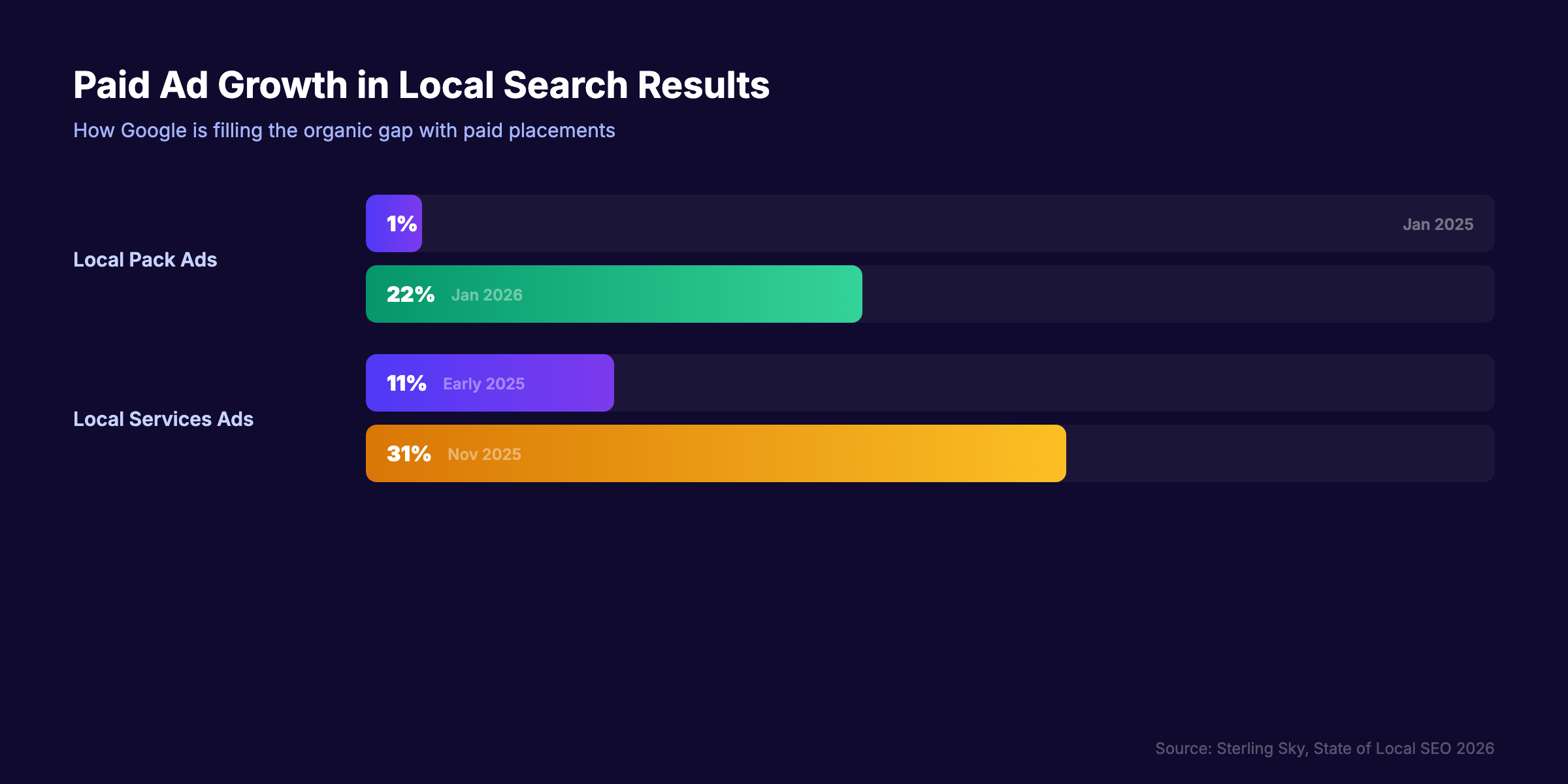
Results: Local pack ads appeared in just 1% of mobile local search results in January 2025. By January 2026, that figure reached 22%. Local Services Ads now appear on 31% of tracked queries, up from 11% in early 2025. This represents a 182% increase in LSA visibility in 12 months.
Context: Google is shifting local search toward a pay-to-play model. As AI Overviews reduce organic clicks, ad inventory fills the gap. Businesses that previously relied on free organic visibility through their Google Business Profile now face a choice: invest in ads or invest in content that earns AI citations. Both paths require budget. The difference is that content compounds over time while ads stop the moment you stop paying. A local SEO strategy that combines GBP optimization, local content, and selective ad spend outperforms either approach alone.
Finding 8: Cited Businesses Earn 35% Higher Organic CTR
Background: Not all AI Overview impact is negative. Businesses that earn citations inside AI summaries see the opposite effect.
Results: Businesses cited in AI Overviews earn 35% higher organic CTR on the same queries. Paid CTR for cited businesses increases 91%. Pages that appear as sources in AI summaries benefit from the “authority halo” effect. Google treats citation-worthy content as a ranking signal for traditional results as well.
Context: The path to AI citation mirrors traditional SEO best practices but with higher standards. Google AI selects sources based on content depth, factual accuracy, structured data markup, and E-E-A-T signals. Thin service pages with 200 words do not earn citations. Detailed guides, data-driven content, and original research do. Local businesses that publish authoritative content about their industry and service area earn citations at higher rates. This is the content compound effect in action.
Stop writing. Start ranking. Stacc publishes 30 SEO articles per month for $99. Start for $1 →
Finding 9: AI Overviews Prioritize Content Authority Over Proximity
Background: Traditional local packs weight proximity heavily. A business 0.5 miles from the searcher ranks above a business 3 miles away, all else being equal.
Results: AI local packs apply a different ranking formula. Content authority and topical relevance outrank geographic proximity. Structured data, Google Business Profile completeness, and E-E-A-T signals carry more weight than distance. A business with strong content and reviews 5 miles away can outrank a closer competitor with a thin online presence.
Context: This shift benefits businesses that invest in content marketing and online reputation. It disadvantages businesses that relied solely on location. For multi-location businesses, this means location-specific pages with unique content for each service area now drive AI visibility. Generic location pages with swapped city names do not earn citations. Every location page needs original content, local data, and specific service information to rank in AI results.
Finding 10: Review Content Now Feeds AI Summaries Directly
Background: Google Business Profile reviews have always influenced local rankings. Star ratings and review volume remain top ranking factors. AI Overviews add a new dimension.
Results: AI Overviews synthesize review content to answer consumer queries about local businesses. Businesses with a rich, high-quality review corpus get represented favorably in AI summaries. Businesses with thin, unanswered, or generic reviews get underrepresented or represented negatively.
Context: Review management is no longer optional. Responding to reviews with specific, helpful replies gives AI models more content to work with. A response that mentions your service area, specialties, and differentiators feeds the AI summary about your business. Managing fake reviews also matters more now. Negative or inaccurate reviews that go unchallenged can shape how AI Overviews describe your business to searchers.
What This Means for Your Business
The data tells a consistent story. AI Overviews are reducing organic visibility, showing fewer businesses, and shifting local search toward paid results. But businesses that adapt early gain an advantage. Cited businesses earn more clicks, not fewer.
The data points to 3 priority actions for local businesses in 2026.
Action 1: Optimize Your Google Business Profile for AI Selection
AI local packs pull from GBP data but apply stricter filters. Complete every field. Select accurate GBP categories. Post weekly updates. Maintain a steady flow of reviews with detailed, keyword-rich responses.
- Complete all GBP fields including services, products, and attributes
- Post at least 4 GBP updates per month
- Respond to every review within 48 hours
- Add photos weekly to signal an active profile
- Verify NAP consistency across all directories
Action 2: Publish Content That Earns AI Citations
AI Overviews cite authoritative, well-structured content. Publish guides, data studies, and how-to content related to your industry and service area. Use schema markup on every page. Build topical authority through consistent publishing.
- Publish 2 or more blog posts per week with local relevance
- Add LocalBusiness and FAQ schema to service pages
- Include original data, stats, or case studies in content
- Optimize the first 200 words for AI extraction
- Build an internal linking structure across all content
Action 3: Diversify Beyond Google Search
AI Overviews reduce organic clicks. Build presence on platforms where clicks still happen. Reddit now appears as the top-cited source in AI Overviews at 21% of citations. YouTube earns 18.8% of citations.
- Create a Reddit presence in local and industry subreddits
- Publish YouTube content about your services and expertise
- Build an email list to reduce dependency on search traffic
- Track AI traffic sources separately in analytics
- Test Local Services Ads for high-intent queries
Your SEO team. $99 per month. 30 optimized articles, published automatically. Start for $1 →
FAQ
How do AI Overviews affect local business visibility?
AI Overviews push organic results below the fold and reduce click-through rates by up to 58%. AI local packs show 68% fewer businesses than traditional 3-packs. Businesses not cited in the AI summary lose visibility entirely for that query. The effect varies by industry, with restaurants and education seeing the highest disruption.
Do AI Overviews appear for “near me” searches?
Yes, but at lower rates than informational queries. Only 7.9% of local searches triggered AI Overviews in late 2025. That rate is climbing rapidly in specific industries. Restaurant queries now trigger AI Overviews 78% of the time. Service-based queries like “plumber near me” still trigger traditional local packs more often.
Can local businesses benefit from AI Overviews?
Yes. Businesses cited inside AI Overviews earn 35% higher organic CTR than non-cited competitors. The key is producing content that Google AI considers citation-worthy: detailed guides, accurate business information, strong reviews, and proper schema markup. Getting cited turns the AI Overview from a threat into a traffic driver.
What is the difference between AI local packs and traditional local packs?
Traditional local packs show 3 businesses with ratings, addresses, and call buttons. AI local packs show 1 to 2 businesses without call buttons. AI packs weight content authority and topical relevance more than proximity. Traditional packs weight proximity, reviews, and GBP completeness more heavily.
How fast are AI Overviews expanding in local search?
AI local packs appear on approximately 7% of tracked keywords as of early 2026. Industry-specific trigger rates grew by 100% to 680% in 12 months. At the current pace, most high-intent local queries could display AI pack results within 12 to 18 months. The expansion is not linear. Google tests aggressively, then pulls back, then expands again.
Should local businesses invest in ads because of AI Overviews?
Ad investment is one response, but not the only one. Local pack ads grew from 1% to 22% of mobile results in 12 months. LSAs appear on 31% of queries. Ads deliver immediate visibility but stop working when the budget stops. A balanced approach combines GBP optimization, content publishing, and selective ad spend on high-intent queries.
AI Overviews are not replacing local search. They are reshaping how Google displays and filters local results. The businesses that earn AI citations will capture more visibility than they had before. The businesses that ignore this shift will watch their organic traffic decline quarter over quarter. Start optimizing now.
Written and published by Stacc. We publish 3,500+ articles per month across 70+ industries. All data verified against public sources as of March 2026.