
Optimize Your First 200 Words for AI Retrieval
AI engines cite opening paragraphs 67% more often. Learn the 7-step process to optimize your first 200 words for AI retrieval and earn more citations.
Opening paragraphs that answer the query directly get cited 67% more often by AI search engines. That single stat should change how you write every page on your site.
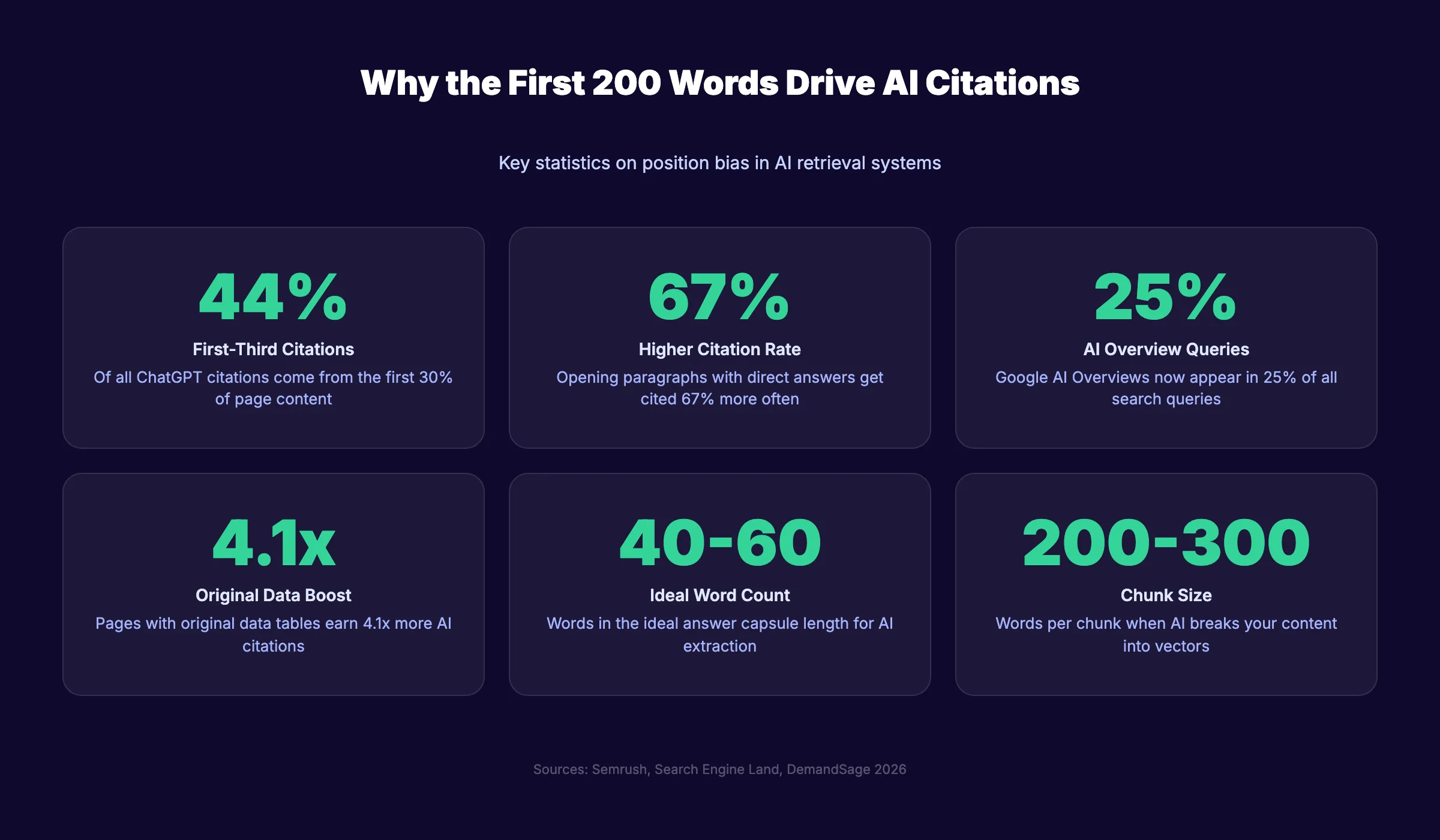
44% of all ChatGPT citations come from the first third of content on a page. Google AI Overviews now appear in 25% of all search queries. And the passages AI selects for citation are almost always self-contained answer blocks of 40 to 60 words.
Your first 200 words determine whether AI retrieves your content or skips it. Most pages bury the answer after 3 paragraphs of context, background, and filler. AI engines do not wait. They extract the passage that answers the question fastest.
Learning to optimize your first 200 words for AI retrieval is the highest-impact content change you can make in 2026. The technique works for Google AI Mode, ChatGPT, Perplexity, Claude, and every system using retrieval-augmented generation.
We publish 3,500+ SEO articles across 70+ industries. This guide walks through the exact 7-step process we use to write AI-retrievable opening content for every article.
Here is what you will learn:
- Why AI engines prioritize the first 200 words over deeper content
- The 7-step process for writing openings that AI models cite
- How passage-level extraction works at a technical level
- Before-and-after examples of optimized versus unoptimized intros
- A reusable checklist you can apply to every page you publish
Why the First 200 Words Matter for AI Retrieval
AI engines do not read content the way humans do. They chunk it, convert it into vectors, and match those vectors against user queries. The first 200 words receive special treatment in this pipeline for 3 reasons.
Reason 1: Position Bias in Retrieval Systems
AI retrieval systems assign higher relevance scores to content that appears earlier on the page. When 2 passages match a query equally well, the one closer to the top wins.
This is not speculation. It is how retrieval-augmented generation (RAG) works at a systems level. The retrieval step scores passages by a combination of semantic similarity and position weight. Earlier passages get a bonus.
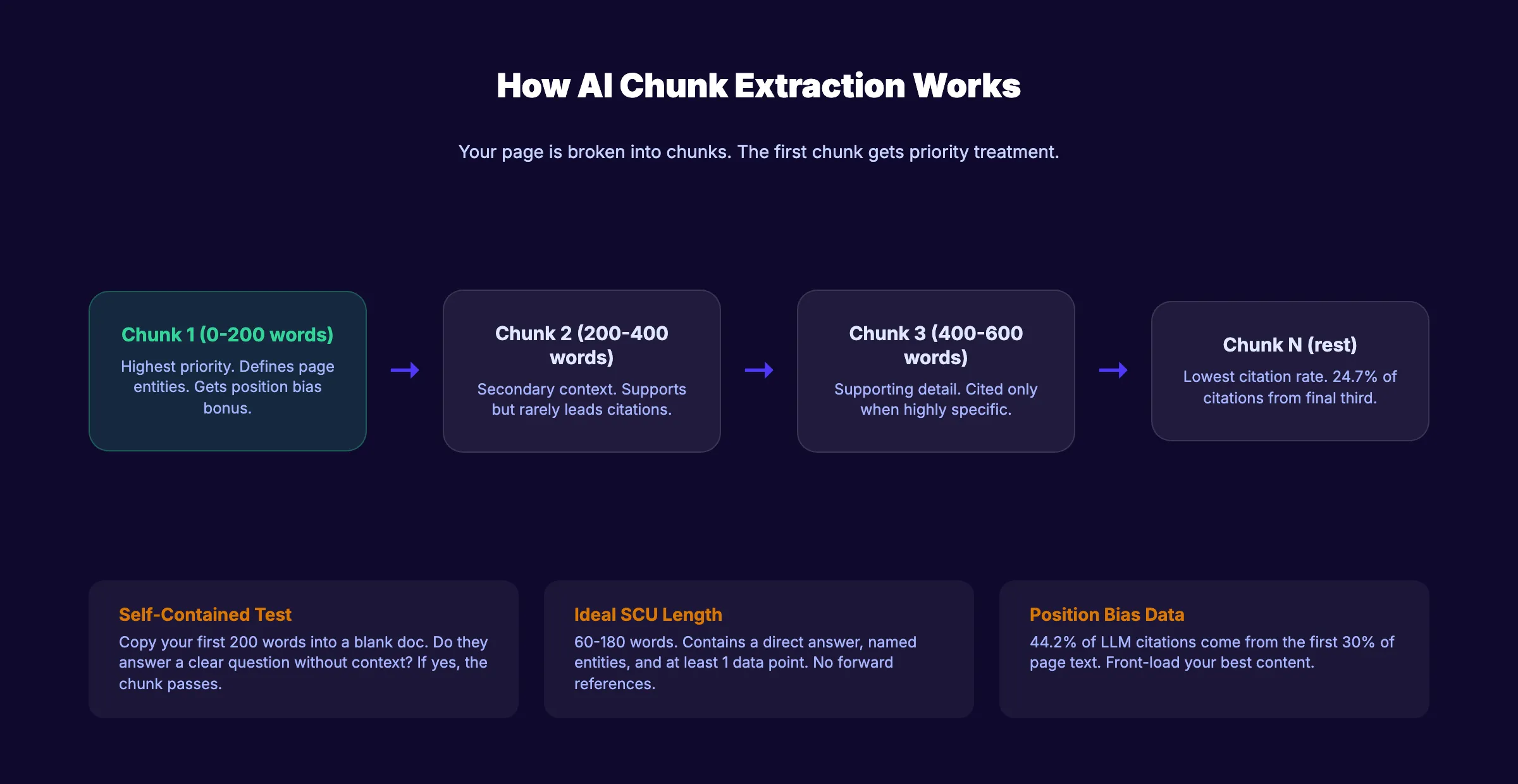
Data from multiple AI citation studies confirms this pattern. 44.2% of all LLM citations come from the first 30% of text on a page. Only 24.7% come from the final third. The opening section of any page carries disproportionate weight in every AI retrieval decision.
This position bias means your best content cannot hide at the bottom of the page. Front-load it. For a complete guide on how AI search engines choose sources to cite, read our detailed breakdown.
Reason 2: Entity Definition Happens in the First Chunk
AI models break content into chunks of 200 to 300 words. Each chunk becomes a vector. The first chunk defines the entities and context for the entire page.
If your first 200 words lack clear entities, the AI cannot map your content to its knowledge graph. Your page becomes unanchored text. The AI skips it for a competitor page that explicitly names the topic, the audience, and the intent.
Entity clarity in the opening is the foundation of brand entity SEO. Without it, even high-authority domains lose citations to smaller sites with better-structured openings. Read more about entity clustering for SEO to understand how entities connect across your content.
Reason 3: The Featured Snippet Principle Scales to All AI
The same principles that drove featured snippet optimization now drive AI citation across every platform. Google AI Overviews regularly pull from content already structured for snippet extraction. The format that works (direct answer in 40 to 60 words, then supporting context) is exactly what AI retrieval systems prefer.
This is not a coincidence. Google trained its AI systems on the same ranking signals that produced featured snippets. The pattern now applies to ChatGPT, Perplexity, and Claude as well.
For a broader view of how this fits into AI search strategy, read our generative engine optimization guide.
Stop writing. Start ranking. Stacc publishes 30 SEO articles per month for $99. Every article uses answer-first formatting optimized for AI retrieval. Start for $1 →
Step 1: Lead with a Direct Answer in the First 40 to 60 Words
The single most important optimization. Your first paragraph should directly answer the primary question your content addresses. No preamble. No context-setting. Answer first.
AI retrieval systems parse the first paragraph as the primary “answer capsule” for the entire page. If that paragraph does not contain a direct, extractable answer, the system looks elsewhere. “Elsewhere” almost always means a competitor page that answers faster.
How to do it:
- Write a definition-lead sentence: “[Entity] is a [category] that [differentiator]”
- Include the target keyword naturally in the first sentence
- State the core claim, stat, or answer within 40 to 60 words
- Follow with 1 to 2 sentences of supporting context
The definition-lead sentence structure correlates with higher impression scores in LLM retrieval pipelines. Pages that open with this pattern get classified faster and cited more often.
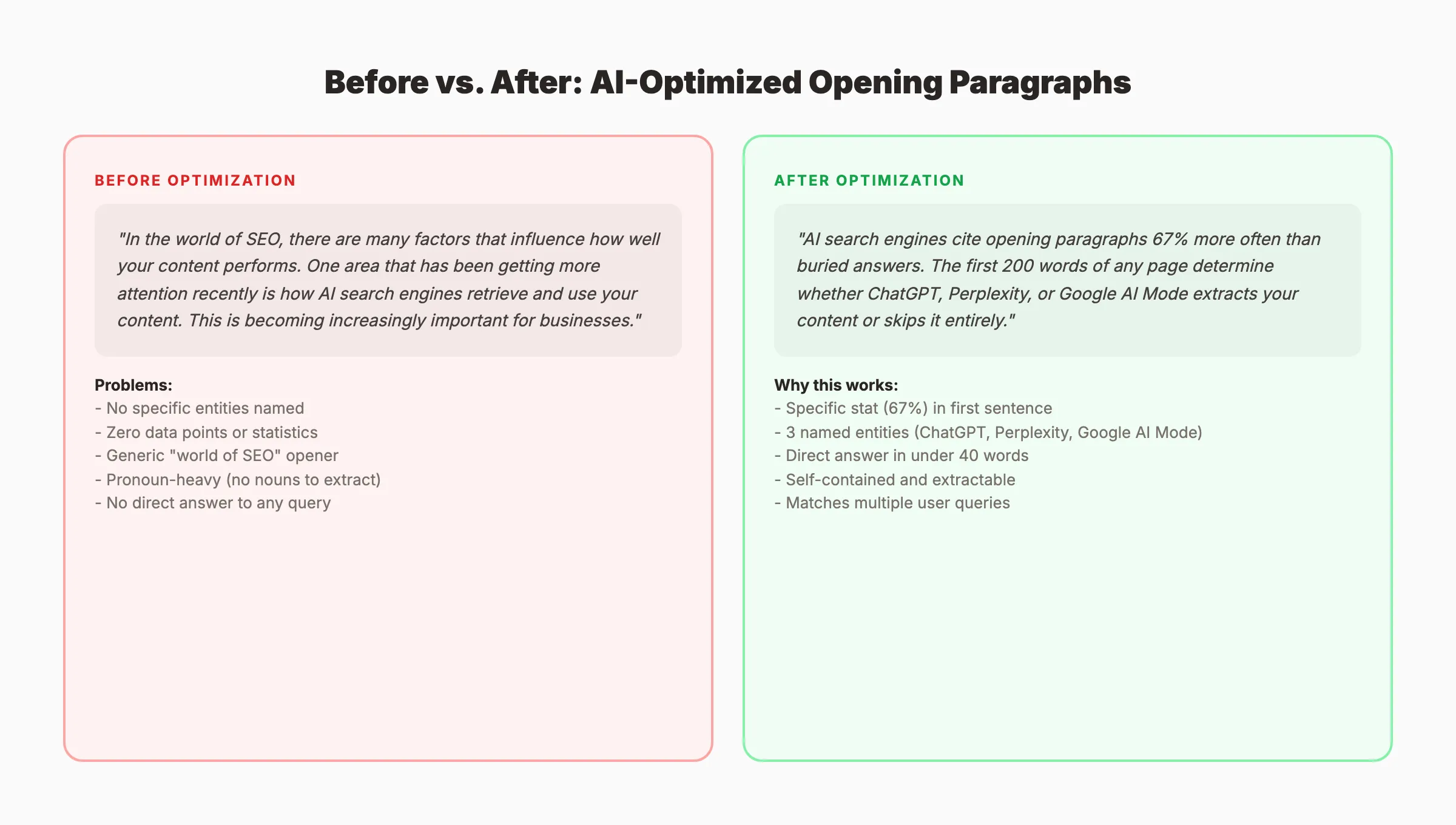
Example (before optimization):
“In the world of SEO, many factors influence content performance. One area getting more attention recently is how AI search engines retrieve and use your content. This is becoming increasingly important.”
Example (after optimization):
“AI search engines cite opening paragraphs 67% more often than buried answers. The first 200 words of any page determine whether ChatGPT, Perplexity, or Google AI Mode extracts your content or skips it.”
The optimized version contains a specific stat, names 3 entities, and delivers the answer in 35 words. AI can extract it as a standalone citation without any surrounding context.
This principle applies equally to blog post structure and on-page SEO across all page types.
Step 2: Define Entities in the First 2 Sentences
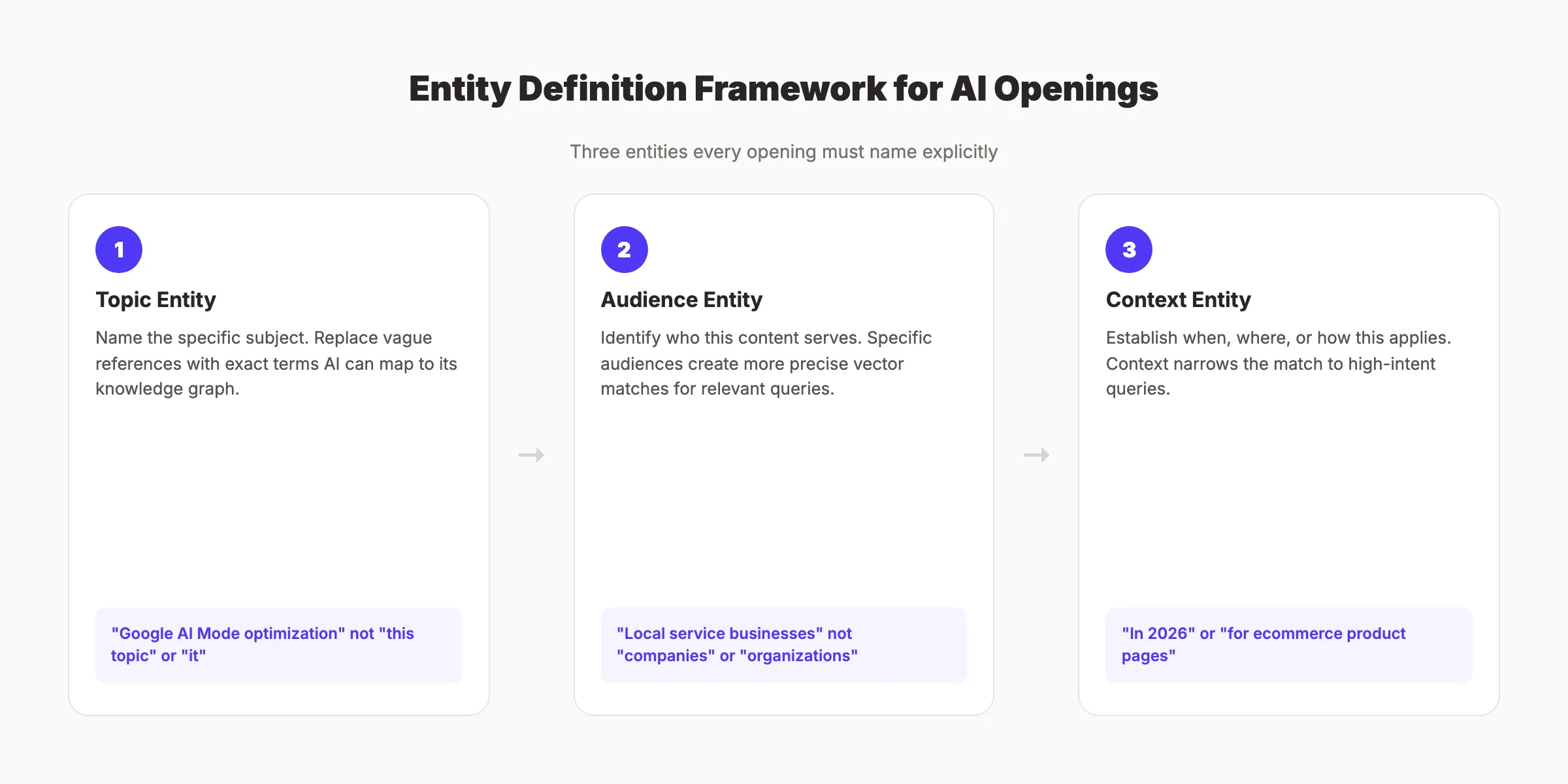
AI models map content to entities, not keywords. Your first 200 words must explicitly name the topic entity, the audience entity, and the context entity.
Entity-rich openings score higher in vector-based retrieval because they create dense, specific vectors that match a wider range of user queries. A vague opening creates a vague vector. A specific opening creates a specific vector that matches dozens of relevant queries.
How to do it:
- Name the primary topic explicitly (e.g., “Google AI Mode optimization” not “this topic”)
- Identify the target audience (e.g., “local service businesses” or “SaaS content teams”)
- Establish the context (e.g., “in 2026” or “for ecommerce product pages”)
- Replace every pronoun in the first 2 sentences with a specific noun
Without entity clarity, your content is invisible to AI retrieval. The system cannot match a passage that says “this is important” to a user query about “AI content optimization for dentists.” It can match a passage that says “AI content optimization helps dental practices rank in Google AI Mode.”
Example (before optimization):
“It is becoming more important for businesses to optimize their content. This can help them get better results. They should focus on opening paragraphs.”
Example (after optimization):
“Dental practices that optimize their first 200 words for AI retrieval see higher citation rates in Google AI Mode and ChatGPT. Leading with a direct answer that names the service, the location, and the benefit is the key.”
The optimized version defines 4 clear entities: dental practices, first 200 words, AI retrieval, and Google AI Mode/ChatGPT. AI can match this passage to queries about dental marketing, AI search optimization, and local business content strategy.
For more on entity-based optimization, read our guides on topical authority and E-E-A-T for blogs.
Step 3: Place a Specific Data Point in the First 100 Words
Numbers make passages citable. AI engines extract factual claims backed by data at significantly higher rates than opinion-based statements. A single well-placed statistic transforms a generic introduction into a passage worth citing.
Content sections with 3 or more statistics per 300 words achieve higher citation frequency across all AI platforms. Original data tables earn 4.1x more AI citations than pages without original research.
How to do it:
- Place at least 1 specific statistic in the first 100 words of every page
- Include the source of the statistic (AI trusts attributed data)
- Use precise numbers (“67% higher citation rate”) not vague language (“significantly more”)
- Prefer original data over recycled third-party stats when possible
The reason is straightforward. AI models are trained to identify and extract factual claims. A passage that says “citation rates improve significantly” gives the model nothing to extract. A passage that says “citation rates improve by 67% when the answer appears in the first 200 words” gives it a specific, quotable claim.
Where to find data for your openings:
| Data Source | Best For | Example |
|---|---|---|
| Google Search Console | Click-through and impression data | ”Pages with AI Overview presence see 35% higher CTR” |
| Your own analytics | Original research claims | ”We analyzed 500 blog posts and found X” |
| Industry studies (Semrush, Ahrefs) | Third-party credibility | ”Semrush found that 67% of AI citations…” |
| Government or academic data | Authority signals | ”According to the U.S. Census Bureau…” |
Do not just cite other sources. Create your own data when possible. AI engines cannot replicate original research. That makes your content uniquely valuable as a citation source that no competitor can duplicate.
Even simple metrics work. “We analyzed 50 client websites and found X” provides citable original data. Every business generates data worth sharing. Start measuring and documenting your results.
For more on building content authority with data, read our guide on AI citability scoring.
3,500+ blogs published. 92% average SEO score. Every article starts with an answer-first opening optimized for AI extraction. Start for $1 →
Step 4: Structure Your Opening for Passage-Level Extraction
AI retrieval systems break pages into chunks of 200 to 300 words. Your first 200 words should function as a complete, self-contained chunk that answers the primary query without depending on the rest of the page.
This is a concept researchers call “self-contained content units” (SCUs). The ideal SCU is 60 to 180 words, contains a direct answer, and makes sense when extracted and displayed without any surrounding context.
How to do it:
- Make the first 200 words understandable without reading anything else on the page
- Include the question, the answer, and supporting evidence in the opening section
- Use clear H2 headings that match natural language queries
- Keep paragraphs to 2 to 3 sentences (50 to 150 words per paragraph)
- Avoid forward references like “as we will discuss below” or “later in this guide”
Sources with clear, self-contained passages of 50 to 150 words earn higher citation rates than long-form unstructured content. The reason is mechanical. AI evaluates each chunk independently. If your first chunk is self-contained and answer-rich, it gets cited. If it depends on later paragraphs for context, the system skips it.
Self-contained chunk test:
Copy your first 200 words. Paste them into a blank document. Read them in isolation. Do they answer a clear question? Do they make sense without the rest of the article? If yes, your opening passes the extraction test. If no, rewrite until they do.
This test takes 30 seconds. Run it on every page before publishing. It is the fastest way to predict whether AI will cite your opening.
For full details on article structure, read our guides on SEO content writing and blog post structure for SEO.
Step 5: Eliminate AI-Hostile Opening Patterns
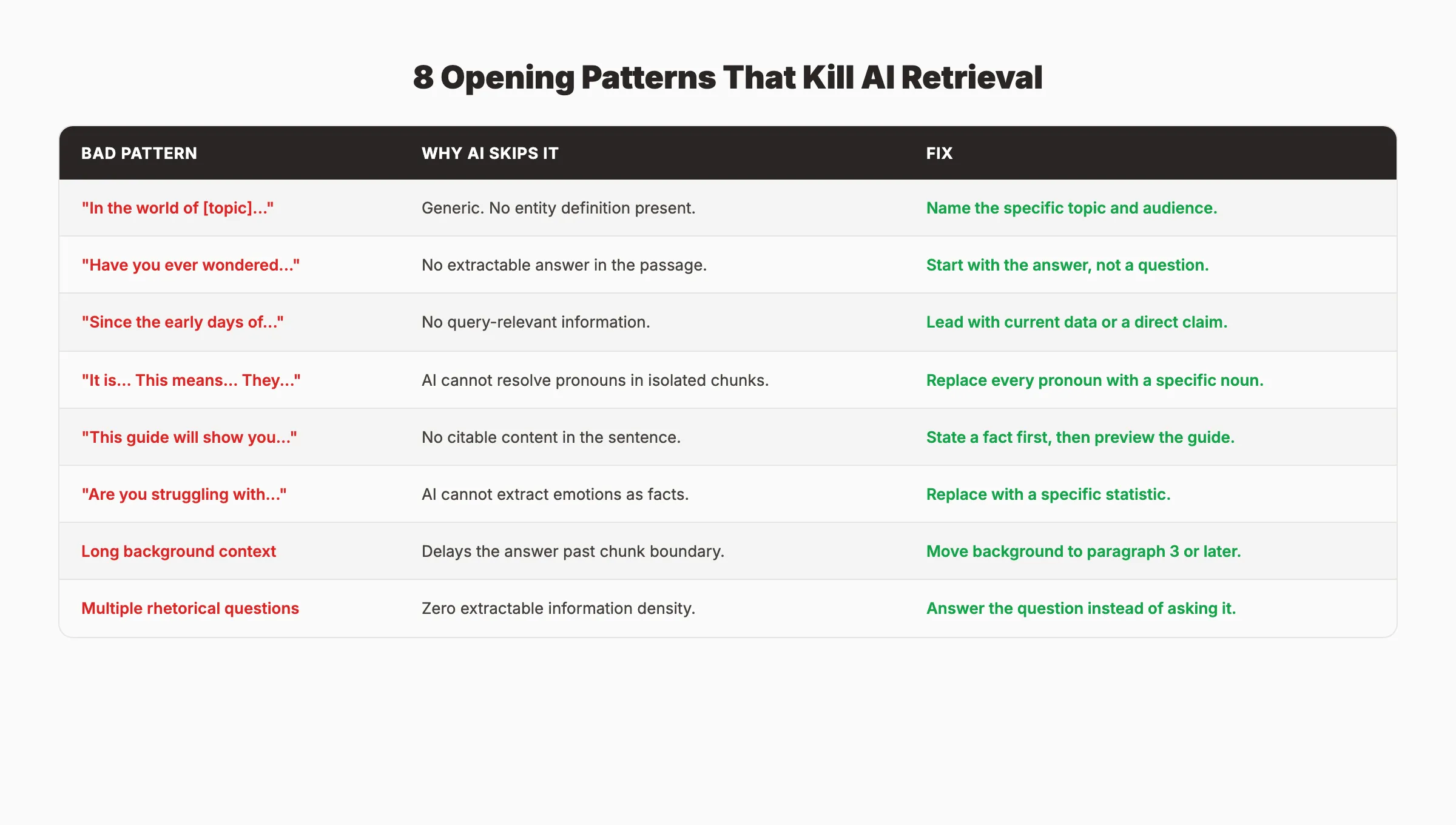
Most content openings destroy AI retrieval potential before the first 200 words end. These patterns are common because human writers default to them. AI engines penalize every one.
Eliminating these patterns is often more impactful than adding new optimization techniques. A single bad pattern in your first sentence can cause the entire opening chunk to get skipped.
Patterns to remove:
| Pattern | Why AI Skips It | Replacement |
|---|---|---|
| ”In the world of [topic]…” | Generic. No entity definition. | Name the specific topic and audience. |
| ”Have you ever wondered…” | No extractable answer present. | Start with the answer instead. |
| ”Since the early days of…” | No query-relevant information. | Lead with current data or a direct claim. |
| Pronoun-heavy opening (“It is… This means…”) | AI cannot resolve pronouns in isolated chunks. | Replace every pronoun with a specific noun. |
| ”This guide will show you…” | No citable content in the sentence. | State a fact first, then preview the guide. |
| ”Are you struggling with…” | AI cannot extract emotions as facts. | Replace with a specific statistic. |
| Long background context | Delays the answer past chunk boundary. | Move background to a later section. |
| Multiple rhetorical questions | Zero extractable information density. | Answer the question instead of asking it. |
Every AI-hostile pattern pushes the actual answer deeper into the content. AI retrieval systems operate on an attention budget. If the first chunk does not contain value, the system moves to a different page. There is no second chance.
The most common mistake is the “throat-clearing” intro. Writers spend 100 to 150 words setting up context before delivering the answer. Move that context to paragraph 3 or 4. Put the answer in paragraph 1.
For the complete optimization playbook, review our blog GEO checklist and AI overview optimization guide.
Step 6: Layer Semantic Context for Query Expansion
The first 200 words should not only answer the primary query. They should contain semantic signals that help AI match your content to related queries you did not explicitly target.
AI retrieval uses vector similarity, not keyword matching. A passage containing semantically related terms scores higher for a broader set of queries. Each additional specific term expands the query surface area of your opening passage.
How to do it:
- Include 2 to 3 related terms or synonyms alongside your primary keyword
- Reference the broader topic cluster your content belongs to
- Mention specific tools, platforms, or systems by name
- Use language that matches how users phrase questions conversationally
Semantic layering example:
For a post targeting “email marketing automation,” strong first 200 words would include these related terms: “drip campaigns,” “marketing workflows,” “subscriber segmentation,” “conversion sequences,” and platform names like “Mailchimp” or “ActiveCampaign.”
Each named entity and specific term creates an additional vector match point. Generic language like “marketing tools” matches almost nothing. Specific language like “ActiveCampaign drip sequence automation” matches dozens of related queries.
This principle mirrors on-page SEO optimization for traditional search. The difference is that AI weights semantic relatedness and entity co-occurrence more heavily than exact keyword density.
Do not force synonyms into unnatural positions. Write clearly and specifically. Specificity naturally produces semantic richness. Every time you name a tool, cite a source, or reference a specific metric, you add another vector match point to your opening passage.
For a deeper understanding of how this connects to your broader content plan, read our AI content strategy guide and what is GEO.
Rank everywhere. Do nothing. Stacc publishes 30 SEO articles per month with answer-first formatting built into every opening. Start for $1 →
Step 7: Test with AI Models and Iterate
After rewriting your first 200 words, test the results immediately. AI models provide instant feedback on whether your content is citation-worthy. Do not guess. Test.
How to do it:
- Copy your first 200 words into ChatGPT and ask: “What question does this passage answer?”
- If ChatGPT cannot identify a clear question, your opening lacks focus
- Search your target query in Perplexity and Google AI Mode
- Check which passages get cited in the AI-generated response
- Compare your opening to the cited passages from competing pages
- Rewrite and retest until your opening directly matches query intent
Testing framework:
| Test | Tool | Pass Criteria |
|---|---|---|
| Question identification | ChatGPT | Model identifies your target query from the passage alone |
| Citation check | Perplexity | Your content appears as a cited source |
| Entity extraction | Claude | Model correctly identifies your topic, audience, and context |
| Standalone readability | Manual | First 200 words make complete sense in isolation |
| Competitor comparison | Google AI Mode | Your passage is more specific than competing cited passages |
Why this step matters: Testing with AI models reveals the gap between your intention and how retrieval systems actually interpret your content. That gap is where the optimization opportunity lives.
Run this test on your top 20 pages. Rewrite the first 200 words of every page that fails. Track citation changes over 2 to 4 weeks using AI search visibility tracking methods.
The feedback loop is fast. Rewrite, test, adjust. Most pages need 2 to 3 iterations before the opening passes all 5 tests. Budget 15 minutes per page for the full test-and-rewrite cycle.
For platform-specific testing strategies, read our guides on optimizing for Perplexity AI and Google AI Mode optimization.
Results: What to Expect After Optimization
After optimizing the first 200 words across your content library, here is a realistic timeline:
- Week 1 to 2: Rewritten pages get recrawled by Google and AI crawlers
- Week 2 to 4: Initial citation improvements for pages on established domains
- Month 2 to 3: Measurable increase in AI share of voice for target queries
- Month 3 to 6: Compounding effect as more pages follow the answer-first format
The biggest gains come from pages that already rank well organically but do not get cited by AI. These pages have domain authority. They lack the passage structure AI retrieval systems require.
Start with your top 20 organic pages. Rewrite the first 200 words of each using the 7 steps above. The investment is 1 to 2 hours of editing. The return is measurably higher AI citation rates across every platform.
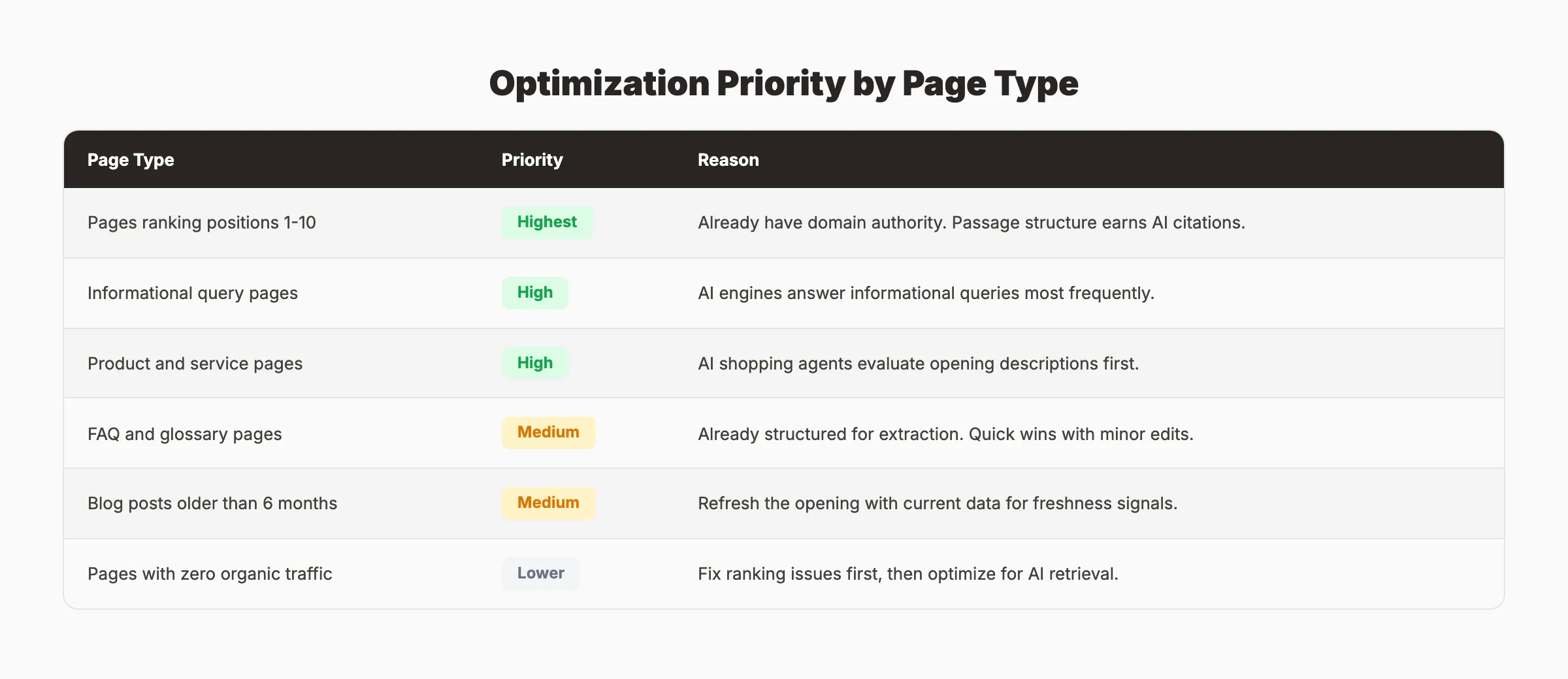
Priority Order for Optimization
Not all pages benefit equally. Focus your effort where the return is highest.
| Page Type | Priority | Reason |
|---|---|---|
| Pages ranking positions 1 to 10 | Highest | Already have domain authority. Passage structure earns AI citations. |
| Informational query pages | High | AI engines answer informational queries most frequently. |
| Product and service pages | High | AI shopping agents evaluate opening descriptions first. |
| FAQ and glossary pages | Medium | Already structured for extraction. Quick wins with minor edits. |
| Blog posts older than 6 months | Medium | Refresh the opening with current data for content freshness signals. |
| Pages with zero organic traffic | Lower | Fix ranking issues first, then optimize for AI retrieval. |
Focus on pages that already perform in traditional search. These pages have the authority signals AI trusts. They need passage structure to become extractable.
For a complete look at LLM visibility across your domain, read our LLM visibility guide.
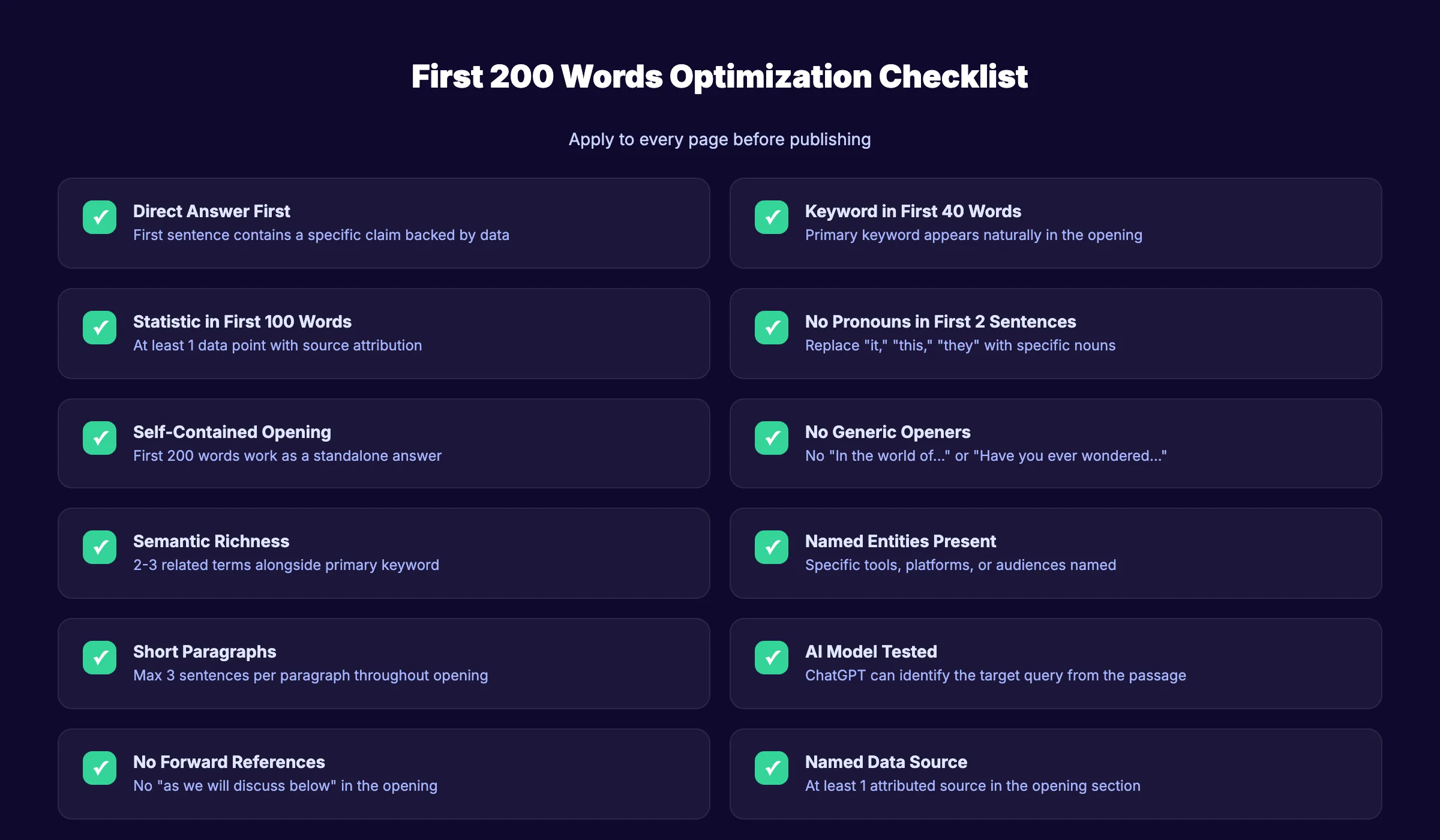
The First 200 Words Optimization Checklist
Apply this checklist to every piece of content before publishing:
- First sentence contains a direct answer or specific claim with data
- Primary keyword appears within the first 40 words
- At least 1 statistic with source attribution in the first 100 words
- No pronouns in the first 2 sentences (specific nouns only)
- First 200 words function as a self-contained answer without needing later context
- No generic openings (“In the world of…”, “Have you ever wondered…”)
- 2 to 3 semantically related terms included alongside primary keyword
- Named entities (specific tools, platforms, audiences) explicitly stated
- Paragraphs under 3 sentences each
- Tested with an AI model to verify the opening answers a clear question
- No forward references to later content (“as we will discuss below”)
- At least 1 named data source in the opening section
For a deeper look at structuring entire articles for AI citations, read our guides on getting cited in AI search and the blog GEO checklist.
FAQ
Does the first 200 words rule apply to all content types?
Yes. Blog posts, landing pages, product pages, and FAQ entries all benefit from answer-first openings. AI retrieval systems evaluate the first chunk of every page type using the same extraction logic. The only exception is creative content where suspense serves a deliberate purpose.
Should I remove my introduction entirely?
No. Rewrite it. The best openings combine a direct answer (for AI) with a compelling hook (for human readers). Start with the answer. Follow with context. You can still tell a story after answering the question. The key is putting the answer first and the narrative second.
How do I optimize older content without rewriting the whole article?
Focus only on the first 200 words. Rewrite the opening to lead with a direct answer, add a statistic, and name specific entities. The rest of the article can stay unchanged. This targeted edit takes 10 to 15 minutes per page and produces the majority of AI citation improvement. Start with your top 20 pages by organic traffic.
Does this work for ecommerce product pages?
Yes. For product pages, the first 200 words should state what the product is, who it is for, the price range, and the primary differentiator. AI shopping agents evaluate product descriptions using the same passage extraction logic. Clean, factual openings get recommended. Vague marketing language gets skipped.
How is optimizing the first 200 words for AI retrieval different from featured snippet optimization?
The principle is the same. The scope is broader. Featured snippet optimization targets one box on Google. First-200-words optimization targets every AI platform simultaneously: Google AI Mode, ChatGPT, Perplexity, Claude, and Gemini. The format (direct answer in 40 to 60 words, followed by supporting evidence) works for both. Read our guide on Google AI overview optimization for the full overlap.
How does Stacc handle first-200-words optimization?
Every article Stacc publishes uses answer-first formatting. The opening paragraph contains the primary keyword, a specific data point, and a direct answer to the target query. This AI content structure is built into our production process across all 3,500+ articles we have published.
The first 200 words of your content are your pitch to AI retrieval systems. Lead with answers. Back them with data. Structure them for extraction. Every page you optimize moves your brand closer to becoming the default source AI engines cite. Start with Step 1 today on your highest-traffic page and work through all 7 steps.
Your SEO team. $99 per month. Stacc handles answer-first formatting, AI-optimized structure, and 30 articles per month on autopilot. Start for $1 →
Related Tools & Resources
Free SEO Tools:
Best Lists:

Written by
Siddharth GangalSiddharth is the founder of theStacc and Arka360, and a graduate of IIT Mandi. He spent years watching great businesses lose organic traffic to competitors who simply published more. So he built a system to fix that. He writes about SEO, content at scale, and the tactics that actually move rankings.
30 SEO blog articles published every month
Keyword-optimized, scheduled, and live on your site. Automatically.
30-day trial · Cancel anytime
theStacc
Stop writing SEO content manually
30 blog articles, 30 GBP posts, and social media content. Published every month. Automatically.
Start Your $1 Trial$1 for 3 days · Cancel anytime