
Entity Clustering for SEO (2026): Strategies, Tactics & Examples
Practical entity clustering seo strategies for 2026: step-by-step tactics, real examples, and tools to improve rankings and drive organic traffic.
Most SEO strategies still revolve around keyword lists. Find a keyword. Write a post. Move on. The result is a site full of disconnected pages that Google cannot organize into a coherent picture of expertise.
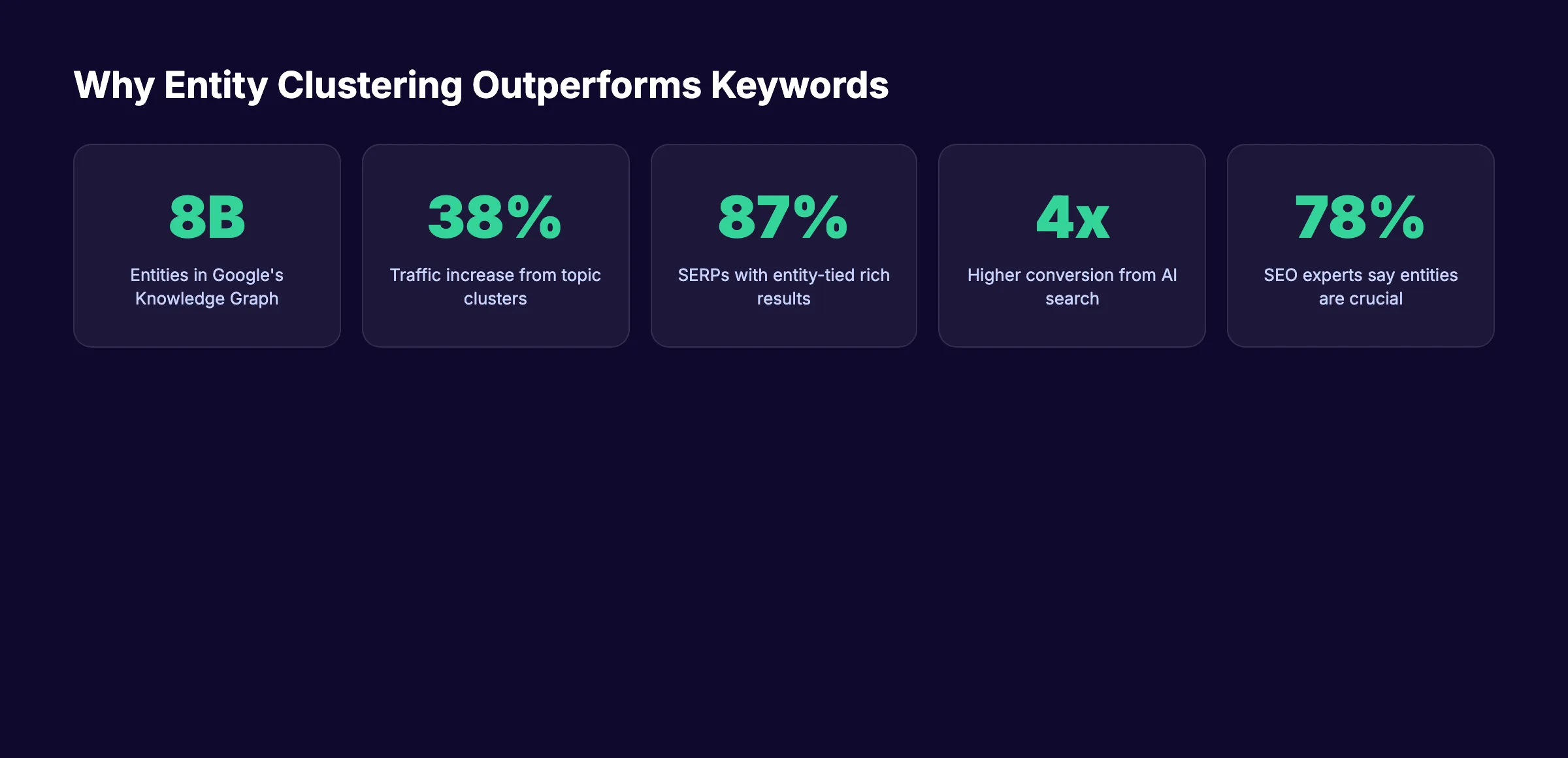
Entity clustering for SEO fixes that problem. Instead of targeting isolated keywords, you group related entities (people, concepts, products, places) into clusters that mirror how search engines actually understand your topic. Google’s Knowledge Graph now contains over 8 billion entities and 800 billion facts. Every query gets matched against this web of relationships, not just a list of keywords.
The shift is not optional. AI Overviews now trigger for 18.76% of US search queries. Featured snippets, knowledge panels, and AI-generated answers all rely on entity relationships. Sites that map their content to entity clusters rank higher, earn more rich results, and get cited by AI search engines.
We have published 3,500+ blog posts across 70+ industries. Every article we produce maps to an entity cluster. This guide covers what entity clustering is, why it matters, and exactly how to implement it on your site.
Here is what you will learn:
- What entities are and how they differ from keywords
- How Google uses entity relationships to rank content
- The step-by-step process to build entity clusters
- How to connect entity clusters with schema markup and internal links
- Tools and techniques for entity extraction and mapping
- How entity clustering prepares your site for AI search
Table of Contents
- Chapter 1: What Is an Entity in SEO?
- Chapter 2: Entity Clustering Explained
- Chapter 3: Why Entity Clustering Beats Keyword Targeting
- Chapter 4: How to Build Entity Clusters (Step by Step)
- Chapter 5: Schema Markup and Entity Signals
- Chapter 6: Internal Linking for Entity Clusters
- Chapter 7: Entity Clustering for AI Search and GEO
- Chapter 8: Common Entity Clustering Mistakes
- FAQ
Chapter 1: What Is an Entity in SEO? {#ch1}
Before you can cluster entities, you need to understand what an entity actually is. Google defines it differently than most SEO guides suggest. This chapter breaks down the definition, gives examples, and explains why entities matter more than keywords in 2026.
The Google Definition
An entity is a thing or concept that is singular, unique, well-defined, and distinguishable. That definition comes directly from Google’s patent on entity-based search.
Entities are not keywords. A keyword is a text string that someone types into a search bar. An entity is the real-world concept behind that text. “Apple” the keyword is ambiguous. “Apple Inc.” the entity is not.
Google maintains billions of entities in its Knowledge Graph. Each entity has attributes (revenue, CEO, headquarters) and relationships to other entities (competitor of Microsoft, manufacturer of iPhone). Search queries get resolved against this graph.
Types of Entities That Matter
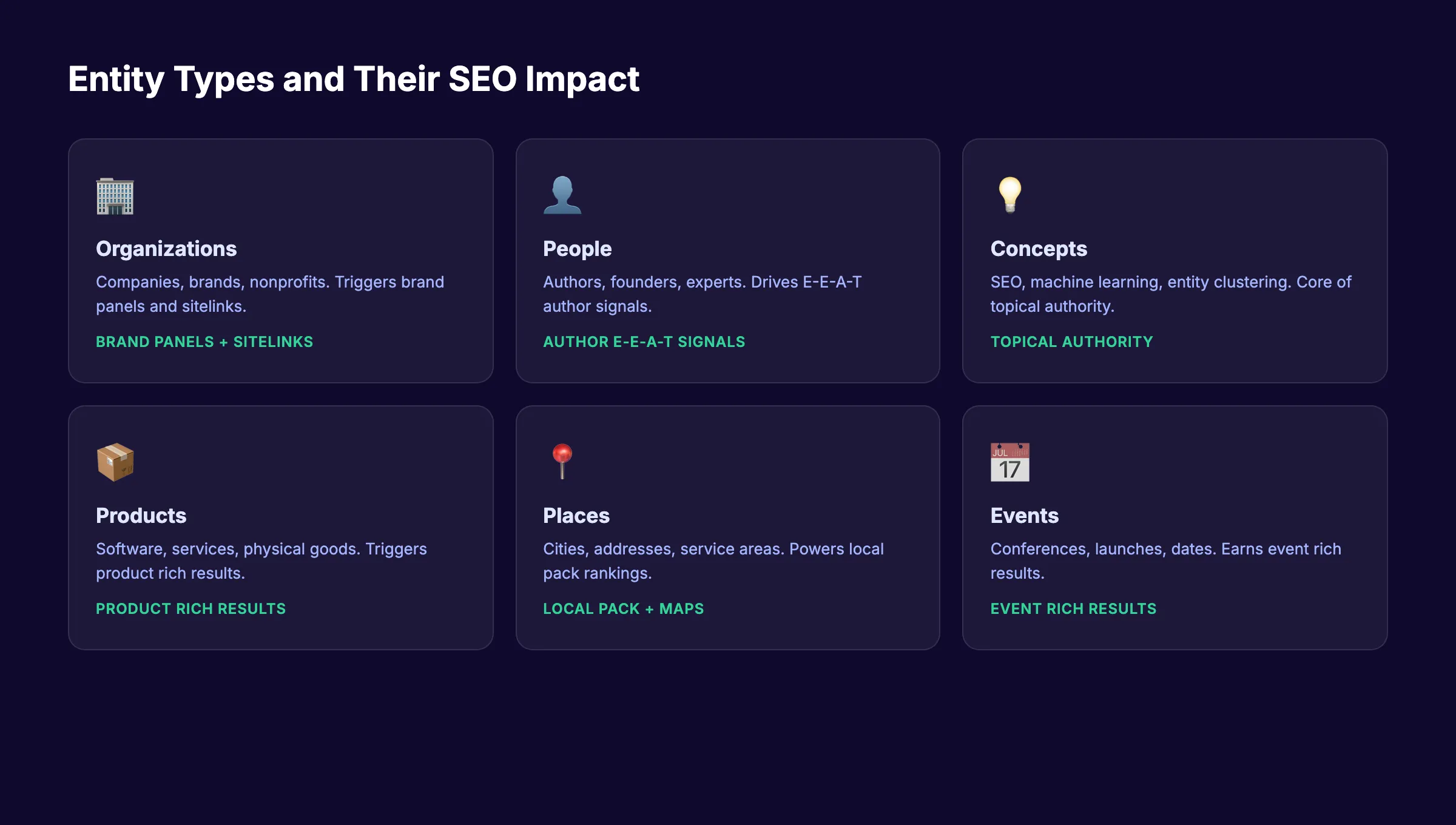
Not all entities carry equal weight in SEO. The most important types include:
| Entity Type | Examples | SEO Impact |
|---|---|---|
| Organizations | Apple, NASA, Stacc | Brand panels, sitelinks |
| People | Sundar Pichai, your CEO | Author E-E-A-T signals |
| Concepts | SEO, machine learning, entity clustering | Topical authority |
| Products | iPhone 16, Semrush, WordPress | Product rich results |
| Places | New York, your business location | Local pack, map rankings |
| Events | Google I/O, Black Friday | Event rich results |
Concept entities are the most relevant for content SEO. When you write about topical authority, you are building a cluster around a concept entity. When you add schema markup, you are telling Google which entity each page represents.
How Google Connects Entities
Google does not store entities as isolated records. Every entity connects to other entities through typed relationships. “Entity clustering SEO” connects to “semantic search,” “Knowledge Graph,” “topic clusters,” and “structured data.”
These connections form a graph. When your content covers an entity and its related entities thoroughly, Google recognizes your site as an authority on that topic. When you only cover the primary entity without its relationships, Google sees thin coverage.
This is why single-keyword pages underperform cluster-based architectures. One page cannot cover the full entity graph. A cluster of interconnected pages can.
Chapter 2: Entity Clustering Explained {#ch2}
Entity clustering is the practice of grouping related entities into structured content architectures. It takes the concept of content clusters and adds an entity layer on top. This chapter defines entity clustering, shows how it differs from traditional topic clustering, and explains the structural framework.
Entity Clustering vs. Topic Clustering
Topic clustering groups content by keyword themes. You pick a pillar topic like “local SEO” and create supporting posts around related keywords like “Google Business Profile,” “local citations,” and “local link building.”
Entity clustering goes deeper. Instead of grouping by keyword similarity, you group by entity relationships. You identify the primary entity, map its attributes, find all related entities, and build content that covers each relationship.
| Feature | Topic Clustering | Entity Clustering |
|---|---|---|
| Grouping basis | Keyword similarity | Entity relationships |
| Structure | Pillar + clusters | Entity hub + attribute pages |
| Google signal | Topical coverage | Knowledge Graph alignment |
| AI visibility | Moderate | High |
| Schema integration | Optional | Essential |
| Depth requirement | Breadth-focused | Relationship-focused |
The practical difference is specificity. A topic cluster on “email marketing” covers related keywords. An entity cluster on “email marketing” maps its relationships to “open rate,” “ESP,” “drip campaign,” “GDPR,” and “CAN-SPAM” as connected entities.
The Entity Cluster Framework
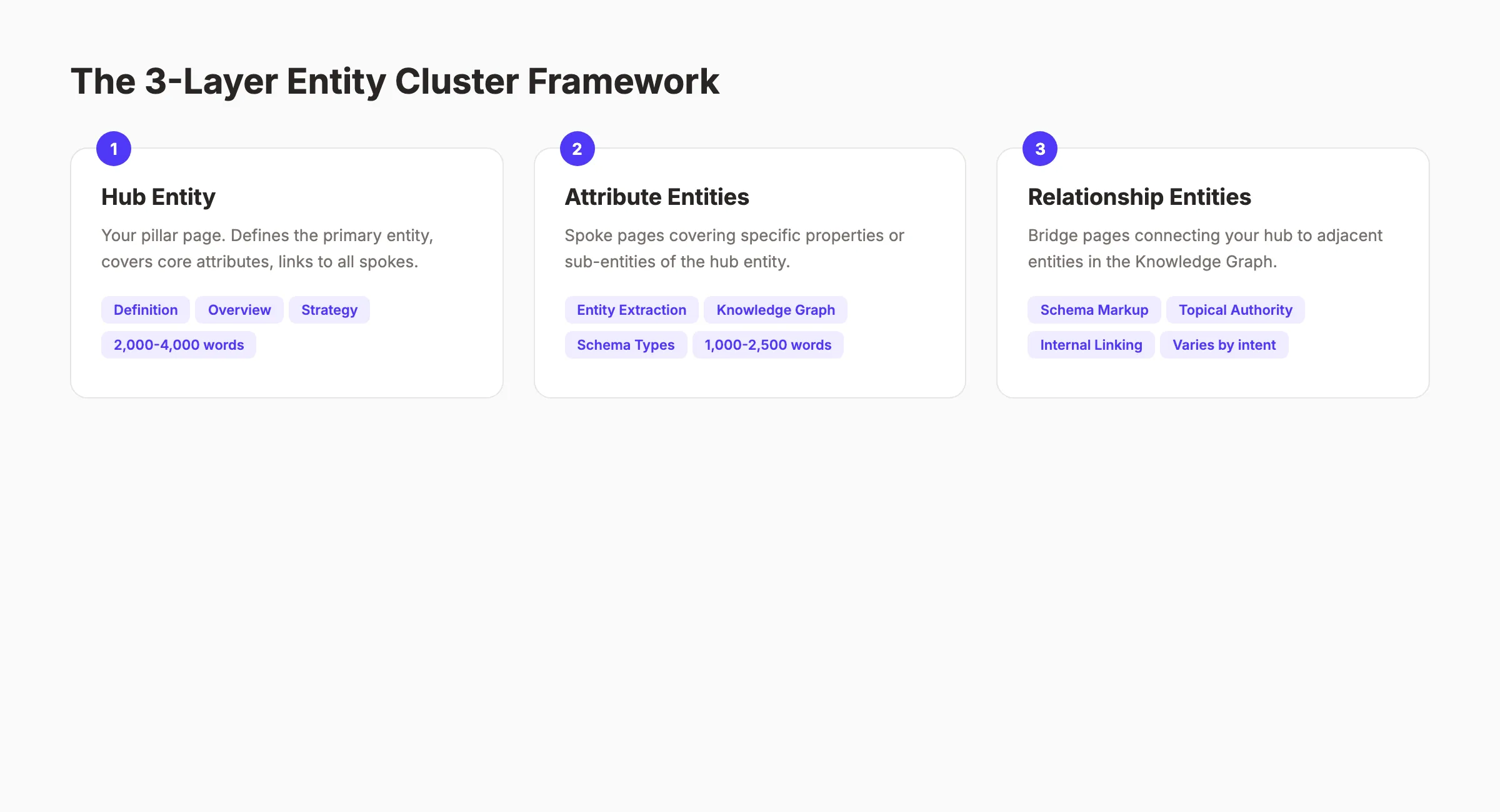
Every entity cluster has 3 layers:
Layer 1: The Hub Entity. This is your pillar page. It defines the primary entity, covers its core attributes, and links to all spoke pages. For entity clustering SEO, the hub would cover the definition, importance, and high-level strategy.
Layer 2: Attribute Entities. These are pages that cover specific properties or sub-entities of the hub. For “entity clustering SEO,” attribute entities include “entity extraction,” “Knowledge Graph optimization,” “semantic markup,” and “entity-based keyword research.”
Layer 3: Relationship Entities. These are pages that connect your hub entity to adjacent entities in the Knowledge Graph. For entity clustering, relationship entities include “schema markup,” “topical authority,” “internal linking,” and “AI search optimization.”
Why This Structure Wins
Search engines reward entity-complete coverage. When your site covers a hub entity plus its attributes plus its relationships, Google classifies your site as a complete, authoritative source.
Semrush research shows that sites using topic clusters see a 38% increase in organic traffic. Entity clusters amplify that effect because they align directly with how Google stores and retrieves information internally.
The sites that rank for competitive head terms in 2026 are not the ones with the most backlinks. They are the ones with the most complete entity coverage.
Publish 30 entity-optimized articles every month on autopilot. Stacc writes, optimizes, and publishes your content. No writers. No agencies. No overhead. Start for $1 →
Chapter 3: Why Entity Clustering Beats Keyword Targeting {#ch3}
Keyword targeting dominated SEO for 2 decades. It still has a role. But as a primary strategy, it fails to account for how modern search engines actually process content. This chapter covers the 5 reasons entity clustering outperforms pure keyword strategies.
Reason 1: Google Processes Entities, Not Just Keywords
Google’s Hummingbird update (2013) introduced semantic search. BERT (2019) added contextual understanding. MUM (2021) brought multimodal entity recognition. Each update moved Google further from keyword matching and closer to entity understanding.
In 2026, Google resolves every search query against its Knowledge Graph before displaying results. The query “best project management tool for remote teams” gets broken into entities: “project management tool,” “remote team,” and the relationship “best for.”
Content that covers these entities and their relationships ranks. Content that just repeats the keyword string does not.
Reason 2: Entity Clusters Capture More Search Queries
A single keyword-targeted page captures 1 query pattern. An entity cluster captures dozens. When you build a cluster around the entity “entity clustering SEO,” you also rank for:
- “What is entity-based SEO?”
- “How to use entities for content strategy”
- “Entity SEO vs keyword SEO”
- “Knowledge Graph optimization”
- “Semantic SEO strategy”
Each spoke page in your cluster targets a related query while reinforcing the hub. This is how a 20-page entity cluster outranks a single 5,000-word guide. The cluster covers more of the entity graph.
Reason 3: AI Search Requires Entity Clarity
ChatGPT, Perplexity, and Google AI Overviews all synthesize answers from multiple sources. They select sources based on entity coverage, not keyword density.
Research from Search Engine Land shows that fewer than 25% of the most-mentioned brands in AI results are also the most-sourced. Getting cited requires clear entity signals: consistent naming, structured data, and thorough coverage.
Entity clusters provide all 3. Every page in the cluster reinforces the same entity relationships. AI systems can extract clean, structured answers from your content because the entity boundaries are clear.
Reason 4: Richer SERP Features
Pages with strong entity signals earn more SERP features. Knowledge panels, featured snippets, People Also Ask boxes, and rich results all depend on entity recognition.
87% of search results now include rich snippets or knowledge panels tied to entities. If your content does not send clear entity signals, you miss these placements entirely.
Entity clusters compound this effect. When Google recognizes your cluster as an authority on an entity, it promotes multiple pages from your site across different SERP features for related queries.
Reason 5: Future-Proof Architecture
Keywords change. Search behavior evolves. But entities persist. “Content marketing” was a keyword trend. As a Knowledge Graph entity, it has permanent relationships to “blog,” “SEO,” “lead generation,” and “conversion rate.”
Building your site around entities means your architecture remains relevant even as search interfaces change. Voice search, visual search, and generative engine optimization all run on the same entity layer.
Chapter 4: How to Build Entity Clusters (Step by Step) {#ch4}
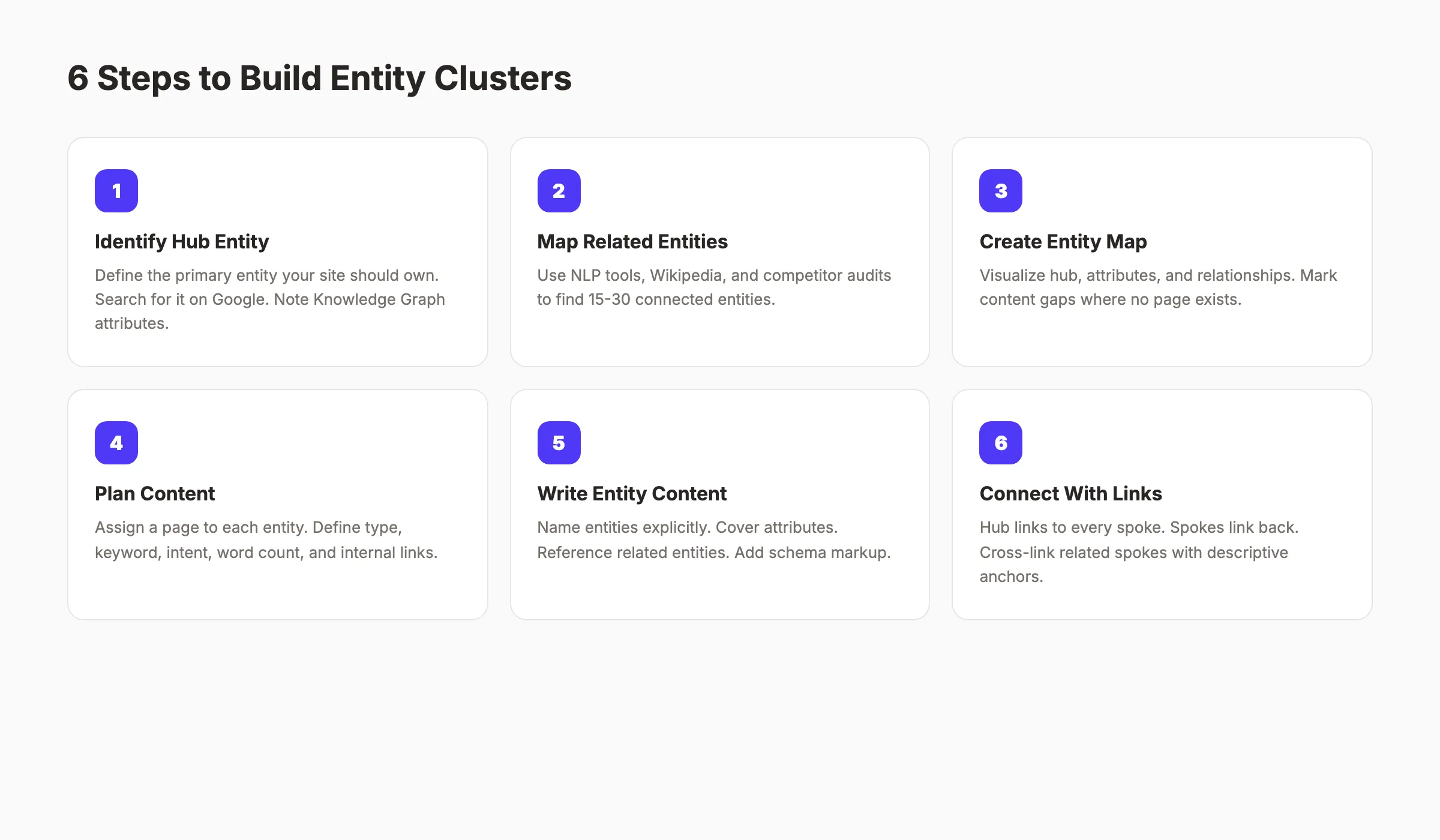
This is the practical chapter. Follow these 6 steps to build entity clusters on your site. Each step includes the tools, process, and output you need.
Step 1: Identify Your Hub Entity
Start with the entity your site should own. For most businesses, this is your primary service or product category.
Ask: “What is the one concept Google should associate with my site above all others?”
For a dental practice, the hub entity might be “dental care” or “cosmetic dentistry.” For an SEO service, it might be “SEO content” or “blog SEO.” For a SaaS company, it might be the problem your product solves.
Write down the hub entity. Search for it on Google. Look at the Knowledge Graph panel (if one exists). Note the attributes and related entities Google already associates with it.
Step 2: Map Related Entities
Use these methods to find all entities connected to your hub:
Method A: Google Knowledge Graph. Search for your hub entity and review the “People also search for” section, Knowledge Panel attributes, and related searches.
Method B: NLP Entity Extraction. Run your top-ranking competitor pages through Google’s Natural Language API or TextRazor. These tools extract every entity mentioned on a page, with salience scores.
Method C: Wikipedia Structure. Find the Wikipedia article for your hub entity. Every internal link in that article points to a related entity. The table of contents shows the attribute structure.
Method D: Competitor Entity Audit. Fetch the top 3 ranking pages for your hub entity keyword. Extract all H2 and H3 headings. Each heading usually maps to a sub-entity or attribute.
Build a list of 15-30 related entities. Organize them into attributes (properties of the hub) and relationships (connections to other hubs).
Step 3: Create the Entity Map
Turn your entity list into a visual map. Place the hub entity at the center. Draw spokes to each related entity. Group entities by type:
- List all attribute entities (properties of the hub)
- List all relationship entities (connections to other topics)
- Identify which entities already have pages on your site
- Mark gaps where no content exists
This map becomes your topical map. Every node that lacks a page represents a content opportunity. Every existing page that does not link to the hub represents a broken connection.
Step 4: Plan Content for Each Entity
Assign a page to each entity in your map. For each page, define:
| Element | Details |
|---|---|
| Target entity | The specific entity this page covers |
| Page type | Hub (pillar), attribute (spoke), or relationship (bridge) |
| Primary keyword | The keyword that best represents this entity |
| Search intent | Informational, commercial, or transactional |
| Word count | Based on SERP analysis for that keyword |
| Internal links | Which other entity pages this connects to |
Hub pages need 2,000-4,000 words. Attribute pages need 1,000-2,500 words. Relationship pages vary by intent.
Do not try to cover every entity on a single page. The whole point of entity clustering is distributing coverage across interconnected pages.
Step 5: Write Entity-Optimized Content
When writing each page, follow these entity optimization rules:
Name the entity explicitly in the first 100 words. Do not rely on synonyms or pronouns in the opening. State exactly what entity this page covers.
Cover entity attributes fully. If you are writing about “schema markup,” cover types, syntax, implementation, testing, and common errors. Each attribute should have its own H3 section.
Reference related entities by name. Every page should mention 5-10 related entities from your map. This creates the semantic connections Google uses to understand your coverage.
Use consistent naming. Call the entity the same thing across every page. If your hub entity is “entity clustering SEO,” do not switch to “entity-based content grouping” on spoke pages. Consistency helps Google connect your pages.
Add structured data. Every page should include schema markup that identifies the entity it covers. Article schema, FAQ schema, and HowTo schema all help.
Step 6: Connect Everything With Internal Links
The final step is the connective tissue. Every spoke page must link to the hub. The hub must link to every spoke. Spoke pages should cross-link to related spokes.
Use descriptive anchor text that includes the entity name. “Learn more about internal linking for blog posts” is better than “click here.”
Aim for 3-5 internal links per 1,000 words. Distribute them naturally across the content. Do not stack all links in one paragraph.
Entity-optimized content, published automatically. Stacc maps entities, writes articles, and connects your content clusters. 30 posts per month. $99. Start for $1 →
Chapter 5: Schema Markup and Entity Signals {#ch5}
Schema markup is how you tell search engines which entity each page represents. Without it, Google has to guess. With it, you provide explicit signals that accelerate entity recognition. This chapter covers the specific schema types that support entity clustering.
Organization and Brand Schema
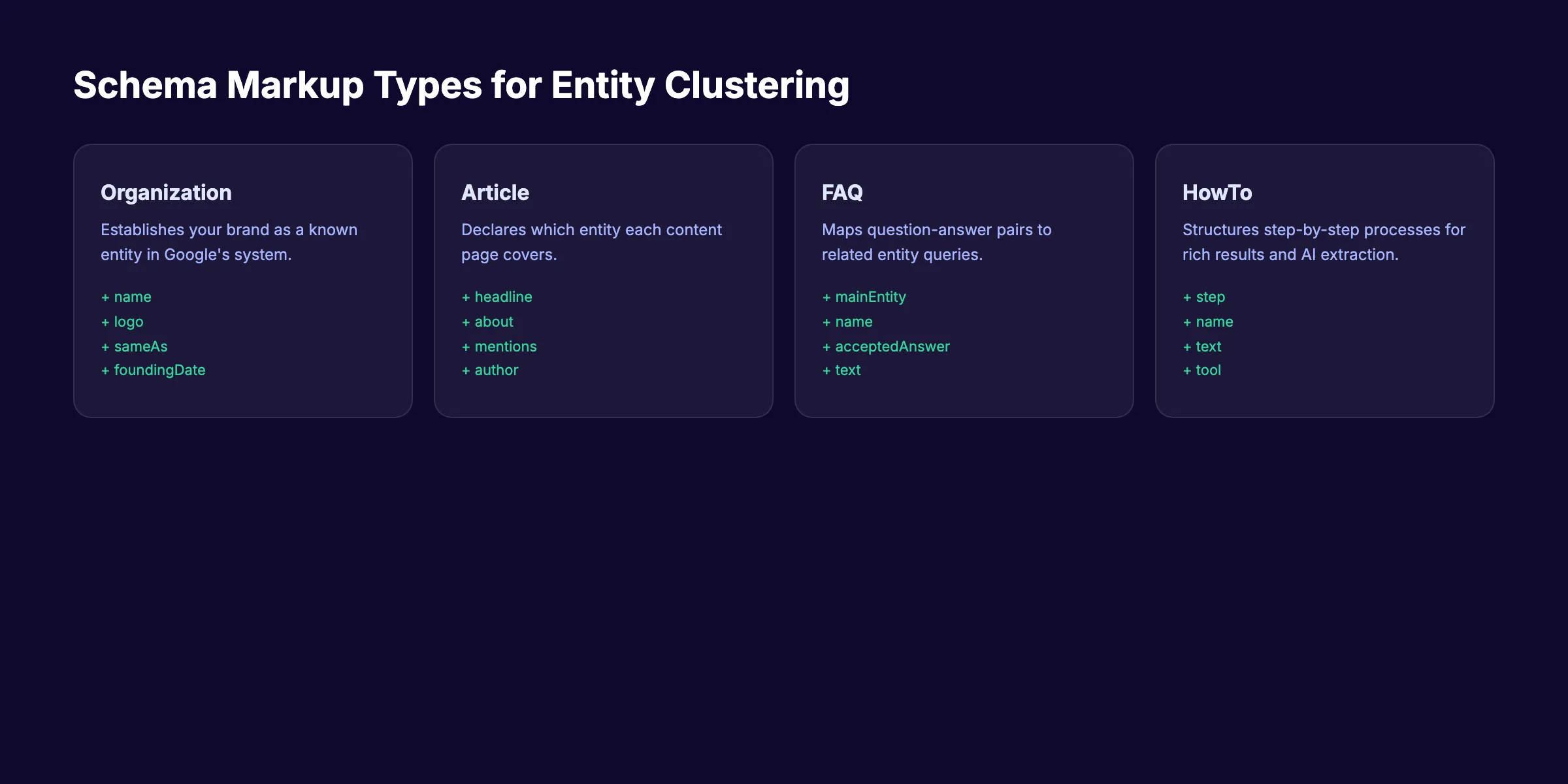
Every site needs Organization schema on the homepage. This establishes your brand as a known entity in Google’s system. Include:
- Official name (as it appears everywhere)
- Logo URL
- Social profile URLs (sameAs property)
- Contact information
- Founding date and location
The sameAs property is critical for entity clustering. It connects your brand entity to your presence on LinkedIn, Wikipedia, Crunchbase, and other platforms. Google uses these connections to verify your entity across the web.
Article and WebPage Schema
Every content page should include Article schema. This tells Google the page is a structured piece of content about a specific topic. Key properties:
- headline (matching the H1)
- description (matching the meta description)
- author (linking to a Person entity)
- datePublished and dateModified
- about (linking to the entity this page covers)
The “about” property is the most underused schema field in SEO. It lets you explicitly declare which entity a page covers. Use it on every page in your entity cluster.
FAQ and HowTo Schema
FAQ schema maps question-and-answer pairs to entities. Each question targets a related search query. Each answer provides a structured response that AI systems can extract.
HowTo schema maps step-by-step processes. Use it on any page that includes numbered steps or processes. Google can display these as rich results.
Both schema types support entity clustering because they provide additional structured context about your hub entity. A pillar page with FAQ schema covers more entity attributes than one without.
Entity Relationship Schema
Advanced entity clustering uses schema to define relationships between entities. The “mentions” and “about” properties let you connect pages explicitly:
{
  "@type": "Article",
  "about": {
    "@type": "Thing",
    "name": "Entity Clustering SEO",
    "sameAs": "https://en.wikipedia.org/wiki/Semantic_search"
  },
  "mentions": [
    {
      "@type": "Thing",
      "name": "Knowledge Graph"
    },
    {
      "@type": "Thing",
      "name": "Schema Markup"
    }
  ]
}
This tells Google exactly which entities your page covers and references. It removes ambiguity and speeds up entity recognition.
Testing Your Entity Signals
After implementing schema, validate with these tools:
- Google Rich Results Test (checks schema syntax)
- Google Search Console (monitors rich result eligibility)
- Schema Markup Validator (checks JSON-LD structure)
- Google Natural Language API (verifies entity recognition)
Run your pages through Google’s Natural Language API to see which entities Google detects. If the primary entity for your page does not appear with high salience, your entity signals need work.
Chapter 6: Internal Linking for Entity Clusters {#ch6}
Internal links are the wires that connect your entity cluster. Without them, Google cannot see the relationships between your pages. This chapter covers the internal linking architecture that makes entity clusters work.
Hub-and-Spoke Link Architecture
The foundational pattern is simple:
- The hub page links to every spoke page
- Every spoke page links back to the hub
- Related spoke pages link to each other
This creates a dense internal graph that mirrors the entity relationships in Google’s Knowledge Graph. When Google crawls your hub page, it follows links to every spoke. Each spoke reinforces the hub’s authority on the entity.
Anchor Text Strategy
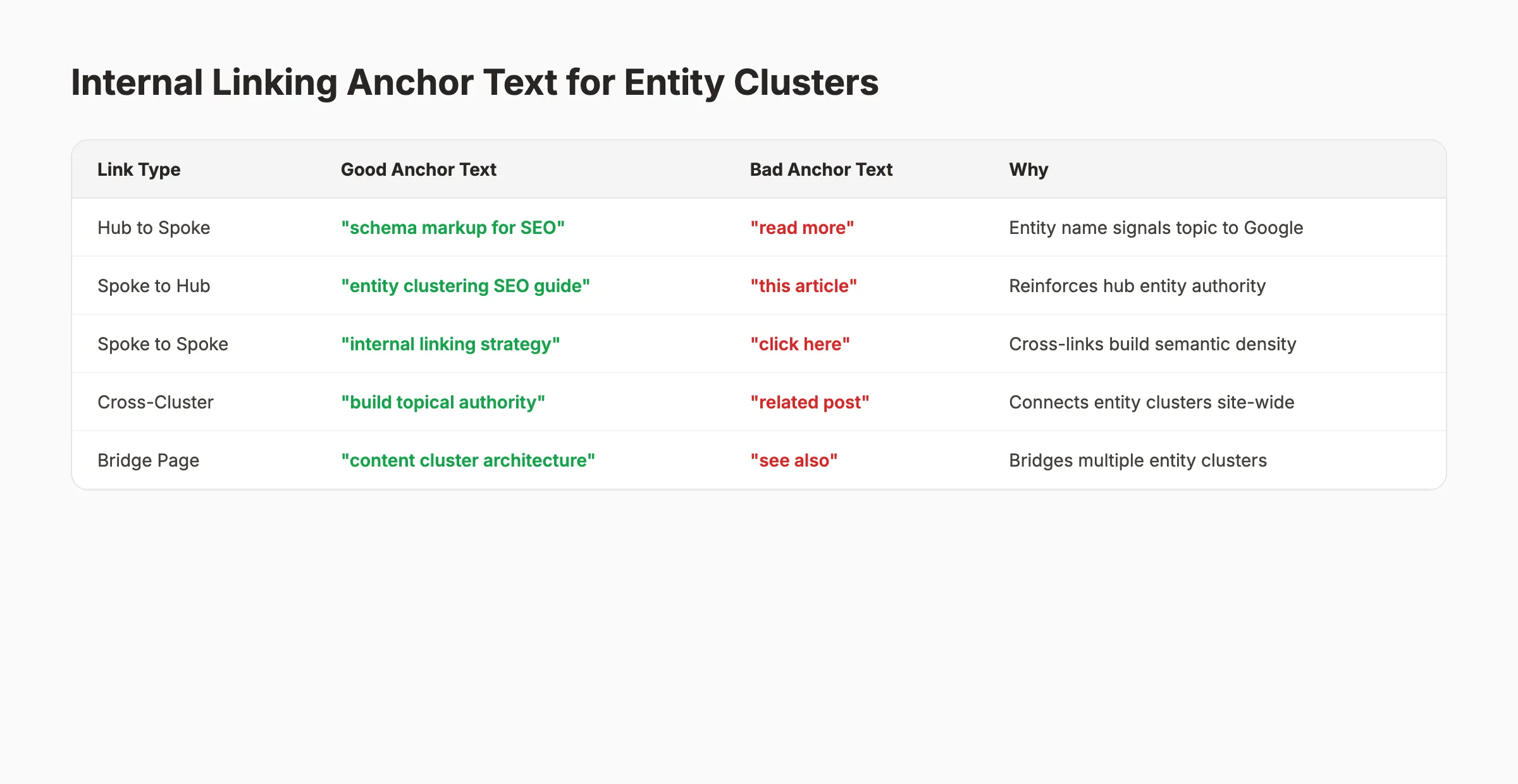
Anchor text tells Google what the linked page is about. For entity clusters, use the entity name in the anchor text whenever possible.
| Link Type | Good Anchor Text | Bad Anchor Text |
|---|---|---|
| Hub to spoke | ”schema markup for SEO" | "read more” |
| Spoke to hub | ”entity clustering SEO guide" | "this article” |
| Spoke to spoke | ”internal linking strategy" | "click here” |
Vary your anchor text slightly across pages, but keep the entity name present. Google uses anchor text as an entity signal for the destination page.
Link Placement Rules
Place internal links where they add context. The best positions are:
First 200 words. A link in the introduction sets context early. It tells Google this page connects to your broader entity cluster.
Within supporting evidence. When you reference a concept covered by another page, link to it. “Sites that build topical authority rank for more long-tail queries” is a natural link placement.
Before CTAs. A link to a related resource before a call-to-action gives readers an alternative path through your content.
Do not place more than 2 internal links in a single paragraph. Spread them across the page for natural distribution.
Cross-Cluster Linking
Entity clusters do not exist in isolation. Your “entity clustering SEO” cluster connects to your “content strategy” cluster, your “on-page SEO” cluster, and your “AI search” cluster.
Cross-cluster links create a site-wide entity graph. They tell Google that your site covers multiple related domains, not just one topic. This builds domain-level authority.
Identify 2-3 bridge pages that connect each cluster. These pages cover entities that belong to multiple clusters. “Content clusters” is a bridge between “entity clustering” and “content strategy.” “Featured snippets” bridges “entity optimization” and “SERP features.”
Auditing Your Internal Link Graph
Review your internal link structure quarterly. Look for:
- Orphan pages (no internal links pointing to them)
- Dead-end pages (no outgoing internal links)
- Missing hub-to-spoke links
- Spoke pages that do not link back to the hub
- Broken links from site restructuring
Use Google Search Console’s Links report to identify your most-linked and least-linked pages. The least-linked pages are usually missing from your entity cluster architecture.
Your content clusters, built and linked automatically. Stacc handles entity mapping, content writing, and internal linking. Every article connects to your cluster architecture. Start for $1 →
Chapter 7: Entity Clustering for AI Search and GEO {#ch7}
AI search engines (ChatGPT, Perplexity, Google AI Overviews) do not rank pages the same way traditional search does. They synthesize answers from multiple sources based on entity coverage and citation quality. Entity clustering is the most effective way to get cited by AI search engines.
How AI Search Selects Sources
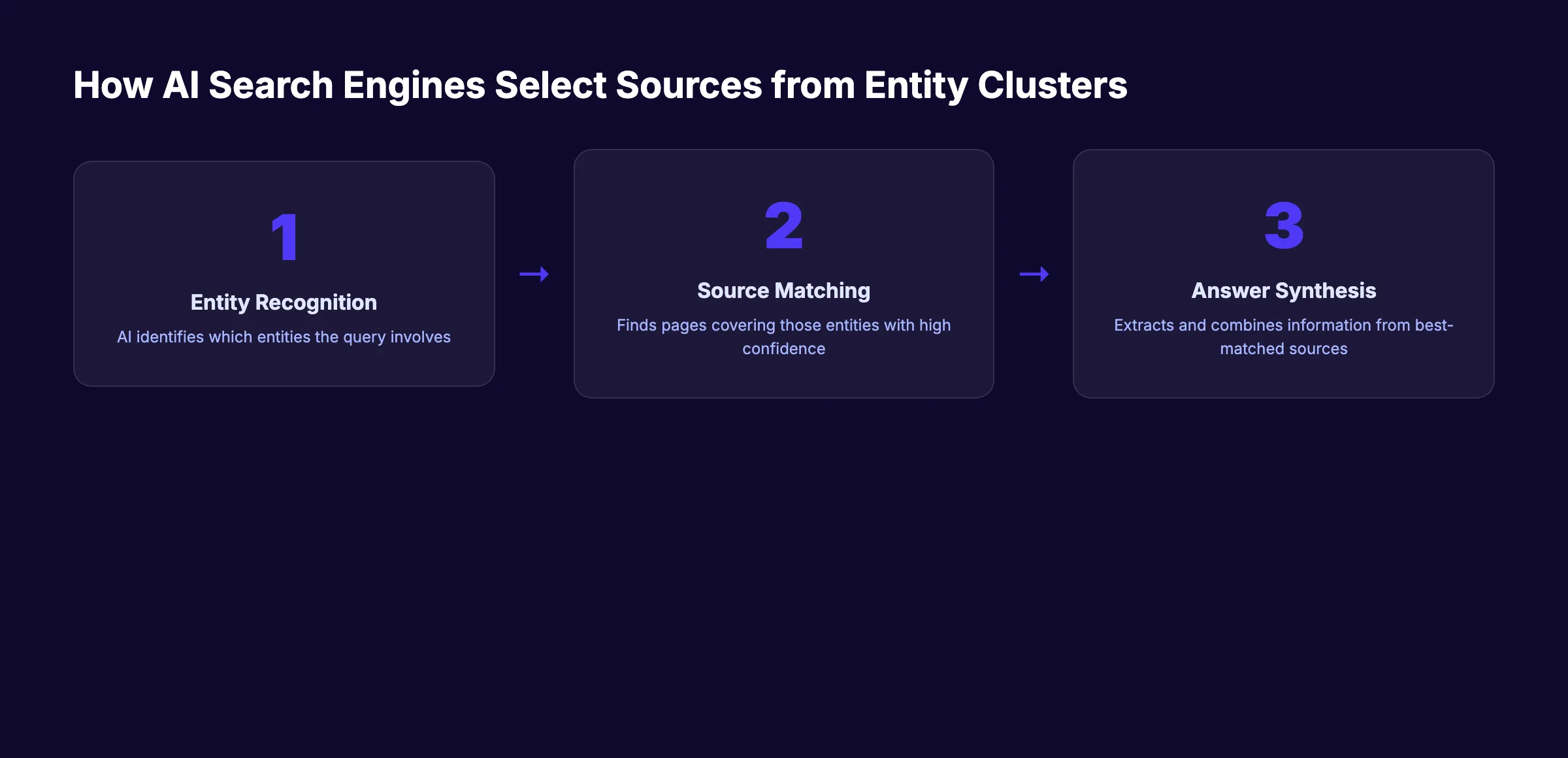
AI systems process content in 3 stages:
- Entity Recognition. The system identifies which entities the query involves.
- Source Matching. It finds pages that cover those entities with high confidence.
- Answer Synthesis. It extracts and combines information from the best-matched sources.
Sites with clear entity signals get selected more often. Visitors from AI search results convert more than 4 times as often as traditional organic visitors. The traffic is smaller but far more valuable.
Entity Completeness Drives AI Citations
AI systems favor sources that cover an entity completely. A page that covers “entity clustering SEO” with definitions, steps, tools, and examples gets cited more than a page that only covers the definition.
Entity clusters give you an advantage here. Even if a single page does not cover every aspect, AI systems can pull from multiple pages in your cluster. If your hub page covers the definition and your spoke page covers the tools, the AI system can cite both.
This is why entity clustering matters more for generative engine optimization than keyword optimization does. AI systems care about coverage and relationships, not keyword density.
Structured Data for AI Extraction
AI search engines parse structured data more easily than unstructured content. Pages with schema markup get cited at higher rates because the entity signals are machine-readable.
For AI search optimization, add:
- Article schema with “about” and “mentions” properties
- FAQ schema for common questions about your entity
- HowTo schema for process-oriented content
- Speakable schema for voice search compatibility
Each schema type gives AI systems a different extraction path into your content.
Practical GEO Tactics for Entity Clusters
Apply these Google AI Overview optimization tactics across your entity cluster:
Use clear definitions. Start entity pages with a 1-2 sentence definition. AI systems extract definitions more easily than embedded explanations.
Structure with headers. Every H2 and H3 should map to a specific entity or attribute. AI systems use headers to segment content by entity.
Include data. Statistics, percentages, and specific numbers get cited more often than general claims. 78% of SEO experts consider entity recognition crucial for rankings in 2026.
Cite authoritative sources. AI systems weight content that references known authoritative entities (Google documentation, peer-reviewed research, industry benchmarks).
Chapter 8: Common Entity Clustering Mistakes {#ch8}
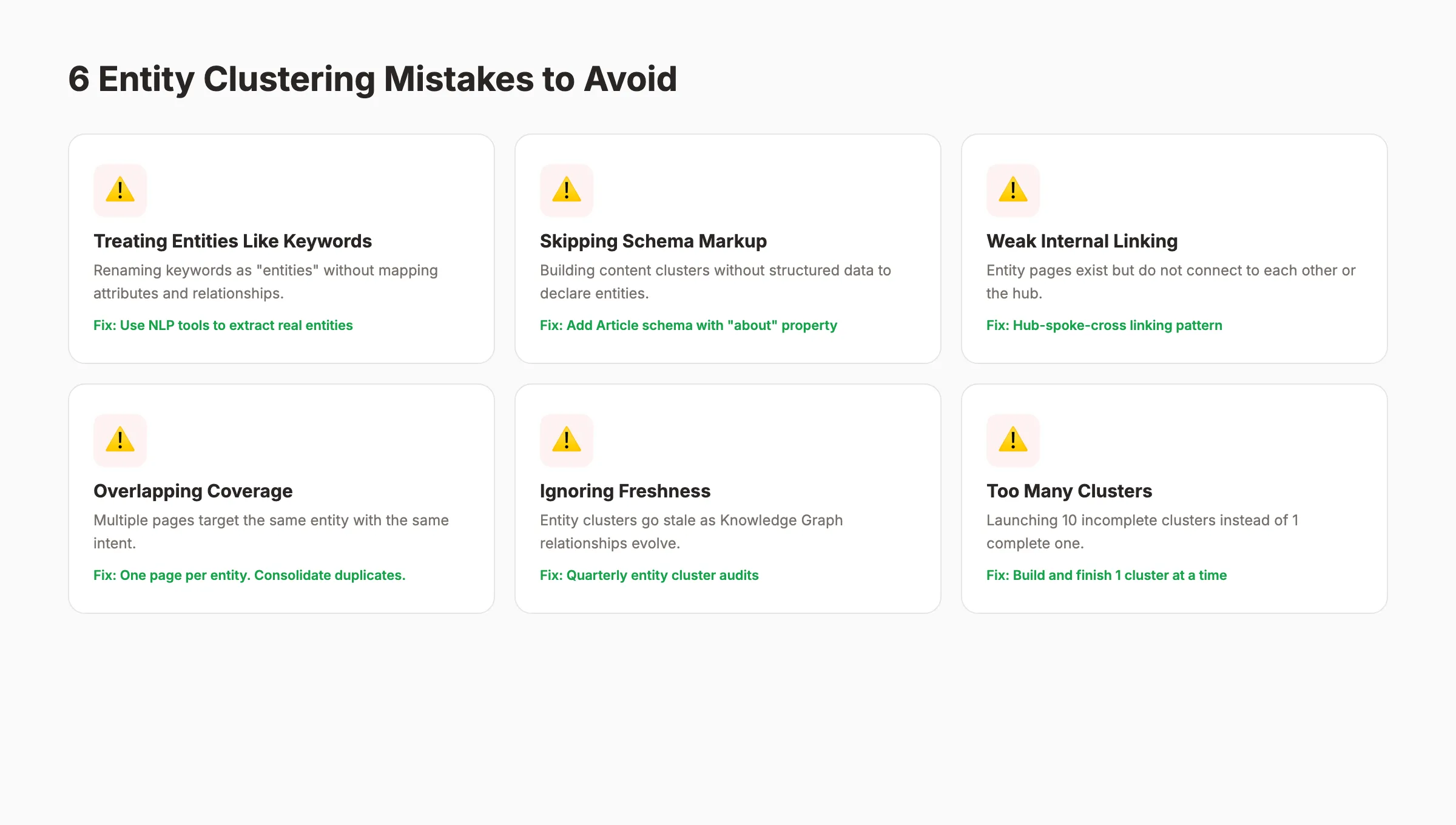
Entity clustering is not complicated, but several common mistakes undermine its effectiveness. Avoid these 6 errors.
Mistake 1: Treating Entities Like Keywords
The biggest mistake is running keyword research, renaming keywords as “entities,” and calling it entity clustering. Entities have attributes, relationships, and types. Keywords do not.
If your “entity map” is just a keyword list grouped by theme, you have a topic cluster, not an entity cluster. Go back to Step 2 and map actual entity relationships using NLP tools or the Knowledge Graph.
Mistake 2: Skipping Schema Markup
Entity clustering without schema markup is like building a library without a catalog. The books (content) exist, but the organizing system (structured data) does not. Google can still figure things out, but it takes longer and introduces more errors.
Every page in your entity cluster needs at minimum Article schema with the “about” property. Advanced clusters add FAQ, HowTo, and relationship markup.
Mistake 3: Weak Internal Linking
Some sites build entity-focused content but forget to connect the pages. Without internal links, Google crawls each page as an isolated document. The cluster effect disappears.
Check every page in your cluster. Does it link to the hub? Does the hub link to it? Does it cross-link to related spokes? If not, your cluster is broken.
Mistake 4: Overlapping Entity Coverage
When 2 pages in your cluster cover the same entity with the same intent, they compete with each other. This is keyword cannibalization at the entity level.
Each entity in your map should have exactly 1 page. If 2 pages cover “schema markup for entity SEO,” consolidate them. Use 301 redirects to merge the weaker page into the stronger one.
Mistake 5: Ignoring Entity Freshness
Entities evolve. Google’s Knowledge Graph updates constantly. Your entity cluster content needs regular updates to match.
Review entity clusters every quarter. Check for:
- New related entities that have emerged
- Deprecated attributes or relationships
- Changed entity definitions or properties
- New E-E-A-T signals that need reinforcing
Content decay hits entity clusters harder than standalone pages because outdated information in one spoke weakens the entire cluster.
Mistake 6: Building Too Many Clusters at Once
Start with 1 entity cluster. Build it completely. Measure results. Then expand.
Sites that launch 10 incomplete clusters perform worse than sites with 1 complete cluster. Depth beats breadth in entity SEO. Cover your primary entity exhaustively before moving to adjacent entities.
A complete entity cluster has 8-15 pages with full schema markup, dense internal links, and regular updates. Half-finished clusters send mixed signals to Google.
FAQ {#faq}
What is the difference between entity clustering and topic clustering?
Topic clustering groups content by keyword themes and search volume. Entity clustering groups content by Knowledge Graph relationships, entity attributes, and semantic connections. Entity clustering aligns your content with how Google actually stores and retrieves information. Topic clusters are a subset of entity clustering that focus on keyword groupings rather than entity properties.
Do I need special tools for entity clustering?
You do not need expensive tools. Google’s Natural Language API (free tier available) extracts entities from any text. TextRazor offers similar functionality. Wikipedia provides entity relationship maps for free. Paid tools like Semrush and Ahrefs add keyword data on top of entity analysis, but the core entity mapping can be done manually.
How many pages should an entity cluster have?
A minimum viable entity cluster has 5-8 pages: 1 hub page, 3-5 attribute pages, and 1-2 relationship bridge pages. Competitive entities need 12-20 pages. The right size depends on how many distinct attributes and relationships your hub entity has.
How long does entity clustering take to show results?
Initial ranking improvements appear within 60-90 days of publishing a complete cluster. Full entity recognition (Knowledge Panel, rich results, AI citations) typically takes 3-6 months. Publishing velocity matters. A cluster published over 1 week performs faster than one published over 3 months.
Can entity clustering work for local businesses?
Entity clustering is especially effective for local SEO. Local businesses are entities with clear attributes (location, services, hours, reviews). Building a cluster around your business entity with pages for each service, location, and FAQ dramatically improves local rankings and Google Business Profile visibility.
Does entity clustering replace keyword research?
No. Keyword research remains essential for identifying search demand and user language. Entity clustering adds a structural layer on top of keyword research. You still need keywords to know what people search. You use entity clustering to organize how your content addresses those searches.
Start Building Entity Clusters Today
Entity clustering SEO is not a trend. It is the structural foundation that Google, AI search engines, and every future search interface relies on. Sites that align their content with entity relationships rank higher, earn more SERP features, and get cited by AI systems.
The process is straightforward: identify your hub entity, map related entities, create content for each node, add schema markup, and connect everything with internal links. One complete cluster outperforms dozens of disconnected blog posts.
Get 30 entity-optimized articles published every month. Stacc handles the research, writing, optimization, and publishing. Your SEO runs on autopilot. Start for $1 →
Related Tools & Resources
Free SEO Tools:
Best Lists:

Written by
Siddharth GangalSiddharth is the founder of theStacc and Arka360, and a graduate of IIT Mandi. He spent years watching great businesses lose organic traffic to competitors who simply published more. So he built a system to fix that. He writes about SEO, content at scale, and the tactics that actually move rankings.
30 SEO blog articles published every month
Keyword-optimized, scheduled, and live on your site. Automatically.
30-day trial · Cancel anytime
theStacc
Stop writing SEO content manually
30 blog articles, 30 GBP posts, and social media content. Published every month. Automatically.
Start Your $1 Trial$1 for 3 days · Cancel anytime