
What Is AI Citability Score? Complete Guide (2026)
AI citability score measures how likely AI search engines are to cite your content. Learn the scoring factors, how to measure, and how to improve. April 2026.
What Is AI Citability Score? Complete Guide (2026)
You rank #1 on Google. ChatGPT ignores you. Perplexity cites your competitor instead. Google AI Overviews pull from a page that ranks below yours.
This disconnect is the biggest problem in SEO right now. Traditional rankings no longer guarantee visibility in AI-generated responses. The metric that explains this gap is your AI citability score.
An AI citability score measures how likely AI search engines are to reference, quote, or cite your content when generating answers. It is a number from 0 to 100. A score of 100 means every foundational element for AI citation is in place. A score below 40 means AI systems will skip your content even if you rank on page 1.
We have published 3,500+ blogs across 70+ industries with a 92% average SEO score. Optimizing for AI citability is now part of every article we produce. This guide explains exactly what the score measures and how to improve it.
Here is what you will learn:
- What AI citability score actually measures (and what it does not)
- The 8 factors AI systems evaluate when choosing sources to cite
- How each AI platform (ChatGPT, Perplexity, Google AI Overviews) differs
- How to measure your current citability score
- A step-by-step process to improve your score from any starting point
- Why traditional SEO metrics fail to predict AI citation success
Why Traditional SEO Metrics Do Not Predict AI Citations
Domain authority, keyword rankings, and backlink counts have driven SEO strategy for 15 years. None of them reliably predict whether AI systems will cite your content.
A Search Engine Land analysis of 8,000 AI citations found that content depth and readability matter most for AI citations. Traditional metrics like traffic volume and backlink counts had little impact on citation likelihood.
This means a page with 50 backlinks and position 3 on Google can get zero AI citations. Meanwhile, a page with 5 backlinks and position 8 gets cited by ChatGPT, Perplexity, and AI Overviews because its content structure matches what AI systems need.
The AI citability score captures what traditional metrics miss. It evaluates your content through the lens of how AI retrieval systems actually work.
How AI Systems Select Sources
AI platforms use Retrieval-Augmented Generation (RAG). When a user asks a question, the AI model:
- Searches the web for relevant pages
- Retrieves the most relevant passages (not entire pages)
- Evaluates each passage for accuracy, structure, and authority
- Synthesizes an answer from multiple sources
- Cites the sources it referenced
Citation decisions happen at the passage level. Not the page level. Not the domain level. AI systems do not cite your website. They cite specific paragraphs that answered a specific question well.
This is why blog post structure matters more for AI visibility than domain authority.
The 8 Factors That Determine Your AI Citability Score
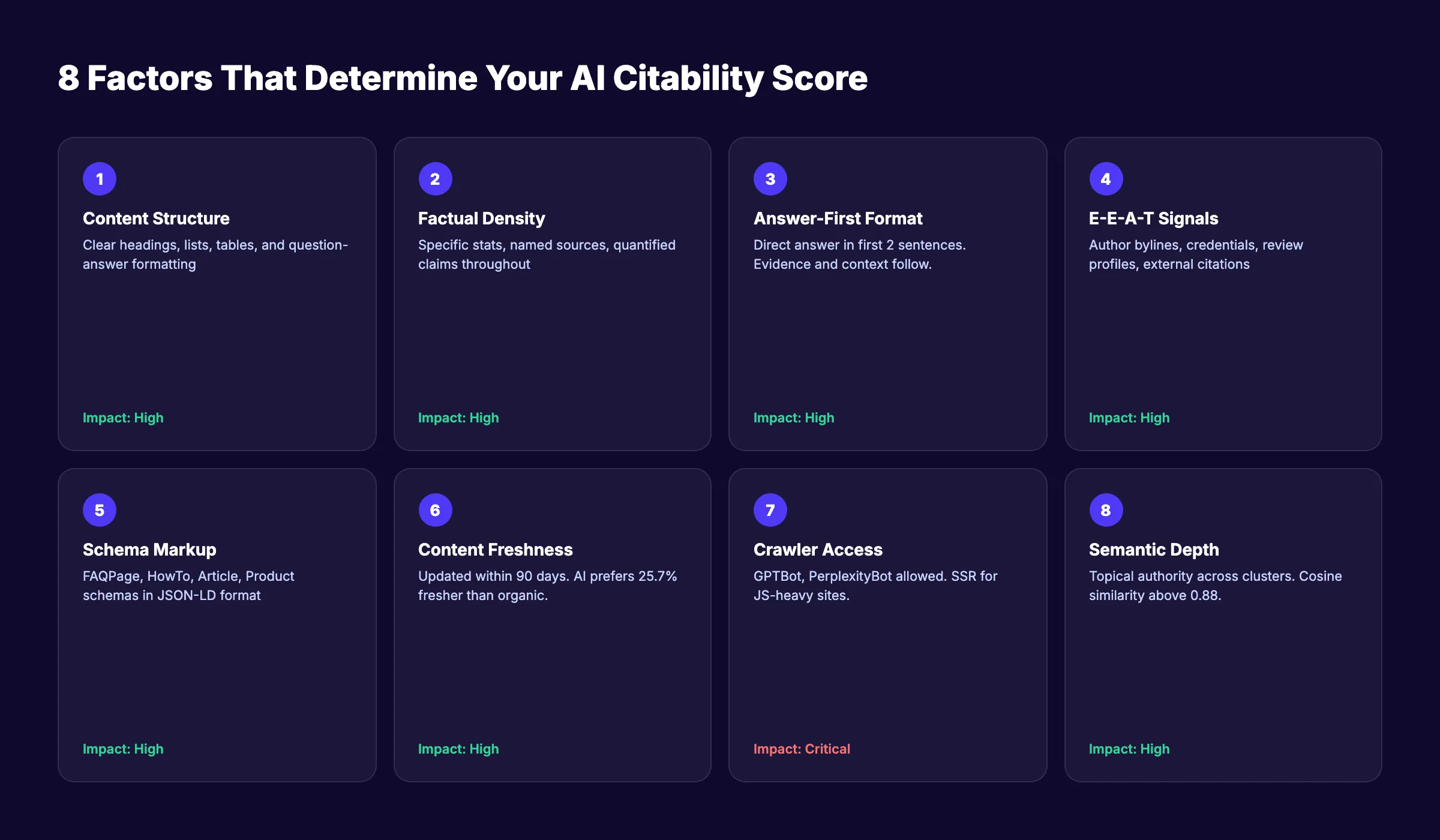
Every AI citability scoring system weights these factors differently. But the underlying signals are consistent across platforms. Here are the 8 factors that determine whether AI systems cite your content.
1. Content Structure and Formatting
AI systems parse structured content faster and more accurately than dense paragraphs. The GEO-16 research framework identified semantic HTML, metadata, and structured data as the top 3 on-page factors predicting citation likelihood.
What scores high:
- Clear H2/H3 heading hierarchy
- Numbered lists and bullet points
- Comparison tables with labeled columns
- Question-answer formatting (H2 as question, paragraph as answer)
- Short paragraphs (2 to 3 sentences maximum)
What scores low:
- Wall-of-text paragraphs with no formatting
- Missing or inconsistent heading hierarchy
- Information buried mid-paragraph without structural markers
Read our on-page SEO guide for the full heading and structure framework.
2. Factual Density
AI systems prioritize content with specific, verifiable claims over vague statements. Content with statistics, dates, named sources, and quantified claims gets cited at dramatically higher rates.
| Content Type | Example | Citability Impact |
|---|---|---|
| Vague claim | ”Many companies see better results with AI” | Low |
| Specific claim | ”68% of businesses report higher content ROI with AI (HubSpot, 2026)“ | High |
| Named source | ”According to Ahrefs research on 8,000 citations…” | High |
| Quantified result | ”23% average CTR improvement across 1,000+ pages” | High |
The top 3 optimization strategies for AI citations are: citing sources in your content, adding direct quotations, and including statistics. All 3 increase factual density.
3. Answer-First Content Format
AI engines want the opposite of traditional marketing copy. They want answer first, evidence second, context third. This is the core of Answer Engine Optimization (AEO).
Traditional blog format:
Introduction → Background → Discussion → Answer (buried at the bottom)
AI-optimized format:
Direct Answer → Supporting Evidence → Additional Context
When someone asks “What is AI citability score?”, the AI system needs a clear, citable definition in the first 2 sentences. Pages that provide immediate definitions become source material. Pages that make readers scroll to find the answer get skipped.
This aligns with how featured snippets work. Google already rewards answer-first content. AI systems take this preference further.
4. E-E-A-T Signals
E-E-A-T (Experience, Expertise, Authoritativeness, Trustworthiness) is not just a Google quality factor anymore. Every AI platform uses it as a core filter for selecting reliable sources.
What strengthens E-E-A-T for AI citation:
- Author bylines with credentials and expertise descriptions
- Links to authoritative external sources within your content
- Mentions on third-party review platforms (Trustpilot, G2, Capterra)
- Consistent brand entity across the web (same name, same claims)
- Original data, research, or first-person experience
According to research, brands with active profiles on Trustpilot, G2, and Capterra have a 3x higher chance of being cited by ChatGPT.
5. Schema Markup and Structured Data
Schema markup helps AI systems extract facts without reading full articles. JSON-LD structured data signals content structure to AI retrieval systems.
The most impactful schema types for AI citability:
| Schema Type | Use Case | Citability Impact |
|---|---|---|
| FAQPage | Question-answer content | High |
| HowTo | Step-by-step guides | High |
| Article/BlogPosting | Blog content with author and date | Medium-High |
| Product with Offer | Pricing and product details | High |
| AggregateRating | Review scores | Medium |
| Organization | Brand entity data | Medium |
| Review | Individual product reviews | Medium |
Pages with proper schema markup score significantly higher on citability because AI systems can extract structured facts programmatically rather than parsing unstructured text.
6. Content Freshness
AI systems are biased toward recently updated content. An Ahrefs study found that AI assistants prefer content that is 25.7% fresher than the URLs appearing in traditional organic search results. Perplexity shows the strongest freshness bias among all AI platforms.
What this means for your citability score:
- Update high-value pages quarterly with fresh data and examples
- Include publication dates and “last updated” timestamps
- Remove or refresh outdated statistics and screenshots
- Add current-year references where relevant
Our guide on updating old blog posts covers the full refresh process.
Your SEO team. $99 per month. 30 optimized articles, published automatically. Start for $1 →
7. AI Crawler Accessibility
If AI crawlers cannot access your content, your citability score is zero. Period.
ChatGPT uses GPTBot. Perplexity uses PerplexityBot. Google AI Overviews use Googlebot (the same crawler as traditional search). Each crawler must be allowed in your robots.txt file.
Server-side rendering (SSR) is also critical. Many AI crawlers struggle with JavaScript-heavy sites. Static HTML or SSR ensures your content is immediately accessible to every crawler.
Check our AI crawlers guide to verify your site allows access from all major AI bots. And read our llms.txt guide for the emerging standard that helps AI systems understand your site structure.
8. Semantic Relevance and Topical Authority
AI systems evaluate how well your content matches the semantic meaning of a query. Not just keywords. Meaning.
Research shows that content with cosine similarity scores above 0.88 to the target query achieves 7.3x higher citation rates compared to content with lower semantic alignment.
Building topical authority across an entire subject cluster increases the semantic relevance of every page in that cluster. A single blog post about “AI citability” scores lower than a site with 20+ articles covering AI search, GEO, structured data, E-E-A-T, and related topics.
How Each AI Platform Cites Differently
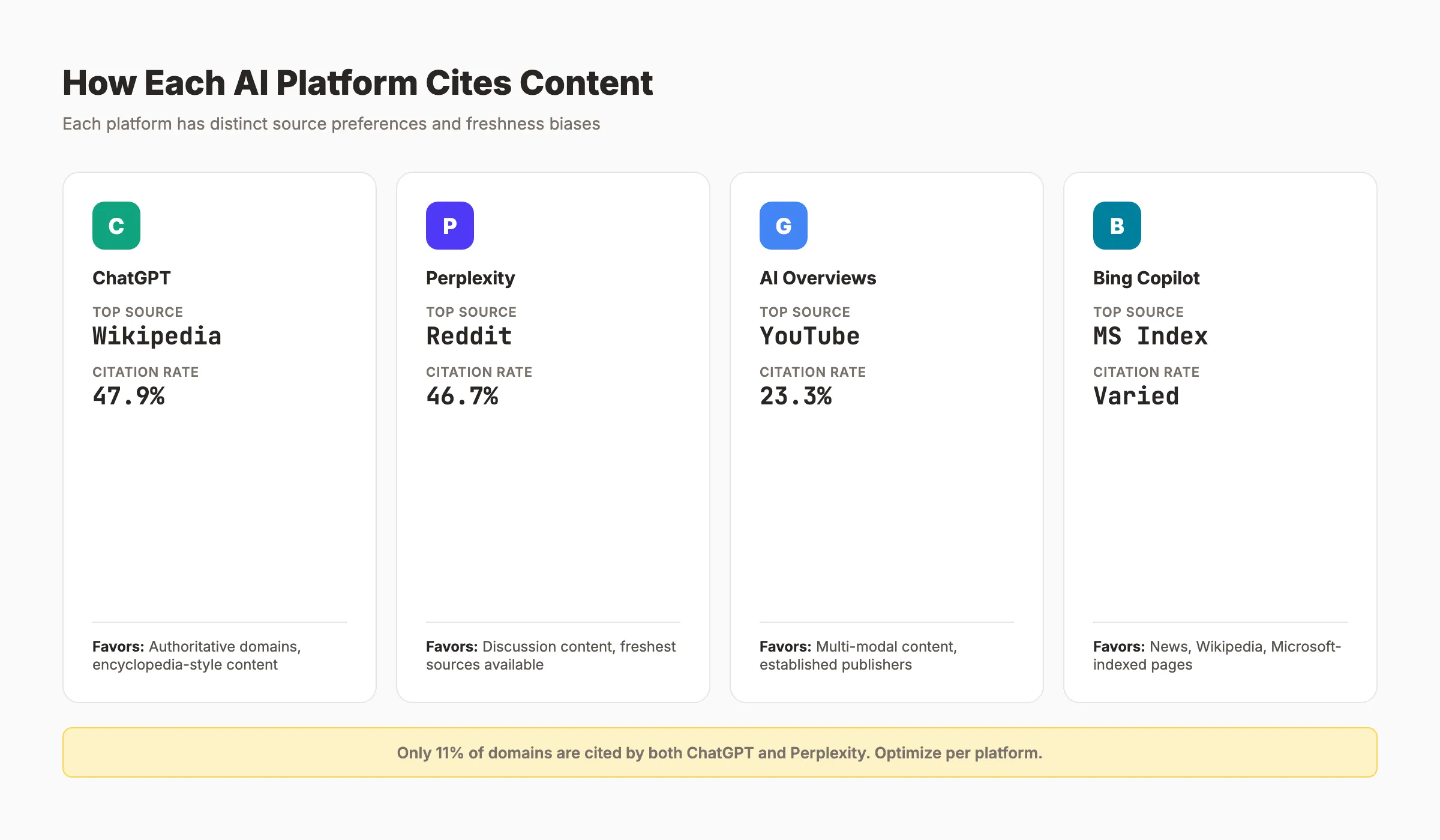
Not all AI systems cite the same sources. Understanding platform-specific behavior helps you optimize strategically.
| Platform | Citation Behavior | Favored Sources | Freshness Bias |
|---|---|---|---|
| ChatGPT | Cites during web search mode | Wikipedia (47.9%), news sites, authoritative blogs | Moderate |
| Perplexity | Cites inline with numbered references | Reddit (46.7%), niche blogs, forums | Strongest |
| Google AI Overviews | Cites below the generated summary | YouTube (23.3%), established publishers, Quora (3.6%) | Moderate |
| Bing Copilot | Cites with clickable source cards | Microsoft-indexed pages, news, Wikipedia | Moderate |
| Claude | Cites when using web search | Academic sources, official documentation | Low |
Source: Semrush study on most-cited domains in AI.
These differences explain why a one-size-fits-all approach fails.
ChatGPT favors established, authoritative domains. Wikipedia dominates at 47.9% of top citations. If your content reads like an encyclopedia entry with clear definitions and cited sources, ChatGPT is more likely to reference it.
Perplexity leans heavily on discussion content. Reddit accounts for 46.7% of citations. Perplexity also shows the strongest freshness bias. Content updated within the past 30 days scores significantly higher.
Google AI Overviews pull from a broader mix of sources. YouTube leads at 23.3%, followed by traditional publishers and Quora at 3.6%. AI Overviews appear directly in Google search results, making this the highest-traffic AI citation opportunity.
Key takeaway: only 11% of domains are cited by both ChatGPT and Perplexity. Each platform has distinct preferences. A high citability score on one platform does not guarantee citation on another.
For platform-specific optimization, read our guides on optimizing for Perplexity AI and Google AI Overviews.
3,500+ blogs published. 92% average SEO score. See what Stacc can do for your site. Start for $1 →
How to Measure Your AI Citability Score
Several tools now provide citability scoring. Here is how to measure where you stand.
Available Measurement Tools
| Tool | What It Measures | Free/Paid |
|---|---|---|
| OptimizeCamp | Citability, accuracy, and authority scores out of 100 | Paid |
| Frase GEO | Citation optimization scoring with recommendations | Paid |
| LinkNabber AI Search Simulator | Simulates how AI would cite your content | Free |
| Averi AI Citation Dashboard | Tracks citation frequency across AI platforms | Paid |
| Manual audit (below) | DIY assessment using the 8-factor framework | Free |
DIY Citability Audit Checklist
Score each factor from 0 to 10. Total your score out of 80, then convert to a percentage.
- Structure (0-10): Clear headings, lists, tables, answer-first format
- Factual density (0-10): Specific stats, named sources, quantified claims
- Answer format (0-10): Direct answers within first 2 sentences per section
- E-E-A-T signals (0-10): Author bylines, credentials, external citations
- Schema markup (0-10): FAQPage, Article, HowTo, or relevant schemas present
- Freshness (0-10): Updated within last 90 days, current-year references
- Crawler access (0-10): GPTBot, PerplexityBot, Googlebot all allowed
- Semantic depth (0-10): Covers topic thoroughly with related subtopics
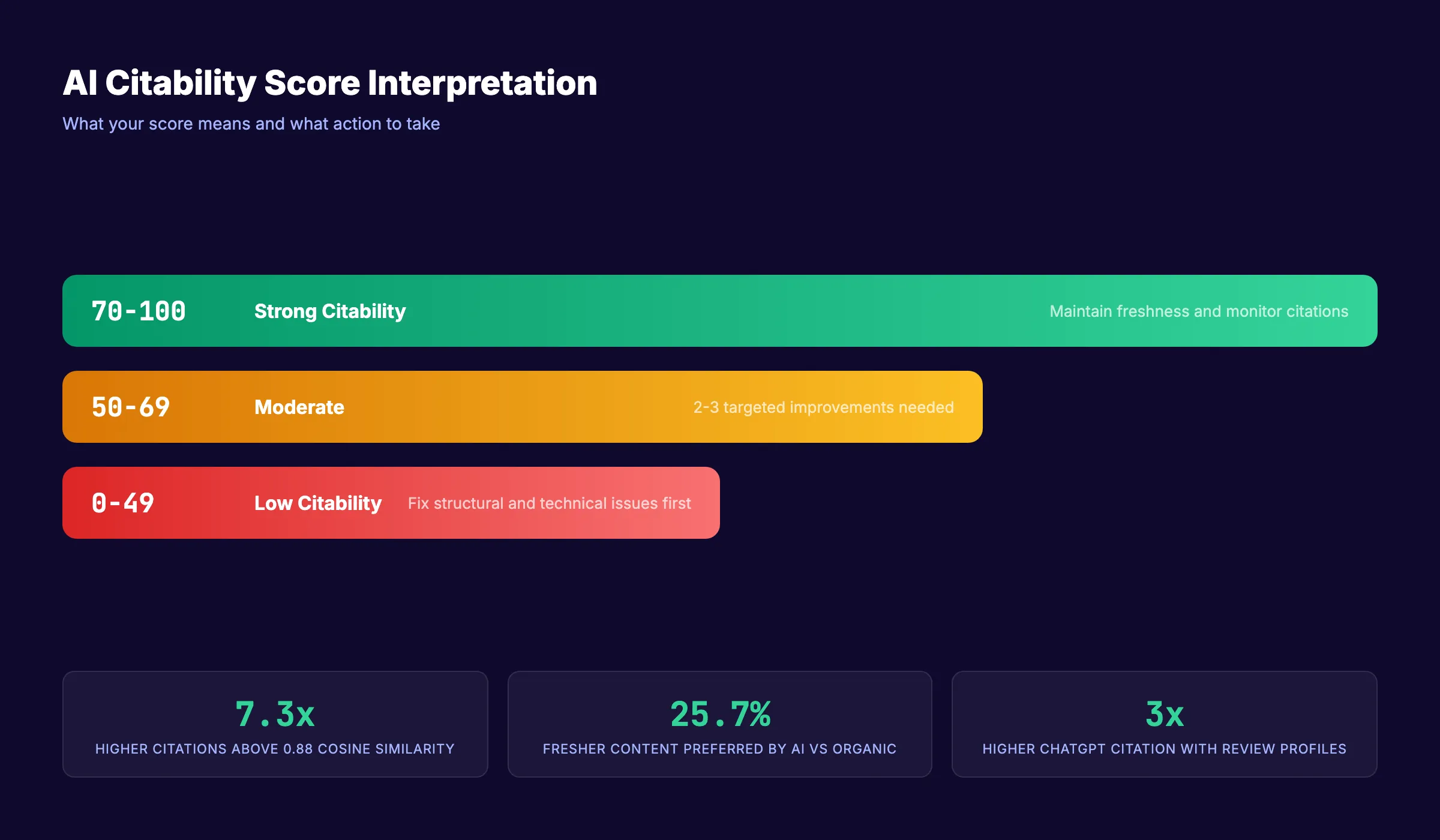
Score interpretation:
- 70-100%: Strong citability. Focus on maintaining freshness and monitoring citations.
- 50-69%: Moderate citability. 2 to 3 targeted improvements will make a significant difference.
- Below 50%: Low citability. Structural and technical issues need attention before content improvements matter.
Tracking Citations Over Time
Use Google Search Console to monitor impressions from AI-related queries. Track brand mentions in AI responses manually or with tools like Averi AI. Our guide on tracking AI search visibility covers the full measurement framework.
How to Improve Your AI Citability Score
Here is a prioritized action plan. Start with the highest-impact changes.
Priority 1: Technical Foundations (Week 1)
These changes unlock AI visibility. Without them, content quality does not matter.
- Allow GPTBot, PerplexityBot, and ClaudeBot in
robots.txt - Implement server-side rendering if your site is JavaScript-heavy
- Add JSON-LD Article/BlogPosting schema to all blog posts
- Add FAQPage schema to pages with FAQ sections
- Create an
llms.txtfile mapping your site structure - Verify all pages return 200 status codes and load under 3 seconds
Priority 2: Content Structure (Week 2)
Restructure existing content for AI parsing.
- Add a direct answer definition in the first 2 sentences of every article
- Break long paragraphs into 2 to 3 sentence blocks
- Add comparison tables where relevant data exists
- Convert key information into numbered lists or bullet points
- Use H2 headings as questions that match user queries
- Follow the blog GEO checklist for every post
Priority 3: Authority Signals (Week 3)
Build the trust indicators AI systems look for.
- Add author bylines with credentials to every article
- Link to 2 to 3 authoritative external sources per article
- Include original data or first-person experience where possible
- Claim and maintain profiles on G2, Trustpilot, and relevant review platforms
- Ensure consistent brand entity information across all web properties
Priority 4: Ongoing Optimization (Monthly)
Keep your citability score high over time.
- Update top 10 pages quarterly with fresh statistics and examples
- Monitor AI citation frequency with tracking tools
- Add new schema types as your content library grows
- Publish new content targeting AI-friendly question formats
- Track which content gets cited and double down on those formats
For a complete strategy, read our guide on Generative Engine Optimization.
Rank everywhere. Do nothing. Blog SEO, Local SEO, and Social on autopilot. Start for $1 →
AI Citability Score vs Traditional SEO Metrics
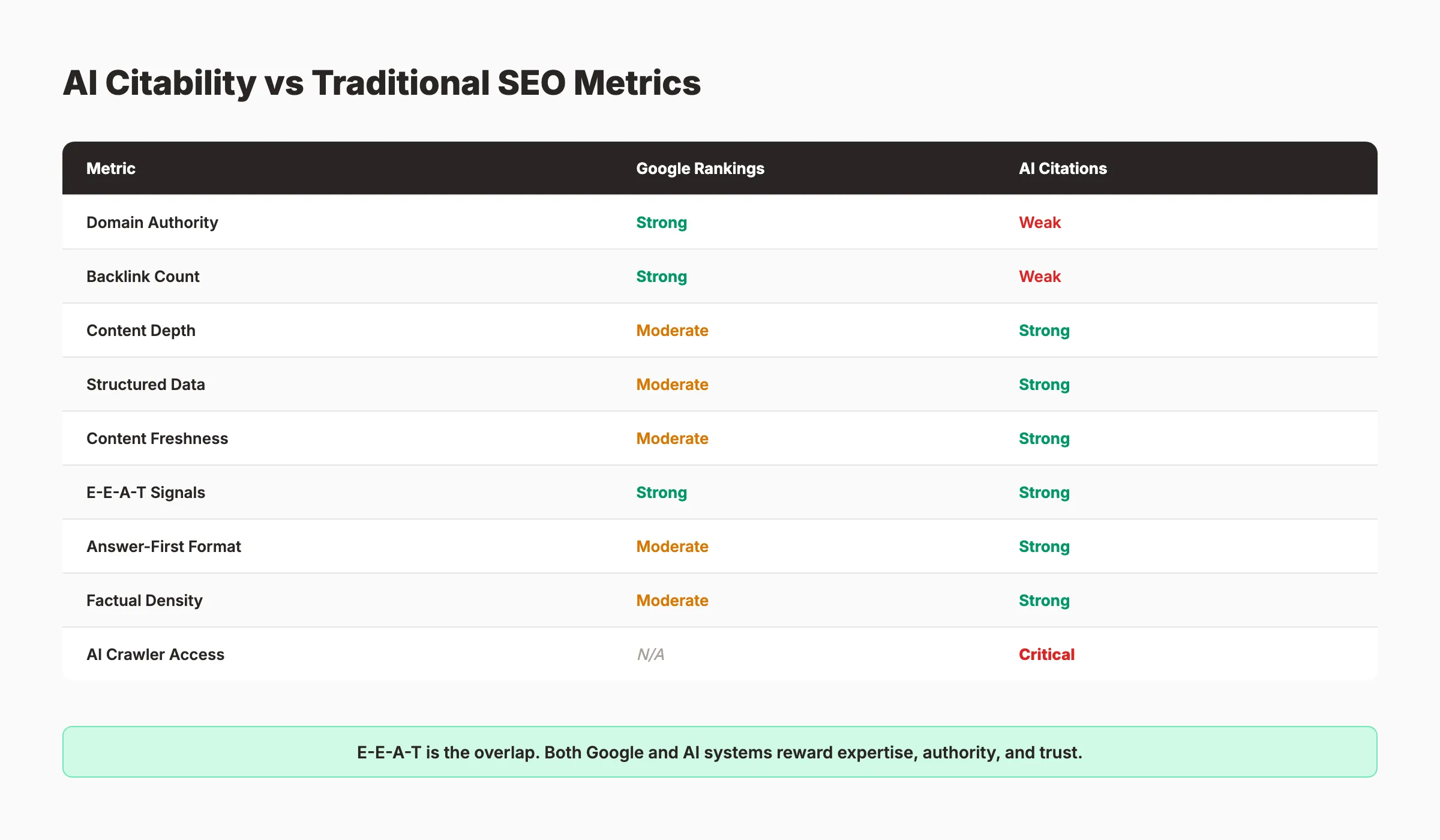
Understanding where these metrics overlap and diverge helps you allocate effort correctly.
| Metric | Predicts Google Rankings | Predicts AI Citations |
|---|---|---|
| Domain authority | Strong | Weak |
| Backlink count | Strong | Weak |
| Keyword rankings | Strong | Moderate |
| Content depth/word count | Moderate | Strong |
| Structured data presence | Moderate | Strong |
| Content freshness | Moderate | Strong |
| E-E-A-T signals | Strong | Strong |
| Answer-first formatting | Moderate | Strong |
| Factual density (stats, sources) | Moderate | Strong |
| AI crawler access | Not applicable | Critical |
The overlap is E-E-A-T. Both traditional Google rankings and AI citations reward expertise, authority, and trust. The divergence is technical: AI systems care about structure, schema, and crawler access in ways traditional SEO does not emphasize.
The smart approach: treat AI citability as an additive layer on top of traditional SEO. You do not abandon keyword optimization and link building. You add structured data, answer-first formatting, and AI crawler access on top of what already works.
Read our complete guide on what is GEO to understand how Generative Engine Optimization fits into your broader strategy.
FAQ
What is a good AI citability score?
A score above 70 out of 100 indicates strong citability. Most content that gets cited by AI platforms scores in the 75 to 95 range. Below 50 signals structural or technical issues that prevent AI systems from parsing and referencing your content effectively.
Does AI citability score affect Google rankings?
Not directly. AI citability score is a separate metric from Google’s ranking algorithm. However, many of the same factors (structured data, E-E-A-T, content freshness) influence both. Improving your citability score typically improves your traditional SEO performance as well.
How do I check if AI is citing my content?
Search for your brand name or specific content phrases in ChatGPT, Perplexity, and Google AI Overviews. Tools like Averi AI and OptimizeCamp track citations automatically. You can also monitor referral traffic from AI platforms in Google Analytics.
Do nofollow links affect AI citability?
No. AI citability is not based on link equity. It depends on content structure, factual density, authority signals, and crawler access. A page with zero backlinks but excellent structure and schema markup can score higher than a page with hundreds of backlinks but poor formatting.
Is AI citability the same as GEO?
AI citability score is one metric within the broader GEO (Generative Engine Optimization) discipline. GEO covers all strategies for optimizing content for AI search platforms. The citability score specifically measures how likely a given page is to be cited. GEO includes citability plus content strategy, platform analysis, and technical optimization.
Can Stacc help improve my AI citability score?
Yes. Every article Stacc publishes follows AI citability best practices: structured headings, schema markup, answer-first formatting, internal and external citations, and regular freshness updates. Our 92% average SEO score reflects optimization for both traditional search and AI citation.
The Metric That Defines SEO in 2026
AI citability score is not a nice-to-have anymore. It is the metric that determines whether your content shows up in the fastest-growing search channel. AI search is not replacing Google. It is adding a new layer on top of it. The businesses that optimize for both layers will capture traffic from every direction.
Start with the technical foundations. Layer in structured content. Build authority signals. Measure and iterate monthly. That is the formula.
Related Tools & Resources
Free SEO Tools:
Best Lists:

Written by
Siddharth GangalSiddharth is the founder of theStacc and Arka360, and a graduate of IIT Mandi. He spent years watching great businesses lose organic traffic to competitors who simply published more. So he built a system to fix that. He writes about SEO, content at scale, and the tactics that actually move rankings.
30 SEO blog articles published every month
Keyword-optimized, scheduled, and live on your site. Automatically.
30-day trial · Cancel anytime
theStacc
Stop writing SEO content manually
30 blog articles, 30 GBP posts, and social media content. Published every month. Automatically.
Start Your $1 Trial$1 for 3 days · Cancel anytime