
How to Optimize for Google AI Mode: Step-by-Step Guide (2026)
Learn how to optimize for Google AI Mode with 8 actionable steps. Covers citations, schema, topical authority, and passage-level SEO. Updated April 2026.
Google AI Mode reached 75 million daily active users by Q3 2025. It now operates in 180+ countries. And unlike AI Overviews, AI Mode removes the 10 blue links entirely. The traffic implications are significant — Google AI Overview Statistics shows how AI search features are already reshaping organic click-through rates.
That changes how to optimize for Google AI Mode. Traditional ranking factors still matter. But the game has shifted from earning a position on page 1 to earning a citation inside a Gemini-generated answer.
Sites that show up in AI Mode responses get traffic. Sites that do not get nothing. There is no second page to fall back on.
We have published 3,500+ SEO articles across 70+ industries and tracked how AI search features affect organic visibility. This guide walks through the exact steps we use to optimize content for Google AI Mode citations.
Here is what you will learn:
- What Google AI Mode is and how it differs from AI Overviews
- The 8 steps to optimize your content for AI Mode citations
- How to structure content at the passage level for AI extraction
- Which schema markup types improve AI Mode visibility
- How to track whether your content appears in AI Mode responses
What Google AI Mode Is (And Why It Changes SEO)
Google AI Mode is a standalone conversational search experience powered by Gemini 2.5. Users activate it from the Google Search bar or Google app. It works like a research assistant, not a search engine.
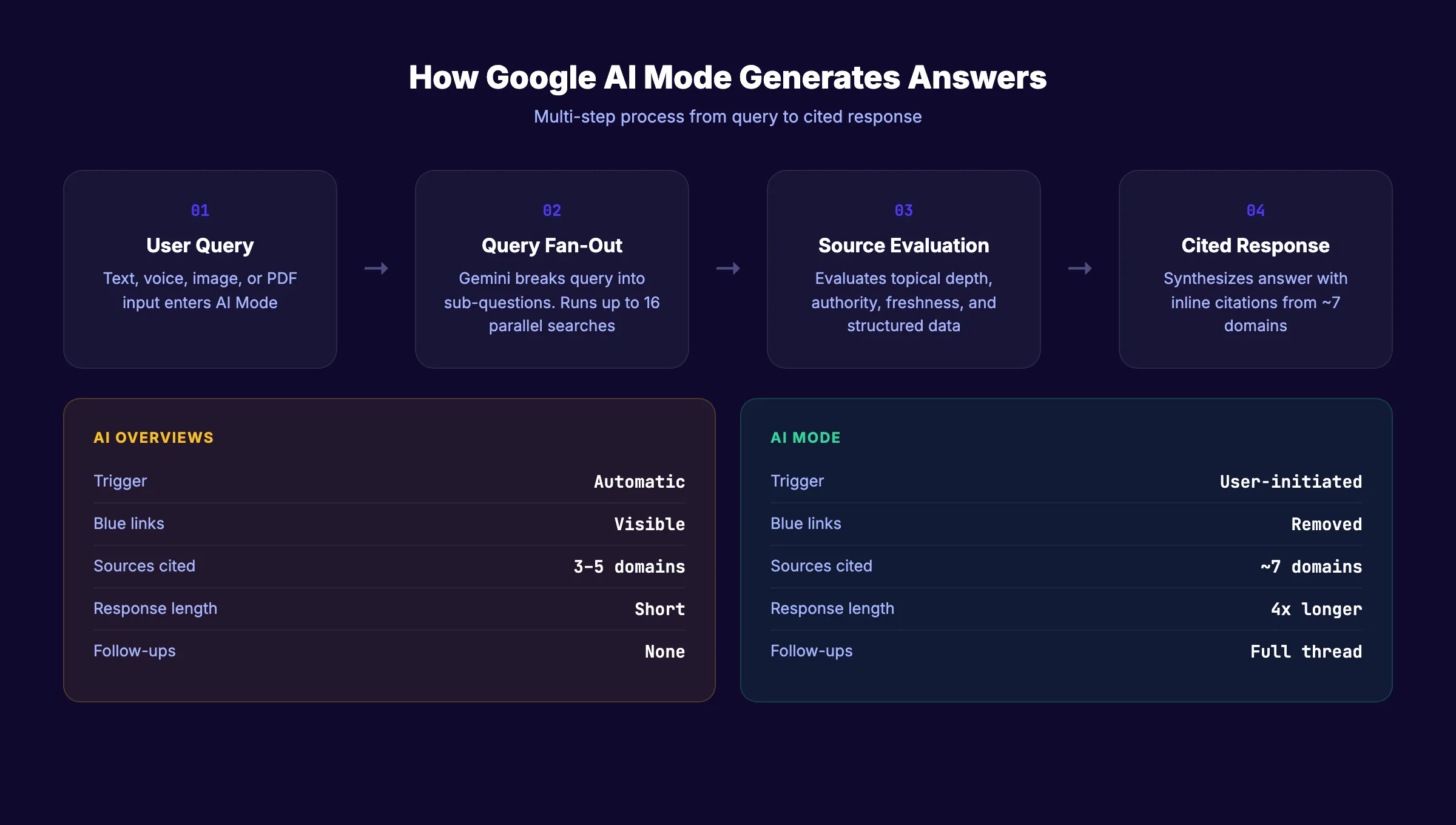
Here is the key difference. When a user enters a query in AI Mode, Google does not return a list of links. Instead, Gemini runs up to 16 parallel searches, synthesizes information from multiple sources, and generates a single conversational answer with inline citations.
How AI Mode Differs from AI Overviews
| Feature | AI Overviews | AI Mode |
|---|---|---|
| Trigger | Automatic on qualifying queries | User-initiated |
| Blue links | Visible below the overview | Removed entirely |
| Response length | Short summary (2-3 paragraphs) | 4x longer on average |
| Follow-up questions | Not supported | Full conversation thread |
| Sources cited | 3-5 domains | ~7 unique domains per response |
| Citation overlap with organic | ~53% domain overlap | Only 35% URL match with organic results |
According to Ahrefs, AI Mode and AI Overviews reach similar conclusions (86% semantic similarity) but cite different sources. Only 13.7% of citations overlap between the two features.
That means optimizing for traditional search and AI Overviews is not enough. AI Mode pulls from different signals.
Overview: What You Need
Time required: 2-4 hours for initial optimization. Ongoing maintenance weekly.
Difficulty: Intermediate
What you need:
- Google Search Console access
- A content management system (WordPress, Webflow, Ghost, or similar)
- Basic understanding of schema markup and HTML
- Existing content to optimize (or a plan to create new content)
Step 1: Audit Your Current AI Mode Visibility
Before optimizing, find out where you stand. You need a baseline.
Specifically:
- Search your brand name in Google AI Mode and check if your site gets cited
- Search your top 10 target keywords in AI Mode and note which domains appear
- Compare those cited domains to your current organic competitors
- Document which of your pages (if any) currently receive AI Mode citations
Why this step matters: If you skip the audit, you will optimize blindly. You need to know which queries AI Mode already cites you for and which ones it does not. That gap defines your priority list.
Pro tip: Use the AI search visibility tracking process to build a repeatable monitoring system. Manual checks work for the initial audit, but you need automation for ongoing tracking.
Create a simple spreadsheet with 3 columns: keyword, cited domain, and your citation status (yes/no). Update this weekly. After 4 weeks, you will see clear patterns in which topics AI Mode trusts you for and which it does not.
Step 2: Build Topical Authority Across Entire Subject Areas
AI Mode does not cite pages. It cites sources it trusts on a topic. Gemini evaluates whether your site covers a topic deeply enough to sustain a multi-turn conversation.
Specifically:
- Map every subtopic under your primary topics using a topical map
- Create pillar content that covers the core topic at a high level
- Build cluster pages that dive deep into each subtopic
- Interlink all pages in the cluster using descriptive internal links
Why this step matters: AI Mode uses “semantic saturation” as a signal. Sites that cover a topic across 20 to 30 pages rank higher in AI Mode responses than sites with a single article on the same topic.
Google stated this directly: content that covers a topic thoroughly gets prioritized in AI search features. Single keyword pages are not enough.
If you publish 2 to 4 articles per month, building topical authority takes 12 to 18 months. At 30 articles per month, you can build a complete topic cluster in 60 to 90 days.
Stop writing. Start ranking. Stacc publishes 30 SEO articles per month for $99. Build topical authority 10x faster. Start for $1 →
Step 3: Optimize at the Passage Level
This is the single biggest shift from traditional SEO to AI Mode optimization. AI Mode does not extract entire pages. It extracts specific passages.
Specifically:
- Write self-contained paragraphs that answer a specific question without depending on surrounding context
- Front-load each paragraph with the key claim or answer in the first sentence
- Keep paragraphs to 2 to 3 sentences maximum
- Use clear H2 and H3 headings that match natural language questions
Why this step matters: Research shows that pages using clear H2/H3 and bullet point structures are 40% more likely to get cited by AI engines. Opening paragraphs that answer the query upfront get cited 67% more often.
Example of a poorly structured passage:
“There are many factors to consider when thinking about SEO. One of the most important things is to make sure your content is high quality. This means writing content that provides value to readers.”
Example of an AI-extractable passage:
“Google AI Mode cites 7 unique domains per response on average. Sites that rank in positions 1 through 10 organically account for only 35% of those citations. The remaining 65% come from sources with strong topical authority and structured content.”
The second version gives AI a self-contained fact it can cite. The first version says nothing specific.
Checklist for passage-level optimization:
- Every paragraph answers one specific question or makes one specific claim
- The first sentence of each paragraph contains the key takeaway
- No paragraph exceeds 3 sentences
- Every H2 heading could function as a standalone search query
- Data points include the source and specific numbers
- Technical terms are defined inline (AI Mode pulls definitions from content)
Apply this checklist to your top 20 pages first. Those are the pages most likely to earn AI Mode citations based on your existing organic authority.
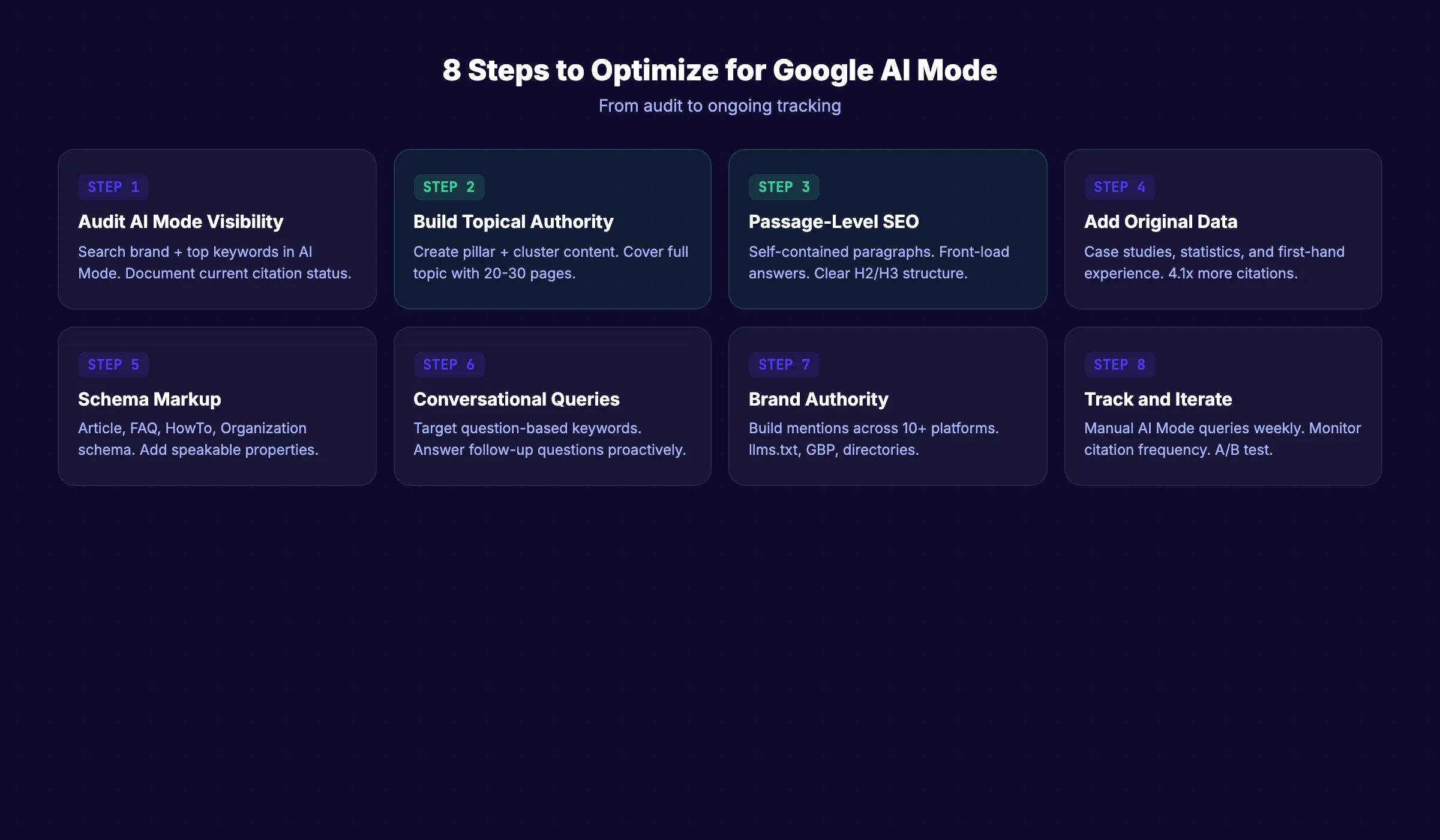
Step 4: Add Original Data, Statistics, and First-Hand Experience
AI Mode cannot generate original data. That makes your original research, case studies, and proprietary statistics uniquely valuable.
Specifically:
- Add specific numbers, percentages, and data points from your own work
- Include case studies with real outcomes (traffic increases, revenue changes, before/after)
- Cite your methodology so AI can trust the data source
- Create data tables that AI can parse and extract
Why this step matters: Pages that include original data tables earn 4.1x more AI citations. Adding specific statistics boosts citation performance by more than 5.5%. This is the strongest single factor for getting cited in AI search. For context on how AI features affect click-through rates across the board, see our Google AI Overview Statistics report.
E-E-A-T signals carry more weight in AI Mode than in traditional search. The “Experience” factor matters most. AI Mode favors content written by people who have done the thing they are writing about.
Types of original data that earn citations:
| Data Type | Citation Boost | Example |
|---|---|---|
| Survey results | High | ”We surveyed 500 marketers on AI tool adoption” |
| Performance benchmarks | High | ”Average CTR dropped 34% with AI features present” |
| Before/after case studies | Medium-high | ”Traffic increased 240% after 6 months of publishing” |
| Industry cost data | Medium | ”Average agency retainer in 2026 is $2,917/month” |
| Tool comparison tests | Medium | ”We tested 10 tools on the same 50 keywords” |
| Expert quotes with attribution | Low-medium | ”According to John Mueller at Google…” |
You do not need a research team to create original data. Track your own results. Document your own processes. Share what you measure in your business. That counts as first-hand experience.
Step 5: Implement Schema Markup for AI Comprehension
Schema markup helps AI systems understand what your content is about, who wrote it, and how it should be categorized. AI Mode uses structured data to validate source authority.
Specifically:
- Add
Articleschema with author, datePublished, and dateModified - Add
FAQPageschema to FAQ sections (AI Mode heavily uses FAQ content) - Add
HowToschema to step-by-step guides - Add
Organizationschema withsameAslinks to your social profiles and Wikipedia - Use
speakableproperties on passages you want AI to cite
Check our full schema markup SEO guide for implementation details.
Priority order for schema implementation:
Articleschema on every blog post (most impact per effort)FAQPageschema on posts with FAQ sectionsOrganizationschema on your homepageHowToschema on tutorial and guide contentspeakableproperties on your most cited passages
Most CMS platforms support schema through plugins. WordPress users can add schema with Yoast or Rank Math. Custom sites need manual JSON-LD implementation in the page head.
Why this step matters: Schema does not directly cause citations. But it removes ambiguity. When AI Mode evaluates 2 sources of equal quality, the one with structured data wins because the AI can parse it with higher confidence.
3,500+ blogs published. 92% average SEO score. Every article includes optimized schema, structured headings, and internal links. Start for $1 →
Step 6: Optimize for Conversational and Long-Tail Queries
AI Mode users ask questions differently than traditional searchers. They use natural language, full sentences, and follow-up questions.
Specifically:
- Target question-based keywords (“how do I improve my local SEO” rather than “local SEO tips”)
- Write content that answers the follow-up question, not just the initial query
- Include FAQ sections that address related questions AI Mode users commonly ask
- Use the exact phrasing people use in conversation (check Google’s “People Also Ask” for patterns)
Why this step matters: AI Mode breaks complex queries into sub-questions and runs parallel searches for each one. If your content answers the follow-up question that the user has not asked yet, you are more likely to get cited in the ongoing conversation thread.
For example, someone searching “how to optimize for Google AI Mode” will likely follow up with “how is AI Mode different from AI Overviews” or “does AI Mode affect my SEO traffic.” If your content covers both, Gemini can cite you across multiple turns.
This approach overlaps with generative engine optimization strategies. The principles are the same: answer specific questions with specific answers.
Step 7: Strengthen Your Brand Authority Across the Web
AI Mode trusts brands it can verify. If your brand appears on Wikipedia, industry directories, social platforms, and trusted publications, Gemini assigns higher authority scores.
Specifically:
- Build and maintain profiles on major platforms (LinkedIn, X, YouTube, industry forums)
- Earn mentions on authoritative sites (guest posts, interviews, press coverage)
- Keep your Google Business Profile fully optimized (AI Mode uses GBP data)
- Create an
llms.txtfile to help AI crawlers understand your site structure - Ensure AI crawlers can access your content through proper
robots.txtsettings
Why this step matters: Semrush’s research confirms that AI Mode has shifted SEO from “ranking to reputation.” Domain authority in AI Mode is not measured by backlinks alone. It is measured by brand presence across the web.
Sites with consistent brand mentions across 10+ platforms receive more AI Mode citations than sites with high Domain Authority but low brand visibility.
Brand authority checklist for AI Mode:
- Google Business Profile claimed and fully optimized
- LinkedIn company page with regular posts
- Industry-specific directories (G2, Capterra, Clutch, or relevant vertical sites)
- Wikipedia mention or Wikidata entity (if eligible)
- Guest posts on 3+ authoritative sites in your niche
-
llms.txtfile published at your domain root -
robots.txtallows Googlebot and major AI crawlers - Author bios on all content with links to social profiles
Start with the items you can control today. GBP optimization, directory listings, and llms.txt take under an hour each. Guest posts and Wikipedia entries are longer-term goals.
Step 8: Track and Iterate on AI Mode Performance
Traditional analytics do not fully capture AI Mode traffic. Google Search Console does not yet distinguish AI Mode clicks from organic clicks. You need to build your own tracking.
Specifically:
- Monitor referral traffic patterns for unusual spikes (AI Mode citations increase referral variance)
- Use AI search visibility tracking tools to check citation frequency
- Run weekly manual AI Mode queries for your top 20 keywords
- Track brand mention volume across AI platforms (ChatGPT, Perplexity, Gemini)
- A/B test content changes and measure citation impact within 2 to 4 weeks
Why this step matters: AI Mode ranking changes occur faster than traditional SEO. Updated content on established domains can appear in AI Mode responses within 2 to 4 weeks. New content can appear within 1 to 2 weeks if it fills a clear information gap.
If you are not tracking AI Mode visibility, you have no way to know whether your optimization efforts are working. And in a channel where cited sources capture all the traffic, visibility is everything.
Tracking cadence:
| Action | Frequency |
|---|---|
| Manual AI Mode queries for top 20 keywords | Weekly |
| Brand mention monitoring across AI platforms | Weekly |
| Referral traffic pattern analysis | Bi-weekly |
| Content update and re-optimization | Monthly |
| Full AI Mode audit (repeat Step 1) | Quarterly |
Content freshness matters for AI Mode. AI engines show a documented “recency bias,” preferring sources that are 26% fresher than what traditional search results favor. Update your top-performing pages at least quarterly with new data, updated statistics, and recent examples.
For a broader view of how AI search is changing SEO, read our full analysis. AI Mode is one piece of a larger shift that includes ChatGPT search, Perplexity, and Gemini.
Results: What to Expect
After completing these 8 steps, here is a realistic timeline:
- Week 1-2: Schema and structural changes indexed by Google
- Week 2-4: Initial AI Mode citations for updated content on established domains
- Month 2-3: Increased citation frequency as topical authority builds
- Month 3-6: Measurable traffic from AI Mode referrals
- Month 6+: Compounding effect as your content cluster covers more subtopics
AI Mode optimization is not a one-time project. Google updates Gemini regularly. New features like Deep Search and Personal Intelligence change how citations work. Plan to revisit these steps quarterly.
Rank everywhere. Do nothing. Blog SEO, Local SEO, and Social on autopilot. Stacc builds topical authority while you focus on your business. Start for $1 →
Structured Data and Schema Markup for AI Mode
Schema markup is not optional for AI Mode optimization — it is table stakes. Gemini uses structured data to resolve ambiguity about what a piece of content is, who produced it, and how it should be categorized. When two sources cover the same topic equally well, the one with cleaner structured data gets cited more consistently.
Here is what to implement, in priority order:
Article schema belongs on every blog post and guide. Include author (with sameAs pointing to a LinkedIn profile or author page), datePublished, dateModified, headline, and publisher. This gives Gemini a clear attribution chain and signals content freshness.
FAQPage schema gets the most direct payoff. AI Mode heavily surfaces FAQ-style content because it matches how people ask follow-up questions in a conversation thread. Any page with a Q&A section should have FAQPage markup with Question and Answer entities. Keep answers under 300 characters — AI tends to cite shorter, punchier answers over paragraphs.
HowTo schema applies to step-by-step guides like this one. Each HowToStep gives Gemini a discrete, extractable unit. This is exactly how AI Mode processes instructional content: it pulls individual steps, not the full page.
Organization schema on your homepage is the trust anchor. Include your name, url, logo, sameAs links to LinkedIn, X, Crunchbase, and any industry directories. This helps Gemini verify that you are a real, established entity rather than a thin-content site.
Speakable properties mark specific passages as cite-ready. Use speakableSpecification with cssSelector to point at your key definitions, statistics, and callout blocks. This is an advanced step — implement it after the basics are solid.
Validate all schema with Google’s Rich Results Test before and after implementation. Invalid JSON-LD will be ignored entirely, which is worse than having no schema at all.
How to Measure AI Mode Visibility
Google Search Console does not yet break out AI Mode impressions separately from standard organic results. That makes measurement harder, but not impossible. You need a combination of manual checks, third-party tools, and indirect traffic signals.
Manual query monitoring is your baseline. Pick your 20 most important keywords and run them in Google AI Mode weekly. Screenshot or log which domains appear in the citations. Note whether your site is cited, and if not, which domain appears instead. This takes 20–30 minutes per week and gives you a qualitative read on trends.
Third-party AI visibility tools are maturing quickly. Platforms like SE Ranking, Semrush’s AI Toolkit, and dedicated tools like Profound track AI citation frequency across large keyword sets. If you have more than 50 target keywords, manual checking does not scale — you need tooling. Budget for this as a separate line item from your traditional rank tracking.
Referral traffic patterns provide indirect evidence. When your site starts getting cited in AI Mode, you often see a shift in traffic character: higher direct traffic, increased branded search volume, and referral sessions with very short paths (single-page visits from users who just wanted one specific answer). These patterns are not definitive, but they correlate with AI citation activity.
Brand mention monitoring across AI platforms (ChatGPT, Perplexity, Gemini App) shows whether your brand is being surfaced in conversational AI contexts broadly. Tools like Brand24, Mention, or SparkToro can pick up citations across platforms where you cannot log in and check manually.
Set a 90-day baseline before making major content changes. Track your citation rate for your top 20 keywords, your branded traffic trend, and your direct traffic trend. After 90 days, you will have enough data to see whether changes are moving the needle. For detailed data on how AI features affect organic visibility overall, our Google AI Overview Statistics post has the most current benchmarks.
Common Mistakes to Avoid in AI Mode Optimization
Most AI Mode optimization failures come from applying traditional SEO instincts to a different problem. Here are the mistakes that consistently hurt performance.
Optimizing for a single page instead of a topic cluster. In traditional SEO, you can rank with one well-optimized page. In AI Mode, Gemini evaluates your site’s coverage of an entire topic. A single article on “email marketing” will not get cited as consistently as a site with 20+ interlinked articles covering every sub-question. Single-page optimization is necessary but not sufficient.
Using generic, hedged language. AI Mode prefers specific, extractable claims. Phrases like “there are many ways to approach this” or “it depends on your situation” give Gemini nothing to cite. Write declaratively. “The average CTR for position 1 drops 34% when an AI Overview appears above organic results” is citable. “CTR can be affected by AI features” is not.
Blocking AI crawlers in robots.txt. Several site owners have blocked Googlebot-extended or specific AI crawlers to limit AI scraping. This backfires for AI Mode specifically, because it prevents Gemini from crawling and indexing your content for citations. Check your robots.txt and ensure Googlebot (and its variants) has full access to your content pages.
Ignoring content freshness. AI Mode shows a documented preference for recently updated content. Pages with a dateModified from 18 months ago are at a disadvantage, even if the content is accurate. Quarterly content refreshes — updating statistics, adding new examples, revising outdated sections — are not optional maintenance. They are part of the ranking process.
Chasing AI citations without tracking organic performance. Some sites have over-indexed on AI Mode optimization and degraded their traditional organic performance in the process — shorter paragraphs that lose topical depth, FAQ sections that replace actual analysis, and schema markup that is technically valid but semantically thin. AI Mode should be additive to your SEO strategy, not a replacement for it.
Not building entity associations. AI Mode uses entity recognition to determine which sources are authoritative on which topics. If your site has no clear entity associations (who you are, what you cover, where you appear), Gemini has less reason to trust you as a source. Building consistent author profiles, maintaining social presence, and earning mentions on authoritative sites all contribute to entity establishment.
FAQ
What is Google AI Mode?
Google AI Mode is a conversational search experience powered by Gemini 2.5 that users activate from the Google Search bar. Unlike standard search, it generates a synthesized answer with inline citations rather than returning a list of links. It handles follow-up questions in a continuous thread, runs up to 16 parallel sub-searches per query, and cites around 7 unique domains per response.
How is AI Mode different from AI Overviews?
AI Overviews trigger automatically on qualifying queries and display above the standard 10 blue links. AI Mode is user-initiated, removes the blue links entirely, generates responses 4x longer on average, and supports full multi-turn conversations. Only 13.7% of citations overlap between the two features, so you need to optimize for them separately.
Does AI Mode affect organic rankings?
AI Mode does not directly change where your pages rank in standard organic results. However, it significantly affects click-through rates. When users get complete answers inside AI Mode, many do not click through to source pages. Research shows position 1 CTR dropping by 34% or more when AI search features are present. See our Google AI Overview Statistics for current data on AI feature impact across query types.
How long does it take to rank in AI Mode?
Updated content on established domains can appear in AI Mode citations within 2–4 weeks of publication or update. New content on newer domains takes longer — typically 4–8 weeks for initial citations. Building consistent topical authority across a full content cluster takes 3–6 months before you see reliable citation frequency. AI Mode ranking changes faster than traditional organic rankings, but building sustained citation authority is a long-term process.
What content does AI Mode prefer?
AI Mode prefers content that is specific, structured, and authoritative. Concretely: self-contained paragraphs that answer one question directly, clear H2/H3 headings that match natural language queries, original data with cited sources, FAQ sections with structured schema markup, and pages produced by identifiable authors with verifiable expertise. Thin content, vague claims, and pages without schema markup consistently underperform in AI Mode citation analysis.
Google AI Mode is the biggest shift in search since the introduction of featured snippets. The sites that optimize for citations now will own the traffic when AI Mode becomes the default search experience. Start with Step 1 today. Run the audit. Then work through each step in order.
Related Tools & Resources
Free SEO Tools:
Best Lists:

Written by
Siddharth GangalSiddharth is the founder of theStacc and Arka360, and a graduate of IIT Mandi. He spent years watching great businesses lose organic traffic to competitors who simply published more. So he built a system to fix that. He writes about SEO, content at scale, and the tactics that actually move rankings.
30 SEO blog articles published every month
Keyword-optimized, scheduled, and live on your site. Automatically.
30-day trial · Cancel anytime
theStacc
Stop writing SEO content manually
30 blog articles, 30 GBP posts, and social media content. Published every month. Automatically.
Start Your $1 Trial$1 for 3 days · Cancel anytime