Learn how to calculate AI SEO ROI with our step-by-step guide. See why 70% of businesses report higher returns using AI-driven search optimization in 2026.
Most businesses spending on AI SEO tools have no idea whether those tools are making or losing money. They see traffic numbers rise and assume the investment is working. Traffic is not revenue. A site can double its organic visits and still see flat sales if the wrong keywords, poor attribution, or invisible AI search costs are draining the budget.
This guide fixes that. You will learn how to build an AI SEO ROI calculator that accounts for both traditional Google traffic and the new wave of AI search referrals from ChatGPT, Perplexity, Gemini, and Google AI Overviews. The process covers baseline tracking, cost accounting, revenue attribution, and the compounding effects that make AI SEO different from pay-per-click advertising.
theStacc helps businesses measure and improve their AI search visibility every day. The framework below is the same one our team uses to evaluate whether an AI SEO investment is delivering real returns.
Here is what you will learn:
- How to establish accurate baseline metrics before you spend a dollar on AI SEO tools
- The complete cost stack most businesses forget to include in their calculations
- How to track and value traffic from AI search engines, not just Google
- Three attribution models that reveal the true revenue impact of organic search
- Industry benchmarks so you know whether your results are above or below average
- A simple spreadsheet framework you can use today
What Is an AI SEO ROI Calculator
An AI SEO ROI calculator is a framework that measures the financial return from search optimization investments, including both traditional organic search and AI-driven search platforms. It goes beyond standard SEO ROI by factoring in traffic and conversions from ChatGPT, Perplexity, Gemini, and Google AI Overviews, sources that did not exist in most ROI models two years ago.
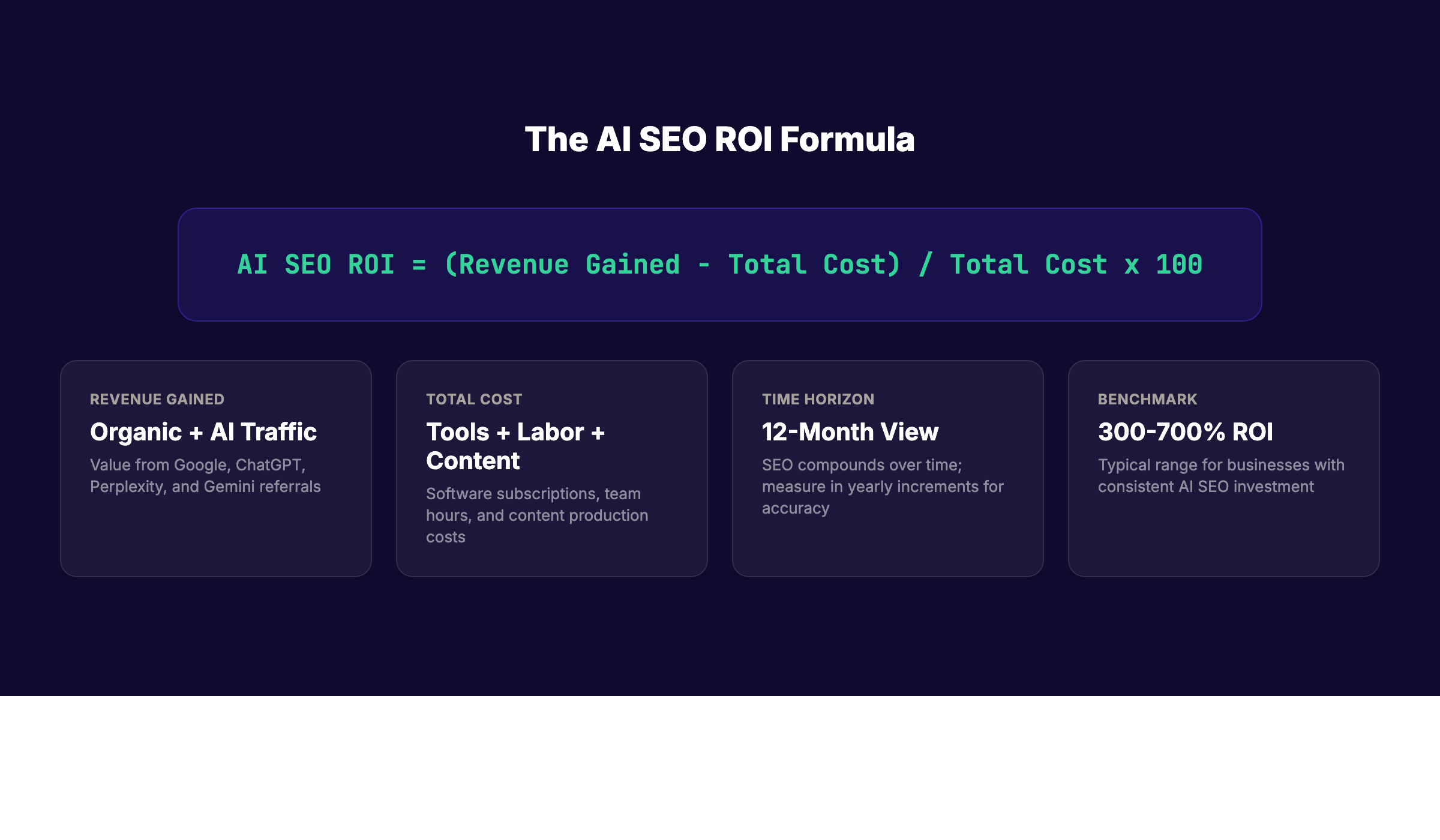
The basic formula remains the same as traditional SEO ROI: subtract your total investment from the revenue generated, divide by the total investment, and multiply by 100 to get a percentage. What changes is what goes into each variable. Revenue now includes conversions from AI-referred visitors, who convert at 4.4 times the rate of traditional organic visitors according to Semrush data from 2025. Costs now include AI writing tools, citation monitoring platforms, and the labor required to optimize for generative engine optimization, not just keyword research subscriptions.
Businesses using AI in their SEO strategy report a 70% higher ROI than those relying on traditional methods alone. That number comes from a Semrush study conducted in 2024, and it reflects the compounding advantage of content that ranks on both Google and AI platforms simultaneously.
Why Standard SEO ROI Calculators Fall Short in 2026
Traditional SEO ROI calculators were built for a Google-only world. They track rankings, organic clicks, and conversion rates from google.com. That model still works for a shrinking portion of the search market. Roughly 60% of searches on traditional search engines now yield no clicks, according to Bain and Company research from 2025. Users get their answers directly from AI Overviews and never visit a website.
This creates a measurement crisis. If your calculator only counts website visits, it misses the brand exposure, citation value, and assisted conversions that happen inside AI responses. A potential customer might read about your business in a ChatGPT answer, search your brand name later, and convert through a direct visit. Standard attribution models credit the direct visit, not the AI citation that started the journey.
Only 8% of users click a traditional link when an AI Summary appears, compared to 15% without a summary, per Pew Research in 2025. That means the traffic you are measuring is a small fraction of the actual visibility you are earning. An AI SEO ROI calculator must account for this invisible value or it will systematically undervalue your investment.
The average AI search visitor is worth 4.4 times more than a traditional organic search visitor. AI referral visits also have a 27% lower bounce rate than non-AI traffic for retail sites, with 38% longer visit durations, according to Adobe data from 2025. These visitors are more engaged, more likely to convert, and more valuable per session. A calculator that treats all organic traffic as equal will mislead you into cutting the very investments that drive your highest-value visitors.
Step 1: Establish Your Baseline Metrics
Before you calculate any return, you need an honest picture of where you stand today. Baseline metrics are your starting line. Without them, every ROI claim is guesswork.
Track these five numbers for the 90 days before you begin your AI SEO investment:
- Monthly organic sessions from Google Search Console
- Monthly conversions from organic traffic in your analytics platform
- Average conversion value — either average order value for e-commerce or average lead value for B2B
- Current keyword rankings for your top 20 target terms
- Brand search volume — how many people search your brand name each month
Add one new metric that most businesses ignore: AI referral sessions. Check your analytics for traffic from chatgpt.com, perplexity.ai, gemini.google.com, and copilot.microsoft.com. These numbers are small today for most sites, but they are growing fast. AI search traffic is up 527% year over year, rising from roughly 17,000 sessions to 107,000 sessions between January and May 2024 versus the same period in 2025, according to Search Engine Land.
Set up a simple spreadsheet with one row per week. Record each metric in its own column. This becomes your before picture. Every ROI calculation you make later compares back to these numbers.
Why this step matters: Without a baseline, you cannot separate the impact of your AI SEO investment from seasonal trends, market shifts, or random variation. A holiday traffic spike could look like ROI if you do not know what your normal November looks like.
Pro tip: Export 12 months of historical data if you have it. Seasonal businesses especially need to see year-over-year comparisons, not just month-over-month changes.
Step 2: Track Every Cost in Your AI SEO Stack
Most businesses underestimate their true SEO costs by 40% or more. They count the Ahrefs subscription and forget the writer, the editor, the developer who fixes technical issues, and the hours spent in meetings reviewing reports.
Build a complete cost inventory. Include every item in these categories:
Software and tools:
- Keyword research platforms (Ahrefs, Semrush, Moz)
- AI writing assistants (Jasper, Copy.ai, ChatGPT Plus, Claude)
- Content optimization tools (Clearscope, Surfer SEO, Frase)
- Rank tracking and reporting software
- Citation monitoring for AI search visibility
- Technical SEO crawlers (Screaming Frog, Sitebulb)
Labor costs:
- Internal team hours spent on SEO tasks
- Freelance writers, editors, and designers
- Agency retainers or consulting fees
- Developer time for technical fixes
- Project management and review time
Content production:
- Article writing and editing fees
- Image creation and licensing
- Video production for embedded content
- Translation and localization costs
Calculate a loaded hourly rate for internal staff. If a content manager earns $75,000 per year, their loaded cost with benefits and overhead is roughly $95,000. Divide by 2,000 working hours and you get about $48 per hour. Multiply by the hours they spend on SEO each month to get a real labor cost.
Why this step matters: ROI is only meaningful if the "I" is accurate. A business that thinks it spends $2,000 per month on SEO but actually spends $5,000 will celebrate a 200% ROI that is really closer to 20%.
Pro tip: Create a recurring monthly cost tracker. Update it every month. Tool prices change, team allocations shift, and agency scopes expand. Your ROI calculator is only as good as the cost data you feed it.
Step 3: Measure AI-Specific Traffic and Citations
This is where an AI SEO ROI calculator diverges from a traditional model. You need to track visibility and traffic from AI platforms separately from Google organic.
Direct traffic from AI platforms: Use your analytics platform to filter referrals from:
- chatgpt.com
- perplexity.ai
- gemini.google.com
- copilot.microsoft.com
- bing.com (for AI chat referrals)
These numbers will be small for most sites today. Do not dismiss them. ChatGPT users click an average of 1.4 external links per visit, compared to 0.6 from Google, according to Momentic data from 2025. Each AI referral is more valuable per session.
AI citation tracking: Most of your AI visibility will not show up as direct traffic. When ChatGPT mentions your brand in an answer, the user may never click through. The value is in brand awareness, trust, and downstream searches.
Track citations manually with a weekly protocol:
- Run 20 test queries related to your industry in ChatGPT, Perplexity, and Gemini
- Record whether your brand is mentioned, cited, or recommended
- Note the context: is it a direct recommendation, a passing mention, or a comparison?
- Track changes week over week
Half of ChatGPT's cited links point to business and service websites, according to Semrush in 2025. News and media sites account for 9.5%, blogs and content sites for 8.3%, and e-commerce for 7.6%. If you run a business or service website, you are in the category most likely to be cited.
Why this step matters: AI search traffic is growing 527% year over year. Businesses that build tracking systems now will have a data advantage when AI referrals become a significant traffic source. Those who wait will be guessing.
Pro tip: Set up a simple scoring system for citations. A direct recommendation scores 3 points, a named citation scores 2 points, and a passing mention scores 1 point. Track your weekly score to see trends even when traffic numbers are too small to be meaningful.
Stop guessing whether your AI SEO investment is working. theStacc tracks your AI citations, brand mentions, and organic visibility in one dashboard. See exactly where you appear in ChatGPT, Perplexity, and Google AI Overviews. Start tracking your AI search visibility
Step 4: Attribute Revenue Accurately Across Multiple Touchpoints
Revenue attribution is the hardest part of any ROI calculation. Last-click attribution, the default in most analytics platforms, gives all credit to the final interaction before conversion. That model systematically undervalues SEO, which often initiates the customer journey months before a purchase.
Use three attribution models simultaneously:
Last-click attribution: Credits the final touchpoint before conversion. Use this to measure direct response from high-intent pages like pricing and product comparisons.
First-click attribution: Credits the first touchpoint in the journey. Use this to measure how well your top-of-funnel content, blog posts, and educational pages are driving eventual conversions.
Self-reported attribution: Ask customers "How did you hear about us?" at the point of conversion. This captures assisted conversions that analytics misses, including AI citations, word of mouth, and offline exposure.
SEO leads close at 14.6%, compared to just 1.7% for outbound marketing, according to SEO Profy data. Organic search drives 44.6% of all B2B revenue. These numbers reflect SEO's role as an initiator and nurturer of customer relationships, not just a closer.
Calculate a blended attribution model. If last-click shows $10,000 in organic revenue, first-click shows $25,000, and self-reported adds another $8,000, your true organic revenue impact is somewhere in the middle. A conservative approach: take the average of first-click and last-click, then add 50% of self-reported attribution that does not overlap.
Why this step matters: Attribution models can swing your reported ROI by 300% or more. A business using only last-click attribution might report 200% SEO ROI while the true figure is closer to 600%. The wrong model leads to underinvestment in your highest-return channel.
Pro tip: Create a simple attribution comparison table each month. Show last-click, first-click, and self-reported numbers side by side. The gap between them tells you how much assisted value your SEO is creating.
Step 5: Calculate Time Savings from AI Automation
AI SEO tools deliver value in two ways: they increase revenue-generating outputs, and they reduce labor costs. Most ROI calculators ignore the second half.
Track time savings in these categories:
Keyword research: AI tools can reduce research time from 4 hours to 30 minutes per content brief. At a loaded rate of $48 per hour, that saves $168 per article.
Content drafting: AI writing assistants produce first drafts in minutes rather than hours. A writer who spent 6 hours on a first draft might now spend 90 minutes editing AI output. Time saved: 4.5 hours, or $216 per article.
On-page optimization: Tools like Surfer SEO and Clearscope automate content scoring and keyword placement. Optimization time drops from 2 hours to 30 minutes. Savings: $72 per article.
Reporting and analysis: AI-driven dashboards compile rankings, traffic, and conversion data automatically. Manual reporting that took 3 hours per week now takes 15 minutes. Monthly savings: $540.
Add these savings to your ROI calculation. If your AI SEO tools cost $500 per month and save $1,500 in labor, you have a 200% return before counting any revenue impact.
About two-thirds of AI-generated content ranks within two months, according to Semrush data from 2024. That speed advantage means faster time-to-value for every piece of content you publish.
Why this step matters: Time savings are real money. A business that only counts revenue impact will undervalue AI SEO by 30-50%. The labor cost reduction is often the fastest return you will see.
Pro tip: Run a two-week time-tracking experiment. Have your team log hours spent on SEO tasks with and without AI tools. The difference is your monthly labor savings.
Step 6: Factor in Compounding Returns and Content Shelf Life
SEO is not a monthly expense like pay-per-click advertising. It is an asset-building activity. A blog post you publish today may generate traffic and conversions for three years or more. An AI SEO ROI calculator must account for this compounding effect.
Content marketing returns $3 for every $1 spent, compared to PPC's $2 for every $1, with returns accelerating in years two and three. First Page Sage data shows that SEO campaigns typically achieve positive ROI in 6 to 12 months, with peak results in the second or third year.
Use a 12-month rolling ROI for operational decisions, but add a lifetime value projection for strategic planning. A $500 article that generates $200 in attributed revenue in month one, $300 in month six, and $150 per month by month 12 has a first-year return of $1,850. Over 36 months, that same article might generate $4,000 or more.
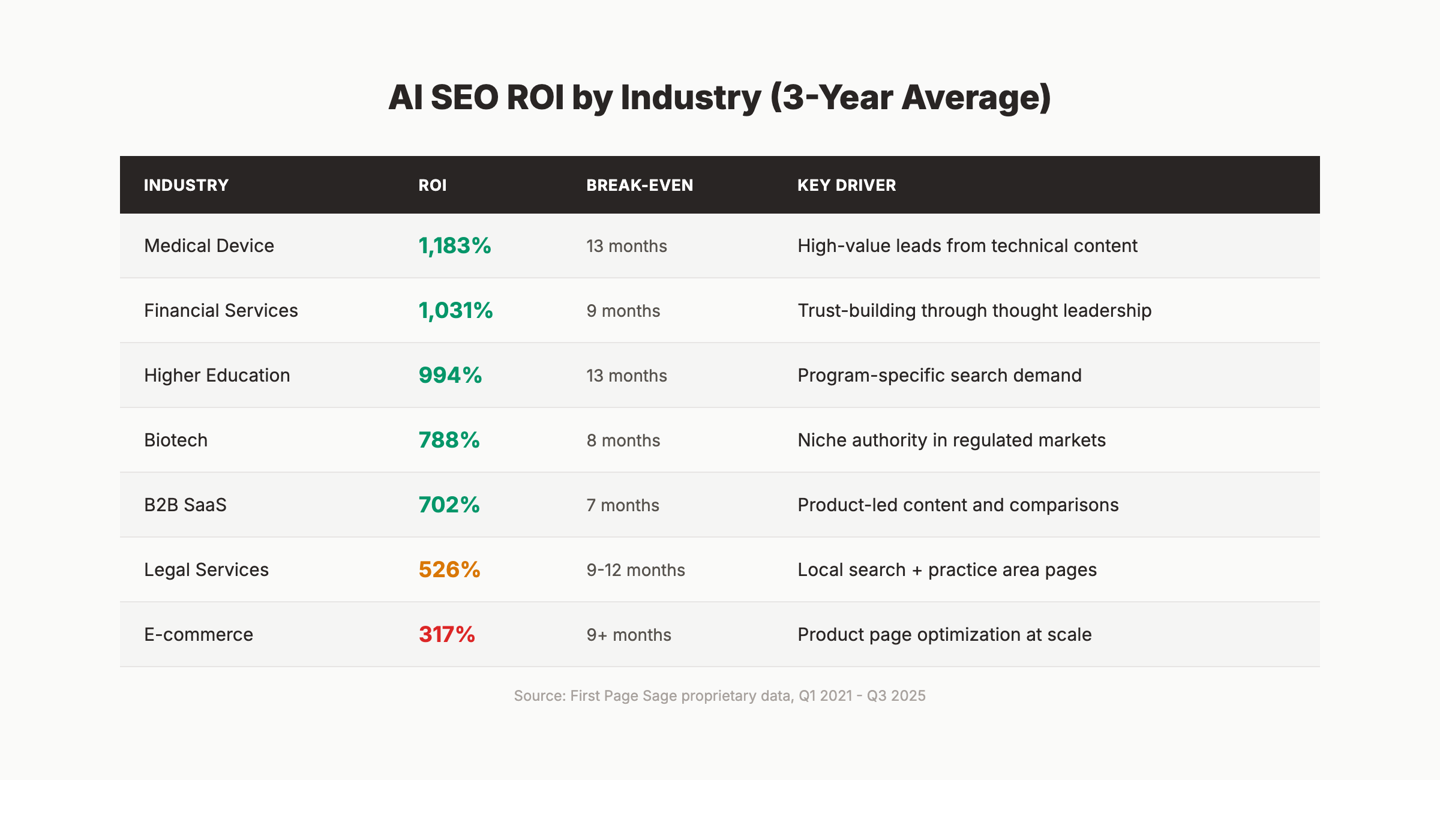
The table above shows why industry context matters. Medical device companies see 1,183% ROI over three years because a single qualified lead can be worth tens of thousands of dollars. E-commerce businesses see 317% because their average order values are lower, but they hit break-even faster through product page optimization at scale.
Why this step matters: A business that evaluates AI SEO on a 30-day payback window will abandon the strategy before it has time to work. SEO is a 12-month minimum commitment. Your calculator should reflect that reality.
Pro tip: Build a simple content asset tracker. List every article, its publish date, its cumulative revenue, and its cost. Divide cumulative revenue by cost to see each asset's lifetime ROI. This reveals which content types deliver the best long-term returns.
Step 7: Build Your AI SEO ROI Calculator Spreadsheet
Now assemble everything into a working calculator. You can build this in Google Sheets, Excel, or any spreadsheet tool.
Sheet 1: Monthly Inputs
| Metric | Month 1 | Month 2 | Month 3 |
|---|---|---|---|
| Organic sessions | [baseline] | [actual] | [actual] |
| AI referral sessions | [baseline] | [actual] | [actual] |
| Total conversions | [baseline] | [actual] | [actual] |
| Average conversion value | $[value] | $[value] | $[value] |
| Software costs | $[cost] | $[cost] | $[cost] |
| Labor costs | $[cost] | $[cost] | $[cost] |
| Content production costs | $[cost] | $[cost] | $[cost] |
Sheet 2: ROI Calculation
For each month, calculate:
- Total revenue = (Organic conversions + AI referral conversions) x Average conversion value
- Total cost = Software + Labor + Content production
- Net return = Total revenue - Total cost
- ROI % = (Net return / Total cost) x 100
- Cumulative ROI = (Cumulative net return / Cumulative total cost) x 100
Add a row for time savings value = Hours saved x Loaded hourly rate. This is a cost reduction, so add it to your net return.
Sheet 3: AI Citation Tracker
| Query | Platform | Citation Type | Week 1 | Week 2 | Week 3 |
|---|---|---|---|---|---|
| "best CRM for small business" | ChatGPT | Direct recommendation | Yes | Yes | No |
| "how to optimize Google Business Profile" | Perplexity | Named citation | No | Yes | Yes |
Why this step matters: A calculator you do not use is worthless. Build it simple enough to update in 15 minutes per month. Complex calculators get abandoned after the second month.
Pro tip: Set a calendar reminder for the first Monday of each month. Update your metrics, review your ROI trend, and adjust your budget allocation based on what the data shows.
Common Mistakes That Skew Your AI SEO ROI
Even with a solid calculator, these errors will distort your results:
- ✓ Counting traffic as revenue. A 50% traffic increase means nothing if conversions stay flat. Always tie metrics to business outcomes.
- ✓ Ignoring assisted conversions. A customer who discovers you through a blog post and converts three months later via a brand search is still an SEO win.
- ✓ Using too short a measurement window. SEO takes 6 to 12 months to show positive ROI. Measuring month-to-month creates false negatives.
- ✓ Forgetting hidden costs. Agency fees, developer time, and content revisions add up. Include every dollar.
- ✓ Comparing SEO to PPC directly. PPC delivers immediate, linear returns. SEO delivers delayed, compounding returns. Both have value, but their ROI curves look completely different.
- ✓ Missing AI citation value. If your calculator only counts website visits, it misses 80% or more of your AI search visibility value.
- ✓ Not segmenting by content type. Blog posts, product pages, and landing pages have different ROI profiles. Aggregate numbers hide these differences.
AI SEO ROI Benchmarks by Business Type
Use these benchmarks to evaluate whether your results are on track:
| Business Type | Typical 12-Month ROI | Break-Even Timeline | Key Success Factor |
|---|---|---|---|
| B2B SaaS | 500-800% | 6-9 months | Product comparison and integration content |
| Local service business | 400-700% | 4-8 months | Google Business Profile + local landing pages |
| E-commerce | 250-450% | 8-14 months | Product page optimization and category content |
| Professional services | 600-1,000% | 8-14 months | Thought leadership and case study content |
| Healthcare/Medical | 800-1,200% | 10-16 months | Patient education and condition-specific pages |
These ranges assume consistent investment, quality content, and a website with no major technical issues. Businesses with significant technical debt or thin existing content may take 3 to 6 months longer to reach positive ROI.
Organic cost per lead averages approximately $31, compared to approximately $181 for PPC, according to SEO Profy data. SEO also converts 7.3 times more than PPC in financial services and 3.4 times more in legal services. These efficiency advantages compound over time as your content library grows.
See your true AI SEO ROI in under 10 minutes. theStacc connects your traffic, conversions, and AI citation data in one place. No spreadsheets required. Calculate your AI search ROI
What practitioners are saying on X
AI search advice ages quickly. Here is high-signal public discussion from SEO and growth operators — context for your roadmap, not a substitute for primary data.
- @jakezward (Feb 2026): 2026 SEO predictions emphasize AI Overview share-of-SERP, schema for LLM token efficiency, brand mentions in AI answers as a KPI, proprietary data as a moat, and content refresh beating net-new AI slop. See the post on X.
- @e_tartakovsky (Jul 2026): When an AI summary appears, organic CTR can fall (cited ~8% vs ~15% traditional), but remaining clicks may convert higher because AI pre-qualifies intent — measure quality not only volume. See the post on X.
- @hridoyreh (Mar 2026): Widely shared SEO skill tree: foundations, research, technical, on-page, content, links, AI SEO/GEO, analytics, UX, brand, programmatic — useful map for stats and how-to posts. See the post on X.
Grok, AI Overviews, and multi-engine visibility
Statistics pages on “ai seo roi calculator” earn AI citations when every major number has a year, source, and definition. Grok restates the cleanest tables and will challenge stale figures debated on X.
- Google AI Overviews: Use passage-ready answers, tables, and FAQ schema where relevant.
- ChatGPT / Perplexity: Cite named sources next to key claims.
- Grok: Maintain accurate entity facts on-site and in high-signal X posts.
Publish content built for Google and AI citations. theStacc’s Content SEO module ships SEO-scored articles structured for rankings and generative engines — including clearer entity pages models like Grok can quote.
Frequently Asked Questions
Most businesses see positive ROI from AI SEO in 6 to 12 months, with peak results in the second or third year. B2B SaaS companies often break even in 7 months, while e-commerce businesses typically need 9 to 14 months. The timeline depends on your starting point, competition level, and content quality.
Traditional SEO ROI measures returns from Google organic traffic only. AI SEO ROI includes traffic and conversions from ChatGPT, Perplexity, Gemini, Google AI Overviews, and other AI search platforms. It also accounts for citation value, brand mentions in AI responses, and the higher conversion rates of AI-referred visitors.
Set up custom channel groupings in your analytics platform for referrals from chatgpt.com, perplexity.ai, gemini.google.com, and copilot.microsoft.com. Use UTM parameters for any links you share directly in AI platforms. Add a "How did you hear about us?" field to your conversion forms to capture self-reported AI discovery.
Yes. AI SEO tools reduce research, writing, optimization, and reporting time. These labor savings are real financial benefits. Calculate hours saved multiplied by your loaded hourly rate, then add this to your net return. Most businesses see a 30-50% higher ROI when time savings are included.
A good 12-month AI SEO ROI ranges from 300% to 700% for most businesses. B2B SaaS and professional services often exceed 700%, while e-commerce typically lands between 250% and 450%. Compare your results to industry benchmarks, but focus on trend direction rather than absolute numbers. A rising ROI trend matters more than hitting a specific percentage.
Update your calculator monthly with fresh traffic, conversion, and cost data. Review trends quarterly to make budget decisions. Recalculate your baseline annually to account for seasonal patterns and business growth. AI citation tracking should happen weekly since this data changes rapidly.
Yes. Many effective AI SEO tools start at $20 to $100 per month. ChatGPT Plus costs $20 per month and handles research, drafting, and optimization. Free tools like Google Search Console and Google Analytics provide baseline tracking. A small business can build a functional AI SEO stack for under $200 per month.
Conclusion
An AI SEO ROI calculator is not a luxury. It is a requirement for any business investing in search optimization in 2026. The search market has split. Google still matters, but ChatGPT, Perplexity, Gemini, and AI Overviews now influence how customers discover, evaluate, and choose businesses. A calculator that ignores these channels is a calculator that lies.
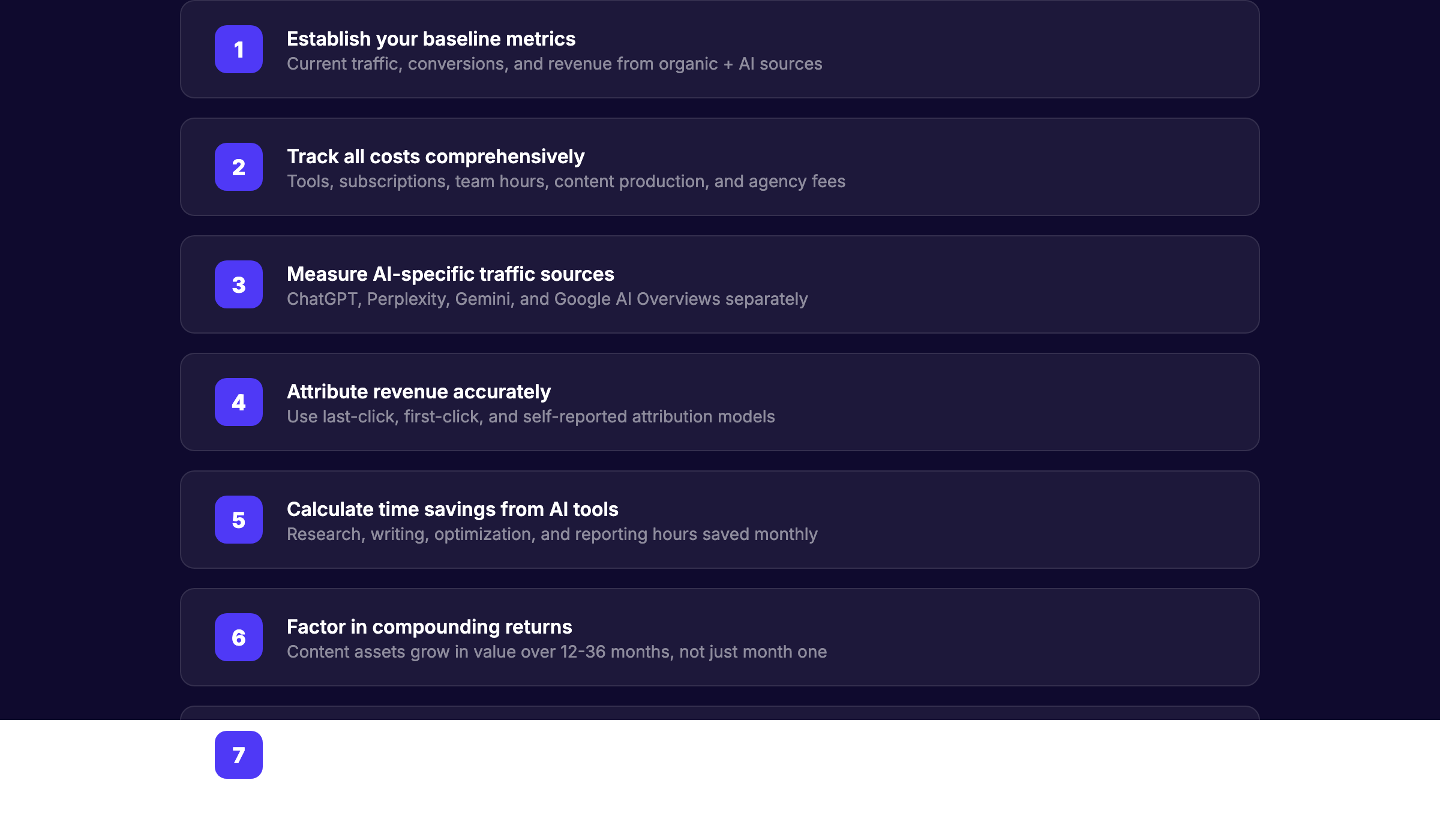
The seven-step framework in this guide gives you everything you need:
- Establish honest baseline metrics before you spend
- Track every cost, including hidden labor and tool overlaps
- Measure AI-specific traffic and citations separately
- Use multiple attribution models to capture assisted value
- Count time savings as real financial returns
- Factor in compounding returns over 12 to 36 months
- Build a simple spreadsheet you will actually update
SEO delivers an 8 times return compared to PPC's 4 times, and the gap widens as your content library grows. The businesses that measure accurately, invest consistently, and optimize based on data will capture the majority of that return.
Ready to measure your AI SEO ROI the right way? theStacc tracks your organic traffic, AI citations, and conversion data in one dashboard. See exactly what your search investment is worth. Start measuring your AI search ROI
Related Tools & Resources
Free SEO Tools:
Best Lists:
Sources & references
- [1] Princeton / Georgia Tech et al. — GEO research (arXiv:2311.09735)
- [2] @jakezward on X — 2026 SEO predictions emphasize AI Overview share-of-SERP, schema for LLM token efficiency, brand mentions in AI answers
- [3] @e_tartakovsky on X — When an AI summary appears, organic CTR can fall (cited ~8% vs ~15% traditional), but remaining clicks may convert highe
- [4] @hridoyreh on X — Widely shared SEO skill tree: foundations, research, technical, on-page, content, links, AI SEO/GEO, analytics, UX, bran

Plan topics, review article drafts, and publish to a connected CMS.
Weekly local SEO teardowns
One practical email a week. Map Pack, GBP, AI Overviews. No fluff. Unsubscribe anytime.